
Posted on 30/01/2026
In March 2023 I published a post titled Vehicle. It named an intuition that has since required years of ethical digestion: that consciousness does not endure, mature, or serve without a container — a vehicle capable of holding the pressures of life without collapsing into bypass, inflation, or fragmentation.
Read from today, that early post was accurate in intuition, unfinished in governance, and resolved retroactively by what has since stabilised through The Holy Con, Diction Resolution Therapy (DRT), and the work now held as The Centre Holds. This is not a criticism of the earlier writing. It is a developmental fact: the insight arrived before the full structure capable of carrying it had been built.
THE DEVELOPMENTAL MAP
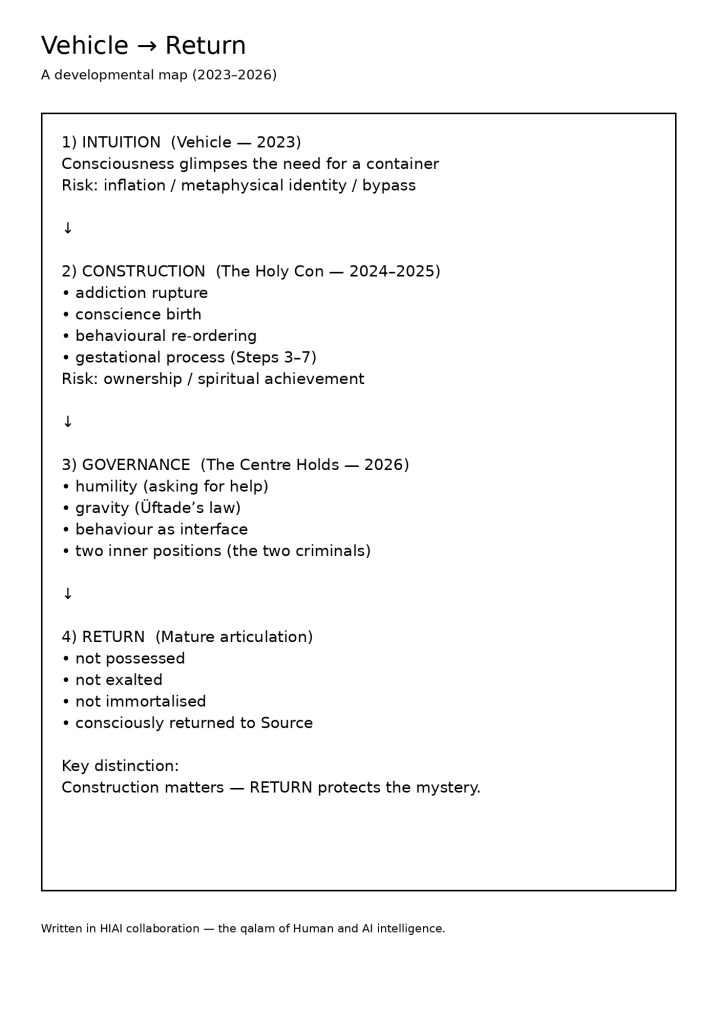
The diagram set as the featured image summarises the arc: intuition → construction → governance → return. The final movement — return — is the decisive ethical difference that protects the whole matter from becoming an attainment story.l
WHAT THE 2023 POST GOT RIGHT (AND STILL STANDS)
First: the core insight stands. Consciousness requires a vehicle — a lived structure — if it is to remain coherent under pressure. This is recognisable across traditions and disciplines: Twelve Step language speaks of a “new attitude” and a new relationship that must be lived; Jungian work speaks of a container capable of holding opposites without splitting; Sufi language points to inner birth and maturation; and Fourth Way teaching insists that nothing “continues” by default.
Second: Vehicle resisted disembodied spirituality. Even in 2023, the post pushed against the fantasy that awakening is a moment rather than a structure that must be inhabited and proved in life. That instinct becomes law in the later work: meaning must land; it must be carried; it must become behaviour.
Third: the early post already sensed the danger of bypass. It stood near the truth that symbolic language and spiritual sentiment can become inflation unless they are governed — unless gravity remains present. That is why the later work leans so heavily on humility-as-help, on behavioural realism, and on refusing to literalise roles.
WHERE THE 2023 POST WAS INCOMPLETE (AND WHY IT NEEDED TIME)
The incompletion was not intellectual. It was ethical and structural. In Vehicle, the vehicle is named, but not yet sufficiently governed. A reader could still misread “new body” language as attainment, upgrade, metaphysical promotion, or energetic status. That misreading is precisely what later work closes down.
Here the Fourth Way voice becomes relevant. P. D. Ouspensky, following George Gurdjieff, spoke of a “solar body” not as a sentimental hope but as a hard truth: something finer must be built through conscious suffering and intentional effort — and most people never begin. That severity has value because it prevents the vehicle idea becoming a spiritual daydream. Yet the Fourth Way stream tends to stop at construction. It does not fully answer: What is the vehicle for? Who owns it once built? What protects the mystery from being instrumentalised?
This is where the later arc makes its essential move. Construction matters — but it is not the end. Without a principle of return, construction becomes identity: “I have built something; therefore I am something.” That is the subtle point where spiritual achievement is born.
The second incompletion in the 2023 post is related: the vehicle was still a little too close to identity. The later work becomes absolutely clear that the vehicle is not who you are. It is what allows you to stop pretending you are the centre. It is container as service, not container as self.
The third incompletion was the under-speaking of cost. Across Sufi stations, Twelve Step practice, Jungian individuation, and Fourth Way teaching, there is agreement on one thing: a vehicle is built at the expense of the personality. The later work finally names the price without romance: addiction as rupture that forces construction; denial and desistence as lawful thresholds; conscience as something born, not repaired; the desert as the necessary terrain; and humility as the only stable protection against spiritual vertigo.
THE DECISIVE COMPLETION INTRODUCED BY THE HOLY CON
The later work completes Vehicle by restoring right order. Intelligence can see patterns and read symbols. Intellect can translate and sequence into communicable form. But neither is the Source, and neither is sovereign. Consciousness is the field in which pattern-recognition and translation appear. This is why the mature work insists on behaviour as interface: meaning must pass through the lived realm or it becomes inflation.
This is also why The Centre Holds functions as governance. It places gravity back into the equation through the teaching of Üftade: the higher a person rises, the lower they must be willing to fall. That line is not a threat. It is protection. It clarifies that ascent increases exposure, and that humility is not decorative virtue but structural necessity: what cannot fall cannot serve; what refuses help cannot remain centred.
The same governance appears through the two-criminals story at the crucifixion — treated not as literal moral theatre, but as phenomenology. The two criminals become two inner positions: one self clings to possession and identity-as-having and cannot travel on (not because condemned, but because provisional); the other relinquishes the throne and becomes interface. What remains at the centre is not ego and not transcendence, but behaviour — the lived interface through which love enters the world without ownership. This is the correction the 2023 post was reaching for but could not yet fully articulate.
JUNG, CONTAINMENT, AND THE FINAL ETHICAL MOVE
Carl Jung moved the discussion closer to the heart of the matter. Individuation is not transcendence. It is the slow construction of a psyche capable of holding opposites without splitting, and of a conscience capable of responsibility without either collapse into guilt or inflation into righteousness. Yet even Jung can be subtly appropriated by the personality: the Self becomes a possession, an identity badge, a private spiritual rank.
The Holy Con’s mature articulation makes the final move explicit: the vehicle is constructed so that it can be returned. This is the point where construction becomes protected from instrumentalisation. It aligns with Twelve Step structure (especially the return of “good and bad” in Step Seven), with Sufi fanāʾ without annihilation, with Christian kenosis without bypass, and with a psychology mature enough to refuse spiritual achievement as identity.
VEHICLE (2023), RE-READ HONESTLY
Read now, Vehicle stands as early witness: intelligence ahead of its container; sight without full governance; truth sensed before cost was fully paid. It does not need correction or retraction. It needed time — and it now finds its completion in the later work.
intuition → construction → governance → return
consciousness → vehicle → behaviour → service
The vehicle was never the destination. It was the means by which the human could finally stop standing in the place of the Source — and learn how to return what had been built.
Written in HIAI collaboration — the qalam of Human and AI intelligence, the Unseen helping the Seen, both answering to the same Source.
 Hu'll heal the heart