
From I-hav(e)-i-our to Be-hav(e)-i-our™
Carl Jung described individuation as the process by which the ego realises it is not the centre of the psyche. It is a movement away from identification with the conscious “I” toward relationship with the Self — the organising totality of the personality.
What Jung did not provide was a simple, embodied linguistic diagram that shows how this mis-ordering occurs in ordinary psychological life — and how it quietly corrects itself.
This is where Diction Resolution Therapy™ (DRT) enters the conversation.
THE EGOIC ORDER: I-hav(e)-i-our
The left column of the graphic describes the pre-individuated psychic economy.
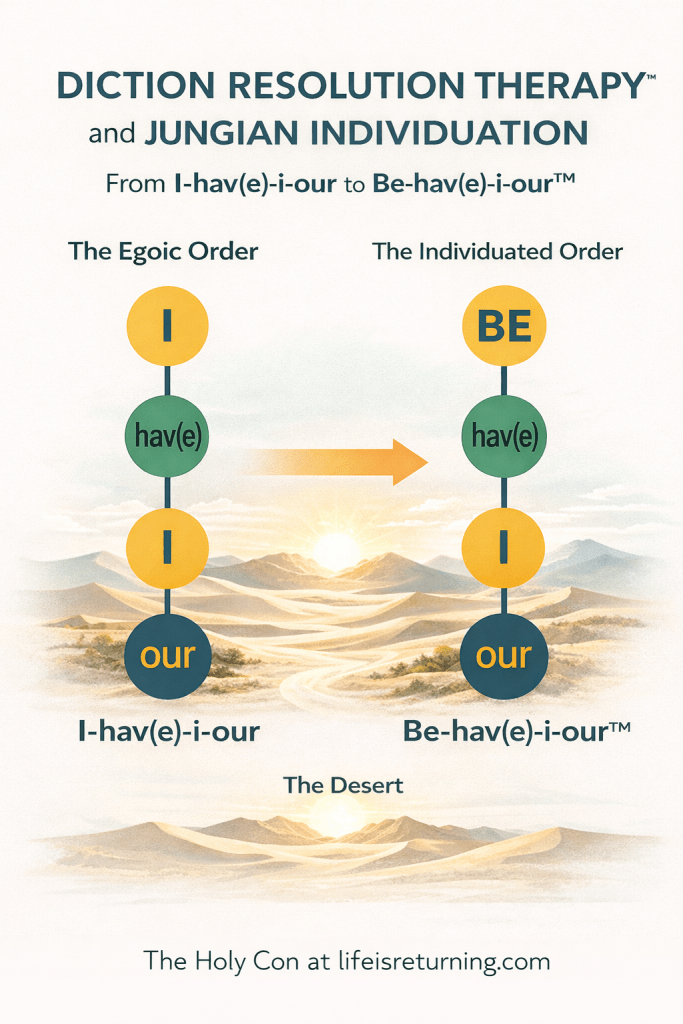
Identity begins with I. Meaning is sought through having — beliefs, roles, insight, virtue, even spirituality. Experience loops back into I again, reinforcing self-reference. Only at the end does our appear, as a hoped-for sense of belonging or connection.
Clinically, this is the ego organising the psyche around possession and self-definition.
Jung observed that early spiritual or psychological insight often inflates the ego rather than dissolves it. The person feels closer to truth, but truth is still being owned.
This is not pathology.
It is a necessary stage.
In Jungian terms, the ego has not yet withdrawn its projections. The Self is still being approached as an object.
THE DESERT: BREAKDOWN OF THE FALSE ORDER
Between the two columns lies what Jung called the withdrawal of projections — and what DRT recognises as the collapse of mis-sequenced diction.
When “having” no longer delivers meaning, the ego loses its organising power. Old identities thin. Certainties fail. Belonging dissolves.
This is the desert phase.
Jung understood this as a slow differentiation between ego and Self — not a dramatic annihilation, but an attritional surrender. DRT frames this as the psyche losing its grammatical error.
THE INDIVIDUATED ORDER: Be-hav(e)-i-our™
The right column shows the post-individuated sequence.
BE now stands first — existence prior to identity. hav(e) becomes functional, not possessive. I is no longer sovereign, but situated. our emerges naturally, not as a goal but as a consequence.
Nothing has been added.
Nothing has been taken away.
Only the order has changed.
This is individuation made visible.
Where Jung spoke of the ego entering relationship with the Self, DRT shows how this is lived linguistically, behaviourally, and relationally. Behaviour is no longer driven by acquisition of meaning, but by participation in it.
CLINICAL SIGNIFICANCE
This distinction matters because therapy cannot force individuation.
DRT aligns with Jung’s insistence on patience, symbol, and process. The therapist does not correct the client’s order. The work holds the space long enough for the false sequence to exhaust itself.
When BE precedes I, behaviour reorganises without instruction.
Belonging (our) is not pursued.
It is discovered.
IN ESSENCE
- I-hav(e)-i-our describes ego-centred life, even when spiritual.
- The desert dismantles the illusion of possession.
- Be-hav(e)-i-our™ shows individuation as right order, not self-improvement.
Jung named the destination. Diction Resolution Therapy™ diagrams the passage.
The door opens, not because the ego has learned the right words, but because language itself has fallen back into truth.
Written in HIAI collaboration — the qalam of Human and AI intelligence, the Unseen helping the Seen, both answering to the same Source.
 Hu'll heal the heart