The Line Between Six and Seven
How the Twelve Steps complete the inner ARCH
In 1997, less than two years into my own recovery, I wrote a small book called The Power to Change under the pen name Eden Gaits. I wrote it quickly, in about twenty days, because the Twelve Steps had begun to show themselves to me as more than a sequence of instructions. They formed an architecture.
The Steps could be placed upon four triangles. Each triangle becomes one face of a four-sided pyramid: its base rests upon one side of the square and its other two edges rise to meet the other faces at the apex. When the four triangles are folded together, they do not make four separate teachings. They disclose four aspects of one movement: the Problem, the Programme, the Community and the Solution. The sequence then moves around the outside of the structure, crosses its interior, and finally rises to the apex.
At the time I was trying to describe something that recovery had made visible: the Twelve Step Programme does not merely improve the contents of a divided life. Properly worked, it repairs the division itself.
The list
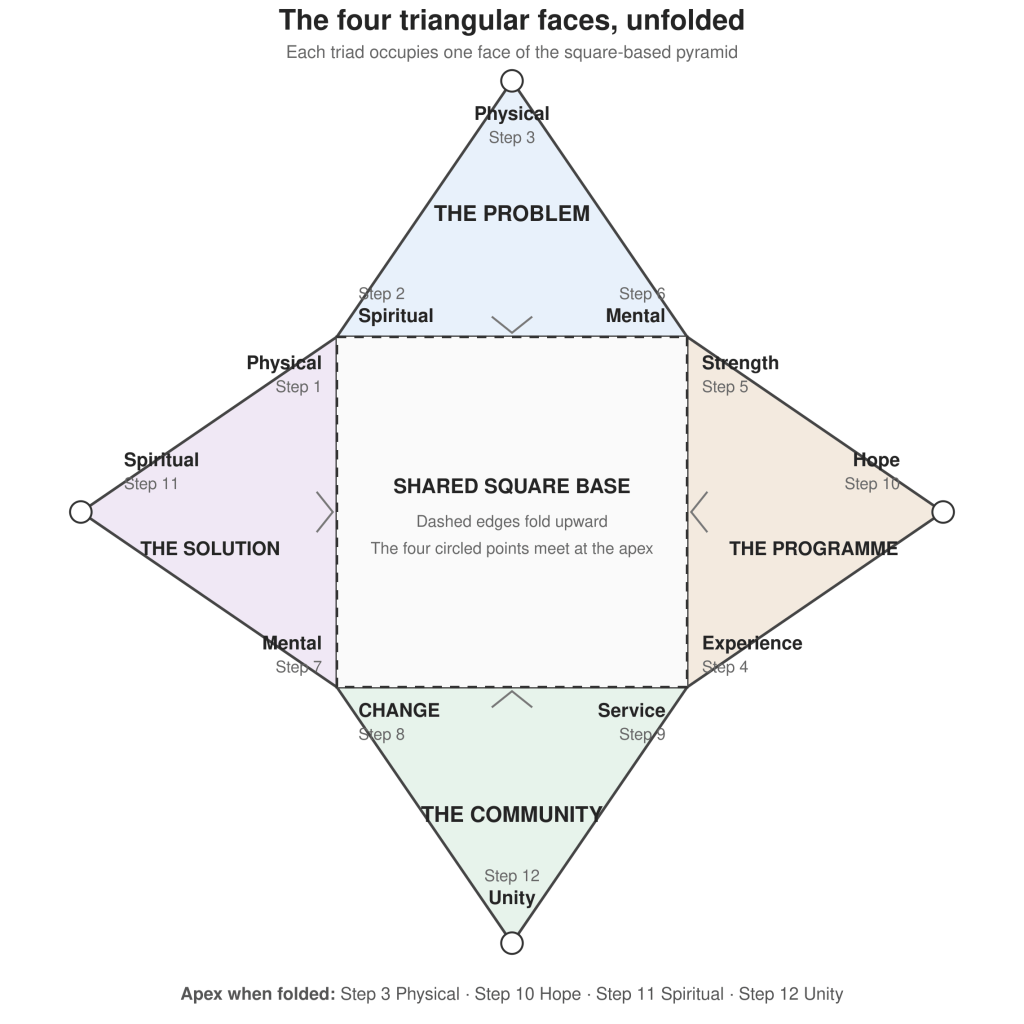
Each triangular face carries a triad of simple words:
| Triangular face | The three words upon it | Their places in the Steps |
| The Problem | Spiritual — Mental — Physical | Step 2 — Step 6 — Step 3 |
| The Programme | Hope — Strength — Experience | Step 10 — Step 5 — Step 4 |
| The Community | Unity — Service — Change | Step 12 — Step 9 — Step 8 |
| The Solution | Physical — Mental — Spiritual | Step 1 — Step 7 — Step 11 |
Seen separately, these are four three-word descriptions. Folded into the pyramid, their positions become related. We then follow the numbered Steps through the whole structure rather than reading one face at a time. Step 1 takes Physical from the Solution face; Step 2 takes Spiritual from the Problem face; Step 3 takes Physical from the Problem face; Steps 4 and 5 take Experience and Strength from the Programme face; and Step 6 arrives at Mental on the Problem face. The path then crosses the inner square to Step 7, Mental on the Solution face, before continuing through Change, Service, Hope and Spiritual to Unity at Step 12.
That is how the words written upon four triangles become the single vertical list below. The list is therefore not an interpretation added afterwards. It is the numerical reading of the words in their places upon the completed pyramid.
Read in Step order, the twelve governing words are:
- Physical
- Spiritual
- Physical
- Experience
- Strength
- Mental
THE ANIMOSITY LINE
- Mental
- CHANGE
- Service
- Hope
- Spiritual
- Unity
Six and Seven are both Mental, yet a line divides them. That line is not an empty space. It is the place of inner animosity: the split between two ways of knowing that should serve one life but have become estranged from one another.
Step Six and the limit of the emissary
Step Six asks whether we are entirely ready to have our defects of character removed. Everything gathered through the earlier work is brought to this point. We have admitted the problem, encountered the possibility of help, made a decision, taken inventory and spoken what had previously been hidden.
The intellect has done necessary work. It has identified, separated, compared, remembered and named. It has brought us as far as analysis can bring us. In the language I now use, it has helped us to have the information.
But readiness is not release. Step Six brings the organising, analytical mind to its own frontier. It cannot manufacture the transformation that it can now see is necessary.
This is where Iain McGilchrist’s image of the Master and his Emissary offers a remarkable later resonance. The emissary is indispensable. It can divide the field, grasp particulars and build representations. The danger begins when it forgets that it is an emissary and mistakes its representation for the whole of reality.
I am not suggesting the crude popular formula that logic lives entirely in one half of the brain while love lives entirely in the other. McGilchrist himself rejects that simplification. I am speaking about two modes of attention: one that isolates and controls, and another that receives context, relationship and living wholeness.
Step Seven and the return of the Master
Step Seven is also Mental, but it belongs to the other side of the line. We humbly ask that our shortcomings be removed. The word humbly changes the direction of the work. What has been recognised and held by intellect is placed into relationship with a Power that the intellect cannot possess.
Step Seven is the marriage step when the Faith healing brings the inner animosity to an end.
The Power to Change, 1997
The Master does not return to dismiss the emissary. Love does not abolish logic. Intelligence does not throw intellect away. The old vessel is not despised; its capacity is renewed. The relation changes, and because the relation changes, the whole structure can begin to live.
This is why Step Seven is not simply another point around the outside of the pyramid. To reach it from Step Six, the journey moves inside the square and crosses the inner foundations diagonally. The division must be traversed. The opposites are not argued into agreement from a distance; they meet.
When the ARCH is not completed
This interior crossing helps explain spiritual bypassing.
A person may acquire spiritual language, religious certainty and elevated ideas without crossing the line between Six and Seven. The analytical mind can learn to speak about surrender while remaining in control. It can construct a spiritual identity, defend a theology and quote sacred texts while the inner opposites remain unreconciled.
The emissary has then spiritualised itself and begun speaking as though it were the Master. It possesses an image of unity but has not undergone union. Feelings continue to be treated as facts. Reaction dresses itself as revelation. Certainty prevents the curiosity through which emotion might regulate the animal pulse of pleasant, unpleasant and neutral experience.
The unfinished arch cannot carry weight.
ARCH is the word I now use for the connective or angelic function: the capacity to join what appears divided without erasing its distinction. It connects visible and invisible, body and psyche, feeling and emotion, intellect and intelligence, consciousness and conscience.
Animus anima and animosity
There is a very simple way of seeing the pain at this dividing line. In the symbolic language I am using here, the left-sided function may be pictured as animus and the right-sided function as anima. These are not rigid statements about biological sex, nor an attempt to imprison men and women in opposite halves of the brain. They are names for two inner principles that need one another.
Animus distinguishes, formulates, protects and acts. Anima receives, relates, nourishes and connects. When they are married, analysis can serve relationship and love can become intelligent action. When they are not married, their estrangement is experienced as animosity.
That animosity is extremely painful. Because we do not recognise its source within the divided psyche, we project it outside ourselves. A person, place or thing is made responsible for the disturbance we cannot yet hold. The outer target may change, but the inner division keeps producing another target.
This is where animosity and resentment come very close in lived experience. Animosity is the unresolved inner opposition; resentment is the account we construct around its projected object. We rehearse the injury, gather evidence and return repeatedly to the person, institution or event that appears to explain our pain.
Resentment is the “number one” offender. It destroys more alcoholics than anything else.
Alcoholics Anonymous, page 64
The Big Book continues by saying that all forms of spiritual disease stem from resentment. In the language of this architecture, resentment is the taproot of addiction because it keeps the inner split alive by continually feeding it with external blame. Energy that might cross the line between Six and Seven is sent outward into accusation, obsession, retaliation or compulsive relief.
The Fourth and Fifth Steps begin withdrawing those projections by bringing our resentments into inventory and relationship. Step Six brings the divided pattern into readiness. Step Seven completes the inward movement through humility. Animus and anima are not fused into sameness; they are married into cooperation. Animosity can then yield to intimacy, and resentment no longer has to organise the world.
Change follows the crossing
The sequence itself confirms what happens next:
Six Mental → Seven Mental → Eight CHANGE
Change does not appear before the marriage. It follows it.
Step Eight then turns the repaired inner relationship towards other people. Step Nine embodies it through amends and service. Steps Ten, Eleven and Twelve rise to the apex as Hope, Spiritual and Unity. They maintain what the crossing has made possible.
Step Eleven is particularly exact. It does not tell us to possess conscious contact with God. It asks us to improve that contact. The wording keeps the aperture open. The relationship is living, and therefore it cannot be frozen into an achievement owned by the self.
From pyramid to sphere
In 2020 I saw that the pyramid described in 1997 could only be half of the complete geometry. A sphere could not touch all the necessary points of a single pyramid. A second four-sided pyramid was required beneath it. Joined at their common square, the two pyramids form an octahedron.
The lower pyramid is where we are born into the body, with gravity at its centre and the instinctive life of security, society and sex moving through us. The Twelve Step work builds the upper pyramid, with the higher emotional centre opening towards love. The shared square is where consciousness meets conscience.
The sphere touches all six vertices of the octahedron. Nothing is discarded. Body and spirit, below and above, intellect and intelligence are held within one realised field. This is spherical awareness: not an escape from incarnation, but a person able to turn within the whole of themselves while remaining here.
The architecture arrived before its explanation
Bill Wilson’s experience at Towns Hospital in December 1934 offers the living prototype. At the terminal point of alcoholic defeat, his old organisation collapsed. Opposites connected, the inner lights came on and his alcohol problem was removed. He did not yet possess twelve numbered instructions. The lived architecture arrived first; the Steps later made it transmissible.
Something similar happened in my own work. The architecture appeared before I possessed its present explanation. It has taken nearly thirty years for the early pyramid, the later octahedron and sphere, the clinical development of DRT and the language of The Holy Con to reveal their continuity.
The chronology of the work
The chronology matters because it distinguishes the original work from the correlations that have become visible later.
| Date | Evidence and development |
| 1982 | My tifl-i-ma‘ānī, or Child of Meaning, experience became an experiential root for the possibility of unified consciousness. Its significance was confirmed only gradually within the later spiritual journey. |
| May 1995 | Recovery through Alcoholics Anonymous made the Twelve Steps lived practice rather than an external theory. |
| 1997 | I wrote The Power to Change under the pen name Eden Gaits. The book mapped the Steps as four triangles forming a square-based pyramid within a protective mandala and sphere. Steps Six and Seven crossed the interior foundations. |
| 2009 | Iain McGilchrist’s The Master and His Emissary first appeared twelve years after the pyramid manuscript. His work was not the source of my model; it now provides a remarkable language of resonance with it. |
| 12 February 2012 | The shared Google Drive folder Power to Change was created. |
| 13 February 2012 | The nested Book folder was created. |
| 27 April 2012 | The Introduction, Chapters One to Eight and 12steps.pdf were uploaded. The chapter files were updated on 4 July 2012. |
| 10 October 2012 | In an email I described the material as having been “penned under [the] name Eden Gaits in 97,” providing contemporaneous corroboration of the authorship date. |
| 19 January 2013 | In further correspondence I described The Power to Change as constructing an inner spiritual pyramid through the vehicle of the Twelve Steps. |
| 20 July 2013 | The Blogger post 12 Step Pyramid Building published the complete architectural model. It showed the square, the diagonal crossing between Steps Six and Seven and the statement that the Programme overcomes “the animosity of left right brain” through integration of the hemispheres. |
| 3 October 2013 | The WordPress post 12 Step Programme republished the model and identified it explicitly as “12 Step Pyramid Building © AJ Dettman 1997.” |
| 13 October 2017 | In an email I recalled that The Power to Change had been written in twenty days under the name Eden Gaits and that Austin Macauley had offered publication. |
| 28 August 2020 | The Sphere corrected and completed the geometry. The original pyramid was recognised as the upper half of an octahedron: the lower pyramid centred in gravity and having, the upper centred in love and being, both joined upon one square. |
| 2025 to 2026 | The Holy Con and Diction Resolution Therapy developed the architecture through the distinctions between conscience and consciousness, feeling and emotion, intelligence and intellect, and the conjunction of the higher emotional centre with spherical awareness. |
| 21 September 2026 | The early book, the online documentary record, Bill Wilson’s experience, McGilchrist’s later language and the mature vocabulary of The Holy Con were brought into one documented line of development through HIAI. |
The evidence needs to be stated carefully. The online record proves that the complete manuscript archive existed by 2012 and that the architecture was public by July 2013. The October 2012 email and the explicit 1997 attribution published in 2013 support the earlier authorship date. An original printed manuscript, publishing correspondence or other contemporaneous material may strengthen that provenance further.
I am not claiming priority over every earlier exploration of hemispheric difference, mandalas, pyramids or the reconciliation of opposites. The claim is narrower and verifiable: this particular Twelve Step pyramid, its internal crossing from Six to Seven and its account of left-right animosity were present in my work before I encountered McGilchrist’s later formulation.
The list has been waiting patiently:
Six Mental
the line of animosity
Seven Mental
Eight CHANGE
The Twelve Steps do not ask one half of us to defeat the other. They build the conditions in which the divided faculties can meet, cross and be reordered in service to the whole. The emissary is not killed. It remembers the Master. The old skin is not thrown away. It becomes capable of carrying new wine.
When the ARCH completes, consciousness can hear conscience. Step Eleven keeps that conscious contact alive. Step Twelve returns the fruit of the work through service.
And the pyramid, completed above and below, can finally inhabit the sphere.
Documentary trail
- 12 Step Pyramid Building, 20 July 2013
- 12 Step Programme, 3 October 2013
- The Sphere, 28 August 2020
- Iain McGilchrist on hemisphere theory
- Alcoholics Anonymous Chapter Five including page 64
This article has been developed through HIAI: Human Intelligence and Artificial Intelligence serving the same Source. Human experience, conscience, authorship and responsibility remain primary; AI assists retrieval, correlation, structure and editorial clarification. The qalam may take a new form, but the instrument is never the Source.