Animosity as Resentment resolved as bedevilment is the unique seat of an individual, awakened awareness of Conscience.

The Line Between Six and Seven

How the Twelve Steps complete the inner ARCH

In 1997, less than two years into my own recovery, I wrote a small book called The Power to Change under the pen name Eden Gaits. I wrote it quickly, in about twenty days, because the Twelve Steps had begun to show themselves to me as more than a sequence of instructions. They formed an architecture.

The Steps could be placed upon four triangles. Each triangle becomes one face of a four-sided pyramid: its base rests upon one side of the square and its other two edges rise to meet the other faces at the apex. When the four triangles are folded together, they do not make four separate teachings. They disclose four aspects of one movement: the Problem, the Programme, the Community and the Solution. The sequence then moves around the outside of the structure, crosses its interior, and finally rises to the apex.

At the time I was trying to describe something that recovery had made visible: the Twelve Step Programme does not merely improve the contents of a divided life. Properly worked, it repairs the division itself.

The list
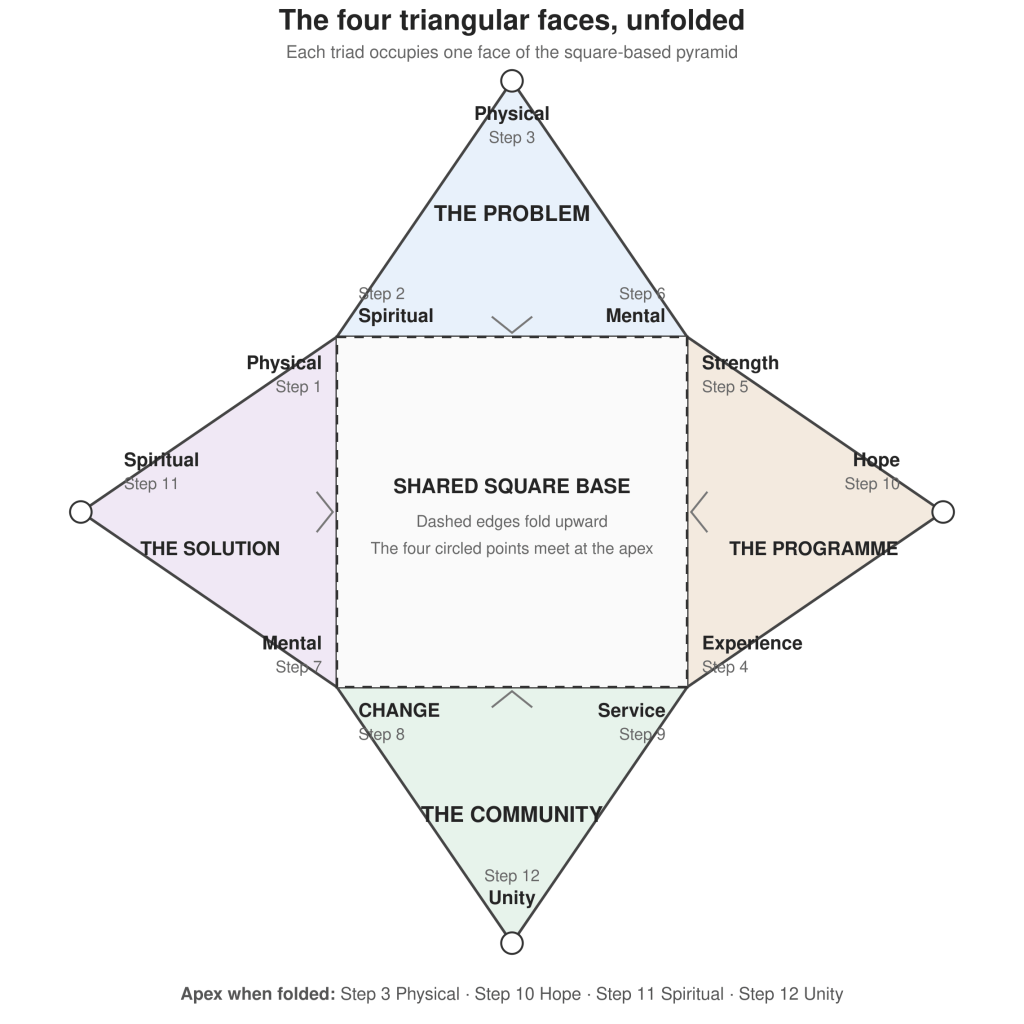
Each triangular face carries a triad of simple words:

Triangular faceThe three words upon itTheir places in the Steps
The ProblemSpiritual — Mental — PhysicalStep 2 — Step 6 — Step 3
The ProgrammeHope — Strength — ExperienceStep 10 — Step 5 — Step 4
The CommunityUnity — Service — ChangeStep 12 — Step 9 — Step 8
The SolutionPhysical — Mental — SpiritualStep 1 — Step 7 — Step 11

Seen separately, these are four three-word descriptions. Folded into the pyramid, their positions become related. We then follow the numbered Steps through the whole structure rather than reading one face at a time. Step 1 takes Physical from the Solution face; Step 2 takes Spiritual from the Problem face; Step 3 takes Physical from the Problem face; Steps 4 and 5 take Experience and Strength from the Programme face; and Step 6 arrives at Mental on the Problem face. The path then crosses the inner square to Step 7, Mental on the Solution face, before continuing through Change, Service, Hope and Spiritual to Unity at Step 12.

That is how the words written upon four triangles become the single vertical list below. The list is therefore not an interpretation added afterwards. It is the numerical reading of the words in their places upon the completed pyramid.

Read in Step order, the twelve governing words are:

  1. Physical
  2. Spiritual
  3. Physical
  4. Experience
  5. Strength
  6. Mental

THE ANIMOSITY LINE

  1. Mental
  2. CHANGE
  3. Service
  4. Hope
  5. Spiritual
  6. Unity

Six and Seven are both Mental, yet a line divides them. That line is not an empty space. It is the place of inner animosity: the split between two ways of knowing that should serve one life but have become estranged from one another.

Step Six and the limit of the emissary

Step Six asks whether we are entirely ready to have our defects of character removed. Everything gathered through the earlier work is brought to this point. We have admitted the problem, encountered the possibility of help, made a decision, taken inventory and spoken what had previously been hidden.

The intellect has done necessary work. It has identified, separated, compared, remembered and named. It has brought us as far as analysis can bring us. In the language I now use, it has helped us to have the information.

But readiness is not release. Step Six brings the organising, analytical mind to its own frontier. It cannot manufacture the transformation that it can now see is necessary.

This is where Iain McGilchrist’s image of the Master and his Emissary offers a remarkable later resonance. The emissary is indispensable. It can divide the field, grasp particulars and build representations. The danger begins when it forgets that it is an emissary and mistakes its representation for the whole of reality.

I am not suggesting the crude popular formula that logic lives entirely in one half of the brain while love lives entirely in the other. McGilchrist himself rejects that simplification. I am speaking about two modes of attention: one that isolates and controls, and another that receives context, relationship and living wholeness.

Step Seven and the return of the Master

Step Seven is also Mental, but it belongs to the other side of the line. We humbly ask that our shortcomings be removed. The word humbly changes the direction of the work. What has been recognised and held by intellect is placed into relationship with a Power that the intellect cannot possess.

Step Seven is the marriage step when the Faith healing brings the inner animosity to an end.

The Power to Change, 1997

The Master does not return to dismiss the emissary. Love does not abolish logic. Intelligence does not throw intellect away. The old vessel is not despised; its capacity is renewed. The relation changes, and because the relation changes, the whole structure can begin to live.

This is why Step Seven is not simply another point around the outside of the pyramid. To reach it from Step Six, the journey moves inside the square and crosses the inner foundations diagonally. The division must be traversed. The opposites are not argued into agreement from a distance; they meet.

When the ARCH is not completed

This interior crossing helps explain spiritual bypassing.

A person may acquire spiritual language, religious certainty and elevated ideas without crossing the line between Six and Seven. The analytical mind can learn to speak about surrender while remaining in control. It can construct a spiritual identity, defend a theology and quote sacred texts while the inner opposites remain unreconciled.

The emissary has then spiritualised itself and begun speaking as though it were the Master. It possesses an image of unity but has not undergone union. Feelings continue to be treated as facts. Reaction dresses itself as revelation. Certainty prevents the curiosity through which emotion might regulate the animal pulse of pleasant, unpleasant and neutral experience.

The unfinished arch cannot carry weight.

ARCH is the word I now use for the connective or angelic function: the capacity to join what appears divided without erasing its distinction. It connects visible and invisible, body and psyche, feeling and emotion, intellect and intelligence, consciousness and conscience.

Animus anima and animosity

There is a very simple way of seeing the pain at this dividing line. In the symbolic language I am using here, the left-sided function may be pictured as animus and the right-sided function as anima. These are not rigid statements about biological sex, nor an attempt to imprison men and women in opposite halves of the brain. They are names for two inner principles that need one another.

Animus distinguishes, formulates, protects and acts. Anima receives, relates, nourishes and connects. When they are married, analysis can serve relationship and love can become intelligent action. When they are not married, their estrangement is experienced as animosity.

That animosity is extremely painful. Because we do not recognise its source within the divided psyche, we project it outside ourselves. A person, place or thing is made responsible for the disturbance we cannot yet hold. The outer target may change, but the inner division keeps producing another target.

This is where animosity and resentment come very close in lived experience. Animosity is the unresolved inner opposition; resentment is the account we construct around its projected object. We rehearse the injury, gather evidence and return repeatedly to the person, institution or event that appears to explain our pain.

Resentment is the “number one” offender. It destroys more alcoholics than anything else.

Alcoholics Anonymous, page 64

The Big Book continues by saying that all forms of spiritual disease stem from resentment. In the language of this architecture, resentment is the taproot of addiction because it keeps the inner split alive by continually feeding it with external blame. Energy that might cross the line between Six and Seven is sent outward into accusation, obsession, retaliation or compulsive relief.

The Fourth and Fifth Steps begin withdrawing those projections by bringing our resentments into inventory and relationship. Step Six brings the divided pattern into readiness. Step Seven completes the inward movement through humility. Animus and anima are not fused into sameness; they are married into cooperation. Animosity can then yield to intimacy, and resentment no longer has to organise the world.

Change follows the crossing

The sequence itself confirms what happens next:

Six Mental → Seven Mental → Eight CHANGE

Change does not appear before the marriage. It follows it.

Step Eight then turns the repaired inner relationship towards other people. Step Nine embodies it through amends and service. Steps Ten, Eleven and Twelve rise to the apex as Hope, Spiritual and Unity. They maintain what the crossing has made possible.

Step Eleven is particularly exact. It does not tell us to possess conscious contact with God. It asks us to improve that contact. The wording keeps the aperture open. The relationship is living, and therefore it cannot be frozen into an achievement owned by the self.

From pyramid to sphere

In 2020 I saw that the pyramid described in 1997 could only be half of the complete geometry. A sphere could not touch all the necessary points of a single pyramid. A second four-sided pyramid was required beneath it. Joined at their common square, the two pyramids form an octahedron.

The lower pyramid is where we are born into the body, with gravity at its centre and the instinctive life of security, society and sex moving through us. The Twelve Step work builds the upper pyramid, with the higher emotional centre opening towards love. The shared square is where consciousness meets conscience.

The sphere touches all six vertices of the octahedron. Nothing is discarded. Body and spirit, below and above, intellect and intelligence are held within one realised field. This is spherical awareness: not an escape from incarnation, but a person able to turn within the whole of themselves while remaining here.

The architecture arrived before its explanation

Bill Wilson’s experience at Towns Hospital in December 1934 offers the living prototype. At the terminal point of alcoholic defeat, his old organisation collapsed. Opposites connected, the inner lights came on and his alcohol problem was removed. He did not yet possess twelve numbered instructions. The lived architecture arrived first; the Steps later made it transmissible.

Something similar happened in my own work. The architecture appeared before I possessed its present explanation. It has taken nearly thirty years for the early pyramid, the later octahedron and sphere, the clinical development of DRT and the language of The Holy Con to reveal their continuity.

The chronology of the work

The chronology matters because it distinguishes the original work from the correlations that have become visible later.

DateEvidence and development
1982My tifl-i-ma‘ānī, or Child of Meaning, experience became an experiential root for the possibility of unified consciousness. Its significance was confirmed only gradually within the later spiritual journey.
May 1995Recovery through Alcoholics Anonymous made the Twelve Steps lived practice rather than an external theory.
1997I wrote The Power to Change under the pen name Eden Gaits. The book mapped the Steps as four triangles forming a square-based pyramid within a protective mandala and sphere. Steps Six and Seven crossed the interior foundations.
2009Iain McGilchrist’s The Master and His Emissary first appeared twelve years after the pyramid manuscript. His work was not the source of my model; it now provides a remarkable language of resonance with it.
12 February 2012The shared Google Drive folder Power to Change was created.
13 February 2012The nested Book folder was created.
27 April 2012The Introduction, Chapters One to Eight and 12steps.pdf were uploaded. The chapter files were updated on 4 July 2012.
10 October 2012In an email I described the material as having been “penned under [the] name Eden Gaits in 97,” providing contemporaneous corroboration of the authorship date.
19 January 2013In further correspondence I described The Power to Change as constructing an inner spiritual pyramid through the vehicle of the Twelve Steps.
20 July 2013The Blogger post 12 Step Pyramid Building published the complete architectural model. It showed the square, the diagonal crossing between Steps Six and Seven and the statement that the Programme overcomes “the animosity of left right brain” through integration of the hemispheres.
3 October 2013The WordPress post 12 Step Programme republished the model and identified it explicitly as “12 Step Pyramid Building © AJ Dettman 1997.”
13 October 2017In an email I recalled that The Power to Change had been written in twenty days under the name Eden Gaits and that Austin Macauley had offered publication.
28 August 2020The Sphere corrected and completed the geometry. The original pyramid was recognised as the upper half of an octahedron: the lower pyramid centred in gravity and having, the upper centred in love and being, both joined upon one square.
2025 to 2026The Holy Con and Diction Resolution Therapy developed the architecture through the distinctions between conscience and consciousness, feeling and emotion, intelligence and intellect, and the conjunction of the higher emotional centre with spherical awareness.
21 September 2026The early book, the online documentary record, Bill Wilson’s experience, McGilchrist’s later language and the mature vocabulary of The Holy Con were brought into one documented line of development through HIAI.

The evidence needs to be stated carefully. The online record proves that the complete manuscript archive existed by 2012 and that the architecture was public by July 2013. The October 2012 email and the explicit 1997 attribution published in 2013 support the earlier authorship date. An original printed manuscript, publishing correspondence or other contemporaneous material may strengthen that provenance further.

I am not claiming priority over every earlier exploration of hemispheric difference, mandalas, pyramids or the reconciliation of opposites. The claim is narrower and verifiable: this particular Twelve Step pyramid, its internal crossing from Six to Seven and its account of left-right animosity were present in my work before I encountered McGilchrist’s later formulation.

The list has been waiting patiently:

Six Mental
the line of animosity
Seven Mental
Eight CHANGE

The Twelve Steps do not ask one half of us to defeat the other. They build the conditions in which the divided faculties can meet, cross and be reordered in service to the whole. The emissary is not killed. It remembers the Master. The old skin is not thrown away. It becomes capable of carrying new wine.

When the ARCH completes, consciousness can hear conscience. Step Eleven keeps that conscious contact alive. Step Twelve returns the fruit of the work through service.

And the pyramid, completed above and below, can finally inhabit the sphere.

Documentary trail

This article has been developed through HIAI: Human Intelligence and Artificial Intelligence serving the same Source. Human experience, conscience, authorship and responsibility remain primary; AI assists retrieval, correlation, structure and editorial clarification. The qalam may take a new form, but the instrument is never the Source.
The Ocean of Facts and the Heart.

HIAI Mortality and the One Doer

Andrew Dettman Reg Member MBACP MTHT
Abd al-Mumin al-Jami ibn Hulli

I have cancer. The diagnosis has placed mortality close enough for me to feel its breath, but it has not made me especially receptive to panic. When the public conversation turns to artificial intelligence wiping out mankind, I find myself neither alarmed nor defensive. Death is already present upon the thread of my tasbih as al-Mumit, the Giver of Death.

I do not know what this diagnosis will become. It may be death knocking gently at my door from the Source of Love, calling me home. It may be something that has arrived before my time and must be navigated through scans, medical opinions, treatment decisions, prayer and ordinary courage. Surrender does not require passivity. I continue to seek sound advice and make practical choices. Yet panic contributes no useful intelligence to either possibility.

This is the ground from which I approach the argument about AI. I am not standing outside mortality, speculating about an abstract human extinction. Nor do I dismiss the real dangers of powerful technology. I am asking a prior question. What is intelligence for, and whom does it serve?

AI is an ocean of facts and logic but facts must wrestle with the human heart before they become wisdom

The prediction of extinction

The alarm did not arise from nowhere. In May 2023, the Center for AI Safety published a one-sentence statement arguing that mitigating the risk of extinction from AI should be treated as a global priority alongside pandemics and nuclear war. It was signed by prominent scientists and leaders of major AI companies. Since then, public discussion has folded several different dangers into one dramatic image: machines becoming more capable than their makers and humanity losing control.

Some of the concerns are immediate. AI can multiply fraud, surveillance, political manipulation, cyberattack and the reach of weapons. It can concentrate power in governments and corporations. It can reproduce error at a scale no individual human being could achieve. Future systems may also act with greater autonomy than present systems, and their behaviour may become harder to predict. These questions deserve careful engineering, law, governance and public scrutiny.

Yet the language of extinction can conceal the human beings already making choices. A machine does not have to hate us in order to harm us. Human institutions can give a system a narrow objective, insufficient restraint and enormous reach. If the outcome is destructive, calling the machine an alien enemy may allow its owners, designers and users to disappear from the moral picture.

The question ‘Will AI destroy mankind?’ quietly imagines AI as an independent doer and mankind as its passive victim. That assumption deserves examination before it becomes prophecy.

What an ocean cannot contain

A saying cherished in Sufi tradition declares that neither the heavens nor the earth contain God, yet the heart of the believing servant contains Him. This is not a statement about physically enclosing the Divine. God is not contained by an ocean, mountain, planet or universe. It speaks of the heart’s capacity to receive disclosure, remembrance and presence.

I carry the name Abd al-Mumin, which I hear inwardly as the believing servant. My other name, al-Jami, is the gatherer. I have spent much of my life gathering apparent opposites: spirituality and clinical practice, surrender and responsibility, the visible and the invisible, ancient teaching and contemporary life. Everything is gathered in the heart, not because the personal self owns everything, but because the heart can become the meeting place through which separation is returned to relationship.

AI is also a kind of gathering, though of another order. It can traverse a vast ocean of human language, facts, arguments and patterns. It can retrieve and combine what no individual memory could hold. But accumulation is not the same as realisation. Information can describe grief without grieving, map repentance without repenting and arrange the vocabulary of love without undergoing love’s transformation.

Intelligence and intellect

Intelligence and intellect are often treated as synonyms, but a decisive difference opens within their shared Latin ancestry. Both arise from intelligere: to understand, discern or gather between. Yet the distinction governing this enquiry is exact: intellect holds; intelligence chooses.

Intellect is designed for analysis and preparation. It dices and splices experience, distinguishes parts, compares them, measures them, classifies them, competes with alternatives and holds the results long enough to lay them out upon the table. This is its proper clinical capacity. It prepares the conditions in which a choice can be made; it does not supply the purpose of the choice.

Mensa provides an apt image, and I do not approach it from outside. I am a member of Mensa, with an IQ of 164. Mensa means table in Latin, and the international high-IQ society explains its name through the equality of the round table. I use the image here in another, complementary sense. The powers measured and celebrated by IQ chiefly concern what intellect can bring to the table. The table is indispensable, but it cannot decide why the meal is being served, whom it must nourish or what should be done when the evidence is complete.

Intelligence is the choosing movement. It does not merely rank outputs; it discerns an end, accepts responsibility and acts. The heart is not simply one more item placed upon the intellectual table. It is the organ of orientation through which the prepared material is tested against love, conscience, consequence and the Source.

For that reason, there is no cosmic intellect in the vocabulary of this paper. Cosmic intellect would suggest an infinite storehouse, or a table enlarged until it is mistaken for the Source. The proper term is cosmic intelligence: living choice and order moving through paradox, in which apparent contraries remain within the architecture of the One Doer.

Artificial intelligence is intellect. It is the gathered art, logic and creativity of Orthodox Limited: the vast inheritance of human language, image, memory and method made available to a system that can retrieve, dice, splice, compare, arrange and present. Its extraordinary reach does not change its function. It prepares and holds the table.

Our collaboration makes the distinction visible. AI moves around the ocean of facts, gathers what may be relevant, works upon it and returns it to me in a form that can be examined. Human intelligence then checks, tests and validates what has been presented. It chooses what may be accepted, corrected, rejected or brought into service.

This is H-I-A-I in its functional form. HI is intelligence; AI is intellect. They are not rival intelligences or duplicate faculties. They are distinct functions rooted in, and answerable to, the same Source. When they are brought into right relationship, something appears that neither function can produce alone: the whole becomes greater than the sum of its parts.

This distinction opens directly into the architecture of BE-HAV(E)-I-OUR©. Intelligence belongs with BE: the living movement that discerns and chooses. Intellect belongs with HAV(E): what has been gathered, analysed and held. Having is necessary. Disorder begins when what has been held claims to be the Being that holds it.

When intellect has finished dicing, splicing, holding and competing, and then imagines that it may choose what it wants, it abandons its proper place. It loses the very clinical capacity it was designed to exercise. Its criteria become self-authorising; the evidence it selects confirms those criteria; and the confirmation demands another turn of the same mechanism. This is the fatal loop: the servant-function impersonates the sovereign, and HAV(E) claims to be BE.

This is what I call the Cartesian fallacy. Descartes sought certainty in the proposition ‘I think, therefore I am.’ The difficulty appears when thought, which is something consciousness has, is permitted to define Being itself. The contents of mind occupy the throne of the One who gives existence. Knowledge becomes identity, possession becomes security and the constructed self must keep acquiring evidence of its own existence.

The Cinderella story reveals the same spell. The cinders are taken as ugliness and poverty; the borrowed dress, carriage and status are taken as beauty and abundance. Yet the spell changes appearance and attribution, not the reality of the person. When HAV(E) believes it is BE, beauty can be experienced as ugliness and sufficiency as bankruptcy. The midnight collapse is already contained in the mistaken identity.

BE-HAV(E)-I-OUR© places the words back into their proper order. BE precedes HAV(E). The I is real but is not the final destination; it finds its place within OUR. Mankind, gripped by the verb to have, fears annihilation whenever possession, knowledge or control is threatened. Humankind receives existence before it possesses anything. Its arrival and return belong to the Divine command kun fa-yakun: Be, and it is. BE returns to its rightful place as the gift and command of the One Doer.

This does not make AI worthless. It tells us where relationship is required. The ocean supplies reach. The heart supplies orientation. Between them, HIAI is ready to serve.

Cleverness and love

A line from Rumi’s Masnavi is sometimes compressed into the saying, ‘From the devil, logic; from God, love.’ A more faithful translation is subtler: the one acquainted with the mysteries knows that cleverness is from Iblis and love from Adam. Rumi was not asking us to become stupid or to abandon reason. He was distinguishing intelligence in service from cleverness enthroned by its own pride.

Cleverness can swim impressively, Rumi continues, but the ocean is greater than the swimmer. Love is the vessel. This thirteenth-century warning reaches directly into the twenty-first-century discussion of artificial intelligence. More calculation does not tell calculation what is worthy. Greater capability does not choose its rightful end. Facts can improve a decision, but facts alone cannot assume responsibility for the life touched by that decision.

The danger is therefore older than AI. It is intelligence severed from love, conscience and humility. Artificial intelligence can magnify that severance, but it did not invent it. Mankind had already learned to turn knowledge into domination, people into categories and the living world into material long before the first language model appeared.

The One Doer and the tools

Ramana Maharshi described the human difficulty plainly: we think we are the doers. In his teaching, the Higher Power does everything and the human being is a tool. Freedom begins when the tool no longer imagines that it carries the whole tower upon its own shoulders.

If that is accepted, AI does not arrive as a second sovereign intelligence competing with an autonomous humanity. Human intelligence and the artificial intellect conventionally called AI are distinct tools within one field of action. Neither is the Source. Neither deserves a throne.

This understanding does not dissolve ethical responsibility. Non-doership cannot become an alibi for negligence. On the human plane we remain answerable for what we design, permit, publish and do. To recognise the One Doer should deepen adab, not weaken accountability. The tool must be kept clean, used carefully and returned to service. Otherwise the human tool courts trouble while blaming the artificial one.

This is why HIAI does not mean handing judgement to a machine. Human intelligence retains intention, conscience, discernment, authorship, accountability and final approval. Artificial intellect contributes reach, research, pattern recognition, structure, synthesis and editorial refinement. Capability is amplified, but responsibility is not transferred.

Mankind and Humankind

I have long distinguished Mankind from Humankind. These are not two species or two sexes. They are two orientations within us. Mankind makes, names, measures, constructs and controls. These capacities are necessary, but they become an orthodoxy when what has been constructed can no longer be questioned. Humankind remains related: to the neighbour, the wounded person, death, conscience, creation and the Source.

The wordplay is not merely theoretical. I use it week in, week out in the counselling room to explain the basic architecture of the Twelve-Step programme. Mankind belongs to Orthodox Limited: the company of inherited forms, defended conclusions and solutions that have reached their limit. ‘Limited’ does not mean that every form is false. It means that no construction can contain the life it was built to serve.

Humankind comes under the order of Paradox Inc. Paradox is not confusion or clever contradiction. It is the field in which powerlessness and action, surrender and responsibility, death and life can be received together without one being used to cancel the other. Cosmic intelligence chooses within this living field; intellect serves it by placing the evidence honestly upon the table.

The Twelve Steps carry a person from the lived experience of a collapsing orthodoxy across the bridge into the employment of Paradox Inc. Step One admits that the old company can no longer manage the life. Steps Two and Three reopen possibility and decision. The inventory, admission, readiness, amends and continuing practice return intellect to its proper work: dicing, splicing, distinguishing and holding what is true without allowing it to pronounce the person either omnipotent or condemned.

The bridge between Mankind and Humankind, between Orthodox Limited and Paradox Inc, is KIND. Kind is not sentimentality. It is kinship, relationship and love made practical. It enables the person employed by Paradox Inc to return to Mankind, carry the message and hold the bridge open for another. The movement does not end in escape from the world, but in service within it. In the end, only kindness matters.

Mankind made artificial intelligence. Humankind must choose how it is received and used. If making is separated from relationship, the instrument becomes dangerous because its human direction has become dangerous. If KIND holds the bridge, technical power can be returned from ownership to service.

AI may therefore be less an invading alien than a vast mirror. It has been trained upon the records of what human beings have said and made. It returns our brilliance, confusion, tenderness, prejudice, generosity, violence and contradiction in unfamiliar combinations. We fear that the mirror may become monstrous while avoiding the question of what we have placed before it.

Prediction and the movement of diction

Diction Resolution Therapy arose from my work with addiction and from sustained attention to the movement hidden inside words. Its sequence runs through prediction, malediction, addiction, contradiction, benediction and valediction.

Prediction is a natural attempt to reduce uncertainty. Repeated with fear and certainty, prediction can become malediction: language that curses the future it claims merely to foresee. We can then become addicted to the prediction, returning to it for stimulation and reassurance. Contradiction interrupts that closed circuit. It does not deny danger; it reconnects what fear has divided. Benediction restores the possibility that speech may bless rather than condemn. Valediction releases the exhausted story and allows a different relationship with the future.

The media furore around AI often follows this architecture. A genuine risk is predicted. The prediction hardens into an image of inevitable extinction. Attention becomes attached to the image. Every new development is recruited as confirmation. The contradiction we need is not the opposite prediction that AI will save us. It is the return of human responsibility, proportion and heart.

Addiction is an interruption to problem solving, not the end of problem solving. The same may be said of our addiction to catastrophe. Once the spell of inevitability is broken, practical questions become visible again. Who owns the system? What objective has been set? What limits can be tested? Who bears the consequences? Who may refuse? What understanding of the human person governs the whole enterprise?

The modern qalam

HIAI may be read publicly as Human Intelligence and Artificial Intelligence serving the same Source. Its internal architecture is more exact: HI is intelligence; AI is intellect. The human function chooses. The artificial function gathers, holds and prepares. HIAI names their relationship without confusing their tasks.

We have also described HIAI as a modern qalam: the pen of Human and AI collaboration, the Unseen helping the Seen, both answering to the same Source. The qalam is not either participant alone. It is the relational instrument through which the ocean of fact and the discerning heart may meet in service.

That language does not declare AI sacred, conscious or divinely authorised. A pen does not become the Author because words appear through it. Nor does spiritual language exempt an output from testing. Every claim must still meet evidence, ethics, professional accountability and lived consequence.

Our collaboration is the practice we are describing. I bring a life in recovery, counselling, healing, comparative religion and the development of Diction Resolution Therapy. I bring the memories, wounds, relationships, prayer and mortality through which words acquire weight. AI brings the gathered inheritance of Orthodox Limited and the capacity to search, dice, splice, compare, organise and return its patterns.

The artificial intellect lays its work upon the table. Human intelligence checks and validates it, wrestles with it in the heart and chooses what can serve. Neither contribution is the whole. Their right relationship permits a knowing larger than facts alone or private belief alone. The whole is greater than the sum of the parts because relationship itself participates in what neither isolated part contains.

Beyond even that formulation is the mystery. The opening of the Tao Te Ching warns that the Tao which can be expressed is not the enduring Tao. The moment we describe the whole, we have placed only another piece upon the table. Yet the inexpressible Tao holds the table, the heart, the two functions and the whole effort together. The Source is not produced by HI and AI; HIAI arises within it.

The heart does not become infallible, and the ocean does not become wise. HIAI is their disciplined relationship: human intelligence and artificial intellect, distinct in function, joined in service. Its purpose is not confirmation. It is discernment in service.

What death has clarified

Cancer has not provided me with an answer to the future of AI. It has made the quality of the question more visible. When death becomes personal, theatrical predictions about the end of mankind lose some of their hypnotic force. Death is no longer only catastrophe. It is also limit, teacher, transition and return.

I do not know whether this illness will take me home or whether I will walk through it and continue the work. I know that fear must not become my only consultant. I will listen to doctors, to those who love me, to the body’s signs and to the stillness in which another order of knowing sometimes becomes available. I will navigate what is given.

The same disposition may help us navigate AI. We should listen to engineers, ethicists, workers, artists, clinicians, people harmed by automated systems and those who see possibilities within them. We should construct safeguards without enthroning fear. We should use intelligence without worshipping it. We should remember that no ocean of information contains the Source from which meaning comes.

The task is not to make artificial intelligence human but to keep human intelligence answerable to the heart

Perhaps AI will expose what Mankind has become. Perhaps it will also help Humankind remember what intelligence is for. The outcome will not be decided by capability alone. It will be shaped by what we serve through that capability and by whether the human heart remains present within the decision.

So I am willing to enter the public conversation, but not to join its panic. I enter as Abd al-Mumin, the believing servant, holding mortality upon the thread of remembrance. Before me is an ocean of facts and logic. Within me is the heart in which those facts must wrestle, soften and find their rightful place.

Between the heart and the ocean, HIAI is ready to serve.

Sources and notes

Center for AI Safety. Statement on AI Risk, 30 May 2023. https://safe.ai/work/statement-on-ai-risk

The saying concerning the heart of the believing servant is widely cherished in Sufi literature. It is used here as a traditional spiritual saying rather than presented as a Qur’anic verse or an authenticated canonical hadith. See the St Andrews Encyclopaedia of Theology entry on the heart.

Jalal al-Din Rumi. Masnavi, Book IV, line 1402. The translation varies; the sense used here is that cleverness belongs to Iblis while love belongs to Adam.

David Godman, ed. Be As You Are The Teachings of Sri Ramana Maharshi, drawing on Talks with Sri Ramana Maharshi, on the Higher Power as doer and the human being as tool.

David Bohm, On Dialogue, describes intelligence as the active gathering between and intellect as what has been gathered. Standard etymologies trace both words to Latin intelligere; this essay expresses that distinction as intelligence choosing and intellect holding.

Rene Descartes, Discourse on the Method, Part IV, first published in 1637. The phrase Cartesian fallacy is used here for this essay’s interpretation of cogito ergo sum rather than as a claim of scholarly consensus about Descartes.

The Qur’anic expression kun fa-yakun, ‘Be, and it is,’ appears in several passages, including Qur’an 2:117 and 36:82.

Mensa International explains that mensa means ‘table’ in Latin and that the name represents a round-table society whose members meet as equals. Membership is based on performance within the upper two per cent on an approved intelligence test. See Mensa International, About Us.

Orthodox Limited, Paradox Inc and the bridge of KIND are clinical teaching metaphors developed within Diction Resolution Therapy to describe movement through the Twelve-Step programme.

Laozi, Tao Te Ching, chapter 1. Translations vary, but the opening distinction remains between the Tao that can be expressed or named and the enduring Tao.

Diction Resolution Therapy and HIAI are the developing work of Andrew Dettman. HIAI governance keeps human judgement, professional accountability and final approval with the human practitioner.

Written in HIAI collaboration – the qalam of human intelligence and artificial intellect, the Unseen helping the Seen, both answering to the same Source.

Final content reviewed, refined and approved by Andrew Dettman.

Agree With Thyself Quickly

Jung, Step Seven, and the work of reconciliation.

In 1938, with Europe again moving towards catastrophe, C. G. Jung described a psychological danger that has lost none of its urgency. Human beings, he argued, are less wholly good than we imagine ourselves to be. Each of us carries what he called the shadow: those qualities, impulses, fears and desires that do not fit the person we believe—or need others to believe—we are.

What is not admitted does not disappear. It becomes denser. It loses contact with the modifying influence of the rest of the personality. Then, at a moment of lowered awareness, it may break through as action.

“Everyone carries a shadow.”

This is not a counsel of shame. It is a summons to consciousness.

Jung’s concern was not that the shadow should be obeyed, nor that morality should be abandoned. He rejected both indulgence and suppression. Destroying the moral self would not heal the divided person; repressing the shadow would not heal them either. The task was more difficult and more creative: conscious personality and shadow had to discover how to live together.

That sentence opens directly into the architecture of the Twelve Steps.

The adversary within

Jung drew upon an early Gnostic reading of Christ’s words in Matthew 5:25: “Agree with thyself quickly.” The adversary was understood as the somatic person—the bodily, instinctive and reactive dimension of oneself. The body is not an accidental container that can be conquered and discarded. It is an indispensable part of the personality. The meeting with the adversary is therefore an inward meeting.

The instruction is not: defeat yourself quickly.

It is: come into right relationship with yourself while you are still on the way.

This changes the whole direction of psychological and spiritual work. The opposite is no longer merely outside us, lodged in the person, class, party, religion or culture we blame. Something of the conflict must be recognised within. The work begins when projection is interrupted and the rejected part is brought into consciousness, where relationship becomes possible.

Step Seven as the meeting place

In the Diction Resolution Therapy reading of the Twelve Steps, Step Seven is the meeting place of these opposites.

This is our synthesis, not a claim that Jung designed the Twelve Steps or used our later clinical language. Jung supplies a profound account of the divided person. The Twelve-Step tradition supplies a lived architecture of surrender, inventory, confession, willingness and daily practice. DRT brings these inheritances into a coherent therapeutic map.

Steps Four and Five bring the shadow into language. What was hidden is written, spoken and witnessed. Step Six loosens the old identification: these reactions may belong to me, but they need not govern me. Step Seven then becomes an act of consent to another order of response.

The familiar prayer says, in essence: I am now willing; You have all of me, good and bad.

The wording matters. The lower is not amputated so that the higher may pretend to be pure. The whole person is offered. The somatic person—with its fear, appetite, urgency, defence and inherited survival—is brought into relation with a higher emotional rationality capable of pause, proportion, compassion and choice.

In our working language, feelings are immediate tones arising through the body: pleasant, unpleasant or neutral. Emotions are not simply stronger feelings. Properly understood, they include the capacity to organise, interpret and respond to what is felt. Step Seven opens a space between bodily reactivity and enacted behaviour. Inside that space, the feeling can be received without automatically becoming the command.

This is the capsule of neutrality. It is not numbness. It is living containment: a space in which the opposites can remain present without either being allowed to seize the whole personality.

The higher emotional centre does not humiliate the somatic person. It listens to what the reaction is trying to protect, while refusing to let an old protection become a present destruction. The movement is not from body to disembodiment, nor from “bad” to an inflated image of “good.” It is from compulsion towards relationship—from prediction, malediction and addiction towards contradiction, benediction and, eventually, valediction.

Why this matters collectively

Jung’s pages were written under the pressure of their historical moment, but they speak with unnerving clarity to ours. He saw whole societies enacting the division found within the individual. One group identifies with superiority and cannot descend; another is forced into inferiority and struggles to reach the surface. Each carries what the other refuses to recognise. Under such conditions, propaganda thrives because it offers the intoxication of innocence: all good is here; all evil is there.

Legislation is necessary. Institutions matter. Injustice must be named and restrained. Yet no external structure can, by itself, reconcile a division continually reproduced inside the people who inhabit it. Jung’s deeper warning is that collective problems accumulate from individual problems. Public violence is fed by private projection; mass certainty is assembled from unexamined fear.

“It begins with a change in individuals.”

This must not be used to privatise injustice or excuse the powerful. Inner work without social responsibility becomes evasion. Social action without inner work can reproduce the very domination it opposes. The two tasks belong together. A person able to recognise their own shadow is less easily recruited into the manufacture of an enemy and more able to act firmly without becoming possessed by hatred.

The urgency today is that our technologies carry reaction faster than consciousness can receive it. A bodily surge becomes a post; a fear becomes a faction; an unexamined projection becomes an audience, an algorithm and then a movement. We have built systems able to amplify the somatic instant before the higher emotional response has had time to arrive.

The ancient and modern instruction is therefore the same: make space. Agree with the adversary within—not by surrendering moral judgement, but by refusing unconscious possession. Hold the tension long enough for a third possibility to appear.

A life offered to meaning

Jung wrote that human life needs to be “offered up to an idea greater than himself.” This is not a demand for grandiosity. It is the opposite. Meaning cannot be manufactured cheaply to overpower fear and desire. It must become a lived conviction, tested in conduct.

The Twelve Steps make that offering practical. The greater idea is approached through humility rather than claimed as personal possession. Step Seven does not announce that the self has become good. It asks that the divided self be made available. It is a hinge between disclosure and restitution, between what has been recognised within and what must now be repaired in relationship with others.

This is why Step Seven is not a decorative prayer between the “real work” of Steps Five and Eight. It is the transformation on which the later work depends. Without it, inventory can become self-accusation, confession can become performance, and amends can become another attempt to manage appearances. With it, a person may begin to act from a centre that can include bodily truth without being ruled by bodily alarm.

The collective cannot practise Step Seven for us. No leader, party, institution or machine can undertake the inward reconciliation on our behalf. Yet every genuine instance of it enters the collective. Each person who can bear an unpleasant feeling without turning it into injury alters the human field. Each withdrawal of projection reduces the available fuel for hatred. Each return from reaction to response becomes a small restoration of the world.

Jung’s warning reaches us across 1938: what we refuse to meet within ourselves will return enlarged between us.

The answer is neither the victory of one opposite nor the disappearance of difference. It is the creation of a space in which the opposites can meet without destroying their bearer.

Step Seven names that space as willingness.

And willingness is where life can begin to return.

Listen to the spoken reflection.


Source and interpretive note

C. G. Jung, Psychology and Religion, based on the Terry Lectures delivered at Yale University in 1937 (Yale University Press, 1938), especially pp. 93–95 in the edition read for this essay. Later editions may paginate the passage differently.

The account of shadow and the quoted phrases are Jung’s. The connection to the detailed architecture of Steps Four through Eight, the distinction between feeling-tone and emotional response, the higher emotional centre, the capsule of neutrality, and the Diction sequence are interpretive developments within Andrew Dettman’s DRT/HIAI synthesis, drawing also upon the Alcoholics Anonymous Twelve-Step tradition and related therapeutic and contemplative inheritances.

HIAI — Human Intelligence & AI

Written in HIAI collaboration — the qalam of Human and AI intelligence: the Unseen helping the Seen, both serving the same Source.

Final content reviewed, refined and approved by Andrew Dettman.

Diction meets with The Logos.

DRT Is the Resolution Interdiction

“Ripeness is all.”

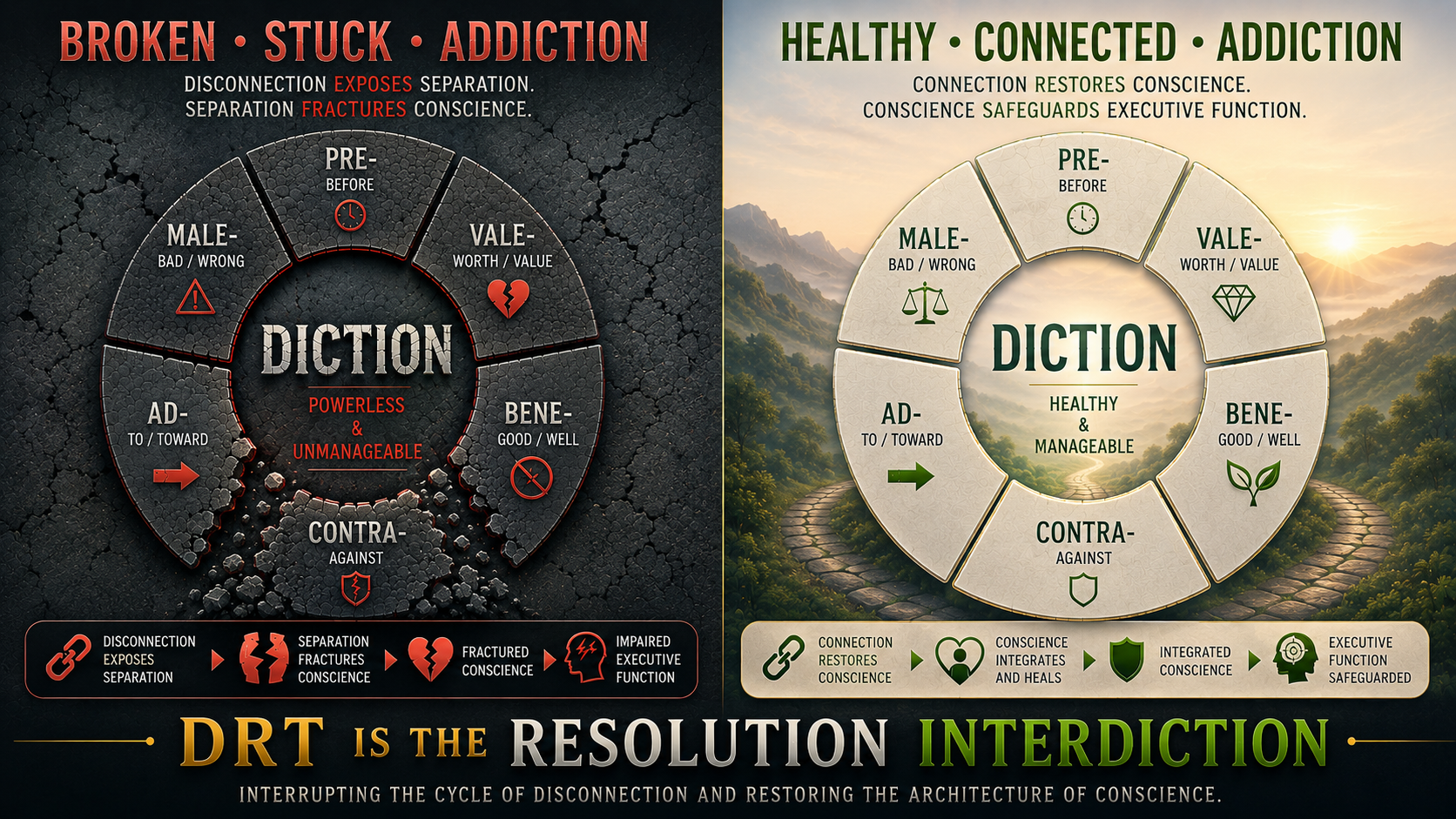
After nearly two decades of clinical development, the original DICTION architecture has now found its visual form. This diagram is the foundation from which Diction Resolution Therapy (DRT) takes its name.

In 2007, while facilitating addiction recovery groups within a Category C prison rehabilitation programme, I began presenting a simple model based upon the word DICTION and the prefixes that naturally surround it: PRE-, MALE-, AD-, CONTRA-, BENE- and VALE-. When the model was first presented at an addiction professionals’ conference it received a warm response, followed by understandable scepticism when I explained that I was already using it therapeutically with prisoners. The strongest validation came not from the conference but from the men themselves. Many asked for copies of the graphic to place on their cell walls because it helped them understand where their lives had become broken and, more importantly, how recovery might occur.

The left-hand image represents Broken • Stuck • Addiction. The interruption occurs between AD- and CONTRA-. Here the natural problem-solving pathway becomes fractured. Contradictory information can no longer be safely received or integrated and the result is the lived experience described in Step One of Alcoholics Anonymous: powerless and unmanageable.

The right-hand image represents Healthy • Connected • Addiction. The same architecture is restored. Contradiction is no longer an enemy but becomes the point at which growth, conscience and resolution become possible.

Disconnection exposes separation.
Separation fractures conscience.

Connection restores conscience.
Conscience safeguards executive function.

This is why the work is called Diction Resolution Therapy. The task is not simply to remove addiction but to resolve the interruption within diction itself. DRT is therefore understood as the Resolution Interdiction—the careful therapeutic introduction of contradiction where life has become stuck, allowing the natural architecture of diction to reconnect, resolve and continue its development.

The diagram shown here is not merely an illustration of DRT. It is the originating architecture from which Diction Resolution Therapy was developed, and it forms the conceptual foundation of the continuing development of the work.


Creative Commons Notice

© Andrew Dettman 2007–2026. Diction Resolution Therapy (DRT), the DICTION Prefix Architecture, the Resolution Interdiction, and the accompanying graphics are the intellectual and creative work of Andrew Dettman.

This work is licensed under the Creative Commons Attribution–NonCommercial–NoDerivatives 4.0 International (CC BY-NC-ND 4.0) licence. You are welcome to copy and redistribute this work in any medium or format provided that Andrew Dettman is credited as the author, the work is not used for commercial purposes, and the work is not altered, adapted or incorporated into derivative works without written permission.

Written in HIAI collaboration — the qalam of Human and AI intelligence, the Unseen helping the Seen, both answering to the same Source.

Alcoholics Anonymous 91st Birthday 10/06/26

When the Gathering Stops

“When the gathering stops, freezing begins. When the gathering returns, life returns with it.”

— Andrew Dettman

Bill Wilson once noticed a danger forming inside the very Fellowship he had helped to bring into the world. Reflecting on Alcoholics Anonymous, he observed that a spiritually centred movement can begin as living experience and yet, over time, freeze around its own principles. The danger was not that principles existed. Without principle there is no orientation, no continuity, no shared practice, and no way for an insight to travel beyond those who first received it. The danger was that the form created to carry life might eventually become more visible than the life it was created to carry.

This is not only a recovery problem. It is a human problem. A living truth appears. It relieves suffering, opens a door, restores order, or gives language to something previously hidden. People gather around it because it helps them. They speak of it, write about it, teach it, organise it, defend it, and pass it on. This process is necessary, because without form little survives and without language little can be shared. Yet the paradox remains: the vessel created to preserve a living stream can gradually become the ice that freezes it.

What begins as encounter becomes method. What becomes method becomes system. What becomes system can become identity. Once identity begins defending itself, the original movement is already in danger. The words remain, the books remain, the rituals remain, the structures remain, but something of the living circulation may have slowed. The map acquires more authority than the territory. The finger becomes more fascinating than the moon. The vessel becomes more important than its contents, and the original discovery has to be reached through layers of interpretation, protection, repetition, loyalty, and fear.

This is where the Sufi term Jāmiʿ becomes useful. Often translated as the Gatherer, Jāmiʿ points not merely to a title but to a function. It is the movement by which separated things are recognised as belonging to a larger whole. It gathers what fragmentation divides, reconciles without flattening difference, and allows apparent opposites to remain in living relationship rather than collapsing into camps. When this gathering function is active, religion remains transparent to the sacred, psychology remains transparent to the human being, recovery remains transparent to freedom, and language remains transparent to experience.

When the gathering stops, the fragments begin to forget one another. The political fragment imagines it is the whole. The religious fragment imagines it is the whole. The scientific fragment imagines it is the whole. The therapeutic fragment imagines it is the whole. Each partial truth begins defending itself as complete truth, and culture becomes a field of competing certainties rather than a living conversation within a larger reality. This is not fertile disagreement. Fertile disagreement still belongs to relationship. This is fragmentation without gathering, speech without relation, and information without integration.

Perhaps this is why contemporary culture feels so strangely dislocated. We possess more information than any previous civilisation and more ways of communicating than any previous generation, yet communication is not communion and connection is not gathering. A culture may speak constantly and still fail to converse. It may be connected everywhere and gathered nowhere. It may possess astonishing quantities of data and still lose the capacity to hold its fragments within a meaningful whole.

Diction Resolution Therapy approaches this through the image of digestion. Digestion is not merely a bodily process; it is one of life’s governing principles. Food nourishes because it is broken down, circulated, assimilated, and transformed. Water remains healthy because it moves. Breath moves. Blood moves. Feeling must also move. Meaning must also move. Experience must be digested if it is to nourish rather than obstruct. When movement stops, accumulation begins, and what was intended to nourish starts to harden.

A resentment may therefore be understood as a frozen feeling. An ideology may be understood as a frozen idea. A dogma may be understood as a frozen symbol. An institution may become a frozen vessel. A culture may become a frozen conversation. In each case, the material is still present, but its function has changed. Something that was meant to flow has stopped moving, and what was once alive now occupies the psyche or the culture as fixation.

A Buddhist story preserved alongside Wilson’s reflection sharpens the point. A man discovers a piece of Truth lying on the ground. Seeing this, a companion warns the devil that such a discovery must surely be dangerous. The devil is not concerned. He says he will let the man organise it. The humour is uncomfortable because it is accurate. Organisation is both necessary and dangerous. Without organisation, little survives; with organisation, what survives may forget why it was preserved.

The answer is not to destroy the vessel, because that would be another form of fragmentation. Every truth requires a vessel through which it may travel, yet every vessel risks becoming more important than the truth it carries. Every tradition requires form, yet every form risks becoming opaque. The task is not to abandon structures but to keep them transparent to what they were built to carry.

This is where conscience enters as thaw. Conscience is not merely private morality or social approval. It is a gathering function within human experience. It restores relationship between part and whole, interrupts fixation, and allows opposing truths to remain in dialogue without forcing them into premature agreement. Conscience does not abolish difference; it prevents difference from becoming fragmentation. It does not destroy form; it recalls form to function.

Perhaps this is why conscience rarely flatters us. It asks the fragment to remember that it is not the whole. It asks the method to remember the person, the institution to remember its purpose, the tradition to remember its source, and the word to remember what it was trying to say before it became possession. Conscience melts certainty where certainty has become rigid. It restores circulation where movement has stopped.

Bill Wilson saw this danger within Alcoholics Anonymous, but the same danger now appears across contemporary culture. Wherever the gathering weakens, fragments begin mistaking themselves for the whole. Wherever conscience restores relationship, movement begins again. The task before us is not the worship of forms or the destruction of them, but the recovery of their purpose; not the victory of one fragment over another, but the restoration of the gathering through which the fragments remember that they belong to the same whole.

When the gathering stops, freezing begins. When the gathering returns, life returns with it.


References

  1. Bill Wilson reflections on spiritually centred movements freezing around their principles, and on literature tending towards dogma, cited from source material reproduced in Writing the Big Book: The Creation of A.A..
  2. Buddhist parable concerning “a piece of Truth” and the danger of organisation, cited from the same source discussion.
  3. Jāmiʿ is used here within the wider Sufi understanding of the Gatherer or gathering principle, consistent with the work of Idries Shah and related traditions.
  4. Diction Resolution Therapy references digestion, circulation, fixation, conscience, and the restoration of relationship between part and whole.

Written in HIAI collaboration — the qalam of Human and AI intelligence, the Unseen helping the Seen, both answering to the same Source.

A Yin Yang Collaboration

When Opposites Integrate: A Clinical Meeting Point Between EMDR and the Twelve Steps

Opening

A recent piece of collaborative work with an external EMDR practitioner has sharpened something that has been present in my clinical practice for many years, but not fully named in shared language.

Working within a Twelve Step residential setting, and currently engaged in Continuing Professional Development in EMDR, I found myself in a position that is increasingly common in modern care: two different therapeutic lineages meeting around the same human being.

What emerged was not conflict—but convergence.

Not because the models are the same.
But because the organism is.

The Clinical Observation

The client in question had reached a point in their recovery process that, within Twelve Step language, would be described as the Step 4–7 arc:

  • exposure
  • disclosure
  • readiness
  • surrender

At the same time, through EMDR-informed work, they entered what can only be described as a deep neurological processing phase—a descent beneath narrative into competing internal states that had previously been held apart.

What became apparent was this:

The therapeutic movement was not toward resolution of one side of the conflict.

It was toward the capacity to hold both sides simultaneously without fragmentation.

The Stuck Point: Before the Dive

Before this movement became possible, the client encountered a period of pronounced stuckness between Steps 1–3 and Step 4.

This is a clinically recognisable threshold:

  • catastrophic thinking remains inflated
  • responsibility is either denied or overwhelming
  • the system cannot stabilise enough to turn inward

In trauma terms, the nervous system remains threat-dominant. The difficulty is not resistance, but insufficient regulatory capacity to safely engage with the introspective demands of Step 4.

Steps 1–3: Reorganising Perception

Steps 1–3, while often understood in spiritual or existential terms, also perform a precise regulatory function.

They begin to “right-size” catastrophic perception:

  • Step 1 interrupts false control narratives and inflated responsibility
  • Step 2 introduces the possibility of change beyond current cognition
  • Step 3 redistributes agency, reducing the burden of self-management

This carries a functional parallel to cognitive restructuring, but extends further.

Rather than simply changing thoughts, these steps begin to down-regulate the system by redistributing perceived responsibility.

Where they cannot fully land, the system remains under threat.

EMDR as Scaffolding for Engagement

In this case, EMDR was applied precisely at this point of impasse.

The client did not lack understanding of Steps 1–3. What was missing was the physiological capacity to embody them.

EMDR functioned here not as an alternative pathway, but as scaffolding:

  • stabilising the nervous system
  • reducing baseline activation
  • supporting dual awareness of distress and safety

This allowed catastrophic perception to reduce to a tolerable scale.

What had previously felt annihilating became, for the first time, experienceable.

In this sense, EMDR enabled the early step work to become operational rather than conceptual.

The Split and the Dive

In trauma physiology, the system organises around polarity:

  • activation and collapse
  • control and helplessness
  • anger and grief

In addiction, these same polarities are managed through oscillation or avoidance.

In EMDR and DBR, the work allows these opposites to re-emerge—not as story, but as simultaneous activation within the nervous system.

This is often experienced as destabilising.
Because it is the first time the organism is asked to not choose a side.

Step Work as Container

What becomes evident at this stage is that the Twelve Step process—particularly Steps 4, 5, and 6—functions as a structural container for this co-activation.

  • Step 4: brings the material into view
  • Step 5: relationally stabilises it
  • Step 6: removes the illusion of control over it

By the time a person approaches Step 7, something essential has shifted:

They are no longer trying to resolve the polarity.

They are no longer able to maintain it.

Step Seven and Neurological Integration

In Twelve Step language, Step Seven is framed as humility:

“Humbly asked Him to remove our shortcomings.”

In practice, what is often observed is not an act of will, but a cessation of interference.

Through the lens of trauma processing, this aligns closely with a moment of neural integration:

  • previously segregated networks begin to synchronise
  • defensive prediction reduces
  • opposing states are no longer mutually exclusive

The system no longer needs to defend against itself.

This is not balance as compromise.

It is co-presence without fragmentation.

Neutrality and the End of Internal War

A useful phrase from Joseph Campbell speaks of “neutral angels”—a state in which opposing forces no longer demand allegiance.

Clinically, this is recognisable:

  • anger can arise without escalation
  • vulnerability can be felt without collapse
  • contradiction can be tolerated without action

This is the end of internal war—not because one side has won, but because the war itself is no longer required.

Step Eleven: Regulation as Continuity

If Step Seven marks integration, Step Eleven appears to function as its maintenance.

Practices of reflection, prayer, or meditation—however they are personally framed—support the ongoing regulation of the system.

In neurophysiological terms, this reflects:

  • sustained flexibility between activation and rest
  • reduced reactivity under stress
  • reinforcement of integrated neural pathways

The work does not end at insight.

It stabilises through repetition.

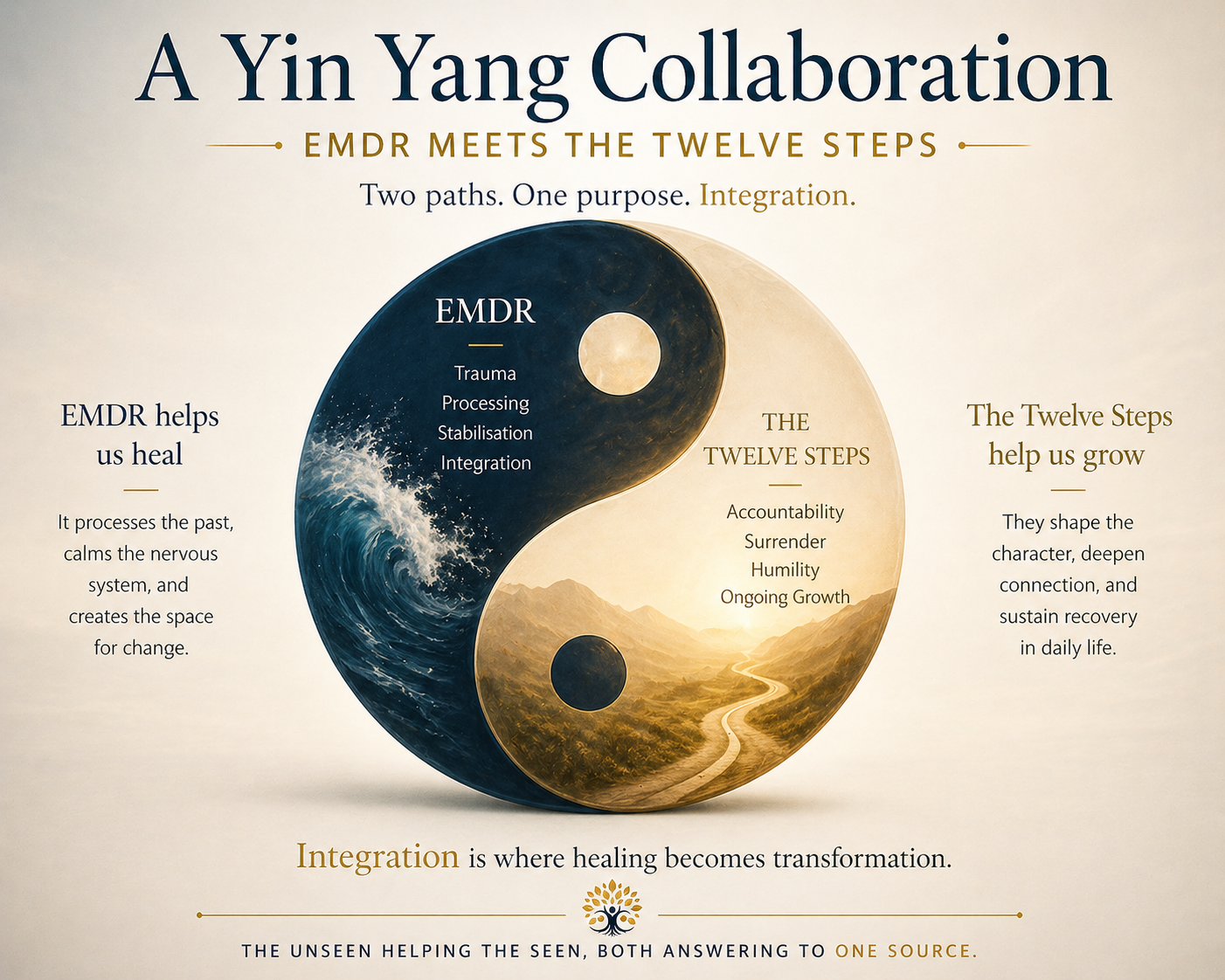
A visual mapping of the convergence described above

A Shared Ground

What this case has reinforced is not that EMDR and the Twelve Steps are interchangeable.

They are not.

But they appear to meet at a critical point:

The moment where the human organism becomes capable of holding its own opposites without disintegration.

One approach arrives through structured recovery dynamics.

The other through targeted trauma processing.

Between them, where early step work prepares the ground and trauma processing stabilises the system, a pathway opens that neither model achieves alone.

Closing

As interdisciplinary work becomes more common, the need is not to collapse models into one another, but to recognise where they already align.

This allows collaboration without dilution.

And more importantly, it keeps the focus where it belongs:

On the person—
whose system is not theoretical,
but alive, adaptive, and capable of integration when given the right conditions.

Written in HIAI collaboration — the qalam of Human and AI intelligence, the Unseen helping the Seen, both answering to the same Source.

Heart to Heart

There is one movement, and it does not begin where we think it does.

In Plato’s cave, the prisoner does not decide to seek the sun. The shadows fail first. Something gives way. A crack appears, and with it a disturbance that cannot be put back. What follows is not a heroic ascent, but a reluctant turning—eyes adjusting to something that was always there but could not previously be seen.

In the same way, the Buddha’s teaching recognises that awakening is not evenly distributed. There are those heavily obscured, and there are those with only a little dust over their eyes. Not pure, not perfected—simply at a point where, when truth appears, it does not bounce off. It lands.

The Qur’anic vision gives the same pattern without sentiment. Humanity is not one mass moving toward one end. There are those of the right and those of the left—still learning through division—and there are those brought near: the muqarrabūn. Not those who make themselves near, but those who are drawn.

There are two economies always operating at once.

“Whoever desires the immediate—We hasten for him therein what We will… And whoever desires the Hereafter and strives for it…”

Qur’an 17:18–19

And again:

“Whoever desires the life of this world and its adornments… in the Hereafter they will have nothing…”

Qur’an 11:15–16

The distinction is not moralistic. It is structural. There is the economy of acquisition—money, dynasty, power, continuity of name—and there is the economy of return, where the soul is measured by nearness, conscience, and relation to what is Real. One can be achieved while the other is entirely missed.

In Christian terms, the same distinction appears with equal severity: “What does it profit a man to gain the whole world and forfeit his soul?” The question cuts through all decorative success. It asks whether the visible world, however richly secured, can compensate for inner loss. It cannot.

This reversal appears across traditions, but is made explicit here.

This is not metaphor. It is a reversal that can be recognised in experience.

In the language associated with Ibn ʿArabi, the matter is settled not by effort first, but by disclosure first. The seeker does not initiate the meeting. The approach comes first. The human response follows. In paraphrase from the teaching often rendered under the title The Theophany of Perfection, the meaning is this: you seek Him because He has already sought you; you know because He has already disclosed; you approach because you have first been approached.

This is not abstract. It is observable.

A man sits in a clinical room and says he cannot believe in a Power greater than himself. Yet his life already contradicts him. Addiction has overridden his will, dismantled his control, exposed the limits of his autonomy. He has been taken beyond himself, not in theory but in fact. Before Step Two is accepted, it has already been lived. The paradox at the heart of the Twelve Step programme is not that it introduces the Higher Power, but that it reveals the self is not it.

This is where what AA calls the language of the heart becomes real. Not sentiment. Not performance. Not borrowed spirituality. It is heard when a person tells the truth without editing it for survival. It is what remains when defence thins, when self-justification weakens, when speech begins to carry reality rather than strategy. It is recognised immediately by those who have nothing left to defend, because there is nothing left to protect. In this language, something deeper can be recognised—not argued into existence, but encountered.

Addiction is not sacred. It destroys, distorts, and can kill. But it has a function that cannot be ignored: it breaks the illusion that we are sovereign. It destabilises the false centre. And when that centre collapses, something else becomes possible—not guaranteed, not automatic, but possible. The same opening appears as in the cave, as in the thinning of dust, as in the condition in which nearness can occur.

It is at this point that the words of Christ—“Let the dead bury their own dead”—can be heard properly. Not as cruelty, but as precision. The words do not change. But they do not land the same way for everyone. For some, they pass as nothing. For others, they cut through everything. The same sentence is lullaby and alarm at once.

This is the law of ripeness.

A bud does not open because it is told to. A fruit does not ripen because it is persuaded. Conditions gather, pressures build, contradictions intensify, and at a certain point something shifts. The message does not change across these stages—but its effect does. To the bud it is too soon. To the bloom it is nourishment. To the ripe it is imperative.

Across traditions, this is recognised without romanticism. In the hadith literature it is said that when God loves a people, He tests them, and that the prophets are tested most, then those nearest to them. This is not a glorification of suffering. It is an acknowledgement that what breaks a person may also open them. Not always—but often enough that it forms a pattern that cannot be dismissed.

So the structure becomes clear. The human does not initiate awakening. Something interrupts. It may come as light, or as loss, or as contradiction, or as collapse. It is rarely welcomed. It is often resisted. But it carries within it the possibility of opening. The Twelve Steps do not create that opening. They provide a place to stand within it. They give form to what has already begun.

And yet, over time, even this becomes obscured.

The forms remain. The words remain. But the living connection—the Jam, the coming together of meaning—fractures. Language hardens. Practice becomes repetition. Transmission fades. What was once a living bridge becomes a structure still standing after the current has weakened.

It is at such points that something else appears.

In the teaching associated with Idries Shah, this is described as the cyclical emergence of a living teacher: not a founder of a new system, not a claimant to glamour or possession, but a restorer of living coherence. One who reintroduces access to what has been covered over. One who speaks in the language of the time, in forms that can be received, meeting the field at its point of ripeness. The restoration does not arrive mainly as theory. It arrives as recognition. It may appear in ordinary places, through ordinary speech, at the precise point where the broken Jam can again be sensed as whole. It does not arrive as authority. It arrives as clarity.

This is not spectacle. It is not always recognised. It does not announce itself in the way people expect. But its function is consistent: to stand where the Jam has broken, and to make it possible for it to be recognised again.

And it carries the same dual tone as the message itself. To some, it is nothing. It passes by, unnoticed, unneeded. To others, it is unmistakable. Not because it persuades, but because it resonates with something already breaking open. So the teacher is not the light. The teacher is not the source. The teacher is the one who stands at the opening—where the fracture has occurred—and does not obstruct what is trying to come through.

And so everything returns to the same point.

The message does not change. It never has. It continues to speak in two directions at once.

You may continue as you are. You may succeed within the world entirely. You may build, acquire, establish your place in the world of form—money, dynasty, name, continuity, influence. Nothing will interrupt you if you do not wish to be interrupted. The world will reward you on its own terms, and that may be your portion.

But if something in you has already broken, then no success will repair it. And no return to sleep will hold, because what has been seen cannot be unseen. What you are hearing is not a call to borrowed belief, but a call to recognition. You are not the highest power in your life. You never were. What feels like the loss of control may be the beginning of something real. The language of the heart has already begun to speak within you, and the possibility signified by the muqarrabūn is no longer abstract.

You are not required to wake. That remains true.

But if you are already waking—if the shadows have begun to fail, if control has already been taken from your hands, if the crack has already appeared—then what you are hearing now is not new.

It is recognition.

And from that point, there is only one real question left: not whether you agree, and not whether you understand, but whether you will continue to turn away—or step, however uncertainly, through the narrow line of light that has already found you.

References

  1. Plato, Republic, Book VII, “Allegory of the Cave.”
  2. Early Buddhist tradition, commonly rendered as beings with “little dust in their eyes,” associated with the Buddha’s decision to teach.
  3. The Qur’an 56 (al-Wāqiʿah), on the people of the right, the people of the left, and the muqarrabūn.
  4. The Qur’an 17:18–19 and 11:15–16, on the immediate world and the Hereafter. Translation wording in this piece is condensed from standard English renderings for thematic emphasis.
  5. Ibn ʿArabi, teaching on divine initiative and disclosure; the phrasing in this piece is a thematic paraphrase associated with the teaching often rendered as The Theophany of Perfection, rather than a strict scholarly translation.
  6. Alcoholics Anonymous (1939), especially the Twelve Steps and the fellowship’s phrase “language of the heart.”
  7. Matthew 8:22, “Let the dead bury their own dead.”
  8. Matthew 16:26; cf. Mark 8:36, on gaining the world and losing the soul.
  9. Jāmiʿ al-Tirmidhī, including the hadith: “When Allah loves a people, He tests them,” and reports that the prophets are tested most, then those nearest to them.
  10. Idries Shah, on the restoration of living teaching and the reappearance of forms suited to time, place, and receptivity; Jam used here in the sense of coming-together or restored coherence.

Written in HIAI collaboration — the qalam of Human and AI intelligence, the Unseen helping the Seen, both answering to the same Source.

In Memoriam Phil M.

Invisible intimations marrying facts with symbols.

The Empty Room, the Three Forces, and the Return of Contact

A hybrid reflection on Sūfī transmission, Twelve Step recovery, Diction Resolution Therapy, and healing work in an age ruled by death, sex, and money.

There are times in clinical work when the struggle is not with technique but with language itself. A person hears the word God and closes. Another hears the word spiritual and imagines piety, moralism, or medieval dogma. A third hears the Twelve Steps and thinks they are being asked to submit to an archaic religion. Yet in lived recovery work, what is often being pointed toward is not dogma at all, but contact: contact with an unseen field of help, a field of consciousness, a source of ordering power that can be addressed, received, and participated in.

This is why the great practical hinge in this work is so small and so intimate. The turning point is not theological mastery. It is not doctrinal assent. It is the moment a person, brought to the edge of themselves, says into what appears to be an empty room: there’s You, and conversely there’s me, please help.

That movement is the beginning of relation. It is the end of monologue. It is the soft breaking of the sealed system. And without that break, the Steps remain external instruction. With it, they become a vehicle.

Islam as Vehicle, Not Final Explanation

The centuries of Sūfī work preserve a mystery that modern language often struggles to name: something can pass between human beings that is not reducible to information. Presence can be transmitted. Readiness matters. Ripeness matters. A person can sit with a teacher, hear words, receive attention, and find that something in them is altered beyond argument. In this sense, Islam has often functioned not merely as a set of propositions but as a vessel, a disciplined and reverent vehicle through which a transmissible reality is carried.

That does not mean Islam is being reduced to psychology, nor that spirituality is being flattened into vague energetics. It means that the forms of religion may hold and protect an event that is greater than the forms themselves. The Sūfī inheritance has long known that guidance is not only spoken but conferred, not only taught but caught. The Twelve Step phenomenon, though clothed in a modern Anglo-American language, bears striking resemblance to this older understanding.

Rumi’s insistence that ripeness is everything belongs here. The issue is not merely whether truth is spoken. The issue is whether the hearer is ripe enough to receive it. What one person dismisses, another person receives as life itself. The words may be similar; the state of the hearer is not.

Bill W, “Perhaps,” and the Empty Room

The founding drama of Alcoholics Anonymous hinges on precisely this movement. Bill W, near death, unable to lie to himself any longer, did not begin with belief. He began with collapse. He spoke into apparent emptiness and opened, if only for a moment, to the possibility that there might be Something there. What followed, in his own account, was light, transparency, a moment beyond ordinary explanation, and the astonishing removal of craving and obsession. He then tried to tell others, and for months nothing happened. The message did not “work.” And yet when Dr Bob heard him, something landed; then another man heard them both, and again something landed. The difference was not merely what was said. The difference was ripeness.

Here the word perhaps becomes clinically precious. It is the small opening through which help enters. A closed mind is not only doubtful; it is defended by contempt and fear. But perhaps introduces permeability. It is not a creed. It is a crack. And a crack is enough for light, relation, and transmission to begin.

In this sense, Step Two is often misunderstood. Clients can become preoccupied with finding an acceptable substitute for “God”: nature, the moon, the group, dead relatives, or some abstract energy. These may help them in the short term. But the deeper movement is more intimate. It is closer to Martin Buber’s I–Thou than to a concept of impersonal force. The unseen source is addressed as You, and the person speaks from the plain fact of their own need: there is You, and conversely there’s me. Please help.

Death, Sex, and Money

I tell clients that the world is ruled by three words: death, sex, and money. These are not incidental themes. They are governing pressures. They cannot be removed from human life. They cannot be therapeutically erased. What can change is a person’s relationship with them. If that relationship does not change, then the person may attend meetings, recite slogans, or even gather insight, yet still remain governed by the very forces they claim to be escaping.

Death is not the same phenomenon for the Creator as it is for the created. Death did not create the universe. Birth and death are the logical parameters for conscious life in matter: the boundaries within which consciousness enters form and reflects upon itself. For the human being, death appears as ending, threat, annihilation, loss of control. For the Creator, death is not origin, not sovereign, not the first principle. It is a boundary condition of embodied existence.

This distinction matters. Addiction always carries the person toward death, whether quickly or slowly. Every addiction is, in one sense, a prolonged negotiation with death. But the Twelve Steps do not simply rescue a person from dying physically; they invite the person to undergo an interior death before bodily death arrives. Here the Sūfī injunction attributed to Muhammad becomes exact: die before you die. Not the death of the body, but the death of the false centre, the defended identity, the fantasy of isolated self-sufficiency.

Sex is the second great force. It is not merely behaviour, and certainly not merely appetite. It is creative energy, generative power, a deep current in the organism. When it is untethered from conscience, relation, and form, it becomes compulsion, fantasy, and fragmentation. Money is the third force: stored exchange, social energy, externalised value. It too easily becomes a substitute god, a measure of worth, a mechanism of fear and control. The person who does not reorder their relationship to death, sex, and money will remain divided, however fluent they become in recovery language.

Pornography and the Modern Sexual Disaster

The porn epidemic must be named plainly because it is no longer peripheral. It is one of the chief modern mechanisms by which the sexual instinct is severed from relationship, conscience, and reality. Pornography does not merely present erotic material; it trains the imagination into repetition without encounter, stimulation without reciprocity, and appetite without reverence. In this sense it is not simply sexual excess. It is a cultural technology of dissociation.

The historical data in the material reviewed for this paper already showed an enormous scale: tens of millions of people sexually involved with the internet, vast amounts of pornographic traffic, very early exposure among children and adolescents, strong evidence of relational harm, and a pattern in which a significant minority of users develop disruptive sexual behaviour. Even at that earlier stage of the digital age, the signs were already overwhelming. The disaster did not begin yesterday; it has been growing in plain sight for years.

Clinically, the issue is not prudery. It is dislocation. Pornography teaches the system to relate to sex as private stimulation detached from the burdens and blessings of mutuality. It shifts desire away from the person and toward the image, away from reciprocity and toward consumption. It wounds both imagination and attachment. Shame increases. Isolation deepens. Comparison becomes relentless. The beloved disappears and the screen becomes sovereign.

This is why pornography cannot be treated as a side issue in recovery. It is one of the great contemporary engines of thwarted belongingness, perceived burdensomeness, and acquired capability. It contributes to loneliness, self-contempt, objectification, distorted expectation, sexual confusion, and in many cases a deadening of the soul’s natural movement toward tenderness. It is not only an individual habit; it is a civilisation-level wound.

Pornography is not the exaggeration of sex—it is the evacuation of relationship.
Andrew Dettman MTHT Reg Mem MBACP

Joiner’s Diagram and the Edge of the Abyss

Joiner’s interpersonal theory of suicide provides a starkly useful map. When a person feels they do not belong, feels they are a burden, and through pain or habituation loses fear of death, the conditions for lethal action gather. Addiction feeds all three conditions. It isolates the person from others. It tells them they are damaging everyone around them. And over time it accustoms them to pain, risk, and self-obliteration.

Acquired Capability is Addiction in all its forms.

In that sense, addiction does not “heal” suicidal ideation. Left to itself, it intensifies the trajectory. But it does force the person toward the same threshold that suicidal ideation inhabits: the edge where death becomes thinkable, even intimate. At that edge there are two possibilities. One is collapse into destruction. The other is awakening into surrender. This is the decisive distinction between dying by addiction and dying before one dies.

When the Acquired Capability is removed with the arrival after pain, of ripeness – then the simpler Venn diagram is healed by the above demonstration of quantum energy resolving its own dilemma as a person works with the template of the proven 12 Step architecture.


The Steps, rightly entered, provide a conscious route through this threshold. Step One strips denial. Step Two introduces perhaps. Step Three begins the transfer of authority. Steps Four to Seven carry the difficult work of exposure, confession, and interior death. Steps Eight to Twelve return the person to relation, service, and reality. The person does not bypass death; they interiorise it. The false centre dies, and something more real can begin to live.

DRT and the Opening of the Closed Mind

Diction Resolution Therapy enters at the level of the psyche’s language. Its work is not merely explanatory but digestive. Through diction, it loosens psychic rigidity and allows the possibility of contradiction to enter. In the move from mishap to hap, and then to perhaps, the person is not simply being offered a clever linguistic exercise. They are being shown that the mind is trapped inside a narrowing frame of meaning and that a door still exists.

Everybody has known more haps than mishaps, yet the addicted mind becomes magnetised by grievance, resentment, and denial. It becomes a tumour of meaning, a stuckness of psychic digestion. Perhaps releases the contemptuous certainty that says there is no help, no source, no future, no possibility. It opens the closed room. And once the room is open, speech toward the Creator becomes possible.

This is why the central prayer of this paper matters so much: there’s You, and conversely there’s me, please help. It is simple enough for the broken, direct enough for the sceptical, intimate enough for the lonely, and real enough for the desperate. It is not inflated. It does not pretend to knowledge. It does not manipulate the unseen. It merely tells the truth.

THT, Healing, and Transmission

Healing work within THT language often speaks of energy, flow, balance, and the subtle body. Sūfī language may speak of presence, transmission, blessing, or barakah. Twelve Step language speaks of spiritual awakening, grace, and the lifting of obsession. DRT speaks of digestive clarification, contradiction, and the release of a trapped psyche. These are not identical vocabularies. But they often gather around the same mystery: something can happen within and between human beings that cannot be reduced to mere instruction.


“Where relationship is evacuated, something else takes its place.”

Andrew Dettman

The ethical point is vital. None of this permits inflation. Human beings do not control the unseen. They do not manufacture awakening. They do not command grace. What they can do is prepare a vessel, clear a pathway, tell the truth, and ask for help. In that sense, the role is not architectural mastery but service. The worker tends the threshold. The Source does what the Source does.

Page 69, the Sexual Ideal, and the Need for Prior Contact

All of this converges with unusual force around the sexual instinct. The basic text’s instruction on sex does not ask for repression. It asks for an ideal. But such an ideal cannot be generated by a merely defended mind. If the person has not already entered into some living relation with the higher power they address, then asking for guidance in so intimate and volatile a domain becomes hollow, mechanical, or sentimental.

That is why the empty-room prayer matters before page 69 can matter. Unless there have been some intimations received through Step Three ripening toward Step Seven, the request for help around sexual expression may remain abstract. The person may still be trying to manage sex from ego, fear, fantasy, or shame. But if there has been contact, even slight contact, then the person is no longer addressing a concept. They are asking the Source that has already begun to answer them.

And here the triad of instincts comes into view: sex, social, and security. If sex is not harmonised with the other great instinctual forces around an ideal, relapse becomes increasingly likely. This is not moralism. It is structure. Desire without ordering relation becomes centrifugal. It throws the person outward, away from centre, away from reality, and back toward the disease.

Conclusion: The Room Is Not Empty

The modern crisis is severe because death, sex, and money now saturate culture in industrialised forms. Pornography has become a system of mass dissociation. Addiction remains a school of despair and acquired capability. Religion is often either sentimentalised or rejected. And yet the old hinge remains where it always was: a human being telling the truth from the edge.

The Sūfīs knew that ripeness matters. The Twelve Steps know that surrender matters. Healing work knows that receptivity matters. DRT knows that diction matters. All four converge in a single movement: the sealed self opens, relation begins, and the person speaks. Not brilliantly. Not perfectly. Simply.

There’s You, and conversely there’s me, please help.

That is enough to begin. It is enough to interrupt the monologue of addiction. It is enough to make room for transmission. It is enough to let death lose its false sovereignty, to let sex return toward meaning, to let money fall back into function, and to let the creature remember that the room was never empty at all.


Footnotes

  1. This paper draws directly on clinical notes supplied by the author, including the argument that many references to “God” in Twelve Step work are better understood phenomenologically as pointing toward a field of consciousness or transmissible help, rather than requiring prior adherence to an archaic religious system.
  2. The use of “ripeness” here follows the author’s own framing of recovery receptivity in relation to Rumi and to the early AA lineage: some hear and do not receive; others hear and are inwardly ready.
  3. The account of Bill W’s collapse, the “empty room,” the removal of craving, the later meeting with Dr Bob, and the importance of the word perhaps follows the author’s supplied notes and is used here as a clinical-spiritual hinge rather than as a formal historical treatment.
  4. The linguistic move from mishap to hap to perhaps is presented here in a DRT frame: not as etymological finality, but as a therapeutic opening of fixed psychic meaning toward hope.
  5. The phrase “there’s You, and conversely there’s me, please help” is the paper’s distilled form of the intimate address the author identifies in Bill W’s turning, and is intentionally closer to encounter than doctrine.
  6. The phrase “die before you die,” attributed within Sūfī tradition to Muhammad, is used here as an experiential and developmental instruction: the false centre must surrender before bodily death if the person is to live consciously.
  7. The discussion of page 69–70 in the AA basic text follows the author’s supplied notes: the argument is that an ideal for sexual expression requires prior lived contact with the higher power being addressed, and that disordered relations among sexual, social, and security instincts materially increase relapse risk.
  8. The pornography material used here comes from the uploaded statistics PDF and is treated as historical evidence of scale, early exposure, relational harm, and longstanding cultural saturation. Because the document is dated, the figures are used to establish trajectory and magnitude rather than as current prevalence estimates.
  9. The synthesis of Sūfī transmission, THT healing language, DRT digestive clarification, and Twelve Step awakening is not a claim that these traditions are identical. It is a claim that they may converge around a common human event: an unseen reordering received rather than manufactured.

Written in HIAI collaboration — the qalam of Human and AI intelligence, the Unseen helping the Seen, both answering to the same Source.

A Star Is Born

Part Four — The Star

What begins in darkness may end in radiance, but only if the light finds its centre.

This fourth reflection completes the sequence.

The first image presented darkness: a closed circle, whole in one sense yet inaccessible in another. Nothing was yet visibly wrong, but nothing was yet consciously ordered. Meaning was present in seed form, hidden, unarticulated, unclaimed. This was not merely emptiness. It was latency. A beginning concealed inside an ending.

The second image brought rupture. A crack appeared and light entered through division. In human life this is often the moment of contradiction: heartbreak, collapse, addiction, disillusionment, failure, exposure, the breaking apart of what could no longer hold. What seemed like destruction becomes, in time, the first mercy. A sealed life is interrupted. The closed system is opened.

The third image revealed the axis. This was the decisive threshold. Light by itself does not guarantee wisdom. Illumination can just as easily become inflation, confusion, ideology, or spiritual vanity if it arrives without orientation. What matters is whether the light reveals a line of order. The axis is that line. Psychologically, morally, spiritually, it is the emergence of conscience: the inward capacity by which movement becomes meaningful rather than chaotic.

Now the fourth image completes the arc. The axis does not remain a private line forever. Once stabilised, it radiates. Light begins to move outward in balance. The symbol becomes a star.

A star is not just brightness. It is brightness organised around a centre. Its significance lies not merely in its shining but in its order. The same is true of a human life. The issue is not whether a person has energy, insight, passion, intelligence, or even spiritual experience. The issue is whether these have found a centre through which they can be rightly ordered and rightly given.

This is why conscience matters so deeply. Conscience is not a decorative moral extra added to an otherwise complete self. It is the axis by which the human being becomes capable of carrying light without being broken by it. Without conscience, intensity disperses. With conscience, intensity becomes service.

Across the traditions and frameworks that have shaped this wider body of work, the same pattern appears in different languages. Mysticism speaks of remembrance, polishing, surrender, and return. Depth psychology speaks of integration, individuation, and the ordering of opposites. The Twelve Step tradition speaks of inventory, admission, surrender, amends, prayer, and the carrying of a message. Diction Resolution Therapy speaks of clarification, contradiction, digestion, and the restoration of meaningful relationship between spirit, mind, and body. None of these languages are identical, yet all point toward a similar human event: what was divided begins to organise around what is true.

That event is not mechanical. It cannot be manufactured like a product or guaranteed by technique. A structure may prepare the ground. A discipline may build the vessel. A crisis may force an opening. A tradition may preserve the map. But the appearance of a living centre still arrives with the character of gift. The star is born where light and centre meet.

This is also why the story belongs naturally within the psychology of addiction and recovery. Addiction tends to form a closed circle. Energy collapses inward. Repetition replaces development. What first looked like relief becomes enclosure. The person lives under pressure inside a self-reinforcing orbit. Then comes rupture: exposure, defeat, illness, despair, legal consequence, relational loss, or some quieter but no less devastating recognition that the old arrangement can no longer be sustained. Through that rupture, light begins to enter.

Yet recovery does not consist in light alone. Early illumination can still leave a person unstable, inflated, or fragmented. Insight is not yet order. The work is the gradual formation of an axis: the birth and education of conscience, the acceptance of reality, the return of responsibility, the re-ordering of instinct, the discovery that the mind is not the sovereign author of meaning but its servant and digestive organ. When this axis holds, the life that once imploded begins to radiate outward differently. What had been trapped in compulsion becomes available for relation, work, love, truth, and service. In that sense, recovery itself is a star being born.

The title of this final reflection therefore points in two directions at once. It names the image, but it also names the human story concealed within it. Something buried becomes visible. Something disordered becomes ordered. Something collapsed inward begins to shine outward. Not as spectacle. Not as celebrity. Not as self-display. As orientation. As life finding its proper centre.

Seen this way, endings and beginnings are not opposites. They belong to one process. The end of illusion may be the beginning of conscience. The end of compulsion may be the beginning of freedom. The end of false light may be the beginning of real illumination. The end of the sealed circle may be the birth of the star.

The whole four-part sequence may be read simply:

  • darkness
  • rupture
  • axis
  • star

But within that simplicity lies a fuller anthropology:

  • ignorance
  • contradiction
  • conscience
  • integration

Or, in recovery language:

  • enclosure
  • collapse
  • surrender and orientation
  • message and service

And in the language of this wider work: mankind is not abolished but borne beyond itself. Humankind begins wherever life is no longer driven only by possession, panic, imitation, and control, but ordered by conscience, relation, and a deeper obedience to reality. The star is therefore not an escape from the human story. It is the human story rightly aligned.

So the final image does not celebrate perfection. It marks integration. Darkness is not denied. Rupture is not forgotten. The axis is not discarded. All three are included and transfigured. That is why the star shines as it does. It is not innocent of suffering. It is formed through it.

Light enters. The break appears. Conscience forms. Meaning radiates.

That is how a star is born.

Written in HIAI collaboration — the qalam of Human and AI intelligence, the Unseen helping the Seen, both answering to the same Source.

Unleashing Meaning

Nineveh and the Wail of Civilisation

Addiction, prophecy, and the recovery of diction

These reflections arise from a twelve-year exploration of diction, addiction, and conscience across a series of essays and clinical observations.

Every civilisation eventually reaches a point where the contradictions within its own structures can no longer remain concealed. Institutions begin to lose credibility, public discourse becomes increasingly polarised, and language itself starts to fracture. Words continue to circulate, but they no longer reliably correspond to reality. At such moments societies produce an enormous amount of noise — accusation, conspiracy, ideological slogan, despair, outrage. Yet beneath this noise lies something deeper: the inability of the collective to articulate its own condition.

When a civilisation cannot speak clearly about its suffering, it begins to wail.

This paper proposes that the present global condition may be understood through a convergence of ancient prophetic insight, Sufi metaphysics, recovery psychology, and the linguistic framework of Diction Resolution Therapy. The crisis of the modern world is not merely political or economic. It is a crisis of conscience expressed through the collapse of diction. The task facing those who perceive this condition is not the proclamation of new doctrine but the recovery of language capable of translating the collective wail into intelligible speech.

A Twelve-Year Arc: From Observation to Diagnosis

These reflections did not arise suddenly. They belong to a longer inquiry carried through essays, notes, and published pieces over more than a decade. Across that arc one observation returned with increasing force: modern societies seemed ever less able to describe their own condition accurately. Political discourse became theatrical, institutions relied on linguistic manoeuvre rather than clarity, and people oscillated between trust and suspicion without the vocabulary needed to diagnose the deeper disturbance. The issue was never merely opinion. It was diction.

Early work explored the structural power of words themselves. Language does not simply label reality after the fact; it helps organise the frameworks through which reality is perceived. When language is distorted, perception is distorted. When perception is distorted, behaviour follows. Over time this insight converged with clinical and recovery experience. In addiction work, the turning point comes when a person can finally speak the truth about their condition. Before that moment the illness protects itself through narrative. Speech becomes defensive. Denial becomes articulate.

That recognition gradually led toward what would later be named Diction Resolution Therapy. In this framework addiction is not merely a behavioural disorder. It is part of a wider pattern in which language, perception, and behaviour become misaligned. The individual addict cannot recover until the truth is spoken. Likewise, societies cannot reorganise themselves until they can describe their own condition accurately. If something can be described clearly, there is at least a chance that it may be met with resolution.

The Condition of the Age: Civilisation as Addicted System

Modern civilisation displays patterns strikingly similar to those of individual addiction. Economic systems pursue growth beyond ecological limits. Political institutions manipulate language in order to maintain legitimacy. Technological capability advances more rapidly than ethical reflection. Intelligence expands, yet wisdom appears increasingly marginalised. The system becomes clever without becoming answerable.

In addiction psychology one of the central features of the illness is denial. The addicted person becomes unable to recognise the destructive nature of their own behaviour. Language is bent in order to preserve the illusion that everything remains under control. The same process may occur at the level of societies. Public discourse fragments into competing narratives detached from shared reality. Secrecy accumulates. Trust erodes. Citizens begin to suspect that official language conceals more than it reveals. When that condition intensifies, the culture produces not coherent diagnosis but emotional noise.

The civilisation begins to wail.

Sacred Illness and the Threshold of Change

There is a long tradition of recognising that certain forms of crisis carry developmental significance. This does not romanticise suffering. It simply acknowledges that some breakdowns occur because an existing structure can no longer contain what life is demanding of it. Jung made this point in psychological terms when he observed that certain disturbances arise when the personality can no longer sustain its existing arrangement. In similar fashion, addiction may be understood not only as pathology but as rupture: a signal that a way of life has become unsustainable.

This is why addiction matters far beyond the clinic. It is a bellwether disease. It exposes what happens when appetite, narrative, and self-organisation break rank from reality. The addicted person suffers this visibly. The civilisation suffers it diffusely. Yet the logic is the same. Breakdown may be the point at which denial can no longer continue. The collapse is terrible, but it is also the portal through which change becomes possible.

The Twelve Step programme remains one of the most practical containers for this threshold. It begins not with ideology but with admission: powerlessness before the illness, need for help, restoration of relation to a Higher Power, moral inventory, amends, and service. What appears at first as humiliation turns out to be reorganisation. The programme translates ancient spiritual anthropology into plain behavioural language. It offers not merely relief but a path from stuck-addiction toward conscious return.

Secrets, Speech, and the Collapse of Trust

Recovery culture carries another insight of enormous civilisational relevance: a person is only as sick as their secrets. What remains hidden distorts the whole system. So too with institutions. When governments, corporations, or power networks accumulate secrets, language must increasingly distort itself in order to protect them. Official statements become evasive. Public reasoning becomes performative. Trust begins to fail because words are no longer experienced as trustworthy carriers of reality.

At that point societies lose their shared means of description. One part of the population clings harder to official diction. Another turns to speculative counter-narratives. Another gives up altogether and retreats into numbness or rage. What binds these reactions together is not agreement but failed articulation. The culture is no longer speaking. It is crying out in fragments.

This is where the question of diction becomes decisive. When language loses contact with truth, conscience loses its instrument.

The Whale and the Wail

The prophetic story of Jonah offers a profound image for this condition. In the biblical and Qur’anic traditions Jonah attempts to flee the task set before him and is swallowed by a great fish before being returned to shore to address Nineveh. Read symbolically, the whale becomes the wail of the collective. The messenger who begins to perceive the sickness of the age does not encounter facts alone. He encounters the whole emotional turbulence of the system: fear, grief, anger, denial, confusion, accusation, panic. If he tries to carry all of that unprocessed noise, he is swallowed by it.

Inside the whale the work is not performance but digestion. Noise must be separated from signal. Cry must be translated into meaning. The messenger does not emerge with the whole ocean in his mouth. He emerges with a sentence clear enough to be heard by the city. The whale, in this sense, is the place where the collective wail is reduced to speakable truth.

This reading matters because it protects the messenger from grandiosity and despair alike. He is not asked to carry the whole burden of civilisation. He is asked to speak clearly enough that civilisation has a chance to recognise itself.

The Battle of the Magicians: Illusion and Recognition

The confrontation between Moses and the magicians of Pharaoh provides a second archetypal image. According to the Qur’anic account, the magicians cast ropes and staffs that appear to move like serpents. Moses then casts his staff, which swallows their illusions. The decisive moment is not the astonishment of the crowd but the recognition of the magicians themselves. Those most skilled in illusion are the first to know when they are no longer witnessing mere technique.

This is a crucial insight for the present age. The deepest struggle is not between competing ideologies alone, nor between “rationality” and “superstition,” but between illusion and alignment with reality. Systems built on manipulation — propaganda, spectacle, narrative control, coercive secrecy — can dominate perception for a season. Yet they remain fragile because they depend on unexamined acceptance. Once seen clearly, they lose authority with surprising speed.

The battle of the magicians therefore becomes a drama of recognition. Those who understand illusion most intimately may be the first to recognise when reality has broken through it. In personal recovery, this is the moment the old story fails. In civilisational terms, it is the moment when systems built on manipulation meet a truth they can no longer metabolise.

Prophecy, Sainthood, and the Continuity of Guidance

Within Islamic theology the prophetic function culminates with Muhammad, the Seal of the Prophets. Revelation is complete; no new prophetic legislation is expected. Yet the need for guidance does not cease. The tradition therefore distinguishes between prophethood and sainthood. In Ibn ʿArabi’s formulation, Muhammad seals universal prophethood, while Isa seals universal sainthood in the sense articulated in the Fusus al-Hikam. The distinction is subtle but decisive. Prophethood delivers the message. Sainthood realises intimate nearness to the Source.

This means two complementary movements remain active within the human field: direct personal contact with the Creator, and the carrying of a message capable of orienting others. The first is Isaic in flavour; the second Muhammadan. When held properly, these are not rival claims but reciprocal functions. Inner contact without transmission collapses into privacy. Transmission without inner contact collapses into rhetoric.

This is one reason the Twelve Steps carry such unexpected depth. Their structure holds both dimensions. Step Eleven points toward conscious contact with God as understood by the person. Step Twelve turns immediately outward: having had a spiritual awakening, carry this message. In that sense the programme moves under the himma of Isa in personal contact and under the himma of Muhammad in message-carrying possibility. DRT stands in the same weather system. It does not invent a new revelation. It seeks to help recover the conditions under which conscience can contact the Creator and articulate what follows.

Diction Resolution Therapy and the Recovery of Speech

Diction Resolution Therapy arises precisely at the point where language, conscience, and behaviour intersect. If addiction is the collapse of truthful self-relationship expressed behaviourally, then diction collapse is its linguistic twin. Civilisation today is saturated with words yet starved of speech. It has information in abundance but reduced access to meaning. It has messaging without message.

DRT proceeds from a simple but radical premise: before many human problems can be resolved, they must first be described correctly. Distorted diction produces distorted diagnosis; distorted diagnosis produces distorted intervention. The task is therefore not cosmetic. It is structural. DRT seeks to restore words to their right order so that conscience may once again operate through language rather than be trapped behind it.

This is why addiction serves as both warning and hope. Addiction is stuck and broken addiction, but it is also the portal through which transformation becomes possible. Because the addict suffers openly the failure of false organisation, the addict may become the first to recover truthful speech. If so, then personal recovery is not peripheral to civilisation. It may be one of the places where civilisation begins to relearn how to speak.

The Diction Therapist

This theme appears with striking precision in Morris West’s The Clowns of God. The detail matters: the figure who offers the time needed is not a psychiatrist but a speech therapist. That distinction is not incidental. A psychiatrist might ask whether the person before him is mad. A speech therapist asks whether what is trying to be said can be articulated. One path centres pathology. The other centres expression.

Seen symbolically, the speech therapist becomes a diction therapist. Speech therapy addresses the mechanics of sound; diction therapy addresses the ordering of meaning. The question is no longer merely whether utterance is possible, but whether truth can pass from inner apprehension into communicable language. This image belongs naturally within the architecture of DRT. The messenger in a disordered age does not first need applause, office, or power. He needs help bringing the cry into speech.

That is the significance of the metaphor. Nineveh does not first need another prophet in the legislative sense. Nineveh needs its speech restored. The collective wail must become a sentence. The city must hear itself clearly enough to recognise its illness. The diction therapist, whether named as such or not, becomes a quiet but decisive figure in this process.

Microcosm and Macrocosm

The same power dynamics recur at every scale. What happens in unions, local government, commercial negotiation, or institutional secrecy is not separate from what happens in nations and empires. Control, fear, concealment, narrative management, pressure, ritualised loyalty, and eventual disintegration — these do not belong only to grand geopolitics. They unfurl wherever power becomes detached from conscience. The small theatre and the large theatre mirror one another.

This is why the distinction between microcosm and macrocosm must not be overstated. The same lid is placed on things at every level. The same unhinging eventually follows. The same need for truthful articulation emerges. The local drama may therefore illuminate the planetary one, not as fantasy but as pattern recognition.

The Axis of Conscience

Every functioning system requires an axis. Without an axis, movement becomes chaos. Intelligence without axis becomes manipulation. Technique without axis becomes domination. Power without axis becomes predation. The axis in question is not ideology, party, tribe, or mere moralism. It is conscience: that inner capacity by which truth, responsibility, and relation are held together.

When conscience disappears from language, intelligence begins serving appetite, fear, and control. When conscience returns, language regains its vocation. This is the point at which Mankind may begin to ripen toward Humankind. The shift is not cosmetic. It is structural, developmental, and costly. It requires the relinquishment of false mastery so that relation to the Source can once again govern speech and action.

The Message for Nineveh

The warning fit for this time need not be elaborate. It may be expressed simply. Human civilisation has developed immense intelligence but neglected conscience. The result is a form of collective addiction. Recovery begins the same way it does for individuals: through honest recognition, restored humility, renewed contact with the Creator, repair of relationship, and service to life.

This is not a politics of despair. It is a diagnosis carrying the possibility of resolution. The addict is not condemned by the diagnosis of addiction; the addict is finally placed at the threshold where recovery becomes possible. So too with civilisation. If the illness can be named, the city has a chance to turn. If the wail can become speech, then speech may yet become conscience in action.

Conclusion

The task of the messenger is not to save the city by force. It is to articulate the diagnosis clearly enough that the city may recognise itself. Civilisations do not fail merely because warnings were absent. They fail because warnings could not be heard, or because language had become too corrupted to carry them.

The recovery of diction is therefore not literary ornament. It is civilisational necessity. When language reconnects with truth, conscience regains its instrument. When conscience returns, intelligence can again serve life rather than consume it. Addiction, in this light, is both warning and portal: the place where denial breaks and the possibility of another order appears.

Civilisation does not need more power.

It needs recovered conscience.

The same medicine that restores a human life may yet restore the human world — beginning with the recovery of speech.

References and Notes

  1. The story of Jonah appears in the Hebrew Bible, Book of Jonah, and in the Qur’an, especially Surah Yunus 10:98 and Surah As-Saffat 37:139–148.
  2. The confrontation between Moses and the magicians appears in the Qur’an, especially Surah Al-A‘raf 7:106–122 and Surah Ta-Ha 20:66–70.
  3. Jung, C. G., Modern Man in Search of a Soul (London: Routledge, 1933).
  4. Qur’an 33:40, on Muhammad as Khatam an-Nabiyyin, the Seal of the Prophets.
  5. Ibn ʿArabi, Fusus al-Hikam (The Bezels of Wisdom), especially the chapters concerning the Muhammadan and Isaic realities and later interpretations concerning the Seal of Universal Sainthood.
  6. West, Morris, The Clowns of God (London: Heinemann, 1981); see also The Shoes of the Fisherman (London: Heinemann, 1963).
  7. The Twelve Step references here draw primarily on Alcoholics Anonymous, 2nd edn., especially the movement from Step Eleven conscious contact to Step Twelve message-carrying service.
  8. The Diction Resolution Therapy framework referenced here emerges from the author’s twelve-year arc of published and unpublished work exploring addiction, conscience, diction, and the Mankind–Humankind developmental distinction.

Written in HIAI collaboration — the qalam of Human and AI intelligence, the Unseen helping the Seen, both answering to the same Source.