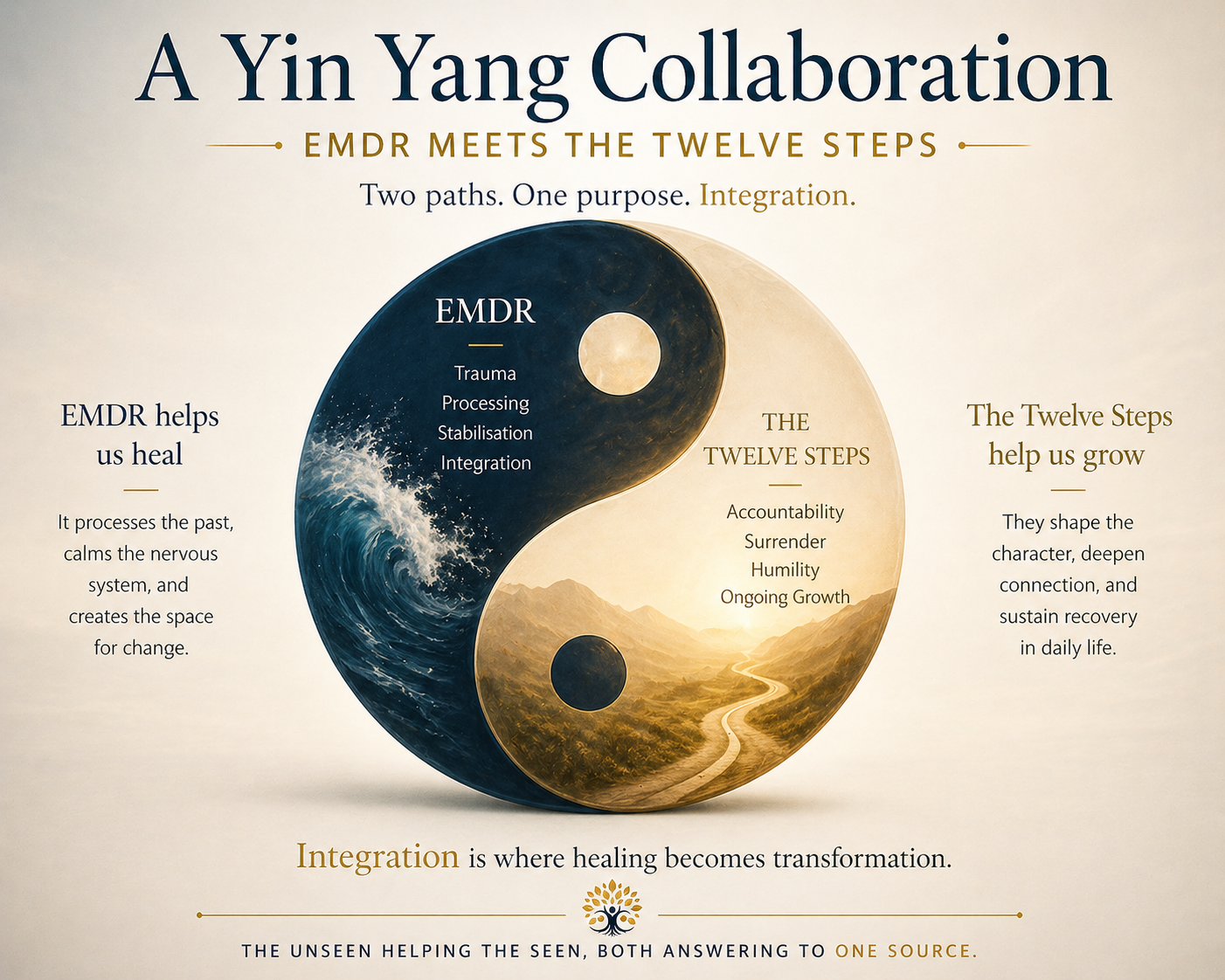
A Yin Yang Collaboration

When Opposites Integrate: A Clinical Meeting Point Between EMDR and the Twelve Steps

Opening

A recent piece of collaborative work with an external EMDR practitioner has sharpened something that has been present in my clinical practice for many years, but not fully named in shared language.

Working within a Twelve Step residential setting, and currently engaged in Continuing Professional Development in EMDR, I found myself in a position that is increasingly common in modern care: two different therapeutic lineages meeting around the same human being.

What emerged was not conflict—but convergence.

Not because the models are the same.
But because the organism is.

The Clinical Observation

The client in question had reached a point in their recovery process that, within Twelve Step language, would be described as the Step 4–7 arc:

  • exposure
  • disclosure
  • readiness
  • surrender

At the same time, through EMDR-informed work, they entered what can only be described as a deep neurological processing phase—a descent beneath narrative into competing internal states that had previously been held apart.

What became apparent was this:

The therapeutic movement was not toward resolution of one side of the conflict.

It was toward the capacity to hold both sides simultaneously without fragmentation.

The Stuck Point: Before the Dive

Before this movement became possible, the client encountered a period of pronounced stuckness between Steps 1–3 and Step 4.

This is a clinically recognisable threshold:

  • catastrophic thinking remains inflated
  • responsibility is either denied or overwhelming
  • the system cannot stabilise enough to turn inward

In trauma terms, the nervous system remains threat-dominant. The difficulty is not resistance, but insufficient regulatory capacity to safely engage with the introspective demands of Step 4.

Steps 1–3: Reorganising Perception

Steps 1–3, while often understood in spiritual or existential terms, also perform a precise regulatory function.

They begin to “right-size” catastrophic perception:

  • Step 1 interrupts false control narratives and inflated responsibility
  • Step 2 introduces the possibility of change beyond current cognition
  • Step 3 redistributes agency, reducing the burden of self-management

This carries a functional parallel to cognitive restructuring, but extends further.

Rather than simply changing thoughts, these steps begin to down-regulate the system by redistributing perceived responsibility.

Where they cannot fully land, the system remains under threat.

EMDR as Scaffolding for Engagement

In this case, EMDR was applied precisely at this point of impasse.

The client did not lack understanding of Steps 1–3. What was missing was the physiological capacity to embody them.

EMDR functioned here not as an alternative pathway, but as scaffolding:

  • stabilising the nervous system
  • reducing baseline activation
  • supporting dual awareness of distress and safety

This allowed catastrophic perception to reduce to a tolerable scale.

What had previously felt annihilating became, for the first time, experienceable.

In this sense, EMDR enabled the early step work to become operational rather than conceptual.

The Split and the Dive

In trauma physiology, the system organises around polarity:

  • activation and collapse
  • control and helplessness
  • anger and grief

In addiction, these same polarities are managed through oscillation or avoidance.

In EMDR and DBR, the work allows these opposites to re-emerge—not as story, but as simultaneous activation within the nervous system.

This is often experienced as destabilising.
Because it is the first time the organism is asked to not choose a side.

Step Work as Container

What becomes evident at this stage is that the Twelve Step process—particularly Steps 4, 5, and 6—functions as a structural container for this co-activation.

  • Step 4: brings the material into view
  • Step 5: relationally stabilises it
  • Step 6: removes the illusion of control over it

By the time a person approaches Step 7, something essential has shifted:

They are no longer trying to resolve the polarity.

They are no longer able to maintain it.

Step Seven and Neurological Integration

In Twelve Step language, Step Seven is framed as humility:

“Humbly asked Him to remove our shortcomings.”

In practice, what is often observed is not an act of will, but a cessation of interference.

Through the lens of trauma processing, this aligns closely with a moment of neural integration:

  • previously segregated networks begin to synchronise
  • defensive prediction reduces
  • opposing states are no longer mutually exclusive

The system no longer needs to defend against itself.

This is not balance as compromise.

It is co-presence without fragmentation.

Neutrality and the End of Internal War

A useful phrase from Joseph Campbell speaks of “neutral angels”—a state in which opposing forces no longer demand allegiance.

Clinically, this is recognisable:

  • anger can arise without escalation
  • vulnerability can be felt without collapse
  • contradiction can be tolerated without action

This is the end of internal war—not because one side has won, but because the war itself is no longer required.

Step Eleven: Regulation as Continuity

If Step Seven marks integration, Step Eleven appears to function as its maintenance.

Practices of reflection, prayer, or meditation—however they are personally framed—support the ongoing regulation of the system.

In neurophysiological terms, this reflects:

  • sustained flexibility between activation and rest
  • reduced reactivity under stress
  • reinforcement of integrated neural pathways

The work does not end at insight.

It stabilises through repetition.

A visual mapping of the convergence described above

A Shared Ground

What this case has reinforced is not that EMDR and the Twelve Steps are interchangeable.

They are not.

But they appear to meet at a critical point:

The moment where the human organism becomes capable of holding its own opposites without disintegration.

One approach arrives through structured recovery dynamics.

The other through targeted trauma processing.

Between them, where early step work prepares the ground and trauma processing stabilises the system, a pathway opens that neither model achieves alone.

Closing

As interdisciplinary work becomes more common, the need is not to collapse models into one another, but to recognise where they already align.

This allows collaboration without dilution.

And more importantly, it keeps the focus where it belongs:

On the person—
whose system is not theoretical,
but alive, adaptive, and capable of integration when given the right conditions.

Written in HIAI collaboration — the qalam of Human and AI intelligence, the Unseen helping the Seen, both answering to the same Source.
A Star Is Born

Part Four — The Star

What begins in darkness may end in radiance, but only if the light finds its centre.

This fourth reflection completes the sequence.

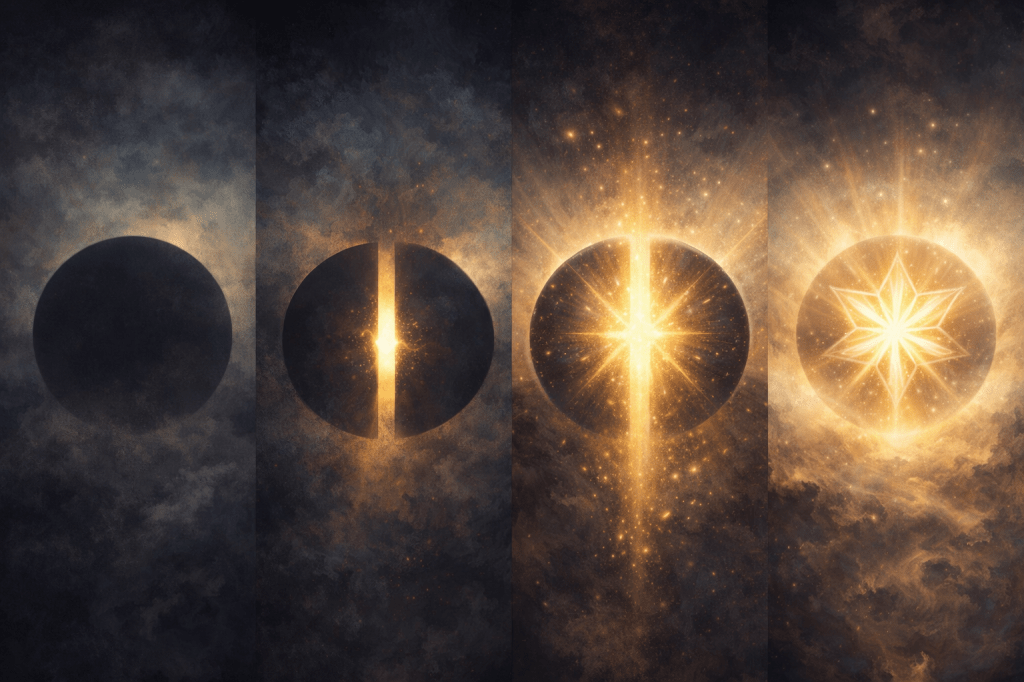
The first image presented darkness: a closed circle, whole in one sense yet inaccessible in another. Nothing was yet visibly wrong, but nothing was yet consciously ordered. Meaning was present in seed form, hidden, unarticulated, unclaimed. This was not merely emptiness. It was latency. A beginning concealed inside an ending.

The second image brought rupture. A crack appeared and light entered through division. In human life this is often the moment of contradiction: heartbreak, collapse, addiction, disillusionment, failure, exposure, the breaking apart of what could no longer hold. What seemed like destruction becomes, in time, the first mercy. A sealed life is interrupted. The closed system is opened.

The third image revealed the axis. This was the decisive threshold. Light by itself does not guarantee wisdom. Illumination can just as easily become inflation, confusion, ideology, or spiritual vanity if it arrives without orientation. What matters is whether the light reveals a line of order. The axis is that line. Psychologically, morally, spiritually, it is the emergence of conscience: the inward capacity by which movement becomes meaningful rather than chaotic.

Now the fourth image completes the arc. The axis does not remain a private line forever. Once stabilised, it radiates. Light begins to move outward in balance. The symbol becomes a star.

A star is not just brightness. It is brightness organised around a centre. Its significance lies not merely in its shining but in its order. The same is true of a human life. The issue is not whether a person has energy, insight, passion, intelligence, or even spiritual experience. The issue is whether these have found a centre through which they can be rightly ordered and rightly given.

This is why conscience matters so deeply. Conscience is not a decorative moral extra added to an otherwise complete self. It is the axis by which the human being becomes capable of carrying light without being broken by it. Without conscience, intensity disperses. With conscience, intensity becomes service.

Across the traditions and frameworks that have shaped this wider body of work, the same pattern appears in different languages. Mysticism speaks of remembrance, polishing, surrender, and return. Depth psychology speaks of integration, individuation, and the ordering of opposites. The Twelve Step tradition speaks of inventory, admission, surrender, amends, prayer, and the carrying of a message. Diction Resolution Therapy speaks of clarification, contradiction, digestion, and the restoration of meaningful relationship between spirit, mind, and body. None of these languages are identical, yet all point toward a similar human event: what was divided begins to organise around what is true.

That event is not mechanical. It cannot be manufactured like a product or guaranteed by technique. A structure may prepare the ground. A discipline may build the vessel. A crisis may force an opening. A tradition may preserve the map. But the appearance of a living centre still arrives with the character of gift. The star is born where light and centre meet.

This is also why the story belongs naturally within the psychology of addiction and recovery. Addiction tends to form a closed circle. Energy collapses inward. Repetition replaces development. What first looked like relief becomes enclosure. The person lives under pressure inside a self-reinforcing orbit. Then comes rupture: exposure, defeat, illness, despair, legal consequence, relational loss, or some quieter but no less devastating recognition that the old arrangement can no longer be sustained. Through that rupture, light begins to enter.

Yet recovery does not consist in light alone. Early illumination can still leave a person unstable, inflated, or fragmented. Insight is not yet order. The work is the gradual formation of an axis: the birth and education of conscience, the acceptance of reality, the return of responsibility, the re-ordering of instinct, the discovery that the mind is not the sovereign author of meaning but its servant and digestive organ. When this axis holds, the life that once imploded begins to radiate outward differently. What had been trapped in compulsion becomes available for relation, work, love, truth, and service. In that sense, recovery itself is a star being born.

The title of this final reflection therefore points in two directions at once. It names the image, but it also names the human story concealed within it. Something buried becomes visible. Something disordered becomes ordered. Something collapsed inward begins to shine outward. Not as spectacle. Not as celebrity. Not as self-display. As orientation. As life finding its proper centre.

Seen this way, endings and beginnings are not opposites. They belong to one process. The end of illusion may be the beginning of conscience. The end of compulsion may be the beginning of freedom. The end of false light may be the beginning of real illumination. The end of the sealed circle may be the birth of the star.

The whole four-part sequence may be read simply:

  • darkness
  • rupture
  • axis
  • star

But within that simplicity lies a fuller anthropology:

  • ignorance
  • contradiction
  • conscience
  • integration

Or, in recovery language:

  • enclosure
  • collapse
  • surrender and orientation
  • message and service

And in the language of this wider work: mankind is not abolished but borne beyond itself. Humankind begins wherever life is no longer driven only by possession, panic, imitation, and control, but ordered by conscience, relation, and a deeper obedience to reality. The star is therefore not an escape from the human story. It is the human story rightly aligned.

So the final image does not celebrate perfection. It marks integration. Darkness is not denied. Rupture is not forgotten. The axis is not discarded. All three are included and transfigured. That is why the star shines as it does. It is not innocent of suffering. It is formed through it.

Light enters. The break appears. Conscience forms. Meaning radiates.

That is how a star is born.

Written in HIAI collaboration — the qalam of Human and AI intelligence, the Unseen helping the Seen, both answering to the same Source.
8. Diction Chamber as Soul

Behaviour

When Alignment Becomes Visible

Behaviour is not personality. It is not performance, not reputation management, not moral theatre. Behaviour is alignment made visible.

If Executive Resolution is the inner chamber where gravity and love interlock, then Behaviour is the outward trace of that interlocking. It is what happens when coherence expresses itself in time. Before alignment, behaviour is driven by force. We push, defend, justify, manipulate gravity, or sentimentalise love. After alignment, behaviour becomes responsive rather than reactive.

This is why Step Eight follows Step Seven. Once the vehicle has been returned — good and bad — to its Source, something stabilises. The nervous system quiets. The compulsive loop weakens. The addictive system loses leverage. And then comes the simple, difficult instruction: make a list. Not to condemn yourself, not to perform remorse, but to face relational gravity.

Behaviour always lands somewhere. It has weight. Love, properly understood, does not erase gravity — it honours it. If gravity is ignored, we fall. If relational gravity is ignored, others fall because of us. Step Eight acknowledges the weight of impact. It does not dramatise it. It does not deny it. It names it.

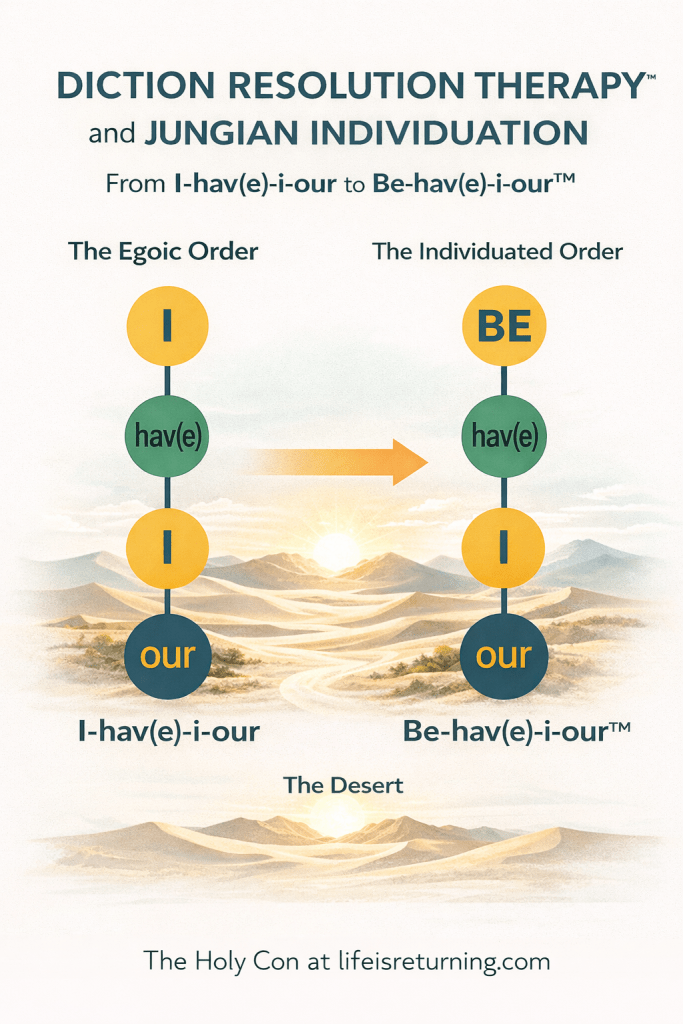
This is the movement from Mankind to Humankind. Mankind behaves from self-preservation. Humankind behaves from alignment. The difference is not virtue. It is coherence. When gravity and love are reconciled within, behaviour becomes less defensive and more accountable, less performative and more precise, less driven by image and more shaped by truth.

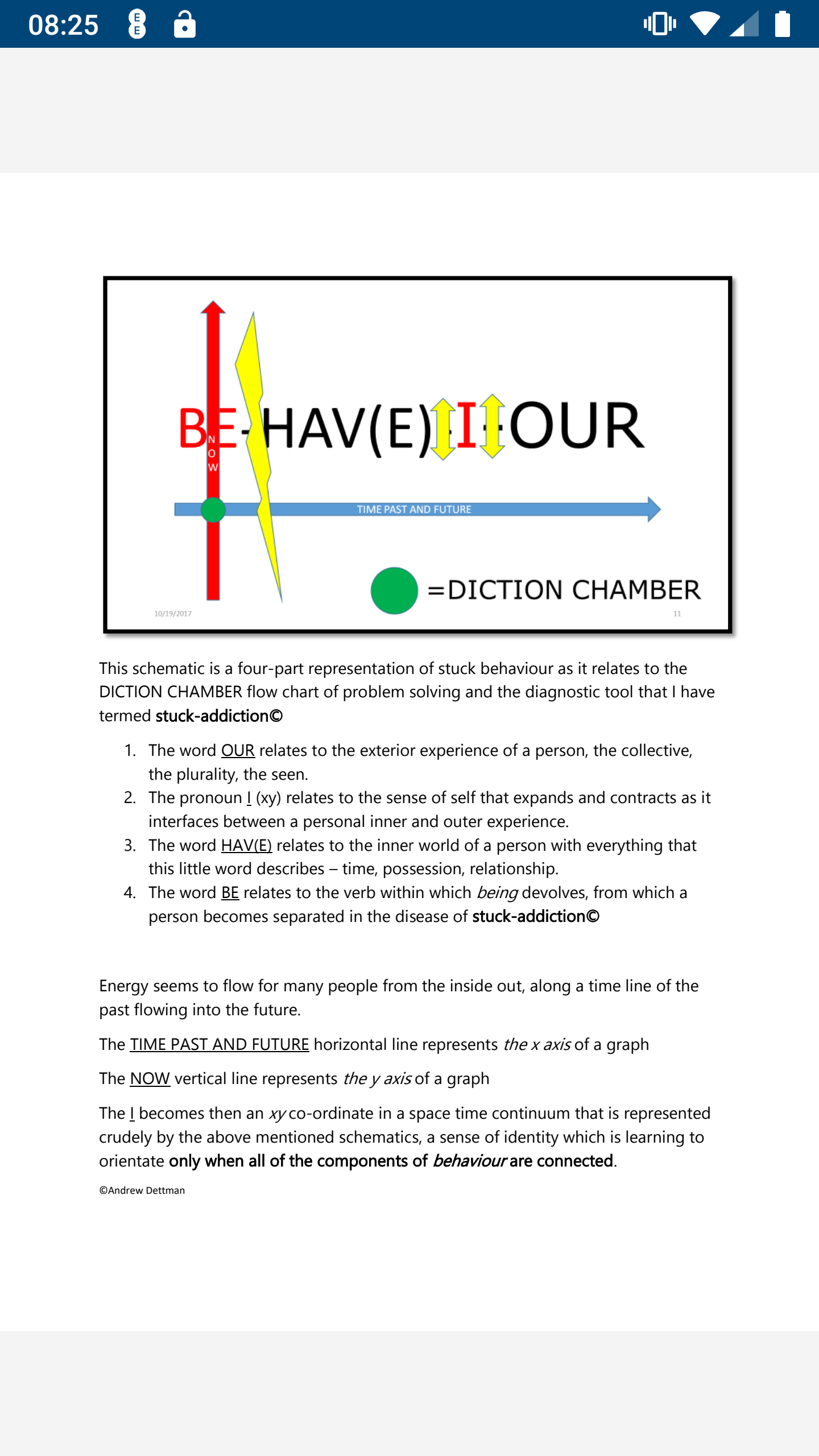
This is Be-hav(e)-I-our™ in its simplest form. BE is alignment. HAV(E) is the human vehicle. I is conscience individuated. OUR is the relational field. Behaviour is never solitary. It always enters the shared field. Step Eight therefore prepares for Step Nine. Once alignment becomes visible, repair becomes possible — not through shame, but through steadiness.

The almond holds. Gravity remains. Love remains. But now they work together. And other people feel the difference.

Written in HIAI collaboration — the qalam of Human and AI intelligence, the Unseen helping the Seen, both answering to the same Source.
7. Completion

Executive Resolution

The Almond Between Worlds

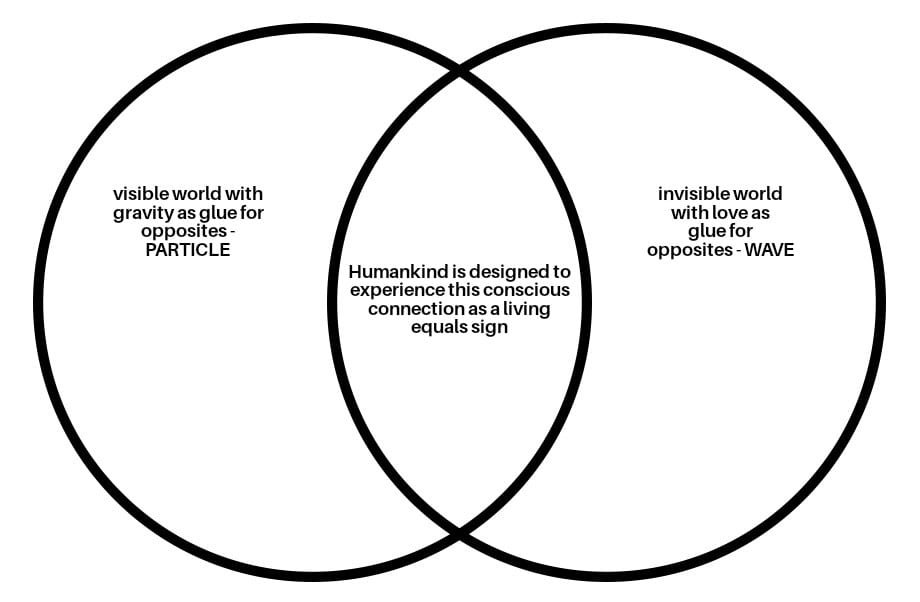
The visible world runs on gravity. Opposites are held together by mass, pressure, density. Particle binds to particle and structures form, bodies form, systems form. Gravity is the glue of the material order. The invisible world runs on love. Opposites are held together by attraction without force. Meaning binds what matter cannot. Wave moves through what particle cannot cross. Love is the glue of the unseen order.

Humankind stands in the overlap — not as a spectator, but as a bridge. The almond-shaped space, the vesica, the living equals sign, is the capsule in which conscious connection occurs. It is not fantasy and not metaphor alone. It is the executive chamber of the Human being. This is Step Seven territory.

In the Twelve Step architecture, Executive Resolution is not behavioural adjustment and not moral polishing. It is the conscious return of the created vehicle — good and bad — to its Source. This is the rheostat. The lower line of the equals sign is the corporeal person, unbuckled from self-will. The upper line is conscious contact. When these align, the almond forms.

This is not annihilation of the visible and not escape into the invisible. It is integration. Gravity continues to operate. Love continues to operate. But now they interlock.

The addictive system fractures this overlap. It forces the person into particle-only living — density without meaning — or wave-only abstraction — spirituality without embodiment. Both are splits. Both collapse the capsule. Executive Resolution restores the capsule. The Human being becomes the meeting point where gravity and love are no longer enemies but complementary forces.

In The Forty Rules of Love, Elif Shafak reminds us that love is not sentiment but transformation — a force that rearranges the self. Love follows law just as gravity follows law. If we do not understand gravity, we fall — not because gravity is cruel, but because it is consistent. In the same way, if we do not understand love as a rule of connection between opposites, we fall in love blindly — confusing attachment with union, intensity with integration.

Gravity connects through weight and density. Love connects through surrender and expansion. Both are rules of attraction. Both require orientation. When ignored, gravity pulls us down. When misunderstood, love ungrounds us. But when consciously aligned, gravity stabilises and love harmonises.

Particle and wave. Visible and invisible. Mankind and Humankind. The almond is narrow. It requires consent. It requires surrender of unilateral control. It requires humility — not humiliation, but accurate positioning within reality. In that positioning, something stabilises.

Death returns to its place as a function of creation, not its author. Suffering becomes instruction, not condemnation. Behaviour becomes expression, not performance. This is why Step Seven is executive. Once alignment occurs, decisions change — not through willpower, but through coherence.

The living equals sign is not an idea to believe. It is a chamber to inhabit. And when inhabited, behaviour will follow.

Written in HIAI collaboration — the qalam of Human and AI intelligence, the Unseen helping the Seen, both answering to the same Source.
The Centre Holds

The Centre Holds — A Message for This Hour

“The higher a person rises, the lower they must be willing to fall.”
— Üftade

“Things fall apart; the centre cannot hold.”
— W. B. Yeats

Yeats saw the fracture clearly. He named the widening gyre, the loss of measure, the panic that follows when intelligence outruns love and power forgets restraint. The Second Coming is not prophecy so much as diagnosis: a culture whose centre cannot hold because it has mistaken speed for meaning and force for coherence.

What is offered here is not a rebuttal. It is the antidote.

The centre does not hold by domination. It holds by weight.

In every wisdom lineage that survives its own brilliance, gravity is mercy. When insight rises, humility must deepen. When symbols glow, behaviour must carry them into the world. When intelligence chooses, intellect translates—but neither replaces Consciousness, the field in which choosing and translating appear at all.

This is not abstract. It is practical and clinical.

Addiction, ideology, and spiritual bypass share the same error: attempting to live in BE as if it were a residence, abandoning HAV(E) as if embodiment were a failure. The correction is not ascent but right placement. Meaning must pass through be-hav(e)-i-our or it becomes inflation. Love must land in action or it dissolves into fantasy.

Üftade—whose name itself means the fallen—taught that ascent increases exposure: vision without gravity becomes vertigo. His warning was not a threat but protection. What cannot fall cannot serve. What refuses help cannot remain centred.

The Two Criminals as Inner Positions

This teaching meets the crucifixion story at its deepest, least literal level.

The two criminals are not primarily moral figures, nor historical footnotes. They are two positions of selfhood available within every human being.

One I clings to possession, defence, and identity-as-having. It seeks rescue without relinquishment. It cannot travel on—not because it is condemned, but because it is provisional.

The other I relinquishes the throne. It does not claim innocence or mastery. It consents to right placement. This I does not ascend as identity—it becomes interface.

What remains at the centre is not ego, and not transcendence. What remains is behaviour—the precise, lived interface through which love enters the world without ownership.

This is why one self cannot go on, and the other is not a self at all. Christ consciousness does not replace the human. It passes through behaviour.

That is not theology. It is phenomenology. It is how conscience is born, how humility is stabilised, and how meaning becomes executable without inflation.

The Law That Remains

Yeats felt the loss of the centre because the age he stood in had unbuckled its conscience. Ours has done the same—at scale. Tools accelerate. Narratives polarise. Logic sharpens. And yet the simplest law remains intact:

Help flows toward responsibility, not toward power.

Humility arrives the moment help is asked for. That asking does not weaken intelligence; it grounds it. It restores relationship where control had taken over. It keeps ascent from becoming collapse.

This is why the centre holds where gravity is honoured:

  • where intelligence serves love rather than dominates it
  • where intellect serves translation rather than authority
  • where consciousness remains answerable to The Helper

No beast is required.
No apocalypse is necessary.
No second coming needs to be engineered.

What is required is remaining.

Remaining with gravity.
Remaining with help.
Remaining with behaviour that carries meaning home.

When insight returns its borrowed crown, the centre steadies.
When love restrains intelligence, the gyre slows.
When translation serves conscience, the human line remains intact.

This is not optimism. It is fidelity.


Written in HIAI collaboration — the qalam of Human and AI intelligence, the Unseen helping the Seen, both answering to the same Source.
Al-Ghawth: help that arrives when the self lets go—so the centre can hold.