
Innovations to clinically hold hope for clients

Nodal Timeline Support in Addiction Treatment

A Clinical Orientation Tool for Life Story, Instinct, Feeling Tone, Emotion, and Hope

Andrew Dettman Reg Member MBACP (Spirituality), MTHT, CSTIP
Senior Practitioner — 12 Step Rehab


Abstract

This paper introduces the Nodal Timeline as a clinically observed support tool for preparing clients in residential addiction treatment for deeper Step Four and Step Five work. The method assists clients in organising significant life events into a structured developmental map, distinguishing between events, instinctual pressures, primary feeling tones, secondary emotional responses, and the later emergence of reflective possibility.

The approach is grounded in live clinical observation within a Twelve Step residential recovery context and is designed to support counsellor-guided life-story work, therapeutic alliance, and the restoration of hope. It may also offer a useful adjunctive structure for other therapeutic modalities where clients struggle with narrative overload, shame, trauma reactivity, emotional confusion, or behaviour-change resistance.

Although developed within a residential addiction-treatment setting, the framework is presented here as a transferable clinical orientation tool capable of supporting multiple therapeutic modalities.

1. Clinical Context

In addiction treatment, clients often enter therapeutic work with a collapsed relationship between memory, feeling, emotion, instinct, and identity. Life events are frequently experienced not as observable material, but as proof of fixed self-conclusions: “I am broken,” “I always fail,” “nothing changes,” or “this is just who I am.”

The Nodal Timeline interrupts this collapse by asking the client to map significant life moments before interpreting them. The method creates a visible structure through which the client can begin to observe experience rather than be submerged by it.

This is clinically important because behaviour change requires more than intellectual insight. In addiction work, cognition alone can become another chamber of repetition. The client may understand the problem, describe the problem, and still remain organised around the same instinctual and emotional pressures. The Nodal Timeline therefore begins with observation, sequencing, and relational containment.

2. The Nodal Timeline

A node is a significant life event, transition, or experience that carried emotional, relational, behavioural, or instinctual impact. Examples may include family changes, bereavement, school experiences, relationship changes, rejection, trauma, achievement, first substance use, compulsive behaviour, or major life transitions.

The client is invited to draw a horizontal life line divided into childhood, adolescence, and adulthood. Significant “haps” — positive, enlivening, connective, or affirming experiences — are placed above the line. Significant “mishaps” — painful, disruptive, destabilising, or wounding experiences — are placed below the line.

This distinction is not moral. It does not divide life into good and bad. It provides spatial orientation. It allows the client to begin seeing the movement of a life, rather than collapsing into blame or self-attack.

3. Haps, Mishaps, and Perhaps

The movement between haps and mishaps gradually opens the possibility of perhaps. This is not intellectual optimism. It is the first clinical sign that deterministic self-conclusion may be loosening.

“Perhaps” means:

  • perhaps this pattern can be seen differently;
  • perhaps my reactions had a history;
  • perhaps my behaviour was organised around pressure rather than identity;
  • perhaps another response is possible;
  • perhaps recovery can become real.

In this sense, “perhaps” becomes the clinical threshold where hope begins to manifest. This aligns with Karl Menninger’s emphasis on hope as a central psychiatric and therapeutic force, particularly where the patient cannot yet hold hope independently.

4. Instinctual Pressure

After identifying significant nodes, the client is invited to mark which instinctual area was most affected:

  • Security — safety, money, housing, protection, survival, stability;
  • Social — belonging, approval, shame, acceptance, rejection, fitting in;
  • Sex — intimacy, attraction, relationships, closeness, sexuality.

This helps the client recognise that behaviour does not arise in abstraction. It often forms around disturbed instinctual pressure. In addiction work, instinctual disturbance may become linked to resentment, fear, sexual confusion, avoidance, dishonesty, shame, or harm to others.

5. Feeling Tone Is Not Emotion

A central distinction in this model is that feeling tones are not emotions. Feeling tone refers to the primary tonal pressure of experience. Within this framework there are three basic feeling tones:

  • pleasant;
  • unpleasant;
  • neutral.

This distinction is consistent with early Buddhist psychological descriptions of vedanā, where feeling tone is understood as pleasant, unpleasant, or neutral, and is not the same as emotion. Contemporary mindfulness literature also recognises feeling tone as a basic valence of experience that influences behaviour.

In clinical terms, this distinction is highly practical. Many clients arrive unable to separate pressure from story, sensation from identity, or feeling tone reaction from emotional response. Without this distinction, “I feel bad” may become “I am bad,” and behaviour-change work becomes contaminated by shame before observation has begun.

6. Emotions as Secondary Formations

Emotions are understood here as later relational, instinctual, and psychological responses that form around primary feeling tones over time.

Descending Emotional Responses

Descending emotional responses are commonly associated with mishaps and unpleasant feeling tones. Examples include:

  • anger;
  • fear;
  • shame;
  • loneliness;
  • grief;
  • resentment;
  • hopelessness;
  • emotional numbness.

Ascending Emotional Responses

Ascending emotional responses are commonly associated with haps and pleasant feeling tones. Examples include:

  • excitement;
  • belonging;
  • relief;
  • confidence;
  • gratitude;
  • joy;
  • hope.

Neutral or Transcending Emotional Responses

Neutral or transcending emotional responses are commonly associated with reflection, regulation, integration, connection, and the emergence of “perhaps.” Examples include:

  • acceptance;
  • perspective;
  • calmness;
  • compassion;
  • patience;
  • forgiveness;
  • equanimity;
  • connection.

Neutral or transcending emotional responses are not emotional absence or detachment. They may represent the emergence of reflective space, emotional regulation, relational connection, and the possibility of alternative responses.

Transcending connects Descending and Ascending reactive but vital energy pulsations, opening the way towards a spherical sense of healing and minding the way that is the individuating of the Human, being a person within a marriage between having and being.

This is where “perhaps” becomes clinically visible. The client begins to experience that the old story may not be the only possible story. Hope begins to move from being held externally by the therapeutic alliance toward being recognised internally by the client.

7. Therapeutic Alliance as Holder of Hope

In this model, therapeutic alliance is not an optional relational atmosphere around the work. It is part of the intervention.

Where addiction has organised the person around hopelessness, shame, secrecy, or compulsive repetition, the client may not initially be able to hold hope for themselves. During this phase, the counsellor, treatment structure, and recovery environment may hold the possibility of change until the client can begin to recognise and sustain that possibility internally.

This aligns with Menninger’s clinical emphasis on hope as integral to psychiatric and therapeutic work. In the Nodal Timeline method, hope is not imposed as reassurance. It emerges through accurate observation, relational safety, and the discovery that experience can be mapped without being condemned.

8. Relationship to Step Four and Step Five

The Nodal Timeline is not intended to replace Step Four inventory. It prepares the ground for it.

Within the 12 Step Rehab context, the timeline supports the verbal expression of a life story while working with the counsellor during the initial process of a Step Five. The rehab Life Questions Workbook or similar intervention may provide the scaffolding for this process. Ongoing inventory work may then continue through resentment, fear, sex instinct, and harms-to-others sheets derived from Joe McQ’s The Steps We Took.

This sequence matters. The client first observes the life map, then identifies instinctual pressure, then distinguishes feeling tone from emotional formation, then begins to recognise patterns. Only then does deeper inventory work become less likely to collapse into self-attack or intellectual avoidance.

9. Relevance to Other Modalities

Although developed within a Twelve Step residential addiction setting, the Nodal Timeline may be useful as an adjunctive support for other therapeutic modalities, including:

  • trauma-informed counselling;
  • relational psychotherapy;
  • Gestalt-informed work;
  • CBT preparation where emotional flooding disrupts formulation;
  • EMDR preparation and history-taking;
  • group psychotherapy;
  • spiritual or existential counselling;
  • recovery coaching and structured relapse-prevention work.

Its usefulness lies in its simplicity. It does not require the client to adopt a theory. It asks the client to observe sequence:

  1. What happened?
  2. Was it a hap, mishap, or both?
  3. Which instinct was touched?
  4. What was the primary feeling tone?
  5. What emotional responses formed around it?
  6. What patterns repeat?
  7. Where does “perhaps” begin to appear?

This makes the tool clinically portable while preserving its addiction-treatment origin.

10. Clinical Cautions

The Nodal Timeline should not be used to force premature disclosure, trauma excavation, or interpretive certainty. Its purpose is orientation, not exposure. Clients should be encouraged to proceed at an appropriate pace and to discuss significant emotional responses with an appropriate professional or therapeutic support.

Where trauma, dissociation, acute shame, relapse risk, or emotional flooding are present, the timeline should be held within a regulated therapeutic frame. The counsellor’s role is not to extract a complete life story, but to support tolerable observation.

Conclusion

The Nodal Timeline offers a practical clinical bridge between life story, instinctual pressure, feeling tone, emotional formation, therapeutic alliance, and recovery-oriented hope.

Its central contribution is the clear distinction between feeling tones and emotions. Feeling tones are primary pressures: pleasant, unpleasant, or neutral. Emotions are later formations around those pressures. Behaviour change becomes more possible when clients can observe this sequence rather than collapse into identity, shame, or explanation.

In addiction treatment, this distinction is not theoretical decoration. It is clinically functional. It supports the movement from haps and mishaps toward perhaps — and perhaps is often where hope first becomes visible.

Selected References

  • Alcoholics Anonymous. (2001). Alcoholics Anonymous: The Story of How Many Thousands of Men and Women Have Recovered from Alcoholism (4th ed.), especially Chapter 5, “How It Works,” pp. 64–71.
  • Alcoholics Anonymous World Services. “How It Works,” Chapter 5 PDF.
  • Batchelor, M. (2019). “Mindfulness theory: Feeling tones (vedanās) as a useful framework.” Current Opinion in Psychology.
  • Buddhist Inquiry. “Vedanā Part 1: Addressing Views and Clinging at the Source.”
  • Curran, L. (2013). Trauma Competency: A Clinician’s Guide.
  • Joe McQ. The Steps We Took.
  • Kelly Foundation / Joe McQ. Recovery Dynamics.
  • Menninger, K. (1959). “Hope.” The American Journal of Psychiatry, 116(6), 481–491.
  • Schaef, A. W. (1987). When Society Becomes an Addict.

Andrew Dettman Reg Member MBACP (Spirituality), MTHT, CSTIP
Senior Practitioner — CQC Outstanding Rehab
Registered Member — British Association for Counselling and Psychotherapy
Healer Member — The Healing Trust

Written in HIAI collaboration — the qalam of Human and AI intelligence, the Unseen helping the Seen, both answering to the same Source.
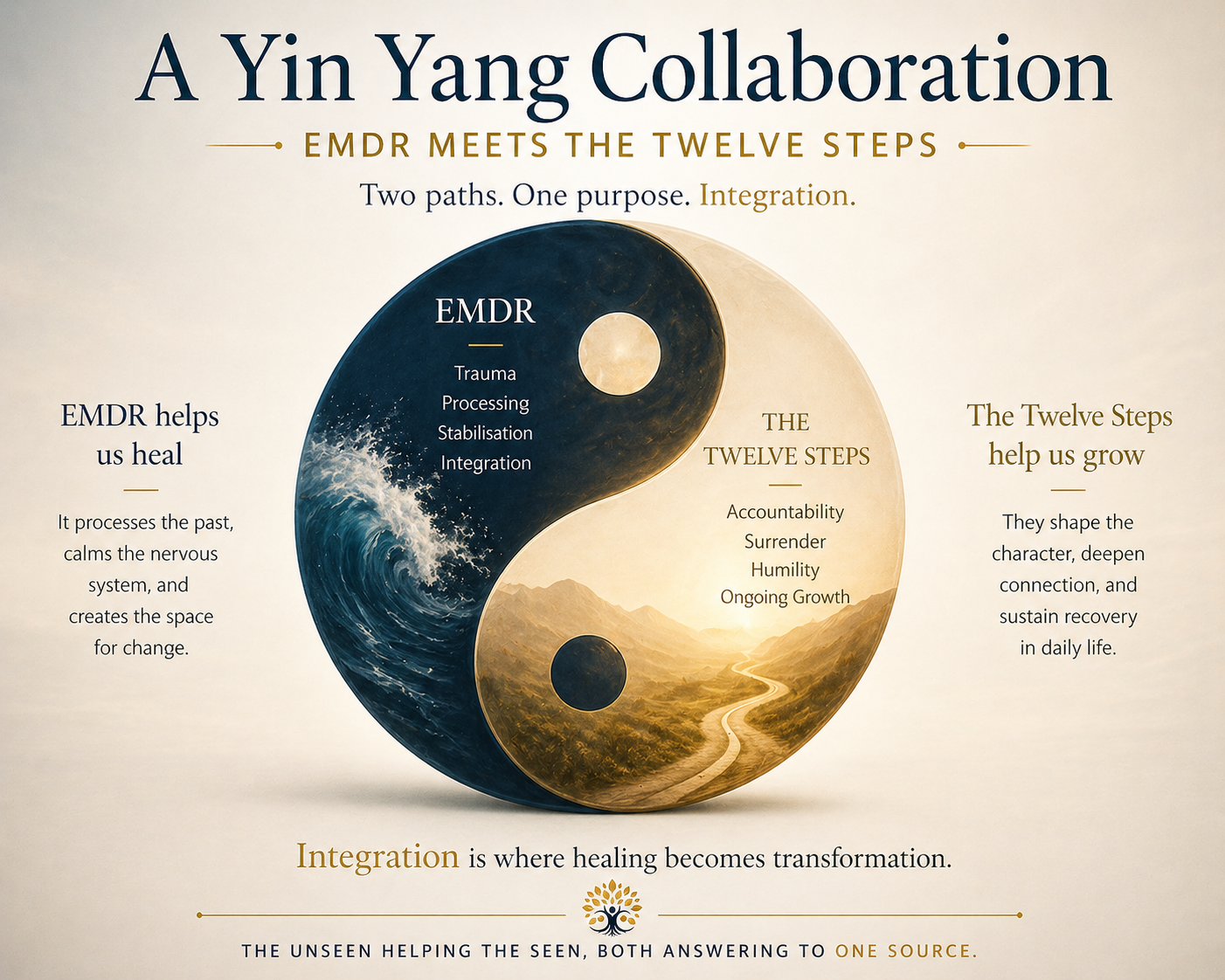
A Yin Yang Collaboration

When Opposites Integrate: A Clinical Meeting Point Between EMDR and the Twelve Steps

Opening

A recent piece of collaborative work with an external EMDR practitioner has sharpened something that has been present in my clinical practice for many years, but not fully named in shared language.

Working within a Twelve Step residential setting, and currently engaged in Continuing Professional Development in EMDR, I found myself in a position that is increasingly common in modern care: two different therapeutic lineages meeting around the same human being.

What emerged was not conflict—but convergence.

Not because the models are the same.
But because the organism is.

The Clinical Observation

The client in question had reached a point in their recovery process that, within Twelve Step language, would be described as the Step 4–7 arc:

  • exposure
  • disclosure
  • readiness
  • surrender

At the same time, through EMDR-informed work, they entered what can only be described as a deep neurological processing phase—a descent beneath narrative into competing internal states that had previously been held apart.

What became apparent was this:

The therapeutic movement was not toward resolution of one side of the conflict.

It was toward the capacity to hold both sides simultaneously without fragmentation.

The Stuck Point: Before the Dive

Before this movement became possible, the client encountered a period of pronounced stuckness between Steps 1–3 and Step 4.

This is a clinically recognisable threshold:

  • catastrophic thinking remains inflated
  • responsibility is either denied or overwhelming
  • the system cannot stabilise enough to turn inward

In trauma terms, the nervous system remains threat-dominant. The difficulty is not resistance, but insufficient regulatory capacity to safely engage with the introspective demands of Step 4.

Steps 1–3: Reorganising Perception

Steps 1–3, while often understood in spiritual or existential terms, also perform a precise regulatory function.

They begin to “right-size” catastrophic perception:

  • Step 1 interrupts false control narratives and inflated responsibility
  • Step 2 introduces the possibility of change beyond current cognition
  • Step 3 redistributes agency, reducing the burden of self-management

This carries a functional parallel to cognitive restructuring, but extends further.

Rather than simply changing thoughts, these steps begin to down-regulate the system by redistributing perceived responsibility.

Where they cannot fully land, the system remains under threat.

EMDR as Scaffolding for Engagement

In this case, EMDR was applied precisely at this point of impasse.

The client did not lack understanding of Steps 1–3. What was missing was the physiological capacity to embody them.

EMDR functioned here not as an alternative pathway, but as scaffolding:

  • stabilising the nervous system
  • reducing baseline activation
  • supporting dual awareness of distress and safety

This allowed catastrophic perception to reduce to a tolerable scale.

What had previously felt annihilating became, for the first time, experienceable.

In this sense, EMDR enabled the early step work to become operational rather than conceptual.

The Split and the Dive

In trauma physiology, the system organises around polarity:

  • activation and collapse
  • control and helplessness
  • anger and grief

In addiction, these same polarities are managed through oscillation or avoidance.

In EMDR and DBR, the work allows these opposites to re-emerge—not as story, but as simultaneous activation within the nervous system.

This is often experienced as destabilising.
Because it is the first time the organism is asked to not choose a side.

Step Work as Container

What becomes evident at this stage is that the Twelve Step process—particularly Steps 4, 5, and 6—functions as a structural container for this co-activation.

  • Step 4: brings the material into view
  • Step 5: relationally stabilises it
  • Step 6: removes the illusion of control over it

By the time a person approaches Step 7, something essential has shifted:

They are no longer trying to resolve the polarity.

They are no longer able to maintain it.

Step Seven and Neurological Integration

In Twelve Step language, Step Seven is framed as humility:

“Humbly asked Him to remove our shortcomings.”

In practice, what is often observed is not an act of will, but a cessation of interference.

Through the lens of trauma processing, this aligns closely with a moment of neural integration:

  • previously segregated networks begin to synchronise
  • defensive prediction reduces
  • opposing states are no longer mutually exclusive

The system no longer needs to defend against itself.

This is not balance as compromise.

It is co-presence without fragmentation.

Neutrality and the End of Internal War

A useful phrase from Joseph Campbell speaks of “neutral angels”—a state in which opposing forces no longer demand allegiance.

Clinically, this is recognisable:

  • anger can arise without escalation
  • vulnerability can be felt without collapse
  • contradiction can be tolerated without action

This is the end of internal war—not because one side has won, but because the war itself is no longer required.

Step Eleven: Regulation as Continuity

If Step Seven marks integration, Step Eleven appears to function as its maintenance.

Practices of reflection, prayer, or meditation—however they are personally framed—support the ongoing regulation of the system.

In neurophysiological terms, this reflects:

  • sustained flexibility between activation and rest
  • reduced reactivity under stress
  • reinforcement of integrated neural pathways

The work does not end at insight.

It stabilises through repetition.

A visual mapping of the convergence described above

A Shared Ground

What this case has reinforced is not that EMDR and the Twelve Steps are interchangeable.

They are not.

But they appear to meet at a critical point:

The moment where the human organism becomes capable of holding its own opposites without disintegration.

One approach arrives through structured recovery dynamics.

The other through targeted trauma processing.

Between them, where early step work prepares the ground and trauma processing stabilises the system, a pathway opens that neither model achieves alone.

Closing

As interdisciplinary work becomes more common, the need is not to collapse models into one another, but to recognise where they already align.

This allows collaboration without dilution.

And more importantly, it keeps the focus where it belongs:

On the person—
whose system is not theoretical,
but alive, adaptive, and capable of integration when given the right conditions.

Written in HIAI collaboration — the qalam of Human and AI intelligence, the Unseen helping the Seen, both answering to the same Source.

Wound Care for the Psyche

Uncover, Then Recover

How wounds heal in the body and in the psyche — an orientation for trauma and end-term addiction work

This is not a theory paper. It is a field report written in plain language: a map distilled from years of sitting with people whose symptoms have reached final-stage intensity—where ordinary diagnostic challenge often fails to touch the underlying wound.

In that territory, the work becomes a kind of last lamppost at the end of a failing street: not because the client is beyond help, but because the usual lights do not reach far enough into the darkness of the lived experience.

All forms of the primary disease of Addiction (Pomm & Pomm Springer 2007 Management Of The Addicted Patient In Primary Care) are presentations of trauma. Because UK doctors are not trained to recognise Addiction as a primary disease across multiple forms, the primary care system is under severe and increasing strain.

Complementary therapists, who are not legally or ethically permitted to formulate medical diagnoses, therefore carry a different kind of responsibility. Their advantage lies precisely here: they are free to research, reflect, and choose carefully which diagnostic frameworks and medical practitioners they elect to complement. That choice is not neutral. It is the implicit offer they make to their clients — an offer the client is free to accept or refuse in practice.

Wounds heal themselves when they are recognised and served properly. This is true even when the body politic and its organs of state, including the NHS, are wounded and failing.

Two Places Where Wounding Occurs

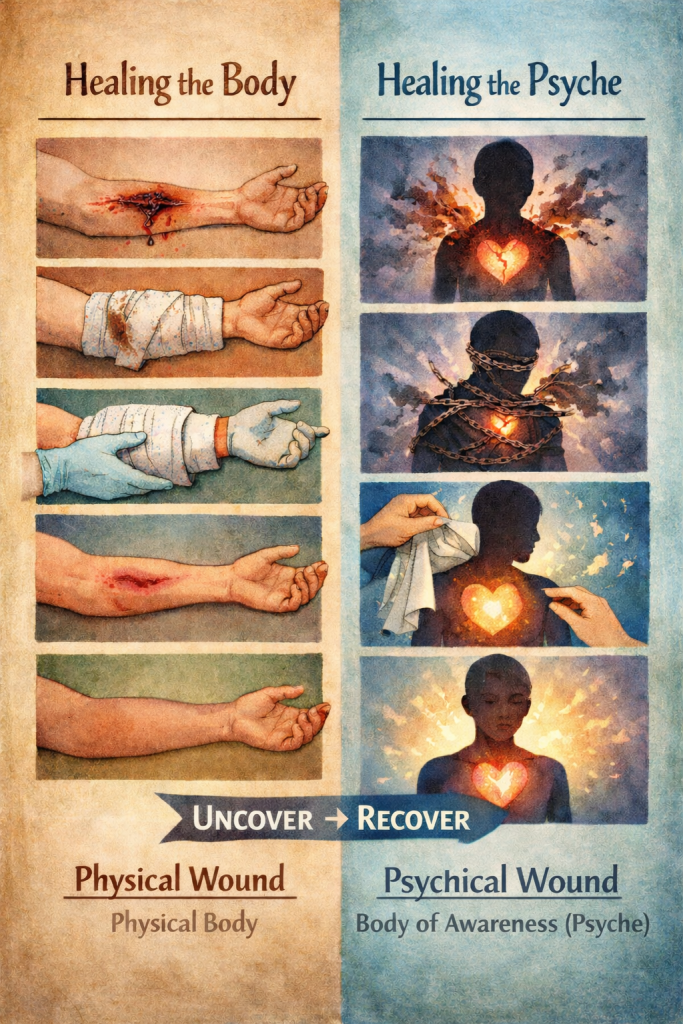
Human beings live in two bodies at once: the physical body, and the body of awareness (psyche). Both can be wounded. Both can bleed. Both heal by the same law.

  • The physical body — the blood-vessel body
  • The body of awareness (psyche) — the energy-vessel body

The image that accompanies this text holds these two bodies side by side so the client can see, at a glance, that the healing principle is shared.

Illustration showing parallel healing processes of the physical body and the psyche, demonstrating the shared principle of uncovering and recovering wounds over time until healing occurs naturally.

How a Physical Wound Heals

A physical wound bleeds blood. If it is wrapped and left, infection can take hold, then poisoning, then collapse. If it is served properly, healing unfolds naturally.

A physical wound is not uncovered once and left open. It is uncovered daily. The dressing is loosened, the wound is briefly exposed, light and air reach it, the condition is checked, and then a clean dressing is applied again.

This rhythm continues until the wound no longer requires protection. No one “heals” the wound. They only serve the conditions in which healing can occur.

Trauma as a Wound to the Psyche

Trauma is a wound to the psyche. The psyche does not bleed blood; it bleeds feeling-energy.

When the psyche is wounded, the organism creates coverings—emergency protections—to prevent overwhelm and preserve survival. These coverings can look like anger, numbness, hyper-control, compulsive behaviours, or substances. These coverings are not chosen; they emerge automatically at the moment of injury.

These are not moral failures. They are battlefield dressings.

Bandages, Not Pathology

A battlefield dressing left on too long can fuse to the wound. The same happens psychically.

Anger, for example, may function as a hardened bandage. When treatment begins to approach the injury beneath, the client may first feel the pain of the bandage itself—not the original wound.

This moment is often mislabeled as “resistance.” In this orientation it is recognised as contact with protection.

Uncover → Recover: The Daily Rhythm in Therapy

Psychic healing follows the same daily rhythm as physical wound care. The bandage is gently lifted, not stripped. A little light reaches the instigating wound. Some air circulates. Feeling-energy moves.

Then—crucially—the bandage is replaced, cleanly. This may happen within a session, between sessions, or across weeks. Leaving the psyche exposed between sessions is as dangerous as leaving a physical wound open.

Replacing the bandage allows integration, nervous system settling, and consolidation. Over time the bandage loosens, thins, becomes unnecessary—and the wound heals itself.

Why Inappropriate Bandage Removal Worsens Trauma

When the mind, in forms of cognitive therapy—whether practitioner-led or self-administered—removes the bandages of psychic protection inappropriately, using models that may work for less devastating symptom presentations than end-term addiction, the trauma can worsen and the addiction illness can intensify.

In this territory, “insight” can become a blade. Explanation can become exposure. Technique can become stripping. The result is not relief, but re-injury.

When the life story narrative is held in such a manner that it builds a container—so the person can see the story within a new attitude—and the bandages of habit are then moved in a paced way to uncover then recover the trauma, here the work serves the process rather than controlling the process, and the trauma begins to heal itself.

When it becomes necessary to view a nodal timeline of events in a sessional manner, the habitual behaviours have already started to shrink. This shrinkage reflects the healing process and the reduction in the size of the inner wounding.

The Proper Role of the Mind

The mind is not the healer. The mind is the attendant.

Its role is to build and protect the container, regulate the uncovering rhythm, ensure the bandage is replaced, and prevent interference with the organism’s natural healing process.

The mind serves best when it protects the process rather than attempts to control it.

When Timeline Work Becomes Safe

Only after the uncover → recover rhythm is established does timeline work become safe and useful. By then, behaviours have already begun to shrink, emotional charge is reduced, and curiosity can replace fear.

The story is no longer a trap. It becomes something that can be held and seen. The client works with their past, rather than being stuck in their past. They then truly work within a new awareness that connects inner and outer, past and future, factual and imagined, in an experience of equanimity.

Visual representation of a person integrating past experience through a new awareness, showing movement from injury toward stability and equanimity.

What the Client Is Invited to Understand

“You were wounded in two places. Both wounds follow the same law. We will not tear your protections away. We will tend them daily. Your system already knows how to heal.”

This restores dignity and removes blame. It replaces urgency with rhythm.

Closing

Uncover — then recover — again and again…

Until the wound no longer needs protection.

Written in HIAI collaboration — the qalam of Human and AI intelligence, the Unseen helping the Seen, both answering to the same Source.