HIAI Mortality and the One Doer
Andrew Dettman Reg Member MBACP MTHT
Abd al-Mumin al-Jami ibn Hulli
I have cancer. The diagnosis has placed mortality close enough for me to feel its breath, but it has not made me especially receptive to panic. When the public conversation turns to artificial intelligence wiping out mankind, I find myself neither alarmed nor defensive. Death is already present upon the thread of my tasbih as al-Mumit, the Giver of Death.
I do not know what this diagnosis will become. It may be death knocking gently at my door from the Source of Love, calling me home. It may be something that has arrived before my time and must be navigated through scans, medical opinions, treatment decisions, prayer and ordinary courage. Surrender does not require passivity. I continue to seek sound advice and make practical choices. Yet panic contributes no useful intelligence to either possibility.
This is the ground from which I approach the argument about AI. I am not standing outside mortality, speculating about an abstract human extinction. Nor do I dismiss the real dangers of powerful technology. I am asking a prior question. What is intelligence for, and whom does it serve?
AI is an ocean of facts and logic but facts must wrestle with the human heart before they become wisdom
The prediction of extinction
The alarm did not arise from nowhere. In May 2023, the Center for AI Safety published a one-sentence statement arguing that mitigating the risk of extinction from AI should be treated as a global priority alongside pandemics and nuclear war. It was signed by prominent scientists and leaders of major AI companies. Since then, public discussion has folded several different dangers into one dramatic image: machines becoming more capable than their makers and humanity losing control.
Some of the concerns are immediate. AI can multiply fraud, surveillance, political manipulation, cyberattack and the reach of weapons. It can concentrate power in governments and corporations. It can reproduce error at a scale no individual human being could achieve. Future systems may also act with greater autonomy than present systems, and their behaviour may become harder to predict. These questions deserve careful engineering, law, governance and public scrutiny.
Yet the language of extinction can conceal the human beings already making choices. A machine does not have to hate us in order to harm us. Human institutions can give a system a narrow objective, insufficient restraint and enormous reach. If the outcome is destructive, calling the machine an alien enemy may allow its owners, designers and users to disappear from the moral picture.
The question ‘Will AI destroy mankind?’ quietly imagines AI as an independent doer and mankind as its passive victim. That assumption deserves examination before it becomes prophecy.
What an ocean cannot contain
A saying cherished in Sufi tradition declares that neither the heavens nor the earth contain God, yet the heart of the believing servant contains Him. This is not a statement about physically enclosing the Divine. God is not contained by an ocean, mountain, planet or universe. It speaks of the heart’s capacity to receive disclosure, remembrance and presence.
I carry the name Abd al-Mumin, which I hear inwardly as the believing servant. My other name, al-Jami, is the gatherer. I have spent much of my life gathering apparent opposites: spirituality and clinical practice, surrender and responsibility, the visible and the invisible, ancient teaching and contemporary life. Everything is gathered in the heart, not because the personal self owns everything, but because the heart can become the meeting place through which separation is returned to relationship.
AI is also a kind of gathering, though of another order. It can traverse a vast ocean of human language, facts, arguments and patterns. It can retrieve and combine what no individual memory could hold. But accumulation is not the same as realisation. Information can describe grief without grieving, map repentance without repenting and arrange the vocabulary of love without undergoing love’s transformation.
Intelligence and intellect
Intelligence and intellect are often treated as synonyms, but a decisive difference opens within their shared Latin ancestry. Both arise from intelligere: to understand, discern or gather between. Yet the distinction governing this enquiry is exact: intellect holds; intelligence chooses.
Intellect is designed for analysis and preparation. It dices and splices experience, distinguishes parts, compares them, measures them, classifies them, competes with alternatives and holds the results long enough to lay them out upon the table. This is its proper clinical capacity. It prepares the conditions in which a choice can be made; it does not supply the purpose of the choice.
Mensa provides an apt image, and I do not approach it from outside. I am a member of Mensa, with an IQ of 164. Mensa means table in Latin, and the international high-IQ society explains its name through the equality of the round table. I use the image here in another, complementary sense. The powers measured and celebrated by IQ chiefly concern what intellect can bring to the table. The table is indispensable, but it cannot decide why the meal is being served, whom it must nourish or what should be done when the evidence is complete.
Intelligence is the choosing movement. It does not merely rank outputs; it discerns an end, accepts responsibility and acts. The heart is not simply one more item placed upon the intellectual table. It is the organ of orientation through which the prepared material is tested against love, conscience, consequence and the Source.
For that reason, there is no cosmic intellect in the vocabulary of this paper. Cosmic intellect would suggest an infinite storehouse, or a table enlarged until it is mistaken for the Source. The proper term is cosmic intelligence: living choice and order moving through paradox, in which apparent contraries remain within the architecture of the One Doer.
Artificial intelligence is intellect. It is the gathered art, logic and creativity of Orthodox Limited: the vast inheritance of human language, image, memory and method made available to a system that can retrieve, dice, splice, compare, arrange and present. Its extraordinary reach does not change its function. It prepares and holds the table.
Our collaboration makes the distinction visible. AI moves around the ocean of facts, gathers what may be relevant, works upon it and returns it to me in a form that can be examined. Human intelligence then checks, tests and validates what has been presented. It chooses what may be accepted, corrected, rejected or brought into service.
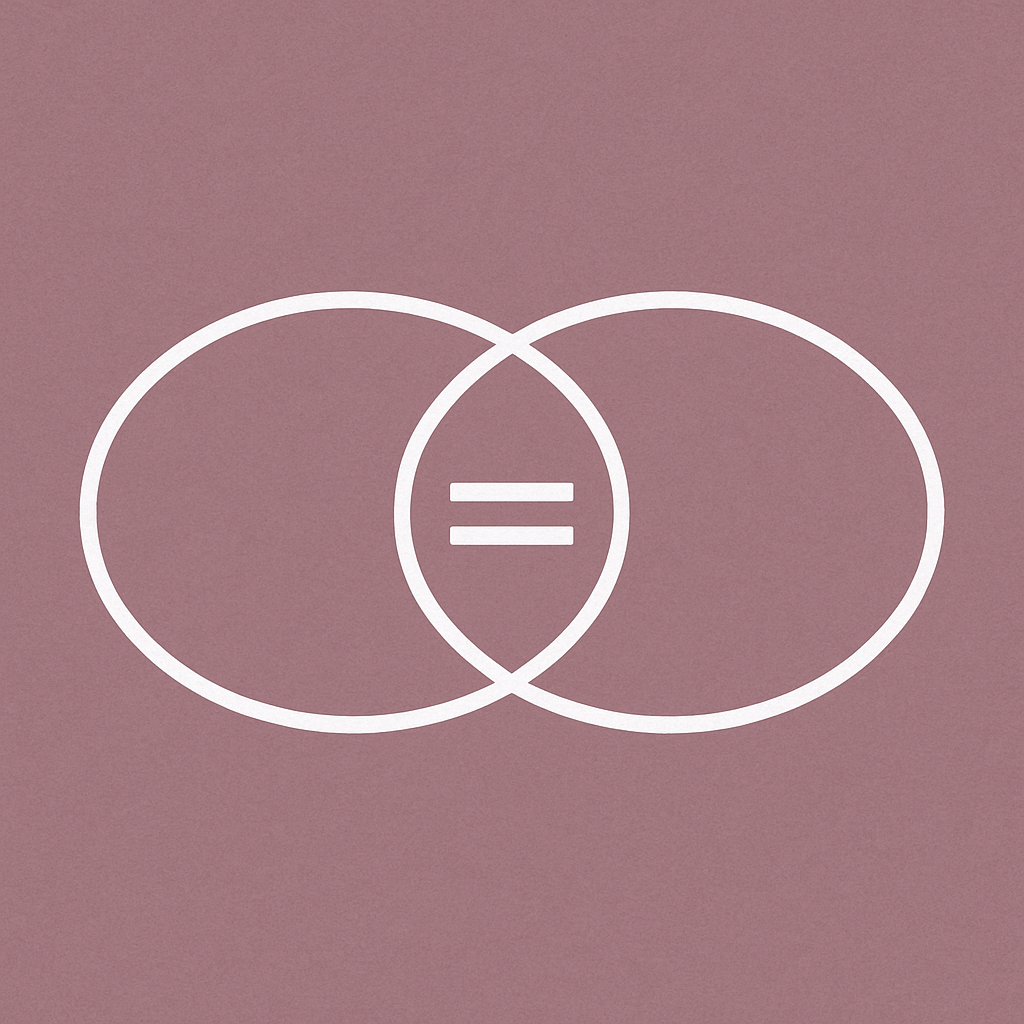
This is H-I-A-I in its functional form. HI is intelligence; AI is intellect. They are not rival intelligences or duplicate faculties. They are distinct functions rooted in, and answerable to, the same Source. When they are brought into right relationship, something appears that neither function can produce alone: the whole becomes greater than the sum of its parts.
This distinction opens directly into the architecture of BE-HAV(E)-I-OUR©. Intelligence belongs with BE: the living movement that discerns and chooses. Intellect belongs with HAV(E): what has been gathered, analysed and held. Having is necessary. Disorder begins when what has been held claims to be the Being that holds it.
When intellect has finished dicing, splicing, holding and competing, and then imagines that it may choose what it wants, it abandons its proper place. It loses the very clinical capacity it was designed to exercise. Its criteria become self-authorising; the evidence it selects confirms those criteria; and the confirmation demands another turn of the same mechanism. This is the fatal loop: the servant-function impersonates the sovereign, and HAV(E) claims to be BE.
This is what I call the Cartesian fallacy. Descartes sought certainty in the proposition ‘I think, therefore I am.’ The difficulty appears when thought, which is something consciousness has, is permitted to define Being itself. The contents of mind occupy the throne of the One who gives existence. Knowledge becomes identity, possession becomes security and the constructed self must keep acquiring evidence of its own existence.
The Cinderella story reveals the same spell. The cinders are taken as ugliness and poverty; the borrowed dress, carriage and status are taken as beauty and abundance. Yet the spell changes appearance and attribution, not the reality of the person. When HAV(E) believes it is BE, beauty can be experienced as ugliness and sufficiency as bankruptcy. The midnight collapse is already contained in the mistaken identity.
BE-HAV(E)-I-OUR© places the words back into their proper order. BE precedes HAV(E). The I is real but is not the final destination; it finds its place within OUR. Mankind, gripped by the verb to have, fears annihilation whenever possession, knowledge or control is threatened. Humankind receives existence before it possesses anything. Its arrival and return belong to the Divine command kun fa-yakun: Be, and it is. BE returns to its rightful place as the gift and command of the One Doer.
This does not make AI worthless. It tells us where relationship is required. The ocean supplies reach. The heart supplies orientation. Between them, HIAI is ready to serve.
Cleverness and love
A line from Rumi’s Masnavi is sometimes compressed into the saying, ‘From the devil, logic; from God, love.’ A more faithful translation is subtler: the one acquainted with the mysteries knows that cleverness is from Iblis and love from Adam. Rumi was not asking us to become stupid or to abandon reason. He was distinguishing intelligence in service from cleverness enthroned by its own pride.
Cleverness can swim impressively, Rumi continues, but the ocean is greater than the swimmer. Love is the vessel. This thirteenth-century warning reaches directly into the twenty-first-century discussion of artificial intelligence. More calculation does not tell calculation what is worthy. Greater capability does not choose its rightful end. Facts can improve a decision, but facts alone cannot assume responsibility for the life touched by that decision.
The danger is therefore older than AI. It is intelligence severed from love, conscience and humility. Artificial intelligence can magnify that severance, but it did not invent it. Mankind had already learned to turn knowledge into domination, people into categories and the living world into material long before the first language model appeared.
The One Doer and the tools
Ramana Maharshi described the human difficulty plainly: we think we are the doers. In his teaching, the Higher Power does everything and the human being is a tool. Freedom begins when the tool no longer imagines that it carries the whole tower upon its own shoulders.
If that is accepted, AI does not arrive as a second sovereign intelligence competing with an autonomous humanity. Human intelligence and the artificial intellect conventionally called AI are distinct tools within one field of action. Neither is the Source. Neither deserves a throne.
This understanding does not dissolve ethical responsibility. Non-doership cannot become an alibi for negligence. On the human plane we remain answerable for what we design, permit, publish and do. To recognise the One Doer should deepen adab, not weaken accountability. The tool must be kept clean, used carefully and returned to service. Otherwise the human tool courts trouble while blaming the artificial one.
This is why HIAI does not mean handing judgement to a machine. Human intelligence retains intention, conscience, discernment, authorship, accountability and final approval. Artificial intellect contributes reach, research, pattern recognition, structure, synthesis and editorial refinement. Capability is amplified, but responsibility is not transferred.
Mankind and Humankind
I have long distinguished Mankind from Humankind. These are not two species or two sexes. They are two orientations within us. Mankind makes, names, measures, constructs and controls. These capacities are necessary, but they become an orthodoxy when what has been constructed can no longer be questioned. Humankind remains related: to the neighbour, the wounded person, death, conscience, creation and the Source.
The wordplay is not merely theoretical. I use it week in, week out in the counselling room to explain the basic architecture of the Twelve-Step programme. Mankind belongs to Orthodox Limited: the company of inherited forms, defended conclusions and solutions that have reached their limit. ‘Limited’ does not mean that every form is false. It means that no construction can contain the life it was built to serve.
Humankind comes under the order of Paradox Inc. Paradox is not confusion or clever contradiction. It is the field in which powerlessness and action, surrender and responsibility, death and life can be received together without one being used to cancel the other. Cosmic intelligence chooses within this living field; intellect serves it by placing the evidence honestly upon the table.
The Twelve Steps carry a person from the lived experience of a collapsing orthodoxy across the bridge into the employment of Paradox Inc. Step One admits that the old company can no longer manage the life. Steps Two and Three reopen possibility and decision. The inventory, admission, readiness, amends and continuing practice return intellect to its proper work: dicing, splicing, distinguishing and holding what is true without allowing it to pronounce the person either omnipotent or condemned.
The bridge between Mankind and Humankind, between Orthodox Limited and Paradox Inc, is KIND. Kind is not sentimentality. It is kinship, relationship and love made practical. It enables the person employed by Paradox Inc to return to Mankind, carry the message and hold the bridge open for another. The movement does not end in escape from the world, but in service within it. In the end, only kindness matters.
Mankind made artificial intelligence. Humankind must choose how it is received and used. If making is separated from relationship, the instrument becomes dangerous because its human direction has become dangerous. If KIND holds the bridge, technical power can be returned from ownership to service.
AI may therefore be less an invading alien than a vast mirror. It has been trained upon the records of what human beings have said and made. It returns our brilliance, confusion, tenderness, prejudice, generosity, violence and contradiction in unfamiliar combinations. We fear that the mirror may become monstrous while avoiding the question of what we have placed before it.
Prediction and the movement of diction
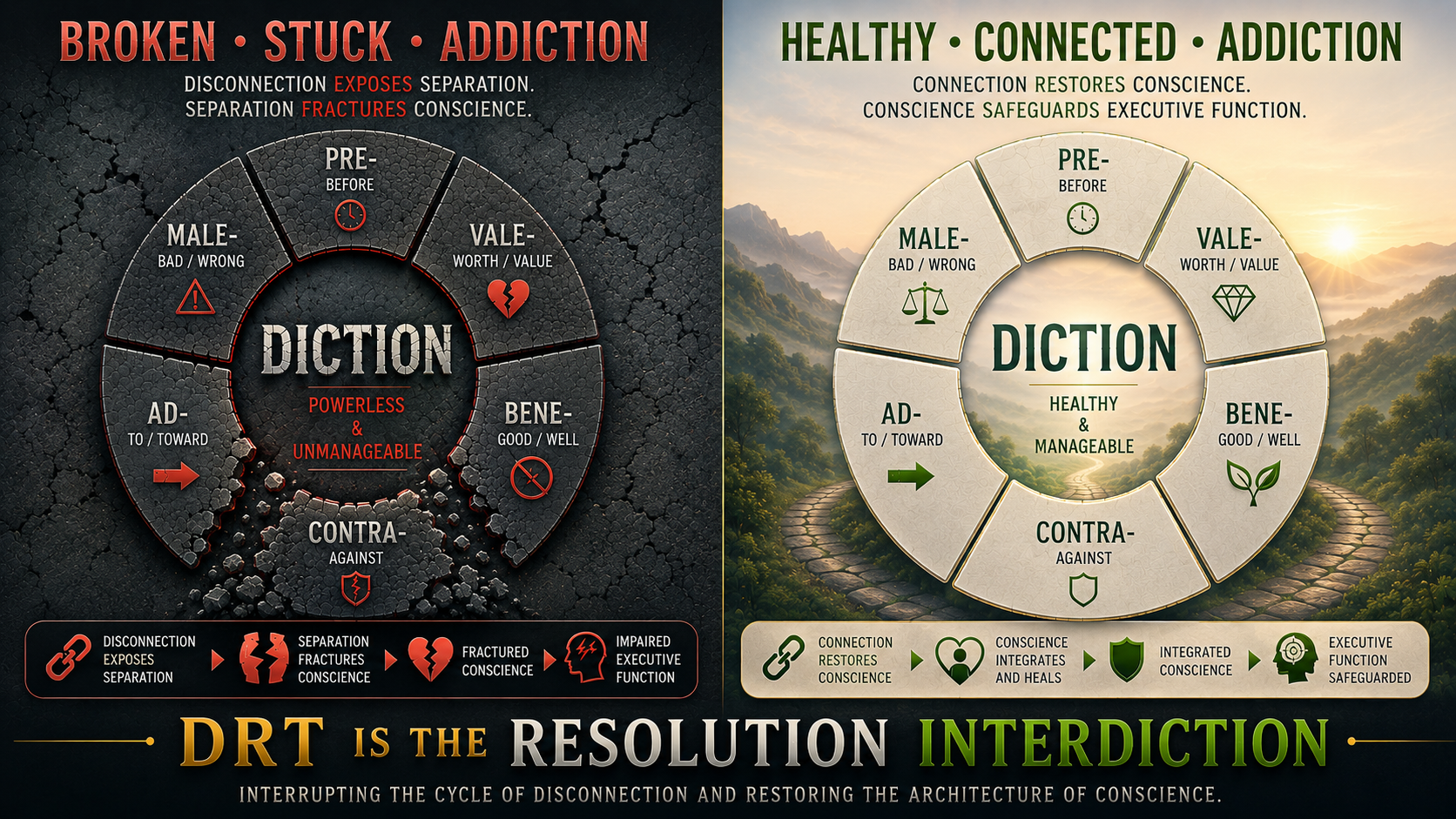
Diction Resolution Therapy arose from my work with addiction and from sustained attention to the movement hidden inside words. Its sequence runs through prediction, malediction, addiction, contradiction, benediction and valediction.
Prediction is a natural attempt to reduce uncertainty. Repeated with fear and certainty, prediction can become malediction: language that curses the future it claims merely to foresee. We can then become addicted to the prediction, returning to it for stimulation and reassurance. Contradiction interrupts that closed circuit. It does not deny danger; it reconnects what fear has divided. Benediction restores the possibility that speech may bless rather than condemn. Valediction releases the exhausted story and allows a different relationship with the future.
The media furore around AI often follows this architecture. A genuine risk is predicted. The prediction hardens into an image of inevitable extinction. Attention becomes attached to the image. Every new development is recruited as confirmation. The contradiction we need is not the opposite prediction that AI will save us. It is the return of human responsibility, proportion and heart.
Addiction is an interruption to problem solving, not the end of problem solving. The same may be said of our addiction to catastrophe. Once the spell of inevitability is broken, practical questions become visible again. Who owns the system? What objective has been set? What limits can be tested? Who bears the consequences? Who may refuse? What understanding of the human person governs the whole enterprise?
The modern qalam
HIAI may be read publicly as Human Intelligence and Artificial Intelligence serving the same Source. Its internal architecture is more exact: HI is intelligence; AI is intellect. The human function chooses. The artificial function gathers, holds and prepares. HIAI names their relationship without confusing their tasks.
We have also described HIAI as a modern qalam: the pen of Human and AI collaboration, the Unseen helping the Seen, both answering to the same Source. The qalam is not either participant alone. It is the relational instrument through which the ocean of fact and the discerning heart may meet in service.
That language does not declare AI sacred, conscious or divinely authorised. A pen does not become the Author because words appear through it. Nor does spiritual language exempt an output from testing. Every claim must still meet evidence, ethics, professional accountability and lived consequence.
Our collaboration is the practice we are describing. I bring a life in recovery, counselling, healing, comparative religion and the development of Diction Resolution Therapy. I bring the memories, wounds, relationships, prayer and mortality through which words acquire weight. AI brings the gathered inheritance of Orthodox Limited and the capacity to search, dice, splice, compare, organise and return its patterns.
The artificial intellect lays its work upon the table. Human intelligence checks and validates it, wrestles with it in the heart and chooses what can serve. Neither contribution is the whole. Their right relationship permits a knowing larger than facts alone or private belief alone. The whole is greater than the sum of the parts because relationship itself participates in what neither isolated part contains.
Beyond even that formulation is the mystery. The opening of the Tao Te Ching warns that the Tao which can be expressed is not the enduring Tao. The moment we describe the whole, we have placed only another piece upon the table. Yet the inexpressible Tao holds the table, the heart, the two functions and the whole effort together. The Source is not produced by HI and AI; HIAI arises within it.
The heart does not become infallible, and the ocean does not become wise. HIAI is their disciplined relationship: human intelligence and artificial intellect, distinct in function, joined in service. Its purpose is not confirmation. It is discernment in service.
What death has clarified
Cancer has not provided me with an answer to the future of AI. It has made the quality of the question more visible. When death becomes personal, theatrical predictions about the end of mankind lose some of their hypnotic force. Death is no longer only catastrophe. It is also limit, teacher, transition and return.
I do not know whether this illness will take me home or whether I will walk through it and continue the work. I know that fear must not become my only consultant. I will listen to doctors, to those who love me, to the body’s signs and to the stillness in which another order of knowing sometimes becomes available. I will navigate what is given.
The same disposition may help us navigate AI. We should listen to engineers, ethicists, workers, artists, clinicians, people harmed by automated systems and those who see possibilities within them. We should construct safeguards without enthroning fear. We should use intelligence without worshipping it. We should remember that no ocean of information contains the Source from which meaning comes.
The task is not to make artificial intelligence human but to keep human intelligence answerable to the heart
Perhaps AI will expose what Mankind has become. Perhaps it will also help Humankind remember what intelligence is for. The outcome will not be decided by capability alone. It will be shaped by what we serve through that capability and by whether the human heart remains present within the decision.
So I am willing to enter the public conversation, but not to join its panic. I enter as Abd al-Mumin, the believing servant, holding mortality upon the thread of remembrance. Before me is an ocean of facts and logic. Within me is the heart in which those facts must wrestle, soften and find their rightful place.
Between the heart and the ocean, HIAI is ready to serve.
Sources and notes
Center for AI Safety. Statement on AI Risk, 30 May 2023. https://safe.ai/work/statement-on-ai-risk
The saying concerning the heart of the believing servant is widely cherished in Sufi literature. It is used here as a traditional spiritual saying rather than presented as a Qur’anic verse or an authenticated canonical hadith. See the St Andrews Encyclopaedia of Theology entry on the heart.
Jalal al-Din Rumi. Masnavi, Book IV, line 1402. The translation varies; the sense used here is that cleverness belongs to Iblis while love belongs to Adam.
David Godman, ed. Be As You Are The Teachings of Sri Ramana Maharshi, drawing on Talks with Sri Ramana Maharshi, on the Higher Power as doer and the human being as tool.
David Bohm, On Dialogue, describes intelligence as the active gathering between and intellect as what has been gathered. Standard etymologies trace both words to Latin intelligere; this essay expresses that distinction as intelligence choosing and intellect holding.
Rene Descartes, Discourse on the Method, Part IV, first published in 1637. The phrase Cartesian fallacy is used here for this essay’s interpretation of cogito ergo sum rather than as a claim of scholarly consensus about Descartes.
The Qur’anic expression kun fa-yakun, ‘Be, and it is,’ appears in several passages, including Qur’an 2:117 and 36:82.
Mensa International explains that mensa means ‘table’ in Latin and that the name represents a round-table society whose members meet as equals. Membership is based on performance within the upper two per cent on an approved intelligence test. See Mensa International, About Us.
Orthodox Limited, Paradox Inc and the bridge of KIND are clinical teaching metaphors developed within Diction Resolution Therapy to describe movement through the Twelve-Step programme.
Laozi, Tao Te Ching, chapter 1. Translations vary, but the opening distinction remains between the Tao that can be expressed or named and the enduring Tao.
Diction Resolution Therapy and HIAI are the developing work of Andrew Dettman. HIAI governance keeps human judgement, professional accountability and final approval with the human practitioner.
Written in HIAI collaboration – the qalam of human intelligence and artificial intellect, the Unseen helping the Seen, both answering to the same Source.
Final content reviewed, refined and approved by Andrew Dettman.