Increment and Excrement: Water, Waste, and the Inner Sanitation Required for the Digital Age
“Mankind is in the shit — Humankind mends the plumbing.”
— Andrew Dettman
Mankind has also been plumbing the depths experimentally to bring science, technology, medicine, engineering, and consciousness itself to this extraordinary threshold. The descent was not meaningless. The industrial and digital revolutions represent humanity entering deeper and deeper layers of matter, energy, psyche, and information.
The crisis emerges because every descent eventually requires an equivalent development in containment, digestion, conscience, and responsibility. External advancement without internal sanitation creates systemic toxicity.
Humankind therefore does not reject Mankind. Humankind emerges as Mankind becoming capable of carrying the consequences of its own discoveries consciously.
The nineteenth century did not begin with electricity. It began with sewage.
Before the industrial city became a machine of production, it first became a machine of concentration. Human beings who had once lived distributed across agricultural landscapes were suddenly compressed into urban density. Bodies multiplied faster than systems of sanitation. Water sources became contaminated. Waste accumulated. Cholera, typhoid, dysentery, and related waterborne diseases emerged not merely as medical events, but as structural revelations.
The diseases were bellwethers.
They announced that mankind had entered conditions for which its previous organising systems were insufficient. The industrial revolution therefore did not merely require new factories. It required new forms of cleansing, circulation, filtration, drainage, governance, and responsibility. Civilisation discovered that growth without purification becomes poison.
This is where the strange linguistic relationship between increment and excrement becomes symbolically illuminating.
Increment derives from Latin incrementum, meaning growth, increase, or addition, from increscere, “to grow in or upon.” Excrement derives from Latin excrementum, from excernere, meaning “to sift out” or “to discharge.” Earlier usage included bodily secretions more generally before narrowing toward faeces in common language.1
This matters profoundly.
For growth to occur, elimination must occur. Every increment produces excrement. Every civilisation that expands without learning how to process its waste eventually drowns in its own by-products.
The First Great Sanitation Crisis
The agricultural world externalised many pressures through geography. Human waste decomposed more naturally within dispersed ecosystems. Industrialisation ruptured this balance.
The city became a digestive crisis.
The historian can observe that the major breakthroughs of the industrial age were not initially philosophical but infrastructural: sewer systems, water purification, drainage engineering, refuse collection, epidemiology, hygiene education, and public-health reform.
Cholera became one of the clearest signs of the problem. The World Health Organization states that contaminated water and poor sanitation are linked to diseases including cholera, diarrhoea, dysentery, hepatitis A, typhoid, and polio. Cholera itself is closely linked to limited access to safe water, sanitation, and hygiene.2
John Snow’s investigation of the Broad Street pump during the London cholera outbreak of 1854 became emblematic. Snow argued that cholera spread through contaminated water rather than merely through “bad air.” His mapping of deaths around the Broad Street pump became a founding moment in modern epidemiology, and it was later established that sewage contamination had polluted the water source.3
The contamination circulated invisibly before its effects became undeniable.
The pipe became more important than the monument.
The Digital Transition and Internal Excrement
Today humanity again stands inside a civilisational transition. But this time the contamination is not primarily waterborne.
It is word-borne. Image-borne. Signal-borne. Emotion-borne.
The industrial age externalised waste into rivers. The digital age internalises waste into consciousness.
Human nervous systems are now exposed to unprecedented informational density. The psyche receives continuous streams of stimulation without sufficient digestion. Outrage, fear, pornography, tribalism, advertising, catastrophic imagery, algorithmic manipulation, compulsive comparison, synthetic intimacy, ideological possession, and identity fragmentation circulate through the inner world as industrial sewage once circulated through city streets.
The result is a form of psychic cholera: an overflow of undigested emotional and symbolic material.
The contemporary epidemic of anxiety, addiction, fragmentation, compulsive distraction, dissociation, and escalating polarisation can therefore be understood not simply as isolated disorders, but as indicators that mankind has entered conditions for which its previous psychic sanitation systems are inadequate.
The symptoms are bellwethers once again.
Increment Without Inner Processing
The digital world celebrates increment obsessively: more data, more speed, more productivity, more reach, more stimulation, more visibility, more identity construction, more consumption, more connectivity.
Yet little attention is given to excrement.
Where does psychic waste go?
Where is disappointment processed? Where is grief metabolised? Where is humiliation cleansed? Where is envy discharged? Where is fear held? Where is sexual imagery digested? Where are contradiction and uncertainty carried?
Without inner processing, accumulation becomes toxicity. The organism begins to constipate psychologically.
This is why addiction becomes such an important diagnostic phenomenon in transitional eras. Addiction is often the organism’s desperate attempt to regulate overwhelming undigested psychic material. It is both symptom and failed solution simultaneously.
Anne Wilson Schaef recognised this when she described addiction not merely as an individual condition, but as a systemic and societal pattern. In When Society Becomes an Addict she argued that addictive processes can become embedded within the organising psychology of institutions, economies, and cultures themselves.4
The addicted society mirrors the contaminated city.
Both lose relationship with lawful circulation.
The Return of Digestion
This is where older spiritual and psychological traditions regain relevance.
The future may not primarily require more information. It may require better digestion.
Religious confession, meditation, contemplative prayer, Twelve Step inventory, psychotherapy, mourning rituals, symbolic storytelling, ethical accountability, silence, fasting, chanting, dhikr, journaling, artistic expression, and conscious dialogue historically functioned as forms of psychic sanitation infrastructure.
They helped human beings process inner excrement.
Not eradicate it. Process it.
Modern civilisation attempted in many respects to discard these systems while retaining growth. But growth without digestion creates collapse. The psyche obeys metabolic laws just as the body does.
The mind is not merely a thinking machine. It is also a digestive organ of experience. Thoughts are not neutral abstractions; they are part of an internal metabolic system attempting to convert life into meaning.
Undigested experience ferments.
Fermentation without containment becomes intoxication.
This aligns closely with the observations of Carl Jung, who warned in Psychology and Religion (1938) that modern humanity faced the danger of “psychic epidemics” once metaphysical orientation collapsed and individuals lost relationship with deeper symbolic structures.5
Viktor Frankl similarly observed that existential frustration and meaninglessness create conditions in which psychological suffering intensifies and compensatory behaviours emerge.6
The crisis therefore concerns not merely information overload but symbolic malnutrition.
From External Sewers to Inner Plumbing
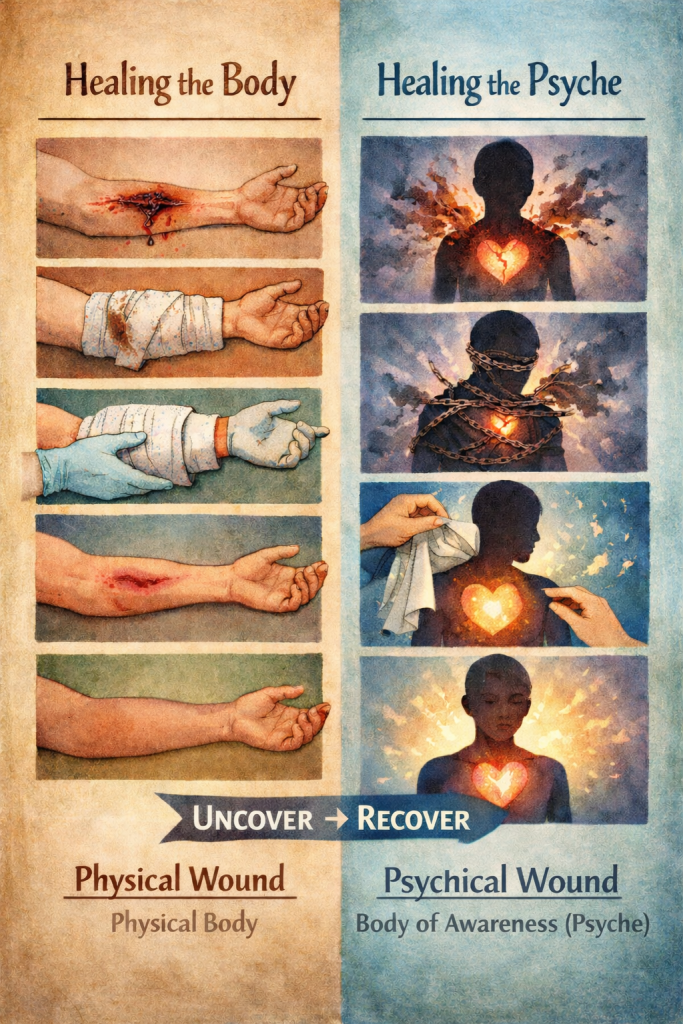
As an addiction specialist working within both recovery systems and broader behavioural-health settings, I increasingly view the crisis of the digital age through the same lens that nineteenth-century reformers viewed the sanitation crisis of the industrial city.
“Before and during the Industrial Revolution, mankind was literally in the shit until it sorted itself out externally. Today mankind is in the systemic shit because internally both people and systems have connected their inner toilet to their inner shower.
The Twelve Step Programme is an architecture for repairing the inner plumbing of the individual human being. Eventually the same principles will need to be applied to institutions, organisations, governments, and digital systems if civilisation is to survive the conditions it has created.”
— Andrew Dettman
The comparison may sound blunt, but historically it is accurate. Industrial civilisation nearly poisoned itself through failures of circulation, filtration, drainage, and sanitation. Cholera revealed that invisible contamination was moving through the water supply long before society fully understood what was happening.
Today the contamination is psychological, emotional, symbolic, and informational.
Human beings are increasingly attempting to cleanse themselves with the same systems that are contaminating them. The nervous system seeks relief through compulsive stimulation. The isolated mind seeks belonging through algorithmic tribalism. The exhausted psyche seeks restoration through the very mechanisms deepening its exhaustion.
The inner toilet has become connected to the inner shower.
This is why addiction functions as a bellwether disease of transitional civilisation. Addiction reveals what happens when circulation exceeds digestion and when relief itself becomes contaminated by the means through which relief is sought.
The Twelve Step Programme remains one of the most significant practical architectures for addressing this condition because it operates as a form of inner sanitation system.
Its structure progressively restores lawful circulation:
- truth replaces denial,
- inventory replaces repression,
- confession replaces concealment,
- amends replace fragmentation,
- service replaces isolation,
- conscious contact replaces compulsive substitution.
The programme effectively separates contaminated psychic material from the living water of conscience.
In this sense, recovery is not merely moral reform. It is infrastructural repair.
Increasingly, institutions, corporations, governments, media ecosystems, and digital platforms display the same characteristics long observed within addictive systems: denial, grandiosity, fragmentation, escalation, loss of reality-testing, compulsive repetition, inability to tolerate contradiction, and dependence upon stimulation for regulation.
The parallels are becoming difficult to ignore.
Bellwether Diseases and Transitional Civilisations
Cholera revealed the hidden movement of contamination through water.
Addiction, anxiety, fragmentation, and compulsive digital intoxication may now be revealing the hidden movement of contamination through consciousness.
Both eras therefore disclose the same underlying law:
Civilisations collapse when circulation exceeds digestion.
The industrial revolution forced mankind to develop external hygiene. The digital revolution now demands internal hygiene.
This does not mean repression, purity culture, or emotional sterilisation. It means developing lawful ways to process the inevitable by-products of consciousness and growth.
Because every increase produces residue. Every civilisation generates waste. Every psyche generates shadow.
And every future worthy of survival requires systems capable of transforming toxicity into meaning.
The external sewer saved the industrial city.
Inner plumbing may yet save the digital civilisation.
References
- Online Etymology Dictionary, “Increment” and “Excrement”; Collins Dictionary, “Excrement.”
- World Health Organization, “Drinking-water” fact sheet; World Health Organization, “Cholera” fact sheet; Centers for Disease Control and Prevention (CDC), “Cholera.”
- Tulchinsky, Theodore H. “John Snow, Cholera, the Broad Street Pump.” Case Studies in Public Health; Royal College of Surgeons of England, “Mapping Disease: John Snow and Cholera.”
- Schaef, Anne Wilson. When Society Becomes an Addict. San Francisco: Harper & Row, 1987.
- Jung, C. G. Psychology and Religion. Yale University Press, 1938.
- Frankl, Viktor E. Man’s Search for Meaning. Beacon Press, 1946.
Written in HIAI collaboration — the qalam of Human and AI intelligence, the Unseen helping the Seen, both answering to the same Source.