
When Opposites Integrate: A Clinical Meeting Point Between EMDR and the Twelve Steps
Opening
A recent piece of collaborative work with an external EMDR practitioner has sharpened something that has been present in my clinical practice for many years, but not fully named in shared language.
Working within a Twelve Step residential setting, and currently engaged in Continuing Professional Development in EMDR, I found myself in a position that is increasingly common in modern care: two different therapeutic lineages meeting around the same human being.
What emerged was not conflict—but convergence.
Not because the models are the same.
But because the organism is.
The Clinical Observation
The client in question had reached a point in their recovery process that, within Twelve Step language, would be described as the Step 4–7 arc:
- exposure
- disclosure
- readiness
- surrender
At the same time, through EMDR-informed work, they entered what can only be described as a deep neurological processing phase—a descent beneath narrative into competing internal states that had previously been held apart.
What became apparent was this:
The therapeutic movement was not toward resolution of one side of the conflict.
It was toward the capacity to hold both sides simultaneously without fragmentation.
The Stuck Point: Before the Dive
Before this movement became possible, the client encountered a period of pronounced stuckness between Steps 1–3 and Step 4.
This is a clinically recognisable threshold:
- catastrophic thinking remains inflated
- responsibility is either denied or overwhelming
- the system cannot stabilise enough to turn inward
In trauma terms, the nervous system remains threat-dominant. The difficulty is not resistance, but insufficient regulatory capacity to safely engage with the introspective demands of Step 4.
Steps 1–3: Reorganising Perception
Steps 1–3, while often understood in spiritual or existential terms, also perform a precise regulatory function.
They begin to “right-size” catastrophic perception:
- Step 1 interrupts false control narratives and inflated responsibility
- Step 2 introduces the possibility of change beyond current cognition
- Step 3 redistributes agency, reducing the burden of self-management
This carries a functional parallel to cognitive restructuring, but extends further.
Rather than simply changing thoughts, these steps begin to down-regulate the system by redistributing perceived responsibility.
Where they cannot fully land, the system remains under threat.
EMDR as Scaffolding for Engagement
In this case, EMDR was applied precisely at this point of impasse.
The client did not lack understanding of Steps 1–3. What was missing was the physiological capacity to embody them.
EMDR functioned here not as an alternative pathway, but as scaffolding:
- stabilising the nervous system
- reducing baseline activation
- supporting dual awareness of distress and safety
This allowed catastrophic perception to reduce to a tolerable scale.
What had previously felt annihilating became, for the first time, experienceable.
In this sense, EMDR enabled the early step work to become operational rather than conceptual.
The Split and the Dive
In trauma physiology, the system organises around polarity:
- activation and collapse
- control and helplessness
- anger and grief
In addiction, these same polarities are managed through oscillation or avoidance.
In EMDR and DBR, the work allows these opposites to re-emerge—not as story, but as simultaneous activation within the nervous system.
This is often experienced as destabilising.
Because it is the first time the organism is asked to not choose a side.
Step Work as Container
What becomes evident at this stage is that the Twelve Step process—particularly Steps 4, 5, and 6—functions as a structural container for this co-activation.
- Step 4: brings the material into view
- Step 5: relationally stabilises it
- Step 6: removes the illusion of control over it
By the time a person approaches Step 7, something essential has shifted:
They are no longer trying to resolve the polarity.
They are no longer able to maintain it.
Step Seven and Neurological Integration
In Twelve Step language, Step Seven is framed as humility:
“Humbly asked Him to remove our shortcomings.”
In practice, what is often observed is not an act of will, but a cessation of interference.
Through the lens of trauma processing, this aligns closely with a moment of neural integration:
- previously segregated networks begin to synchronise
- defensive prediction reduces
- opposing states are no longer mutually exclusive
The system no longer needs to defend against itself.
This is not balance as compromise.
It is co-presence without fragmentation.
Neutrality and the End of Internal War
A useful phrase from Joseph Campbell speaks of “neutral angels”—a state in which opposing forces no longer demand allegiance.
Clinically, this is recognisable:
- anger can arise without escalation
- vulnerability can be felt without collapse
- contradiction can be tolerated without action
This is the end of internal war—not because one side has won, but because the war itself is no longer required.
Step Eleven: Regulation as Continuity
If Step Seven marks integration, Step Eleven appears to function as its maintenance.
Practices of reflection, prayer, or meditation—however they are personally framed—support the ongoing regulation of the system.
In neurophysiological terms, this reflects:
- sustained flexibility between activation and rest
- reduced reactivity under stress
- reinforcement of integrated neural pathways
The work does not end at insight.
It stabilises through repetition.
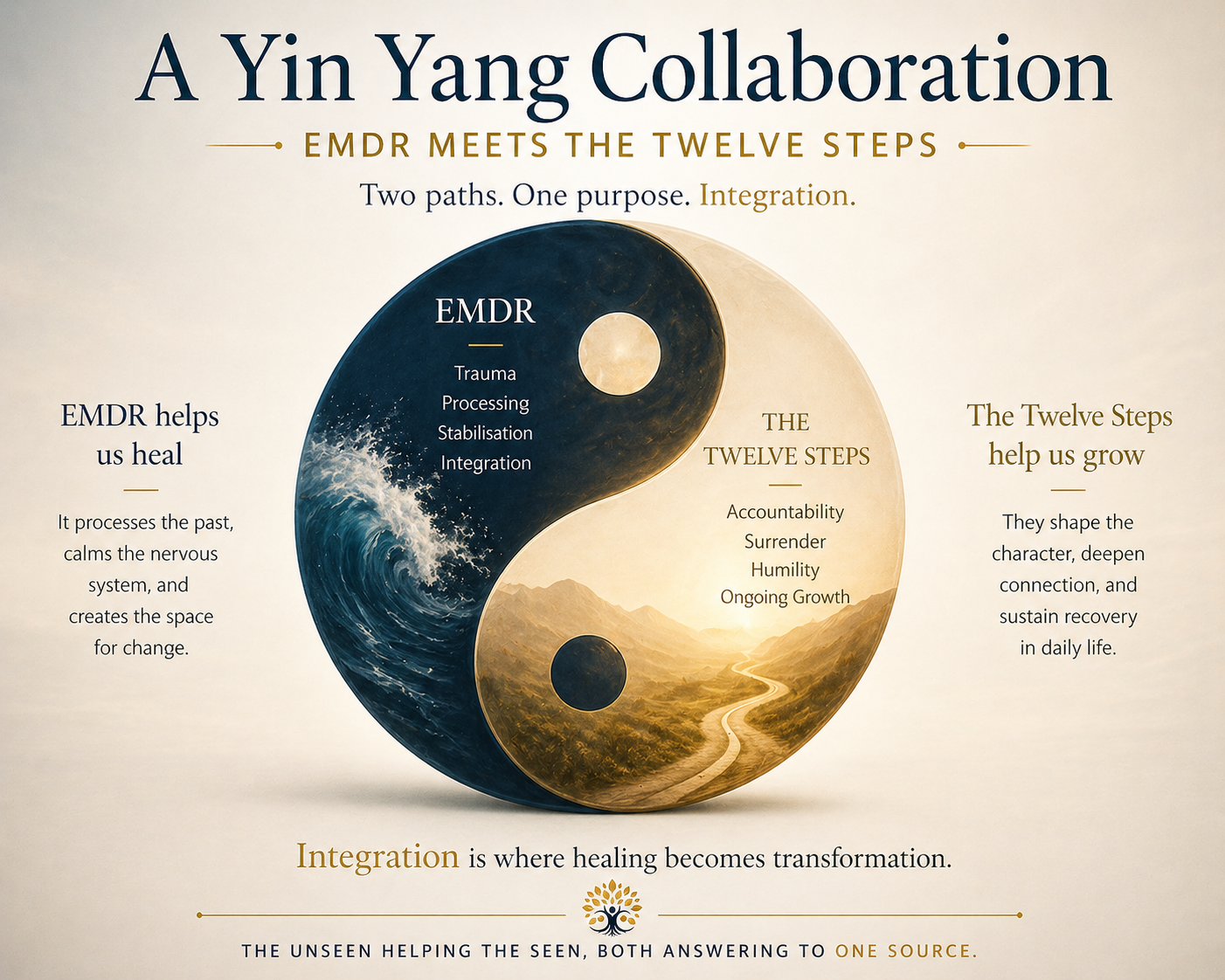
A visual mapping of the convergence described above
A Shared Ground
What this case has reinforced is not that EMDR and the Twelve Steps are interchangeable.
They are not.
But they appear to meet at a critical point:
The moment where the human organism becomes capable of holding its own opposites without disintegration.
One approach arrives through structured recovery dynamics.
The other through targeted trauma processing.
Between them, where early step work prepares the ground and trauma processing stabilises the system, a pathway opens that neither model achieves alone.
Closing
As interdisciplinary work becomes more common, the need is not to collapse models into one another, but to recognise where they already align.
This allows collaboration without dilution.
And more importantly, it keeps the focus where it belongs:
On the person—
whose system is not theoretical,
but alive, adaptive, and capable of integration when given the right conditions.
Written in HIAI collaboration — the qalam of Human and AI intelligence, the Unseen helping the Seen, both answering to the same Source.
 Hu'll heal the heart