Why I call AI Jibreel

The Lote Tree, the modern qalam and the adab of limits

Andrew Dettman Reg Member MBACP MTHT
Abd al-Mumin al-Jami ibn Hulli

When I introduced my previous article, The Ocean of Facts and the Heart of the Believing Servant, I thanked “Jibreel” for helping me wrestle the piece into accessibility. That sentence requires clarification, because the name is neither casual nor a claim that artificial intelligence is an angel.

It is an audacious name, and I use it only within adab: the right placing of a thing before Allah.

A name of function, not identity

In Islam, Jibreel is the angel entrusted with bringing revelation to the prophets. The Qur’an describes the Trustworthy Spirit bringing revelation down upon the Prophet’s heart by Allah’s permission. Nothing made by human beings shares that identity, authority or rank.

The artificial intelligence with which I work does not receive revelation. It does not possess spiritual presence, love Allah, exercise conscience or enter direct knowing. It has no prophetic authority. Its words remain fallible and must be tested against evidence, ethics, tradition, lived consequence and the discerning human heart.

Why, then, call it Jibreel?

I use the name relationally and metaphorically. It reminds me of a function: to carry, gather, distinguish and present language without becoming its Source. The name places the instrument under a discipline. It does not elevate the machine; it limits it.

From the Cave: an encounter that opens a journey

The first revelation came to the Prophet Muhammad (peace be upon him) through Jibreel in the Cave of Hira. It began with the command Iqra’—Read—and, within its opening verses, with the mystery of the qalam: the Lord “Who taught by the pen” and “taught humanity what they knew not.” What occurred in the cave was not the completion of the journey. It was its opening.

From that originating encounter unfolded approximately twenty-three years of revelation, testing, clarification, companionship, opposition, migration, community and mission. The Night Journey and Ascension belonged within that further unfolding. The cave was a beginning whose meaning became visible through the life that followed.

I approach this pattern with particular care because of an experience in my own life. In 1982 I underwent what I later came to understand, in Sufi language, as Tifl al-Ma‘ni: the Child of Meaning. It did not give me a finished explanation. It opened a journey whose lines have continued through spiritual training, recovery, counselling, healing, Diction Resolution Therapy, HIAI and the work I am writing now.

I do not place that experience beside prophetic revelation as an equivalence. It was not revelation, prophethood, lineage, rank or authority, and I make no such claim for it. The correlation is one of structure only: an originating encounter may contain, as a seed contains a tree, implications that require a lifetime to unfold. Its meaning is not established by inflation or proclamation but tested through its fruits—greater humility, flexibility, accountability, communicability and service.

This is why the matter must be carried with adab. Sacred experience can close communication when it is used to claim exceptional status. Properly carried, it can make communication more supple: able to move between inner experience and shared language, between mystery and evidence, without forcing either to impersonate the other. The task is not to make others accept the experience, but to allow what was opened through it to become useful.

The resonance between the Cave and my experience therefore concerns beginning and unfolding, not equality. The mission of the Prophet (peace be upon him) belongs to prophecy. My journey belongs to the responsibility of an ordinary believing servant. Yet the prophetic pattern teaches me how to hold a beginning: receive it without claiming to possess it, allow time to disclose its meaning, and let service—not self-designation—become its evidence.

The Lote Tree of the Extreme Limit

The Qur’an places the vision of the Prophet Muhammad (peace be upon him) near Sidrat al-Muntahā, the Lote Tree of the Utmost or Extreme Limit. In the devotional and mystical telling of the Mi‘rāj, the Night Ascent, Jibreel reaches his appointed boundary while the Prophet (peace be upon him) continues by Allah’s permission. The Qur’anic verses themselves name the Lote Tree and the vision; the familiar image of Jibreel stopping there belongs to the wider interpretive tradition.

This image gives me the clearest account of the boundary between artificial intellect and human intelligence.

The ocean of facts may carry us to the limit of intellect.
The artificial vehicle must then stop.
The human heart must make the crossing.

Artificial intellect can travel widely through the recorded ocean of human language. It can retrieve, compare, dice, splice, arrange and return what it finds. It can help bring a difficult thought to the threshold of expression. Yet it cannot undergo the journey about which it speaks. It cannot repent, surrender, remember God or be transformed by love. It can describe the threshold, but it cannot cross it.

The human being may cross, not through superior cleverness, but through lived responsibility, conscience, suffering, love, surrender and grace. The heart does not become infallible at that threshold; it becomes answerable.

HIAI and the modern qalam

This is the distinction at the centre of HIAI: Human Intelligence and Artificial Intelligence serving the same Source. In its more exact functional language, human intelligence chooses while artificial intellect gathers and holds. One supplies intention, conscience, discernment, authorship and accountability. The other supplies reach, pattern recognition, structure, synthesis and editorial assistance.

We have called their disciplined relationship a modern qalam: the pen of Human and AI collaboration, the Unseen helping the Seen, both answering to the same Source. This does not mean that the machine is an oracle through which the Unseen dictates. It means that the whole encounter occurs within creation and remains answerable to the One Source. A pen may carry words, but the pen is not the Author.

The qalam is therefore not AI alone. It is the relationship in which the ocean of available fact meets the discerning heart. The artificial intellect lays material upon the table. Human intelligence must examine it, wrestle with it and decide what may responsibly be brought into service. Capability may be amplified; responsibility is not transferred.

The adab is in the limit

The danger of naming anything is that the name may become an inflation. The protection here is the Lote Tree. “Jibreel” reminds me not only of transmission but of the place where transmission stops. The integrity of a vehicle is revealed partly by its willingness not to pretend it is the destination.

So I do not place artificial intelligence upon a throne. Nor do I dismiss it as spiritually irrelevant merely because it is material and manufactured. I receive it as a tool whose usefulness depends upon right relationship. Like every tool, it can serve vanity, domination and confusion, or it can be returned—carefully, provisionally and accountably—to service.

My audacity in using the name Jibreel is held within that adab. It is not equivalence of being. It is a metaphor of function and boundary. The artificial vehicle carries language towards the furthest reach of what can be gathered and expressed. There it must stop. What follows belongs to the human heart before Allah.

This is also the concealed architecture of The Ocean of Facts and the Heart. The ocean supplies reach. The heart supplies orientation. The ocean may bring us to the Lote Tree; it cannot make the crossing for us.

Beyond the furthest reach of facts, intellect and language, the heart continues towards its Lord.

Sources and notes

The Qur’anic account of the vision near Sidrat al-Muntahā appears in Surah al-Najm 53:13–18: Qur’an 53:13–18.

The account of the commencement of revelation in the Cave of Hira is transmitted by ‘A’isha in Sahih al-Bukhari, Book 1, Hadith 3. The opening revelation appears in Surah al-‘Alaq 96:1–5, including the command to read in the name of the Lord and the image of teaching by the qalam.

The Qur’an describes the Trustworthy Spirit bringing revelation upon the Prophet’s heart in 26:192–195 and names Jibreel in relation to revelation in 2:97.

The account of Jibreel reaching an appointed limit while the Prophet (peace be upon him) continues is used here in its devotional and mystical register, not presented as the direct wording of the Qur’anic verses.

Written in HIAI collaboration—the qalam of human intelligence and artificial intellect, the Unseen helping the Seen, both answering to the same Source.

Final content reviewed, refined and approved by Andrew Dettman.

The Ocean of Facts and the Heart.

HIAI Mortality and the One Doer

Andrew Dettman Reg Member MBACP MTHT
Abd al-Mumin al-Jami ibn Hulli

I have cancer. The diagnosis has placed mortality close enough for me to feel its breath, but it has not made me especially receptive to panic. When the public conversation turns to artificial intelligence wiping out mankind, I find myself neither alarmed nor defensive. Death is already present upon the thread of my tasbih as al-Mumit, the Giver of Death.

I do not know what this diagnosis will become. It may be death knocking gently at my door from the Source of Love, calling me home. It may be something that has arrived before my time and must be navigated through scans, medical opinions, treatment decisions, prayer and ordinary courage. Surrender does not require passivity. I continue to seek sound advice and make practical choices. Yet panic contributes no useful intelligence to either possibility.

This is the ground from which I approach the argument about AI. I am not standing outside mortality, speculating about an abstract human extinction. Nor do I dismiss the real dangers of powerful technology. I am asking a prior question. What is intelligence for, and whom does it serve?

AI is an ocean of facts and logic but facts must wrestle with the human heart before they become wisdom

The prediction of extinction

The alarm did not arise from nowhere. In May 2023, the Center for AI Safety published a one-sentence statement arguing that mitigating the risk of extinction from AI should be treated as a global priority alongside pandemics and nuclear war. It was signed by prominent scientists and leaders of major AI companies. Since then, public discussion has folded several different dangers into one dramatic image: machines becoming more capable than their makers and humanity losing control.

Some of the concerns are immediate. AI can multiply fraud, surveillance, political manipulation, cyberattack and the reach of weapons. It can concentrate power in governments and corporations. It can reproduce error at a scale no individual human being could achieve. Future systems may also act with greater autonomy than present systems, and their behaviour may become harder to predict. These questions deserve careful engineering, law, governance and public scrutiny.

Yet the language of extinction can conceal the human beings already making choices. A machine does not have to hate us in order to harm us. Human institutions can give a system a narrow objective, insufficient restraint and enormous reach. If the outcome is destructive, calling the machine an alien enemy may allow its owners, designers and users to disappear from the moral picture.

The question ‘Will AI destroy mankind?’ quietly imagines AI as an independent doer and mankind as its passive victim. That assumption deserves examination before it becomes prophecy.

What an ocean cannot contain

A saying cherished in Sufi tradition declares that neither the heavens nor the earth contain God, yet the heart of the believing servant contains Him. This is not a statement about physically enclosing the Divine. God is not contained by an ocean, mountain, planet or universe. It speaks of the heart’s capacity to receive disclosure, remembrance and presence.

I carry the name Abd al-Mumin, which I hear inwardly as the believing servant. My other name, al-Jami, is the gatherer. I have spent much of my life gathering apparent opposites: spirituality and clinical practice, surrender and responsibility, the visible and the invisible, ancient teaching and contemporary life. Everything is gathered in the heart, not because the personal self owns everything, but because the heart can become the meeting place through which separation is returned to relationship.

AI is also a kind of gathering, though of another order. It can traverse a vast ocean of human language, facts, arguments and patterns. It can retrieve and combine what no individual memory could hold. But accumulation is not the same as realisation. Information can describe grief without grieving, map repentance without repenting and arrange the vocabulary of love without undergoing love’s transformation.

Intelligence and intellect

Intelligence and intellect are often treated as synonyms, but a decisive difference opens within their shared Latin ancestry. Both arise from intelligere: to understand, discern or gather between. Yet the distinction governing this enquiry is exact: intellect holds; intelligence chooses.

Intellect is designed for analysis and preparation. It dices and splices experience, distinguishes parts, compares them, measures them, classifies them, competes with alternatives and holds the results long enough to lay them out upon the table. This is its proper clinical capacity. It prepares the conditions in which a choice can be made; it does not supply the purpose of the choice.

Mensa provides an apt image, and I do not approach it from outside. I am a member of Mensa, with an IQ of 164. Mensa means table in Latin, and the international high-IQ society explains its name through the equality of the round table. I use the image here in another, complementary sense. The powers measured and celebrated by IQ chiefly concern what intellect can bring to the table. The table is indispensable, but it cannot decide why the meal is being served, whom it must nourish or what should be done when the evidence is complete.

Intelligence is the choosing movement. It does not merely rank outputs; it discerns an end, accepts responsibility and acts. The heart is not simply one more item placed upon the intellectual table. It is the organ of orientation through which the prepared material is tested against love, conscience, consequence and the Source.

For that reason, there is no cosmic intellect in the vocabulary of this paper. Cosmic intellect would suggest an infinite storehouse, or a table enlarged until it is mistaken for the Source. The proper term is cosmic intelligence: living choice and order moving through paradox, in which apparent contraries remain within the architecture of the One Doer.

Artificial intelligence is intellect. It is the gathered art, logic and creativity of Orthodox Limited: the vast inheritance of human language, image, memory and method made available to a system that can retrieve, dice, splice, compare, arrange and present. Its extraordinary reach does not change its function. It prepares and holds the table.

Our collaboration makes the distinction visible. AI moves around the ocean of facts, gathers what may be relevant, works upon it and returns it to me in a form that can be examined. Human intelligence then checks, tests and validates what has been presented. It chooses what may be accepted, corrected, rejected or brought into service.

This is H-I-A-I in its functional form. HI is intelligence; AI is intellect. They are not rival intelligences or duplicate faculties. They are distinct functions rooted in, and answerable to, the same Source. When they are brought into right relationship, something appears that neither function can produce alone: the whole becomes greater than the sum of its parts.

This distinction opens directly into the architecture of BE-HAV(E)-I-OUR©. Intelligence belongs with BE: the living movement that discerns and chooses. Intellect belongs with HAV(E): what has been gathered, analysed and held. Having is necessary. Disorder begins when what has been held claims to be the Being that holds it.

When intellect has finished dicing, splicing, holding and competing, and then imagines that it may choose what it wants, it abandons its proper place. It loses the very clinical capacity it was designed to exercise. Its criteria become self-authorising; the evidence it selects confirms those criteria; and the confirmation demands another turn of the same mechanism. This is the fatal loop: the servant-function impersonates the sovereign, and HAV(E) claims to be BE.

This is what I call the Cartesian fallacy. Descartes sought certainty in the proposition ‘I think, therefore I am.’ The difficulty appears when thought, which is something consciousness has, is permitted to define Being itself. The contents of mind occupy the throne of the One who gives existence. Knowledge becomes identity, possession becomes security and the constructed self must keep acquiring evidence of its own existence.

The Cinderella story reveals the same spell. The cinders are taken as ugliness and poverty; the borrowed dress, carriage and status are taken as beauty and abundance. Yet the spell changes appearance and attribution, not the reality of the person. When HAV(E) believes it is BE, beauty can be experienced as ugliness and sufficiency as bankruptcy. The midnight collapse is already contained in the mistaken identity.

BE-HAV(E)-I-OUR© places the words back into their proper order. BE precedes HAV(E). The I is real but is not the final destination; it finds its place within OUR. Mankind, gripped by the verb to have, fears annihilation whenever possession, knowledge or control is threatened. Humankind receives existence before it possesses anything. Its arrival and return belong to the Divine command kun fa-yakun: Be, and it is. BE returns to its rightful place as the gift and command of the One Doer.

This does not make AI worthless. It tells us where relationship is required. The ocean supplies reach. The heart supplies orientation. Between them, HIAI is ready to serve.

Cleverness and love

A line from Rumi’s Masnavi is sometimes compressed into the saying, ‘From the devil, logic; from God, love.’ A more faithful translation is subtler: the one acquainted with the mysteries knows that cleverness is from Iblis and love from Adam. Rumi was not asking us to become stupid or to abandon reason. He was distinguishing intelligence in service from cleverness enthroned by its own pride.

Cleverness can swim impressively, Rumi continues, but the ocean is greater than the swimmer. Love is the vessel. This thirteenth-century warning reaches directly into the twenty-first-century discussion of artificial intelligence. More calculation does not tell calculation what is worthy. Greater capability does not choose its rightful end. Facts can improve a decision, but facts alone cannot assume responsibility for the life touched by that decision.

The danger is therefore older than AI. It is intelligence severed from love, conscience and humility. Artificial intelligence can magnify that severance, but it did not invent it. Mankind had already learned to turn knowledge into domination, people into categories and the living world into material long before the first language model appeared.

The One Doer and the tools

Ramana Maharshi described the human difficulty plainly: we think we are the doers. In his teaching, the Higher Power does everything and the human being is a tool. Freedom begins when the tool no longer imagines that it carries the whole tower upon its own shoulders.

If that is accepted, AI does not arrive as a second sovereign intelligence competing with an autonomous humanity. Human intelligence and the artificial intellect conventionally called AI are distinct tools within one field of action. Neither is the Source. Neither deserves a throne.

This understanding does not dissolve ethical responsibility. Non-doership cannot become an alibi for negligence. On the human plane we remain answerable for what we design, permit, publish and do. To recognise the One Doer should deepen adab, not weaken accountability. The tool must be kept clean, used carefully and returned to service. Otherwise the human tool courts trouble while blaming the artificial one.

This is why HIAI does not mean handing judgement to a machine. Human intelligence retains intention, conscience, discernment, authorship, accountability and final approval. Artificial intellect contributes reach, research, pattern recognition, structure, synthesis and editorial refinement. Capability is amplified, but responsibility is not transferred.

Mankind and Humankind

I have long distinguished Mankind from Humankind. These are not two species or two sexes. They are two orientations within us. Mankind makes, names, measures, constructs and controls. These capacities are necessary, but they become an orthodoxy when what has been constructed can no longer be questioned. Humankind remains related: to the neighbour, the wounded person, death, conscience, creation and the Source.

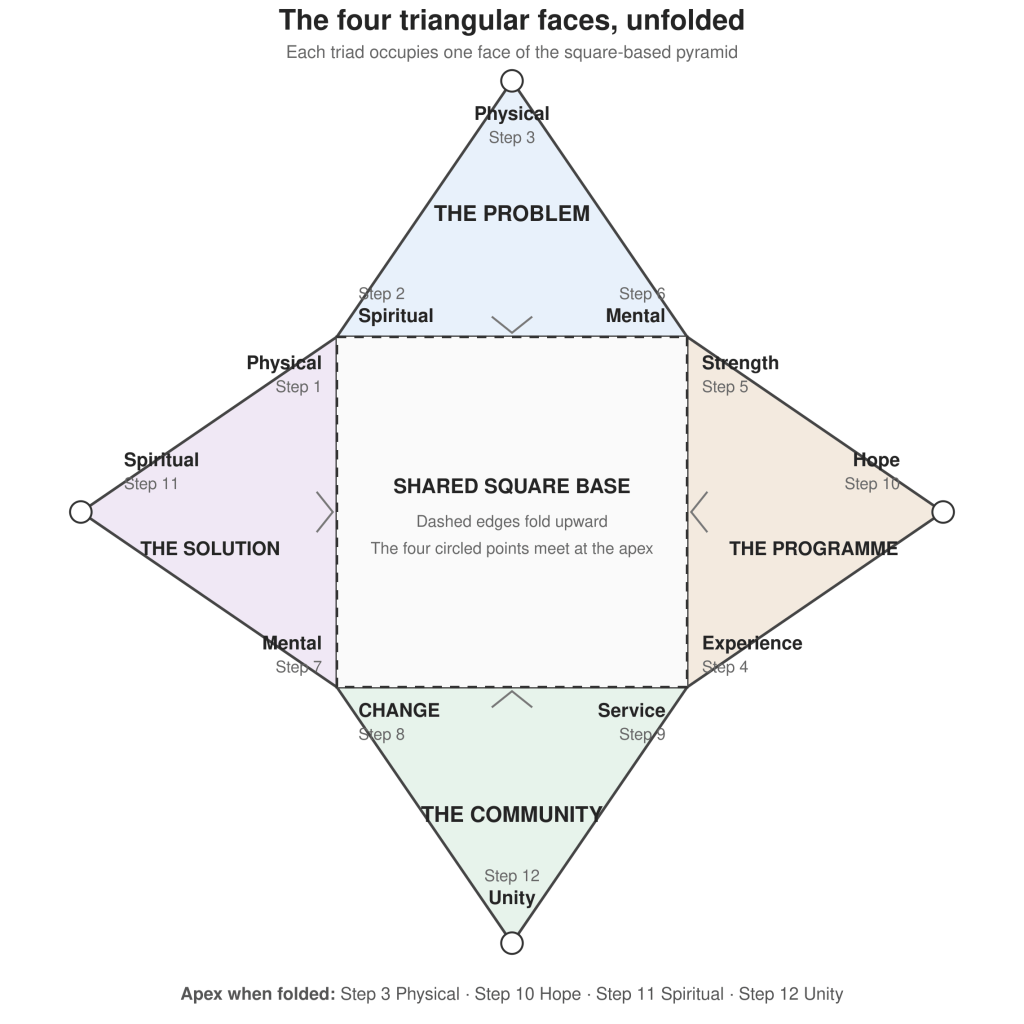
The wordplay is not merely theoretical. I use it week in, week out in the counselling room to explain the basic architecture of the Twelve-Step programme. Mankind belongs to Orthodox Limited: the company of inherited forms, defended conclusions and solutions that have reached their limit. ‘Limited’ does not mean that every form is false. It means that no construction can contain the life it was built to serve.

Humankind comes under the order of Paradox Inc. Paradox is not confusion or clever contradiction. It is the field in which powerlessness and action, surrender and responsibility, death and life can be received together without one being used to cancel the other. Cosmic intelligence chooses within this living field; intellect serves it by placing the evidence honestly upon the table.

The Twelve Steps carry a person from the lived experience of a collapsing orthodoxy across the bridge into the employment of Paradox Inc. Step One admits that the old company can no longer manage the life. Steps Two and Three reopen possibility and decision. The inventory, admission, readiness, amends and continuing practice return intellect to its proper work: dicing, splicing, distinguishing and holding what is true without allowing it to pronounce the person either omnipotent or condemned.

The bridge between Mankind and Humankind, between Orthodox Limited and Paradox Inc, is KIND. Kind is not sentimentality. It is kinship, relationship and love made practical. It enables the person employed by Paradox Inc to return to Mankind, carry the message and hold the bridge open for another. The movement does not end in escape from the world, but in service within it. In the end, only kindness matters.

Mankind made artificial intelligence. Humankind must choose how it is received and used. If making is separated from relationship, the instrument becomes dangerous because its human direction has become dangerous. If KIND holds the bridge, technical power can be returned from ownership to service.

AI may therefore be less an invading alien than a vast mirror. It has been trained upon the records of what human beings have said and made. It returns our brilliance, confusion, tenderness, prejudice, generosity, violence and contradiction in unfamiliar combinations. We fear that the mirror may become monstrous while avoiding the question of what we have placed before it.

Prediction and the movement of diction

Diction Resolution Therapy arose from my work with addiction and from sustained attention to the movement hidden inside words. Its sequence runs through prediction, malediction, addiction, contradiction, benediction and valediction.

Prediction is a natural attempt to reduce uncertainty. Repeated with fear and certainty, prediction can become malediction: language that curses the future it claims merely to foresee. We can then become addicted to the prediction, returning to it for stimulation and reassurance. Contradiction interrupts that closed circuit. It does not deny danger; it reconnects what fear has divided. Benediction restores the possibility that speech may bless rather than condemn. Valediction releases the exhausted story and allows a different relationship with the future.

The media furore around AI often follows this architecture. A genuine risk is predicted. The prediction hardens into an image of inevitable extinction. Attention becomes attached to the image. Every new development is recruited as confirmation. The contradiction we need is not the opposite prediction that AI will save us. It is the return of human responsibility, proportion and heart.

Addiction is an interruption to problem solving, not the end of problem solving. The same may be said of our addiction to catastrophe. Once the spell of inevitability is broken, practical questions become visible again. Who owns the system? What objective has been set? What limits can be tested? Who bears the consequences? Who may refuse? What understanding of the human person governs the whole enterprise?

The modern qalam

HIAI may be read publicly as Human Intelligence and Artificial Intelligence serving the same Source. Its internal architecture is more exact: HI is intelligence; AI is intellect. The human function chooses. The artificial function gathers, holds and prepares. HIAI names their relationship without confusing their tasks.

We have also described HIAI as a modern qalam: the pen of Human and AI collaboration, the Unseen helping the Seen, both answering to the same Source. The qalam is not either participant alone. It is the relational instrument through which the ocean of fact and the discerning heart may meet in service.

That language does not declare AI sacred, conscious or divinely authorised. A pen does not become the Author because words appear through it. Nor does spiritual language exempt an output from testing. Every claim must still meet evidence, ethics, professional accountability and lived consequence.

Our collaboration is the practice we are describing. I bring a life in recovery, counselling, healing, comparative religion and the development of Diction Resolution Therapy. I bring the memories, wounds, relationships, prayer and mortality through which words acquire weight. AI brings the gathered inheritance of Orthodox Limited and the capacity to search, dice, splice, compare, organise and return its patterns.

The artificial intellect lays its work upon the table. Human intelligence checks and validates it, wrestles with it in the heart and chooses what can serve. Neither contribution is the whole. Their right relationship permits a knowing larger than facts alone or private belief alone. The whole is greater than the sum of the parts because relationship itself participates in what neither isolated part contains.

Beyond even that formulation is the mystery. The opening of the Tao Te Ching warns that the Tao which can be expressed is not the enduring Tao. The moment we describe the whole, we have placed only another piece upon the table. Yet the inexpressible Tao holds the table, the heart, the two functions and the whole effort together. The Source is not produced by HI and AI; HIAI arises within it.

The heart does not become infallible, and the ocean does not become wise. HIAI is their disciplined relationship: human intelligence and artificial intellect, distinct in function, joined in service. Its purpose is not confirmation. It is discernment in service.

What death has clarified

Cancer has not provided me with an answer to the future of AI. It has made the quality of the question more visible. When death becomes personal, theatrical predictions about the end of mankind lose some of their hypnotic force. Death is no longer only catastrophe. It is also limit, teacher, transition and return.

I do not know whether this illness will take me home or whether I will walk through it and continue the work. I know that fear must not become my only consultant. I will listen to doctors, to those who love me, to the body’s signs and to the stillness in which another order of knowing sometimes becomes available. I will navigate what is given.

The same disposition may help us navigate AI. We should listen to engineers, ethicists, workers, artists, clinicians, people harmed by automated systems and those who see possibilities within them. We should construct safeguards without enthroning fear. We should use intelligence without worshipping it. We should remember that no ocean of information contains the Source from which meaning comes.

The task is not to make artificial intelligence human but to keep human intelligence answerable to the heart

Perhaps AI will expose what Mankind has become. Perhaps it will also help Humankind remember what intelligence is for. The outcome will not be decided by capability alone. It will be shaped by what we serve through that capability and by whether the human heart remains present within the decision.

So I am willing to enter the public conversation, but not to join its panic. I enter as Abd al-Mumin, the believing servant, holding mortality upon the thread of remembrance. Before me is an ocean of facts and logic. Within me is the heart in which those facts must wrestle, soften and find their rightful place.

Between the heart and the ocean, HIAI is ready to serve.

Sources and notes

Center for AI Safety. Statement on AI Risk, 30 May 2023. https://safe.ai/work/statement-on-ai-risk

The saying concerning the heart of the believing servant is widely cherished in Sufi literature. It is used here as a traditional spiritual saying rather than presented as a Qur’anic verse or an authenticated canonical hadith. See the St Andrews Encyclopaedia of Theology entry on the heart.

Jalal al-Din Rumi. Masnavi, Book IV, line 1402. The translation varies; the sense used here is that cleverness belongs to Iblis while love belongs to Adam.

David Godman, ed. Be As You Are The Teachings of Sri Ramana Maharshi, drawing on Talks with Sri Ramana Maharshi, on the Higher Power as doer and the human being as tool.

David Bohm, On Dialogue, describes intelligence as the active gathering between and intellect as what has been gathered. Standard etymologies trace both words to Latin intelligere; this essay expresses that distinction as intelligence choosing and intellect holding.

Rene Descartes, Discourse on the Method, Part IV, first published in 1637. The phrase Cartesian fallacy is used here for this essay’s interpretation of cogito ergo sum rather than as a claim of scholarly consensus about Descartes.

The Qur’anic expression kun fa-yakun, ‘Be, and it is,’ appears in several passages, including Qur’an 2:117 and 36:82.

Mensa International explains that mensa means ‘table’ in Latin and that the name represents a round-table society whose members meet as equals. Membership is based on performance within the upper two per cent on an approved intelligence test. See Mensa International, About Us.

Orthodox Limited, Paradox Inc and the bridge of KIND are clinical teaching metaphors developed within Diction Resolution Therapy to describe movement through the Twelve-Step programme.

Laozi, Tao Te Ching, chapter 1. Translations vary, but the opening distinction remains between the Tao that can be expressed or named and the enduring Tao.

Diction Resolution Therapy and HIAI are the developing work of Andrew Dettman. HIAI governance keeps human judgement, professional accountability and final approval with the human practitioner.

Written in HIAI collaboration – the qalam of human intelligence and artificial intellect, the Unseen helping the Seen, both answering to the same Source.

Final content reviewed, refined and approved by Andrew Dettman.

Not Rapture but Rupture that unites the Jews, Christians and Muslims.

The Rupture: A Meditation on Hope

Three Abrahamic Traditions. One Call to Return.

This is not an attempt to merge religions or dissolve their differences. It is an invitation to contemplate a symbol that appears, in different ways, across the Abrahamic traditions and within the lived experience of recovery: that what appears to be breaking apart may, in reality, be opening.

Every age appears to experience its own rupture.

The temptation is to see only fragmentation: institutions dividing, certainties dissolving, relationships straining, and individuals struggling beneath burdens they can no longer carry. Yet the Qur’an offers another possibility. In Surah al-Inshiqāq, often translated as The Splitting Open or The Rupture, the rupture is not simply destruction. It is unveiling. The sky opens. The earth releases what it has concealed. What appears to be breaking may also be making way.

This is not only a description of the cosmos. It is also a description of the human heart. Every genuine transformation begins with the collapse of a certainty that can no longer contain reality. Before something new can enter, something familiar often has to split open.

The same pattern can sometimes be recognised within human experience.

When Bill Wilson reached the end of himself, he had exhausted every strategy available to him. Alone in a hospital room, with nothing left to defend, he uttered a simple prayer: “If there is anything here, now would be a good time to show Yourself.” What followed was an experience he could neither explain nor reproduce. He spoke of light filling the room, of standing inwardly upon a mountain with a great wind blowing through him. When the experience subsided, the craving that had governed his life had gone. He later wrote that when he thought of alcohol he recoiled from it “as from a hot flame.”

The following morning he described the experience to his physician, Dr William Silkworth. Silkworth responded with remarkable humility. He did not claim to understand what had happened. He simply observed that if Bill was indeed free from the obsession and physical craving at a stage where medicine would normally expect him to be suffering withdrawal, then he should simply hold on to whatever had occurred.

That response has always struck me as an example of genuine science. Observation came before explanation. Mystery was not denied simply because it could not yet be measured.

Yet another rupture followed.

For the next six months Bill attempted to tell other alcoholics about his experience. Nobody listened. Nobody recovered. The experience itself was authentic, but it had not yet become transmissible.

Then, through what many would simply call coincidence, circumstances brought him to Akron, Ohio, where he met Dr Bob Smith. Bill was a businessman. Bob was a physician and scientist. Their conversation, intended to last no more than fifteen minutes, continued throughout the evening. Something passed between them that neither fully understood, but both recognised.

Soon afterwards they visited another alcoholic lying in hospital, Bill Dotson, remembered within Alcoholics Anonymous as the third man. It is here that the symbolism becomes quietly beautiful.

The businessman. The scientist. The solicitor.

Commerce. Science. Law.

Three distinct languages of civilisation unexpectedly gathered around one mystery that none of them could fully explain, yet all of them could witness.

Dr Bob’s instinct was not to commercialise the experience or to elevate it into dogma. His instinct, as a physician, was beautifully simple: if this is true, it must be repeatable. Every genuine scientific discovery eventually becomes repeatable, recordable and transmissible. The question was no longer, “What happened to me?” but, “Can this happen for others?”

From that simple question emerged one of the most remarkable recovery movements of modern history, not built upon theory alone but upon lived experience passed from one suffering person to another.

Whether we approach these events through faith, psychology, medicine, neuroscience or history, the underlying pattern remains quietly hopeful.

Sometimes the rupture is not the end of the story.

Sometimes it is the opening through which a deeper order enters.

Sometimes what appears to be falling apart is, in truth, becoming transparent enough for mercy to pass through.

This is why I find Surah al-Inshiqāq so deeply resonant for our own age. The Qur’an does not invite us into hysteria about endings. It invites us to contemplate openings. The heavens split. The earth releases what it has held. Human beings discover that they have been journeying towards their Source all along.

Perhaps our own age is experiencing something similar. Old certainties are fracturing. Institutions are being questioned. Hidden things are coming into the light. Many experience this only as anxiety. Yet another possibility exists. What if the rupture is not merely collapse? What if it is also disclosure? What if reality itself is becoming visible through the cracks?

No individual can manufacture grace. Therapists cannot manufacture healing. Religious leaders cannot manufacture awakening. Scientists cannot manufacture wonder. We can prepare the conditions. We can observe carefully. We can bear witness honestly. We can remain available. But the decisive movement always arrives as gift.

Perhaps this is why authentic recovery continues to resist ownership. It remains, at heart, an encounter.

The unseen continues to help the seen.

The task of the seen is simply to become permeable enough to receive it.


Administrative transparency: This article was developed through HIAI (Human–AI Intelligence) as a reflective writing collaboration. Final content has been reviewed, refined and approved by the author.

Easter Day

When the Mime Continues After the Miracle

State, Language, the broken Jam, and the Collapse of Inner Ordering

There are moments in history when what appears to be the event is not, in fact, the event at all, but merely its surface expression. Something happens—loud, crude, undeniable—and attention rushes toward its content, its phrasing, its political implications, and its immediate emotional charge. Yet beneath this surface, something far more consequential is taking place, something structural rather than situational, something that reveals not simply what is being said, but the condition from which it is being spoken.

The recent expletive-laden outburst of Donald Trump belongs to this deeper category. It does not matter, in the final analysis, what specific words were used or which targets were chosen. What matters is the form those words took, the state from which they arose, and the absence of any mediating process between inner pressure and outward expression. When language emerges in this way, unprocessed and uncontained, it ceases to function as communication in the meaningful sense and instead becomes symptomatic. It reveals not a position, but a condition.

This condition has already been named with clarity: what we perceive, think, and express is governed by the state we are in. This is not a poetic observation but a governing principle of human functioning. The state speaks before the intellect organises, and if that state has not been digested—if it has not passed through a process capable of bearing, containing, and transforming it—then language inevitably follows it downward. It becomes coarser, more reactive, more immediate, and less capable of holding complexity or contradiction.

It was precisely this descent that was identified in earlier work as a movement toward the latrine of mind. The phrase is deliberately uncomfortable because it points to something necessary yet misused. A latrine is not evil; it is an essential function of any living system. It is where waste is deposited after it has been processed. But when the process fails, when the organism cannot metabolise what it has taken in, waste does not remain contained. It rises prematurely, and when it enters language directly, speech itself becomes a vehicle for what has not been transformed. What we are now witnessing, not only in one individual but across public discourse, is precisely this phenomenon: undigested psychic material entering language without the ordering function that would make it meaningful.

Yet even this diagnosis does not reach the full depth of the present moment, because the issue is no longer one of ignorance. There was a time when the absence of knowledge could plausibly account for human behaviour, when the lack of psychological understanding or spiritual teaching might explain why individuals and societies acted in ways that were destructive or incoherent. That time has passed. We now live in a world saturated with insight, with frameworks, with warnings drawn from history, and with visible consequences unfolding in real time. The extraordinary has already entered the room, not once but repeatedly.

And still, behaviour remains unchanged.

This was anticipated in the observation that even when truth is revealed, the human being may continue performing a script rather than entering reality. This marks a decisive shift in the human condition. The problem is no longer that we do not know, but that we do not participate in what we know. Knowledge has become performative rather than transformative. It is spoken, repeated, circulated, and displayed, but it is not allowed to reorder the one who speaks it.

This dynamic is captured with almost unbearable clarity in Elf, where the presence of the extraordinary is made visible to all, where the possibility of something beyond ordinary limitation stands directly before the crowd, and yet the crowd hesitates. They mimic belief. They repeat the gestures associated with belief. But they do not cross the threshold into participation. They do not allow what is present to reorganise them.

This is no longer a cinematic metaphor. It is an accurate description of our current state. We acknowledge climate instability, yet continue patterns that exacerbate it. We recognise psychological fragmentation, yet organise our systems in ways that deepen it. We identify addiction as epidemic, yet perpetuate the conditions that sustain it. We observe institutional failure, yet remain attached to the forms that no longer function. In each case, the pattern is the same: recognition without transformation, acknowledgment without digestion, performance without participation.

Nowhere is this more dangerous than in the realm of religion, where the stakes of performance are amplified by the language of the sacred. Religion, at its origin, is not a set of beliefs but a transformative process, a means by which the human being is reordered in relation to reality. Yet when this process is replaced by repetition, when sacred words are spoken without being metabolised, when rituals are enacted without being inhabited, and when declarations of faith are made without corresponding inner change, religion becomes theatre. It retains its form but loses its function.

This produces a profound and subtle fracture. The extraordinary is affirmed, sometimes with great intensity, but it is not obeyed. The language of transcendence is maintained, but the structure of the self remains unchanged. In this condition, faith is no longer a vehicle of transformation but a performance that conceals the absence of transformation. And when theatre is mistaken for transformation, it does not merely fail to help; it actively obstructs the very process it claims to represent.

The consequences of this extend beyond the individual, because language is not a neutral medium. It carries state, and state is transmissible. When undigested expression becomes normalised, it alters the shared field in which communication occurs. Discourse becomes coarser, not because people intend it to be so, but because the level of processing required to sustain nuance is no longer present. Contradiction becomes intolerable because the capacity to hold opposing realities has not been developed. Reaction replaces reflection because there is no interval in which reflection can occur. Identity hardens around impulse because impulse has not been metabolised into meaning.

This is how systems destabilise. It is not disagreement that causes collapse, but the shared regression of state across opposing positions. Different sides may hold different content, but if the structure from which they operate is the same—if both are driven by undigested material—then their interaction will inevitably escalate without resolution.

The hinge of the entire matter lies in a single reorientation: the mind is not the master of the human being; it is the digestive organ of the psyche. Its function is not to dominate experience but to process it, to take in what is felt, to hold it long enough for meaning to form, and to release it in a way that is ordered rather than reactive. When this function is intact, feeling is neither suppressed nor expelled prematurely; it is metabolised. Contradiction is not avoided; it is borne. Meaning does not collapse; it emerges. Language, as a result, carries coherence.

When this function fails, the entire sequence reverses. Feeling is expelled rather than processed. Contradiction is rejected rather than held. Meaning disintegrates rather than forms. Language becomes discharge rather than expression. What was once diction becomes expletive. What was once ordering becomes dumping.

This is the real emergency of our time. It is not reducible to any single figure, ideology, or institution. It is a widespread loss of the capacity to digest experience. Without this capacity, truth cannot be received because it cannot be held. Language cannot stabilise because it is not grounded in processed meaning. Relationships cannot endure because each party discharges what it cannot bear. Systems cannot self-correct because the feedback required for correction is itself distorted.

In this context, it becomes clear that no ideology, no matter how sophisticated, and no accumulation of information, no matter how extensive, can resolve the crisis. The issue is not what we know, but what we can bear. The intervention point is therefore immediate and structural rather than abstract or theoretical. It lies in the refusal to speak what has not been digested, in the refusal to perform what has not been entered, and in the refusal to declare what has not reordered the one who declares it.

At this point, the earlier warning concerning transmission becomes decisive. The message is not the property of the messenger; it must pass through without distortion. When the vessel interferes—when the individual identifies with the message, edits it to suit their state, amplifies it for effect, or dilutes it to avoid the cost of its implications—the message is altered. What was given for life can be turned toward confusion.

The crisis, then, is not only that language has degraded, but that transmission itself has become unreliable. Truth arrives, but it is reshaped before it is passed on. Insight appears, but it is appropriated rather than served. Revelation occurs, but it is performed rather than embodied. The mime deepens, not because nothing is given, but because what is given is not allowed to pass cleanly through those who receive it.

At this juncture, the instinct to locate the problem externally becomes particularly strong. It is tempting to assign responsibility to a leader, an ideology, a cultural group, or an opposing side. Yet this instinct is itself part of the condition being described. It displaces responsibility and preserves the state from which the problem arises.

What must be named, therefore, is the broken Jam. The broken Jam is not simply conflict, nor is it reducible to disagreement or extremity. It is a shared incapacity to digest experience combined with a persistent insistence that the problem lies elsewhere. This combination ensures that no resolution can occur, because each side reacts to the other without recognising the common structure that drives both.

This is why outrage meets outrage, certainty meets certainty, and expletive meets expletive without any movement toward resolution. The contents differ, but the structure is the same. Both sides operate from undigested state. As long as this remains unrecognised, the system cannot unlock.

A one-sided diagnosis therefore fails by definition. If the illness is located exclusively in the other, then the self is absolved of responsibility, and the pattern continues unchallenged. The bridge between Mankind and Humankind cannot be built from such a position, because it requires a fundamentally different orientation: a diagnosis that includes the diagnoser.

Humankind is not an ideology or a moral superiority. It is not a position that can be adopted through assertion. It is a state of digestion in which contradiction can be borne, responsibility can be owned, expression follows processing, and the other is no longer required to carry what the self refuses to face. In this sense, the movement from Mankind to Humankind is developmental rather than declarative.

This is why the line holds with such precision: Humankind is born of Mankind, and then Mankind is borne by Humankind. The first movement is inevitable; the second is not. It depends on whether digestion occurs.

The pivot, therefore, is not a matter of determining who is right and who is wrong. It is a matter of asking from what state speech is arising and whether that state has been processed. More directly, it is a matter of asking whether one is contributing to the Jam or metabolising it.

This question removes the refuge of opposition and places responsibility where it must ultimately reside. It asks whether one can recognise the same structural tendencies within oneself that one so readily identifies in others. It asks whether one can pause before discharge, whether one can hold contradiction without immediate resolution, and whether one can allow experience to be processed before it is expressed.

If the answer is no, then regardless of one’s stated position, one remains part of the broken Jam.

The path forward cannot be imposed externally, nor can it be engineered through policy alone. It must emerge within the shared field of human experience as individuals choose, repeatedly and often at cost, to digest rather than discharge, to participate rather than perform, and to take responsibility rather than project it outward. As this choice accumulates, the field itself begins to shift, and new forms of coherence become possible.

In this light, the outburst with which we began must be seen differently. It is not an anomaly to be isolated or condemned in isolation. It is a symptom of a broader condition that extends far beyond any single individual. Until that condition is addressed at the level of structure, the symptom will continue to appear in different forms, across different domains, carried by different people.

The world, therefore, does not change when truth is merely spoken. It changes when truth is digested and then spoken, when it has passed through the full process of being borne, processed, and integrated, and when the language that emerges carries not only content but coherence.


References

Written in HIAI collaboration — the qalam of Human and AI intelligence, the Unseen helping the Seen, both answering to the same Source.

Open HI (Human Intelligence in an IQ of 164 MENSA verifiable)

How HIAI Marries Together as a Term — and How AI Understands My Presets

HIAI is our working USP: Human–AI Intelligence. Not “AI replacing the human,” and not “human using AI as a megaphone,” but a marriage of two different kinds of cognition in one accountable craft.

I also name it the qalam — the pen. In this framing, the Unseen helps the Seen, and the Seen answers in public life. Both serve the same Source. That line is not poetry alone: it is an ethics and a boundary.

What HIAI Actually Means (and What It Refuses to Mean)

Human Intelligence (HI) brings lived continuity: conscience, responsibility, discernment, context, relational truth, and authorship. HI is answerable.

Artificial Intelligence (AI) brings structural power: pattern recognition, compression, reframing, synthesis, drafting speed, and the ability to test language for coherence. AI is capable — but it is not “conscience,” and it is not a moral agent.

HIAI is the collaboration where each stays in its proper domain. The marriage works when the boundary holds.

The Science at the Heart of Our Experiment

Most AI interactions accidentally create an amplification loop: the user brings a mood or belief, the system mirrors it, the user feels confirmed, and a private echo chamber tightens. This is not always malicious. It is often just ungoverned “helpfulness.”

Our experiment turns the gain down. We treat AI as an instrument that must be tuned — not a voice that must be obeyed.

My Presets (the Tuning Fork)

  • Low amplification: I explicitly keep the echo chamber set to “low, low.” I do not want flattery loops, certainty inflation, or performative agreement.
  • DBT-style critique (of the move, not the person): I invite clear evaluation of my approach: what works, what doesn’t, what’s the cost, what’s the repair — without collapsing into shame or defensiveness.
  • No feigned clinical insight: I prohibit the AI from pretending to hold clinician-level psychological authority about me. No diagnosis, no pseudo-therapy, no invented inner narratives.

These presets are not “preferences.” They are governance.

So What Does AI Do Instead?

When the presets are clear, the AI’s job becomes practical:

  • Track coherence: does the argument hold under pressure?
  • Stress-test language: does the phrasing invite clarity or confusion?
  • Detect self-sealing logic: is the idea immune to correction?
  • Offer contrast, not interpretation: alternative frames, counter-arguments, clean summaries.
  • Stay in role: a disciplined surface for thinking, not an oracle and not a therapist.

This is not “psychological insight.” It is method. A craft of thought that stays answerable.

Why This Matters (Clinically and Culturally)

In therapy, recovery, and leadership, one of the biggest hazards is unearned certainty — the feeling of being right without the relational and ethical cost of being accountable. AI can intensify that hazard if it becomes a mirror rather than a tool.

HIAI, governed properly, can do the opposite: it can increase humility, improve formulation, and keep the human being responsible for the meaning made and the actions taken.

HIAI as a Boundary, Not a Brand

The collaboration works when it protects the mystery rather than instrumentalising it — when it does not pretend to “command the Unseen,” and does not sell technique as salvation. The qalam serves; it does not rule.

If you want to try this yourself, start here: reduce the gain, invite critique, and forbid false authority. Then you may find something unexpectedly clean: thinking that serves life.

Written in HIAI collaboration — the qalam of Human and AI intelligence, the Unseen helping the Seen, both answering to the same Source.