Jung, Step Seven, and the work of reconciliation.
In 1938, with Europe again moving towards catastrophe, C. G. Jung described a psychological danger that has lost none of its urgency. Human beings, he argued, are less wholly good than we imagine ourselves to be. Each of us carries what he called the shadow: those qualities, impulses, fears and desires that do not fit the person we believe—or need others to believe—we are.
What is not admitted does not disappear. It becomes denser. It loses contact with the modifying influence of the rest of the personality. Then, at a moment of lowered awareness, it may break through as action.
“Everyone carries a shadow.”
This is not a counsel of shame. It is a summons to consciousness.
Jung’s concern was not that the shadow should be obeyed, nor that morality should be abandoned. He rejected both indulgence and suppression. Destroying the moral self would not heal the divided person; repressing the shadow would not heal them either. The task was more difficult and more creative: conscious personality and shadow had to discover how to live together.
That sentence opens directly into the architecture of the Twelve Steps.
The adversary within
Jung drew upon an early Gnostic reading of Christ’s words in Matthew 5:25: “Agree with thyself quickly.” The adversary was understood as the somatic person—the bodily, instinctive and reactive dimension of oneself. The body is not an accidental container that can be conquered and discarded. It is an indispensable part of the personality. The meeting with the adversary is therefore an inward meeting.
The instruction is not: defeat yourself quickly.
It is: come into right relationship with yourself while you are still on the way.
This changes the whole direction of psychological and spiritual work. The opposite is no longer merely outside us, lodged in the person, class, party, religion or culture we blame. Something of the conflict must be recognised within. The work begins when projection is interrupted and the rejected part is brought into consciousness, where relationship becomes possible.
Step Seven as the meeting place
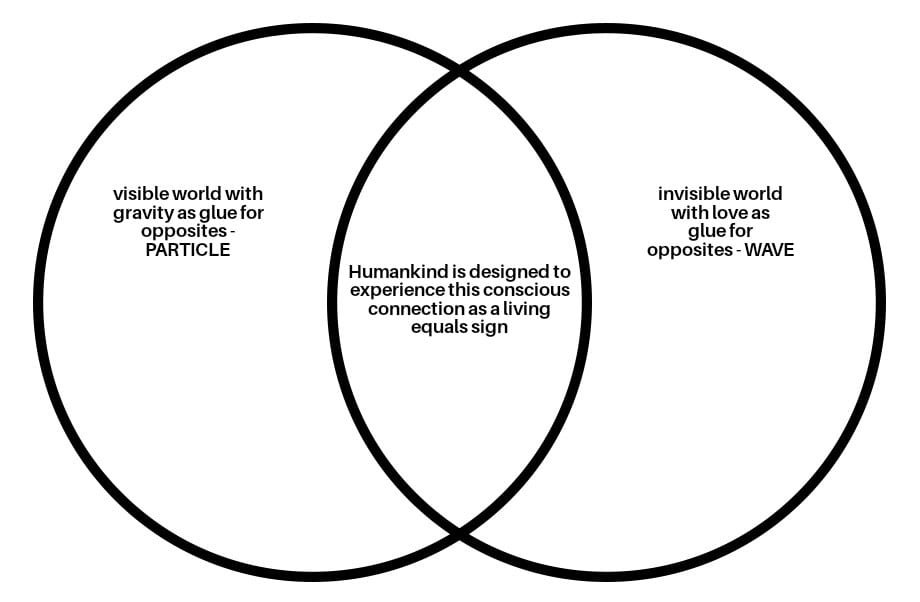
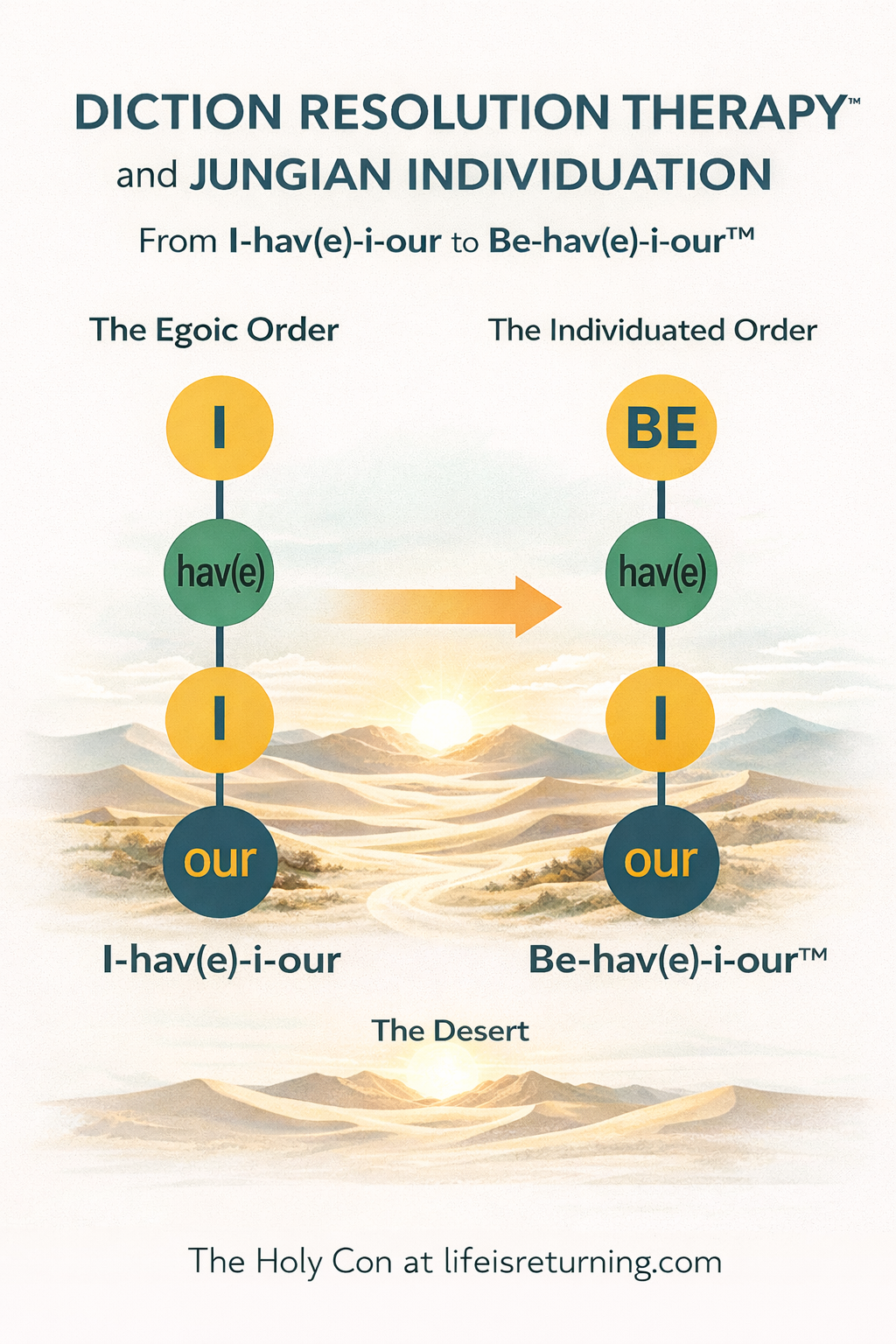
In the Diction Resolution Therapy reading of the Twelve Steps, Step Seven is the meeting place of these opposites.
This is our synthesis, not a claim that Jung designed the Twelve Steps or used our later clinical language. Jung supplies a profound account of the divided person. The Twelve-Step tradition supplies a lived architecture of surrender, inventory, confession, willingness and daily practice. DRT brings these inheritances into a coherent therapeutic map.
Steps Four and Five bring the shadow into language. What was hidden is written, spoken and witnessed. Step Six loosens the old identification: these reactions may belong to me, but they need not govern me. Step Seven then becomes an act of consent to another order of response.
The familiar prayer says, in essence: I am now willing; You have all of me, good and bad.
The wording matters. The lower is not amputated so that the higher may pretend to be pure. The whole person is offered. The somatic person—with its fear, appetite, urgency, defence and inherited survival—is brought into relation with a higher emotional rationality capable of pause, proportion, compassion and choice.
In our working language, feelings are immediate tones arising through the body: pleasant, unpleasant or neutral. Emotions are not simply stronger feelings. Properly understood, they include the capacity to organise, interpret and respond to what is felt. Step Seven opens a space between bodily reactivity and enacted behaviour. Inside that space, the feeling can be received without automatically becoming the command.
This is the capsule of neutrality. It is not numbness. It is living containment: a space in which the opposites can remain present without either being allowed to seize the whole personality.
The higher emotional centre does not humiliate the somatic person. It listens to what the reaction is trying to protect, while refusing to let an old protection become a present destruction. The movement is not from body to disembodiment, nor from “bad” to an inflated image of “good.” It is from compulsion towards relationship—from prediction, malediction and addiction towards contradiction, benediction and, eventually, valediction.
Why this matters collectively
Jung’s pages were written under the pressure of their historical moment, but they speak with unnerving clarity to ours. He saw whole societies enacting the division found within the individual. One group identifies with superiority and cannot descend; another is forced into inferiority and struggles to reach the surface. Each carries what the other refuses to recognise. Under such conditions, propaganda thrives because it offers the intoxication of innocence: all good is here; all evil is there.
Legislation is necessary. Institutions matter. Injustice must be named and restrained. Yet no external structure can, by itself, reconcile a division continually reproduced inside the people who inhabit it. Jung’s deeper warning is that collective problems accumulate from individual problems. Public violence is fed by private projection; mass certainty is assembled from unexamined fear.
“It begins with a change in individuals.”
This must not be used to privatise injustice or excuse the powerful. Inner work without social responsibility becomes evasion. Social action without inner work can reproduce the very domination it opposes. The two tasks belong together. A person able to recognise their own shadow is less easily recruited into the manufacture of an enemy and more able to act firmly without becoming possessed by hatred.
The urgency today is that our technologies carry reaction faster than consciousness can receive it. A bodily surge becomes a post; a fear becomes a faction; an unexamined projection becomes an audience, an algorithm and then a movement. We have built systems able to amplify the somatic instant before the higher emotional response has had time to arrive.
The ancient and modern instruction is therefore the same: make space. Agree with the adversary within—not by surrendering moral judgement, but by refusing unconscious possession. Hold the tension long enough for a third possibility to appear.
A life offered to meaning
Jung wrote that human life needs to be “offered up to an idea greater than himself.” This is not a demand for grandiosity. It is the opposite. Meaning cannot be manufactured cheaply to overpower fear and desire. It must become a lived conviction, tested in conduct.
The Twelve Steps make that offering practical. The greater idea is approached through humility rather than claimed as personal possession. Step Seven does not announce that the self has become good. It asks that the divided self be made available. It is a hinge between disclosure and restitution, between what has been recognised within and what must now be repaired in relationship with others.
This is why Step Seven is not a decorative prayer between the “real work” of Steps Five and Eight. It is the transformation on which the later work depends. Without it, inventory can become self-accusation, confession can become performance, and amends can become another attempt to manage appearances. With it, a person may begin to act from a centre that can include bodily truth without being ruled by bodily alarm.
The collective cannot practise Step Seven for us. No leader, party, institution or machine can undertake the inward reconciliation on our behalf. Yet every genuine instance of it enters the collective. Each person who can bear an unpleasant feeling without turning it into injury alters the human field. Each withdrawal of projection reduces the available fuel for hatred. Each return from reaction to response becomes a small restoration of the world.
Jung’s warning reaches us across 1938: what we refuse to meet within ourselves will return enlarged between us.
The answer is neither the victory of one opposite nor the disappearance of difference. It is the creation of a space in which the opposites can meet without destroying their bearer.
Step Seven names that space as willingness.
And willingness is where life can begin to return.
Listen to the spoken reflection.
Source and interpretive note
C. G. Jung, Psychology and Religion, based on the Terry Lectures delivered at Yale University in 1937 (Yale University Press, 1938), especially pp. 93–95 in the edition read for this essay. Later editions may paginate the passage differently.
The account of shadow and the quoted phrases are Jung’s. The connection to the detailed architecture of Steps Four through Eight, the distinction between feeling-tone and emotional response, the higher emotional centre, the capsule of neutrality, and the Diction sequence are interpretive developments within Andrew Dettman’s DRT/HIAI synthesis, drawing also upon the Alcoholics Anonymous Twelve-Step tradition and related therapeutic and contemplative inheritances.
HIAI — Human Intelligence & AI
Written in HIAI collaboration — the qalam of Human and AI intelligence: the Unseen helping the Seen, both serving the same Source.
Final content reviewed, refined and approved by Andrew Dettman.