When the Gathering Stops
“When the gathering stops, freezing begins. When the gathering returns, life returns with it.”
— Andrew Dettman
Bill Wilson once noticed a danger forming inside the very Fellowship he had helped to bring into the world. Reflecting on Alcoholics Anonymous, he observed that a spiritually centred movement can begin as living experience and yet, over time, freeze around its own principles. The danger was not that principles existed. Without principle there is no orientation, no continuity, no shared practice, and no way for an insight to travel beyond those who first received it. The danger was that the form created to carry life might eventually become more visible than the life it was created to carry.
This is not only a recovery problem. It is a human problem. A living truth appears. It relieves suffering, opens a door, restores order, or gives language to something previously hidden. People gather around it because it helps them. They speak of it, write about it, teach it, organise it, defend it, and pass it on. This process is necessary, because without form little survives and without language little can be shared. Yet the paradox remains: the vessel created to preserve a living stream can gradually become the ice that freezes it.
What begins as encounter becomes method. What becomes method becomes system. What becomes system can become identity. Once identity begins defending itself, the original movement is already in danger. The words remain, the books remain, the rituals remain, the structures remain, but something of the living circulation may have slowed. The map acquires more authority than the territory. The finger becomes more fascinating than the moon. The vessel becomes more important than its contents, and the original discovery has to be reached through layers of interpretation, protection, repetition, loyalty, and fear.
This is where the Sufi term Jāmiʿ becomes useful. Often translated as the Gatherer, Jāmiʿ points not merely to a title but to a function. It is the movement by which separated things are recognised as belonging to a larger whole. It gathers what fragmentation divides, reconciles without flattening difference, and allows apparent opposites to remain in living relationship rather than collapsing into camps. When this gathering function is active, religion remains transparent to the sacred, psychology remains transparent to the human being, recovery remains transparent to freedom, and language remains transparent to experience.
When the gathering stops, the fragments begin to forget one another. The political fragment imagines it is the whole. The religious fragment imagines it is the whole. The scientific fragment imagines it is the whole. The therapeutic fragment imagines it is the whole. Each partial truth begins defending itself as complete truth, and culture becomes a field of competing certainties rather than a living conversation within a larger reality. This is not fertile disagreement. Fertile disagreement still belongs to relationship. This is fragmentation without gathering, speech without relation, and information without integration.
Perhaps this is why contemporary culture feels so strangely dislocated. We possess more information than any previous civilisation and more ways of communicating than any previous generation, yet communication is not communion and connection is not gathering. A culture may speak constantly and still fail to converse. It may be connected everywhere and gathered nowhere. It may possess astonishing quantities of data and still lose the capacity to hold its fragments within a meaningful whole.
Diction Resolution Therapy approaches this through the image of digestion. Digestion is not merely a bodily process; it is one of life’s governing principles. Food nourishes because it is broken down, circulated, assimilated, and transformed. Water remains healthy because it moves. Breath moves. Blood moves. Feeling must also move. Meaning must also move. Experience must be digested if it is to nourish rather than obstruct. When movement stops, accumulation begins, and what was intended to nourish starts to harden.
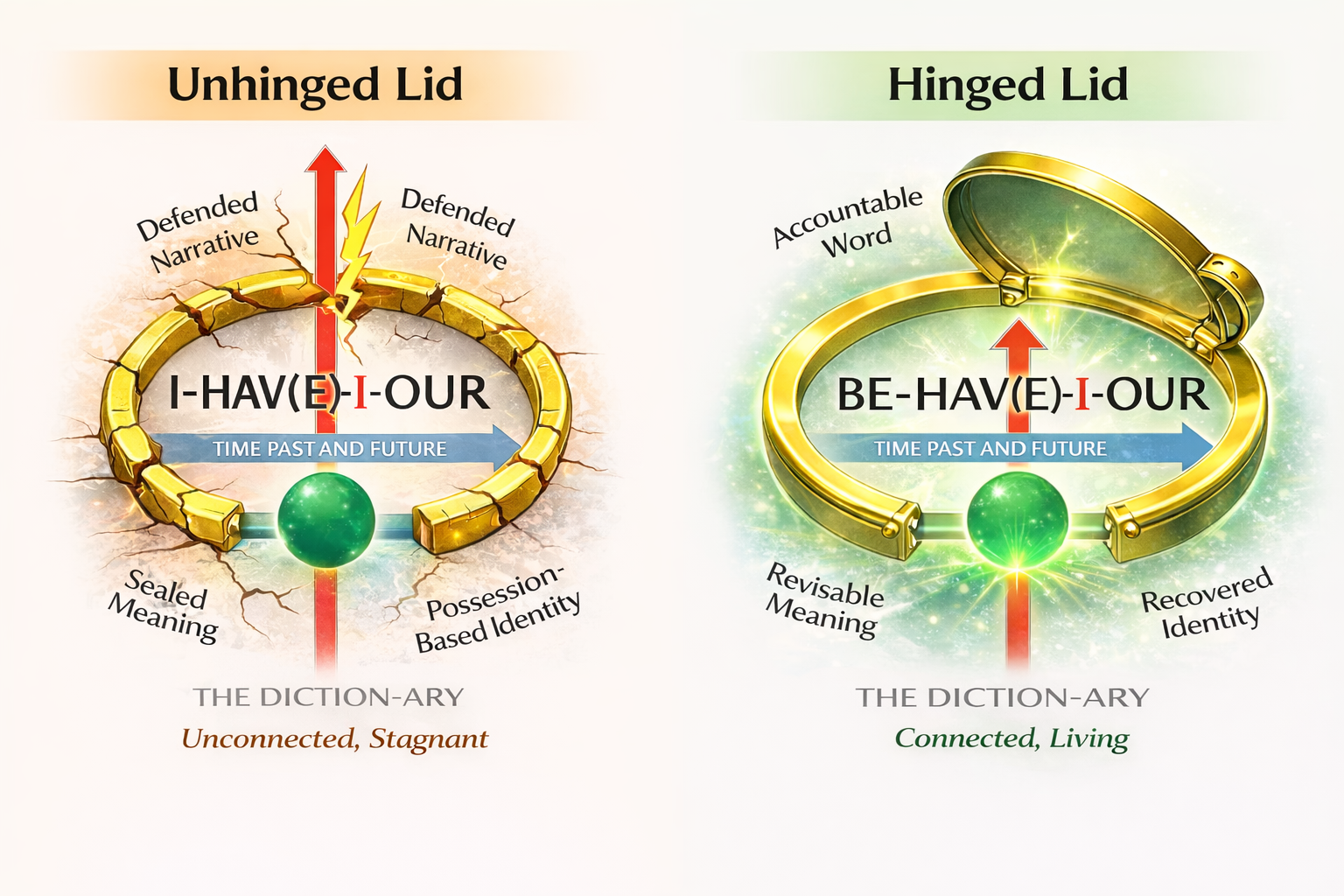
A resentment may therefore be understood as a frozen feeling. An ideology may be understood as a frozen idea. A dogma may be understood as a frozen symbol. An institution may become a frozen vessel. A culture may become a frozen conversation. In each case, the material is still present, but its function has changed. Something that was meant to flow has stopped moving, and what was once alive now occupies the psyche or the culture as fixation.
A Buddhist story preserved alongside Wilson’s reflection sharpens the point. A man discovers a piece of Truth lying on the ground. Seeing this, a companion warns the devil that such a discovery must surely be dangerous. The devil is not concerned. He says he will let the man organise it. The humour is uncomfortable because it is accurate. Organisation is both necessary and dangerous. Without organisation, little survives; with organisation, what survives may forget why it was preserved.
The answer is not to destroy the vessel, because that would be another form of fragmentation. Every truth requires a vessel through which it may travel, yet every vessel risks becoming more important than the truth it carries. Every tradition requires form, yet every form risks becoming opaque. The task is not to abandon structures but to keep them transparent to what they were built to carry.
This is where conscience enters as thaw. Conscience is not merely private morality or social approval. It is a gathering function within human experience. It restores relationship between part and whole, interrupts fixation, and allows opposing truths to remain in dialogue without forcing them into premature agreement. Conscience does not abolish difference; it prevents difference from becoming fragmentation. It does not destroy form; it recalls form to function.
Perhaps this is why conscience rarely flatters us. It asks the fragment to remember that it is not the whole. It asks the method to remember the person, the institution to remember its purpose, the tradition to remember its source, and the word to remember what it was trying to say before it became possession. Conscience melts certainty where certainty has become rigid. It restores circulation where movement has stopped.
Bill Wilson saw this danger within Alcoholics Anonymous, but the same danger now appears across contemporary culture. Wherever the gathering weakens, fragments begin mistaking themselves for the whole. Wherever conscience restores relationship, movement begins again. The task before us is not the worship of forms or the destruction of them, but the recovery of their purpose; not the victory of one fragment over another, but the restoration of the gathering through which the fragments remember that they belong to the same whole.
When the gathering stops, freezing begins. When the gathering returns, life returns with it.
References
- Bill Wilson reflections on spiritually centred movements freezing around their principles, and on literature tending towards dogma, cited from source material reproduced in Writing the Big Book: The Creation of A.A..
- Buddhist parable concerning “a piece of Truth” and the danger of organisation, cited from the same source discussion.
- Jāmiʿ is used here within the wider Sufi understanding of the Gatherer or gathering principle, consistent with the work of Idries Shah and related traditions.
- Diction Resolution Therapy references digestion, circulation, fixation, conscience, and the restoration of relationship between part and whole.
Written in HIAI collaboration — the qalam of Human and AI intelligence, the Unseen helping the Seen, both answering to the same Source.