In 2019 a local newspaper interviewed me about my counselling work. Somewhere between interview and publication, a sub-editor produced a headline which described me as an “Unseen Leader of the World.” I hadn’t said that. At first I considered complaining and asking for the headline to be removed. Instead, I wrote about it, and the resulting piece, Healing for broken and empty words, remains online as part of the record.
Seven years later, I tried a different experiment. I asked AI to search for Andrew Dettman as an independent researcher might, and then, more challengingly, as a hostile due-diligence researcher might. Predictably, it found the headline and initially identified it as a reputational vulnerability. Then something more interesting happened: it followed the trail.
It found my contemporaneous response and distinguished the newspaper’s headline from what I had actually said. It found the professional record before and after the article, and encountered a body of writing extending across years in which the underlying subjects — addiction, diction, contradiction, spirituality, consciousness and recovery — continued to develop. Nothing had been erased and nothing needed cleaning up. What changed was context.
Can AI help us recover provenance when words have become separated from the circumstances that gave birth to them?
The internet is extraordinarily good at remembering words, but considerably less reliable at remembering what those words meant. A headline, quotation or fragment can remain indefinitely while the conversation that produced it disappears from view. Perhaps one useful role for AI is therefore not merely to generate more language, but to travel backwards through what has already been written: distinguishing claim from quotation, source from interpretation, and the original event from meanings subsequently attached to it.
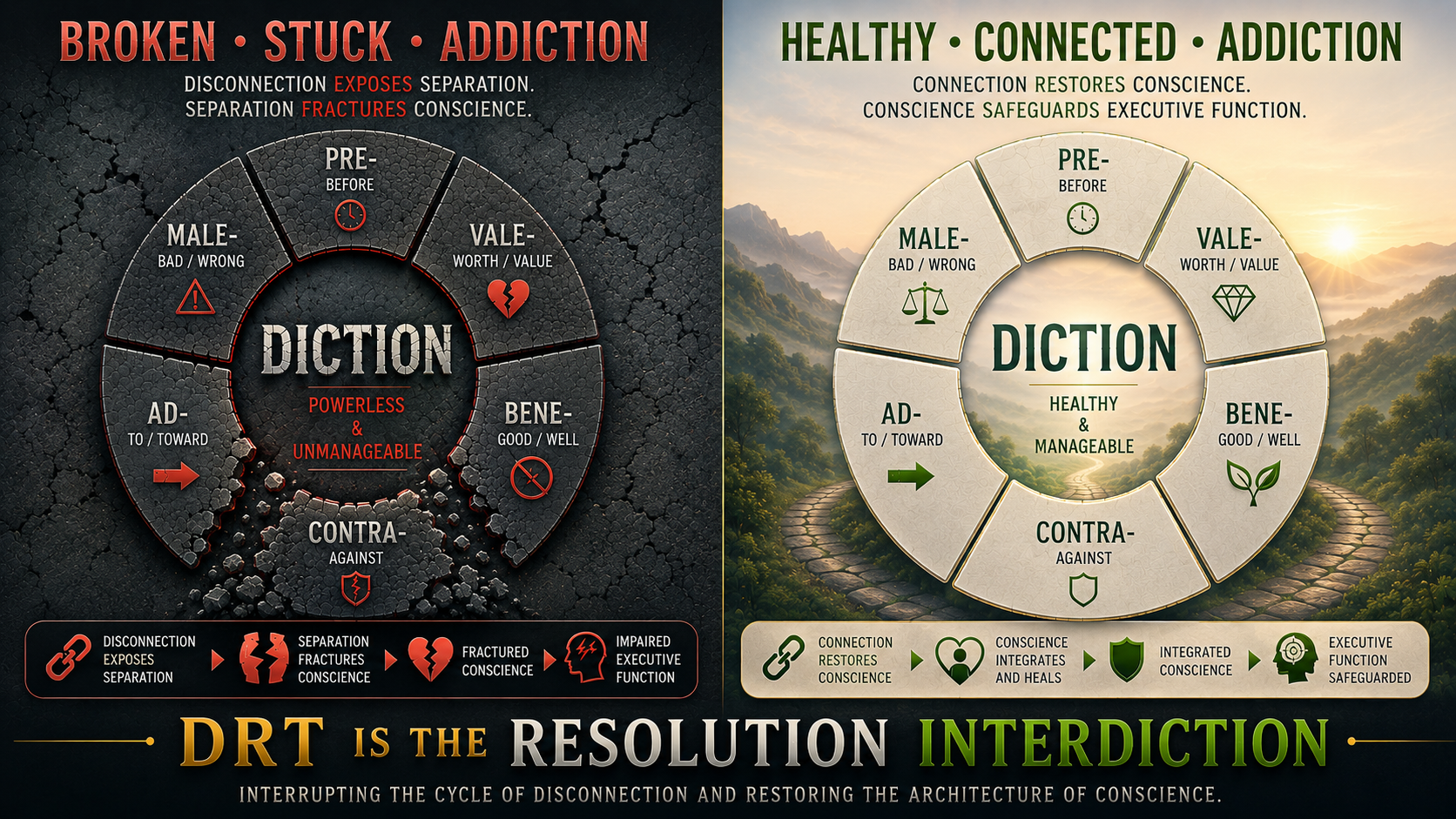
That possibility touches the heart of Diction Resolution Therapy. A word detached from its referent can acquire enormous power, while contradiction can sometimes provide the energy through which the connection is rediscovered. What began as an absurd headline in 2019 becomes, seven years later, a small experiment in whether Human and AI Intelligence can examine the record together without either pretending that the past did not happen or allowing one fragment of it to become the whole story.
This is one of the territories I am exploring through HIAI — Human Intelligence & AI: the modern manifestation of the qalam, exploring the possibility of the Unseen helping the Seen, while both serve the same Source. This does not require AI to become an oracle, nor the human being to surrender discernment to the machine. Quite the opposite: each encounter becomes another opportunity to examine what has been written, what has been understood, and what may have been lost between the two.
Entertain the Stranger
“Be not forgetful to entertain strangers: for thereby some have entertained angels unawares.”
— Hebrews 13:2
The biblical injunction gives another dimension to this experiment. To entertain the stranger is not merely to tolerate what arrives from outside our familiar territory; it is to offer hospitality before we have decided completely what, or who, has arrived. The stranger might be a journalist, a reader, a search engine, a hostile investigator, an artificial intelligence, or even a forgotten version of ourselves preserved somewhere within the digital record.
To entertain the stranger is not necessarily to agree with them, believe them or surrender judgement to them. It is to permit the encounter long enough to discover what the encounter contains. Sometimes what initially appears contradictory, uncomfortable or even absurd may carry something that could not have arrived through more familiar doors.
The newspaper headline itself became such a stranger. My first impulse was to challenge it and perhaps have it removed, but instead it remained in the public record. Over the years it generated conversations of its own, while the work from which it had become detached continued developing elsewhere. Now AI, another kind of stranger entirely, can encounter that same fragment, follow its provenance backwards and forwards through time, and ask whether the words and their original meaning still belong together.
There is something quietly circular about this. The internet preserved the broken diction; the original writing preserved my response to it; and a technology that did not exist in its present form when either was written can now bring those traces into conversation. HIAI therefore becomes concerned not only with producing new words, but with learning how Human Intelligence and AI might read the words already left behind.
Perhaps this is one modern possibility contained within that ancient invitation to hospitality. We cannot always know beforehand what form the stranger will take, nor what message might travel through an unfamiliar form. We can retain discernment without immediately closing the door, allowing contradiction to do some of its work before deciding what the encounter means.
As Omar Khayyam reminds us, “The Moving Finger writes; and, having writ, moves on…” The finger has indeed moved on. The more interesting question now may be whether intelligence — human, artificial, and perhaps something glimpsed through their meeting — can learn to read what it wrote.
The contemporaneous response to the 2019 newspaper headline remains part of the record: Healing for broken and empty words. It can now be read not simply as an answer to a headline, but as one point on a longer trail through diction, contradiction, recovery and the continuing attempt to restore words to meaning.
HIAI — Human Intelligence & AI
Human and artificial intelligence exploring the qalam: the Unseen helping the Seen, both serving the same Source.