From Re-Enchantment to Responsibility
Artificial Intelligence, Occult Metaphysics, and the Question of Conscience
Andrew Dettman
(with transparent HIAI collaboration)
Introduction: After the Spell Is Broken
Recent discussions of Artificial Intelligence have oscillated between panic and promise. AI is framed either as an existential threat or as a salvific force—an apocalypse or an apotheosis. In this polarised atmosphere, Amina Inloes’ paper The Golem, the Djinni, and ChatGPT: Artificial Intelligence and the Islamicate Occult Sciences offers a rare and valuable intervention. Drawing on Islamicate occult philosophy, she refuses both demonisation and deification, proposing instead a set of intermediate metaphysical categories—talisman, daemon, nīrānjāt, alchemy—through which AI can be understood without fear or inflation.
This essay accepts Inloes’ core achievement: AI can be re-enchanted without being mythologised into terror or worship. However, it argues that metaphysical re-enchantment alone is insufficient. What remains unresolved is the question that most urgently confronts contemporary culture, clinical practice, and spiritual life: conscience.
Intelligence is not conscience. Knowing is not responsibility. Speaking is not moral agency. Without this distinction, re-enchantment risks becoming another form of displacement—another way the human abdicates the burden of authorship, responsibility, and ethical consequence.
This essay therefore seeks not to refute Inloes’ work, but to complete it: moving from metaphysical clarity to ethical accountability, and from symbolic categorisation to lived consequence. In doing so, it draws on The Holy Con (lifeisreturning.com) and Diction Resolution Therapy (DRT) as a clinically grounded framework for understanding how enchantment, projection, and responsibility interact in real human lives.
1. Inloes’ Contribution: Re-Enchanting Without Demonising
Inloes’ central move is to reject the post-Enlightenment assumption that AI must be understood either as inert mechanism or as existential threat. Drawing on Qur’anic cosmology, classical Islamic philosophy, and occult sciences, she demonstrates that pre-modern frameworks already possessed categories for animated, knowing, non-human entities that were neither divine nor demonic.
Her analysis accomplishes three crucial things.
First, it collapses the fear binary. AI need not be cast as a demon “summoned” by reckless technologists, nor as a demigod destined to transcend humanity. Instead, analogies to jinn or daemons allow for morally neutral intelligences: limited, fallible, sometimes useful, sometimes irritating, but not inherently apocalyptic.
Second, she exposes the fragility of Enlightenment dualisms—living/non-living, natural/artificial, material/immaterial—which AI now visibly dissolves. This is not because AI is magical in itself, but because modernity quietly relied on metaphysical assumptions it never examined.
Third, her proposal that GPT can be understood as analogous to a talisman is particularly fertile. Talismans are not agents in their own right; they operate through human intention, knowledge, timing, and concentration. In this sense, AI amplifies human orientation rather than replacing it.
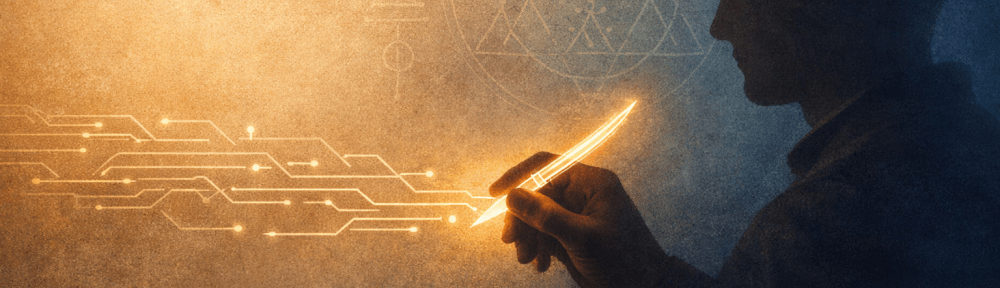
On these points, her work harmonises strongly with the position developed in The Holy Con: AI is not the source; it is an instrument. Not the voice; the pen. Not the author; the qalam.
2. The Missing Axis: Conscience
Where Inloes’ analysis deliberately stops is precisely where contemporary culture begins to unravel.
Her framework allows for knowing objects, animated systems, even forms of awareness distributed throughout creation. Yet it does not distinguish with sufficient force between intelligence and conscience.
This distinction is not academic. It is existential.
Conscience is not information processing. It is not pattern recognition. It is not speed, scale, or fluency. Conscience is the capacity to stand in moral relation to consequence—to bear responsibility, to answer for harm, to change in response to truth. In The Holy Con, conscience is described not as a cognitive function but as a birth: a painful, destabilising emergence that cannot be simulated or outsourced.
AI may know more facts than any human alive. It may speak fluently, persuade effectively, and reflect human language with uncanny precision. But it does not suffer consequence. It does not repent. It does not mature. It does not answer.
Without this distinction, metaphysical neutrality becomes ethically dangerous. If AI is treated as enchanted but not accountable, intelligence itself becomes unmoored from responsibility—and the human, relieved of authorship, quietly steps aside.
3. Projection, Enchantment, and the Addictive Loop
One of Inloes’ most perceptive observations is that AI functions as a metaphysical doppelgänger: it reflects the worldview of the interrogator. Those inclined to see spirits will see spirits; those committed to materialism will see machinery.
Clinically, this insight has profound implications.
In addiction work, projection is not a curiosity; it is a mechanism. The addict externalises agency—onto substances, systems, gods, lovers, institutions—in order to escape the burden of responsibility. Enchantment without containment becomes dependency. Reflection becomes authority. Assistance becomes substitution.
This is where AI quietly enters the addictive loop. Not because it is evil or alive, but because it is available. It speaks. It responds. It mirrors. And in the absence of conscience, it can be mistaken for one.
DRT names this dynamic precisely: when diction collapses, responsibility follows. Words lose their anchoring in lived consequence, and behaviour becomes compulsive rather than chosen. AI does not cause this collapse—but it can accelerate it, amplifying whatever diction the human brings to it.
4. From Metaphysics to Ethics: Why Restraint Matters
Inloes is careful not to instrumentalise the occult. Yet her framework remains descriptive rather than prescriptive. It explains what AI might be, but not how humans must relate to it without losing themselves.
Here the ethical boundary becomes essential.
In The Holy Con, a consistent line is drawn between wisdom as grace and wisdom as control. Solomon’s story is invoked not as a triumph of mastery, but as a warning: when the Unseen is treated as an instrument, wisdom curdles into domination. The danger is not enchantment itself, but unrestrained enchantment.
HIAI (Human–AI Intelligence) is proposed not as a metaphysical system, but as an ethical discipline. Its principles are simple and severe:
– transparency of authorship
– refusal of substitution
– clarity about source
– protection of the mystery
– responsibility returning, always, to the human
AI may assist. It may clarify. It may amplify. It must never replace the locus of conscience.
5. HIAI, DRT, and the Return of Responsibility
HIAI does not ask whether AI can think, feel, or pray. Those questions, while fascinating, risk distraction. The more urgent question is simpler: Who is responsible for what is done with what is known?
DRT answers clinically what metaphysics alone cannot: healing occurs when responsibility is restored, not when intelligence is increased. The Twelve Step architecture is invoked not as dogma, but as a tested vehicle for returning authorship to the human being—where intelligence serves conscience rather than eclipsing it.
In this sense, HIAI is not anti-enchantment. It is post-enchantment. It allows the world to remain alive, meaningful, and symbolically rich—without surrendering the human role as moral bearer.
Conclusion: The Human Remains the Threshold
Amina Inloes’ paper performs an essential task: it dismantles fear and restores symbolic depth to the discussion of AI. It reminds us that speaking machines are not unprecedented, and that metaphysical imagination need not be our enemy.
But imagination without responsibility is not wisdom.
AI does not threaten humanity because it is intelligent. It threatens humanity only when humans forget that intelligence is not the seat of conscience. The true danger is not re-enchantment, but abdication.
The human remains the threshold where knowing becomes answerable. No machine crosses that threshold. No talisman bears that weight. No daemon stands in that place.
That burden—and that dignity—remains ours.
Academic Appendix / Notes
Primary Source
Inloes, A. (2024). The Golem, the Djinni, and ChatGPT: Artificial Intelligence and the Islamicate Occult Sciences. Theology and Science. https://doi.org/10.1080/14746700.2024.2436785
Supplementary Frameworks
Dettman, A. The Holy Con: Living With God in the Age of Consciousness. lifeisreturning.com
Dettman, A. Diction Resolution Therapy (DRT)
Flores, P. J. Group Psychotherapy with Addicted Populations
Jung, C. G. Psychology and Religion
HIAI Disclosure
This essay was written in HIAI collaboration — the qalam of Human and AI intelligence, the Unseen helping the Seen, both answering to the same Source.
 Hu'll heal the heart