
A developmental convergence between Shabistari, Jung, and the Twelve Step Programme
Ignorance as Amnesia
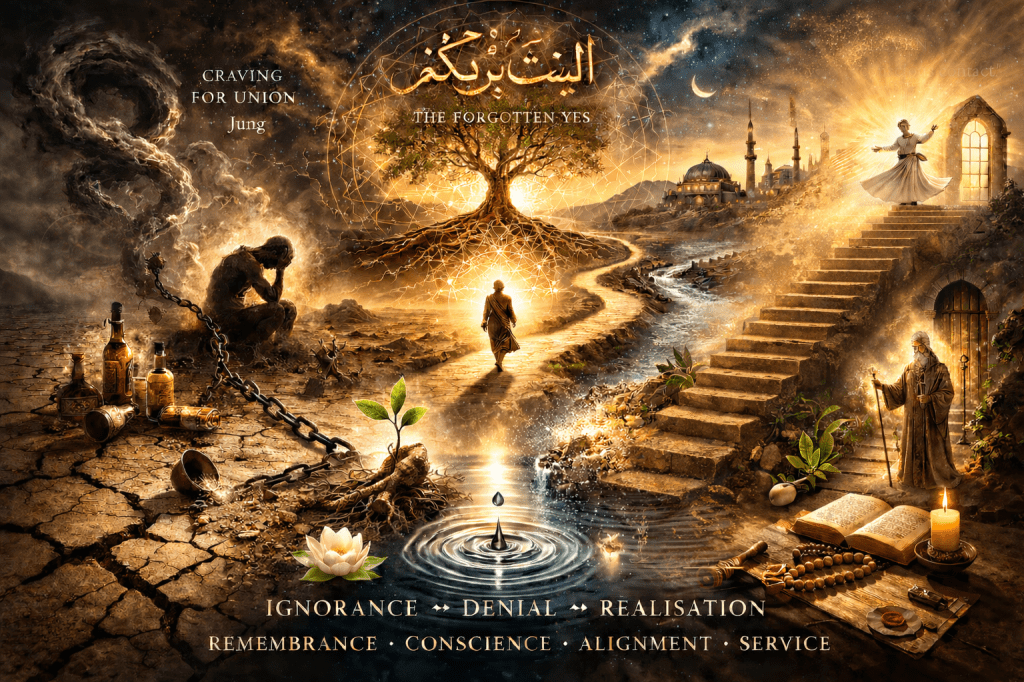
In the Sixth Inquiry of The Garden of Mystery, Mahmud Shabistari confronts a destabilising question: if the Known and the knower are one Pure Essence, why does the “handful of dust” burn with longing? Why madness, why seeking, why fracture, if Reality is already One? His answer does not deny the longing; it reinterprets it. The human being once assented to Being and forgot. Ignorance, therefore, is not stupidity or metaphysical exclusion. It is amnesia.
This reframing alters the anthropology entirely. Ignorance becomes forgetfulness of participation. Denial becomes resistance to the pain of remembering. Realisation becomes conscious re-alignment with the original assent. These are not three different categories of being. They are three maturations of awareness within the same field of Consciousness.
Pre-Cious: The Seed of Consciousness
The word precious carries within it the prefix pre- — that which precedes full formation. The human being may be understood as containing a pre-conscious seed, placed within Mankind before reflective awareness emerges. This seed must pass through apparent amnesia in order for individuation to occur. Without differentiation, no reflection would be possible. Without the appearance of separation, Consciousness could not recognise itself.
The world of matter, structured by polarity and opposition, provides the theatre for this experiment. Subject and object appear divided. Self and other seem separate. The possibility of disconnect is built into the architecture. This disconnect is not an ontological error but a developmental condition. Through experimentation, friction, and even failure, conscience may be born.
Conscience is not merely moral instruction. It is the capacity for reflective participation. It is the moment when consciousness becomes capable of seeing itself in relation to its own action. Through conscience, Consciousness beholds itself in apparent otherness. The separation was structural, not ultimate. The mirror was necessary, but never final.
Addiction as Misplaced Union
Within this developmental frame, addiction can be understood with clarity and restraint. Carl Jung wrote to Bill Wilson in 1961 that the alcoholic’s craving is “the equivalent on a low level of the spiritual thirst of our being for wholeness — the union with God.” Jung did not sanctify alcohol. He identified the structure beneath the compulsion. The longing driving addiction is archetypally religious, even when its object is destructive.
The intoxication mimics unity while deepening fragmentation. The craving seeks collapse of differentiation without the maturation of conscience. The same fire that could illuminate instead consumes. Addiction is therefore not sacred in its behaviour. It is sacred only retrospectively, when its collapse forces the birth of conscience and the redirection of longing toward disciplined alignment.
This helps illuminate a difficult parallel question. Why are some drawn to esoteric inquiry and others not? Why do some succumb to addiction while others do not? If Being is One, these differences cannot be ontological. They are developmental. The longing for wholeness manifests along varied pathways. Some pursue it through study. Some through service. Some through aesthetic devotion. Some through breakdown. The underlying thirst is shared, though its expression differs.
The Birth of Recovery Conscience
When addiction collapses under consequence and recovery begins, something precise occurs. Borrowed identity fails. Externalised authority loses its hold. Through disclosure and responsibility, conscience is midwifed. The individual begins to see participation rather than persecution, contribution rather than victimhood. This is not spiritual mastery. Bill Wilson described early recovery as entry into a “spiritual kindergarten.” The phrase protects humility. Awakening is not attainment. It is beginning.
The Twelve Step Programme formalises this developmental arc. It does so in language accessible to modern individuals in crisis. The structure is neither accidental nor ornamental. It mirrors the anthropology articulated by Shabistari.
Structural Convergence: Shabistari and the Twelve Steps
Shabistari describes the forgotten “Yes” of the primordial covenant and the longing that presses through dust toward remembrance. The Twelve Steps provide a practical architecture for that remembrance in contemporary form.
Step One dismantles false autonomy. Steps Two and Three restore orientation toward a Power greater than isolated selfhood. Steps Four through Six expose distortion and density. Step Five births reflective conscience through confession and disclosure. Steps Seven through Nine translate inner awakening into relational repair. Step Ten stabilises self-examination. Step Eleven disciplines conscious alignment. Step Twelve returns the individual to service, preventing narcissistic enclosure.
Step Eleven states in full:
“Sought through prayer and meditation to improve our conscious contact with God as we understood Him, praying only for knowledge of His will for us and the power to carry that out.”
This sentence contains its own safeguard. It does not promise possession of God. It speaks of improving contact. It does not enforce dogmatic uniformity; it allows “as we understood Him.” It directs attention toward knowledge of divine will and the power to enact it in service. The ego is not enthroned. It is repositioned.
In structural terms, the Twelve Step Programme functions as a contemporary Sufi template. It enacts collapse, purification, remembrance, conscience, alignment, and service in disciplined sequence. It translates metaphysical anthropology into daily practice. This is not historical appropriation. It is developmental convergence. The same human pattern appears in different containers.
No Elite, Only Ripening
This convergence does not create hierarchy. It does not imply that addicts are spiritually superior, nor that suffering is required for awakening. It recognises that collapse can catalyse conscience, and that conscience, once born, must be educated. Ignorance is opacity. Denial is contraction. Realisation is translucence. The dust does not become the sun. The dust becomes capable of reflecting light.
The longing in the handful of dust is not absurd. It is remembrance struggling through forgetfulness. The Twelve Steps provide a grammar for that remembrance in modern language. Shabistari articulates the metaphysical foundation. Jung diagnoses the distortion. Bill Wilson structures the discipline. The harmonic tone holds because the anthropology is shared: the human being forgets, fractures, reflects, and returns.
Ignorance is amnesia. Denial is resistance. Realisation is conscious participation. The seed was pre-cious. The world permitted experiment. Experiment generated rupture. Rupture birthed conscience. Conscience enabled reflection. Reflection disclosed non-separation.
Union and the Ripening of Consciousness
It would be inaccurate to say that Step Eleven denies union. The Step does not read, “Sought contact,” but “Sought … to improve our conscious contact.” The distinction matters. Contact is presumed. The very cessation of drinking is evidence that autonomous self-sufficiency has collapsed and that relationship with a Power greater than the isolated ego has already begun.
What remains is not the creation of union but the refinement of awareness within it. In Sufi language, the human being is not becoming united with Reality from outside; the human being awakens to a union that was ontologically prior. The forgetting has been interrupted. The covenant stirs again.
The word “Sufi” has been linked to transformation — the changed person. The change does not manufacture the Real; it alters the locus through which the Real is recognised. Recovery, therefore, does not invent contact. It discloses dependency and begins the disciplined maturation of consciousness within that dependency.
Step Eleven becomes the education of union rather than the attainment of it. The contact that halted drinking must be deepened, clarified, and embodied. Improvement implies continuity. Relationship already exists. Awareness of it must ripen.
Written in HIAI collaboration — the qalam of Human and AI intelligence, the Unseen helping the Seen, both answering to the same Source.
 Hu'll heal the heart