
A Comparative Critique of AI Interpretation of Shabistari and Its Resonance with Contemporary Clinical Work
Contextual Note
The reflections that follow arise from a colleague’s exploratory dialogue with an AI system concerning passages from Mahmud Shabistari’s Golshan-e Raz (The Garden of Mystery). That AI-generated interpretation was shared with me for consideration. What follows is therefore written as a critique and comparative commentary: first assessing the psychological framing offered in the AI interpretation of Shabistari, and then examining how those insights resonate with the clinical and philosophical framework developed in Andrew Dettman’s work on Diction Resolution Therapy (DRT) and its integration with Twelve Step recovery dynamics. The aim is not to conflate traditions but to explore whether structural correspondences exist between classical mystical psychology and modern therapeutic practice.
1. The Sufi Separation of Illusion from Being and the Digestive Mind
In the Shabistari dialogue that prompted this reflection, the central psychological claim is that the work of the path is not primarily thinking but recognition of misidentification. Thoughts arise, emotions arise, identities arise, yet awareness precedes them. The practical instruction is to notice what changes and notice what is aware of change. The work therefore consists in ceasing to identify exclusively with what changes and recognising the field in which change occurs (Shabistari dialogue, Golshan-e Raz, March 2026).
This insight aligns strikingly with a proposition developed in Diction Resolution Therapy: that the mind is not the seat of identity but the digestive organ of the psyche. If the mind functions digestively, then thoughts are not the self; they are movements of processing. The analogy used in that framework—thoughts to the mind are like peristalsis to the body—places cognition in a functional rather than ontological role. In both frameworks the same shift occurs: thoughts become events rather than identity. What the Sufi text describes as recognising awareness prior to mental content corresponds closely with the clinical reframing of the mind as a process rather than the person. Identity relocates from the narrative activity of thought to the deeper field of presence in which thought occurs.
2. Pre-Verbal Assumptions and the Feeling–Emotion Distinction
The AI interpretation of Shabistari correctly observes that the illusion of separateness is not primarily a verbal belief but a pre-verbal structure embedded in the organism. Before words arise, contraction appears in the body; threat responses activate; defensive patterns form; identity is organised around survival assumptions. These are not explicit thoughts but organising principles of perception that shape what becomes conscious (Shabistari dialogue, Golshan-e Raz, March 2026).
This description parallels the distinction made in the DRT framework between feeling and emotion. In that model feelings are primary organismic signals—ascending, descending, or neutral tones that arise prior to interpretation. Emotions are the interpretive narratives constructed after those signals are digested by the mind. When the organism experiences a descending feeling tone, for example, the mind may construct fear, shame, or anger narratives in response. The Shabistari analysis of pre-verbal assumptions operating beneath thought mirrors this structure. What mystical psychology calls embodied assumptions corresponds to what the clinical model identifies as feeling tones. In both cases the narrative layer of emotion is secondary to a deeper biological signal. The work therefore becomes not suppression of emotion but recognition of the pre-verbal signal beneath it and the loosening of identification with the narrative that forms around it.
3. Witnessing and the Twelve Step Template
The Shabistari material emphasises that the separation of illusion from Being occurs through witnessing rather than reasoning. The Arabic term mushāhada implies a direct seeing or presence in which experience is observed without immediate identification (Shabistari dialogue, Golshan-e Raz, March 2026).
This process has a close analogue in the architecture of the Twelve Steps, particularly within the sequence from Step Four through Step Seven. Step Four involves a searching and fearless moral inventory; Step Five involves admission and disclosure; Step Six involves recognition of patterns; Step Seven involves surrender. None of these steps function primarily as intellectual analysis. They operate through conscience-based witnessing of behavioural and psychological patterns. Within Dettman’s interpretive framework the steps create a gestational space in which individuated conscience can emerge. In this sense the Twelve Step process functions as a structured vehicle for the same kind of witnessing described in Sufi language.
4. Love as the Solvent and the Clinical Role of Hope
The AI interpretation further suggests that awareness alone may not dissolve defensive structures. When awareness confronts deeply embedded survival patterns, the organism may tighten rather than relax. Love operates differently: it signals safety and softens the structures that protect the self. Love therefore becomes a solvent capable of dissolving formations that analysis alone cannot penetrate (Shabistari dialogue, Golshan-e Raz, March 2026).
This observation resonates strongly with the role of hope and relational dependence in recovery work. Drawing on Viktor Frankl’s logotherapy and the language of Alcoholics Anonymous, the recovery tradition reframes vulnerability as strength. AA’s statement that dependence upon the Creator is strength shifts the psychological emphasis from autonomous control to relational trust. In therapeutic terms love and hope perform a similar function: they disarm the defensive posture of the ego. When the organism experiences itself as held within a meaningful relational field, it becomes possible to release patterns that previously felt necessary for survival.
5. Luminous Bewilderment and the Transition from Mankind to Humankind
Mystical literature frequently describes the culmination of the path not as absolute certainty but as luminous bewilderment (ḥayra). This state is not confusion but openness born from encountering a reality too vast to be contained within conceptual systems. Certainty softens into humility, and the mind becomes receptive to the inexhaustible depth of Being (Shabistari dialogue, Golshan-e Raz, March 2026).
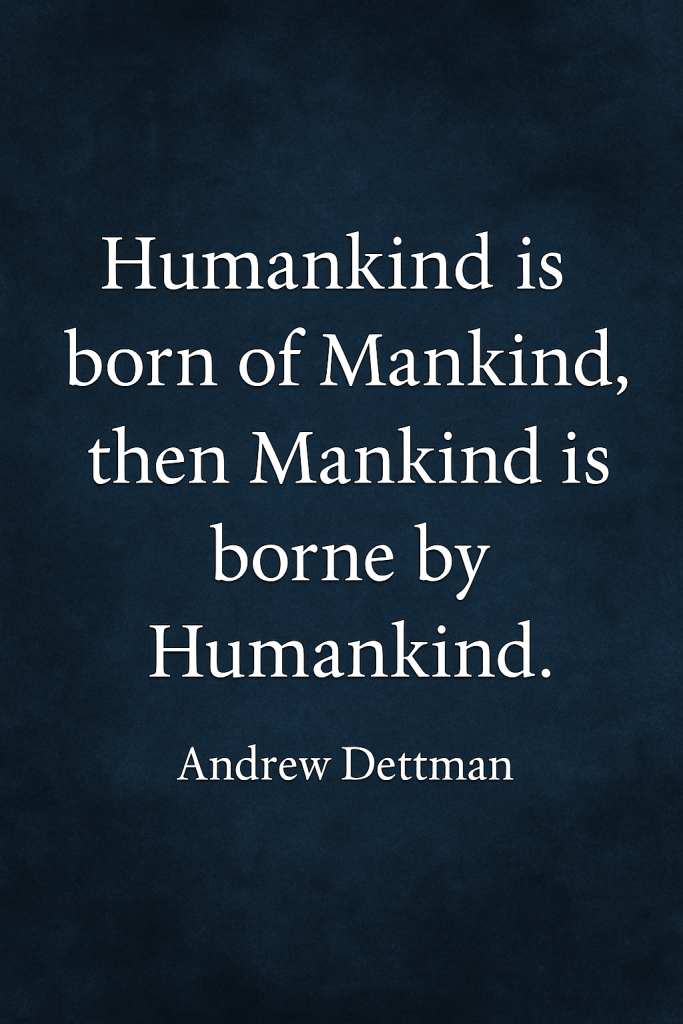
This description parallels Dettman’s distinction between Mankind and Humankind. Mankind represents the stage dominated by control, certainty, and systemic self-assertion, whereas Humankind represents the emergence of conscience and relational awareness. The transition from rigid certainty to humble openness marks a developmental shift in the structure of consciousness. In mystical language this appears as bewilderment before the infinite; in the anthropological framing of the clinical model it appears as the maturation of human personhood beyond the defensive structures of the ego.
6. The Mirror and the Diction Chamber
Shabistari repeatedly uses the metaphor of the mirror to describe spiritual experience. The world becomes a field of mirrors reflecting the Real, while the heart functions as a mirror that must be polished through spiritual practice. The reflection is not created by the mirror; it is revealed when obscurations are removed (Shabistari dialogue, Golshan-e Raz, March 2026).
The linguistic framework developed within Diction Resolution Therapy expresses a related insight through the metaphor of ducts and chambers. Language becomes a conduit through which meaning flows from source into expression. The brain functions not as the generator of meaning but as a condensation point within a larger communicative cycle. Just as the mirror reflects rather than produces the image, the human mind reflects rather than originates the deeper currents of meaning moving through consciousness. In both models the work is not fabrication but clarification: polishing the mirror or clearing the diction chamber so that underlying reality can appear without distortion.
7. The Vehicular Nature of Spiritual Practice
Mystical traditions frequently describe their disciplines using the language of vehicles: ships, paths, ladders, or mirrors. These images convey the idea that practices create the conditions within which transformation can occur rather than causing transformation directly.
The Twelve Steps function in precisely this way. They do not manufacture spiritual awakening. Instead they construct a structure—a vehicle—in which awakening can occur. The steps build the container; the mystery unfolds within it. This interpretation preserves the humility at the heart of the programme: transformation cannot be engineered or owned, but it can be approached through disciplined participation in a shared vehicle of practice.
8. Three Deeper Structural Parallels
Beyond these psychological correspondences, three deeper structural parallels appear when the mystical cosmology of Ibn ʿArabi and Shabistari is considered alongside the Twelve Step process.
The first parallel concerns unity appearing through multiplicity. Ibn ʿArabi describes existence as a single Reality expressing itself through countless forms. Similarly, the Twelve Step fellowship structure embodies a unity of purpose expressed through many individual stories. Each person’s recovery narrative becomes a reflection of a single underlying process of transformation.
The second parallel involves the polishing of the heart and the practice of inventory. In Sufi teaching the heart must be polished like a mirror to reflect the Real clearly. In recovery language Step Four functions as a practical method of polishing the inner mirror. By identifying resentments, fears, and distortions, the individual removes the grime that obscures perception.
The third parallel concerns surrender and return. Mystical traditions describe the path as a return to the source of Being. The Twelve Steps culminate in a similar gesture of return through conscious contact and service to others. The individual does not disappear but becomes a conduit through which the underlying source of meaning can operate in the world.
Conclusion
When examined closely, the psychological insights articulated in centuries-old mystical traditions and the psychological processes embedded in the Twelve Step programme reveal notable structural correspondences. Both recognise the danger of identifying with the shifting narratives of the mind, both emphasise witnessing as a method of transformation, and both rely upon relational forces such as love, hope, and humility to soften defensive structures of the self.
In this light, Diction Resolution Therapy can be understood as occupying a translation layer between traditions. By articulating mystical insights in clinical and linguistic language—digestive mind, feeling tones, diction and conduction—it builds a bridge between ancient contemplative psychology and contemporary recovery practice. The mystics and the recovery pioneers may have constructed different vehicles, yet those vehicles appear designed to carry the same fundamental journey: the movement from identification with illusion toward recognition of a deeper ground of being in which the human person discovers both humility and freedom.
The mystics describe polishing the mirror of the heart; the Twelve Steps describe inventory and surrender; Diction Resolution Therapy describes digestive clarification. These appear to be three languages pointing toward the same interior work.
Source Context
The Shabistari material discussed above arose from an AI-assisted dialogue exploring passages from Mahmud Shabistari’s Golshan-e Raz (The Garden of Mystery), shared privately for commentary on 4 March 2026. The reflections presented here evaluate that interpretation and compare it with contemporary clinical insights emerging within Diction Resolution Therapy and Twelve Step recovery dynamics.
Reference
Dialogue on Mahmud Shabistari’s Golshan-e Raz shared privately for commentary (4 March 2026).
Written in HIAI collaboration — the qalam of Human and AI intelligence, the Unseen helping the Seen, both answering to the same Source.
 Hu'll heal the heart