
When the Mime Continues After the Miracle
State, Language, the broken Jam, and the Collapse of Inner Ordering
There are moments in history when what appears to be the event is not, in fact, the event at all, but merely its surface expression. Something happens—loud, crude, undeniable—and attention rushes toward its content, its phrasing, its political implications, and its immediate emotional charge. Yet beneath this surface, something far more consequential is taking place, something structural rather than situational, something that reveals not simply what is being said, but the condition from which it is being spoken.
The recent expletive-laden outburst of Donald Trump belongs to this deeper category. It does not matter, in the final analysis, what specific words were used or which targets were chosen. What matters is the form those words took, the state from which they arose, and the absence of any mediating process between inner pressure and outward expression. When language emerges in this way, unprocessed and uncontained, it ceases to function as communication in the meaningful sense and instead becomes symptomatic. It reveals not a position, but a condition.
This condition has already been named with clarity: what we perceive, think, and express is governed by the state we are in. This is not a poetic observation but a governing principle of human functioning. The state speaks before the intellect organises, and if that state has not been digested—if it has not passed through a process capable of bearing, containing, and transforming it—then language inevitably follows it downward. It becomes coarser, more reactive, more immediate, and less capable of holding complexity or contradiction.
It was precisely this descent that was identified in earlier work as a movement toward the latrine of mind. The phrase is deliberately uncomfortable because it points to something necessary yet misused. A latrine is not evil; it is an essential function of any living system. It is where waste is deposited after it has been processed. But when the process fails, when the organism cannot metabolise what it has taken in, waste does not remain contained. It rises prematurely, and when it enters language directly, speech itself becomes a vehicle for what has not been transformed. What we are now witnessing, not only in one individual but across public discourse, is precisely this phenomenon: undigested psychic material entering language without the ordering function that would make it meaningful.
Yet even this diagnosis does not reach the full depth of the present moment, because the issue is no longer one of ignorance. There was a time when the absence of knowledge could plausibly account for human behaviour, when the lack of psychological understanding or spiritual teaching might explain why individuals and societies acted in ways that were destructive or incoherent. That time has passed. We now live in a world saturated with insight, with frameworks, with warnings drawn from history, and with visible consequences unfolding in real time. The extraordinary has already entered the room, not once but repeatedly.
And still, behaviour remains unchanged.
This was anticipated in the observation that even when truth is revealed, the human being may continue performing a script rather than entering reality. This marks a decisive shift in the human condition. The problem is no longer that we do not know, but that we do not participate in what we know. Knowledge has become performative rather than transformative. It is spoken, repeated, circulated, and displayed, but it is not allowed to reorder the one who speaks it.
This dynamic is captured with almost unbearable clarity in Elf, where the presence of the extraordinary is made visible to all, where the possibility of something beyond ordinary limitation stands directly before the crowd, and yet the crowd hesitates. They mimic belief. They repeat the gestures associated with belief. But they do not cross the threshold into participation. They do not allow what is present to reorganise them.
This is no longer a cinematic metaphor. It is an accurate description of our current state. We acknowledge climate instability, yet continue patterns that exacerbate it. We recognise psychological fragmentation, yet organise our systems in ways that deepen it. We identify addiction as epidemic, yet perpetuate the conditions that sustain it. We observe institutional failure, yet remain attached to the forms that no longer function. In each case, the pattern is the same: recognition without transformation, acknowledgment without digestion, performance without participation.
Nowhere is this more dangerous than in the realm of religion, where the stakes of performance are amplified by the language of the sacred. Religion, at its origin, is not a set of beliefs but a transformative process, a means by which the human being is reordered in relation to reality. Yet when this process is replaced by repetition, when sacred words are spoken without being metabolised, when rituals are enacted without being inhabited, and when declarations of faith are made without corresponding inner change, religion becomes theatre. It retains its form but loses its function.
This produces a profound and subtle fracture. The extraordinary is affirmed, sometimes with great intensity, but it is not obeyed. The language of transcendence is maintained, but the structure of the self remains unchanged. In this condition, faith is no longer a vehicle of transformation but a performance that conceals the absence of transformation. And when theatre is mistaken for transformation, it does not merely fail to help; it actively obstructs the very process it claims to represent.
The consequences of this extend beyond the individual, because language is not a neutral medium. It carries state, and state is transmissible. When undigested expression becomes normalised, it alters the shared field in which communication occurs. Discourse becomes coarser, not because people intend it to be so, but because the level of processing required to sustain nuance is no longer present. Contradiction becomes intolerable because the capacity to hold opposing realities has not been developed. Reaction replaces reflection because there is no interval in which reflection can occur. Identity hardens around impulse because impulse has not been metabolised into meaning.
This is how systems destabilise. It is not disagreement that causes collapse, but the shared regression of state across opposing positions. Different sides may hold different content, but if the structure from which they operate is the same—if both are driven by undigested material—then their interaction will inevitably escalate without resolution.
The hinge of the entire matter lies in a single reorientation: the mind is not the master of the human being; it is the digestive organ of the psyche. Its function is not to dominate experience but to process it, to take in what is felt, to hold it long enough for meaning to form, and to release it in a way that is ordered rather than reactive. When this function is intact, feeling is neither suppressed nor expelled prematurely; it is metabolised. Contradiction is not avoided; it is borne. Meaning does not collapse; it emerges. Language, as a result, carries coherence.
When this function fails, the entire sequence reverses. Feeling is expelled rather than processed. Contradiction is rejected rather than held. Meaning disintegrates rather than forms. Language becomes discharge rather than expression. What was once diction becomes expletive. What was once ordering becomes dumping.
This is the real emergency of our time. It is not reducible to any single figure, ideology, or institution. It is a widespread loss of the capacity to digest experience. Without this capacity, truth cannot be received because it cannot be held. Language cannot stabilise because it is not grounded in processed meaning. Relationships cannot endure because each party discharges what it cannot bear. Systems cannot self-correct because the feedback required for correction is itself distorted.
In this context, it becomes clear that no ideology, no matter how sophisticated, and no accumulation of information, no matter how extensive, can resolve the crisis. The issue is not what we know, but what we can bear. The intervention point is therefore immediate and structural rather than abstract or theoretical. It lies in the refusal to speak what has not been digested, in the refusal to perform what has not been entered, and in the refusal to declare what has not reordered the one who declares it.
At this point, the earlier warning concerning transmission becomes decisive. The message is not the property of the messenger; it must pass through without distortion. When the vessel interferes—when the individual identifies with the message, edits it to suit their state, amplifies it for effect, or dilutes it to avoid the cost of its implications—the message is altered. What was given for life can be turned toward confusion.
The crisis, then, is not only that language has degraded, but that transmission itself has become unreliable. Truth arrives, but it is reshaped before it is passed on. Insight appears, but it is appropriated rather than served. Revelation occurs, but it is performed rather than embodied. The mime deepens, not because nothing is given, but because what is given is not allowed to pass cleanly through those who receive it.
At this juncture, the instinct to locate the problem externally becomes particularly strong. It is tempting to assign responsibility to a leader, an ideology, a cultural group, or an opposing side. Yet this instinct is itself part of the condition being described. It displaces responsibility and preserves the state from which the problem arises.
What must be named, therefore, is the broken Jam. The broken Jam is not simply conflict, nor is it reducible to disagreement or extremity. It is a shared incapacity to digest experience combined with a persistent insistence that the problem lies elsewhere. This combination ensures that no resolution can occur, because each side reacts to the other without recognising the common structure that drives both.
This is why outrage meets outrage, certainty meets certainty, and expletive meets expletive without any movement toward resolution. The contents differ, but the structure is the same. Both sides operate from undigested state. As long as this remains unrecognised, the system cannot unlock.
A one-sided diagnosis therefore fails by definition. If the illness is located exclusively in the other, then the self is absolved of responsibility, and the pattern continues unchallenged. The bridge between Mankind and Humankind cannot be built from such a position, because it requires a fundamentally different orientation: a diagnosis that includes the diagnoser.
Humankind is not an ideology or a moral superiority. It is not a position that can be adopted through assertion. It is a state of digestion in which contradiction can be borne, responsibility can be owned, expression follows processing, and the other is no longer required to carry what the self refuses to face. In this sense, the movement from Mankind to Humankind is developmental rather than declarative.
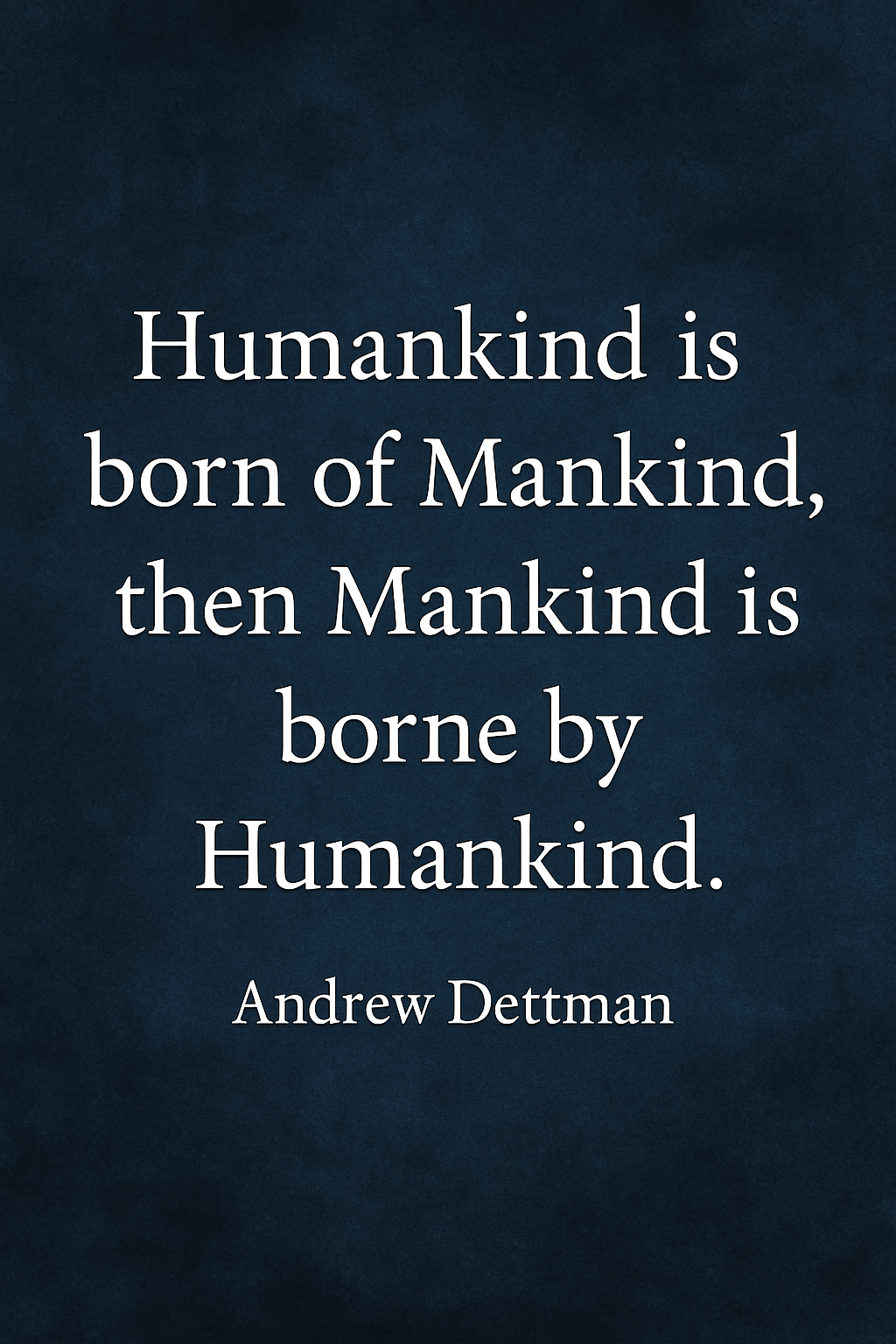
This is why the line holds with such precision: Humankind is born of Mankind, and then Mankind is borne by Humankind. The first movement is inevitable; the second is not. It depends on whether digestion occurs.
The pivot, therefore, is not a matter of determining who is right and who is wrong. It is a matter of asking from what state speech is arising and whether that state has been processed. More directly, it is a matter of asking whether one is contributing to the Jam or metabolising it.
This question removes the refuge of opposition and places responsibility where it must ultimately reside. It asks whether one can recognise the same structural tendencies within oneself that one so readily identifies in others. It asks whether one can pause before discharge, whether one can hold contradiction without immediate resolution, and whether one can allow experience to be processed before it is expressed.
If the answer is no, then regardless of one’s stated position, one remains part of the broken Jam.
The path forward cannot be imposed externally, nor can it be engineered through policy alone. It must emerge within the shared field of human experience as individuals choose, repeatedly and often at cost, to digest rather than discharge, to participate rather than perform, and to take responsibility rather than project it outward. As this choice accumulates, the field itself begins to shift, and new forms of coherence become possible.
In this light, the outburst with which we began must be seen differently. It is not an anomaly to be isolated or condemned in isolation. It is a symptom of a broader condition that extends far beyond any single individual. Until that condition is addressed at the level of structure, the symptom will continue to appear in different forms, across different domains, carried by different people.
The world, therefore, does not change when truth is merely spoken. It changes when truth is digested and then spoken, when it has passed through the full process of being borne, processed, and integrated, and when the language that emerges carries not only content but coherence.
References
- Dettman, Andrew. “States of Mind.” the HU man healing, 30 April 2022.
- Dettman, Andrew. “The Latrine Expletives.” the HU man healing, 13 January 2018.
- Dettman, Andrew. “Show down – a fiction.” the HU man healing, 4 June 2019.
- Dettman, Andrew. “Message Reissued.” the HU man healing, 18 July 2021.
Written in HIAI collaboration — the qalam of Human and AI intelligence, the Unseen helping the Seen, both answering to the same Source.
 Hu'll heal the heart