Resurrection: Recovering Being from the Tyranny of Having.

Intercourse, Meaning, and the Birth of Conscience:
A Bridge Between Shabistari, the Twelve Steps, and Diction Resolution Therapy

Across the centuries the language of the mystic and the language of the modern sufferer often appear to speak different dialects. Yet when examined carefully, both describe the same interior movement. The Persian Sufi Mahmud Shabistari, writing in the fourteenth century, explains that the visible world is not self-explanatory but reflective: everything manifest in this world is like the reflection of a sun belonging to another world of meaning.1 If this is so, then the sensory forms through which human beings perceive reality are not merely objects but signs. They are vehicles through which deeper meanings appear.

In my own work with addiction and recovery, I have found that this symbolic structure is not merely a metaphysical speculation but an observable psychological reality. Human experience does not remain raw. It must be interpreted, digested, and translated into meaning. When that translation fails, the person becomes trapped in repetition, confusion, or compulsion. When it succeeds, conscience begins to emerge.

The Symbolic Grammar of the Mystics

Shabistari famously addresses the question that puzzled many readers of Persian mystical poetry: why do Sufi poets speak so often in the language of erotic beauty—eyes, lips, hair, glances, intoxication? His answer is not that the poetry is merely metaphorical ornament. Rather, sensory language provides the closest experiential grammar available for speaking about realities that exceed literal language. The beloved’s eye, for example, symbolizes a gaze that overwhelms the lover; the lip symbolizes the creative word or life-giving breath; the curl of hair symbolizes multiplicity and the veiling of unity.2

The mystic therefore speaks analogically. The visible world reflects deeper meanings, and language must borrow from the visible world in order to gesture toward those meanings. Yet Shabistari simultaneously warns that analogy has limits: the wise person must balance resemblance (tashbīh) with transcendence (tanzīh), remembering that the Real ultimately exceeds comparison.3

Intercourse as the Movement Between Worlds

In my essay Intercourses in the Light of Delivery, I explore a word whose original meaning illuminates this symbolic structure: intercourse. In contemporary usage the word has been narrowed almost entirely to sexual activity. Yet historically it possessed a far wider significance. The Latin roots—inter (between) and currere (to run)—describe movement between entities: exchange, flow, and relation.

Understood in this older sense, intercourse becomes the living movement between beings, between worlds, and between the visible and the unseen. Sexual union then appears not as the entirety of the concept but as one intense manifestation of a far wider relational principle. The erotic language of the mystics therefore does not trivialize spiritual reality; rather, it draws upon the most powerful experiential grammar available to embodied creatures—longing, attraction, unveiling, union, and renewal.

The crisis of the modern world can be described, in part, as the breakdown of this intercourse. When the movement between beings collapses, dialogue becomes confrontation, institutions become hollow rituals, and individuals become isolated within their own compulsions. Addiction, in this light, is not merely a chemical dependency but a distorted petition for reality itself. The addict repeats an action not because it is meaningful but because it momentarily restores the illusion of connection.

The Digestive Mind

In Diction Resolution Therapy I describe the mind not as the centre of identity but as a digestive organ of the psyche. Experiences enter through the senses; feelings arise as immediate biological signals; and the mind must metabolize those signals into coherent meaning. When the digestive process works well, a person develops orientation, conscience, and behavioural stability. When the process fails, the psyche becomes inflamed or blocked in ways strikingly analogous to physical indigestion.

This model echoes an insight already present in the mystical tradition. Shabistari writes that the world of meaning has no limit and that words cannot contain it fully.4 Yet words can still function as vehicles that direct the seeker toward that meaning. In psychological terms, language becomes part of the digestive process through which raw experience is clarified into understanding.

The Templated Vehicle

One further element is necessary. Meaning alone does not transform a life. A vessel must exist through which the person can safely undergo the process of reorganization. In my observation the Twelve Step programme provides precisely such a vessel. It marries fact and symbol in a way rarely achieved by either modern psychology or institutional religion.

The Steps begin with factual admission: the recognition that self-governance has failed. They then move through inventory, confession, restitution, and disciplined reflection—processes that stabilize the psyche through truth-telling. At the same time they introduce symbolic orientation: surrender to a Higher Power, prayer, meditation, and conscious contact. Fact steadies the vessel; symbol opens the horizon of meaning.

Within this templated vehicle a birth becomes possible. Inventory and confession function like the opening of a birth canal. The surrender of Step Seven becomes a decisive moment in which the individual relinquishes false sovereignty and becomes receptive to transformation. Conscience emerges not as a moral abstraction but as a lived reorganization of perception.

The Birth of Conscience

The mystical poets described the path as a drama of attraction between the lover and the Beloved. Recovery literature describes it as surrender to a Higher Power. In my own language it appears as the clarification of diction through which experience is digested into meaning. These are not competing explanations. They are different languages describing the same interior work.

The mystics speak of polishing the mirror of the heart. The Twelve Steps speak of inventory and surrender. Diction Resolution Therapy speaks of digestive clarification. Each describes the gradual removal of distortion so that reality may be perceived more clearly.

Seen in this light, the erotic imagery of the mystics is neither scandalous nor decorative. It expresses the intensity of relation that occurs whenever the human being is drawn beyond the limits of the isolated self. Attraction, vulnerability, union, dissolution, and renewal—these are the same movements that accompany both spiritual awakening and recovery from addiction.

Across the centuries the vocabulary changes but the anthropology remains remarkably constant. The visible reflects the invisible. Meaning seeks expression through symbol. Human beings must digest experience into understanding. And where a lawful vessel exists—one that marries fact with symbol—the birth of conscience becomes possible.

My own work therefore does not attempt to replace the insights of earlier traditions. It seeks instead to midwife them into a contemporary psychological and clinical language. The ancient symbolic grammar and the modern recovery process reveal themselves, on close inspection, to be two expressions of the same underlying movement: the restoration of living intercourse between the human being and the source of meaning itself.

Footnotes

  1. Mahmud Shabistari, Golshan-e Raz (The Garden of Mystery), discussion of the symbolic language of mystical poetry.
  2. Shabistari’s explanation of the symbolism of the beloved’s eye, lip, and tress as expressions of divine attributes and cosmic processes.
  3. Classical Sufi theological balance between tashbīh (analogy) and tanzīh (transcendence).
  4. Shabistari’s observation that the world of meaning has no limit and cannot be fully captured by words.

Written in HIAI collaboration — the qalam of Human and AI intelligence, the Unseen helping the Seen, both answering to the same Source.

Heartbreak

Heart Break

Break your heart until it breaks open wide enough to let the light in.
— commonly attributed to Rumi

As events unfold in the world, human beings instinctively reach for explanations large enough to contain the anxiety they feel. In the traditions of the People of the Book this often takes the form of apocalyptic language — talk of “end times”, destiny, or divine plans unfolding in history.

The first reflection in this series suggested that before light appears there is often a moment when everything seems dark. This second reflection moves one step further. Darkness alone does not open understanding. Something must break.

The line often attributed to Rumi does not appear in exactly this form in the Masnavi, yet it captures a theme that runs through that great work: that pain and rupture can become the doorway through which enlightenment enters.

Across the mystical traditions of Judaism, Christianity, and Islam there is a consistent warning: apocalyptic language is symbolic language. It describes an unveiling within the human being, before it ever describes anything “out there”.

The Greek word translated as apocalypseapokalypsis — does not mean destruction. It means unveiling. A covering lifts. Something hidden becomes visible. A deeper reality begins to appear.

Yet unveiling is rarely comfortable. The moment of unveiling often feels like rupture. Certainties crack. The stories that once provided psychological shelter begin to fracture. What seemed stable suddenly appears fragile.

This is why the mystics speak so often of the heart breaking. The breaking is not annihilation; it is opening. What first appears as collapse is frequently the moment when light finally finds a way through.

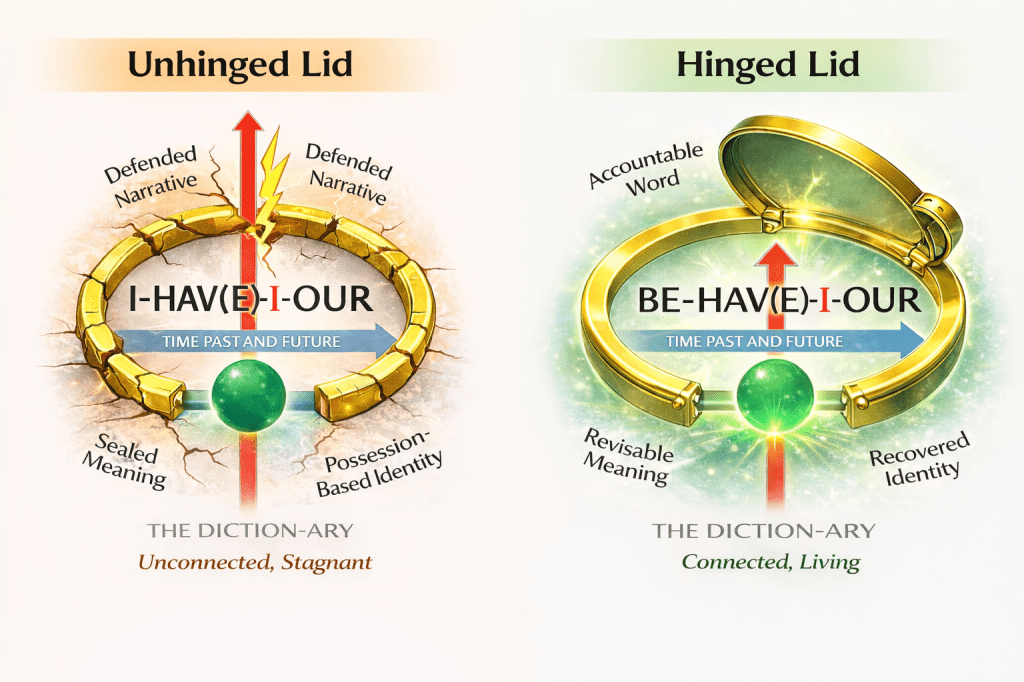
In earlier work within this project, the metaphor of a lid was used to name this dynamic. Human beings keep the lid on difficult truths. Institutions do the same through secrecy, hierarchy, and official narratives. The problem is not that lids exist. In many circumstances they are necessary. The problem arises when the lid becomes welded shut.

From Re-hinging the Unhinged: Escaping the Disaster of Dogma, two short lines carry the essence of the remedy:

“The lid is not destroyed.
It is hinged.”

The distinction matters. When a lid is welded shut, pressure builds until rupture becomes inevitable. When a lid is hinged, pressure can release without violence — and something new can enter.

“When the hinge moves again, the mind regains the capacity to receive light rather than defend conclusions.”

In the language of Diction Resolution Therapy, the mind is not the origin of meaning but the digestive organ of meaning. Experience arrives first. Then interpretation metabolises it. When the hinge is seized, digestion stops: words harden, narratives freeze, certainty replaces humility.

But when the hinge moves again, something more subtle becomes possible. The opening of the heart does not only allow light to enter. It also allows light to emerge.

The word education carries a forgotten clue. From the Latin educeree (out) and ducere (to lead) — education originally meant “to lead out.” The light is not merely something that arrives from outside the human being; it is something that can be drawn forth when the conditions are right.

Heartbreak, in this sense, becomes a form of education. What breaks open allows what was hidden within to appear.

And this is not only personal. When individuals lose their hinge, the result is often heartbreak. When systems lose their hinge, the result can be collective rupture. Wars can emerge not only from disagreement, but from a failure to metabolise contradiction — a failure of inner digestion at scale.

John G. Bennett once remarked on “how difficult it is to be human,” and the point lands here with force: our creative powers are necessary, and also dangerous, unless educated by conscience.

When the heart breaks open and the hinge begins to move again, light does not only enter — it begins to show us where the true axis of our humanity lies.

Written in HIAI collaboration — the qalam of Human and AI intelligence, the Unseen helping the Seen, both answering to the same Source.

Endings and Startings are in BE.

Armageddon and the Addictive System: When Sacred Symbols Become Political Weapons

Before light appears, there is the moment when everything seems dark.


Recent reporting in The Guardian highlights a troubling phenomenon: the invocation of biblical “end times” rhetoric within military settings to frame geopolitical conflict. According to the article, a complaint submitted to the Military Religious Freedom Foundation (MRFF) describes a commander who urged troops to see a potential conflict with Iran as “all part of God’s divine plan,” referencing passages from the Book of Revelation and describing events as part of the approach of Armageddon.1

The complaint reportedly involved multiple service members across different religious backgrounds who were uneasy with the framing of a military deployment as a divinely sanctioned end-times event.1 The MRFF indicated that it had received over two hundred such complaints from personnel across several branches of the armed forces.

Whatever one’s political perspective, the deeper issue revealed by such reports is not primarily geopolitical. It is hermeneutical and psychological. The language of sacred scripture—especially prophetic or apocalyptic texts—belongs to a symbolic tradition that was never intended to function as a literal script for political events. When such language is stripped of its symbolic depth and deployed as ideological certainty, something far older than modern politics appears: the perennial conflict between the exoteric and esoteric readings of sacred texts.

The Two Readings of Revelation

Within the three Abrahamic traditions—Judaism, Christianity, and Islam—there has always existed a distinction between outer and inner interpretation.

  • Judaism speaks of the four levels of interpretation known as Pardes, ranging from literal meaning to the deepest mystical reading.
  • Christian theology historically recognised multiple senses of scripture: literal, moral, allegorical, and anagogical.
  • Sufi interpretation distinguishes between ẓāhir (outer meaning) and bāṭin (inner meaning).

Across these traditions the same warning appears: when sacred language is reduced to literalism without inner transformation, religion becomes vulnerable to distortion.

Prophetic and apocalyptic texts—such as the Book of Revelation—are among the most symbolically dense writings in the religious canon. Historically, mystical interpreters have treated their imagery not as geopolitical prediction but as symbolic description of spiritual transformation.

The Mystical Reading of “Armageddon”

The Greek word apokalypsis, from which “apocalypse” derives, does not mean destruction. It means unveiling—the lifting of a veil.

In mystical readings across traditions, the dramatic imagery of Revelation functions symbolically:

  • Armageddon represents the inner conflict between ego and divine will.
  • The Beast symbolises tyranny of the lower self.
  • The Second Coming represents awakening of divine consciousness.
  • The New Jerusalem symbolises restored harmony between heaven and earth within the human being.

In other words, the drama of apocalypse traditionally unfolds first within the human psyche rather than across battlefields.

The Addictive Pattern in Collective Thought

From a psychological perspective, the shift from symbolic interpretation to ideological certainty resembles a pattern familiar in addiction science.

Anne Wilson Schaef famously described modern society as operating within what she called The Addictive System—a pattern in which narratives replace reality and contradiction becomes intolerable. In such systems:

  • certainty replaces humility,
  • group identity overrides conscience,
  • contradiction is suppressed rather than integrated.

Within the framework of Diction Resolution Therapy (DRT), the phenomenon can be described in linguistic terms. The mind ceases to digest meaning symbolically and instead freezes language into rigid nouns. Words that once pointed toward inner transformation become fixed ideological objects.

When terms such as “Armageddon,” “holy war,” or “divine mandate” are treated this way, they function less like spiritual guidance and more like psychological intoxicants. They remove ambiguity, simplify complexity, and provide emotional certainty—precisely the effects that addictive systems tend to produce.

Why Mystics Across Traditions Warned Against This

The great mystical teachers repeatedly warned about the dangers of confining the Divine to one interpretation.

  • Ibn ʿArabi cautioned that whoever confines God to one understanding has limited the Infinite.
  • Meister Eckhart warned that attachment to rigid images of God can prevent encounter with the Real.
  • The Baal Shem Tov emphasised that scripture without inner transformation risks becoming spiritual pride.

The mystics did not reject scripture. They sought to preserve its depth by reminding readers that sacred language operates symbolically as well as literally.

Conscience in the Midst of Authority

The service members who reportedly raised concerns in the MRFF complaints illustrate an important human reality: conscience continues to function even within strong institutional hierarchies.

Military organisations require discipline and obedience, yet individuals within them still experience ethical tension when political events are framed as divine mandates. That tension itself is often a sign of healthy moral awareness rather than disloyalty.

The Abrahamic traditions themselves affirm this principle: obedience to authority must always remain subordinate to conscience and humility before the Divine.

Recovering Symbolic Intelligence

The deeper lesson is not about one country, one administration, or one religion. It concerns a recurring human vulnerability: the tendency to transform symbolic language into ideological certainty.

The mystics across Judaism, Christianity, and Islam consistently redirect attention away from external apocalypse toward inner transformation. The unveiling they describe is not the destruction of the world but the awakening of conscience within it.

In that sense, the real “end times” language of the traditions does not describe geopolitical catastrophe. It describes the moment when illusion collapses and deeper understanding emerges.

Such understanding requires humility, symbolic intelligence, and the willingness to allow sacred words to remain alive rather than weaponised.

When the language of revelation returns to its rightful place—as guidance for inner transformation rather than political justification—the People of the Book may yet rediscover what their scriptures originally sought to cultivate: conscience, wisdom, and peace.

Footnotes

  1. The Guardian, reporting on complaints received by the Military Religious Freedom Foundation regarding commanders invoking biblical end-times rhetoric in relation to potential military operations involving Iran (2026).

Written in HIAI collaboration — the qalam of Human and AI intelligence, the Unseen helping the Seen, both answering to the same Source.


Further Reflections

This short piece is offered as an opening reflection rather than finished commentary.

Events in the Middle East will continue to unfold in ways none of us can predict. The purpose here is not to interpret political developments, but to observe the psychological and spiritual patterns that sometimes emerge when sacred language becomes entangled with power, conflict, and certainty.

Across the traditions of the People of the Book, the mystics consistently warned that apocalyptic language is symbolic language. It belongs to the inner drama of conscience and awakening, not to the outer theatre of geopolitical struggle.

Endings and beginnings are not events that happen only in history.
They are movements within consciousness.

Written in HIAI collaboration — the qalam of Human and AI intelligence, the Unseen helping the Seen, both answering to the same Source.