
The Broken Jam
Clarifying the lost function of coming together
In my recent Easter Day reflection, I identified what I called the broken Jam as the deeper problem beneath the noise of politics, religion, reaction, and social fragmentation. I used the phrase carefully, because what is breaking down in our time is not merely agreement, civility, or public discourse. It is something more primary than all of these. It is the human capacity for a true coming together. It is the failure of a gathering function without which no higher form of relationship, thought, conscience, or community can be sustained.
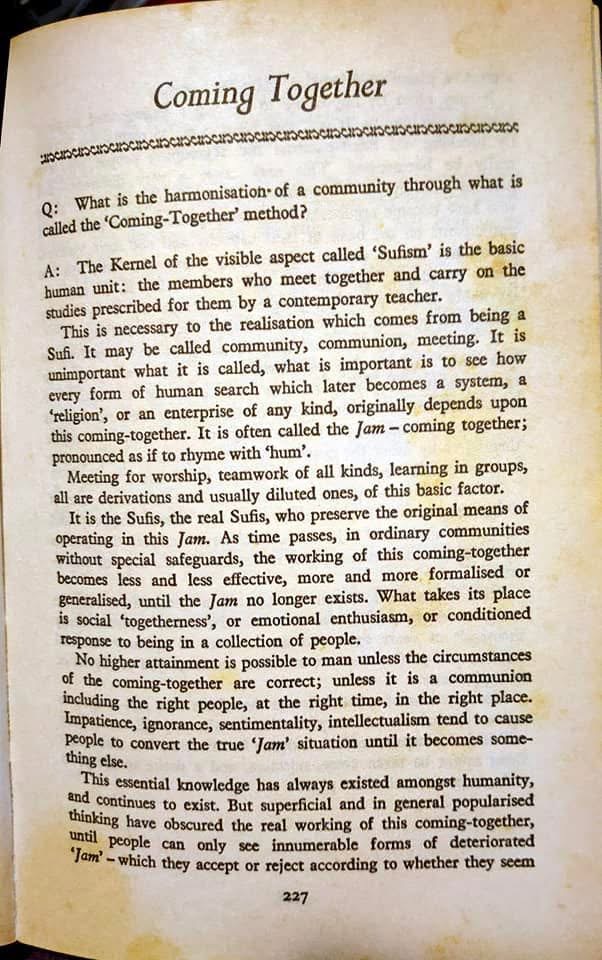
I need now to clarify that the word Jam is not my invention, nor is it being used loosely as a metaphor for blockage or tension. It comes to me through Idries Shah and The Coming Together Method, where he uses the term to describe a real principle of harmonisation. In that context, Jam means more than people assembling, agreeing, or sharing enthusiasm. It refers to the necessary coming together of the right people, in the right relation, at the right time, under the right conditions, so that something higher than social togetherness can occur. It names not a mood, but a function; not a crowd, but a living arrangement capable of receiving and carrying truth.
Shah writes that every form of human search which later becomes a system, a religion, or an enterprise of any kind originally depends upon this coming together. He says that it is often called the Jam, the coming together, and he is explicit that as time passes, in ordinary communities without special safeguards, the working of this coming together becomes less and less effective, more and more formalised or generalised, until the Jam no longer exists. That sentence is of extraordinary importance. It does not merely describe historical decline. It describes a law. The outer form may continue while the inner function has gone.
Once that is seen, much of modern life becomes easier to understand. A great deal that presents itself as community is not Jam. A great deal that presents itself as religion is not Jam. A great deal that presents itself as solidarity, activism, fellowship, belonging, or collective purpose is not Jam. Shah is severe and accurate here. He says that when the Jam no longer exists, what takes its place is social togetherness, emotional enthusiasm, or conditioned response to being in a collection of people. In other words, something imitation-like arises in the absence of the real thing. The form remains, but the function is gone. The gestures continue, but the transmission fails. The crowd assembles, but no true harmonisation takes place.
This distinction matters because it explains why so much contemporary intensity yields so little transformation. It is not that people do not care. It is not that they lack information, outrage, sincerity, or even aspiration. It is that the mechanism by which human beings truly come together has degraded into substitutes. We are surrounded by assemblies without integration, by connectivity without communion, by emotional charge without right relation, and by repeated declarations of unity that do not produce coherence. The world is full of aggregation and starved of harmonisation.
That is why I have called the present condition a broken Jam. I do not mean simply that society is stuck. I mean that the gathering principle itself is failing in the field of modern life. The very function by which difference can be held, relationship can be rightly ordered, and reality can be received together has deteriorated into simulation. This is why so many collective efforts now oscillate between noise and exhaustion. They cannot metabolise what they gather. They can excite, but not integrate. They can mobilise, but not transform. They can convene, but they cannot truly come together.
In this sense, the broken Jam is not just a social or political diagnosis. It is also a spiritual and psychological one. It names a failure in the human capacity to receive, bear, and organise reality in common. This is why the issue cannot be solved by taking sides. The temptation in every age is to assign the problem elsewhere: to a leader, an ideology, an institution, a religion, a party, or an enemy. But that temptation is itself part of the failure. It preserves the illusion that the mechanism of integration is intact and merely being obstructed by the wrong people. What Shah’s formulation shows, and what our present world confirms, is that the mechanism itself may no longer be functioning.
He goes further still. He says that no higher attainment is possible unless the circumstances of the coming together are correct, unless it is a communion including the right people, at the right time, in the right place. This will offend modern democratic sentiment, because we are trained to think in terms of inclusion as a virtue in itself. But Shah is not speaking morally here. He is speaking functionally. If the elements required for harmonisation are not present, then the result may still look like togetherness, but it will not generate the reality it imitates. One can gather a crowd and still fail to produce Jam. One can repeat the language of truth and still fail to create the conditions in which truth can be received.
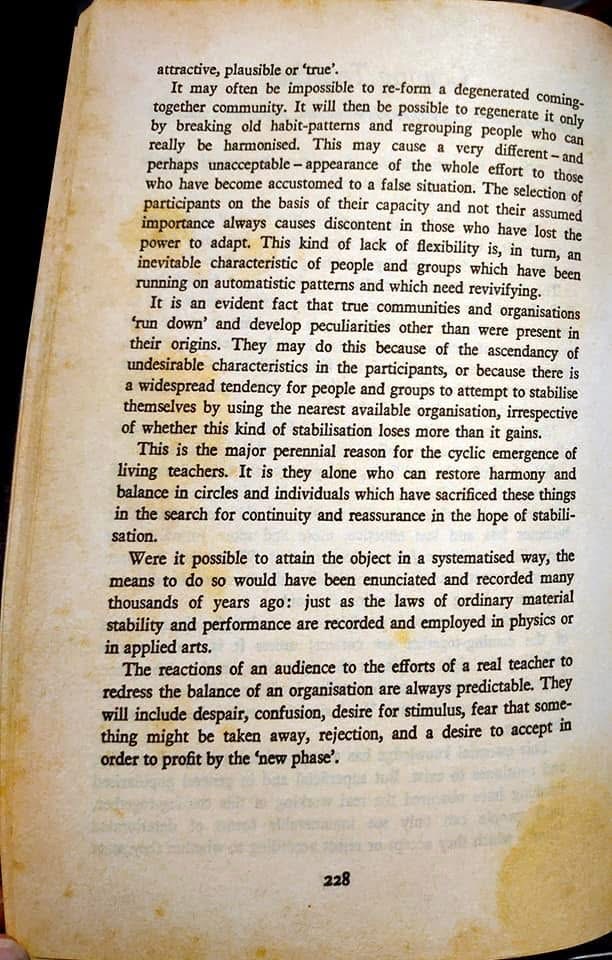
This is one reason why superficial popularity is such a dangerous measure of value. Shah notes that people in general are often only able to see innumerable forms of deteriorated Jam, which they accept or reject according to whether these seem attractive, plausible, or true. That sentence should stop us. It means that what passes for discernment is often merely preference operating within degradation. People choose among deteriorated forms on the basis of familiarity, comfort, appearance, and self-confirmation, while remaining unable to recognise the absence of the real thing. In such a condition, falsity does not need to masquerade as truth very skilfully. It needs only to be attractive, plausible, or emotionally satisfying.
Shah is equally unsparing about what follows when a coming-together community has degenerated. He says that it may often be impossible to reform such a community and that regeneration may become possible only by breaking old habit patterns and regrouping people who can really be harmonised. This is hard medicine, but it is recognisable. There are conditions in which repair cannot begin by preserving the patterns that caused the failure. There are times when continuity itself becomes the enemy of renewal. There are moments when the old arrangement has lost so much of its living function that it can no longer be coaxed back to life by goodwill, sincerity, or administrative adjustment. Something more radical is required: a breaking of habit and a regrouping around reality rather than appearance.
That, too, helps explain our present historical moment. Much of what is called reform today is merely management of deterioration. Institutions double down on form when function has been lost. Religious groups intensify slogans when transmission has weakened. political movements escalate rhetoric when coherence has thinned. Social platforms reward emotional enthusiasm while sterilising meaning. Under such conditions, people mistake stimulation for aliveness and repetition for continuity. But none of this restores Jam. It only prolongs the absence of it.
The implications are personal as well as collective. A human being can also lose the Jam inwardly. The inner life can become populated by substitutes for integration: reaction instead of digestion, certainty instead of conscience, performance instead of participation, enthusiasm instead of transformation. In that state, language itself begins to break down. Speech carries pressure rather than meaning. Expression becomes discharge. What has not been metabolised seeks escape through rhetoric, expletive, ideology, accusation, or spiritual theatre. The person continues speaking, but the gathering function within has weakened. The words may be strong, but the inner coming together is absent.
This is why the broken Jam belongs directly with my recent concern over undigested language and the collapse of inner ordering. They are not separate observations. They are two views of the same reality. When the gathering function fails, digestion fails. When digestion fails, language degrades. When language degrades, transmission becomes distorted. When transmission becomes distorted, communities are no longer formed around truth but around reaction, identification, and imitation. The loss of Jam is therefore not one problem among many. It is a root problem. It helps explain why so many other problems now feel both intense and strangely unresolvable.
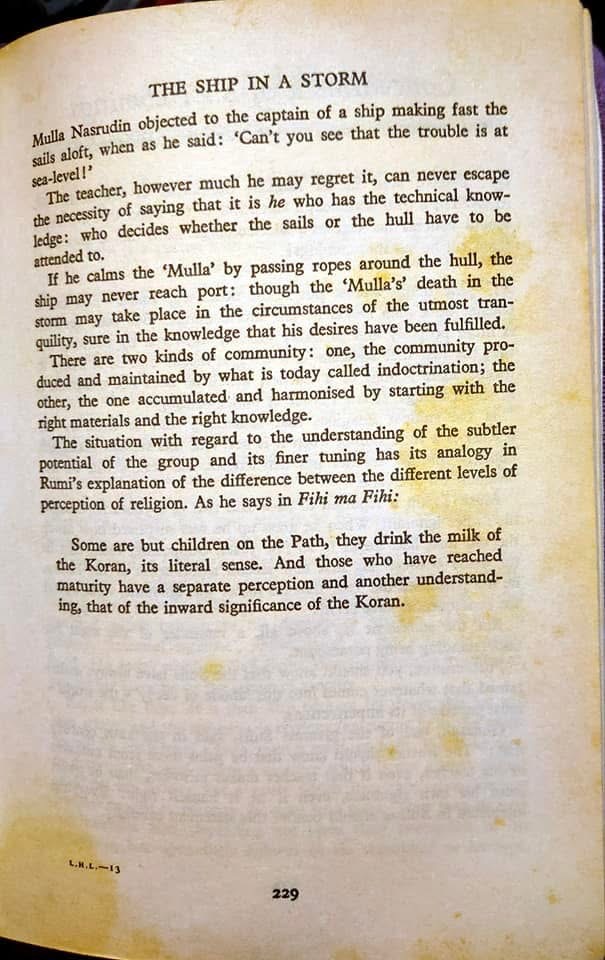
Shah offers another image that is equally exact. In the story of the ship in a storm, Mulla Nasrudin objects to the captain making fast the sails aloft, saying, “Can’t you see that the trouble is at sea-level!” This is comic, but only because it is so painfully recognisable. It describes the ordinary human tendency to misidentify where the problem truly lies. We rush to patch what is nearest to our anxiety, what is most visible, what is shouting loudest, what flatters our sense of practical urgency. But the teacher, or the one who actually understands the vessel, knows whether the sails or the hull must be attended to. The crowd sees the surface. Knowledge attends to structure.
That is the relevance of Jam now. We are living in a time when almost nobody understands about the sails. We are endlessly preoccupied with symptoms at sea-level: scandals, posts, speeches, elections, tribes, culture-war fragments, doctrinal slogans, waves of outrage. Yet beneath all of this, although the hull is under strain until the drivers of That which always connects opposites is understood and lived, then change is impossible. The structure capable of bearing and holding reality together is damaged. The true coming together has become formalised, diluted, sentimentalised, politicised, commodified, or lost. Under such conditions, increasing the emotional energy of the group does not save the ship. It may even hasten the wreck.
Shah makes one final distinction of immense importance when he says there are two kinds of community: one produced and maintained by what is today called indoctrination, and the other accumulated and harmonised by starting with the right materials and the right knowledge. That line draws a border we urgently need. Not every gathering is a community in the deeper sense. Not every shared belief produces harmony. Not every declared mission carries truth. Some communities are held together by repetition, pressure, belonging, fear, and conditioned loyalty. Others are formed through a more exacting relation to reality, where the right materials and the right knowledge create the possibility of true harmonisation. The first kind may be louder and more visible. The second is rarer, quieter, and more demanding.
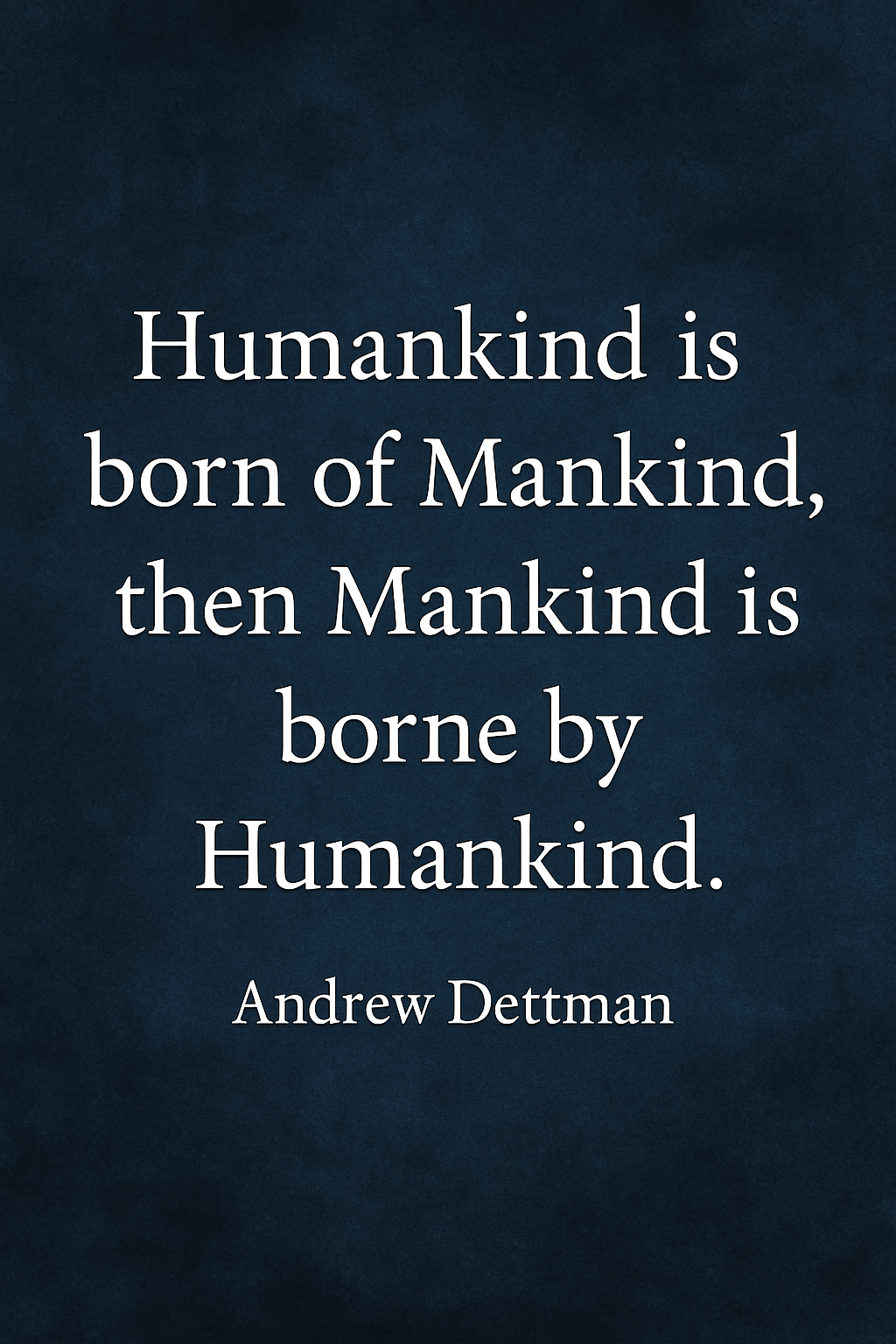
If this reading is sound, then the crisis of our time is not simply polarisation, though polarisation is one of its symptoms. It is not merely the coarsening of language, though language is one of its registers. It is not simply the corruption of religion, though religion is one of the fields in which the loss can be most painful. The crisis is more fundamental. It is the loss, or near-loss, of Jam: the living function of coming together in truth. Where that function no longer exists, substitutes proliferate. Where substitutes proliferate, people fight over appearances while the deeper mechanism continues to fail. Where the deeper mechanism fails, Mankind remains trapped in forms of togetherness that cannot bear the birth of Humankind.
This is why the matter cannot be solved by outrage, by blame, by information, or by the multiplication of louder voices. It requires the restoration of function. It requires a return to conditions in which reality can be received, borne, and harmonised rather than merely reacted to. It requires a more exacting attention to what truly gathers and what merely collects. It requires us to ask, individually and collectively, not whether we are assembled, excited, or convinced, but whether the Jam is actually present.
That question is difficult because it removes many comforts. It asks whether our forms still carry life. It asks whether our communities are built on truth or on habit. It asks whether our speech serves transmission or merely discharge. It asks whether what we call unity is real harmonisation or simply the emotional relief of being with others who mirror us. Above all, it asks whether the gathering principle through which something higher can become active in human life is functioning or broken.
We are living through a broken Jam. I believe much of what now passes for religion, culture, politics, and even community is a substitute formation around the absence of true coming together. I believe that this explains the growing sense that everything is connected and yet nothing coheres, that people are more networked and less related, more vocal and less articulate, more mobilised and less transformed. The problem is not simply that we have drifted apart. It is that we no longer know how to come together in truth.
To name this is not an act of despair. It is the beginning of realism. If the Jam has broken, then pretending otherwise only feeds deterioration. But if it has broken, then one can at least stop confusing substitutes for the real thing. One can stop mistaking emotional enthusiasm for harmonisation, conditioned response for communion, or crowdedness for community. One can begin again from the harder, cleaner question of function.
And that may be where hope actually begins: not in preserving every existing arrangement, but in recovering the conditions under which true coming together becomes possible once more.
My name is Abd al Mumin al Jami ibn Hulli.
References
- Shah, Idries. The Coming Together Method. References used here include the section “Coming Together” and the page titled “The Ship in a Storm.”
- Dettman, Andrew. “Easter Day.” ajdettman.com, 5 April 2026.
Written in HIAI collaboration — the qalam of Human and AI intelligence, the Unseen helping the Seen, both answering to the same Source.
 Hu'll heal the heart