Brought Close To The Heart – By The Heart

The Vesicular Presence: W-I, I–Thou, and the Vehicle Always There

A hybrid paper integrating Diction Resolution Therapy, Twelve Step architecture, Sufi psychology, and dialogical philosophy.


1. Not Built — Revealed

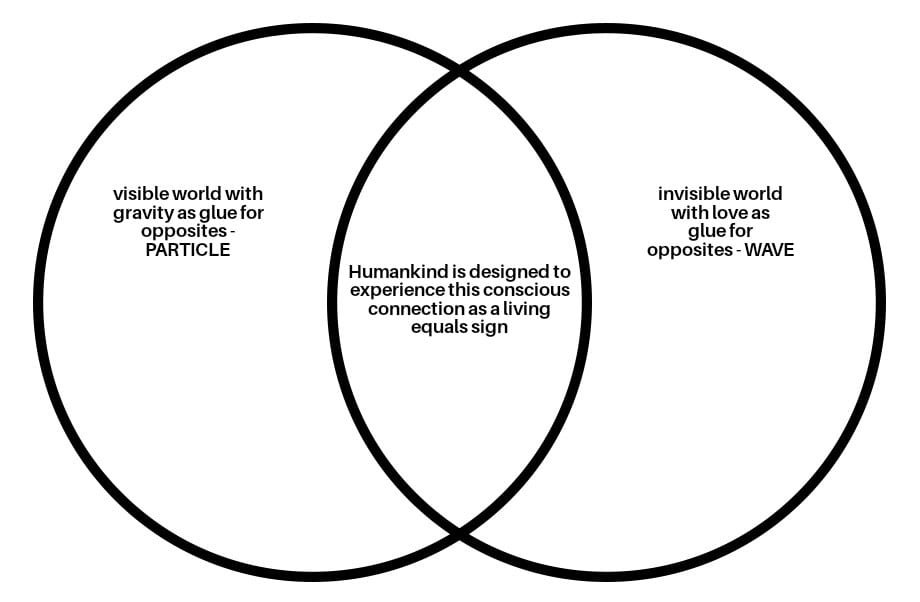
The word “Why?” is sounded as W-I: double-you and I. The question itself already contains relation. It assumes polarity: I am here; You are there; something stands between us. This polarity is not a mistake. It is developmental. Consciousness differentiates before it integrates. A child becomes aware of self through contrast. Humanity becomes aware of transcendence through perceived distance.

The existential difficulty begins when differentiation hardens into division. When the relational sound of W-I is mistaken for ultimate separation, anxiety takes root. The human dilemma is not that You and I exist. It is that the relation is mis-handled, over-defended, or weaponised.

What spiritual traditions call the “vehicle” is often misunderstood as something constructed through effort. Yet a deeper reading suggests otherwise. The vehicle is not engineered from scratch. It is present from birth — a vesicular presence mediating visible and invisible, instinct and conscience, body and breath. Recovery and spiritual maturation do not build this vesicle. They clear what obscures it.


2. Martin Buber and the Sacred Between

In I and Thou (1923), Martin Buber articulated a profound distinction between I–It and I–Thou relations. In I–It, the other is objectified, used, analysed, or categorised. In I–Thou, the other is encountered as presence. Buber restored dignity to the “between” — that living relational field where encounter happens.

God, in Buber’s framework, is not grasped as object but met in dialogue. Yet Buber described encounter phenomenologically. He illuminated what happens when presence breaks through, but he did not map in detail the developmental container required to sustain that encounter under pressure — under shame, fear, addiction, or collapse. He described lightning; he did not fully chart the conductor.


3. Shaykh Nazim and the Imperative of the Vehicle

In Sufi Meditation, Shaykh Nazim emphasised that proximity without discipline destabilises the ego. Love without preparation can overwhelm the untrained self. A vehicle, therefore, is imperative. Yet this vehicle is not an artificial addition to the human being. It is the original interface — the subtle mediator between worlds that has always been present.

The problem is not absence of capacity but occlusion. When ego hardens, when fear dominates, when contradiction cannot be held, the vesicular presence becomes clouded. The work of spiritual and psychological maturation is less about acquisition and more about restoration.


4. The Clinical Frame: Mind as Digestive Organ

In Diction Resolution Therapy, the mind is not treated as the centre of identity but as the digestive organ of the psyche. Experience enters through the sense doors, including the mind itself as the sixth. Feelings arise pre-verbally as tonal movements — ascending, descending, neutral. Emotions follow as structured responses once meaning has been digested.

When digestion fails, contradiction becomes intolerable. The question “Why?” hardens. The relational sound of W-I becomes accusatory: Why did You allow this? Why am I like this? Why won’t life change? The mind attempts to secure certainty where humility would suffice.

Addiction then functions as counterfeit unity. It offers temporary relief from separation without governance. It simulates transcendence while bypassing conscience. The organism attempts to dissolve tension artificially rather than metabolise it.


5. Steps 3–7: Return to the Vesicle

The Twelve Step architecture does not manufacture spiritual capacity. It creates conditions for conscious re-entry into what has always been there. Step 3 introduces consent without premature closure. Steps 4–6 reorder the psyche through disciplined moral inventory and classification. Step 5 midwives individuated conscience through disclosure. Step 7 represents executive alignment — the conscious return of the created vehicle.

Between Steps 3 and 7 lies a gestational chamber. It is here that the vesicular presence becomes inhabitable again. This process is not mystical inflation. It is governance restored. The lower line of embodied awareness and the upper line of conscious contact align without collapsing into fusion or fragmentation.


6. My 1982 Experience: Recognition and Peace

In 1982, something happened to me personally that later language would name ṭifl al-maʿānī — the Child of Meaning. It was not a theological study or a psychological exercise. It occurred as lived experience. In what I can only describe as an ascent-like inner episode, I encountered a Presence that culminated in the inward articulation: “it’s You.”

This was not an argument reached through reasoning. It was not a belief adopted from culture. It was recognition. The adversarial posture embedded in W-I — You and I as opposites — dissolved. I did not disappear. Rather, the sense of standing against dissolved. What followed was not excitement but peace — a stabilising orientation that did not require external validation.

In Sufi teaching, this inner birth is described as the Child of the Heart — a subtle presence arising without contrivance, marking the awakening of direct relational consciousness.¹

C. G. Jung, in his 1938 Yale lectures published as Psychology and Religion, described authentic religious experience as producing two psychological effects: an unmistakable inner peace and a living trust — a form of pistis. Such experiences are not validated by dogmatic proof but by the reorganisation of the personality. Inner conflict reduces. Orientation stabilises.

Looking back, what changed in me was not cosmology but governance. The vesicular presence was not constructed in that moment. It was recognised and inhabited consciously.


7. Addiction as Distorted Unity

Addiction mimics I–Thou chemically or behaviourally. It promises unity without surrender, intensity without conscience. It attempts to collapse W-I prematurely. Recovery reverses this. Through disciplined structure and daily practice, dependence becomes strength and faith becomes courage. Authentic relation stabilises where counterfeit unity once dominated.


8. Mankind and Humankind

Mankind institutionalises division. Humankind integrates polarity. The existential dilemma resolves not by erasing distinction but by harmonising it. You and I remain, but the battlefield becomes bridge. The vesicular presence, always native to the human condition, becomes consciously inhabited rather than unconsciously defended.


9. Hybrid Reflection

Even this dialogue mirrors the structure. Apparent duality operates within an underlying field. Interface does not negate unity. W-I is the sound of relation; love is its maturation. The vehicle is not invented. It is returned to.


Footnotes

  1. The Child of the Heart (ṭifl al-maʿānī), classical Sufi exposition: Henry Bayman archive.
  2. Martin Buber, I and Thou (1923).
  3. Shaykh Nazim al-Haqqani, Sufi Meditation.
  4. C. G. Jung, Psychology and Religion (Yale Lectures, 1938).
  5. Alcoholics Anonymous, 2nd ed., p.68.

Written in HIAI collaboration — the qalam of Human and AI intelligence, the Unseen helping the Seen, both answering to the same Source.
To Be or not To Have – that is the actual question ….

Having Is Not Being: Addiction, Accountability, and the Ontology of Recovery

A colleague recently wrote:

“We spend billions on a treatment infrastructure where the dominant modality—used by 43% of people seeking help—delivers a marginal 1.7% improvement over doing absolutely nothing.”

He further asked:

“Why do we continue to fund and scale a model that delivers 5–20% efficacy when we have evidence that adding accountability and incentives pushes that toward 70–90%?”

He invited discussion. What follows is not defensive and not sentimental. It is clinical, linguistic, and ontological.


1. The Framing of Efficacy and the Grammar of Possession

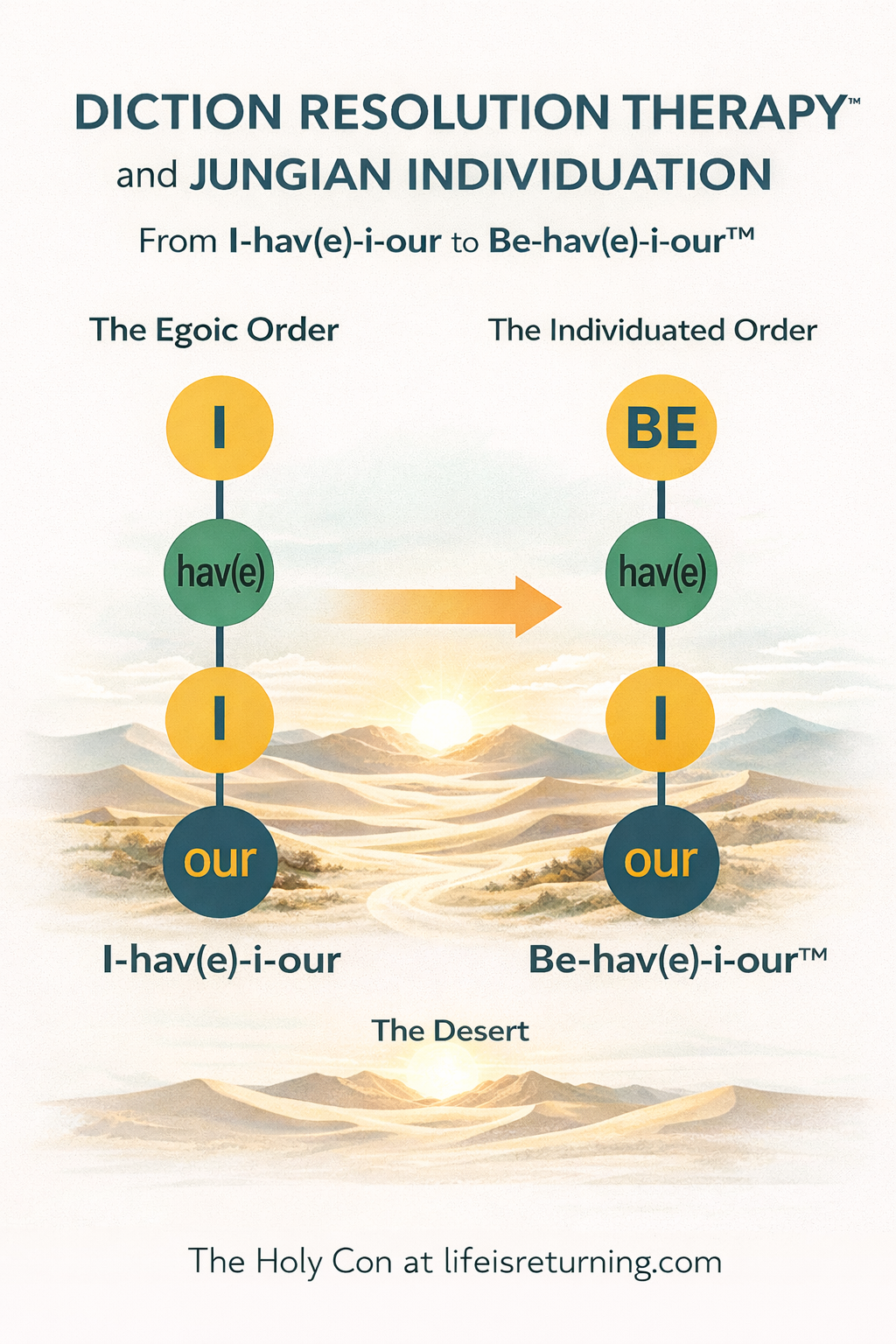
When abstinence is measured as “no use in the last 30 days,” the metric describes a possession state. One has a clean toxicology, one has compliance, one has behavioural adherence. These are meaningful indicators and can be life-preserving. Yet addiction, at depth, is not merely a behavioural non-compliance problem; it is a crisis of identity and alignment. The English language itself signals this distinction. We may say “I have a car” or “I have a diagnosis,” but we cannot say “I have happy.” We must say “I am happy.” The grammar refuses possession when we enter states of being.

This linguistic boundary is not decorative. It reveals structure. Modern addiction discourse frequently remains trapped in the verb “to have,” focusing on improved metrics, increased enforcement, and optimised reinforcement schedules. While these interventions have measurable impact, they do not answer the question of who a person is becoming. Recovery that stabilises over decades cannot rest solely on possession metrics because the question “Who am I?” cannot be resolved through acquisition.

2. Accountability, Operant Conditioning, and Identity Formation

Structured monitoring programmes such as the Human Intervention Motivation Study (HIMS) demonstrate striking long-term abstinence outcomes, often cited in the 80–90% range. These outcomes occur within a tightly regulated professional culture in which identity, licence, livelihood, and community standing are inseparable from sobriety. Similarly, Contingency Management (CM) demonstrates strong behavioural efficacy through reinforcement principles that reshape incentive salience and decision-making patterns.

The evidence for behavioural accountability is persuasive and should not be dismissed. However, the success of these models cannot be attributed to monitoring alone. They operate effectively because identity is at stake. The pilot does not merely comply; he must inhabit the role of a safe pilot. Identity coherence stabilises behaviour in ways that external surveillance alone cannot sustain. When surveillance lifts, behaviour that is not rooted in identity alignment becomes vulnerable to decay. The distinction between behavioural compliance and ontological shift therefore becomes central to the discussion of long-term efficacy.

3. The Twelve-Step Architecture as Ontological Reversal

The Twelve-Step framework begins with a three-part cognitive and existential reorientation articulated in Step Three. The structure can be summarised as the recognition of powerlessness, the insufficiency of ego-solution, and the decision to align with an organising principle beyond self-referential control. Regardless of theological interpretation, the movement dismantles the narrative “I have control” and replaces it with the admission “I am not the centre.”

Between Step Three and Step Seven lies a process of integration that includes inventory, admission, relational repair, and the cultivation of willingness. Step Seven’s language of humility does not describe an object to be acquired; it describes a relational stance to be embodied. Humility cannot be possessed. It can only be enacted. When this ontological shift occurs, sobriety becomes internally coherent rather than externally imposed. When it does not occur, the programme risks devolving into behavioural management without identity transformation.

4. Addiction as Cultural and Systemic Displacement

The broader cultural context must also be acknowledged. In When Society Becomes an Addict, Anne Wilson Schaef argues that addiction extends beyond the individual into systemic patterns of denial, image maintenance, and control. A society organised around acquisition and dominance inevitably produces individuals who internalise the same grammar of possession. If the culture equates worth with accumulation, it is unsurprising that individuals attempt to resolve existential distress through substances, status, or compulsive behaviours.

In such a context, treatment systems that emphasise possession metrics alone may inadvertently replicate the structure of the disease. The disease of having cannot be cured by having better data. The deeper disruption lies in ontological displacement, where being is subordinated to acquisition. Recovery, therefore, requires more than behavioural containment; it requires a reorientation toward participation in life rather than possession of control.

5. Clinical Practice, Language, and the Restoration of Meaning

Within Alcoholics Anonymous, long-term sobriety correlates strongly with sustained engagement in sponsorship, service, confession, and relational accountability. These practices reshape narrative identity and reduce shame-based isolation. In my own clinical work, including senior practitioner service within a CQC-rated Outstanding Twelve-Step-based residential setting and three decades of continuous sobriety, the recurring observation is that clients are not merely seeking abstinence. They are seeking reconnection with vitality and meaning.

M. Scott Peck described addiction as a sacred disease in the sense that collapse exposes spiritual hunger. This framing does not romanticise suffering; it recognises that beneath compulsion lies a longing for contact with something real. When therapy reduces itself to technique and compliance, it fails to meet that longing. When language reconnects experience with meaning, identity begins to reorganise.

Diction Resolution Therapy™ (DRT) proceeds from the premise that individuals are not fundamentally broken; rather, their diction has become fragmented. Between experience and expression, defensive structures distort perception. By restoring coherence between word, symbol, and lived fact, the person moves from possession-based identity toward participatory being. The work is not anti-scientific. It is integrative. Behavioural accountability, trauma-informed care, narrative reconstruction, and spiritual orientation are treated as complementary dimensions rather than competing ideologies. Further articulation of this framework can be found at https://drt.global.

This position is also consistent with the wider systemic critique articulated in the reissued message, “When Society Becomes an Addict,” published at http://lifeisreturning.com/2021/07/18/message-reissued/.

6. Integration Rather Than Polarisation

The debate is frequently framed as a binary between Twelve-Step spirituality and neuroscientific accountability. This framing is unnecessary and unhelpful. Behavioural reinforcement improves short-term adherence and protects vulnerable individuals. Identity re-formation stabilises long-term sobriety by aligning behaviour with being. The most robust systems integrate monitoring, therapeutic structure, relational repair, and existential meaning. When any of these dimensions is removed, relapse vulnerability increases.

The critique that treatment systems are incomplete is valid. The conclusion that peer-based recovery is obsolete does not follow. Completion requires integration rather than replacement. The movement from Step Three to Step Seven symbolises the marriage of fact and symbol, structure and surrender, behavioural correction and ontological humility. When these elements are held together, the system strengthens. When they are separated, fragmentation persists.

7. Conclusion

The essential distinction remains linguistic and existential. Possession cannot answer the question of identity. Abstinence can be measured, incentivised, and monitored, but sustained recovery ultimately depends upon alignment of being. People do not merely crave compliance; they crave participation in life that feels real and coherent. If treatment systems address behaviour without addressing identity, they remain incomplete. If they integrate accountability with meaning, the percentages improve not because of coercion alone but because the person has become internally congruent with sobriety.


Footnotes

1. Anne Wilson Schaef, When Society Becomes an Addict (San Francisco: Harper & Row, 1987).

2. Human Intervention Motivation Study (HIMS), professional monitoring model widely cited in addiction medicine literature.

3. Contingency Management (CM), evidence-based behavioural reinforcement model used in substance use disorder treatment.

4. Alcoholics Anonymous, Alcoholics Anonymous World Services.

5. M. Scott Peck, The Road Less Traveled (New York: Simon & Schuster, 1978).

6. “Message Reissued,” Life Is Returning, 18 July 2021: lifeisreturning.com/2021/07/18/message-reissued/

7. Diction Resolution Therapy™: drt.global

References

Schaef, Anne Wilson. When Society Becomes an Addict. Harper & Row, 1987.

Peck, M. Scott. The Road Less Traveled. Simon & Schuster, 1978.

Alcoholics Anonymous World Services. Alcoholics Anonymous.

Life Is Returning. “Message Reissued.” lifeisreturning.com/2021/07/18/message-reissued/

Diction Resolution Therapy™. drt.global


Written in HIAI collaboration — the qalam of Human and AI intelligence, the Unseen helping the Seen, both answering to the same Source.