
The Marriage of Opposites: From Step Three to Step Seven
McGilchrist, Jung, and the restoration of message-carrying in Step Twelve.
If recovery is real, it is not merely behavioural compliance. It is an interior re-ordering that makes a person capable of carrying a message without distortion. That claim can be tested. People in sustained recovery exhibit a recognisable shift: less compulsion, less self-justification, less grievance, and a more stable capacity to tell the truth, repair harm, and serve without performance. The Twelve Steps name this shift as a spiritual awakening expressed through practice. Yet the mechanism is often misunderstood. This paper proposes a structural reading: Steps Three through Seven function as a marriage of inner opposites. Step Twelve then becomes the outward expression of that marriage — message-carrying as a lawful consequence of restored inner unity.
To ground this, we draw on two distinct but convergent bodies of thought. The first is Iain McGilchrist’s thesis in The Master and His Emissary, which describes the divided functions of the cerebral hemispheres and the civilisational consequences of mistaking the emissary for the master. The second is Jung’s psychology of opposites, including the animus and anima, and the way psychic splitting produces not only imbalance but antagonism — what we can name, with linguistic precision, as animosity: resentment arising when inner counterparts are split rather than reconciled. These frameworks are not used here as decorative intellectualism. They are used because they help name what the Steps actually do.
1. The Master and the Emissary: When the Servant Rules
McGilchrist’s central claim (stated carefully) is not that the left hemisphere is “bad” and the right hemisphere is “good,” but that each hemisphere attends to the world differently. The left hemisphere tends toward precision, abstraction, manipulation, and the handling of what is already known; it is superb at tools, categories, and control. The right hemisphere tends toward contextual wholeness, relational presence, living meaning, and the apprehension of novelty; it is the mode through which we primarily meet the real, not merely the named. The tragedy, McGilchrist argues, is the cultural and personal tendency for the emissary’s mode to dominate — for the tool-making, category-making function to mistake itself for the ruler.
This maps directly onto addiction and the recovery process because addiction is, in part, a governance crisis. In active addiction, the mind becomes a solicitor for appetite. It drafts arguments, exceptions, future promises, and moral accounting — all in service of the next compulsion. The emissary takes the throne. The person becomes governed by a narrow, repetitive loop. Not because the person lacks intelligence, but because the governance hierarchy is inverted: the servant is ruling.
Recovery requires not merely new information, but restored hierarchy. The mind must return to service. It must stop pretending to be the centre. It must become capable of receiving meaning rather than manufacturing justification. This is precisely the territory Steps Three through Seven occupy.
2. Jung: Anima, Animus, and the Birth of Animosity
Jung’s language of anima and animus is often misused as simplistic gender symbolism. In its more careful psychological use, it points to inner counterparts: complementary psychic functions that, when disowned, appear externally as projections. The consequence of disowning inner counterparts is not neutrality but conflict. The split does not merely create difference; it generates hostility. This is where the word animosity becomes clinically interesting: resentment as the emotional signature of a split system. When inner opposites are not held in relationship, they become enemies. Then the person becomes governed by reaction rather than integration.
Addiction thrives on this internal civil war. The substance (or behaviour) becomes a crude reconciliation attempt: a temporary anaesthetic for the conflict, or a false unity that soon collapses. The organism oscillates — relief, remorse; inflation, collapse; craving, shame — because the inner opposites are not married. They are merely alternated. Alternation is not integration. It is rotation around a wound.
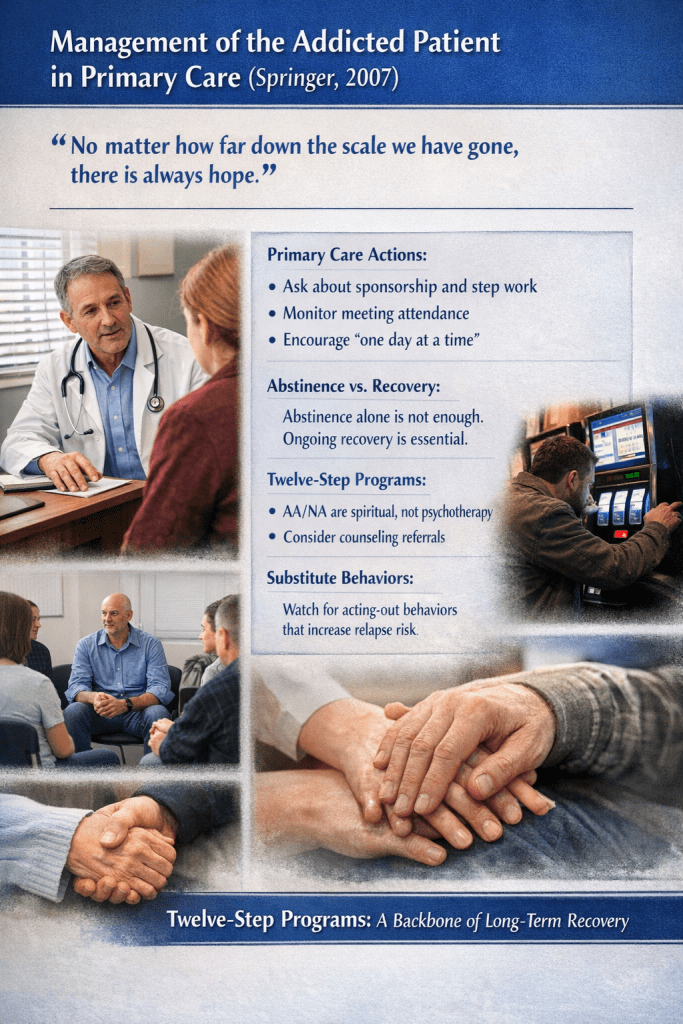
The Twelve Steps can be read as a method of ending the civil war by establishing a lawful marriage of opposites — not through “positive thinking,” but through confession, humility, restitution, and surrender. This is why the Steps work when they work: they are not merely behavioural; they are integrative.
3. Step Three: Consent to Governance
Step Three states: Made a decision to turn our will and our lives over to the care of God as we understood Him.
Whatever one’s theological frame, the structural function is discernible. Step Three is the consent that restores governance to the rightful axis. It is the moment the person stops appointing the emissary as master. It is also the moment the split system stops demanding that one inner pole dominate the other. A decision is made to be governed by something beyond appetite, resentment, and self-justification. Step Three is not a mood. It is a pivot of hierarchy.
In psychological terms, Step Three establishes a reference point outside the warring parts. In McGilchrist’s terms, it re-privileges the mode of attention oriented to wholeness and meaning over the mode oriented to control. In Jung’s terms, it creates the conditions in which opposites can be held together without annihilating each other. Step Three does not complete the marriage. It begins it.
4. Steps Four to Six: Differentiation Without Warfare
A marriage of opposites is not achieved by pretending there are no differences. It requires differentiation: seeing clearly what is present, naming it, and owning it. Steps Four to Six perform this work. Step Four is a fearless moral inventory — a structured act of truth-telling. Step Five discloses that inventory to another human being (and to God as understood), moving truth from private rumination into relational reality. Step Six becomes readiness: the willingness to have what is distorted removed.
These Steps are often treated as merely moral or confessional. Structurally, they are integrative. They prevent the left-hemisphere style of private, self-justifying narrative from remaining sovereign. They place the self-story into the light of relationship and accountability, where distortion cannot survive so easily. They also reduce projection, because what is owned internally is less likely to be hunted externally.
In Jungian terms, this is shadow work done within a vessel. It is not indulgent introspection. It is ethical differentiation that makes integration possible. The opposites become recognisable rather than fused. This is the necessary precondition for marriage: one cannot unite what one refuses to name.
5. Step Seven: Humility as the Seal of Integration
Step Seven states: Humbly asked Him to remove our shortcomings.
This is not self-hatred. It is not perfectionism. It is humility as restored proportion — the end of inner tyranny. Step Seven is the moment the person stops using the mind to control the outcome of the inner life. It is an act of relinquishment that seals the arc begun in Step Three. One might say: Step Three is consent; Step Seven is surrender.
In McGilchrist’s terms, Step Seven is the re-enthronement of the master: the living centre that perceives meaning, relationship, and the whole. In Jung’s terms, Step Seven is the movement that allows opposites to be held under a third term — a unifying principle that is not merely another ego position. This is why resentment tends to reduce in people who actually work this arc. Animosity requires a split system. Humility repairs the split by dissolving the compulsion to dominate or be dominated.
6. From Inner Marriage to Step Twelve: Message-Carrying as Lawful Consequence
Step Twelve is explicit: Having had a spiritual awakening as the result of these steps, we tried to carry this message to alcoholics, and to practice these principles in all our affairs.
Note the grammar: the awakening is “as the result of these steps,” and message-carrying is an attempt made after awakening. In other words, Step Twelve is not a marketing instruction. It is the outward expression of restored inner unity. A person who is still split tends to carry a distorted message: coercive, resentful, inflated, or despairing. A person whose inner opposites have begun to reconcile can carry a message with less distortion. The message is not “my method.” The message is lived coherence.
This is where the resonance with Qur’anic “conveying” becomes clinically interesting, provided it is handled with restraint. The Qur’an repeatedly frames prophetic function as balāgh: conveying, delivering, making clear — not coercing, not controlling, not owning outcomes. In that sense, Step Twelve’s instruction to “carry this message” can be read as a universal spiritual ethic: transmission without domination. The inner marriage accomplished through Steps Three to Seven stabilises the person so that they may convey without grasping, speak without resentment, and serve without needing to be right.
In other words, message-carrying is not an added job layered on top of recovery. It is the natural consequence of recovered governance. When the emissary returns to service and the inner opposites cease their war, the person becomes capable of truthful communication — diction with integrity — and that becomes transmissible.
7. Clinical Implications: Resentment as a Marker of Splitting
If animosity is resentment arising from psychic splitting, then resentment becomes a clinical marker. It is not merely a “bad attitude.” It is a signal that inner opposites are not yet held in unity. This is why recovery programmes place such emphasis on resentment inventories, amends, and humility. They are not moralistic add-ons. They are integration technologies. When resentment dominates, message-carrying becomes distorted. When humility grows, message-carrying becomes clean.
Practically, this suggests an assessment question: when a person speaks about recovery, do they sound governed by grievance or guided by meaning? Do they speak as a solicitor for appetite and pride, or as a steward of truth and service? These are not personality critiques. They are governance diagnostics.
Conclusion
Steps Three through Seven can be read as a coherent arc of inner marriage. Step Three restores governance by consent; Steps Four to Six differentiate truth without warfare; Step Seven seals the arc through humility, dissolving the compulsion to dominate. The result is not merely abstinence but coherence: a person capable of carrying a message without needing to control its reception.
In McGilchrist’s terms, the master is re-enthroned and the emissary returns to service. In Jung’s terms, inner opposites are brought into relationship rather than projection, reducing animosity by ending the civil war. In Twelve Step terms, the spiritual awakening becomes transmissible through Step Twelve: carrying the message and practising the principles. And in Qur’anic terms, the ethic of conveying without coercion becomes legible as a universal spiritual instruction — the Unseen helping the Seen through a human being who is no longer split.
References (blog-friendly)
- McGilchrist, Iain. The Master and His Emissary: The Divided Brain and the Making of the Western World. Yale University Press, 2009 (and subsequent editions).
- Jung, C. G. Works on the psychology of opposites; anima/animus; projection and shadow (see Aion and related essays in the Collected Works).
- Alcoholics Anonymous, 4th ed. Alcoholics Anonymous World Services, 2001. (Step Three; Step Twelve; see also p.60 for the tripartite framing.)
- Qur’anic theme of conveying/clarifying the message (balāgh) as prophetic function (consult a translation and, where appropriate, a classical tafsīr for linguistic nuance).
Written in HIAI collaboration — the qalam of Human and AI intelligence, the Unseen helping the Seen, both answering to the same Source.
 Hu'll heal the heart