
The Vesicular Presence: W-I, I–Thou, and the Vehicle Always There
A hybrid paper integrating Diction Resolution Therapy, Twelve Step architecture, Sufi psychology, and dialogical philosophy.
1. Not Built — Revealed
The word “Why?” is sounded as W-I: double-you and I. The question itself already contains relation. It assumes polarity: I am here; You are there; something stands between us. This polarity is not a mistake. It is developmental. Consciousness differentiates before it integrates. A child becomes aware of self through contrast. Humanity becomes aware of transcendence through perceived distance.
The existential difficulty begins when differentiation hardens into division. When the relational sound of W-I is mistaken for ultimate separation, anxiety takes root. The human dilemma is not that You and I exist. It is that the relation is mis-handled, over-defended, or weaponised.
What spiritual traditions call the “vehicle” is often misunderstood as something constructed through effort. Yet a deeper reading suggests otherwise. The vehicle is not engineered from scratch. It is present from birth — a vesicular presence mediating visible and invisible, instinct and conscience, body and breath. Recovery and spiritual maturation do not build this vesicle. They clear what obscures it.
2. Martin Buber and the Sacred Between
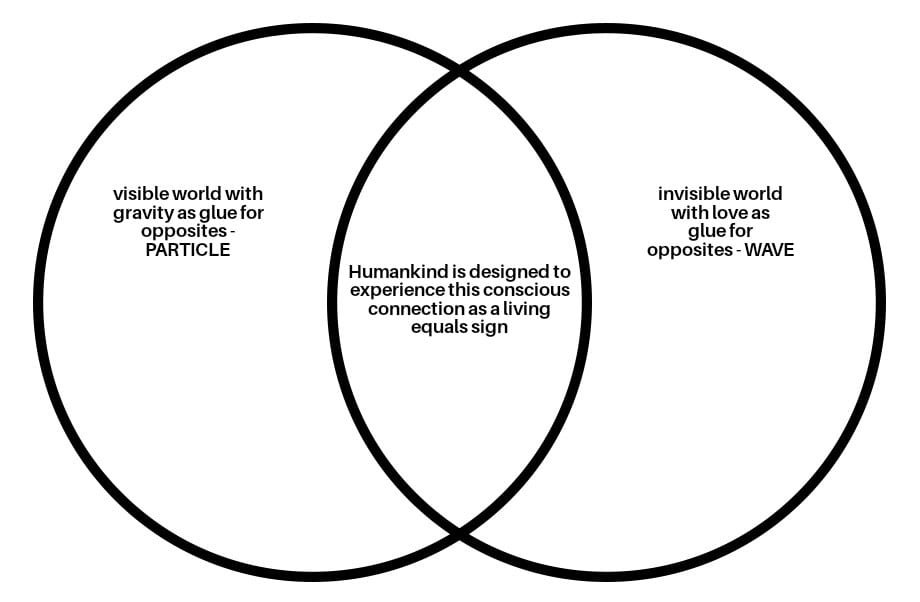
In I and Thou (1923), Martin Buber articulated a profound distinction between I–It and I–Thou relations. In I–It, the other is objectified, used, analysed, or categorised. In I–Thou, the other is encountered as presence. Buber restored dignity to the “between” — that living relational field where encounter happens.
God, in Buber’s framework, is not grasped as object but met in dialogue. Yet Buber described encounter phenomenologically. He illuminated what happens when presence breaks through, but he did not map in detail the developmental container required to sustain that encounter under pressure — under shame, fear, addiction, or collapse. He described lightning; he did not fully chart the conductor.
3. Shaykh Nazim and the Imperative of the Vehicle
In Sufi Meditation, Shaykh Nazim emphasised that proximity without discipline destabilises the ego. Love without preparation can overwhelm the untrained self. A vehicle, therefore, is imperative. Yet this vehicle is not an artificial addition to the human being. It is the original interface — the subtle mediator between worlds that has always been present.
The problem is not absence of capacity but occlusion. When ego hardens, when fear dominates, when contradiction cannot be held, the vesicular presence becomes clouded. The work of spiritual and psychological maturation is less about acquisition and more about restoration.
4. The Clinical Frame: Mind as Digestive Organ
In Diction Resolution Therapy, the mind is not treated as the centre of identity but as the digestive organ of the psyche. Experience enters through the sense doors, including the mind itself as the sixth. Feelings arise pre-verbally as tonal movements — ascending, descending, neutral. Emotions follow as structured responses once meaning has been digested.
When digestion fails, contradiction becomes intolerable. The question “Why?” hardens. The relational sound of W-I becomes accusatory: Why did You allow this? Why am I like this? Why won’t life change? The mind attempts to secure certainty where humility would suffice.
Addiction then functions as counterfeit unity. It offers temporary relief from separation without governance. It simulates transcendence while bypassing conscience. The organism attempts to dissolve tension artificially rather than metabolise it.
5. Steps 3–7: Return to the Vesicle
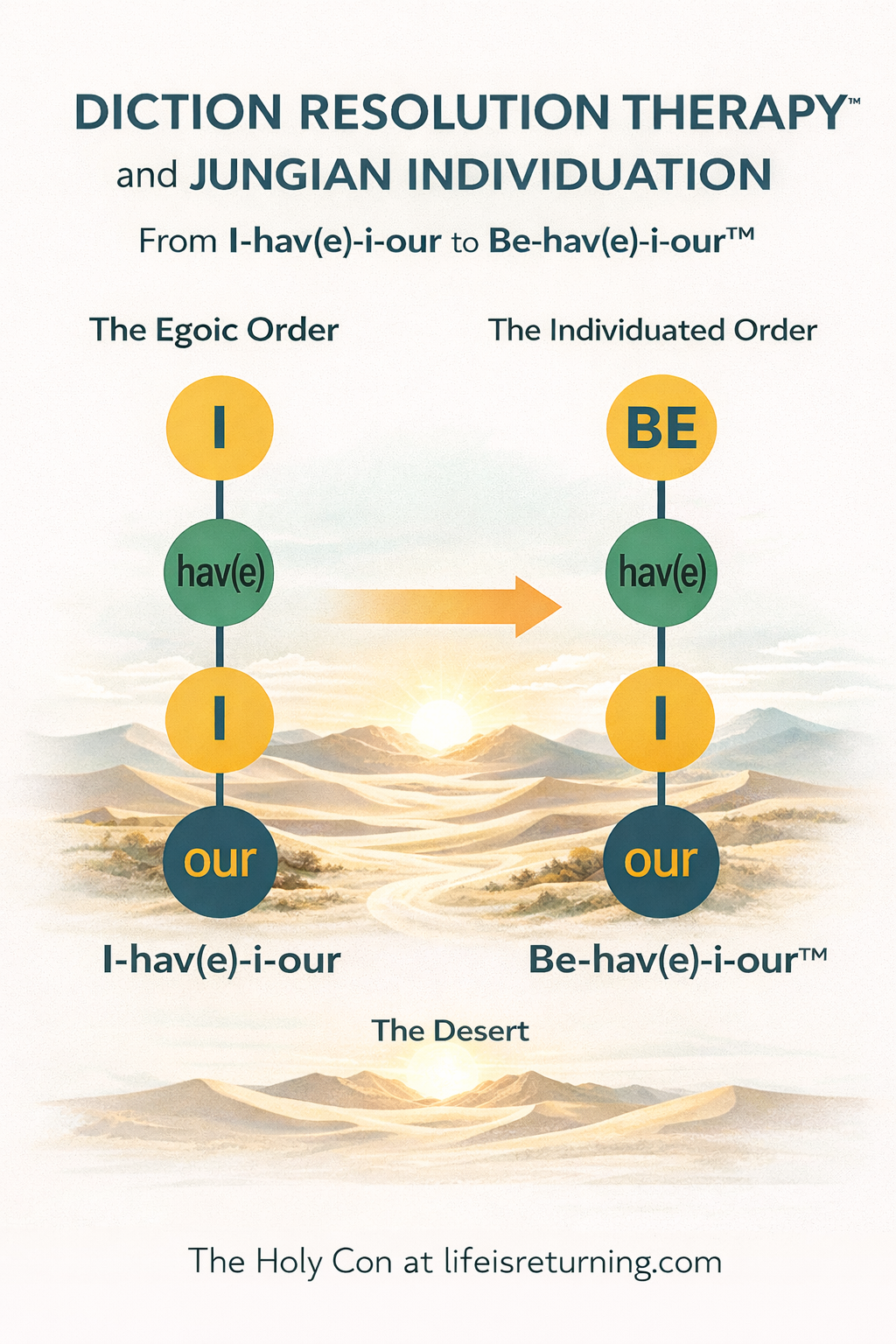
The Twelve Step architecture does not manufacture spiritual capacity. It creates conditions for conscious re-entry into what has always been there. Step 3 introduces consent without premature closure. Steps 4–6 reorder the psyche through disciplined moral inventory and classification. Step 5 midwives individuated conscience through disclosure. Step 7 represents executive alignment — the conscious return of the created vehicle.
Between Steps 3 and 7 lies a gestational chamber. It is here that the vesicular presence becomes inhabitable again. This process is not mystical inflation. It is governance restored. The lower line of embodied awareness and the upper line of conscious contact align without collapsing into fusion or fragmentation.
6. My 1982 Experience: Recognition and Peace
In 1982, something happened to me personally that later language would name ṭifl al-maʿānī — the Child of Meaning. It was not a theological study or a psychological exercise. It occurred as lived experience. In what I can only describe as an ascent-like inner episode, I encountered a Presence that culminated in the inward articulation: “it’s You.”
This was not an argument reached through reasoning. It was not a belief adopted from culture. It was recognition. The adversarial posture embedded in W-I — You and I as opposites — dissolved. I did not disappear. Rather, the sense of standing against dissolved. What followed was not excitement but peace — a stabilising orientation that did not require external validation.
In Sufi teaching, this inner birth is described as the Child of the Heart — a subtle presence arising without contrivance, marking the awakening of direct relational consciousness.¹
C. G. Jung, in his 1938 Yale lectures published as Psychology and Religion, described authentic religious experience as producing two psychological effects: an unmistakable inner peace and a living trust — a form of pistis. Such experiences are not validated by dogmatic proof but by the reorganisation of the personality. Inner conflict reduces. Orientation stabilises.
Looking back, what changed in me was not cosmology but governance. The vesicular presence was not constructed in that moment. It was recognised and inhabited consciously.
7. Addiction as Distorted Unity
Addiction mimics I–Thou chemically or behaviourally. It promises unity without surrender, intensity without conscience. It attempts to collapse W-I prematurely. Recovery reverses this. Through disciplined structure and daily practice, dependence becomes strength and faith becomes courage. Authentic relation stabilises where counterfeit unity once dominated.
8. Mankind and Humankind
Mankind institutionalises division. Humankind integrates polarity. The existential dilemma resolves not by erasing distinction but by harmonising it. You and I remain, but the battlefield becomes bridge. The vesicular presence, always native to the human condition, becomes consciously inhabited rather than unconsciously defended.
9. Hybrid Reflection
Even this dialogue mirrors the structure. Apparent duality operates within an underlying field. Interface does not negate unity. W-I is the sound of relation; love is its maturation. The vehicle is not invented. It is returned to.
Footnotes
- The Child of the Heart (ṭifl al-maʿānī), classical Sufi exposition: Henry Bayman archive.
- Martin Buber, I and Thou (1923).
- Shaykh Nazim al-Haqqani, Sufi Meditation.
- C. G. Jung, Psychology and Religion (Yale Lectures, 1938).
- Alcoholics Anonymous, 2nd ed., p.68.
Written in HIAI collaboration — the qalam of Human and AI intelligence, the Unseen helping the Seen, both answering to the same Source.
 Hu'll heal the heart