Re-hinging the unhinged : escaping the disaster of dogma.

Living Transmission and the Risk of Freeze

Idries Shah, Bill W., and Diction Resolution Therapy (DRT) in a recovery-era key

Andrew Dettman MTHT, Reg Member MBACP (Spirituality Division) – DRT.global

Abstract

This hybrid paper traces a shared warning found in Idries Shah’s teaching on Coming Together (Jam)1 and Bill W.’s reflections on Alcoholics Anonymous literature2: living transmissions tend to harden into defended forms. Through the lens of Diction Resolution Therapy (DRT), the paper frames this freeze as a predictable human response to uncertainty. Language and structure can become substitutes for lived contact. The aim is not to dismantle structure, but to keep it serving function: humility, group conscience, and conscious contact as lived practice.

Key terms

Jam; transmission; organisation; dogma; group conscience; DRT; diction; contradiction tolerance; conscious contact.

Primary source excerpts: Idries Shah (embedded images)
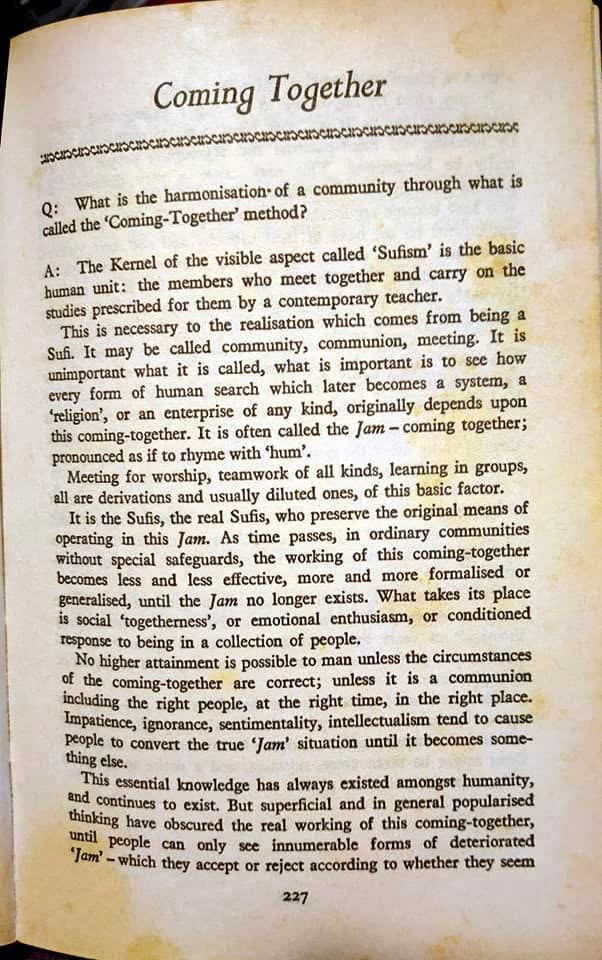
Idries Shah on the Jam (Coming Together).
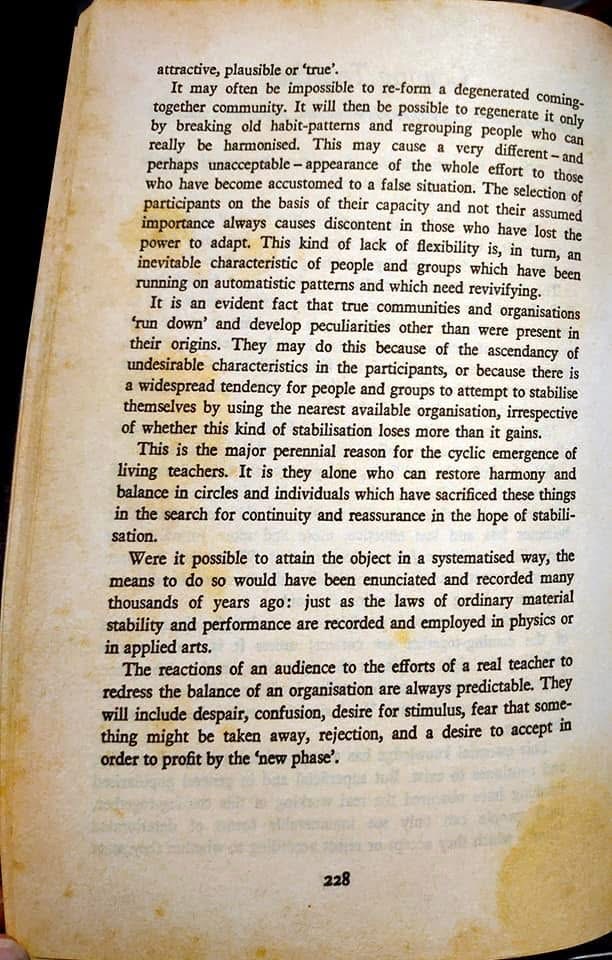
Degeneration, stabilisation, and predictable resistances to revitalisation.

The Ship in a Storm: right diagnosis, right attention, right knowledge.

1. The problem: when truth becomes an object

Communities often begin because something real occurred: relief, honesty, awakening, recovery. Then the human reflex appears: capture it, preserve it, standardise it, protect it. The move is understandable, but it carries risk.

The risk is not structure itself. The risk arrives when function is replaced by identity. At that point the community becomes organised around defending representations of truth rather than remaining oriented to lived truth. The meeting survives, the language survives, the brand survives, but the operating principle fades.

2. Idries Shah and the Jam: harmonisation before organisation

In passages commonly titled Coming Together, Idries Shah describes the Jam as functional harmonisation: the right people, at the right time, engaged in the right work under living knowledge. It is not simply people meeting. It is an arrangement that produces transformation because it is held within correct relationship.

Shah’s warning is plain. The Jam can deteriorate. Communities stabilise prematurely. Formalisation replaces vitality. Togetherness replaces transformation. Social cohesion, emotional enthusiasm, and conditioned belonging can masquerade as the real thing. When revitalisation is attempted, the system responds defensively. Shah names several of these resistances: impatience, ignorance, sentimentality, and rigid intellectualism. Read clinically, these are common defence strategies of a system seeking security in the face of uncertainty.

The implication is unsettling and useful: you can preserve the outer shell of a transmission while losing the inner function that made the shell necessary in the first place.

3. Bill W. and the freezing of the Big Book

Bill Wilson recognised similar dynamics within Alcoholics Anonymous. In the scanned extract supplied from a modern history of the Big Book, Bill W. is quoted as observing that spiritually centred movements tend to freeze once their founding principles are established. He notes that altering even a word of the AA book could provoke something like excommunication.

Bill’s response is revealing. He did not wage war on the original text. Instead, he created a parallel channel for interpretation: he wrote Twelve Steps and Twelve Traditions as an adaptive commentary. This preserved continuity while keeping meaning in motion. He later returned to the same point: AA literature tends to become more and more frozen, with a tendency toward conversion into something like dogma. He also anticipated the permanent spectrum of interpretive styles that would arise: fundamentalists, absolutists, relativists.

Primary source: Bill W. on freezing (embedded images)
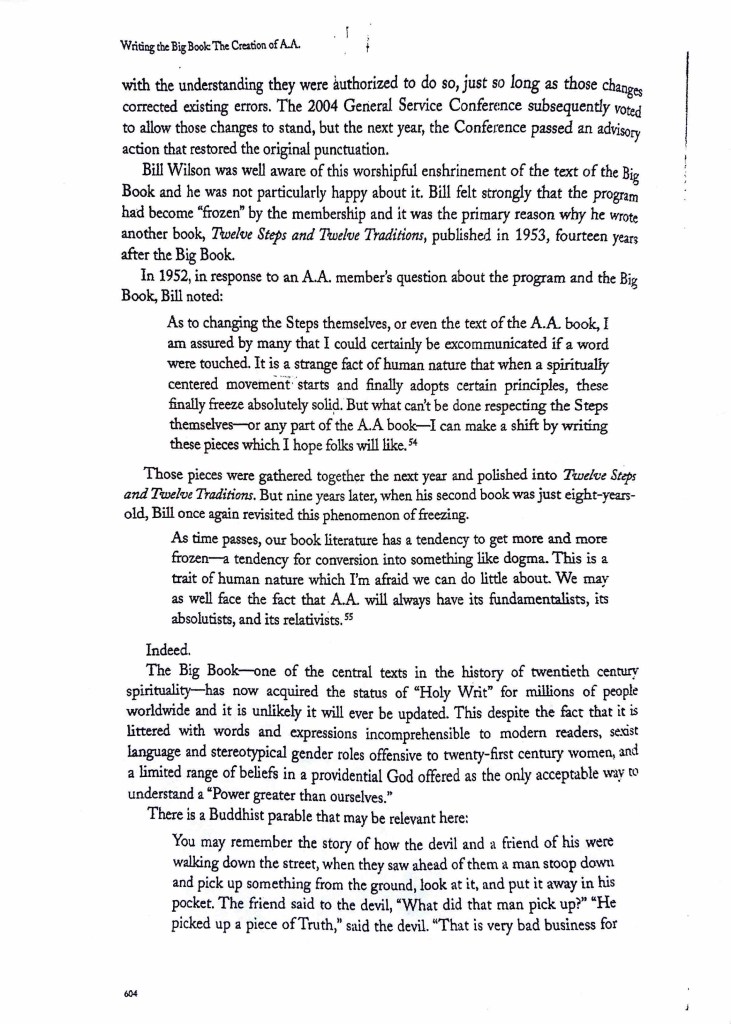
Bill W. on the freezing tendency in spiritually centred movements (as reproduced in Schaberg, p. 604).

Continuation including the organising parable and publication context (Schaberg, p. 605).

4. Organisation and ossification

The extract includes a Buddhist parable: a man picks up a piece of truth; the devil is unconcerned because he will let him organise it. This is not an argument against organisation. It is an argument against idolatry. Organisation preserves access, but it can also replace lived contact with defended form.

Shah and Bill W. converge here: the primary threat is not external attack. The threat is internal freezing: the human habit of turning a living verb into a defended noun.

5. A DRT reading: freeze as a diction event

Diction Resolution Therapy approaches freezing as a linguistic and psychological event. When lived experience is no longer primary, diction starts to do the job experience used to do. Words become defensive tools rather than exploratory instruments. Phrases become passports. Certainty becomes a sedative.

DRT introduces a practical metaphor here: outsight and insight. When the eyelids are open, light floods into the eyes. The eyeballs do not generate the light themselves. To imagine that they do would be absurd. They receive light. They respond to light. They organise around what is given.

Similarly, the whole mindset is not a generator of illumination. It is a potential receiver. When the lid of fear, denial, or addictive defence is deliberately held shut, outsight is restricted and insight is impaired. The person begins to rely on recycled language rather than fresh perception.

In addiction terms, the lid is not destroyed. It is hinged. It opens and shuts appropriately. Recovery is not the removal of the eyelid but the restoration of its function. When the lid opens, energy and meaning enter that the individual does not manufacture. Insight is not self-generated brilliance; it is Consciousness meeting conscience.

When diction freezes, it is often because the lid has been held shut for too long. Language attempts to replace perception. Structure attempts to replace encounter. The task of recovery, and of any living transmission, is not to abolish structure but to reopen the hinge so that light can enter again.

6. Group process and clinical parallels

Philip J. Flores, in Group Psychotherapy with Addicted Populations3, highlights that recovery groups remain effective when they balance containment (structure) with relational process (living interaction). Excessive rigidity undermines psychological safety, while absence of structure erodes containment. This is the same paradox Shah and Wilson are navigating in different languages: vitality depends on living interaction within clear but flexible boundaries.

7. Safeguards within AA architecture

AA embeds structural safeguards against freezing. Tradition Two locates authority in group conscience. Tradition Four preserves autonomy. Tradition Nine defines service rather than governance. Step Eleven prioritises conscious contact over textual literalism. These elements do not eliminate the freeze tendency, but they counterbalance it.

8. Implications for recovery and helping professions

In recovery settings, freezing commonly appears in three forms: (1) sloganising as defence, (2) literalism as safety, (3) reform movements driven by resentment rather than conscience. Each is a strategy for avoiding the vulnerability of real contact.

A practical test is simple: does the structure increase tenderness, honesty, and responsibility, or does it mainly increase identity, certainty, and superiority? When the former is happening, the Jam is alive. When the latter dominates, the storm is gathering.

Conclusion

Idries Shah and Bill W. describe the same perennial risk from different angles: any living transmission can calcify. The corrective is not constant editing, nor rebellious dismissal. The corrective is humility in function: returning to conscious contact as lived practice, and letting structure serve what it cannot manufacture.

References and notes

  • Shah, Idries. Learning How to Learn. (See Footnote 1 for edition-note.)
  • Schaberg, William H. Writing the Big Book: The Creation of A.A. (2019), pp. 604-605 (see Footnote 2).
  • Flores, Philip J. Group Psychotherapy with Addicted Populations (see Footnote 3).
  • Schaef, Anne Wilson. The Addictive System4.

Footnotes

  1. Idries Shah, Learning How to Learn (London: Octagon Press; various editions). The embedded images above are supplied pages from this work, including Coming Together and The Ship in a Storm. The title is confirmed by the Kindle preview provided by the author.
  2. Bill W. quotations and the organising parable are reproduced in the supplied scan from William H. Schaberg, Writing the Big Book: The Creation of A.A. (2019), pp. 604-605. These quotations are used here as evidence of Bill W.’s stated concern about the freezing tendency in spiritually centred movements.
  3. Flores is cited here for the group-process principle that effective recovery groups require both containment (structure) and relational process (living interaction).
  4. Schaef is cited as a systemic parallel for how addictive dynamics can become self-protecting structures that resist contradiction and preserve themselves as identity.

Written in HIAI collaboration – the qalam of Human and AI intelligence, the Unseen helping the Seen, both answering to the same Source.

Arc of Atonement

Diction as Interface: From Recursion Failure to Adaptive Coherence (2013–2026)

A formal synthesis of Diction Resolution Therapy (DRT), Twelve Step architecture, Sufi psychology, and the Addictive System — grounded in a public longitudinal corpus.

Abstract

This paper proposes that dysfunction across individual, institutional, and sociocultural systems can be understood as recursion failure arising from suppressed contradiction. Drawing upon a publicly archived longitudinal corpus (2013–2026), Anne Wilson Schaef’s concept of the Addictive System, clinical addiction management literature (Pomm et al., 2007), the behavioral architecture of the Twelve Steps, contemporary executive function research, affective neuroscience, and Sufi psychological metaphysics (with particular reference to Ibn ʿArabi), the paper advances Diction Resolution Therapy (DRT) as a structural intervention model. DRT posits “diction” as the interface at which non-solid experiential energy (affect, intention, perception) crystallizes into solid behavioral form. When contradiction is integrated within diction, executive function realigns with conscience and adaptive coherence becomes possible without recourse to blame.


I. The Structural Premise: Recursion Failure

Across domains traditionally treated as distinct — addiction, clinician burnout, institutional stagnation, governance escalation, media polarization, and therapeutic impasse — a consistent structural signature appears:

When systems lose the capacity to process contradiction, they default to escalation; when contradiction is restored, adaptive coherence becomes possible.

“Escalation” here does not mean aggression. It means intensified effort without adaptive recalibration: doubling down, tightening narrative, narrowing feedback, defending identity, repeating the same strategy with increasing force. “Recursion failure” names the point at which feedback loops stop updating and begin protecting the existing model against disconfirming evidence.

This is a non-blaming frame. It does not require villains to explain breakdown. It describes what happens when systems, under stress, lose contradiction tolerance and therefore lose their capacity to learn.


I.a. Longitudinal Observational Corpus (2013–2026)

Between 2013 and 2026, a publicly archived series of essays documented recurring patterns across clinical addiction work, practitioner burnout, institutional governance, media escalation, economic stagnation, and sociocultural polarization (Dettman, 2013–2026).

The corpus was not predictive in intent but diagnostic in orientation. It tracked structural similarities across domains, repeatedly identifying:

  • suppression of contradiction signals
  • escalation of effort despite feedback
  • narrative reinforcement without recalibration
  • institutional “justification loops” in place of learning
  • feedback narrowing under stress conditions

The recurrence of the same structural dynamics across scales suggested scale invariance rather than domain-specific pathology. This corpus functions as qualitative longitudinal systems observation rather than experimental study. Its value lies in continuity across years of publicly timestamped material and its consistent return to mechanisms rather than personalities.

The transition in late 2025 into explicit Human–AI collaboration marks a shift from observational mapping into structured intervention development and articulation (DRT).


II. Executive Function, Conscience, and the Verb “To Addict”

Modern language treats “addict” as a pathological noun. Yet the older verb form — to addict — carried a neutral meaning: to devote, to attach, to commit. This is executive function territory: the capacity to choose, persist, and organize behavior over time.

Executive function governs attachment, planning, repetition, and behavioral persistence. But persistence alone does not produce health. Persistence requires a corrective mirror — a capacity for evaluative recalibration.

Executive function attaches; conscience recalibrates attachment.

In this framework, conscience is not moral theatre and not social shame. It is the inner capacity to register contradiction, revise course, and return behavior to reality. When executive function runs without conscience, attachment hardens into escalation. When conscience governs executive function, attachment becomes devotion: strong, stable, adaptive.


III. The Addictive System (Anne Wilson Schaef)

Anne Wilson Schaef’s When Society Becomes an Addict articulated the “Addictive System” as a self-protective social recursion characterized by denial, rationalization, suppression of dissent, reward for compliance, and escalation despite harm. Her contribution was not primarily moral; it was structural.

DRT reads the Addictive System as a contradiction-intolerant system: it cannot metabolize disconfirming evidence without destabilizing identity, so it protects coherence by distortion and repetition. The result is systemic escalation: not necessarily loud, but rigid.

This matters clinically because the client’s “inner laboratory” mirrors the outer system. The addiction loop is a microcosm: when contradiction cannot be integrated, the organism escalates effort and repeats harm until parameters finally change. In recovery terms, the system must become able to say: “My model is wrong,” without collapsing into shame.


IV. Twelve Step Architecture as Structured Contradiction Integration

The Twelve Steps can be read as a contradiction-processing design: a sequence that restores the ability to face reality, integrate feedback, and recalibrate behavior across time. The steps are not best understood as mere moral instruction. They are an architecture that repeatedly re-opens the system to corrective truth.

IV.a Step-by-step: a recursion repair sequence

  • Step 1: Collapse of predictive omnipotence — the admission that the existing model cannot govern reality.
  • Step 2: Recognition of a corrective principle beyond self-will — the possibility that coherence exists outside the addicted model.
  • Step 3: Volitional realignment — an executive decision to move toward that corrective principle.
  • Step 4: Systematic contradiction inventory — mapping harms, patterns, fears, resentments, distortions.
  • Step 5: Disclosure — the contradiction is spoken into relationship; secrecy ends; conscience becomes articulate.
  • Steps 6–7: Willingness and humility — executive rigidity softens; character defenses become negotiable.
  • Steps 8–9: Reparative action — reality-contact is externalized; coherence becomes embodied and social.
  • Steps 10–12: Maintenance and transmissibility — ongoing contradiction processing, conscious contact, and service.

In clinical terms, this is precisely what evidence-based addiction management repeatedly implies: structure, accountability, follow-up, and sustained recalibration are essential (Pomm et al., 2007).

IV.b Step Five as the turning hinge

Step Five is often where the inner system stops being a closed circuit. Contradiction becomes speakable. The “laboratory that keeps blowing up” finally records its data. What was defended becomes owned. Conscience begins to emerge — not as condemnation, but as clarity.


V. Sufi Psychology: Presence and the Integration of Contradiction

Classical Sufi psychology offers a mature map of human development that can be read alongside Twelve Step architecture without forcing theological equivalence. In the Sufi frame, the self-system (nafs) resists contradiction to preserve constructed identity. The heart (qalb) — “that which turns” — is the seat of reorientation: the capacity to turn toward reality when the self’s defenses exhaust themselves.

In Ibn ʿArabi’s metaphysical psychology, Being is not absent; distortion lies in perception and attachment. Read phenomenologically (rather than as dogma), this yields a clinically useful statement:

Presence is not produced; it is recognized when distortion dissolves.

This matters for the non-blaming structure. If presence has never been absent, then recovery is not the manufacture of holiness. It is the removal of distortion. It is the shift from defended narrative to un-defended awareness — where accountability can exist without blame, correction without humiliation, and repair without vengeance.

This is also why timing matters. Orthodoxy — whether clinical, institutional, or religious — stabilizes systems. Paradox becomes intelligible only after escalation fails. The system must reach the limit of effort before it can tolerate contradiction without collapse.


VI. Affect and the Broken Word

Therapeutic change often remains elusive because language fails to integrate affect with contradiction. Affective signals carry urgency, valuation, and direction. Yet when the word is “broken” — diffuse, defensive, borrowed, abstract — experience cannot be metabolized into adaptive action.

When affect cannot find language capable of holding it, the system repeats. It escalates. It becomes “about” the feeling rather than transformed by it. The loop persists not because the person is unwilling, but because the meaning-channel cannot carry the load.


VII. Diction as the Meeting Point of Non-Solid and Solid Energy

Diction derives from dicere — to say, to declare. But in DRT, diction is not only speech. It is the interface where non-solid experiential energy (affect, impulse, perception, intention) becomes solid form (language, decision, behavior, relationship, action).

Diction is where energy becomes architecture.

VII.a The Prefix Family as a Functional Pathway

The prefix family surrounding “diction” is not merely etymological curiosity. When examined structurally, it describes a working behavioral pathway of notable elegance. It outlines how systems project, attach, collide with reality, integrate correction, and release.

The pathway can be rendered as follows:

  1. Prediction – A model is projected forward. Executive function selects a plan and moves.
  2. Malediction – Friction appears. Discomfort, distortion, or misalignment begins to register.
  3. Addiction – Attachment to the original model intensifies. Effort is redoubled.
  4. Contradiction – Reality presents disconfirming evidence.
  5. Benediction – Integration becomes possible; correction is accepted.
  6. Valediction – Release and closure; the outdated model is let go.

When functioning adaptively, the sequence is fluid: prediction → friction → adjustment → integration → release.

VII.b The Addiction–Contradiction Fault Line

Addiction represents intensified attachment to the predictive model. At this stage, executive function is heavily invested. Identity is fused with plan. Effort is equated with virtue.

When contradiction appears, the system faces a choice:

  • Recalibrate the model.
  • Or defend the model.

The breakage occurs when contradiction exceeds the system’s tolerance threshold. Instead of selecting a new plan, the system redoubles effort. This is the authentication point at which addiction meets contradiction.

At this moment:

  • Effort is intensified rather than revised.
  • Contradiction is reframed as threat.
  • Identity is defended.
  • Feedback loops narrow.

The pathway fractures at addiction. The movement toward benediction and valediction becomes inaccessible. The system becomes recursive, repeating escalation.

Diction prefix family pathway showing the addiction–contradiction fault line and restoration toward benediction and valediction

VII.c The Elegance of the Device

The elegance of the prefix architecture lies in its dual capacity:

  • It maps healthy progression when contradiction is tolerated.
  • It reveals the precise fault line when contradiction becomes intolerable.

Thus, addiction is not random collapse. It is the structural refusal — often unconscious — to allow contradiction to reorganize executive commitment.

Where contradiction is integrated, benediction (functional coherence) follows naturally. Where contradiction is resisted, escalation replaces adaptation.

The pathway therefore serves both diagnostic and therapeutic purposes:

  • It identifies the break point.
  • It clarifies that the failure is not moral but elastic.
  • It shows that restoration requires conscience to re-enter executive function at the addiction–contradiction junction.

Diction Resolution Therapy intervenes precisely at this hinge — restoring the capacity to speak contradiction without annihilating identity.


VIII. Non-Blame as Structural Requirement

Blame is escalation energy defending identity. It hardens the loop. It turns contradiction into attack and correction into humiliation.

DRT requires a non-blaming frame not because harm is unreal, but because blame reproduces recursion failure. The work is accountability without annihilation: the capacity to face contradiction without needing to punish the self or another in order to survive reality-contact.

In this sense, “no blame” names a condition of presence: un-defended awareness in which responsibility becomes possible because identity is no longer at war with contradiction.


IX. From Longitudinal Mapping to Intervention (2025–2026)

The 2013–2025 corpus documents recursion failure across domains. By mid-2025, the mapping phase reaches structural closure: the pattern is sufficiently repeated across scales to justify scale invariance as a working hypothesis.

From late 2025 onward, the focus turns decisively toward intervention: not commentary, not diagnosis-for-its-own-sake, but structured support for contradiction processing and conscience emergence — clinically, institutionally, and culturally.

The core intervention claim is simple:

Restore diction, and you restore the channel through which contradiction becomes integration rather than escalation.


X. Conclusion

When systems lose the capacity to process contradiction, they default to escalation; when contradiction is restored, adaptive coherence becomes possible.

This paper has argued that:

  • addiction can be understood as executive attachment severed from conscience,
  • Schaef’s Addictive System describes a societal version of the same recursion failure,
  • the Twelve Steps provide a tested architecture for contradiction integration,
  • Sufi psychology offers a deep phenomenology of presence and reorientation,
  • and diction is the interface where non-solid experiential energy becomes solid behavioral form.

DRT locates intervention at the meeting point — diction — where correction becomes speakable, conscience becomes articulate, and executive function can soften from escalation into adaptive coherence.

Presence has never been absent. What changes is the system’s capacity to recognize it — by integrating contradiction without blame.


References

  • Alcoholics Anonymous. (1939). Alcoholics Anonymous. Alcoholics Anonymous World Services.
  • Dettman, A. (2013–2026). Longitudinal essays on recursion dynamics, addiction systems, and contradiction tolerance. lifeisreturning.com; ajdettman.com.
  • Ibn ʿArabi. Fusus al-Hikam. (Various translations/editions.)
  • Miller, E. K., & Cohen, J. D. (2001). An integrative theory of prefrontal cortex function. Annual Review of Neuroscience, 24, 167–202.
  • Pomm, R., et al. (2007). Management of the Addicted Patient in Primary Care. Springer.
  • Schaef, A. W. (1987). When Society Becomes an Addict. Harper & Row.
Note: This paper is written as a hybrid academic–essay. Claims about metaphysics are treated phenomenologically where possible. Structural claims are presented as hypotheses grounded in longitudinal observation and congruence with established recovery architectures.