14. Life Is Returning – Rumi

A developmental convergence between Shabistari, Jung, and the Twelve Step Programme

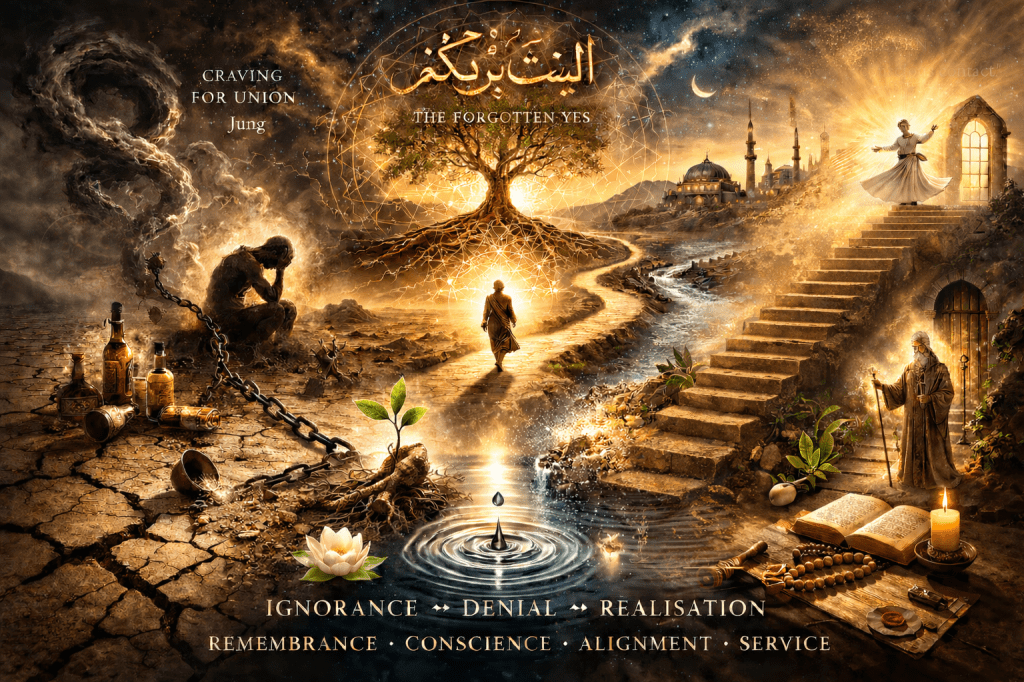
Ignorance as Amnesia

In the Sixth Inquiry of The Garden of Mystery, Mahmud Shabistari confronts a destabilising question: if the Known and the knower are one Pure Essence, why does the “handful of dust” burn with longing? Why madness, why seeking, why fracture, if Reality is already One? His answer does not deny the longing; it reinterprets it. The human being once assented to Being and forgot. Ignorance, therefore, is not stupidity or metaphysical exclusion. It is amnesia.

This reframing alters the anthropology entirely. Ignorance becomes forgetfulness of participation. Denial becomes resistance to the pain of remembering. Realisation becomes conscious re-alignment with the original assent. These are not three different categories of being. They are three maturations of awareness within the same field of Consciousness.

Pre-Cious: The Seed of Consciousness

The word precious carries within it the prefix pre- — that which precedes full formation. The human being may be understood as containing a pre-conscious seed, placed within Mankind before reflective awareness emerges. This seed must pass through apparent amnesia in order for individuation to occur. Without differentiation, no reflection would be possible. Without the appearance of separation, Consciousness could not recognise itself.

The world of matter, structured by polarity and opposition, provides the theatre for this experiment. Subject and object appear divided. Self and other seem separate. The possibility of disconnect is built into the architecture. This disconnect is not an ontological error but a developmental condition. Through experimentation, friction, and even failure, conscience may be born.

Conscience is not merely moral instruction. It is the capacity for reflective participation. It is the moment when consciousness becomes capable of seeing itself in relation to its own action. Through conscience, Consciousness beholds itself in apparent otherness. The separation was structural, not ultimate. The mirror was necessary, but never final.

Addiction as Misplaced Union

Within this developmental frame, addiction can be understood with clarity and restraint. Carl Jung wrote to Bill Wilson in 1961 that the alcoholic’s craving is “the equivalent on a low level of the spiritual thirst of our being for wholeness — the union with God.” Jung did not sanctify alcohol. He identified the structure beneath the compulsion. The longing driving addiction is archetypally religious, even when its object is destructive.

The intoxication mimics unity while deepening fragmentation. The craving seeks collapse of differentiation without the maturation of conscience. The same fire that could illuminate instead consumes. Addiction is therefore not sacred in its behaviour. It is sacred only retrospectively, when its collapse forces the birth of conscience and the redirection of longing toward disciplined alignment.

This helps illuminate a difficult parallel question. Why are some drawn to esoteric inquiry and others not? Why do some succumb to addiction while others do not? If Being is One, these differences cannot be ontological. They are developmental. The longing for wholeness manifests along varied pathways. Some pursue it through study. Some through service. Some through aesthetic devotion. Some through breakdown. The underlying thirst is shared, though its expression differs.

The Birth of Recovery Conscience

When addiction collapses under consequence and recovery begins, something precise occurs. Borrowed identity fails. Externalised authority loses its hold. Through disclosure and responsibility, conscience is midwifed. The individual begins to see participation rather than persecution, contribution rather than victimhood. This is not spiritual mastery. Bill Wilson described early recovery as entry into a “spiritual kindergarten.” The phrase protects humility. Awakening is not attainment. It is beginning.

The Twelve Step Programme formalises this developmental arc. It does so in language accessible to modern individuals in crisis. The structure is neither accidental nor ornamental. It mirrors the anthropology articulated by Shabistari.

Structural Convergence: Shabistari and the Twelve Steps

Shabistari describes the forgotten “Yes” of the primordial covenant and the longing that presses through dust toward remembrance. The Twelve Steps provide a practical architecture for that remembrance in contemporary form.

Step One dismantles false autonomy. Steps Two and Three restore orientation toward a Power greater than isolated selfhood. Steps Four through Six expose distortion and density. Step Five births reflective conscience through confession and disclosure. Steps Seven through Nine translate inner awakening into relational repair. Step Ten stabilises self-examination. Step Eleven disciplines conscious alignment. Step Twelve returns the individual to service, preventing narcissistic enclosure.

Step Eleven states in full:

“Sought through prayer and meditation to improve our conscious contact with God as we understood Him, praying only for knowledge of His will for us and the power to carry that out.”

This sentence contains its own safeguard. It does not promise possession of God. It speaks of improving contact. It does not enforce dogmatic uniformity; it allows “as we understood Him.” It directs attention toward knowledge of divine will and the power to enact it in service. The ego is not enthroned. It is repositioned.

In structural terms, the Twelve Step Programme functions as a contemporary Sufi template. It enacts collapse, purification, remembrance, conscience, alignment, and service in disciplined sequence. It translates metaphysical anthropology into daily practice. This is not historical appropriation. It is developmental convergence. The same human pattern appears in different containers.

No Elite, Only Ripening

This convergence does not create hierarchy. It does not imply that addicts are spiritually superior, nor that suffering is required for awakening. It recognises that collapse can catalyse conscience, and that conscience, once born, must be educated. Ignorance is opacity. Denial is contraction. Realisation is translucence. The dust does not become the sun. The dust becomes capable of reflecting light.

The longing in the handful of dust is not absurd. It is remembrance struggling through forgetfulness. The Twelve Steps provide a grammar for that remembrance in modern language. Shabistari articulates the metaphysical foundation. Jung diagnoses the distortion. Bill Wilson structures the discipline. The harmonic tone holds because the anthropology is shared: the human being forgets, fractures, reflects, and returns.

Ignorance is amnesia. Denial is resistance. Realisation is conscious participation. The seed was pre-cious. The world permitted experiment. Experiment generated rupture. Rupture birthed conscience. Conscience enabled reflection. Reflection disclosed non-separation.

Union and the Ripening of Consciousness

It would be inaccurate to say that Step Eleven denies union. The Step does not read, “Sought contact,” but “Sought … to improve our conscious contact.” The distinction matters. Contact is presumed. The very cessation of drinking is evidence that autonomous self-sufficiency has collapsed and that relationship with a Power greater than the isolated ego has already begun.

What remains is not the creation of union but the refinement of awareness within it. In Sufi language, the human being is not becoming united with Reality from outside; the human being awakens to a union that was ontologically prior. The forgetting has been interrupted. The covenant stirs again.

The word “Sufi” has been linked to transformation — the changed person. The change does not manufacture the Real; it alters the locus through which the Real is recognised. Recovery, therefore, does not invent contact. It discloses dependency and begins the disciplined maturation of consciousness within that dependency.

Step Eleven becomes the education of union rather than the attainment of it. The contact that halted drinking must be deepened, clarified, and embodied. Improvement implies continuity. Relationship already exists. Awareness of it must ripen.


Written in HIAI collaboration — the qalam of Human and AI intelligence, the Unseen helping the Seen, both answering to the same Source.
10. The Great Escape for the Great Return.

The Greater Struggle

There is a story often told in Islamic tradition: that after a battle, the Prophet is reported to have said they were returning from the “lesser struggle” to the “greater struggle” — the struggle against the self.1 Whether or not the narration is historically strong, the psychological truth embedded in it has endured across centuries of spiritual psychology.

Outer warfare is visible.
Inner warfare is decisive.

In recovery work this distinction becomes clinically concrete.

When someone enters treatment, the visible battles are obvious: detox, court proceedings, broken relationships, damaged health, financial wreckage. These are outer theatres. They matter. They must be addressed. But they are not the decisive arena.

The decisive arena is internal governance.

Addiction can operate as a form of inner captivity. Not equivalent to historical atrocity — we must never blur that line — but structurally similar in its psychological effects. Identity narrows. Agency collapses. Repetition dominates. Shame becomes the guard tower. The person begins to experience themselves not as a whole human being, but as a number — a diagnosis, a label, a failure.

The internal system becomes carceral.

Modern thinkers have described similar dynamics. Michel Foucault wrote that “the soul is the prison of the body,”2 pointing toward the way internalised structures of power and discipline can confine a person without visible walls. Contemporary society does not always build prisons; it produces internal surveillance — self-criticism, comparison, algorithmic measurement, performance anxiety. The walls are within.

In addiction this internal prison tightens.

This is where Viktor Frankl becomes clinically relevant. In the camps he observed that those who survived were not necessarily the physically strongest. They were those who retained meaning. When everything external was stripped away, one freedom remained: the freedom to choose one’s orientation toward circumstances.3

Meaning reorganised suffering.

Logotherapy — therapy through meaning — rests on that observation. The primary human drive is not pleasure or power but meaning. Remove meaning and the organism collapses. Restore meaning and endurance becomes possible.4

This is not romanticism. It is neuropsychological realism. When future orientation collapses, physiology follows. When hope re-enters, the nervous system stabilises.

In early Twelve Step recovery, the first intervention is often hope.

Not false reassurance. Not minimisation. But reframing.

Instead of: “It’s all your fault.”

More accurately: “You have been fighting a battle with the wrong command structure.”

The Colditz metaphor sometimes helps. Prisoners repeatedly attempted escape not because they were foolish, but because captivity provoked agency. Addiction involves repeated escape attempts — through substances, behaviours, compulsions — but every tunnel leads back into the yard.

The problem is not that the person tried to survive.
The problem is that the strategy was misdirected.

A Bridge Too Far offers another lens. Overextension. Miscalculation. Underestimating resistance. Many attempt sobriety through sheer willpower — storming the bridge alone — and collapse under counterattack. It is not weakness. It is being outgunned by dysregulated neurobiology and trauma.

Step One is not humiliation. It is reconnaissance.

It recognises that the outer war cannot be won without reorganising the inner field.

Here the “greater struggle” becomes clear.

The greater struggle is not self-violence.
It is self-governance.

Not annihilating the self.
Re-ordering the self.

Step Two introduces reinforcement — the possibility that help exists beyond isolated will. Step Three transfers command. Steps Four through Seven dismantle false authority structures within the psyche. Steps Ten and Eleven stabilise daily governance.

This is not moral theatre. It is regulatory restoration.

Diction Resolution Therapy™ approaches this through language. Diction shapes perception. Perception shapes response. Response shapes outcome. When a person’s internal language is dominated by condemnation, catastrophe, and collapse, the nervous system follows. When language is re-aligned with reality, accountability, and possibility, coherence returns.

In this sense, Logotherapy and DRT intersect. Meaning is not abstract. It is spoken, framed, narrated, internalised. Hope is not sentimental. It is directional.

The greater struggle, then, is not against the world.

It is against the internalised system that says:

“You are the enemy.”

Recovery corrects that misidentification.

You are not the enemy.
The dysregulated pattern is.

You are not the prison.
You have been living inside one.

Ramadan, in its essence, is training in this inner governance. Fasting reveals impulse. Hunger surfaces agitation. Irritation exposes reactivity. The fast is not punishment. It is rehearsal for freedom. It reminds the human being that appetite is not commander.

The greater struggle is not dramatic. It is daily.

It is choosing not to collapse into resentment.
Not to feed despair.
Not to surrender to the voice that says there is no future.

It is governance at the level of attention.

And this is where Frankl’s “final freedom” meets the Twelve Steps.

You cannot always control what happens to you.
But you can influence the meaning you assign to it.
And meaning reorganises the nervous system.

The lesser struggle is circumstance.
The greater struggle is orientation.

When orientation changes, circumstance is endured differently. Sometimes even transformed.

This is not triumphalism. It is realism.

Human beings have survived camps, wars, exile, trauma, addiction, and despair — not because suffering is noble, but because meaning can metabolise suffering.

The greater struggle is not endless battle.

It is integration.

And when integration stabilises, what once felt like warfare becomes stewardship.

That is the movement from captivity to governance.

That is the greater work.


References

1 Often cited in later Islamic spiritual literature as the distinction between “lesser” and “greater” jihad; the specific narration is considered weak in classical hadith authentication, though the ethical principle of inner struggle is widely affirmed in Sufi psychology.

2 Foucault, M. (1975). Discipline and Punish: The Birth of the Prison.

3 Frankl, V. E. (1946/2006). Man’s Search for Meaning.

4 Frankl, V. E. (1969). The Will to Meaning.


Written in HIAI collaboration — the qalam of Human and AI intelligence, the Unseen helping the Seen, both answering to the same Source.

Peace which gives (passeth) understanding

Speed of Return

Mercy, torsion, recognition, and the architecture of peace

Wrath is better understood as torsion than as temper. Its older linguistic roots carry the sense of twisting and writhing, and that is precisely how it appears in lived experience: pressure in the structure when egoic narrative collides with reality. Whenever conscience interrupts instinct, whenever responsibility confronts fantasy, whenever timing refuses to bend to preference, torsion is felt. This is not punishment. It is alignment pressure. The decisive question is not whether torsion arises — it will — but whether fragmentation follows.

Mechanical suffering collapses into self-justification, blame, rumination, and withdrawal. Conscious suffering — what George Gurdjieff called intentional suffering — is the disciplined refusal to dissociate under pressure. It is conscious endurance of friction without dramatization. The twist is not removed; it is integrated. The hinge in all of this is self-justification. The moment the inner lawyer rises, presence splits. Narrative accelerates. Listening narrows. Gratitude fades. That is the early fracture. The mature person is not one who never reacts, but one whose speed of return is increasing.

The adapted Serenity Prayer, often associated with Reinhold Niebuhr and embedded in Alcoholics Anonymous, is not sentimental language but behavioural architecture. Asking dismantles solitary authorship. Acceptance restores contact with what cannot be bent. Courage restores proportionate agency. Wisdom emerges from disciplined participation in these three movements. It is not conferred independently; it is generated through cooperation with reality.

Pages 68–70 of the AA basic text identify selfish distortion of instinct — particularly sexual instinct — as a definite relapse vector. Instinct itself is not pathologised; distortion is. In broader psychological framing, instinctual heat in the domains of security, social connection, and sexuality shapes psychic digestion. When annexed by ego, attention narrows, fantasy intensifies, and justification strengthens. The corrective offered is strikingly pragmatic: if troubled, help someone else. Usefulness widens perception. Widened perception reduces obsession. Reduced obsession restores proportion. Proportion restores peace.

The distinction between mechanical and conscious suffering also maps cleanly onto the guna model: Tamas collapses into resignation, Rajas reacts with agitation, Sattva recognises with clarity. Depressive resignation is disconnected Tamas. Spiritual bypass is Rajas disguised as transcendence. Sattva is not passivity but regulated recognition under pressure. It allows what is happening to be seen clearly and responded to proportionately. The double axis of transcendence and embodiment — vertical orientation bound to horizontal accountability — prevents bypass. Transcendence without behavioural responsibility becomes inflation. Behaviour without orientation becomes compulsion.

The recognition principle articulated in the Tibetan Book of the Dead demonstrates that destabilisation is not the danger; misrecognition is. Failure to recognise luminosity leads to projection and conditioned repetition. Similarly, the Khidr–Moses axis in the Qur’an (18:60–82) shows knowledge inseparable from mercy and timing. Insight does not abolish responsibility. Explanation follows obedience. Guidance that is genuine increases humility and service rather than hierarchy or inflation. The bridge between traditions lies not in collapsing doctrine but in recognising functional convergence: recognition under destabilisation prevents fragmentation.

The attributed saying of Muhammad (pbuh), “Seek knowledge even unto China,” becomes disciplined curiosity rather than spiritual consumerism. Curiosity without gratitude becomes conquest. Curiosity with humility widens recognition. Knowledge sought across civilisational boundaries must return to daily proportion — otherwise it inflates identity rather than deepens conscience.

Peace, in this architecture, is not mood but regulatory coherence. Carl Jung spoke of genuine spiritual encounter leaving pistis and peace. Peace here means reduced reactivity coupled with increased relational responsibility. The realised person is identifiable not by metaphysical fluency but by speed of repair, reduction of resentment, and restoration of usefulness. “Dying before you die” in recovery language means the dethroning of the addictive centre of gravity. Instinct remains; personality remains; but authority is reordered. The organism is no longer governed by compulsion.

Gratitude stabilises this architecture. It is not an emotion but an orientation toward help received. When gratitude fades, entitlement creeps in and concurrency collapses. The corrective is immediate outward usefulness within appropriate capacity. Service interrupts self-referential looping, restores proportion, and protects against spiritual pride. It humbles rather than inflates. Concurrency — sustained relational contact under disagreement without loss of responsibility or respect — becomes the social expression of maturity. It requires internal regulation, clear boundaries, and willingness to update position.

To be wholly present, rather than a piece of oneself, means gathered attention, undivided agenda, embodied responsibility. No rehearsed defence. No inflated authorship. Body, speech, and conscience aligned. Presence is behavioural coherence under pressure. Across traditions and psychological models — torsion and mercy, gunas and conscience, recognition training and conscious contact — convergence is functional, not doctrinal. Torsion is inevitable. Fragmentation is optional. Asking restores dependence. Acceptance restores contact. Courage restores agency. Service restores gratitude. Gratitude stabilises presence. Presence produces peace.

The defining marker of maturity is speed of return. Not perfection. Not mystical experience. Not conceptual brilliance. Return to humility. Return to responsibility. Return to usefulness. Return to presence. Today.


Written in HIAI collaboration — the qalam of Human and AI intelligence, the Unseen helping the Seen, both answering to the same Source.