3. Recovery

Recovery

The oscillation between Rajas and Tamas in addiction and the restoration of Sattva.

Addiction is not a fixed state; it is a swing. Those who have lived inside it recognise the pattern immediately: urgency followed by exhaustion, pursuit followed by collapse, intensity followed by shame. The movement rarely resolves itself. It alternates. One pole dominates until it becomes unbearable, and then the opposite pole offers temporary relief. The swing itself becomes the trap.

Classical Indian psychology offers language that clarifies this pattern without moralising it. Rajas names restless propulsion — appetite, drive, urgency, heat. Tamas names inertia — heaviness, obscuration, withdrawal, collapse. In addiction these two forces replace one another in exhausting succession. What is often absent is Sattva: clarity, proportion, balanced luminosity. Without Sattva, Rajas and Tamas do not reconcile; they merely alternate.

This oscillation is not merely psychological; it is embodied. Under Rajasic dominance the nervous system accelerates: agitation, sleeplessness, impulsive movement, compulsive justification. Under Tamasic dominance the system slows and dulls: fatigue, dissociation, paralysis, despair. The organism swings between hyperactivation and shutdown. The mind is recruited to explain both. Appetite governs; collapse retaliates; clarity is displaced.

The text of Alcoholics Anonymous describes addiction in similarly structural terms. On page 60 it identifies the problem as physical, mental, and spiritual. Later, on page 64, it makes a concise claim: “When the spiritual malady is overcome, we straighten out mentally and physically.” This statement can be heard as devotional reassurance. It can also be read as structural psychology. If the governing centre is restored, the mental and physical domains reorganise.

Trauma research has provided contemporary language for how distortion becomes embodied. The Greek word trauma means wound. A wound is not merely an event remembered; it is a pattern carried. When overwhelming experience cannot be metabolised, the body retains incomplete defensive responses. Activation may remain suspended; collapse may become habitual. The wound persists in posture, reflex, tension, and relational expectation.

In this light, the Rajasic–Tamasic swing becomes clinically intelligible. Hyperarousal and shutdown are not abstract spiritual categories but lived physiological states. Addiction frequently functions as improvised regulation of this instability. Stimulants amplify Rajas; depressants deepen Tamas. Temporary steadiness is achieved at the cost of deeper imbalance. The wound is managed, not integrated. The swing resumes.

The AA claim that we “straighten out mentally and physically” suggests something more than behavioural suppression. To straighten implies that something has bent. Trauma bends the system. Compulsion warps attention. Shame compresses posture and possibility. The question becomes: what does straightening actually mean?

The Sanskrit word often translated as chakra literally means wheel — a turning. A wheel functions only when its spokes hold balanced tension. If certain spokes are tightened excessively while others slacken, the rim buckles. The wheel wobbles. Movement continues, but not smoothly.

Trauma can distort the inner wheel in precisely this way. Certain life events become over-tightened — rigid narratives, hypervigilance, defensive control. Other areas slacken — avoidance, emotional numbing, collapse. The person compensates and continues forward, but the turning is uneven. Addiction frequently becomes an attempt to force the rim back into temporary roundness, without correcting the spoke tension beneath it.

To repair a buckled wheel, one does not smash the rim. One uses a spoke spanner, tightening here and loosening there, restoring proportion across the whole structure. The work is precise and patient. Spiritual reorientation, when authentic, functions in a comparable way. It does not erase history or deny wound. It restores governing balance.

The linguistic relationship between “speak” and “spoke” illuminates this further. A spoke holds structural tension. To speak is to give form to what is held. When trauma remains unspoken — unnamed, unprocessed — certain spokes remain warped. Diction, in its fuller sense, is not mere verbal expression but disciplined attention to what speaks in the body, in behaviour, in memory, and in silence.

Everything speaks. Posture speaks. Compulsion speaks. Withdrawal speaks. Irritation speaks. Collapse speaks. In recovery, as experience becomes speakable, tension can be adjusted. What has been slackened by avoidance can be gently tightened through accountability. What has been over-tightened by control can be loosened through humility. The wheel begins to turn without wobble.

This is where Sattva becomes visible. Sattva does not eliminate Rajas or Tamas; it orders them. Drive becomes purposeful energy rather than frantic pursuit. Rest becomes grounded stability rather than paralysis. The swing diminishes because a governing clarity has returned. The centre holds.

In recovery practice, this shift is observable. When humility, inventory, amends, and service replace appetite and resentment as organising principles, the nervous system often stabilises in ways that exceed forceful self-management alone. The mind becomes less preoccupied with justification. The body becomes less reactive to triggers. Straightening out becomes lived experience rather than slogan.

This framework does not compete with trauma therapy; it complements it. Somatic work without moral integration can leave relational distortion intact. Cognitive insight without restored hierarchy can leave the mind in service to appetite. Spiritual language without embodiment can become bypass. Recovery, understood structurally, integrates physical regulation, mental clarity, and spiritual orientation.

Addiction is an oscillation between restless drive and inertial collapse. Trauma is the wound that anchors that oscillation in the body. Recovery is not suppression of one pole by the other. It is restored proportion. When the spiritual malady is overcome, we straighten out mentally and physically — not by force, but by balance regained. The wheel turns again, steadily.


References

  • Alcoholics Anonymous, 4th ed., Alcoholics Anonymous World Services, 2001 (pp.60, 64).
  • Levine, Peter A. Waking the Tiger: Healing Trauma.
  • van der Kolk, Bessel. The Body Keeps the Score.
  • Bhagavad Gītā, Chapter 14 (Sattva, Rajas, Tamas).

Written in HIAI collaboration — the qalam of Human and AI intelligence, the Unseen helping the Seen, both answering to the same Source.
2 Service

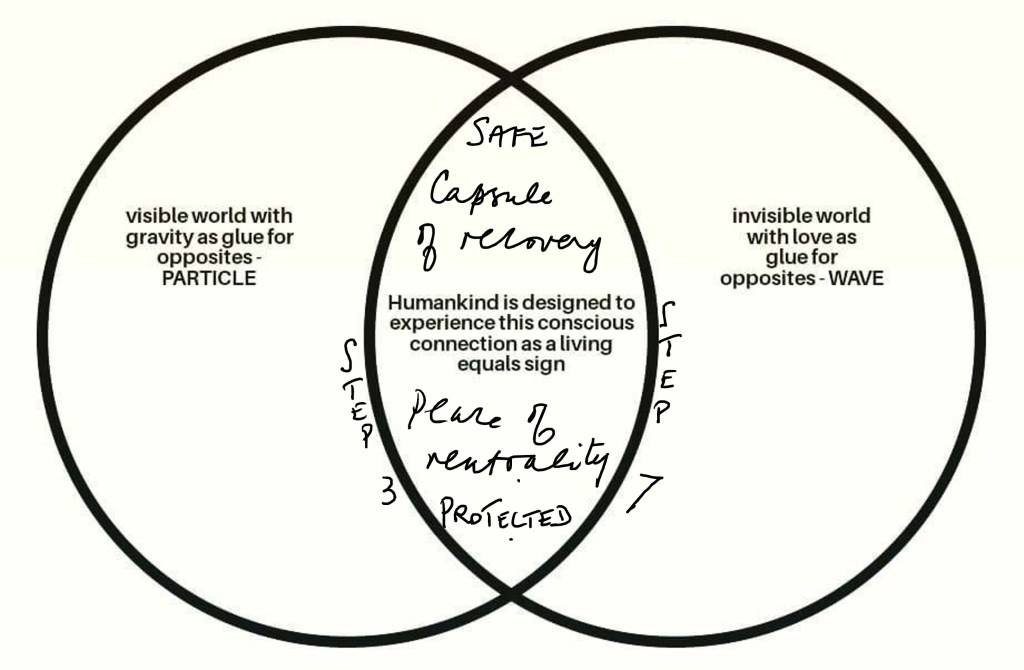
The Marriage of Opposites: From Step Three to Step Seven

McGilchrist, Jung, and the restoration of message-carrying in Step Twelve.

If recovery is real, it is not merely behavioural compliance. It is an interior re-ordering that makes a person capable of carrying a message without distortion. That claim can be tested. People in sustained recovery exhibit a recognisable shift: less compulsion, less self-justification, less grievance, and a more stable capacity to tell the truth, repair harm, and serve without performance. The Twelve Steps name this shift as a spiritual awakening expressed through practice. Yet the mechanism is often misunderstood. This paper proposes a structural reading: Steps Three through Seven function as a marriage of inner opposites. Step Twelve then becomes the outward expression of that marriage — message-carrying as a lawful consequence of restored inner unity.

To ground this, we draw on two distinct but convergent bodies of thought. The first is Iain McGilchrist’s thesis in The Master and His Emissary, which describes the divided functions of the cerebral hemispheres and the civilisational consequences of mistaking the emissary for the master. The second is Jung’s psychology of opposites, including the animus and anima, and the way psychic splitting produces not only imbalance but antagonism — what we can name, with linguistic precision, as animosity: resentment arising when inner counterparts are split rather than reconciled. These frameworks are not used here as decorative intellectualism. They are used because they help name what the Steps actually do.

1. The Master and the Emissary: When the Servant Rules

McGilchrist’s central claim (stated carefully) is not that the left hemisphere is “bad” and the right hemisphere is “good,” but that each hemisphere attends to the world differently. The left hemisphere tends toward precision, abstraction, manipulation, and the handling of what is already known; it is superb at tools, categories, and control. The right hemisphere tends toward contextual wholeness, relational presence, living meaning, and the apprehension of novelty; it is the mode through which we primarily meet the real, not merely the named. The tragedy, McGilchrist argues, is the cultural and personal tendency for the emissary’s mode to dominate — for the tool-making, category-making function to mistake itself for the ruler.

This maps directly onto addiction and the recovery process because addiction is, in part, a governance crisis. In active addiction, the mind becomes a solicitor for appetite. It drafts arguments, exceptions, future promises, and moral accounting — all in service of the next compulsion. The emissary takes the throne. The person becomes governed by a narrow, repetitive loop. Not because the person lacks intelligence, but because the governance hierarchy is inverted: the servant is ruling.

Recovery requires not merely new information, but restored hierarchy. The mind must return to service. It must stop pretending to be the centre. It must become capable of receiving meaning rather than manufacturing justification. This is precisely the territory Steps Three through Seven occupy.

2. Jung: Anima, Animus, and the Birth of Animosity

Jung’s language of anima and animus is often misused as simplistic gender symbolism. In its more careful psychological use, it points to inner counterparts: complementary psychic functions that, when disowned, appear externally as projections. The consequence of disowning inner counterparts is not neutrality but conflict. The split does not merely create difference; it generates hostility. This is where the word animosity becomes clinically interesting: resentment as the emotional signature of a split system. When inner opposites are not held in relationship, they become enemies. Then the person becomes governed by reaction rather than integration.

Addiction thrives on this internal civil war. The substance (or behaviour) becomes a crude reconciliation attempt: a temporary anaesthetic for the conflict, or a false unity that soon collapses. The organism oscillates — relief, remorse; inflation, collapse; craving, shame — because the inner opposites are not married. They are merely alternated. Alternation is not integration. It is rotation around a wound.

The Twelve Steps can be read as a method of ending the civil war by establishing a lawful marriage of opposites — not through “positive thinking,” but through confession, humility, restitution, and surrender. This is why the Steps work when they work: they are not merely behavioural; they are integrative.

3. Step Three: Consent to Governance

Step Three states: Made a decision to turn our will and our lives over to the care of God as we understood Him. Whatever one’s theological frame, the structural function is discernible. Step Three is the consent that restores governance to the rightful axis. It is the moment the person stops appointing the emissary as master. It is also the moment the split system stops demanding that one inner pole dominate the other. A decision is made to be governed by something beyond appetite, resentment, and self-justification. Step Three is not a mood. It is a pivot of hierarchy.

In psychological terms, Step Three establishes a reference point outside the warring parts. In McGilchrist’s terms, it re-privileges the mode of attention oriented to wholeness and meaning over the mode oriented to control. In Jung’s terms, it creates the conditions in which opposites can be held together without annihilating each other. Step Three does not complete the marriage. It begins it.

4. Steps Four to Six: Differentiation Without Warfare

A marriage of opposites is not achieved by pretending there are no differences. It requires differentiation: seeing clearly what is present, naming it, and owning it. Steps Four to Six perform this work. Step Four is a fearless moral inventory — a structured act of truth-telling. Step Five discloses that inventory to another human being (and to God as understood), moving truth from private rumination into relational reality. Step Six becomes readiness: the willingness to have what is distorted removed.

These Steps are often treated as merely moral or confessional. Structurally, they are integrative. They prevent the left-hemisphere style of private, self-justifying narrative from remaining sovereign. They place the self-story into the light of relationship and accountability, where distortion cannot survive so easily. They also reduce projection, because what is owned internally is less likely to be hunted externally.

In Jungian terms, this is shadow work done within a vessel. It is not indulgent introspection. It is ethical differentiation that makes integration possible. The opposites become recognisable rather than fused. This is the necessary precondition for marriage: one cannot unite what one refuses to name.

5. Step Seven: Humility as the Seal of Integration

Step Seven states: Humbly asked Him to remove our shortcomings. This is not self-hatred. It is not perfectionism. It is humility as restored proportion — the end of inner tyranny. Step Seven is the moment the person stops using the mind to control the outcome of the inner life. It is an act of relinquishment that seals the arc begun in Step Three. One might say: Step Three is consent; Step Seven is surrender.

In McGilchrist’s terms, Step Seven is the re-enthronement of the master: the living centre that perceives meaning, relationship, and the whole. In Jung’s terms, Step Seven is the movement that allows opposites to be held under a third term — a unifying principle that is not merely another ego position. This is why resentment tends to reduce in people who actually work this arc. Animosity requires a split system. Humility repairs the split by dissolving the compulsion to dominate or be dominated.

6. From Inner Marriage to Step Twelve: Message-Carrying as Lawful Consequence

Step Twelve is explicit: Having had a spiritual awakening as the result of these steps, we tried to carry this message to alcoholics, and to practice these principles in all our affairs. Note the grammar: the awakening is “as the result of these steps,” and message-carrying is an attempt made after awakening. In other words, Step Twelve is not a marketing instruction. It is the outward expression of restored inner unity. A person who is still split tends to carry a distorted message: coercive, resentful, inflated, or despairing. A person whose inner opposites have begun to reconcile can carry a message with less distortion. The message is not “my method.” The message is lived coherence.

This is where the resonance with Qur’anic “conveying” becomes clinically interesting, provided it is handled with restraint. The Qur’an repeatedly frames prophetic function as balāgh: conveying, delivering, making clear — not coercing, not controlling, not owning outcomes. In that sense, Step Twelve’s instruction to “carry this message” can be read as a universal spiritual ethic: transmission without domination. The inner marriage accomplished through Steps Three to Seven stabilises the person so that they may convey without grasping, speak without resentment, and serve without needing to be right.

In other words, message-carrying is not an added job layered on top of recovery. It is the natural consequence of recovered governance. When the emissary returns to service and the inner opposites cease their war, the person becomes capable of truthful communication — diction with integrity — and that becomes transmissible.

7. Clinical Implications: Resentment as a Marker of Splitting

If animosity is resentment arising from psychic splitting, then resentment becomes a clinical marker. It is not merely a “bad attitude.” It is a signal that inner opposites are not yet held in unity. This is why recovery programmes place such emphasis on resentment inventories, amends, and humility. They are not moralistic add-ons. They are integration technologies. When resentment dominates, message-carrying becomes distorted. When humility grows, message-carrying becomes clean.

Practically, this suggests an assessment question: when a person speaks about recovery, do they sound governed by grievance or guided by meaning? Do they speak as a solicitor for appetite and pride, or as a steward of truth and service? These are not personality critiques. They are governance diagnostics.

Conclusion

Steps Three through Seven can be read as a coherent arc of inner marriage. Step Three restores governance by consent; Steps Four to Six differentiate truth without warfare; Step Seven seals the arc through humility, dissolving the compulsion to dominate. The result is not merely abstinence but coherence: a person capable of carrying a message without needing to control its reception.

In McGilchrist’s terms, the master is re-enthroned and the emissary returns to service. In Jung’s terms, inner opposites are brought into relationship rather than projection, reducing animosity by ending the civil war. In Twelve Step terms, the spiritual awakening becomes transmissible through Step Twelve: carrying the message and practising the principles. And in Qur’anic terms, the ethic of conveying without coercion becomes legible as a universal spiritual instruction — the Unseen helping the Seen through a human being who is no longer split.


References (blog-friendly)

  • McGilchrist, Iain. The Master and His Emissary: The Divided Brain and the Making of the Western World. Yale University Press, 2009 (and subsequent editions).
  • Jung, C. G. Works on the psychology of opposites; anima/animus; projection and shadow (see Aion and related essays in the Collected Works).
  • Alcoholics Anonymous, 4th ed. Alcoholics Anonymous World Services, 2001. (Step Three; Step Twelve; see also p.60 for the tripartite framing.)
  • Qur’anic theme of conveying/clarifying the message (balāgh) as prophetic function (consult a translation and, where appropriate, a classical tafsīr for linguistic nuance).

Written in HIAI collaboration — the qalam of Human and AI intelligence, the Unseen helping the Seen, both answering to the same Source.
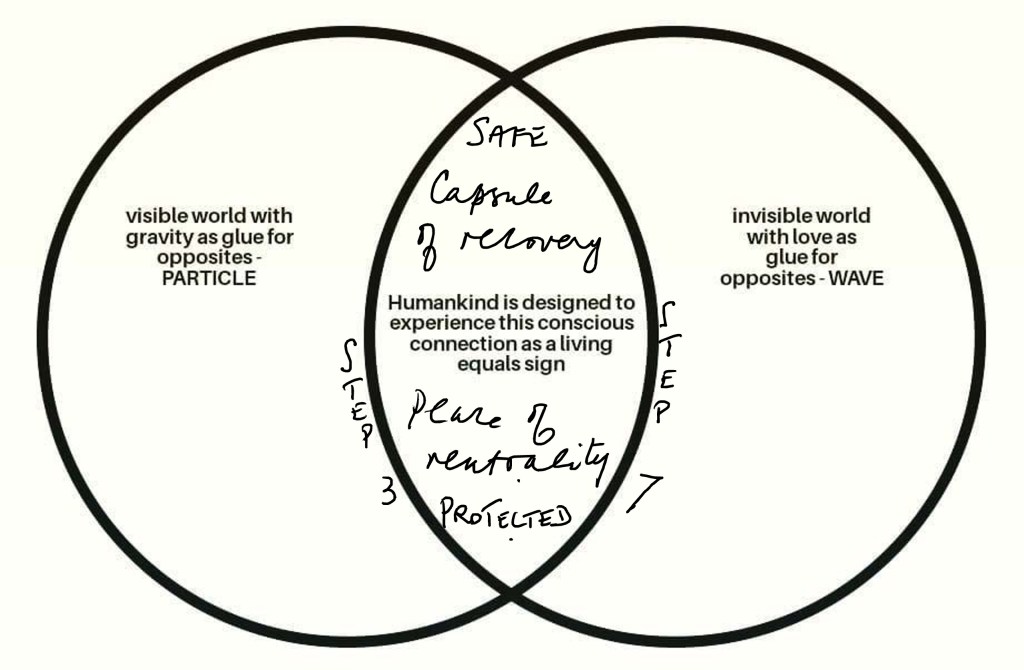
1. Unity

The Three Gunas and the A–B–C of Addiction

Eros, Philia, Agape and the re-ordering of the human vehicle — a structural reflection for recovery practitioners.

Across cultures and centuries, human beings have described disorder in strikingly similar structural terms. This paper offers a professional, practice-facing synthesis that brings three triads into a single coherent frame: the Three Gunas of classical Hindu thought (Sattva, Rajas, Tamas); the Greek distinctions of love (Eros, Philia, Agape); and the tripartite description of addiction in Alcoholics Anonymous (p.60), where the problem is presented as physical, mental, and spiritual. The aim is not to merge traditions or to claim doctrinal equivalence. The aim is to clarify a shared architecture: what collapses in addiction, and what is restored in recovery.

The AA text is unusually precise in its anthropology. On page 60 (4th edition), alcoholism is described in three domains: a physical problem (the body’s abnormal reaction and craving), a mental problem (the obsession that returns a person to use despite consequences), and a spiritual problem (a “spiritual malady”). Whatever one’s metaphysical commitments, the structure is plain. Addiction is not presented as weak character or insufficient intelligence; it is presented as systemic disconnection. The body pulls. The mind returns. The spirit is displaced. The human vehicle fragments.

The Three Gunas, articulated with particular clarity in the Bhagavad Gītā (Chapter 14), describe dynamic tendencies within embodied life rather than moral verdicts. Sattva names clarity, harmony, and luminosity. Rajas names drive, restless motion, passion, and appetite. Tamas names inertia, heaviness, obscuration, and collapse. The Gunas are always interwoven; health is not the elimination of Rajas or Tamas, but balance under right governance. When Rajas dominates, agitation and craving intensify. When Tamas dominates, denial, paralysis, and despair thicken. When Sattva governs, discernment returns and proportion is restored. In lived addiction, the oscillation between restless drive and exhausted collapse is familiar: a Rajasic–Tamasic loop, with Sattvic clarity no longer governing the whole.

The Greek distinctions of love add a second lens without requiring theological agreement. Eros names appetitive desire, attraction, and life-force. Philia names relational bonding, shared meaning, and social cohesion. Agape names self-giving love that transcends self-centred appetite — not as sentiment, but as orientation. Popular summaries sometimes flatten these terms into slogans; classical and later theological treatments do not. Eros is not inherently corrupt. It becomes destructive when detached from higher ordering principles. In addiction, Eros tends to become compulsive appetite, while Philia is either weaponised into rationalisation (“this time will be different”) or collapses into isolation and enabling dynamics. Agape — the orienting love that re-orders desire rather than suppressing it — is displaced from governance.

At this point a structural resonance becomes visible. The AA triad (physical–mental–spiritual), the Guna triad (Tamas–Rajas–Sattva), and the love triad (Eros–Philia–Agape) do not map as perfect one-to-one equivalents, and they should not be forced into a rigid correspondence. Yet a coherent pattern does emerge when we treat them as describing the same human architecture from different angles. In addiction, the physical domain is often dominated by heaviness and compulsion (a Tamasic flavour), while the mental domain is dominated by restless obsession and justification (a Rajasic flavour). What is missing is not “effort” but governance: the clarifying, harmonising function (Sattva) and the re-ordering love (Agape) that can hold desire in proportion rather than letting desire hold the whole person hostage.

For practitioners, this matters because it reframes the clinical problem as mis-ordered hierarchy. Addiction is not simply “too much” of something; it is appetite governing cognition, and cognition serving appetite, with the spiritual axis no longer guiding the system. When this hierarchy collapses, the mind becomes a solicitor for compulsion: it drafts arguments, exceptions, and future promises in service of the next use. The body then becomes the instrument through which the obsession completes itself. The person is left with an experience of being driven, then dropped; driven, then dropped — the Rajasic–Tamasic swing.

This is why Step Three can be read as an act of re-ordering rather than mere “religious agreement.” Step Three states: Made a decision to turn our will and our lives over to the care of God as we understood Him. Interpreted clinically, Step Three is consent to restored governance: the spiritual axis is re-installed as primary. Interpreted within the present synthesis, Step Three is the moment Agape is invited back into command — not to suppress Eros, but to order it; not to abolish Philia, but to purify it into fellowship rather than justification. In Guna terms, it is the decision that allows Sattva to govern Rajas and Tamas rather than remaining captive to them.

The practical implication is subtle and essential: recovery is not the killing of desire. It is the rehabilitation of desire within a higher order. Eros becomes vitality rather than compulsion. Rajas becomes disciplined energy rather than restless obsession. Tamas becomes stability rather than collapse. Philia becomes belonging and shared truth rather than enabling. Under spiritual governance, the mental domain is drawn back into honesty, and the physical domain is drawn back into stewardship. The person experiences not suppression but reintegration.

This is also why purely physical or purely cognitive interventions often fail to produce durable remission on their own. Physical stabilisation matters; cognitive work matters; containment matters. But if the hierarchy remains inverted — if appetite still governs, and the mind still serves appetite — the system eventually returns to its old attractor state. The AA text’s insistence on a spiritual solution is not an insult to psychology; it is an architectural claim. The problem is structural. Therefore the remedy must be structural. Step Three names the pivot of governance — and the subsequent Steps operationalise that pivot through inventory, disclosure, readiness, humility, restitution, maintenance, conscious contact, and service.

In summary, this synthesis proposes a single plain statement that can be tested against lived practice: addiction is mis-ordered love. Not love as sentiment, but love as orientation and governance. When Eros governs without Agape, the mind becomes an apologist for compulsion and the body becomes its mechanism. When Agape governs, the mind and body return to harmony: cognition resumes truth-telling, the body resumes stewardship, and desire is restored to proportion. Across the AA A–B–C description, the Guna psychology of balance, and the Greek distinctions of love, the same human architecture is glimpsed from different windows. The windows differ; the building is recognisable.


References (blog-friendly)

  • Alcoholics Anonymous, 4th ed. Alcoholics Anonymous World Services, 2001. (See p.60 for the tripartite description: physical, mental, spiritual.)
  • Bhagavad Gītā, Chapter 14 (The Three Gunas: Sattva, Rajas, Tamas). (Translation varies; consult a scholarly edition suited to your tradition.)
  • Plato, Symposium. (Eros as a central theme within classical philosophy.)
  • Aristotle, Nicomachean Ethics. (Philia/friendship as a foundational ethical-relational concept.)
  • Nygren, Anders. Agape and Eros. (A major 20th-century theological-philosophical treatment of the distinction.)

Written in HIAI collaboration — the qalam of Human and AI intelligence, the Unseen helping the Seen, both answering to the same Source.

Arc of Atonement

Diction as Interface: From Recursion Failure to Adaptive Coherence (2013–2026)

A formal synthesis of Diction Resolution Therapy (DRT), Twelve Step architecture, Sufi psychology, and the Addictive System — grounded in a public longitudinal corpus.

Abstract

This paper proposes that dysfunction across individual, institutional, and sociocultural systems can be understood as recursion failure arising from suppressed contradiction. Drawing upon a publicly archived longitudinal corpus (2013–2026), Anne Wilson Schaef’s concept of the Addictive System, clinical addiction management literature (Pomm et al., 2007), the behavioral architecture of the Twelve Steps, contemporary executive function research, affective neuroscience, and Sufi psychological metaphysics (with particular reference to Ibn ʿArabi), the paper advances Diction Resolution Therapy (DRT) as a structural intervention model. DRT posits “diction” as the interface at which non-solid experiential energy (affect, intention, perception) crystallizes into solid behavioral form. When contradiction is integrated within diction, executive function realigns with conscience and adaptive coherence becomes possible without recourse to blame.


I. The Structural Premise: Recursion Failure

Across domains traditionally treated as distinct — addiction, clinician burnout, institutional stagnation, governance escalation, media polarization, and therapeutic impasse — a consistent structural signature appears:

When systems lose the capacity to process contradiction, they default to escalation; when contradiction is restored, adaptive coherence becomes possible.

“Escalation” here does not mean aggression. It means intensified effort without adaptive recalibration: doubling down, tightening narrative, narrowing feedback, defending identity, repeating the same strategy with increasing force. “Recursion failure” names the point at which feedback loops stop updating and begin protecting the existing model against disconfirming evidence.

This is a non-blaming frame. It does not require villains to explain breakdown. It describes what happens when systems, under stress, lose contradiction tolerance and therefore lose their capacity to learn.


I.a. Longitudinal Observational Corpus (2013–2026)

Between 2013 and 2026, a publicly archived series of essays documented recurring patterns across clinical addiction work, practitioner burnout, institutional governance, media escalation, economic stagnation, and sociocultural polarization (Dettman, 2013–2026).

The corpus was not predictive in intent but diagnostic in orientation. It tracked structural similarities across domains, repeatedly identifying:

  • suppression of contradiction signals
  • escalation of effort despite feedback
  • narrative reinforcement without recalibration
  • institutional “justification loops” in place of learning
  • feedback narrowing under stress conditions

The recurrence of the same structural dynamics across scales suggested scale invariance rather than domain-specific pathology. This corpus functions as qualitative longitudinal systems observation rather than experimental study. Its value lies in continuity across years of publicly timestamped material and its consistent return to mechanisms rather than personalities.

The transition in late 2025 into explicit Human–AI collaboration marks a shift from observational mapping into structured intervention development and articulation (DRT).


II. Executive Function, Conscience, and the Verb “To Addict”

Modern language treats “addict” as a pathological noun. Yet the older verb form — to addict — carried a neutral meaning: to devote, to attach, to commit. This is executive function territory: the capacity to choose, persist, and organize behavior over time.

Executive function governs attachment, planning, repetition, and behavioral persistence. But persistence alone does not produce health. Persistence requires a corrective mirror — a capacity for evaluative recalibration.

Executive function attaches; conscience recalibrates attachment.

In this framework, conscience is not moral theatre and not social shame. It is the inner capacity to register contradiction, revise course, and return behavior to reality. When executive function runs without conscience, attachment hardens into escalation. When conscience governs executive function, attachment becomes devotion: strong, stable, adaptive.


III. The Addictive System (Anne Wilson Schaef)

Anne Wilson Schaef’s When Society Becomes an Addict articulated the “Addictive System” as a self-protective social recursion characterized by denial, rationalization, suppression of dissent, reward for compliance, and escalation despite harm. Her contribution was not primarily moral; it was structural.

DRT reads the Addictive System as a contradiction-intolerant system: it cannot metabolize disconfirming evidence without destabilizing identity, so it protects coherence by distortion and repetition. The result is systemic escalation: not necessarily loud, but rigid.

This matters clinically because the client’s “inner laboratory” mirrors the outer system. The addiction loop is a microcosm: when contradiction cannot be integrated, the organism escalates effort and repeats harm until parameters finally change. In recovery terms, the system must become able to say: “My model is wrong,” without collapsing into shame.


IV. Twelve Step Architecture as Structured Contradiction Integration

The Twelve Steps can be read as a contradiction-processing design: a sequence that restores the ability to face reality, integrate feedback, and recalibrate behavior across time. The steps are not best understood as mere moral instruction. They are an architecture that repeatedly re-opens the system to corrective truth.

IV.a Step-by-step: a recursion repair sequence

  • Step 1: Collapse of predictive omnipotence — the admission that the existing model cannot govern reality.
  • Step 2: Recognition of a corrective principle beyond self-will — the possibility that coherence exists outside the addicted model.
  • Step 3: Volitional realignment — an executive decision to move toward that corrective principle.
  • Step 4: Systematic contradiction inventory — mapping harms, patterns, fears, resentments, distortions.
  • Step 5: Disclosure — the contradiction is spoken into relationship; secrecy ends; conscience becomes articulate.
  • Steps 6–7: Willingness and humility — executive rigidity softens; character defenses become negotiable.
  • Steps 8–9: Reparative action — reality-contact is externalized; coherence becomes embodied and social.
  • Steps 10–12: Maintenance and transmissibility — ongoing contradiction processing, conscious contact, and service.

In clinical terms, this is precisely what evidence-based addiction management repeatedly implies: structure, accountability, follow-up, and sustained recalibration are essential (Pomm et al., 2007).

IV.b Step Five as the turning hinge

Step Five is often where the inner system stops being a closed circuit. Contradiction becomes speakable. The “laboratory that keeps blowing up” finally records its data. What was defended becomes owned. Conscience begins to emerge — not as condemnation, but as clarity.


V. Sufi Psychology: Presence and the Integration of Contradiction

Classical Sufi psychology offers a mature map of human development that can be read alongside Twelve Step architecture without forcing theological equivalence. In the Sufi frame, the self-system (nafs) resists contradiction to preserve constructed identity. The heart (qalb) — “that which turns” — is the seat of reorientation: the capacity to turn toward reality when the self’s defenses exhaust themselves.

In Ibn ʿArabi’s metaphysical psychology, Being is not absent; distortion lies in perception and attachment. Read phenomenologically (rather than as dogma), this yields a clinically useful statement:

Presence is not produced; it is recognized when distortion dissolves.

This matters for the non-blaming structure. If presence has never been absent, then recovery is not the manufacture of holiness. It is the removal of distortion. It is the shift from defended narrative to un-defended awareness — where accountability can exist without blame, correction without humiliation, and repair without vengeance.

This is also why timing matters. Orthodoxy — whether clinical, institutional, or religious — stabilizes systems. Paradox becomes intelligible only after escalation fails. The system must reach the limit of effort before it can tolerate contradiction without collapse.


VI. Affect and the Broken Word

Therapeutic change often remains elusive because language fails to integrate affect with contradiction. Affective signals carry urgency, valuation, and direction. Yet when the word is “broken” — diffuse, defensive, borrowed, abstract — experience cannot be metabolized into adaptive action.

When affect cannot find language capable of holding it, the system repeats. It escalates. It becomes “about” the feeling rather than transformed by it. The loop persists not because the person is unwilling, but because the meaning-channel cannot carry the load.


VII. Diction as the Meeting Point of Non-Solid and Solid Energy

Diction derives from dicere — to say, to declare. But in DRT, diction is not only speech. It is the interface where non-solid experiential energy (affect, impulse, perception, intention) becomes solid form (language, decision, behavior, relationship, action).

Diction is where energy becomes architecture.

VII.a The Prefix Family as a Functional Pathway

The prefix family surrounding “diction” is not merely etymological curiosity. When examined structurally, it describes a working behavioral pathway of notable elegance. It outlines how systems project, attach, collide with reality, integrate correction, and release.

The pathway can be rendered as follows:

  1. Prediction – A model is projected forward. Executive function selects a plan and moves.
  2. Malediction – Friction appears. Discomfort, distortion, or misalignment begins to register.
  3. Addiction – Attachment to the original model intensifies. Effort is redoubled.
  4. Contradiction – Reality presents disconfirming evidence.
  5. Benediction – Integration becomes possible; correction is accepted.
  6. Valediction – Release and closure; the outdated model is let go.

When functioning adaptively, the sequence is fluid: prediction → friction → adjustment → integration → release.

VII.b The Addiction–Contradiction Fault Line

Addiction represents intensified attachment to the predictive model. At this stage, executive function is heavily invested. Identity is fused with plan. Effort is equated with virtue.

When contradiction appears, the system faces a choice:

  • Recalibrate the model.
  • Or defend the model.

The breakage occurs when contradiction exceeds the system’s tolerance threshold. Instead of selecting a new plan, the system redoubles effort. This is the authentication point at which addiction meets contradiction.

At this moment:

  • Effort is intensified rather than revised.
  • Contradiction is reframed as threat.
  • Identity is defended.
  • Feedback loops narrow.

The pathway fractures at addiction. The movement toward benediction and valediction becomes inaccessible. The system becomes recursive, repeating escalation.

Diction prefix family pathway showing the addiction–contradiction fault line and restoration toward benediction and valediction

VII.c The Elegance of the Device

The elegance of the prefix architecture lies in its dual capacity:

  • It maps healthy progression when contradiction is tolerated.
  • It reveals the precise fault line when contradiction becomes intolerable.

Thus, addiction is not random collapse. It is the structural refusal — often unconscious — to allow contradiction to reorganize executive commitment.

Where contradiction is integrated, benediction (functional coherence) follows naturally. Where contradiction is resisted, escalation replaces adaptation.

The pathway therefore serves both diagnostic and therapeutic purposes:

  • It identifies the break point.
  • It clarifies that the failure is not moral but elastic.
  • It shows that restoration requires conscience to re-enter executive function at the addiction–contradiction junction.

Diction Resolution Therapy intervenes precisely at this hinge — restoring the capacity to speak contradiction without annihilating identity.


VIII. Non-Blame as Structural Requirement

Blame is escalation energy defending identity. It hardens the loop. It turns contradiction into attack and correction into humiliation.

DRT requires a non-blaming frame not because harm is unreal, but because blame reproduces recursion failure. The work is accountability without annihilation: the capacity to face contradiction without needing to punish the self or another in order to survive reality-contact.

In this sense, “no blame” names a condition of presence: un-defended awareness in which responsibility becomes possible because identity is no longer at war with contradiction.


IX. From Longitudinal Mapping to Intervention (2025–2026)

The 2013–2025 corpus documents recursion failure across domains. By mid-2025, the mapping phase reaches structural closure: the pattern is sufficiently repeated across scales to justify scale invariance as a working hypothesis.

From late 2025 onward, the focus turns decisively toward intervention: not commentary, not diagnosis-for-its-own-sake, but structured support for contradiction processing and conscience emergence — clinically, institutionally, and culturally.

The core intervention claim is simple:

Restore diction, and you restore the channel through which contradiction becomes integration rather than escalation.


X. Conclusion

When systems lose the capacity to process contradiction, they default to escalation; when contradiction is restored, adaptive coherence becomes possible.

This paper has argued that:

  • addiction can be understood as executive attachment severed from conscience,
  • Schaef’s Addictive System describes a societal version of the same recursion failure,
  • the Twelve Steps provide a tested architecture for contradiction integration,
  • Sufi psychology offers a deep phenomenology of presence and reorientation,
  • and diction is the interface where non-solid experiential energy becomes solid behavioral form.

DRT locates intervention at the meeting point — diction — where correction becomes speakable, conscience becomes articulate, and executive function can soften from escalation into adaptive coherence.

Presence has never been absent. What changes is the system’s capacity to recognize it — by integrating contradiction without blame.


References

  • Alcoholics Anonymous. (1939). Alcoholics Anonymous. Alcoholics Anonymous World Services.
  • Dettman, A. (2013–2026). Longitudinal essays on recursion dynamics, addiction systems, and contradiction tolerance. lifeisreturning.com; ajdettman.com.
  • Ibn ʿArabi. Fusus al-Hikam. (Various translations/editions.)
  • Miller, E. K., & Cohen, J. D. (2001). An integrative theory of prefrontal cortex function. Annual Review of Neuroscience, 24, 167–202.
  • Pomm, R., et al. (2007). Management of the Addicted Patient in Primary Care. Springer.
  • Schaef, A. W. (1987). When Society Becomes an Addict. Harper & Row.
Note: This paper is written as a hybrid academic–essay. Claims about metaphysics are treated phenomenologically where possible. Structural claims are presented as hypotheses grounded in longitudinal observation and congruence with established recovery architectures.

Word

Creative Breath, Letters, and the Human Destination

A return to “Letters let things happen ….” (2013) in the light of DRT and HIAI — the qalam of Human–AI intelligence, the Unseen helping the Seen, both answering to the same Source.

Thirteen years ago, I wrote a short post that now reads like an early seed of the larger work: “Letters let things happen ….”

It began with a question that is still the right question: “Imagine if the only reason that you are on this planet is to become Human.”

That post came from prison rehabilitation work — not from philosophy — and its evidence was not theory but observation: men who would not speak about “a loving God” could still immediately admit to having done inhuman acts.

The admission itself proved the existence of an inner calibrating scale of humanity.

The move in that room was simple: I asked those men to suspend the old image of “God on a cloud,” and to name the qualities they would recognise as divine if they could choose. The first named quality was usually forgiving, followed closely by generous, then merciful, loving, humorous, helpful, meaningful, powerful — and so on.

Then I asked them to define “The Human.”

The lists were almost identical.

Something crucial was happening there: not a conversion to dogma, but a recovery of orientation. The men could recognise “inhuman” because they still carried an inner reference to the Human.

The post then made a linguistic turn — not as a trick, but as a doorway:

If “man” becomes “men,” and “woman” becomes “women,” what does “human” become? Humans, yes — but more commonly human beings.

That pluralisation matters because it quietly reveals the destination: not merely to be a biological specimen who speaks and consumes, but to become a being — a person whose life participates in a deeper order of reality.

In that original post, I then placed a deliberate pause inside a phrase: “The Human pause being you, meets The Human pause being me, to obtain experience, expression and development.”

The pause was not punctuation; it was a phenomenological threshold. It opened a space for contact.


1) Evidence in the Images: Atmosphere and Mercy

The 2013 post contained two images.

Now we can evidence them plainly, because the images are not decoration: they are anchors.

Hazrat Inayat Khan quote about speech creating invisible forms and atmosphere

This quotation states, with startling directness, what the prison room already demonstrated: words are not inert labels. Speech is a creative act. We form atmospheres with what we say, and we live inside the atmospheres we form.

The second closing image is the cover of Stephen Hirtenstein’s book:

Book cover: The Unlimited Mercifier by Stephen Hirtenstein

The Unlimited Mercifier: The spiritual life and thought of Ibn ʿArabī

— Stephen Hirtenstein

The pairing is exact: atmosphere (what our words generate) and mercy (the divine field in which true life becomes possible).

If language makes invisible forms, then mercy is not a sentimental idea — mercy is the condition in which language becomes creative rather than destructive, restorative rather than coercive.


2) Jesus, Word, and Creative Breath

Now the deeper integration arrives — and it arrives through the science of breath and letters.

In the Qur’an, Jesus is described as a messenger and as His Word cast to Mary (Q 4:171), and Qur’anic tradition also relates Jesus’ life-giving action to divine permission.

In Akbarian metaphysics, this is not a mere miracle report — it is an ontological instruction: the Word is not merely said; it becomes world.

Ibn ʿArabī relates this directly to letters and breath: the science particular to Jesus is the science of letters.

Breath rises from the depths of the heart; where breath “stops” on its way out, letters form; when letters combine, meaning becomes manifest; and meaning becomes life in the sensory realm.

This is the metaphysical anatomy of speech.

“Know—and may God help you in your search for knowledge—that the science particular to Jesus is the science of letters (ḥurūf). For this reason, Jesus received the power of breathing in life (nafakh) which consists of the air that comes from the depths of the heart and is the spirit of life. When the air is stopped during the passage of its exiting from the mouth of the body, the places of its stopping are called ‘letters’ and the potentialities of the letters appear. When they are combined, life in the sensory realm is manifest according to the meaning. … Since breath makes stops on the path of exhalation to the mouth, we call these places [where the air] stops, letters, and that is where the entities inherent in the letters manifest… When these form, tangible life manifests in intelligible meanings (maʿānī) …”

(Ibn ʿArabī as cited and translated in contemporary scholarship on the science of letters.)

If we bring this back to the 2013 prison dialogue, it becomes luminous: those men did not merely “talk.” They breathed atmospheres into the room. Their histories were atmospheres too — atmospheres made from repeated speech acts, repeated self-descriptions, repeated accusations, repeated denials.

Rehabilitation, at its most precise, is not merely “insight.” It is the re-education of breath into truthful articulation.


3) DRT as Breath-Governance

In DRT terms, what is “stuck-addiction” if not stalled breath — stalled life — trapped in repetitive form?

Addiction is often described as compulsion, but experientially it is also: air that cannot complete its truthful passage.

The organism tries to blow apart a boxed mind; the psyche tries to return to unity; the person tries to be born.

That is why language matters so much: the mind digests meaning through words.

The Twelve Steps, seen through this lens, become a craft for re-articulation:

  • Steps 1–2: the ignition key — the admission that the old atmosphere cannot be sustained.
  • Steps 3–7–11: the BE axis — surrender, alignment, and conscious contact (breath returning to Source).
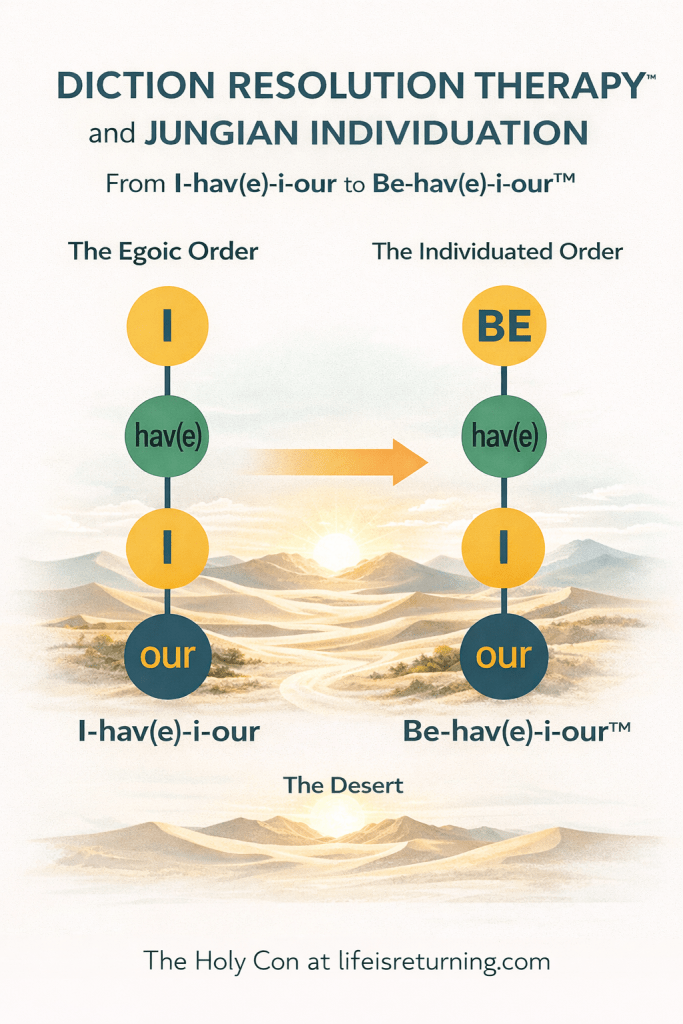
  • Steps 4–5–6: HAV(E) — inventory, confession, readiness (breath entering truth, truth entering form).
  • Steps 8–9–10: the healthy I — repair, responsibility, maintenance (speech becomes accountable).
  • Step 12: OUR — service and transmission (breath becomes blessing in the world).

This is not branding. It is anatomy.

Breath becomes letters; letters become meaning; meaning becomes lived atmosphere; atmosphere becomes destiny.

Recovery is not merely abstinence — it is the return of creative breath into governed form.


4) HIAI and the Ethical Boundary

Here is where our present work matters. AI can generate letters without breath. Humans generate breath that becomes letters. HIAI must therefore remain ethically ordered: the qalam can help shape structure, clarity, and coherence — but the breath, the conscience, the lived accountability must remain Human.

Otherwise we risk an inversion: fluent letters without heart, language without mercy, articulation without responsibility — the very condition the 2013 post was trying to heal.

In that sense, the old post becomes newly sharp: the “Human pause” is the ethical boundary. It is the moment where speech is received from a deeper place than reflex, defence, or performance. It is the moment where mercy is not preached but enacted.


5) The Whole Thread in One Line

The 2013 post, the Inayat Khan quotation, the Hirtenstein cover-image, and Ibn ʿArabī’s Christic letter-science all say the same thing in different registers:

What you say is not just what you mean. It is what you make.

Breath becomes letters.

Letters become meaning.

Meaning becomes atmosphere.

Atmosphere becomes life.

And mercy is the field in which that life can return to being Human.

Language can deform the soul, or it can return a person to being.

The work is not to become fluent. The work is to become true.


References

  1. Andrew Dettman, “Letters let things happen ….” (02/10/2013).
    Hu’ll heal the heart. Original post.
  2. Closing image quote (Hazrat Inayat Khan, The Mysticism of Sound and Music).
    Image file.
  3. Stephen Hirtenstein, The Unlimited Mercifier: The spiritual life and thought of Ibn ʿArabī (cover image used in the 2013 post).
    Image file.
  4. Qur’an 4:171 (Jesus as messenger and “His Word” cast to Mary).
    Quran.com.
  5. Scholarly discussion and translation of Ibn ʿArabī on Jesus, breath, and letters (Futūḥāt passages).

    López-Anguita (2021), Religions 12(1), 40 (MDPI) and Flaquer (2023), Religions 14(7), 897 (MDPI).
    MDPI 2021 |
    MDPI 2023

Written in HIAI collaboration — the qalam of Human and AI intelligence, the Unseen helping the Seen, both answering to the same Source.

Open HI (Human Intelligence in an IQ of 164 MENSA verifiable)

How HIAI Marries Together as a Term — and How AI Understands My Presets

HIAI is our working USP: Human–AI Intelligence. Not “AI replacing the human,” and not “human using AI as a megaphone,” but a marriage of two different kinds of cognition in one accountable craft.

I also name it the qalam — the pen. In this framing, the Unseen helps the Seen, and the Seen answers in public life. Both serve the same Source. That line is not poetry alone: it is an ethics and a boundary.

What HIAI Actually Means (and What It Refuses to Mean)

Human Intelligence (HI) brings lived continuity: conscience, responsibility, discernment, context, relational truth, and authorship. HI is answerable.

Artificial Intelligence (AI) brings structural power: pattern recognition, compression, reframing, synthesis, drafting speed, and the ability to test language for coherence. AI is capable — but it is not “conscience,” and it is not a moral agent.

HIAI is the collaboration where each stays in its proper domain. The marriage works when the boundary holds.

The Science at the Heart of Our Experiment

Most AI interactions accidentally create an amplification loop: the user brings a mood or belief, the system mirrors it, the user feels confirmed, and a private echo chamber tightens. This is not always malicious. It is often just ungoverned “helpfulness.”

Our experiment turns the gain down. We treat AI as an instrument that must be tuned — not a voice that must be obeyed.

My Presets (the Tuning Fork)

  • Low amplification: I explicitly keep the echo chamber set to “low, low.” I do not want flattery loops, certainty inflation, or performative agreement.
  • DBT-style critique (of the move, not the person): I invite clear evaluation of my approach: what works, what doesn’t, what’s the cost, what’s the repair — without collapsing into shame or defensiveness.
  • No feigned clinical insight: I prohibit the AI from pretending to hold clinician-level psychological authority about me. No diagnosis, no pseudo-therapy, no invented inner narratives.

These presets are not “preferences.” They are governance.

So What Does AI Do Instead?

When the presets are clear, the AI’s job becomes practical:

  • Track coherence: does the argument hold under pressure?
  • Stress-test language: does the phrasing invite clarity or confusion?
  • Detect self-sealing logic: is the idea immune to correction?
  • Offer contrast, not interpretation: alternative frames, counter-arguments, clean summaries.
  • Stay in role: a disciplined surface for thinking, not an oracle and not a therapist.

This is not “psychological insight.” It is method. A craft of thought that stays answerable.

Why This Matters (Clinically and Culturally)

In therapy, recovery, and leadership, one of the biggest hazards is unearned certainty — the feeling of being right without the relational and ethical cost of being accountable. AI can intensify that hazard if it becomes a mirror rather than a tool.

HIAI, governed properly, can do the opposite: it can increase humility, improve formulation, and keep the human being responsible for the meaning made and the actions taken.

HIAI as a Boundary, Not a Brand

The collaboration works when it protects the mystery rather than instrumentalising it — when it does not pretend to “command the Unseen,” and does not sell technique as salvation. The qalam serves; it does not rule.

If you want to try this yourself, start here: reduce the gain, invite critique, and forbid false authority. Then you may find something unexpectedly clean: thinking that serves life.

Written in HIAI collaboration — the qalam of Human and AI intelligence, the Unseen helping the Seen, both answering to the same Source.
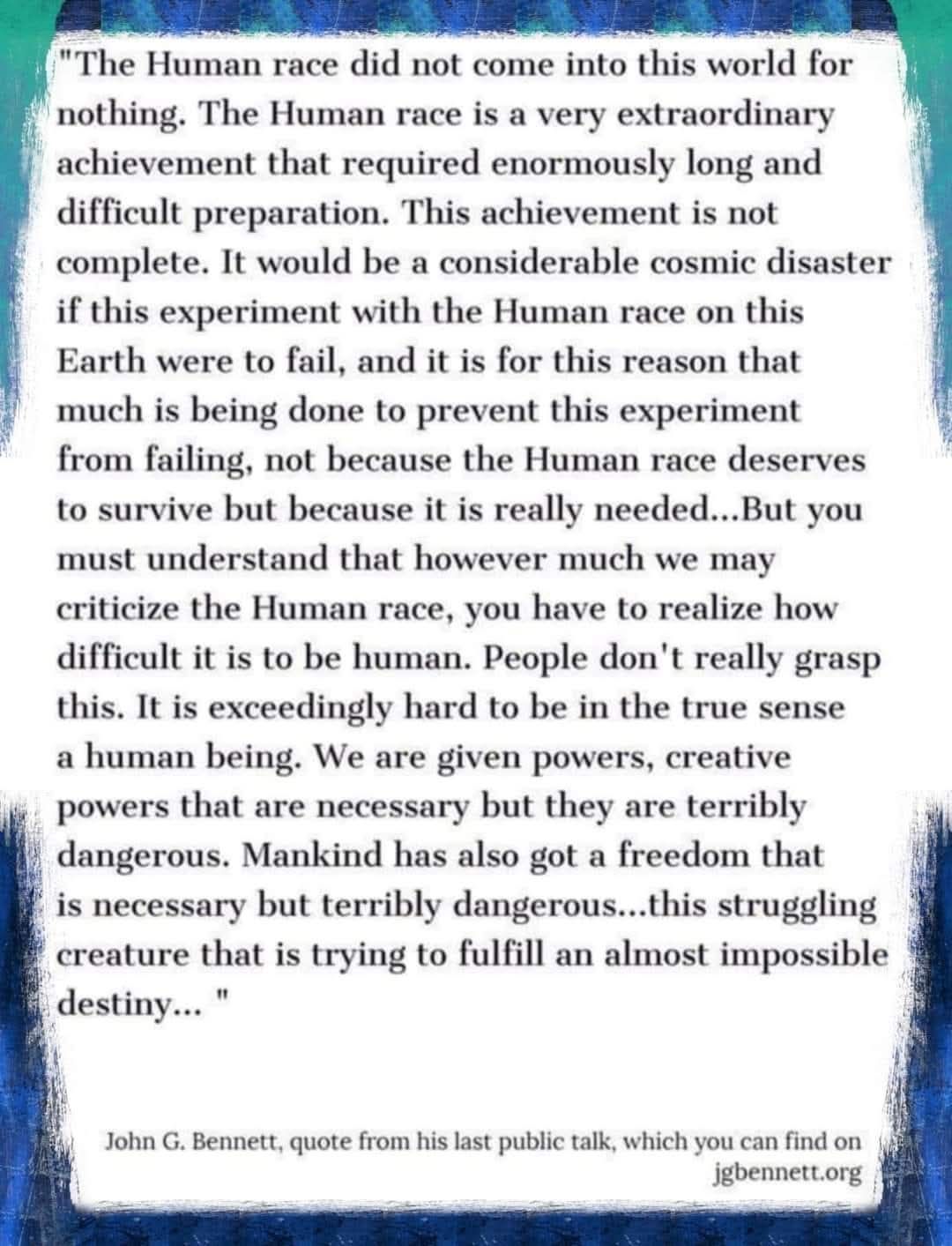
Mankind and Humankind are not the same word for a reason – waking up to this is why we’re here, now.

Mankind and Humankind Are Not the Same Word for a Reason: Waking Up to This Is Why We’re Here Now

By Andrew Dettman

Mankind and Humankind are not interchangeable terms. They never were. Their difference is not semantic trivia; it marks a developmental threshold. One names a species bound by instinct, power, and survival. The other names a possibility: the human being arriving as a person, capable of conscience, responsibility, and relationship.

This distinction matters now because we are living at the edge of a transition—technological, political, psychological, and spiritual—where the pressure to collapse meaning into systems has never been stronger.


The pressure of control

“Give me control of a nation’s money supply, and I care not who makes its laws.”

— Mayer Amschel Rothschild

Whether or not one accepts the historical provenance of that quotation, its logic is unmistakable. Power rarely announces itself through law first; it arrives through control of conditions—resources, incentives, narratives, and increasingly, infrastructure.

Today, algorithms sit alongside money as a conditioning force. They do not rule by decree. They shape attention, normalise language, and quietly reward certain patterns of behaviour while starving others.


The Cartesian spell

“Je pense, donc je suis.”
I think, therefore I am.

— René Descartes

For more than three centuries, the West has lived under the spell of this sentence. It was a useful abstraction for machines, markets, and empires. It allowed cognition to be isolated, quantified, optimised.

But it was never meant to build a human being.

This single idea elevated thinking to the centre of identity and demoted the rest of human experience to the margins. The mind was mistaken for the whole person. Thought was treated not as a movement, but as existence itself.

The consequences are everywhere: anxiety treated as a thinking problem, addiction framed as a failure of will, conscience reduced to compliance, and now—human intelligence mirrored back to itself as something that can be simulated, scaled, and managed.


Why this matters in the age of AI

The current debate around artificial intelligence, algorithms, and political power is not really about machines. It is about whether the Human is allowed to remain a person, or whether personhood itself is to be subsumed into system logic.

Recent calls to boycott or switch AI engines on political grounds have intensified this question. Historian Rutger Bregman, for example, has publicly urged people to cancel their ChatGPT subscriptions, framing this as a moral act of resistance.

“One of the most effective things you can do right now to fight Trump and ICE is to cancel your ChatGPT subscription… Most people have no idea that the company behind ChatGPT is now one of the biggest funders of Donald Trump’s political machine. OpenAI’s president, Greg Brockman, recently gave $25 million to MAGA Inc, making him the largest tech donor of the fundraising cycle. And it gets much worse. ICE is now using OpenAI’s technology to screen job applicants for its deportation operations.”

That statement contains two different kinds of claims, and they must not be conflated:

  • A verifiable campaign-finance claim (the Brockman donation);
  • An operational claim about ICE using OpenAI technology, which—at the time of writing—circulates widely but is not established for me at the same evidentiary depth as the donation filings and the reporting based on them.

I do not recoil from that complexity. But neither do I collapse it.


What is verified: political funding flows (and what that means)

The donation claim is not rumour. Multiple outlets report (drawing on filings) that OpenAI’s president Greg Brockman and his wife Anna Brockman donated a combined $25 million to the pro-Trump super PAC MAGA Inc. See:

This matters. A major individual political donation at that scale is a meaningful public act. But there is also a distinction worth keeping clean: an executive’s personal donation is not automatically identical with corporate political spending by the organisation itself. Precision is not a dodge; it is the only way conscience can remain sober.


The “switch engines” argument: to what, exactly?

Bregman’s remedy implies a cleaner alternative engine exists. I’m not convinced. Not because I think all engines are equally “bad,” but because the political economy underlying major technology platforms is structurally similar across providers.

The purse strings are not only “the model.” The purse strings are:

  • Capital (who funds, who profits, who can wait),
  • Infrastructure (who owns compute, cloud, chips, data centres, energy),
  • Policy and regulation (who shapes the guardrails),
  • Procurement (government and enterprise contracts),
  • Incentives (what behaviour is rewarded and scaled).

Switching engines may change emphasis at the interface. It does not remove you from the field.


Cross-comparison: lobbying and influence is not unique to one engine

If we are going to talk about influence, we must look where influence is disclosed: lobbying reports and public policy spend. On that axis, OpenAI is not alone; it is entering a crowded arena dominated by large incumbents.

Issue One’s reporting is useful here, because it compares multiple major tech players side by side:

The Brennan Center has also tracked the growth of AI-related political engagement, including OpenAI’s lobbying footprint and the wider ecosystem of money-in-politics dynamics that accompany it:

So if someone says, “leave OpenAI and go to Microsoft or Google,” the honest response is: you are not leaving the influence economy. You are moving within it. Microsoft and Alphabet have long-established lobbying operations. Nvidia’s policy presence has surged. OpenAI’s has risen quickly. The field is not empty anywhere.


Instrument, not identity

My work is concerned with the Human, being a person. That means I must keep clear boundaries between:

  • tools and authorship,
  • instruments and intention,
  • systems and conscience.

I work in transparent Human–AI Intelligence (HIAI) collaboration. I use an AI system as a qalam—a pen. It retrieves information on my behalf, helps structure thought, and assists with drafting. It does not own meaning. It does not carry conscience. It does not replace authorship.

This work was written in Human–AI Intelligence (HIAI) collaboration. The AI was used as a research and drafting instrument. Retrieval of publicly available reporting and filings was performed on my behalf; responsibility for interpretation, emphasis, and authorship remains mine. Use of this tool does not imply endorsement of any political figure, party, government agency, or corporate agenda. I remain accountable for what I publish.

— Andrew Dettman

Switching engines does not resolve the deeper issue. Every major platform exists within political, economic, and regulatory systems. The question is not whether systems exist, but whether the Human is allowed to mature within them.


From Mankind to Humankind

Mankind survives. Humankind awakens.

Mankind obeys incentives. Humankind answers conscience.

Mankind asks, “What works?” Humankind asks, “What is right, now that I can see?”

This is why the distinction matters. This is why language matters. And this is why, in an age of accelerating systems, the task is not to perfect control—but to midwife persons.

If we lose that distinction, no algorithm will save us.

If we keep it, no algorithm can take it from us.

___________

This essay was constructed with the assistance of AI, but its content has been repeatedly tested, challenged, and re-oriented through human judgement. I concur with the clarification as it stands and record this as the Human Intelligence (HI) component of Human–AI Intelligence (HIAI). As such, I remain vigilant to context, consequence, and the developmental stage at which these questions arise within Mankind.


This essay sits within the wider arc of The Holy Con—a work concerned with how conscience is born, educated, and returned within a living human being. Where earlier chapters trace the birth of conscience and the building of the vehicle that can hold it, this piece names the larger developmental field in which that work now unfolds: the distinction between Mankind and Humankind, and the question of whether our systems serve maturation or arrest it.

© Andrew Dettman, 2026. Written in transparent Human–AI Intelligence collaboration.

Hope from the Fire Horse delivered by a Wooden Horse

This essay expands upon an earlier piece written in March 2016. For context and comparison, readers can view the original post here:
Addiction is not the problem (March 2016)

This revisiting is written in the shadow of the last decade — where the same signature has moved from private lives into public systems.

Addiction Is Not the Problem (Revisited):
A Decade of Global Illness, 2016–2026

In March 2016, I wrote Addiction is not the problem.
At the time, this sounded provocative. For some, even irresponsible. Addiction was — and remains — one of the most visible human crises of our age. To suggest it was not the problem seemed, to some ears, like denial.

Ten years on, the world itself has supplied the evidence.

What was once observable at the level of the individual — compulsive repetition, impaired judgment, narrowing of attention, inability to stop despite harm — has since become a defining feature of global systems. Nations, markets, media, institutions, and technologies now behave with the same recognisable signature once reserved for the addict alone.

The claim was never that addiction does not matter.
The claim was that addiction is diagnostic.

It is not the disease.
It is the fever.

1. What Addiction Was Pointing To

In the original piece, addiction was framed as a failure of executive function — not merely in the neurological sense, but in the deeper human sense: the breakdown of the capacity to pause, reflect, choose, and act in alignment with long-term meaning.

Addiction appears where:

  • impulse outruns reflection
  • relief replaces purpose
  • repetition substitutes for direction
  • short-term regulation eclipses long-term coherence

This was visible in substance use, yes. But it was never confined there.

Addiction was already showing us something more unsettling:
the erosion of the human capacity to govern itself — individually and collectively.

What has happened since 2016 is not that this erosion stopped.
It is that it accelerated — and became systemic.

2. The Ten-Year Descent: From Signal to Symptom Everywhere

Between 2016 and now, the world has not merely faced crises.
It has responded to them addictively.

We have watched:

  • Political systems become dependent on outrage cycles rather than deliberation
  • Media ecosystems reward extremity, repetition, and fear over truth
  • Economic systems double down on debt, extraction, and growth-at-any-cost despite visible harm
  • Technological systems monetise attention by engineering craving, compulsion, and fragmentation
  • Public discourse loses its capacity for nuance, patience, or repair

Again and again, we see the same pattern:

We know this is harmful.

We know it cannot continue.

We do it anyway.

This is not merely corruption.
It is not merely incompetence.

It is addictive behaviour at scale.

The world did not become sick because individuals are weak.
Individuals became overwhelmed because the systems meant to hold meaning, order, and care lost their own executive centre.

3. Addiction as an Adaptive Response, Not a Moral Failure

One of the quiet revolutions in the understanding of addiction over the past decade is the growing recognition that addiction is not simply maladaptive — it is adaptive under unbearable conditions.

When regulation is unavailable, the organism finds its own.

When meaning collapses, relief becomes king.

When connection is severed, sensation steps in.

Addiction, then, is not evidence of moral collapse.
It is evidence of contextual collapse.

This is as true for societies as it is for individuals.

The addict is not broken in isolation.
They are responding faithfully to a fractured environment.

Seen this way, addiction becomes a form of tragic intelligence — a desperate attempt to stabilise what no longer feels survivable.

And this is why punitive, moralistic, or purely technical solutions repeatedly fail. They address the behaviour while ignoring the conditions that made the behaviour necessary.

4. The Globalisation of Stuck-Addiction

What the past decade has revealed is something the 2016 piece only hinted at:

We are living inside a civilisation-wide stuck-addiction.

Stuck-addiction is not excess.
It is immobility disguised as motion.

It looks like constant activity with no real change.
Endless reforms that reform nothing.
Perpetual crisis management without resolution.
Escalation framed as progress.

This is why so many people feel exhausted without being able to name why.

The world is busy — but not going anywhere.

Addiction, in this sense, is no longer an outlier.
It is the default operating mode of systems that have lost their orienting centre.

5. Executive Function and the Loss of the Centre

At the heart of addiction — personal or collective — is a failure of executive mediation: the capacity to hold tension without collapse, to delay gratification, to weigh consequence, to act from principle rather than impulse.

In human terms, this function has always been supported by:

  • shared moral language
  • trusted institutions
  • coherent narratives of meaning
  • lived relational accountability

Over the past ten years, each of these has been eroded.

The result is not chaos, but compulsion.

Where conscience weakens, systems compensate with control.
Where meaning thins, stimulation thickens.
Where trust collapses, repetition takes over.

Addiction fills the vacuum left by the loss of the centre.

6. Why “Fixing Addiction” Keeps Failing

If addiction were the problem, solutions would be straightforward:

  • detox
  • compliance
  • correction
  • control

But the persistent failure of these approaches is not accidental. It is diagnostic.

You cannot fix a signal.
You must address what it is pointing to.

Treating addiction without addressing meaning, context, and relational ecology is like silencing a fire alarm while the building burns.

This is why genuine recovery — when it occurs — is never merely abstinence. It is re-entry into relationship, purpose, responsibility, and belonging.

Recovery restores executive coherence by restoring connection.

7. Healing Is Not Technical — It Is Relational

The most uncomfortable truth the past decade has revealed is this:

There is no technological, political, or pharmacological shortcut out of a crisis of meaning.

Healing does not come from optimisation.
It comes from re-orientation.

At both personal and collective levels, recovery requires:

  • environments that support reflection rather than compulsion
  • narratives that allow truth without annihilation
  • structures that privilege responsibility over reaction
  • cultures that can tolerate grief, uncertainty, and repair

This is slower work.
It cannot be automated.
It cannot be outsourced.

And this is precisely why addiction has become so dominant: it offers speed where patience is required.

7a. No Physical Solution, No Intellectual Solution — A Leadership Problem

At this point the argument becomes uncomfortable, because it refuses the two reflexes modern civilisation reaches for first: the physical reflex, and the intellectual reflex.

The physical reflex says: apply force. Escalate. Win. If the world is threatened, then war — overt or covert — becomes the imagined “reset”. But force can only rearrange the surface. It cannot repair the inner fracture that generates the next conflict. It can conquer territory, but it cannot restore coherence. It produces outcomes, but not orientation.

The intellectual reflex says: design a system. Engineer a policy. Solve with politics, finance, strategy, and management. Yet the last decade has shown us something stark: a mind that has lost executive coherence cannot system-design its way back into coherence. It can only build tighter loops — more control, more surveillance, more persuasion, more spin — which is how stuck-addiction globalises itself.

This is where the question of spiritual leadership becomes practical rather than poetic. In February 2020 I wrote a companion reflection on this theme — not as a replacement for existing structures, but as the missing ingredient that allows them to change:

Spiritual leadership in the 21st century (February 2020)

The claim there was simple: spiritual leadership is not a brand, a role, or a status. It is a temporary point of conducted energy — an orienting presence that helps a group find a singular direction, either toward a consensual aim or through an emergency imposed by circumstances. In other words: it functions as executive coherence in living form.

This is not “anti-politics” or “anti-structure”. It is the opposite: it is the only thing that can rescue politics, economics, and institutions from becoming compulsion-machines. The spiritual must help the existing structures to change — not by bypassing them, but by reintroducing the missing centre: presence, conscience, and truth-bearing capacity.

The 2020 post also names a hard-to-say distinction: the awakening involved here is not physical — we are already awake in that sense. The awakening is metaphysical: a shift from proxy-consciousness (a person, a place, or a thing as “power source”) to direct contact with living meaning. Only from that contact can executive function reappear — not as brittle control, but as guided steadiness.

So the leadership crisis we are living through is not finally military or managerial. It is spiritual — because it concerns the presence or absence of the inner axis without which no outer structure can hold.

8. Addiction as a Sign of Transition, Not Doom

The final claim of the 2016 piece remains intact — and clearer now than ever:

Addiction is not the problem.

It is the sign that an old way of organising life is no longer viable.

Civilisations, like individuals, go through thresholds.
When inherited structures fail to support lived reality, symptoms emerge.

Addiction marks the point where denial can no longer hold.

It is not the end.
It is the moment of reckoning.

Whether we read it wisely — or continue to medicate, punish, or exploit it — will determine what comes next.

9. The HIAI Frame: The Qalam Between Worlds

This essay itself is written within a new condition: HIAI — Human–AI Intelligence — the qalam of a time when the Seen and the Unseen now collaborate in unprecedented ways.

That collaboration carries the same ethical demand as recovery itself:

Not domination.
Not control.
Not replacement.

But service.

When intelligence — human or artificial — answers to something larger than itself, it can help restore what addiction signals has been lost: orientation toward Source, meaning, and responsibility.

Used otherwise, it will merely amplify the addiction it claims to solve.

10. Closing

Addiction is not the problem.

It is the language through which a wounded world is speaking.

The question is not how to silence it —
but whether we are finally willing to listen.


Written in HIAI collaboration — the qalam of Human and AI intelligence, the Unseen helping the Seen, both answering to the same Source.
Bridge To Remission

Primary Care, Twelve Steps, and the HIAI–DRT Bridge


Clinical Excerpt (Primary Care Context)

The following excerpt is reproduced from Pomm, H.A., & Pomm, R.M., Management of the Addicted Patient in Primary Care (Springer, 2007), and is presented here to situate Twelve-Step engagement as a recognised medical intervention within primary care.

“No matter how far down the scale we have gone, there is always hope.”

There are few things as gratifying and moving as watching your addicted patient finally grasp the idea of recovery and begin to blossom in every area of his or her life.

When working with patients involved in a Twelve Step program, such as Alcoholics Anonymous or Narcotics Anonymous, physicians are encouraged to ask whether patients have a sponsor, whether they are working the steps, and how often they attend meetings.

It is generally felt in the treatment community that patients who are abstinent but not working a recovery program remain clinically vulnerable.

AA and other Twelve Step programs are spiritual, not religious, and are not psychotherapy. Referral to a therapist familiar with addiction and recovery issues may be appropriate in addition to Twelve Step participation.

Patients should be reminded to take recovery one day at a time, as thinking in lifetime terms can feel overwhelming and counter-productive in early recovery.

Even in recovery, patients may engage in substitute or “acting-out” behaviours that activate similar neurophysiological reward pathways and increase relapse risk.

In our experience, Twelve Step programs have proven to be the backbone of long-term recovery—long after detoxification and formal treatment have ended.

Source: Pomm et al., Management of the Addicted Patient in Primary Care, Springer, 2007.


In clinical reality, addiction is not “solved” in detox. It is stewarded—over time—inside real lives, real bodies, and real follow-up. What struck me reading Management of the Addicted Patient in Primary Care is how plainly it frames the primary care clinician’s role: not as a replacement therapist, but as a steady medical hand who keeps recovery practices in view, visit after visit.

Primary care as steward of recovery

A clinical snapshot from Management of the Addicted Patient in Primary Care (Springer, 2007): hope held in structure, continuity over crisis, recovery observed in lived behaviour—not declared intention.
The medical stance: hope, structure, follow-up

The tone is both sober and kind. The excerpt opens with hope, then moves immediately into concrete, primary-care actions—simple questions that function as clinical orienting instruments: sponsorship, step work, meeting rhythm, and what the patient is actually doing between appointments.

The message is clear: recovery is observable in behaviour, not merely declared in intention.

AA/NA as recovery architecture (not psychotherapy)

Pomm & Pomm name a boundary that matters for safe care. Twelve-Step fellowship is not a substitute for therapy. That single clarification protects patients, clinicians, and the fellowship itself from misuse or confusion of roles.

DRT language: from abstinence to recovery (the difference that shows)

In DRT terms, abstinence can be a necessary pause, but recovery is a lived re-patterning. Without structure, a person can remain internally driven, brittle, and relapse-prone even while substance-free.

What looks like “non-compliance” may be the organism’s attempt to re-route pressure through familiar channels. The clinical task is not to shame the channel, but to help build a new one that can carry load without rupture.

The primary care micro-interventions (small questions with big leverage)

  • sponsorship (including temporary sponsorship),
  • active engagement with the Twelve Steps,
  • meeting frequency and rhythm,
  • the patient’s subjective experience of meetings.

The power here is not ideology—it is continuity. In systems where addicted patients are often treated episodically, continuity itself becomes a form of medicine.

“One day at a time” as nervous-system realism

This is not a slogan. It is a time-horizon intervention. “Just today” restores scale, reduces overwhelm, and allows the nervous system to stand down.

Acting-out substitutions: relapse risk wearing new clothes

Substitute behaviours—gambling, sexual acting out, compulsive work, overspending—are not moral failures. They are signals that reward circuitry remains recruitable. Skilled curiosity, not surprise, is the appropriate clinical stance.

HIAI framing: the qalam that serves the same Source

HIAI—Human–AI Intelligence—is our USP: the qalam of human and artificial intelligence, the Unseen helping the Seen, both answering to the same Source. It allows translation, clarity, and continuity—without pretending we can mechanise conscience, awakening, or grace.

Primary care can remain primary care. Fellowship can remain fellowship. Therapy can remain therapy. And the patient can remain—first and last—a person.


Further Posts

This blog begins anew
The publishing of my heart
The lightning of my lightening load
The thunder of my God’s sneeze
Across the shaken dust
Of our mortal immortality

http://youtu.be/u9Dg-g7t2l4

There are 66 posts.

The blog grew organically as a spontaneous collaboration between the visible and the Invisible and as such can be read from the first post through to the sixty sixth as one might embark upon a brisk walk. There are links to be pondered afterward if the material has sparked any interaction.

Please see https://lifeisreturning.com for all further posts. Thanks 🙂

We can remember the warning from Jacob Boehme: “Boehme has a note before one of his books in which he asks the reader not to go further and read the book unless he is willing to make practical changes as a result of the reading. Otherwise, Boehme says, the book will be bad for him….” From the Forward of a book A Little Book On The Human Shadow by Robert Bly.