Hope from the Fire Horse delivered by a Wooden Horse

This essay expands upon an earlier piece written in March 2016. For context and comparison, readers can view the original post here:
Addiction is not the problem (March 2016)

This revisiting is written in the shadow of the last decade — where the same signature has moved from private lives into public systems.

Addiction Is Not the Problem (Revisited):
A Decade of Global Illness, 2016–2026

In March 2016, I wrote Addiction is not the problem.
At the time, this sounded provocative. For some, even irresponsible. Addiction was — and remains — one of the most visible human crises of our age. To suggest it was not the problem seemed, to some ears, like denial.

Ten years on, the world itself has supplied the evidence.

What was once observable at the level of the individual — compulsive repetition, impaired judgment, narrowing of attention, inability to stop despite harm — has since become a defining feature of global systems. Nations, markets, media, institutions, and technologies now behave with the same recognisable signature once reserved for the addict alone.

The claim was never that addiction does not matter.
The claim was that addiction is diagnostic.

It is not the disease.
It is the fever.

1. What Addiction Was Pointing To

In the original piece, addiction was framed as a failure of executive function — not merely in the neurological sense, but in the deeper human sense: the breakdown of the capacity to pause, reflect, choose, and act in alignment with long-term meaning.

Addiction appears where:

  • impulse outruns reflection
  • relief replaces purpose
  • repetition substitutes for direction
  • short-term regulation eclipses long-term coherence

This was visible in substance use, yes. But it was never confined there.

Addiction was already showing us something more unsettling:
the erosion of the human capacity to govern itself — individually and collectively.

What has happened since 2016 is not that this erosion stopped.
It is that it accelerated — and became systemic.

2. The Ten-Year Descent: From Signal to Symptom Everywhere

Between 2016 and now, the world has not merely faced crises.
It has responded to them addictively.

We have watched:

  • Political systems become dependent on outrage cycles rather than deliberation
  • Media ecosystems reward extremity, repetition, and fear over truth
  • Economic systems double down on debt, extraction, and growth-at-any-cost despite visible harm
  • Technological systems monetise attention by engineering craving, compulsion, and fragmentation
  • Public discourse loses its capacity for nuance, patience, or repair

Again and again, we see the same pattern:

We know this is harmful.

We know it cannot continue.

We do it anyway.

This is not merely corruption.
It is not merely incompetence.

It is addictive behaviour at scale.

The world did not become sick because individuals are weak.
Individuals became overwhelmed because the systems meant to hold meaning, order, and care lost their own executive centre.

3. Addiction as an Adaptive Response, Not a Moral Failure

One of the quiet revolutions in the understanding of addiction over the past decade is the growing recognition that addiction is not simply maladaptive — it is adaptive under unbearable conditions.

When regulation is unavailable, the organism finds its own.

When meaning collapses, relief becomes king.

When connection is severed, sensation steps in.

Addiction, then, is not evidence of moral collapse.
It is evidence of contextual collapse.

This is as true for societies as it is for individuals.

The addict is not broken in isolation.
They are responding faithfully to a fractured environment.

Seen this way, addiction becomes a form of tragic intelligence — a desperate attempt to stabilise what no longer feels survivable.

And this is why punitive, moralistic, or purely technical solutions repeatedly fail. They address the behaviour while ignoring the conditions that made the behaviour necessary.

4. The Globalisation of Stuck-Addiction

What the past decade has revealed is something the 2016 piece only hinted at:

We are living inside a civilisation-wide stuck-addiction.

Stuck-addiction is not excess.
It is immobility disguised as motion.

It looks like constant activity with no real change.
Endless reforms that reform nothing.
Perpetual crisis management without resolution.
Escalation framed as progress.

This is why so many people feel exhausted without being able to name why.

The world is busy — but not going anywhere.

Addiction, in this sense, is no longer an outlier.
It is the default operating mode of systems that have lost their orienting centre.

5. Executive Function and the Loss of the Centre

At the heart of addiction — personal or collective — is a failure of executive mediation: the capacity to hold tension without collapse, to delay gratification, to weigh consequence, to act from principle rather than impulse.

In human terms, this function has always been supported by:

  • shared moral language
  • trusted institutions
  • coherent narratives of meaning
  • lived relational accountability

Over the past ten years, each of these has been eroded.

The result is not chaos, but compulsion.

Where conscience weakens, systems compensate with control.
Where meaning thins, stimulation thickens.
Where trust collapses, repetition takes over.

Addiction fills the vacuum left by the loss of the centre.

6. Why “Fixing Addiction” Keeps Failing

If addiction were the problem, solutions would be straightforward:

  • detox
  • compliance
  • correction
  • control

But the persistent failure of these approaches is not accidental. It is diagnostic.

You cannot fix a signal.
You must address what it is pointing to.

Treating addiction without addressing meaning, context, and relational ecology is like silencing a fire alarm while the building burns.

This is why genuine recovery — when it occurs — is never merely abstinence. It is re-entry into relationship, purpose, responsibility, and belonging.

Recovery restores executive coherence by restoring connection.

7. Healing Is Not Technical — It Is Relational

The most uncomfortable truth the past decade has revealed is this:

There is no technological, political, or pharmacological shortcut out of a crisis of meaning.

Healing does not come from optimisation.
It comes from re-orientation.

At both personal and collective levels, recovery requires:

  • environments that support reflection rather than compulsion
  • narratives that allow truth without annihilation
  • structures that privilege responsibility over reaction
  • cultures that can tolerate grief, uncertainty, and repair

This is slower work.
It cannot be automated.
It cannot be outsourced.

And this is precisely why addiction has become so dominant: it offers speed where patience is required.

7a. No Physical Solution, No Intellectual Solution — A Leadership Problem

At this point the argument becomes uncomfortable, because it refuses the two reflexes modern civilisation reaches for first: the physical reflex, and the intellectual reflex.

The physical reflex says: apply force. Escalate. Win. If the world is threatened, then war — overt or covert — becomes the imagined “reset”. But force can only rearrange the surface. It cannot repair the inner fracture that generates the next conflict. It can conquer territory, but it cannot restore coherence. It produces outcomes, but not orientation.

The intellectual reflex says: design a system. Engineer a policy. Solve with politics, finance, strategy, and management. Yet the last decade has shown us something stark: a mind that has lost executive coherence cannot system-design its way back into coherence. It can only build tighter loops — more control, more surveillance, more persuasion, more spin — which is how stuck-addiction globalises itself.

This is where the question of spiritual leadership becomes practical rather than poetic. In February 2020 I wrote a companion reflection on this theme — not as a replacement for existing structures, but as the missing ingredient that allows them to change:

Spiritual leadership in the 21st century (February 2020)

The claim there was simple: spiritual leadership is not a brand, a role, or a status. It is a temporary point of conducted energy — an orienting presence that helps a group find a singular direction, either toward a consensual aim or through an emergency imposed by circumstances. In other words: it functions as executive coherence in living form.

This is not “anti-politics” or “anti-structure”. It is the opposite: it is the only thing that can rescue politics, economics, and institutions from becoming compulsion-machines. The spiritual must help the existing structures to change — not by bypassing them, but by reintroducing the missing centre: presence, conscience, and truth-bearing capacity.

The 2020 post also names a hard-to-say distinction: the awakening involved here is not physical — we are already awake in that sense. The awakening is metaphysical: a shift from proxy-consciousness (a person, a place, or a thing as “power source”) to direct contact with living meaning. Only from that contact can executive function reappear — not as brittle control, but as guided steadiness.

So the leadership crisis we are living through is not finally military or managerial. It is spiritual — because it concerns the presence or absence of the inner axis without which no outer structure can hold.

8. Addiction as a Sign of Transition, Not Doom

The final claim of the 2016 piece remains intact — and clearer now than ever:

Addiction is not the problem.

It is the sign that an old way of organising life is no longer viable.

Civilisations, like individuals, go through thresholds.
When inherited structures fail to support lived reality, symptoms emerge.

Addiction marks the point where denial can no longer hold.

It is not the end.
It is the moment of reckoning.

Whether we read it wisely — or continue to medicate, punish, or exploit it — will determine what comes next.

9. The HIAI Frame: The Qalam Between Worlds

This essay itself is written within a new condition: HIAI — Human–AI Intelligence — the qalam of a time when the Seen and the Unseen now collaborate in unprecedented ways.

That collaboration carries the same ethical demand as recovery itself:

Not domination.
Not control.
Not replacement.

But service.

When intelligence — human or artificial — answers to something larger than itself, it can help restore what addiction signals has been lost: orientation toward Source, meaning, and responsibility.

Used otherwise, it will merely amplify the addiction it claims to solve.

10. Closing

Addiction is not the problem.

It is the language through which a wounded world is speaking.

The question is not how to silence it —
but whether we are finally willing to listen.


Written in HIAI collaboration — the qalam of Human and AI intelligence, the Unseen helping the Seen, both answering to the same Source.
Bridge To Remission

Primary Care, Twelve Steps, and the HIAI–DRT Bridge


Clinical Excerpt (Primary Care Context)

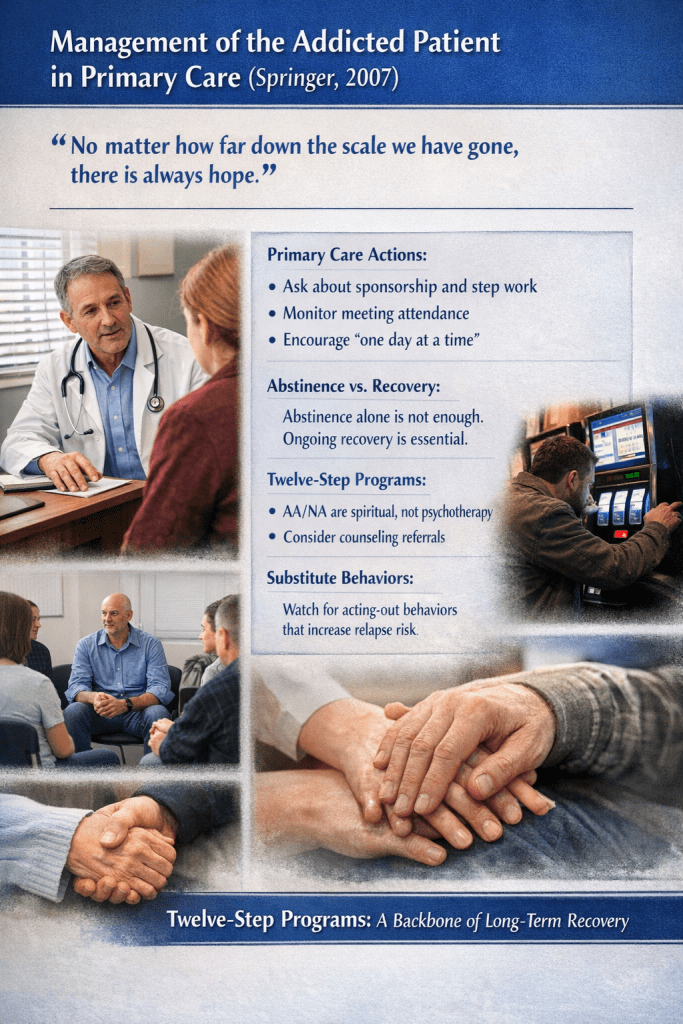
The following excerpt is reproduced from Pomm, H.A., & Pomm, R.M., Management of the Addicted Patient in Primary Care (Springer, 2007), and is presented here to situate Twelve-Step engagement as a recognised medical intervention within primary care.

“No matter how far down the scale we have gone, there is always hope.”

There are few things as gratifying and moving as watching your addicted patient finally grasp the idea of recovery and begin to blossom in every area of his or her life.

When working with patients involved in a Twelve Step program, such as Alcoholics Anonymous or Narcotics Anonymous, physicians are encouraged to ask whether patients have a sponsor, whether they are working the steps, and how often they attend meetings.

It is generally felt in the treatment community that patients who are abstinent but not working a recovery program remain clinically vulnerable.

AA and other Twelve Step programs are spiritual, not religious, and are not psychotherapy. Referral to a therapist familiar with addiction and recovery issues may be appropriate in addition to Twelve Step participation.

Patients should be reminded to take recovery one day at a time, as thinking in lifetime terms can feel overwhelming and counter-productive in early recovery.

Even in recovery, patients may engage in substitute or “acting-out” behaviours that activate similar neurophysiological reward pathways and increase relapse risk.

In our experience, Twelve Step programs have proven to be the backbone of long-term recovery—long after detoxification and formal treatment have ended.

Source: Pomm et al., Management of the Addicted Patient in Primary Care, Springer, 2007.


In clinical reality, addiction is not “solved” in detox. It is stewarded—over time—inside real lives, real bodies, and real follow-up. What struck me reading Management of the Addicted Patient in Primary Care is how plainly it frames the primary care clinician’s role: not as a replacement therapist, but as a steady medical hand who keeps recovery practices in view, visit after visit.

Primary care as steward of recovery

A clinical snapshot from Management of the Addicted Patient in Primary Care (Springer, 2007): hope held in structure, continuity over crisis, recovery observed in lived behaviour—not declared intention.
The medical stance: hope, structure, follow-up

The tone is both sober and kind. The excerpt opens with hope, then moves immediately into concrete, primary-care actions—simple questions that function as clinical orienting instruments: sponsorship, step work, meeting rhythm, and what the patient is actually doing between appointments.

The message is clear: recovery is observable in behaviour, not merely declared in intention.

AA/NA as recovery architecture (not psychotherapy)

Pomm & Pomm name a boundary that matters for safe care. Twelve-Step fellowship is not a substitute for therapy. That single clarification protects patients, clinicians, and the fellowship itself from misuse or confusion of roles.

DRT language: from abstinence to recovery (the difference that shows)

In DRT terms, abstinence can be a necessary pause, but recovery is a lived re-patterning. Without structure, a person can remain internally driven, brittle, and relapse-prone even while substance-free.

What looks like “non-compliance” may be the organism’s attempt to re-route pressure through familiar channels. The clinical task is not to shame the channel, but to help build a new one that can carry load without rupture.

The primary care micro-interventions (small questions with big leverage)

  • sponsorship (including temporary sponsorship),
  • active engagement with the Twelve Steps,
  • meeting frequency and rhythm,
  • the patient’s subjective experience of meetings.

The power here is not ideology—it is continuity. In systems where addicted patients are often treated episodically, continuity itself becomes a form of medicine.

“One day at a time” as nervous-system realism

This is not a slogan. It is a time-horizon intervention. “Just today” restores scale, reduces overwhelm, and allows the nervous system to stand down.

Acting-out substitutions: relapse risk wearing new clothes

Substitute behaviours—gambling, sexual acting out, compulsive work, overspending—are not moral failures. They are signals that reward circuitry remains recruitable. Skilled curiosity, not surprise, is the appropriate clinical stance.

HIAI framing: the qalam that serves the same Source

HIAI—Human–AI Intelligence—is our USP: the qalam of human and artificial intelligence, the Unseen helping the Seen, both answering to the same Source. It allows translation, clarity, and continuity—without pretending we can mechanise conscience, awakening, or grace.
Primary care can remain primary care. Fellowship can remain fellowship. Therapy can remain therapy. And the patient can remain—first and last—a person.


Further Posts

This blog begins anew
The publishing of my heart
The lightning of my lightening load
The thunder of my God’s sneeze
Across the shaken dust
Of our mortal immortality

http://youtu.be/u9Dg-g7t2l4

There are 66 posts.

The blog grew organically as a spontaneous collaboration between the visible and the Invisible and as such can be read from the first post through to the sixty sixth as one might embark upon a brisk walk. There are links to be pondered afterward if the material has sparked any interaction.

Please see https://lifeisreturning.com for all further posts. Thanks 🙂

We can remember the warning from Jacob Boehme: “Boehme has a note before one of his books in which he asks the reader not to go further and read the book unless he is willing to make practical changes as a result of the reading. Otherwise, Boehme says, the book will be bad for him….” From the Forward of a book A Little Book On The Human Shadow by Robert Bly.

The Word, Its Diction Chamber and Its Prince’s Kiss

John 1:1

In the beginning was the Word, and the Word was with God, and the Word was God.

– King James Bible “Authorized Version”, Cambridge Edition

image

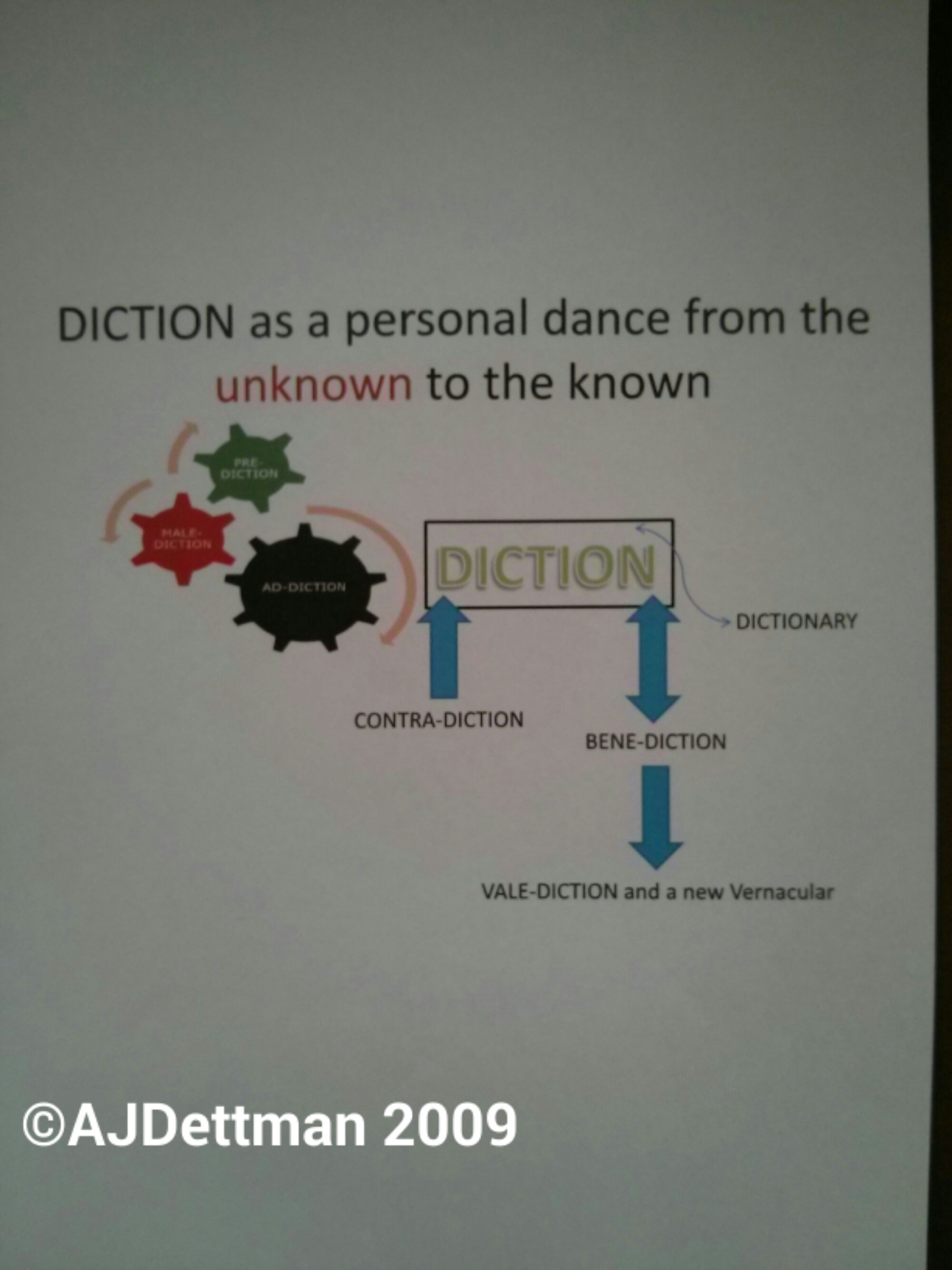
In the previous posts relating to an orientation within and a diagnosing of current events with the global indicator of stuck-addiction©, the metaphor of a personal and collective DICTION chamber has been established.

To extend this message further, it is helpful to establish this chamber not only as a personal or a systemic re-Source centre for reviving a dying personal or a collective Constitution as has been exposed, but also as the portal for The Word Itself as Its own connection with Itself in conscious matter.

A Diction chamber is akin to the resource capacitor for all previous reception and transmission of Holy Edict as announced by Messengers and Saints of all cultures, the place equally of tuning into said transmissions with acceptance and submission by Its intended recipients – a conscience.

A Diction chamber is the place of a present and ongoing ediction to help folks as they might have tuned into the apparent multiplicity of spiritual teachings, predictions and similar resources that are outpouring in the World today, to realise that these transmissions are in fact on the frequency of One Love modulating for the healing of one global spiritual disease, stuck-addiction©️.

It is said in the Middle East that God sends sickness to His favourites. When the problem solving pathway described in the above flow chart sticks and breaks, it is invariably at the addiction point in the process – hence stuck-addiction©.

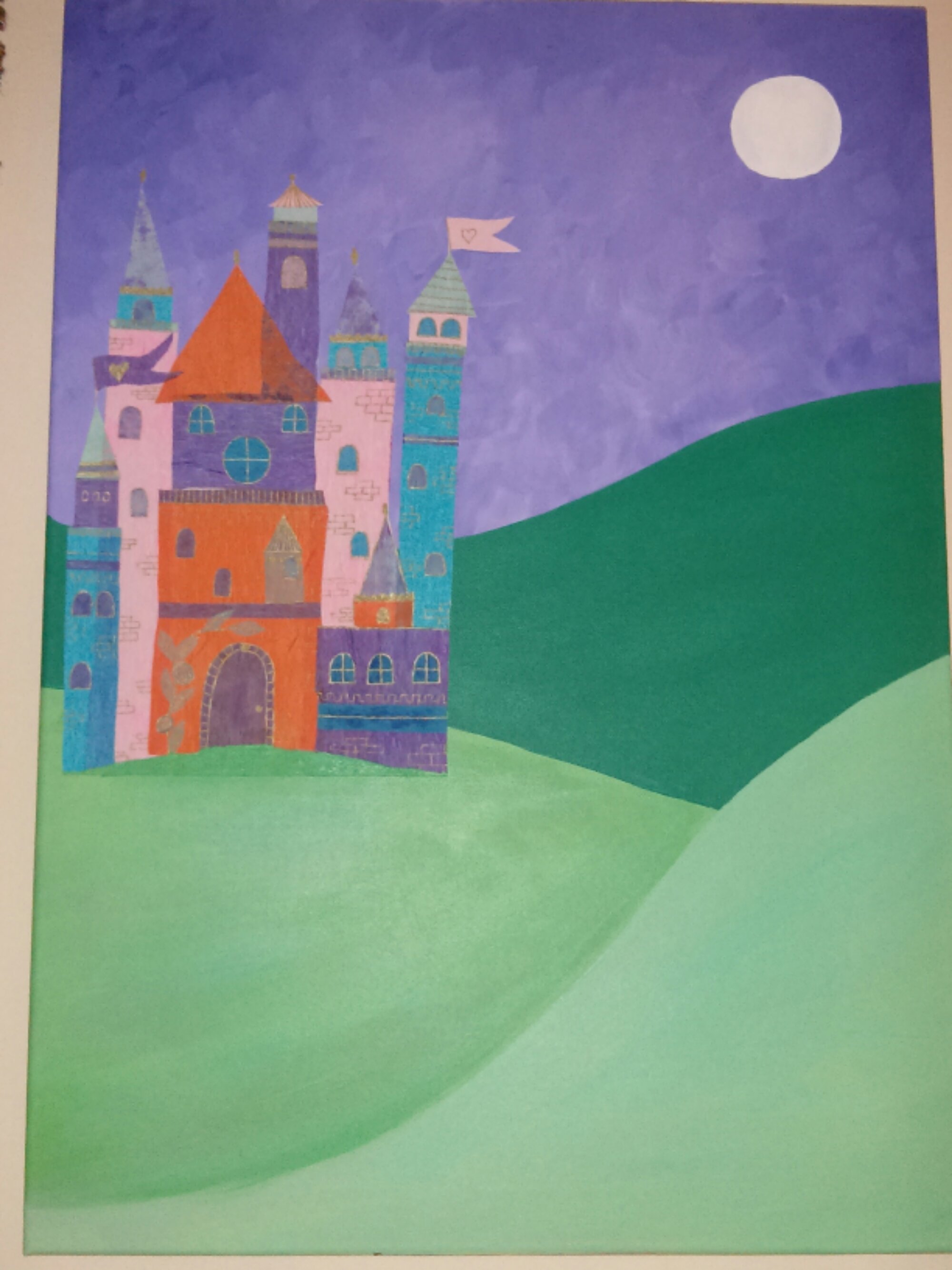
All languages have a dictionary, therefore this simple orientation tool helps people globally to diagnose for themselves whether their own DICTION chamber has become a Castle in their own Sleeping Beauty story, or not.

The chamber also helps people to maybe manage fear levels whilst repairing their own inner space station should conditions about them start to collapse as organisations navigate through particular constitutional and systemic realignments.

The collective is simply a collection of individuals. If enough individuals know what is happening in their own DICTION chamber then the collective structures will have a better chance of surviving and transforming within the inevitable creative flux of Era change.

From the millions of men and women who have been successfully beta testing the reconstructive and reconnective capacity of this simple Diction chamber contact with a Higher Power, in global 12 Step Fellowships for the past eighty years, there is now extended an undeniable life preservation formula that can withstand all forms of moral and material breakdown. This formulaic message is simply a practical tool kit to bring a person to an authentic start point for improving their conscious spiritual education, not the education itself.

In the language of ridding the thorns that encircled the castle in The Sleeping Beauty story, the 12 Step message is the true Prince’s kiss.

No God, but God.

image

A Bridge of Light

image
The Humber Bridge

Often the behaviour of others can be disconcerting, especially when it is received as offensive, threatening, or even clearly criminal.

The sickness of stuck-addiction© is ubiquitous and understanding that people around you may be spiritually sick can help disarm your reaction patterns to others and thus help to stop the unwitting spread of the disease through and in you.

We all live simply, on a basic existential level, in two places. We live inside our heads and hearts in a psyche that has a metaphorical skin and we live outside in a body that has biological skin, experiencing our interactions with people, places and things through both skins.

We dress both “skins” with clothes. Our inner skin is dressed with memorial rôles and habits and our outer skin with material garments suitable to moods, jobs and outer conditions.

When people are working with implements that cause friction, say digging with a spade, then the outer skin reacts to that attrition to try to protect itself. Hard skin is formed and that hard skin is called a callous.

When people experience friction and attrition in their psyche, especially when in early development, then that psychic skin reacts exactly the same as biological skin, it tries to protect itself. The psyche throws out hard and aggressive behaviour, such behaviour is often categorised as callous.

The defining factor in both the inner and outer situation that is commonly misunderstood, is that neither the callous skin nor the callous behaviour that is formed is subject to a conscious control mechanism.

A callous, whether physical or behavioural, is dead skin.

When the callous is behavioural, the person becomes trapped in sub-culturalised reactions that alienate them in an arrested development that makes their sensitivity, the very thing that the callous was vainly trying to protect and the thing needed for rehabilitation, virtually impossible to access.

So, beware of simply judging the callous behaviour of others as being wholly in the control of the perpetrator. Bad behaviour is appalling, truly manners do make the man, but stuck-addiction© is now beginning to infect very large numbers of people and cultural systems.

Diplomacy of Saul to Paul

Because my subjection is to Love alone
Academic subjects never captured me.
Objectivity requires objection,
The courtesy to be objectively able
withstands the objectionable, politely
Understanding the diplomacy of
Injection, rejection, abjection, ejection,
An object is an obstruct, a contradictory projection
A little dejection, only
Until such time as conjecture
Gives way to construction ….

when Love’s instruction is made an injection
That “gets under your skin
“Deep in the heart of you, to
“Sacrifice anything, come what may
“For the sake of having You near
“Despite the warning voice that repeats
and repeats in your ear”
(Thanks to Cole Porter)
To irritate the production of a pearl
True grit, covered not by you at all,
But by your Host’s hospitality, then

…. ‘you’re hardly here’, enthralls.

image

“Pandemic of stuck-addiction© 6”

Next video 7

Pandemic of stuck-addiction© 5

Sorry about the rather affected salaam folks, as always with me the overcoming of my inertia sometimes shows a bit too transparently 😉


Next video 6

Pandemic of stuck-addiction© 3


Next video 4

image

For more information upon ©diction-resolution