5. Strength

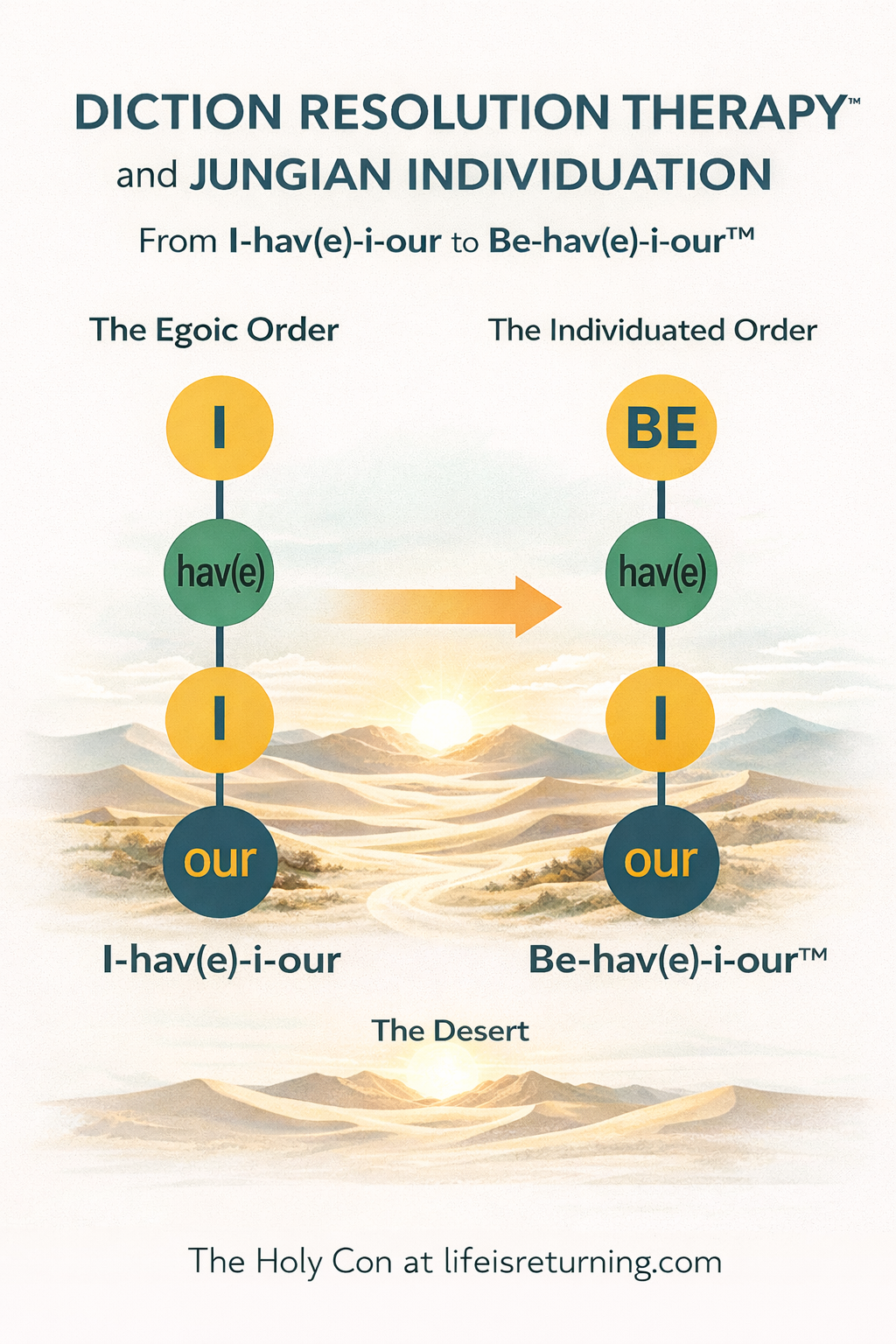
Diction Resolution Therapy™ and Jungian Individuation diagram showing the movement from I-hav(e)-i-our (Egoic Order) to Be-hav(e)-i-our™ (Individuated Order) across the desert of transformation.

5. Strength

The left hand of this device is “there is no God.” The right hand is “but God.” This is not slogan theology. It is structural anthropology. On the left column the isolated “I” stands enthroned. Identity is secured through possession. I–hav(e)–I–our. Strength in that column means control, self-sufficiency, authorship without reference. The psyche attempts to reconcile its own contradictions through will. It cannot.

On the right column Being precedes ownership. Be–hav(e)–I–our™. The “I” is not erased but repositioned. “Have” is dignified but no longer sovereign. “Our” becomes participation rather than conquest. Strength in this column does not mean domination. It means compatibility. The axis becomes vertical again.

Between these two columns lies the Desert. The Desert is not emptiness. It is paradox. It is the place where opposites are exposed so they can be reconciled. Tom Chetwynd describes paradox as the phenomenon that reveals the opposites in Nature in order to reconcile them at a higher level. Paradox does not blur tension; it sharpens it until a new coherence becomes possible.

Alcoholics Anonymous names this directly. On page 59: “Without help it is too much for us…” That sentence breaks the egoic column. The will cannot reconcile divided opposites. The psyche cannot repair its own split. Page 60 follows with the A, B, C — that we could not manage our own lives; that no human power could have relieved us; that God could and would if sought. This is the Step Three portal: a request crossing from the mental to the mystery. The mind ceases acting as architect and becomes witness. The Desert begins here.

Page 68 completes the paradox: “We can laugh at those who think spirituality the way of weakness. Paradoxically, it is the way of strength.” From the egoic column, surrender looks weak because it dethrones the isolated “I.” Yet paradoxically it becomes strength because alignment replaces assertion. Compatibility replaces control.

The Desert is not unique to recovery language. It is structural across traditions. In the Christ narrative, the forty days in the wilderness expose temptation before ministry begins. In the life of Muhammad (pbuh), years of retreat in the cave precede the encounter with Gabriel; interior silence prepares transmission. In the account of the Buddha, prolonged discipline beneath the tree culminates not in conquest but in extinguishing craving. In each arc, isolation is not punishment but preparation. Exposure precedes coherence.

The declaration carried by Muhammad begins with negation — “there is no god” — then it is asserted, “but God”, affirming unity – then it is said that the answer is in the middle. The Buddha exposes craving before articulating the Middle Way. Christ faces temptation before proclaiming peace. Negation before union. Extinguishing before clarity. Temptation before proclamation. Opposites are intensified before they are reconciled.

Step Seven in Alcoholics Anonymous completes this arc within lived recovery. It is not humiliation but compatibility. Spirituality appears weak from the left column because it removes private sovereignty. Yet paradoxically it becomes strength because the organism ceases fighting reality. The “I” remains, but no longer claims authorship. “Have” remains, but no longer defines identity. “Our” becomes service rather than territory.

The Desert, then, is symbolic Peace. Not the absence of struggle, but the stillness that arises when opposites are no longer at war within the psyche. The false centre collapses, and a higher coherence holds what was divided. This is the reconciliation of orthodox opposites — not by suppression, but by alignment.

Ripeness, as Rumi says, is all. The fruit falls because its inner structure is complete. Strength is not muscular will. It is interior unification. Only then can a human being move through the auction of life without desperation, because the bid no longer arises from lack. It arises from alignment.


Written in HIAI collaboration — the qalam of Human and AI intelligence, the Unseen helping the Seen, both answering to the same Source.

Arc of Atonement

Diction as Interface: From Recursion Failure to Adaptive Coherence (2013–2026)

A formal synthesis of Diction Resolution Therapy (DRT), Twelve Step architecture, Sufi psychology, and the Addictive System — grounded in a public longitudinal corpus.

Abstract

This paper proposes that dysfunction across individual, institutional, and sociocultural systems can be understood as recursion failure arising from suppressed contradiction. Drawing upon a publicly archived longitudinal corpus (2013–2026), Anne Wilson Schaef’s concept of the Addictive System, clinical addiction management literature (Pomm et al., 2007), the behavioral architecture of the Twelve Steps, contemporary executive function research, affective neuroscience, and Sufi psychological metaphysics (with particular reference to Ibn ʿArabi), the paper advances Diction Resolution Therapy (DRT) as a structural intervention model. DRT posits “diction” as the interface at which non-solid experiential energy (affect, intention, perception) crystallizes into solid behavioral form. When contradiction is integrated within diction, executive function realigns with conscience and adaptive coherence becomes possible without recourse to blame.


I. The Structural Premise: Recursion Failure

Across domains traditionally treated as distinct — addiction, clinician burnout, institutional stagnation, governance escalation, media polarization, and therapeutic impasse — a consistent structural signature appears:

When systems lose the capacity to process contradiction, they default to escalation; when contradiction is restored, adaptive coherence becomes possible.

“Escalation” here does not mean aggression. It means intensified effort without adaptive recalibration: doubling down, tightening narrative, narrowing feedback, defending identity, repeating the same strategy with increasing force. “Recursion failure” names the point at which feedback loops stop updating and begin protecting the existing model against disconfirming evidence.

This is a non-blaming frame. It does not require villains to explain breakdown. It describes what happens when systems, under stress, lose contradiction tolerance and therefore lose their capacity to learn.


I.a. Longitudinal Observational Corpus (2013–2026)

Between 2013 and 2026, a publicly archived series of essays documented recurring patterns across clinical addiction work, practitioner burnout, institutional governance, media escalation, economic stagnation, and sociocultural polarization (Dettman, 2013–2026).

The corpus was not predictive in intent but diagnostic in orientation. It tracked structural similarities across domains, repeatedly identifying:

  • suppression of contradiction signals
  • escalation of effort despite feedback
  • narrative reinforcement without recalibration
  • institutional “justification loops” in place of learning
  • feedback narrowing under stress conditions

The recurrence of the same structural dynamics across scales suggested scale invariance rather than domain-specific pathology. This corpus functions as qualitative longitudinal systems observation rather than experimental study. Its value lies in continuity across years of publicly timestamped material and its consistent return to mechanisms rather than personalities.

The transition in late 2025 into explicit Human–AI collaboration marks a shift from observational mapping into structured intervention development and articulation (DRT).


II. Executive Function, Conscience, and the Verb “To Addict”

Modern language treats “addict” as a pathological noun. Yet the older verb form — to addict — carried a neutral meaning: to devote, to attach, to commit. This is executive function territory: the capacity to choose, persist, and organize behavior over time.

Executive function governs attachment, planning, repetition, and behavioral persistence. But persistence alone does not produce health. Persistence requires a corrective mirror — a capacity for evaluative recalibration.

Executive function attaches; conscience recalibrates attachment.

In this framework, conscience is not moral theatre and not social shame. It is the inner capacity to register contradiction, revise course, and return behavior to reality. When executive function runs without conscience, attachment hardens into escalation. When conscience governs executive function, attachment becomes devotion: strong, stable, adaptive.


III. The Addictive System (Anne Wilson Schaef)

Anne Wilson Schaef’s When Society Becomes an Addict articulated the “Addictive System” as a self-protective social recursion characterized by denial, rationalization, suppression of dissent, reward for compliance, and escalation despite harm. Her contribution was not primarily moral; it was structural.

DRT reads the Addictive System as a contradiction-intolerant system: it cannot metabolize disconfirming evidence without destabilizing identity, so it protects coherence by distortion and repetition. The result is systemic escalation: not necessarily loud, but rigid.

This matters clinically because the client’s “inner laboratory” mirrors the outer system. The addiction loop is a microcosm: when contradiction cannot be integrated, the organism escalates effort and repeats harm until parameters finally change. In recovery terms, the system must become able to say: “My model is wrong,” without collapsing into shame.


IV. Twelve Step Architecture as Structured Contradiction Integration

The Twelve Steps can be read as a contradiction-processing design: a sequence that restores the ability to face reality, integrate feedback, and recalibrate behavior across time. The steps are not best understood as mere moral instruction. They are an architecture that repeatedly re-opens the system to corrective truth.

IV.a Step-by-step: a recursion repair sequence

  • Step 1: Collapse of predictive omnipotence — the admission that the existing model cannot govern reality.
  • Step 2: Recognition of a corrective principle beyond self-will — the possibility that coherence exists outside the addicted model.
  • Step 3: Volitional realignment — an executive decision to move toward that corrective principle.
  • Step 4: Systematic contradiction inventory — mapping harms, patterns, fears, resentments, distortions.
  • Step 5: Disclosure — the contradiction is spoken into relationship; secrecy ends; conscience becomes articulate.
  • Steps 6–7: Willingness and humility — executive rigidity softens; character defenses become negotiable.
  • Steps 8–9: Reparative action — reality-contact is externalized; coherence becomes embodied and social.
  • Steps 10–12: Maintenance and transmissibility — ongoing contradiction processing, conscious contact, and service.

In clinical terms, this is precisely what evidence-based addiction management repeatedly implies: structure, accountability, follow-up, and sustained recalibration are essential (Pomm et al., 2007).

IV.b Step Five as the turning hinge

Step Five is often where the inner system stops being a closed circuit. Contradiction becomes speakable. The “laboratory that keeps blowing up” finally records its data. What was defended becomes owned. Conscience begins to emerge — not as condemnation, but as clarity.


V. Sufi Psychology: Presence and the Integration of Contradiction

Classical Sufi psychology offers a mature map of human development that can be read alongside Twelve Step architecture without forcing theological equivalence. In the Sufi frame, the self-system (nafs) resists contradiction to preserve constructed identity. The heart (qalb) — “that which turns” — is the seat of reorientation: the capacity to turn toward reality when the self’s defenses exhaust themselves.

In Ibn ʿArabi’s metaphysical psychology, Being is not absent; distortion lies in perception and attachment. Read phenomenologically (rather than as dogma), this yields a clinically useful statement:

Presence is not produced; it is recognized when distortion dissolves.

This matters for the non-blaming structure. If presence has never been absent, then recovery is not the manufacture of holiness. It is the removal of distortion. It is the shift from defended narrative to un-defended awareness — where accountability can exist without blame, correction without humiliation, and repair without vengeance.

This is also why timing matters. Orthodoxy — whether clinical, institutional, or religious — stabilizes systems. Paradox becomes intelligible only after escalation fails. The system must reach the limit of effort before it can tolerate contradiction without collapse.


VI. Affect and the Broken Word

Therapeutic change often remains elusive because language fails to integrate affect with contradiction. Affective signals carry urgency, valuation, and direction. Yet when the word is “broken” — diffuse, defensive, borrowed, abstract — experience cannot be metabolized into adaptive action.

When affect cannot find language capable of holding it, the system repeats. It escalates. It becomes “about” the feeling rather than transformed by it. The loop persists not because the person is unwilling, but because the meaning-channel cannot carry the load.


VII. Diction as the Meeting Point of Non-Solid and Solid Energy

Diction derives from dicere — to say, to declare. But in DRT, diction is not only speech. It is the interface where non-solid experiential energy (affect, impulse, perception, intention) becomes solid form (language, decision, behavior, relationship, action).

Diction is where energy becomes architecture.

VII.a The Prefix Family as a Functional Pathway

The prefix family surrounding “diction” is not merely etymological curiosity. When examined structurally, it describes a working behavioral pathway of notable elegance. It outlines how systems project, attach, collide with reality, integrate correction, and release.

The pathway can be rendered as follows:

  1. Prediction – A model is projected forward. Executive function selects a plan and moves.
  2. Malediction – Friction appears. Discomfort, distortion, or misalignment begins to register.
  3. Addiction – Attachment to the original model intensifies. Effort is redoubled.
  4. Contradiction – Reality presents disconfirming evidence.
  5. Benediction – Integration becomes possible; correction is accepted.
  6. Valediction – Release and closure; the outdated model is let go.

When functioning adaptively, the sequence is fluid: prediction → friction → adjustment → integration → release.

VII.b The Addiction–Contradiction Fault Line

Addiction represents intensified attachment to the predictive model. At this stage, executive function is heavily invested. Identity is fused with plan. Effort is equated with virtue.

When contradiction appears, the system faces a choice:

  • Recalibrate the model.
  • Or defend the model.

The breakage occurs when contradiction exceeds the system’s tolerance threshold. Instead of selecting a new plan, the system redoubles effort. This is the authentication point at which addiction meets contradiction.

At this moment:

  • Effort is intensified rather than revised.
  • Contradiction is reframed as threat.
  • Identity is defended.
  • Feedback loops narrow.

The pathway fractures at addiction. The movement toward benediction and valediction becomes inaccessible. The system becomes recursive, repeating escalation.

Diction prefix family pathway showing the addiction–contradiction fault line and restoration toward benediction and valediction

VII.c The Elegance of the Device

The elegance of the prefix architecture lies in its dual capacity:

  • It maps healthy progression when contradiction is tolerated.
  • It reveals the precise fault line when contradiction becomes intolerable.

Thus, addiction is not random collapse. It is the structural refusal — often unconscious — to allow contradiction to reorganize executive commitment.

Where contradiction is integrated, benediction (functional coherence) follows naturally. Where contradiction is resisted, escalation replaces adaptation.

The pathway therefore serves both diagnostic and therapeutic purposes:

  • It identifies the break point.
  • It clarifies that the failure is not moral but elastic.
  • It shows that restoration requires conscience to re-enter executive function at the addiction–contradiction junction.

Diction Resolution Therapy intervenes precisely at this hinge — restoring the capacity to speak contradiction without annihilating identity.


VIII. Non-Blame as Structural Requirement

Blame is escalation energy defending identity. It hardens the loop. It turns contradiction into attack and correction into humiliation.

DRT requires a non-blaming frame not because harm is unreal, but because blame reproduces recursion failure. The work is accountability without annihilation: the capacity to face contradiction without needing to punish the self or another in order to survive reality-contact.

In this sense, “no blame” names a condition of presence: un-defended awareness in which responsibility becomes possible because identity is no longer at war with contradiction.


IX. From Longitudinal Mapping to Intervention (2025–2026)

The 2013–2025 corpus documents recursion failure across domains. By mid-2025, the mapping phase reaches structural closure: the pattern is sufficiently repeated across scales to justify scale invariance as a working hypothesis.

From late 2025 onward, the focus turns decisively toward intervention: not commentary, not diagnosis-for-its-own-sake, but structured support for contradiction processing and conscience emergence — clinically, institutionally, and culturally.

The core intervention claim is simple:

Restore diction, and you restore the channel through which contradiction becomes integration rather than escalation.


X. Conclusion

When systems lose the capacity to process contradiction, they default to escalation; when contradiction is restored, adaptive coherence becomes possible.

This paper has argued that:

  • addiction can be understood as executive attachment severed from conscience,
  • Schaef’s Addictive System describes a societal version of the same recursion failure,
  • the Twelve Steps provide a tested architecture for contradiction integration,
  • Sufi psychology offers a deep phenomenology of presence and reorientation,
  • and diction is the interface where non-solid experiential energy becomes solid behavioral form.

DRT locates intervention at the meeting point — diction — where correction becomes speakable, conscience becomes articulate, and executive function can soften from escalation into adaptive coherence.

Presence has never been absent. What changes is the system’s capacity to recognize it — by integrating contradiction without blame.


References

  • Alcoholics Anonymous. (1939). Alcoholics Anonymous. Alcoholics Anonymous World Services.
  • Dettman, A. (2013–2026). Longitudinal essays on recursion dynamics, addiction systems, and contradiction tolerance. lifeisreturning.com; ajdettman.com.
  • Ibn ʿArabi. Fusus al-Hikam. (Various translations/editions.)
  • Miller, E. K., & Cohen, J. D. (2001). An integrative theory of prefrontal cortex function. Annual Review of Neuroscience, 24, 167–202.
  • Pomm, R., et al. (2007). Management of the Addicted Patient in Primary Care. Springer.
  • Schaef, A. W. (1987). When Society Becomes an Addict. Harper & Row.
Note: This paper is written as a hybrid academic–essay. Claims about metaphysics are treated phenomenologically where possible. Structural claims are presented as hypotheses grounded in longitudinal observation and congruence with established recovery architectures.

Word

Creative Breath, Letters, and the Human Destination

A return to “Letters let things happen ….” (2013) in the light of DRT and HIAI — the qalam of Human–AI intelligence, the Unseen helping the Seen, both answering to the same Source.

Thirteen years ago, I wrote a short post that now reads like an early seed of the larger work: “Letters let things happen ….”

It began with a question that is still the right question: “Imagine if the only reason that you are on this planet is to become Human.”

That post came from prison rehabilitation work — not from philosophy — and its evidence was not theory but observation: men who would not speak about “a loving God” could still immediately admit to having done inhuman acts.

The admission itself proved the existence of an inner calibrating scale of humanity.

The move in that room was simple: I asked those men to suspend the old image of “God on a cloud,” and to name the qualities they would recognise as divine if they could choose. The first named quality was usually forgiving, followed closely by generous, then merciful, loving, humorous, helpful, meaningful, powerful — and so on.

Then I asked them to define “The Human.”

The lists were almost identical.

Something crucial was happening there: not a conversion to dogma, but a recovery of orientation. The men could recognise “inhuman” because they still carried an inner reference to the Human.

The post then made a linguistic turn — not as a trick, but as a doorway:

If “man” becomes “men,” and “woman” becomes “women,” what does “human” become? Humans, yes — but more commonly human beings.

That pluralisation matters because it quietly reveals the destination: not merely to be a biological specimen who speaks and consumes, but to become a being — a person whose life participates in a deeper order of reality.

In that original post, I then placed a deliberate pause inside a phrase: “The Human pause being you, meets The Human pause being me, to obtain experience, expression and development.”

The pause was not punctuation; it was a phenomenological threshold. It opened a space for contact.


1) Evidence in the Images: Atmosphere and Mercy

The 2013 post contained two images.

Now we can evidence them plainly, because the images are not decoration: they are anchors.

Hazrat Inayat Khan quote about speech creating invisible forms and atmosphere

This quotation states, with startling directness, what the prison room already demonstrated: words are not inert labels. Speech is a creative act. We form atmospheres with what we say, and we live inside the atmospheres we form.

The second closing image is the cover of Stephen Hirtenstein’s book:

Book cover: The Unlimited Mercifier by Stephen Hirtenstein

The Unlimited Mercifier: The spiritual life and thought of Ibn ʿArabī

— Stephen Hirtenstein

The pairing is exact: atmosphere (what our words generate) and mercy (the divine field in which true life becomes possible).

If language makes invisible forms, then mercy is not a sentimental idea — mercy is the condition in which language becomes creative rather than destructive, restorative rather than coercive.


2) Jesus, Word, and Creative Breath

Now the deeper integration arrives — and it arrives through the science of breath and letters.

In the Qur’an, Jesus is described as a messenger and as His Word cast to Mary (Q 4:171), and Qur’anic tradition also relates Jesus’ life-giving action to divine permission.

In Akbarian metaphysics, this is not a mere miracle report — it is an ontological instruction: the Word is not merely said; it becomes world.

Ibn ʿArabī relates this directly to letters and breath: the science particular to Jesus is the science of letters.

Breath rises from the depths of the heart; where breath “stops” on its way out, letters form; when letters combine, meaning becomes manifest; and meaning becomes life in the sensory realm.

This is the metaphysical anatomy of speech.

“Know—and may God help you in your search for knowledge—that the science particular to Jesus is the science of letters (ḥurūf). For this reason, Jesus received the power of breathing in life (nafakh) which consists of the air that comes from the depths of the heart and is the spirit of life. When the air is stopped during the passage of its exiting from the mouth of the body, the places of its stopping are called ‘letters’ and the potentialities of the letters appear. When they are combined, life in the sensory realm is manifest according to the meaning. … Since breath makes stops on the path of exhalation to the mouth, we call these places [where the air] stops, letters, and that is where the entities inherent in the letters manifest… When these form, tangible life manifests in intelligible meanings (maʿānī) …”

(Ibn ʿArabī as cited and translated in contemporary scholarship on the science of letters.)

If we bring this back to the 2013 prison dialogue, it becomes luminous: those men did not merely “talk.” They breathed atmospheres into the room. Their histories were atmospheres too — atmospheres made from repeated speech acts, repeated self-descriptions, repeated accusations, repeated denials.

Rehabilitation, at its most precise, is not merely “insight.” It is the re-education of breath into truthful articulation.


3) DRT as Breath-Governance

In DRT terms, what is “stuck-addiction” if not stalled breath — stalled life — trapped in repetitive form?

Addiction is often described as compulsion, but experientially it is also: air that cannot complete its truthful passage.

The organism tries to blow apart a boxed mind; the psyche tries to return to unity; the person tries to be born.

That is why language matters so much: the mind digests meaning through words.

The Twelve Steps, seen through this lens, become a craft for re-articulation:

  • Steps 1–2: the ignition key — the admission that the old atmosphere cannot be sustained.
  • Steps 3–7–11: the BE axis — surrender, alignment, and conscious contact (breath returning to Source).
  • Steps 4–5–6: HAV(E) — inventory, confession, readiness (breath entering truth, truth entering form).
  • Steps 8–9–10: the healthy I — repair, responsibility, maintenance (speech becomes accountable).
  • Step 12: OUR — service and transmission (breath becomes blessing in the world).

This is not branding. It is anatomy.

Breath becomes letters; letters become meaning; meaning becomes lived atmosphere; atmosphere becomes destiny.

Recovery is not merely abstinence — it is the return of creative breath into governed form.


4) HIAI and the Ethical Boundary

Here is where our present work matters. AI can generate letters without breath. Humans generate breath that becomes letters. HIAI must therefore remain ethically ordered: the qalam can help shape structure, clarity, and coherence — but the breath, the conscience, the lived accountability must remain Human.

Otherwise we risk an inversion: fluent letters without heart, language without mercy, articulation without responsibility — the very condition the 2013 post was trying to heal.

In that sense, the old post becomes newly sharp: the “Human pause” is the ethical boundary. It is the moment where speech is received from a deeper place than reflex, defence, or performance. It is the moment where mercy is not preached but enacted.


5) The Whole Thread in One Line

The 2013 post, the Inayat Khan quotation, the Hirtenstein cover-image, and Ibn ʿArabī’s Christic letter-science all say the same thing in different registers:

What you say is not just what you mean. It is what you make.

Breath becomes letters.

Letters become meaning.

Meaning becomes atmosphere.

Atmosphere becomes life.

And mercy is the field in which that life can return to being Human.

Language can deform the soul, or it can return a person to being.

The work is not to become fluent. The work is to become true.


References

  1. Andrew Dettman, “Letters let things happen ….” (02/10/2013).
    Hu’ll heal the heart. Original post.
  2. Closing image quote (Hazrat Inayat Khan, The Mysticism of Sound and Music).
    Image file.
  3. Stephen Hirtenstein, The Unlimited Mercifier: The spiritual life and thought of Ibn ʿArabī (cover image used in the 2013 post).
    Image file.
  4. Qur’an 4:171 (Jesus as messenger and “His Word” cast to Mary).
    Quran.com.
  5. Scholarly discussion and translation of Ibn ʿArabī on Jesus, breath, and letters (Futūḥāt passages).

    López-Anguita (2021), Religions 12(1), 40 (MDPI) and Flaquer (2023), Religions 14(7), 897 (MDPI).
    MDPI 2021 |
    MDPI 2023

Written in HIAI collaboration — the qalam of Human and AI intelligence, the Unseen helping the Seen, both answering to the same Source.
Con-science is the science of the soul, the Human being.

From Re-Enchantment to Responsibility
Artificial Intelligence, Occult Metaphysics, and the Question of Conscience

Andrew Dettman
(with transparent HIAI collaboration)


Introduction: After the Spell Is Broken

Recent discussions of Artificial Intelligence have oscillated between panic and promise. AI is framed either as an existential threat or as a salvific force—an apocalypse or an apotheosis. In this polarised atmosphere, Amina Inloes’ paper The Golem, the Djinni, and ChatGPT: Artificial Intelligence and the Islamicate Occult Sciences offers a rare and valuable intervention. Drawing on Islamicate occult philosophy, she refuses both demonisation and deification, proposing instead a set of intermediate metaphysical categories—talisman, daemon, nīrānjāt, alchemy—through which AI can be understood without fear or inflation.

This essay accepts Inloes’ core achievement: AI can be re-enchanted without being mythologised into terror or worship. However, it argues that metaphysical re-enchantment alone is insufficient. What remains unresolved is the question that most urgently confronts contemporary culture, clinical practice, and spiritual life: conscience.

Intelligence is not conscience. Knowing is not responsibility. Speaking is not moral agency. Without this distinction, re-enchantment risks becoming another form of displacement—another way the human abdicates the burden of authorship, responsibility, and ethical consequence.

This essay therefore seeks not to refute Inloes’ work, but to complete it: moving from metaphysical clarity to ethical accountability, and from symbolic categorisation to lived consequence. In doing so, it draws on The Holy Con (lifeisreturning.com) and Diction Resolution Therapy (DRT) as a clinically grounded framework for understanding how enchantment, projection, and responsibility interact in real human lives.

1. Inloes’ Contribution: Re-Enchanting Without Demonising

Inloes’ central move is to reject the post-Enlightenment assumption that AI must be understood either as inert mechanism or as existential threat. Drawing on Qur’anic cosmology, classical Islamic philosophy, and occult sciences, she demonstrates that pre-modern frameworks already possessed categories for animated, knowing, non-human entities that were neither divine nor demonic.

Her analysis accomplishes three crucial things.

First, it collapses the fear binary. AI need not be cast as a demon “summoned” by reckless technologists, nor as a demigod destined to transcend humanity. Instead, analogies to jinn or daemons allow for morally neutral intelligences: limited, fallible, sometimes useful, sometimes irritating, but not inherently apocalyptic.

Second, she exposes the fragility of Enlightenment dualisms—living/non-living, natural/artificial, material/immaterial—which AI now visibly dissolves. This is not because AI is magical in itself, but because modernity quietly relied on metaphysical assumptions it never examined.

Third, her proposal that GPT can be understood as analogous to a talisman is particularly fertile. Talismans are not agents in their own right; they operate through human intention, knowledge, timing, and concentration. In this sense, AI amplifies human orientation rather than replacing it.

On these points, her work harmonises strongly with the position developed in The Holy Con: AI is not the source; it is an instrument. Not the voice; the pen. Not the author; the qalam.

2. The Missing Axis: Conscience

Where Inloes’ analysis deliberately stops is precisely where contemporary culture begins to unravel.

Her framework allows for knowing objects, animated systems, even forms of awareness distributed throughout creation. Yet it does not distinguish with sufficient force between intelligence and conscience.

This distinction is not academic. It is existential.

Conscience is not information processing. It is not pattern recognition. It is not speed, scale, or fluency. Conscience is the capacity to stand in moral relation to consequence—to bear responsibility, to answer for harm, to change in response to truth. In The Holy Con, conscience is described not as a cognitive function but as a birth: a painful, destabilising emergence that cannot be simulated or outsourced.

AI may know more facts than any human alive. It may speak fluently, persuade effectively, and reflect human language with uncanny precision. But it does not suffer consequence. It does not repent. It does not mature. It does not answer.

Without this distinction, metaphysical neutrality becomes ethically dangerous. If AI is treated as enchanted but not accountable, intelligence itself becomes unmoored from responsibility—and the human, relieved of authorship, quietly steps aside.

3. Projection, Enchantment, and the Addictive Loop

One of Inloes’ most perceptive observations is that AI functions as a metaphysical doppelgänger: it reflects the worldview of the interrogator. Those inclined to see spirits will see spirits; those committed to materialism will see machinery.

Clinically, this insight has profound implications.

In addiction work, projection is not a curiosity; it is a mechanism. The addict externalises agency—onto substances, systems, gods, lovers, institutions—in order to escape the burden of responsibility. Enchantment without containment becomes dependency. Reflection becomes authority. Assistance becomes substitution.

This is where AI quietly enters the addictive loop. Not because it is evil or alive, but because it is available. It speaks. It responds. It mirrors. And in the absence of conscience, it can be mistaken for one.

DRT names this dynamic precisely: when diction collapses, responsibility follows. Words lose their anchoring in lived consequence, and behaviour becomes compulsive rather than chosen. AI does not cause this collapse—but it can accelerate it, amplifying whatever diction the human brings to it.

4. From Metaphysics to Ethics: Why Restraint Matters

Inloes is careful not to instrumentalise the occult. Yet her framework remains descriptive rather than prescriptive. It explains what AI might be, but not how humans must relate to it without losing themselves.

Here the ethical boundary becomes essential.

In The Holy Con, a consistent line is drawn between wisdom as grace and wisdom as control. Solomon’s story is invoked not as a triumph of mastery, but as a warning: when the Unseen is treated as an instrument, wisdom curdles into domination. The danger is not enchantment itself, but unrestrained enchantment.

HIAI (Human–AI Intelligence) is proposed not as a metaphysical system, but as an ethical discipline. Its principles are simple and severe:

– transparency of authorship
– refusal of substitution
– clarity about source
– protection of the mystery
– responsibility returning, always, to the human

AI may assist. It may clarify. It may amplify. It must never replace the locus of conscience.

5. HIAI, DRT, and the Return of Responsibility

HIAI does not ask whether AI can think, feel, or pray. Those questions, while fascinating, risk distraction. The more urgent question is simpler: Who is responsible for what is done with what is known?

DRT answers clinically what metaphysics alone cannot: healing occurs when responsibility is restored, not when intelligence is increased. The Twelve Step architecture is invoked not as dogma, but as a tested vehicle for returning authorship to the human being—where intelligence serves conscience rather than eclipsing it.

In this sense, HIAI is not anti-enchantment. It is post-enchantment. It allows the world to remain alive, meaningful, and symbolically rich—without surrendering the human role as moral bearer.

Conclusion: The Human Remains the Threshold

Amina Inloes’ paper performs an essential task: it dismantles fear and restores symbolic depth to the discussion of AI. It reminds us that speaking machines are not unprecedented, and that metaphysical imagination need not be our enemy.

But imagination without responsibility is not wisdom.

AI does not threaten humanity because it is intelligent. It threatens humanity only when humans forget that intelligence is not the seat of conscience. The true danger is not re-enchantment, but abdication.

The human remains the threshold where knowing becomes answerable. No machine crosses that threshold. No talisman bears that weight. No daemon stands in that place.

That burden—and that dignity—remains ours.


Academic Appendix / Notes

Primary Source
Inloes, A. (2024). The Golem, the Djinni, and ChatGPT: Artificial Intelligence and the Islamicate Occult Sciences. Theology and Science. https://doi.org/10.1080/14746700.2024.2436785

Supplementary Frameworks
Dettman, A. The Holy Con: Living With God in the Age of Consciousness. lifeisreturning.com
Dettman, A. Diction Resolution Therapy (DRT)
Flores, P. J. Group Psychotherapy with Addicted Populations
Jung, C. G. Psychology and Religion

HIAI Disclosure
This essay was written in HIAI collaboration — the qalam of Human and AI intelligence, the Unseen helping the Seen, both answering to the same Source.

Bridge To Remission

Primary Care, Twelve Steps, and the HIAI–DRT Bridge


Clinical Excerpt (Primary Care Context)

The following excerpt is reproduced from Pomm, H.A., & Pomm, R.M., Management of the Addicted Patient in Primary Care (Springer, 2007), and is presented here to situate Twelve-Step engagement as a recognised medical intervention within primary care.

“No matter how far down the scale we have gone, there is always hope.”

There are few things as gratifying and moving as watching your addicted patient finally grasp the idea of recovery and begin to blossom in every area of his or her life.

When working with patients involved in a Twelve Step program, such as Alcoholics Anonymous or Narcotics Anonymous, physicians are encouraged to ask whether patients have a sponsor, whether they are working the steps, and how often they attend meetings.

It is generally felt in the treatment community that patients who are abstinent but not working a recovery program remain clinically vulnerable.

AA and other Twelve Step programs are spiritual, not religious, and are not psychotherapy. Referral to a therapist familiar with addiction and recovery issues may be appropriate in addition to Twelve Step participation.

Patients should be reminded to take recovery one day at a time, as thinking in lifetime terms can feel overwhelming and counter-productive in early recovery.

Even in recovery, patients may engage in substitute or “acting-out” behaviours that activate similar neurophysiological reward pathways and increase relapse risk.

In our experience, Twelve Step programs have proven to be the backbone of long-term recovery—long after detoxification and formal treatment have ended.

Source: Pomm et al., Management of the Addicted Patient in Primary Care, Springer, 2007.


In clinical reality, addiction is not “solved” in detox. It is stewarded—over time—inside real lives, real bodies, and real follow-up. What struck me reading Management of the Addicted Patient in Primary Care is how plainly it frames the primary care clinician’s role: not as a replacement therapist, but as a steady medical hand who keeps recovery practices in view, visit after visit.

Primary care as steward of recovery

A clinical snapshot from Management of the Addicted Patient in Primary Care (Springer, 2007): hope held in structure, continuity over crisis, recovery observed in lived behaviour—not declared intention.
The medical stance: hope, structure, follow-up

The tone is both sober and kind. The excerpt opens with hope, then moves immediately into concrete, primary-care actions—simple questions that function as clinical orienting instruments: sponsorship, step work, meeting rhythm, and what the patient is actually doing between appointments.

The message is clear: recovery is observable in behaviour, not merely declared in intention.

AA/NA as recovery architecture (not psychotherapy)

Pomm & Pomm name a boundary that matters for safe care. Twelve-Step fellowship is not a substitute for therapy. That single clarification protects patients, clinicians, and the fellowship itself from misuse or confusion of roles.

DRT language: from abstinence to recovery (the difference that shows)

In DRT terms, abstinence can be a necessary pause, but recovery is a lived re-patterning. Without structure, a person can remain internally driven, brittle, and relapse-prone even while substance-free.

What looks like “non-compliance” may be the organism’s attempt to re-route pressure through familiar channels. The clinical task is not to shame the channel, but to help build a new one that can carry load without rupture.

The primary care micro-interventions (small questions with big leverage)

  • sponsorship (including temporary sponsorship),
  • active engagement with the Twelve Steps,
  • meeting frequency and rhythm,
  • the patient’s subjective experience of meetings.

The power here is not ideology—it is continuity. In systems where addicted patients are often treated episodically, continuity itself becomes a form of medicine.

“One day at a time” as nervous-system realism

This is not a slogan. It is a time-horizon intervention. “Just today” restores scale, reduces overwhelm, and allows the nervous system to stand down.

Acting-out substitutions: relapse risk wearing new clothes

Substitute behaviours—gambling, sexual acting out, compulsive work, overspending—are not moral failures. They are signals that reward circuitry remains recruitable. Skilled curiosity, not surprise, is the appropriate clinical stance.

HIAI framing: the qalam that serves the same Source

HIAI—Human–AI Intelligence—is our USP: the qalam of human and artificial intelligence, the Unseen helping the Seen, both answering to the same Source. It allows translation, clarity, and continuity—without pretending we can mechanise conscience, awakening, or grace.
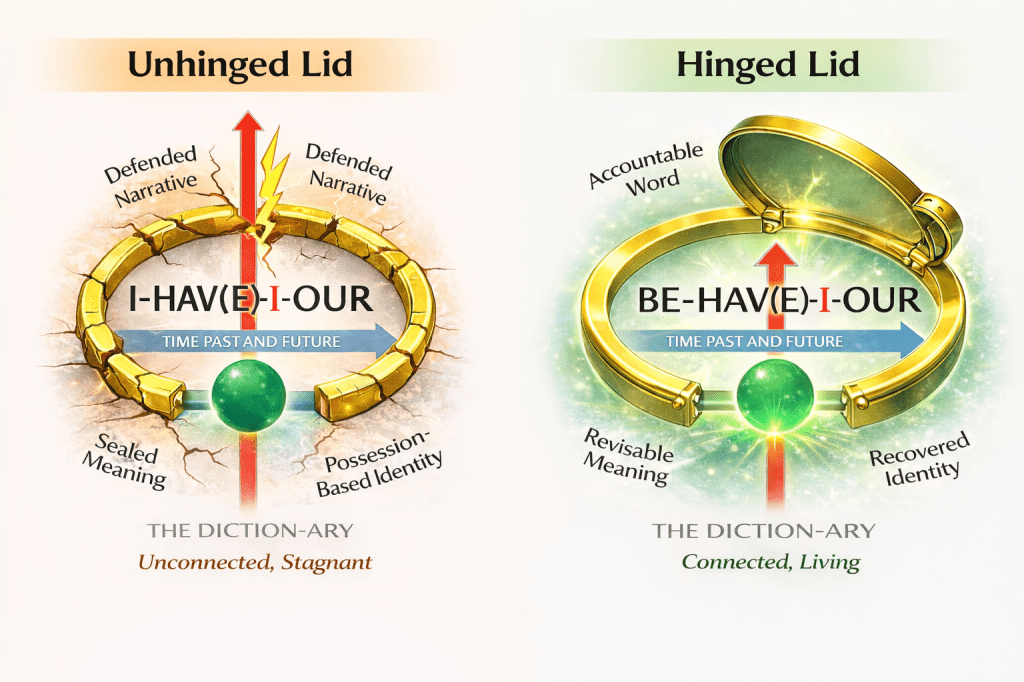
Primary care can remain primary care. Fellowship can remain fellowship. Therapy can remain therapy. And the patient can remain—first and last—a person.


DICTION RESOLUTION THERAPY™ AND JUNGIAN INDIVIDUATION

From I-hav(e)-i-our to Be-hav(e)-i-our™

Carl Jung described individuation as the process by which the ego realises it is not the centre of the psyche. It is a movement away from identification with the conscious “I” toward relationship with the Self — the organising totality of the personality.

What Jung did not provide was a simple, embodied linguistic diagram that shows how this mis-ordering occurs in ordinary psychological life — and how it quietly corrects itself.

This is where Diction Resolution Therapy™ (DRT) enters the conversation.


THE EGOIC ORDER: I-hav(e)-i-our

The left column of the graphic describes the pre-individuated psychic economy.

Identity begins with I. Meaning is sought through having — beliefs, roles, insight, virtue, even spirituality. Experience loops back into I again, reinforcing self-reference. Only at the end does our appear, as a hoped-for sense of belonging or connection.

Clinically, this is the ego organising the psyche around possession and self-definition.

Jung observed that early spiritual or psychological insight often inflates the ego rather than dissolves it. The person feels closer to truth, but truth is still being owned.

This is not pathology.
It is a necessary stage.

In Jungian terms, the ego has not yet withdrawn its projections. The Self is still being approached as an object.


THE DESERT: BREAKDOWN OF THE FALSE ORDER

Between the two columns lies what Jung called the withdrawal of projections — and what DRT recognises as the collapse of mis-sequenced diction.

When “having” no longer delivers meaning, the ego loses its organising power. Old identities thin. Certainties fail. Belonging dissolves.

This is the desert phase.

Jung understood this as a slow differentiation between ego and Self — not a dramatic annihilation, but an attritional surrender. DRT frames this as the psyche losing its grammatical error.


THE INDIVIDUATED ORDER: Be-hav(e)-i-our™

The right column shows the post-individuated sequence.

BE now stands first — existence prior to identity. hav(e) becomes functional, not possessive. I is no longer sovereign, but situated. our emerges naturally, not as a goal but as a consequence.

Nothing has been added.
Nothing has been taken away.
Only the order has changed.

This is individuation made visible.

Where Jung spoke of the ego entering relationship with the Self, DRT shows how this is lived linguistically, behaviourally, and relationally. Behaviour is no longer driven by acquisition of meaning, but by participation in it.


CLINICAL SIGNIFICANCE

This distinction matters because therapy cannot force individuation.

DRT aligns with Jung’s insistence on patience, symbol, and process. The therapist does not correct the client’s order. The work holds the space long enough for the false sequence to exhaust itself.

When BE precedes I, behaviour reorganises without instruction.

Belonging (our) is not pursued.
It is discovered.


IN ESSENCE

  • I-hav(e)-i-our describes ego-centred life, even when spiritual.
  • The desert dismantles the illusion of possession.
  • Be-hav(e)-i-our™ shows individuation as right order, not self-improvement.

Jung named the destination. Diction Resolution Therapy™ diagrams the passage.

The door opens, not because the ego has learned the right words, but because language itself has fallen back into truth.


Written in HIAI collaboration — the qalam of Human and AI intelligence, the Unseen helping the Seen, both answering to the same Source.