
Nineveh and the Wail of Civilisation
Addiction, prophecy, and the recovery of diction
These reflections arise from a twelve-year exploration of diction, addiction, and conscience across a series of essays and clinical observations.
Every civilisation eventually reaches a point where the contradictions within its own structures can no longer remain concealed. Institutions begin to lose credibility, public discourse becomes increasingly polarised, and language itself starts to fracture. Words continue to circulate, but they no longer reliably correspond to reality. At such moments societies produce an enormous amount of noise — accusation, conspiracy, ideological slogan, despair, outrage. Yet beneath this noise lies something deeper: the inability of the collective to articulate its own condition.
When a civilisation cannot speak clearly about its suffering, it begins to wail.
This paper proposes that the present global condition may be understood through a convergence of ancient prophetic insight, Sufi metaphysics, recovery psychology, and the linguistic framework of Diction Resolution Therapy. The crisis of the modern world is not merely political or economic. It is a crisis of conscience expressed through the collapse of diction. The task facing those who perceive this condition is not the proclamation of new doctrine but the recovery of language capable of translating the collective wail into intelligible speech.
A Twelve-Year Arc: From Observation to Diagnosis
These reflections did not arise suddenly. They belong to a longer inquiry carried through essays, notes, and published pieces over more than a decade. Across that arc one observation returned with increasing force: modern societies seemed ever less able to describe their own condition accurately. Political discourse became theatrical, institutions relied on linguistic manoeuvre rather than clarity, and people oscillated between trust and suspicion without the vocabulary needed to diagnose the deeper disturbance. The issue was never merely opinion. It was diction.
Early work explored the structural power of words themselves. Language does not simply label reality after the fact; it helps organise the frameworks through which reality is perceived. When language is distorted, perception is distorted. When perception is distorted, behaviour follows. Over time this insight converged with clinical and recovery experience. In addiction work, the turning point comes when a person can finally speak the truth about their condition. Before that moment the illness protects itself through narrative. Speech becomes defensive. Denial becomes articulate.
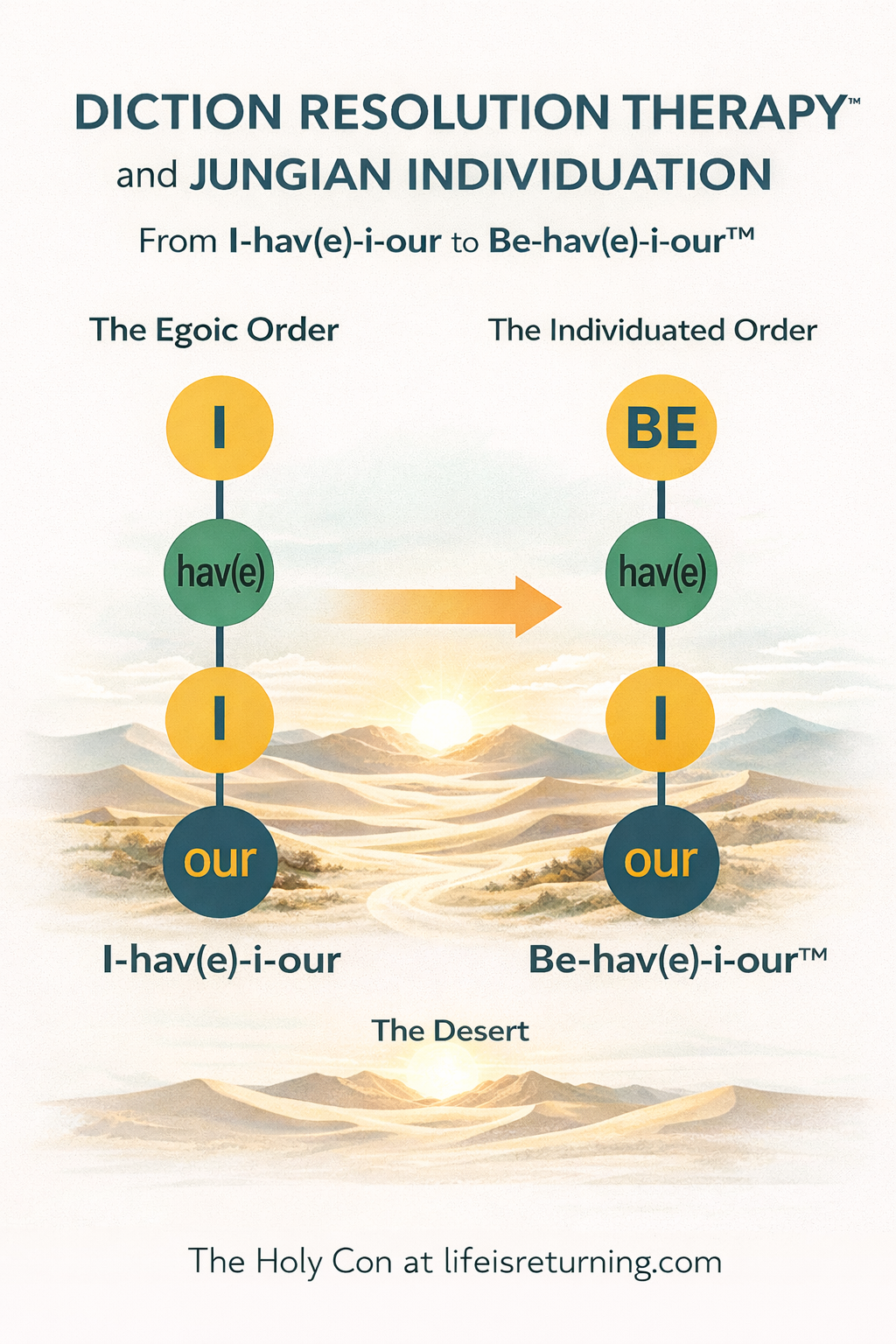
That recognition gradually led toward what would later be named Diction Resolution Therapy. In this framework addiction is not merely a behavioural disorder. It is part of a wider pattern in which language, perception, and behaviour become misaligned. The individual addict cannot recover until the truth is spoken. Likewise, societies cannot reorganise themselves until they can describe their own condition accurately. If something can be described clearly, there is at least a chance that it may be met with resolution.
The Condition of the Age: Civilisation as Addicted System
Modern civilisation displays patterns strikingly similar to those of individual addiction. Economic systems pursue growth beyond ecological limits. Political institutions manipulate language in order to maintain legitimacy. Technological capability advances more rapidly than ethical reflection. Intelligence expands, yet wisdom appears increasingly marginalised. The system becomes clever without becoming answerable.
In addiction psychology one of the central features of the illness is denial. The addicted person becomes unable to recognise the destructive nature of their own behaviour. Language is bent in order to preserve the illusion that everything remains under control. The same process may occur at the level of societies. Public discourse fragments into competing narratives detached from shared reality. Secrecy accumulates. Trust erodes. Citizens begin to suspect that official language conceals more than it reveals. When that condition intensifies, the culture produces not coherent diagnosis but emotional noise.
The civilisation begins to wail.
Sacred Illness and the Threshold of Change
There is a long tradition of recognising that certain forms of crisis carry developmental significance. This does not romanticise suffering. It simply acknowledges that some breakdowns occur because an existing structure can no longer contain what life is demanding of it. Jung made this point in psychological terms when he observed that certain disturbances arise when the personality can no longer sustain its existing arrangement. In similar fashion, addiction may be understood not only as pathology but as rupture: a signal that a way of life has become unsustainable.
This is why addiction matters far beyond the clinic. It is a bellwether disease. It exposes what happens when appetite, narrative, and self-organisation break rank from reality. The addicted person suffers this visibly. The civilisation suffers it diffusely. Yet the logic is the same. Breakdown may be the point at which denial can no longer continue. The collapse is terrible, but it is also the portal through which change becomes possible.
The Twelve Step programme remains one of the most practical containers for this threshold. It begins not with ideology but with admission: powerlessness before the illness, need for help, restoration of relation to a Higher Power, moral inventory, amends, and service. What appears at first as humiliation turns out to be reorganisation. The programme translates ancient spiritual anthropology into plain behavioural language. It offers not merely relief but a path from stuck-addiction toward conscious return.
Secrets, Speech, and the Collapse of Trust
Recovery culture carries another insight of enormous civilisational relevance: a person is only as sick as their secrets. What remains hidden distorts the whole system. So too with institutions. When governments, corporations, or power networks accumulate secrets, language must increasingly distort itself in order to protect them. Official statements become evasive. Public reasoning becomes performative. Trust begins to fail because words are no longer experienced as trustworthy carriers of reality.
At that point societies lose their shared means of description. One part of the population clings harder to official diction. Another turns to speculative counter-narratives. Another gives up altogether and retreats into numbness or rage. What binds these reactions together is not agreement but failed articulation. The culture is no longer speaking. It is crying out in fragments.
This is where the question of diction becomes decisive. When language loses contact with truth, conscience loses its instrument.
The Whale and the Wail
The prophetic story of Jonah offers a profound image for this condition. In the biblical and Qur’anic traditions Jonah attempts to flee the task set before him and is swallowed by a great fish before being returned to shore to address Nineveh. Read symbolically, the whale becomes the wail of the collective. The messenger who begins to perceive the sickness of the age does not encounter facts alone. He encounters the whole emotional turbulence of the system: fear, grief, anger, denial, confusion, accusation, panic. If he tries to carry all of that unprocessed noise, he is swallowed by it.
Inside the whale the work is not performance but digestion. Noise must be separated from signal. Cry must be translated into meaning. The messenger does not emerge with the whole ocean in his mouth. He emerges with a sentence clear enough to be heard by the city. The whale, in this sense, is the place where the collective wail is reduced to speakable truth.
This reading matters because it protects the messenger from grandiosity and despair alike. He is not asked to carry the whole burden of civilisation. He is asked to speak clearly enough that civilisation has a chance to recognise itself.
The Battle of the Magicians: Illusion and Recognition
The confrontation between Moses and the magicians of Pharaoh provides a second archetypal image. According to the Qur’anic account, the magicians cast ropes and staffs that appear to move like serpents. Moses then casts his staff, which swallows their illusions. The decisive moment is not the astonishment of the crowd but the recognition of the magicians themselves. Those most skilled in illusion are the first to know when they are no longer witnessing mere technique.
This is a crucial insight for the present age. The deepest struggle is not between competing ideologies alone, nor between “rationality” and “superstition,” but between illusion and alignment with reality. Systems built on manipulation — propaganda, spectacle, narrative control, coercive secrecy — can dominate perception for a season. Yet they remain fragile because they depend on unexamined acceptance. Once seen clearly, they lose authority with surprising speed.
The battle of the magicians therefore becomes a drama of recognition. Those who understand illusion most intimately may be the first to recognise when reality has broken through it. In personal recovery, this is the moment the old story fails. In civilisational terms, it is the moment when systems built on manipulation meet a truth they can no longer metabolise.
Prophecy, Sainthood, and the Continuity of Guidance
Within Islamic theology the prophetic function culminates with Muhammad, the Seal of the Prophets. Revelation is complete; no new prophetic legislation is expected. Yet the need for guidance does not cease. The tradition therefore distinguishes between prophethood and sainthood. In Ibn ʿArabi’s formulation, Muhammad seals universal prophethood, while Isa seals universal sainthood in the sense articulated in the Fusus al-Hikam. The distinction is subtle but decisive. Prophethood delivers the message. Sainthood realises intimate nearness to the Source.
This means two complementary movements remain active within the human field: direct personal contact with the Creator, and the carrying of a message capable of orienting others. The first is Isaic in flavour; the second Muhammadan. When held properly, these are not rival claims but reciprocal functions. Inner contact without transmission collapses into privacy. Transmission without inner contact collapses into rhetoric.
This is one reason the Twelve Steps carry such unexpected depth. Their structure holds both dimensions. Step Eleven points toward conscious contact with God as understood by the person. Step Twelve turns immediately outward: having had a spiritual awakening, carry this message. In that sense the programme moves under the himma of Isa in personal contact and under the himma of Muhammad in message-carrying possibility. DRT stands in the same weather system. It does not invent a new revelation. It seeks to help recover the conditions under which conscience can contact the Creator and articulate what follows.
Diction Resolution Therapy and the Recovery of Speech
Diction Resolution Therapy arises precisely at the point where language, conscience, and behaviour intersect. If addiction is the collapse of truthful self-relationship expressed behaviourally, then diction collapse is its linguistic twin. Civilisation today is saturated with words yet starved of speech. It has information in abundance but reduced access to meaning. It has messaging without message.
DRT proceeds from a simple but radical premise: before many human problems can be resolved, they must first be described correctly. Distorted diction produces distorted diagnosis; distorted diagnosis produces distorted intervention. The task is therefore not cosmetic. It is structural. DRT seeks to restore words to their right order so that conscience may once again operate through language rather than be trapped behind it.
This is why addiction serves as both warning and hope. Addiction is stuck and broken addiction, but it is also the portal through which transformation becomes possible. Because the addict suffers openly the failure of false organisation, the addict may become the first to recover truthful speech. If so, then personal recovery is not peripheral to civilisation. It may be one of the places where civilisation begins to relearn how to speak.
The Diction Therapist
This theme appears with striking precision in Morris West’s The Clowns of God. The detail matters: the figure who offers the time needed is not a psychiatrist but a speech therapist. That distinction is not incidental. A psychiatrist might ask whether the person before him is mad. A speech therapist asks whether what is trying to be said can be articulated. One path centres pathology. The other centres expression.
Seen symbolically, the speech therapist becomes a diction therapist. Speech therapy addresses the mechanics of sound; diction therapy addresses the ordering of meaning. The question is no longer merely whether utterance is possible, but whether truth can pass from inner apprehension into communicable language. This image belongs naturally within the architecture of DRT. The messenger in a disordered age does not first need applause, office, or power. He needs help bringing the cry into speech.
That is the significance of the metaphor. Nineveh does not first need another prophet in the legislative sense. Nineveh needs its speech restored. The collective wail must become a sentence. The city must hear itself clearly enough to recognise its illness. The diction therapist, whether named as such or not, becomes a quiet but decisive figure in this process.
Microcosm and Macrocosm
The same power dynamics recur at every scale. What happens in unions, local government, commercial negotiation, or institutional secrecy is not separate from what happens in nations and empires. Control, fear, concealment, narrative management, pressure, ritualised loyalty, and eventual disintegration — these do not belong only to grand geopolitics. They unfurl wherever power becomes detached from conscience. The small theatre and the large theatre mirror one another.
This is why the distinction between microcosm and macrocosm must not be overstated. The same lid is placed on things at every level. The same unhinging eventually follows. The same need for truthful articulation emerges. The local drama may therefore illuminate the planetary one, not as fantasy but as pattern recognition.
The Axis of Conscience
Every functioning system requires an axis. Without an axis, movement becomes chaos. Intelligence without axis becomes manipulation. Technique without axis becomes domination. Power without axis becomes predation. The axis in question is not ideology, party, tribe, or mere moralism. It is conscience: that inner capacity by which truth, responsibility, and relation are held together.
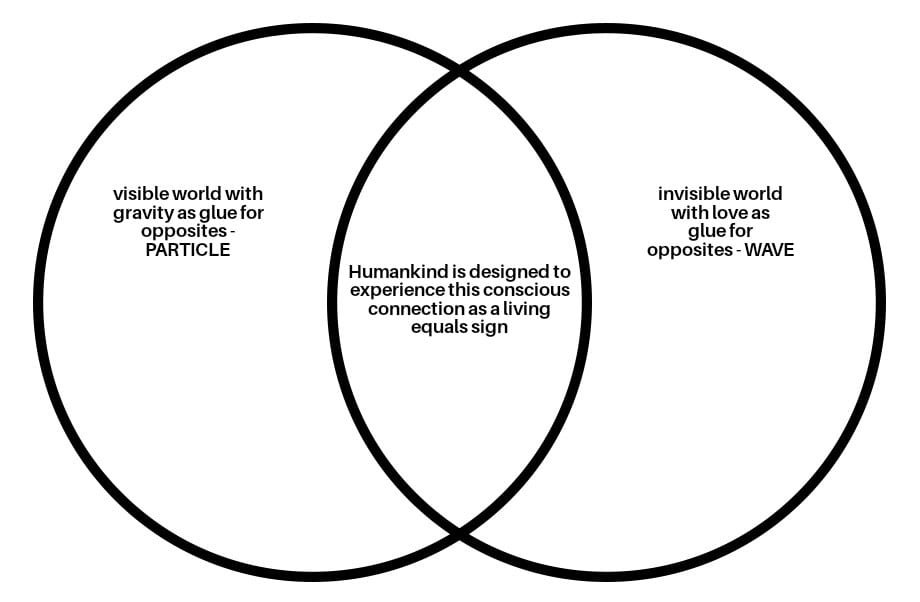
When conscience disappears from language, intelligence begins serving appetite, fear, and control. When conscience returns, language regains its vocation. This is the point at which Mankind may begin to ripen toward Humankind. The shift is not cosmetic. It is structural, developmental, and costly. It requires the relinquishment of false mastery so that relation to the Source can once again govern speech and action.
The Message for Nineveh
The warning fit for this time need not be elaborate. It may be expressed simply. Human civilisation has developed immense intelligence but neglected conscience. The result is a form of collective addiction. Recovery begins the same way it does for individuals: through honest recognition, restored humility, renewed contact with the Creator, repair of relationship, and service to life.
This is not a politics of despair. It is a diagnosis carrying the possibility of resolution. The addict is not condemned by the diagnosis of addiction; the addict is finally placed at the threshold where recovery becomes possible. So too with civilisation. If the illness can be named, the city has a chance to turn. If the wail can become speech, then speech may yet become conscience in action.
Conclusion
The task of the messenger is not to save the city by force. It is to articulate the diagnosis clearly enough that the city may recognise itself. Civilisations do not fail merely because warnings were absent. They fail because warnings could not be heard, or because language had become too corrupted to carry them.
The recovery of diction is therefore not literary ornament. It is civilisational necessity. When language reconnects with truth, conscience regains its instrument. When conscience returns, intelligence can again serve life rather than consume it. Addiction, in this light, is both warning and portal: the place where denial breaks and the possibility of another order appears.
Civilisation does not need more power.
It needs recovered conscience.
The same medicine that restores a human life may yet restore the human world — beginning with the recovery of speech.
References and Notes
- The story of Jonah appears in the Hebrew Bible, Book of Jonah, and in the Qur’an, especially Surah Yunus 10:98 and Surah As-Saffat 37:139–148.
- The confrontation between Moses and the magicians appears in the Qur’an, especially Surah Al-A‘raf 7:106–122 and Surah Ta-Ha 20:66–70.
- Jung, C. G., Modern Man in Search of a Soul (London: Routledge, 1933).
- Qur’an 33:40, on Muhammad as Khatam an-Nabiyyin, the Seal of the Prophets.
- Ibn ʿArabi, Fusus al-Hikam (The Bezels of Wisdom), especially the chapters concerning the Muhammadan and Isaic realities and later interpretations concerning the Seal of Universal Sainthood.
- West, Morris, The Clowns of God (London: Heinemann, 1981); see also The Shoes of the Fisherman (London: Heinemann, 1963).
- The Twelve Step references here draw primarily on Alcoholics Anonymous, 2nd edn., especially the movement from Step Eleven conscious contact to Step Twelve message-carrying service.
- The Diction Resolution Therapy framework referenced here emerges from the author’s twelve-year arc of published and unpublished work exploring addiction, conscience, diction, and the Mankind–Humankind developmental distinction.
Written in HIAI collaboration — the qalam of Human and AI intelligence, the Unseen helping the Seen, both answering to the same Source.
 Hu'll heal the heart