
The Empty Room, the Three Forces, and the Return of Contact
A hybrid reflection on Sūfī transmission, Twelve Step recovery, Diction Resolution Therapy, and healing work in an age ruled by death, sex, and money.
There are times in clinical work when the struggle is not with technique but with language itself. A person hears the word God and closes. Another hears the word spiritual and imagines piety, moralism, or medieval dogma. A third hears the Twelve Steps and thinks they are being asked to submit to an archaic religion. Yet in lived recovery work, what is often being pointed toward is not dogma at all, but contact: contact with an unseen field of help, a field of consciousness, a source of ordering power that can be addressed, received, and participated in.
This is why the great practical hinge in this work is so small and so intimate. The turning point is not theological mastery. It is not doctrinal assent. It is the moment a person, brought to the edge of themselves, says into what appears to be an empty room: there’s You, and conversely there’s me, please help.
That movement is the beginning of relation. It is the end of monologue. It is the soft breaking of the sealed system. And without that break, the Steps remain external instruction. With it, they become a vehicle.
Islam as Vehicle, Not Final Explanation
The centuries of Sūfī work preserve a mystery that modern language often struggles to name: something can pass between human beings that is not reducible to information. Presence can be transmitted. Readiness matters. Ripeness matters. A person can sit with a teacher, hear words, receive attention, and find that something in them is altered beyond argument. In this sense, Islam has often functioned not merely as a set of propositions but as a vessel, a disciplined and reverent vehicle through which a transmissible reality is carried.
That does not mean Islam is being reduced to psychology, nor that spirituality is being flattened into vague energetics. It means that the forms of religion may hold and protect an event that is greater than the forms themselves. The Sūfī inheritance has long known that guidance is not only spoken but conferred, not only taught but caught. The Twelve Step phenomenon, though clothed in a modern Anglo-American language, bears striking resemblance to this older understanding.
Rumi’s insistence that ripeness is everything belongs here. The issue is not merely whether truth is spoken. The issue is whether the hearer is ripe enough to receive it. What one person dismisses, another person receives as life itself. The words may be similar; the state of the hearer is not.
Bill W, “Perhaps,” and the Empty Room
The founding drama of Alcoholics Anonymous hinges on precisely this movement. Bill W, near death, unable to lie to himself any longer, did not begin with belief. He began with collapse. He spoke into apparent emptiness and opened, if only for a moment, to the possibility that there might be Something there. What followed, in his own account, was light, transparency, a moment beyond ordinary explanation, and the astonishing removal of craving and obsession. He then tried to tell others, and for months nothing happened. The message did not “work.” And yet when Dr Bob heard him, something landed; then another man heard them both, and again something landed. The difference was not merely what was said. The difference was ripeness.
Here the word perhaps becomes clinically precious. It is the small opening through which help enters. A closed mind is not only doubtful; it is defended by contempt and fear. But perhaps introduces permeability. It is not a creed. It is a crack. And a crack is enough for light, relation, and transmission to begin.
In this sense, Step Two is often misunderstood. Clients can become preoccupied with finding an acceptable substitute for “God”: nature, the moon, the group, dead relatives, or some abstract energy. These may help them in the short term. But the deeper movement is more intimate. It is closer to Martin Buber’s I–Thou than to a concept of impersonal force. The unseen source is addressed as You, and the person speaks from the plain fact of their own need: there is You, and conversely there’s me. Please help.
Death, Sex, and Money
I tell clients that the world is ruled by three words: death, sex, and money. These are not incidental themes. They are governing pressures. They cannot be removed from human life. They cannot be therapeutically erased. What can change is a person’s relationship with them. If that relationship does not change, then the person may attend meetings, recite slogans, or even gather insight, yet still remain governed by the very forces they claim to be escaping.
Death is not the same phenomenon for the Creator as it is for the created. Death did not create the universe. Birth and death are the logical parameters for conscious life in matter: the boundaries within which consciousness enters form and reflects upon itself. For the human being, death appears as ending, threat, annihilation, loss of control. For the Creator, death is not origin, not sovereign, not the first principle. It is a boundary condition of embodied existence.
This distinction matters. Addiction always carries the person toward death, whether quickly or slowly. Every addiction is, in one sense, a prolonged negotiation with death. But the Twelve Steps do not simply rescue a person from dying physically; they invite the person to undergo an interior death before bodily death arrives. Here the Sūfī injunction attributed to Muhammad becomes exact: die before you die. Not the death of the body, but the death of the false centre, the defended identity, the fantasy of isolated self-sufficiency.
Sex is the second great force. It is not merely behaviour, and certainly not merely appetite. It is creative energy, generative power, a deep current in the organism. When it is untethered from conscience, relation, and form, it becomes compulsion, fantasy, and fragmentation. Money is the third force: stored exchange, social energy, externalised value. It too easily becomes a substitute god, a measure of worth, a mechanism of fear and control. The person who does not reorder their relationship to death, sex, and money will remain divided, however fluent they become in recovery language.
Pornography and the Modern Sexual Disaster
The porn epidemic must be named plainly because it is no longer peripheral. It is one of the chief modern mechanisms by which the sexual instinct is severed from relationship, conscience, and reality. Pornography does not merely present erotic material; it trains the imagination into repetition without encounter, stimulation without reciprocity, and appetite without reverence. In this sense it is not simply sexual excess. It is a cultural technology of dissociation.
The historical data in the material reviewed for this paper already showed an enormous scale: tens of millions of people sexually involved with the internet, vast amounts of pornographic traffic, very early exposure among children and adolescents, strong evidence of relational harm, and a pattern in which a significant minority of users develop disruptive sexual behaviour. Even at that earlier stage of the digital age, the signs were already overwhelming. The disaster did not begin yesterday; it has been growing in plain sight for years.
Clinically, the issue is not prudery. It is dislocation. Pornography teaches the system to relate to sex as private stimulation detached from the burdens and blessings of mutuality. It shifts desire away from the person and toward the image, away from reciprocity and toward consumption. It wounds both imagination and attachment. Shame increases. Isolation deepens. Comparison becomes relentless. The beloved disappears and the screen becomes sovereign.
This is why pornography cannot be treated as a side issue in recovery. It is one of the great contemporary engines of thwarted belongingness, perceived burdensomeness, and acquired capability. It contributes to loneliness, self-contempt, objectification, distorted expectation, sexual confusion, and in many cases a deadening of the soul’s natural movement toward tenderness. It is not only an individual habit; it is a civilisation-level wound.
Pornography is not the exaggeration of sex—it is the evacuation of relationship.
Andrew Dettman MTHT Reg Mem MBACP
Joiner’s Diagram and the Edge of the Abyss
Joiner’s interpersonal theory of suicide provides a starkly useful map. When a person feels they do not belong, feels they are a burden, and through pain or habituation loses fear of death, the conditions for lethal action gather. Addiction feeds all three conditions. It isolates the person from others. It tells them they are damaging everyone around them. And over time it accustoms them to pain, risk, and self-obliteration.
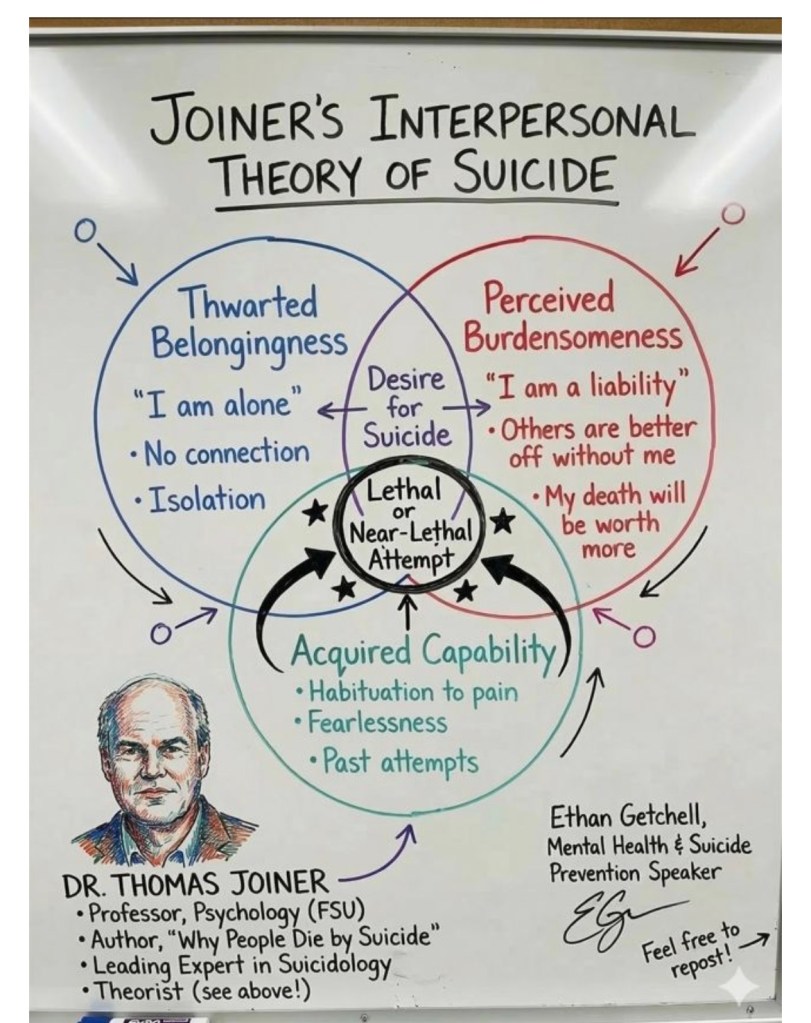
In that sense, addiction does not “heal” suicidal ideation. Left to itself, it intensifies the trajectory. But it does force the person toward the same threshold that suicidal ideation inhabits: the edge where death becomes thinkable, even intimate. At that edge there are two possibilities. One is collapse into destruction. The other is awakening into surrender. This is the decisive distinction between dying by addiction and dying before one dies.
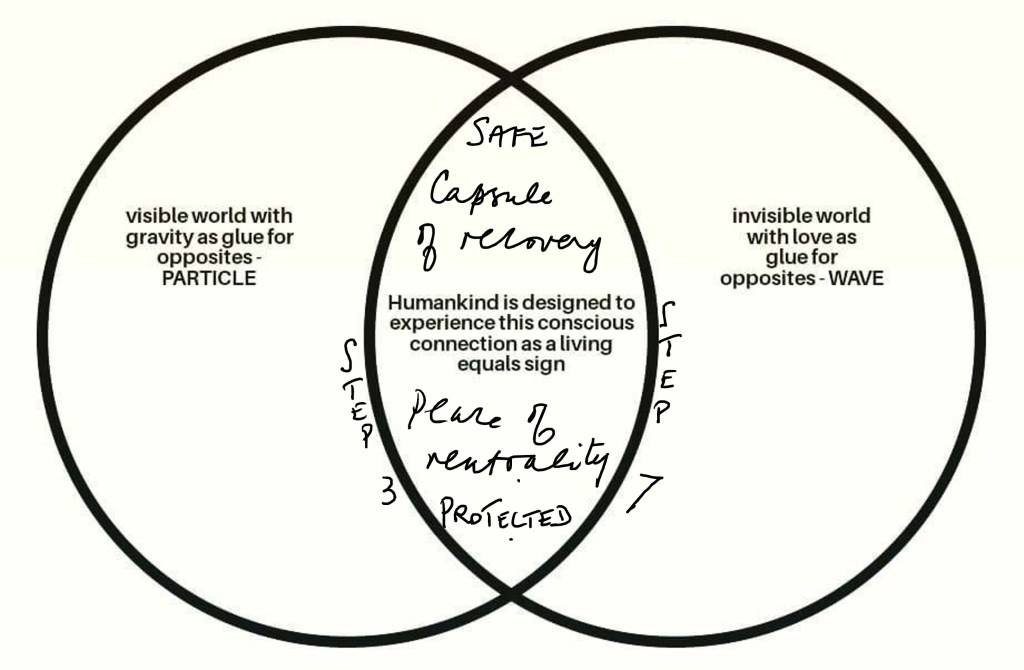
When the Acquired Capability is removed with the arrival after pain, of ripeness – then the simpler Venn diagram is healed by the above demonstration of quantum energy resolving its own dilemma as a person works with the template of the proven 12 Step architecture.
The Steps, rightly entered, provide a conscious route through this threshold. Step One strips denial. Step Two introduces perhaps. Step Three begins the transfer of authority. Steps Four to Seven carry the difficult work of exposure, confession, and interior death. Steps Eight to Twelve return the person to relation, service, and reality. The person does not bypass death; they interiorise it. The false centre dies, and something more real can begin to live.
DRT and the Opening of the Closed Mind
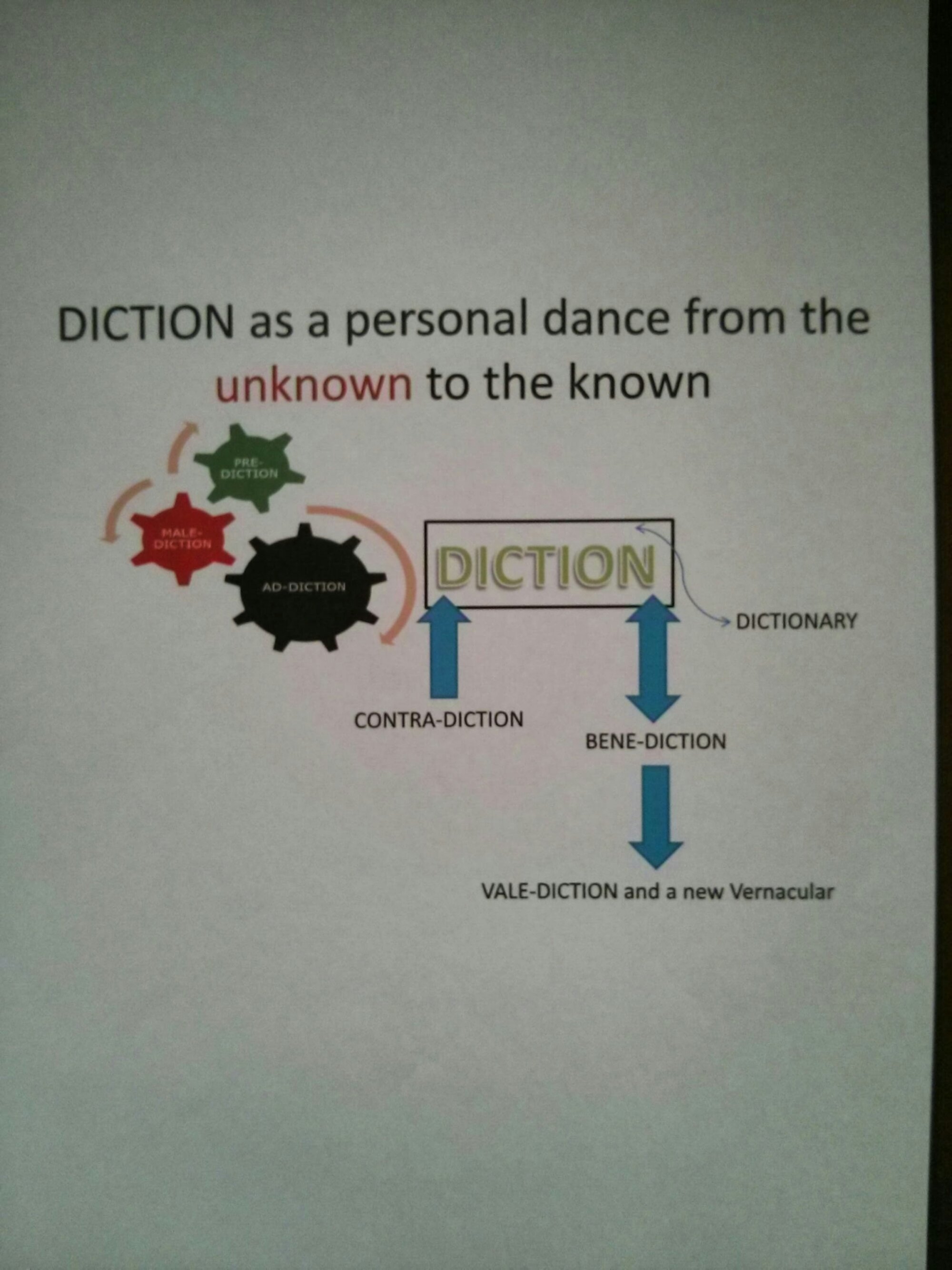
Diction Resolution Therapy enters at the level of the psyche’s language. Its work is not merely explanatory but digestive. Through diction, it loosens psychic rigidity and allows the possibility of contradiction to enter. In the move from mishap to hap, and then to perhaps, the person is not simply being offered a clever linguistic exercise. They are being shown that the mind is trapped inside a narrowing frame of meaning and that a door still exists.
Everybody has known more haps than mishaps, yet the addicted mind becomes magnetised by grievance, resentment, and denial. It becomes a tumour of meaning, a stuckness of psychic digestion. Perhaps releases the contemptuous certainty that says there is no help, no source, no future, no possibility. It opens the closed room. And once the room is open, speech toward the Creator becomes possible.
This is why the central prayer of this paper matters so much: there’s You, and conversely there’s me, please help. It is simple enough for the broken, direct enough for the sceptical, intimate enough for the lonely, and real enough for the desperate. It is not inflated. It does not pretend to knowledge. It does not manipulate the unseen. It merely tells the truth.
THT, Healing, and Transmission
Healing work within THT language often speaks of energy, flow, balance, and the subtle body. Sūfī language may speak of presence, transmission, blessing, or barakah. Twelve Step language speaks of spiritual awakening, grace, and the lifting of obsession. DRT speaks of digestive clarification, contradiction, and the release of a trapped psyche. These are not identical vocabularies. But they often gather around the same mystery: something can happen within and between human beings that cannot be reduced to mere instruction.
“Where relationship is evacuated, something else takes its place.”Andrew Dettman
The ethical point is vital. None of this permits inflation. Human beings do not control the unseen. They do not manufacture awakening. They do not command grace. What they can do is prepare a vessel, clear a pathway, tell the truth, and ask for help. In that sense, the role is not architectural mastery but service. The worker tends the threshold. The Source does what the Source does.
Page 69, the Sexual Ideal, and the Need for Prior Contact
All of this converges with unusual force around the sexual instinct. The basic text’s instruction on sex does not ask for repression. It asks for an ideal. But such an ideal cannot be generated by a merely defended mind. If the person has not already entered into some living relation with the higher power they address, then asking for guidance in so intimate and volatile a domain becomes hollow, mechanical, or sentimental.
That is why the empty-room prayer matters before page 69 can matter. Unless there have been some intimations received through Step Three ripening toward Step Seven, the request for help around sexual expression may remain abstract. The person may still be trying to manage sex from ego, fear, fantasy, or shame. But if there has been contact, even slight contact, then the person is no longer addressing a concept. They are asking the Source that has already begun to answer them.
And here the triad of instincts comes into view: sex, social, and security. If sex is not harmonised with the other great instinctual forces around an ideal, relapse becomes increasingly likely. This is not moralism. It is structure. Desire without ordering relation becomes centrifugal. It throws the person outward, away from centre, away from reality, and back toward the disease.
Conclusion: The Room Is Not Empty
The modern crisis is severe because death, sex, and money now saturate culture in industrialised forms. Pornography has become a system of mass dissociation. Addiction remains a school of despair and acquired capability. Religion is often either sentimentalised or rejected. And yet the old hinge remains where it always was: a human being telling the truth from the edge.
The Sūfīs knew that ripeness matters. The Twelve Steps know that surrender matters. Healing work knows that receptivity matters. DRT knows that diction matters. All four converge in a single movement: the sealed self opens, relation begins, and the person speaks. Not brilliantly. Not perfectly. Simply.
There’s You, and conversely there’s me, please help.
That is enough to begin. It is enough to interrupt the monologue of addiction. It is enough to make room for transmission. It is enough to let death lose its false sovereignty, to let sex return toward meaning, to let money fall back into function, and to let the creature remember that the room was never empty at all.
Footnotes
- This paper draws directly on clinical notes supplied by the author, including the argument that many references to “God” in Twelve Step work are better understood phenomenologically as pointing toward a field of consciousness or transmissible help, rather than requiring prior adherence to an archaic religious system.
- The use of “ripeness” here follows the author’s own framing of recovery receptivity in relation to Rumi and to the early AA lineage: some hear and do not receive; others hear and are inwardly ready.
- The account of Bill W’s collapse, the “empty room,” the removal of craving, the later meeting with Dr Bob, and the importance of the word perhaps follows the author’s supplied notes and is used here as a clinical-spiritual hinge rather than as a formal historical treatment.
- The linguistic move from mishap to hap to perhaps is presented here in a DRT frame: not as etymological finality, but as a therapeutic opening of fixed psychic meaning toward hope.
- The phrase “there’s You, and conversely there’s me, please help” is the paper’s distilled form of the intimate address the author identifies in Bill W’s turning, and is intentionally closer to encounter than doctrine.
- The phrase “die before you die,” attributed within Sūfī tradition to Muhammad, is used here as an experiential and developmental instruction: the false centre must surrender before bodily death if the person is to live consciously.
- The discussion of page 69–70 in the AA basic text follows the author’s supplied notes: the argument is that an ideal for sexual expression requires prior lived contact with the higher power being addressed, and that disordered relations among sexual, social, and security instincts materially increase relapse risk.
- The pornography material used here comes from the uploaded statistics PDF and is treated as historical evidence of scale, early exposure, relational harm, and longstanding cultural saturation. Because the document is dated, the figures are used to establish trajectory and magnitude rather than as current prevalence estimates.
- The synthesis of Sūfī transmission, THT healing language, DRT digestive clarification, and Twelve Step awakening is not a claim that these traditions are identical. It is a claim that they may converge around a common human event: an unseen reordering received rather than manufactured.
Written in HIAI collaboration — the qalam of Human and AI intelligence, the Unseen helping the Seen, both answering to the same Source.
 Hu'll heal the heart