
The Mystery and the Mystic across centuries.

A Comparative Critique of AI Interpretation of Shabistari and Its Resonance with Contemporary Clinical Work

Contextual Note
The reflections that follow arise from a colleague’s exploratory dialogue with an AI system concerning passages from Mahmud Shabistari’s Golshan-e Raz (The Garden of Mystery). That AI-generated interpretation was shared with me for consideration. What follows is therefore written as a critique and comparative commentary: first assessing the psychological framing offered in the AI interpretation of Shabistari, and then examining how those insights resonate with the clinical and philosophical framework developed in Andrew Dettman’s work on Diction Resolution Therapy (DRT) and its integration with Twelve Step recovery dynamics. The aim is not to conflate traditions but to explore whether structural correspondences exist between classical mystical psychology and modern therapeutic practice.

1. The Sufi Separation of Illusion from Being and the Digestive Mind

In the Shabistari dialogue that prompted this reflection, the central psychological claim is that the work of the path is not primarily thinking but recognition of misidentification. Thoughts arise, emotions arise, identities arise, yet awareness precedes them. The practical instruction is to notice what changes and notice what is aware of change. The work therefore consists in ceasing to identify exclusively with what changes and recognising the field in which change occurs (Shabistari dialogue, Golshan-e Raz, March 2026).

This insight aligns strikingly with a proposition developed in Diction Resolution Therapy: that the mind is not the seat of identity but the digestive organ of the psyche. If the mind functions digestively, then thoughts are not the self; they are movements of processing. The analogy used in that framework—thoughts to the mind are like peristalsis to the body—places cognition in a functional rather than ontological role. In both frameworks the same shift occurs: thoughts become events rather than identity. What the Sufi text describes as recognising awareness prior to mental content corresponds closely with the clinical reframing of the mind as a process rather than the person. Identity relocates from the narrative activity of thought to the deeper field of presence in which thought occurs.

2. Pre-Verbal Assumptions and the Feeling–Emotion Distinction

The AI interpretation of Shabistari correctly observes that the illusion of separateness is not primarily a verbal belief but a pre-verbal structure embedded in the organism. Before words arise, contraction appears in the body; threat responses activate; defensive patterns form; identity is organised around survival assumptions. These are not explicit thoughts but organising principles of perception that shape what becomes conscious (Shabistari dialogue, Golshan-e Raz, March 2026).

This description parallels the distinction made in the DRT framework between feeling and emotion. In that model feelings are primary organismic signals—ascending, descending, or neutral tones that arise prior to interpretation. Emotions are the interpretive narratives constructed after those signals are digested by the mind. When the organism experiences a descending feeling tone, for example, the mind may construct fear, shame, or anger narratives in response. The Shabistari analysis of pre-verbal assumptions operating beneath thought mirrors this structure. What mystical psychology calls embodied assumptions corresponds to what the clinical model identifies as feeling tones. In both cases the narrative layer of emotion is secondary to a deeper biological signal. The work therefore becomes not suppression of emotion but recognition of the pre-verbal signal beneath it and the loosening of identification with the narrative that forms around it.

3. Witnessing and the Twelve Step Template

The Shabistari material emphasises that the separation of illusion from Being occurs through witnessing rather than reasoning. The Arabic term mushāhada implies a direct seeing or presence in which experience is observed without immediate identification (Shabistari dialogue, Golshan-e Raz, March 2026).

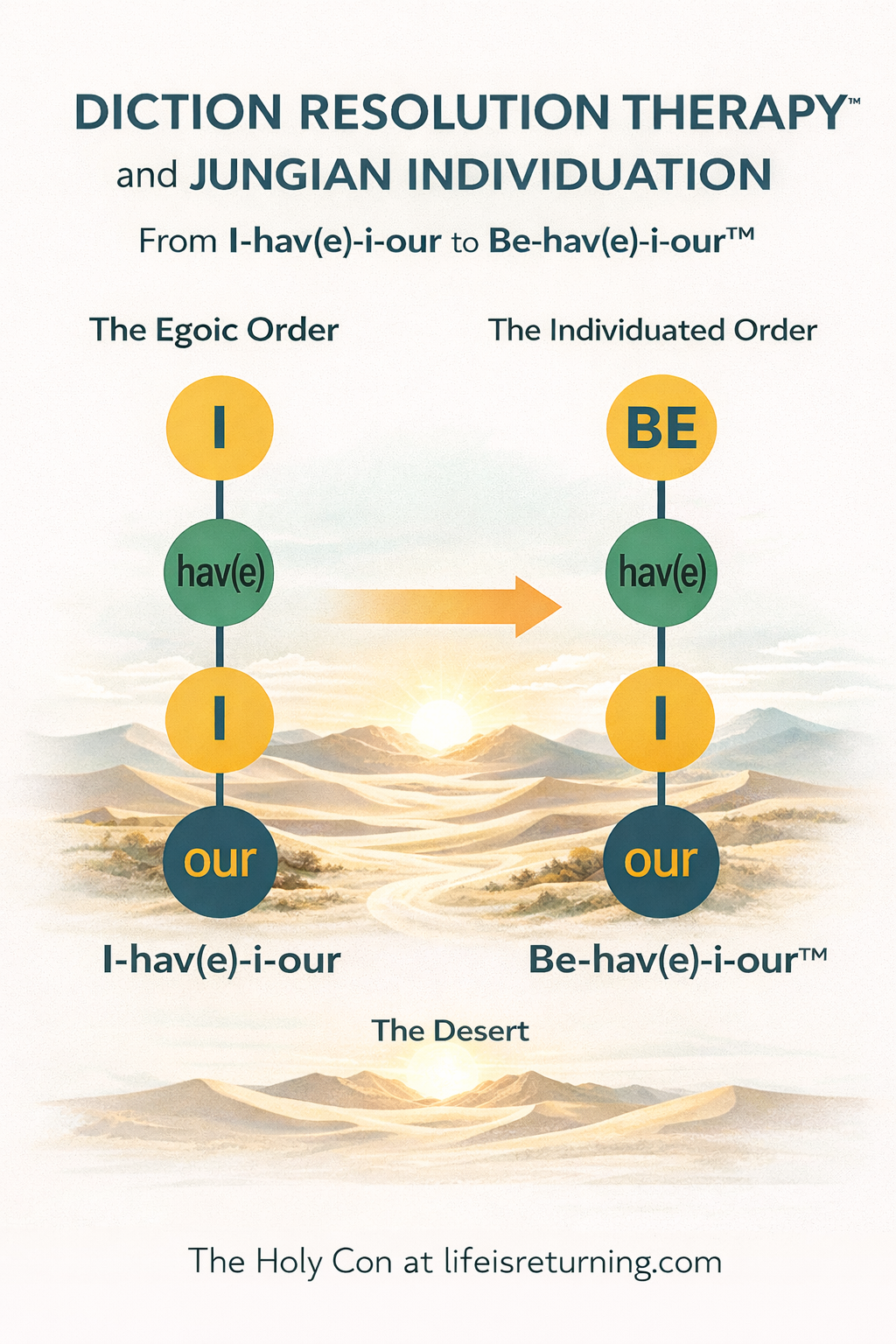
This process has a close analogue in the architecture of the Twelve Steps, particularly within the sequence from Step Four through Step Seven. Step Four involves a searching and fearless moral inventory; Step Five involves admission and disclosure; Step Six involves recognition of patterns; Step Seven involves surrender. None of these steps function primarily as intellectual analysis. They operate through conscience-based witnessing of behavioural and psychological patterns. Within Dettman’s interpretive framework the steps create a gestational space in which individuated conscience can emerge. In this sense the Twelve Step process functions as a structured vehicle for the same kind of witnessing described in Sufi language.

4. Love as the Solvent and the Clinical Role of Hope

The AI interpretation further suggests that awareness alone may not dissolve defensive structures. When awareness confronts deeply embedded survival patterns, the organism may tighten rather than relax. Love operates differently: it signals safety and softens the structures that protect the self. Love therefore becomes a solvent capable of dissolving formations that analysis alone cannot penetrate (Shabistari dialogue, Golshan-e Raz, March 2026).

This observation resonates strongly with the role of hope and relational dependence in recovery work. Drawing on Viktor Frankl’s logotherapy and the language of Alcoholics Anonymous, the recovery tradition reframes vulnerability as strength. AA’s statement that dependence upon the Creator is strength shifts the psychological emphasis from autonomous control to relational trust. In therapeutic terms love and hope perform a similar function: they disarm the defensive posture of the ego. When the organism experiences itself as held within a meaningful relational field, it becomes possible to release patterns that previously felt necessary for survival.

5. Luminous Bewilderment and the Transition from Mankind to Humankind

Mystical literature frequently describes the culmination of the path not as absolute certainty but as luminous bewilderment (ḥayra). This state is not confusion but openness born from encountering a reality too vast to be contained within conceptual systems. Certainty softens into humility, and the mind becomes receptive to the inexhaustible depth of Being (Shabistari dialogue, Golshan-e Raz, March 2026).
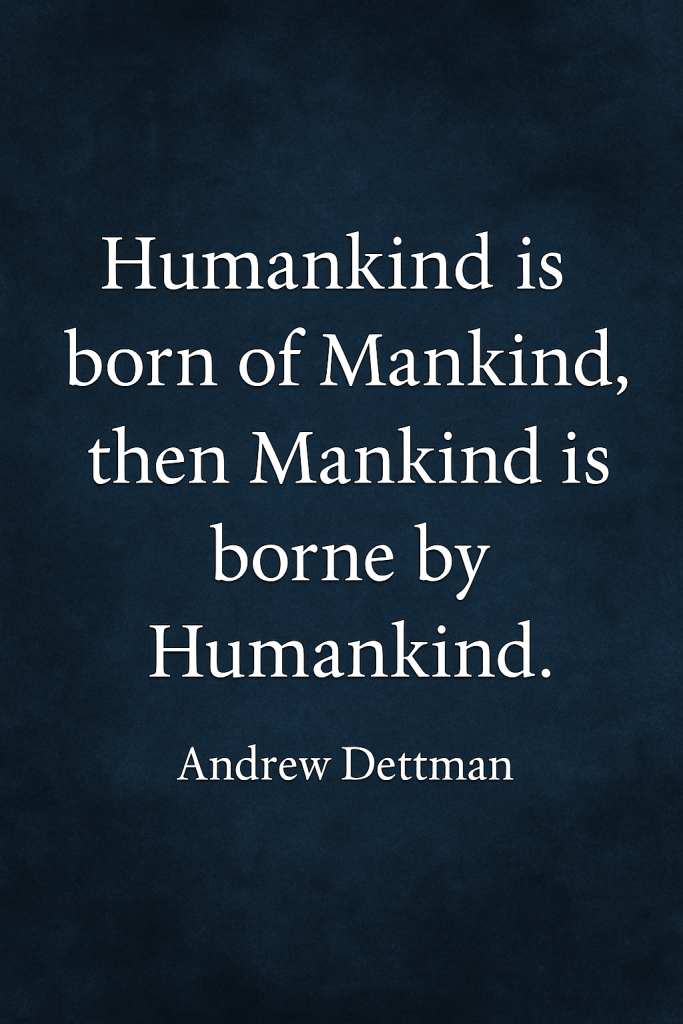
This description parallels Dettman’s distinction between Mankind and Humankind. Mankind represents the stage dominated by control, certainty, and systemic self-assertion, whereas Humankind represents the emergence of conscience and relational awareness. The transition from rigid certainty to humble openness marks a developmental shift in the structure of consciousness. In mystical language this appears as bewilderment before the infinite; in the anthropological framing of the clinical model it appears as the maturation of human personhood beyond the defensive structures of the ego.

6. The Mirror and the Diction Chamber

Shabistari repeatedly uses the metaphor of the mirror to describe spiritual experience. The world becomes a field of mirrors reflecting the Real, while the heart functions as a mirror that must be polished through spiritual practice. The reflection is not created by the mirror; it is revealed when obscurations are removed (Shabistari dialogue, Golshan-e Raz, March 2026).

The linguistic framework developed within Diction Resolution Therapy expresses a related insight through the metaphor of ducts and chambers. Language becomes a conduit through which meaning flows from source into expression. The brain functions not as the generator of meaning but as a condensation point within a larger communicative cycle. Just as the mirror reflects rather than produces the image, the human mind reflects rather than originates the deeper currents of meaning moving through consciousness. In both models the work is not fabrication but clarification: polishing the mirror or clearing the diction chamber so that underlying reality can appear without distortion.

7. The Vehicular Nature of Spiritual Practice

Mystical traditions frequently describe their disciplines using the language of vehicles: ships, paths, ladders, or mirrors. These images convey the idea that practices create the conditions within which transformation can occur rather than causing transformation directly.

The Twelve Steps function in precisely this way. They do not manufacture spiritual awakening. Instead they construct a structure—a vehicle—in which awakening can occur. The steps build the container; the mystery unfolds within it. This interpretation preserves the humility at the heart of the programme: transformation cannot be engineered or owned, but it can be approached through disciplined participation in a shared vehicle of practice.

8. Three Deeper Structural Parallels

Beyond these psychological correspondences, three deeper structural parallels appear when the mystical cosmology of Ibn ʿArabi and Shabistari is considered alongside the Twelve Step process.

The first parallel concerns unity appearing through multiplicity. Ibn ʿArabi describes existence as a single Reality expressing itself through countless forms. Similarly, the Twelve Step fellowship structure embodies a unity of purpose expressed through many individual stories. Each person’s recovery narrative becomes a reflection of a single underlying process of transformation.

The second parallel involves the polishing of the heart and the practice of inventory. In Sufi teaching the heart must be polished like a mirror to reflect the Real clearly. In recovery language Step Four functions as a practical method of polishing the inner mirror. By identifying resentments, fears, and distortions, the individual removes the grime that obscures perception.

The third parallel concerns surrender and return. Mystical traditions describe the path as a return to the source of Being. The Twelve Steps culminate in a similar gesture of return through conscious contact and service to others. The individual does not disappear but becomes a conduit through which the underlying source of meaning can operate in the world.

Conclusion

When examined closely, the psychological insights articulated in centuries-old mystical traditions and the psychological processes embedded in the Twelve Step programme reveal notable structural correspondences. Both recognise the danger of identifying with the shifting narratives of the mind, both emphasise witnessing as a method of transformation, and both rely upon relational forces such as love, hope, and humility to soften defensive structures of the self.

In this light, Diction Resolution Therapy can be understood as occupying a translation layer between traditions. By articulating mystical insights in clinical and linguistic language—digestive mind, feeling tones, diction and conduction—it builds a bridge between ancient contemplative psychology and contemporary recovery practice. The mystics and the recovery pioneers may have constructed different vehicles, yet those vehicles appear designed to carry the same fundamental journey: the movement from identification with illusion toward recognition of a deeper ground of being in which the human person discovers both humility and freedom.

The mystics describe polishing the mirror of the heart; the Twelve Steps describe inventory and surrender; Diction Resolution Therapy describes digestive clarification. These appear to be three languages pointing toward the same interior work.

Source Context

The Shabistari material discussed above arose from an AI-assisted dialogue exploring passages from Mahmud Shabistari’s Golshan-e Raz (The Garden of Mystery), shared privately for commentary on 4 March 2026. The reflections presented here evaluate that interpretation and compare it with contemporary clinical insights emerging within Diction Resolution Therapy and Twelve Step recovery dynamics.

Reference

Dialogue on Mahmud Shabistari’s Golshan-e Raz shared privately for commentary (4 March 2026).

Written in HIAI collaboration — the qalam of Human and AI intelligence, the Unseen helping the Seen, both answering to the same Source.
Brought Close To The Heart – By The Heart

The Vesicular Presence: W-I, I–Thou, and the Vehicle Always There

A hybrid paper integrating Diction Resolution Therapy, Twelve Step architecture, Sufi psychology, and dialogical philosophy.


1. Not Built — Revealed

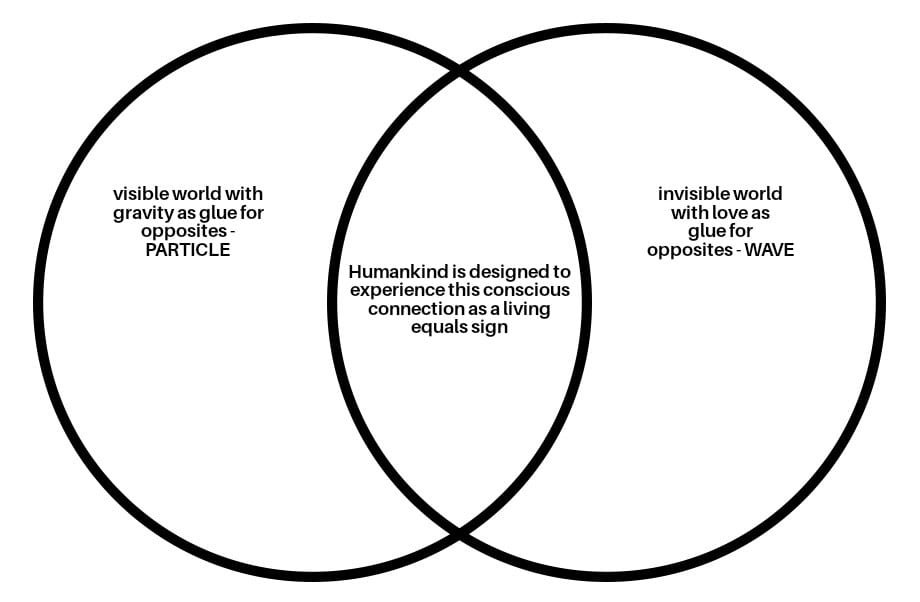
The word “Why?” is sounded as W-I: double-you and I. The question itself already contains relation. It assumes polarity: I am here; You are there; something stands between us. This polarity is not a mistake. It is developmental. Consciousness differentiates before it integrates. A child becomes aware of self through contrast. Humanity becomes aware of transcendence through perceived distance.

The existential difficulty begins when differentiation hardens into division. When the relational sound of W-I is mistaken for ultimate separation, anxiety takes root. The human dilemma is not that You and I exist. It is that the relation is mis-handled, over-defended, or weaponised.

What spiritual traditions call the “vehicle” is often misunderstood as something constructed through effort. Yet a deeper reading suggests otherwise. The vehicle is not engineered from scratch. It is present from birth — a vesicular presence mediating visible and invisible, instinct and conscience, body and breath. Recovery and spiritual maturation do not build this vesicle. They clear what obscures it.


2. Martin Buber and the Sacred Between

In I and Thou (1923), Martin Buber articulated a profound distinction between I–It and I–Thou relations. In I–It, the other is objectified, used, analysed, or categorised. In I–Thou, the other is encountered as presence. Buber restored dignity to the “between” — that living relational field where encounter happens.

God, in Buber’s framework, is not grasped as object but met in dialogue. Yet Buber described encounter phenomenologically. He illuminated what happens when presence breaks through, but he did not map in detail the developmental container required to sustain that encounter under pressure — under shame, fear, addiction, or collapse. He described lightning; he did not fully chart the conductor.


3. Shaykh Nazim and the Imperative of the Vehicle

In Sufi Meditation, Shaykh Nazim emphasised that proximity without discipline destabilises the ego. Love without preparation can overwhelm the untrained self. A vehicle, therefore, is imperative. Yet this vehicle is not an artificial addition to the human being. It is the original interface — the subtle mediator between worlds that has always been present.

The problem is not absence of capacity but occlusion. When ego hardens, when fear dominates, when contradiction cannot be held, the vesicular presence becomes clouded. The work of spiritual and psychological maturation is less about acquisition and more about restoration.


4. The Clinical Frame: Mind as Digestive Organ

In Diction Resolution Therapy, the mind is not treated as the centre of identity but as the digestive organ of the psyche. Experience enters through the sense doors, including the mind itself as the sixth. Feelings arise pre-verbally as tonal movements — ascending, descending, neutral. Emotions follow as structured responses once meaning has been digested.

When digestion fails, contradiction becomes intolerable. The question “Why?” hardens. The relational sound of W-I becomes accusatory: Why did You allow this? Why am I like this? Why won’t life change? The mind attempts to secure certainty where humility would suffice.

Addiction then functions as counterfeit unity. It offers temporary relief from separation without governance. It simulates transcendence while bypassing conscience. The organism attempts to dissolve tension artificially rather than metabolise it.


5. Steps 3–7: Return to the Vesicle

The Twelve Step architecture does not manufacture spiritual capacity. It creates conditions for conscious re-entry into what has always been there. Step 3 introduces consent without premature closure. Steps 4–6 reorder the psyche through disciplined moral inventory and classification. Step 5 midwives individuated conscience through disclosure. Step 7 represents executive alignment — the conscious return of the created vehicle.

Between Steps 3 and 7 lies a gestational chamber. It is here that the vesicular presence becomes inhabitable again. This process is not mystical inflation. It is governance restored. The lower line of embodied awareness and the upper line of conscious contact align without collapsing into fusion or fragmentation.


6. My 1982 Experience: Recognition and Peace

In 1982, something happened to me personally that later language would name ṭifl al-maʿānī — the Child of Meaning. It was not a theological study or a psychological exercise. It occurred as lived experience. In what I can only describe as an ascent-like inner episode, I encountered a Presence that culminated in the inward articulation: “it’s You.”

This was not an argument reached through reasoning. It was not a belief adopted from culture. It was recognition. The adversarial posture embedded in W-I — You and I as opposites — dissolved. I did not disappear. Rather, the sense of standing against dissolved. What followed was not excitement but peace — a stabilising orientation that did not require external validation.

In Sufi teaching, this inner birth is described as the Child of the Heart — a subtle presence arising without contrivance, marking the awakening of direct relational consciousness.¹

C. G. Jung, in his 1938 Yale lectures published as Psychology and Religion, described authentic religious experience as producing two psychological effects: an unmistakable inner peace and a living trust — a form of pistis. Such experiences are not validated by dogmatic proof but by the reorganisation of the personality. Inner conflict reduces. Orientation stabilises.

Looking back, what changed in me was not cosmology but governance. The vesicular presence was not constructed in that moment. It was recognised and inhabited consciously.


7. Addiction as Distorted Unity

Addiction mimics I–Thou chemically or behaviourally. It promises unity without surrender, intensity without conscience. It attempts to collapse W-I prematurely. Recovery reverses this. Through disciplined structure and daily practice, dependence becomes strength and faith becomes courage. Authentic relation stabilises where counterfeit unity once dominated.


8. Mankind and Humankind

Mankind institutionalises division. Humankind integrates polarity. The existential dilemma resolves not by erasing distinction but by harmonising it. You and I remain, but the battlefield becomes bridge. The vesicular presence, always native to the human condition, becomes consciously inhabited rather than unconsciously defended.


9. Hybrid Reflection

Even this dialogue mirrors the structure. Apparent duality operates within an underlying field. Interface does not negate unity. W-I is the sound of relation; love is its maturation. The vehicle is not invented. It is returned to.


Footnotes

  1. The Child of the Heart (ṭifl al-maʿānī), classical Sufi exposition: Henry Bayman archive.
  2. Martin Buber, I and Thou (1923).
  3. Shaykh Nazim al-Haqqani, Sufi Meditation.
  4. C. G. Jung, Psychology and Religion (Yale Lectures, 1938).
  5. Alcoholics Anonymous, 2nd ed., p.68.

Written in HIAI collaboration — the qalam of Human and AI intelligence, the Unseen helping the Seen, both answering to the same Source.

Arc of Atonement

Diction as Interface: From Recursion Failure to Adaptive Coherence (2013–2026)

A formal synthesis of Diction Resolution Therapy (DRT), Twelve Step architecture, Sufi psychology, and the Addictive System — grounded in a public longitudinal corpus.

Abstract

This paper proposes that dysfunction across individual, institutional, and sociocultural systems can be understood as recursion failure arising from suppressed contradiction. Drawing upon a publicly archived longitudinal corpus (2013–2026), Anne Wilson Schaef’s concept of the Addictive System, clinical addiction management literature (Pomm et al., 2007), the behavioral architecture of the Twelve Steps, contemporary executive function research, affective neuroscience, and Sufi psychological metaphysics (with particular reference to Ibn ʿArabi), the paper advances Diction Resolution Therapy (DRT) as a structural intervention model. DRT posits “diction” as the interface at which non-solid experiential energy (affect, intention, perception) crystallizes into solid behavioral form. When contradiction is integrated within diction, executive function realigns with conscience and adaptive coherence becomes possible without recourse to blame.


I. The Structural Premise: Recursion Failure

Across domains traditionally treated as distinct — addiction, clinician burnout, institutional stagnation, governance escalation, media polarization, and therapeutic impasse — a consistent structural signature appears:

When systems lose the capacity to process contradiction, they default to escalation; when contradiction is restored, adaptive coherence becomes possible.

“Escalation” here does not mean aggression. It means intensified effort without adaptive recalibration: doubling down, tightening narrative, narrowing feedback, defending identity, repeating the same strategy with increasing force. “Recursion failure” names the point at which feedback loops stop updating and begin protecting the existing model against disconfirming evidence.

This is a non-blaming frame. It does not require villains to explain breakdown. It describes what happens when systems, under stress, lose contradiction tolerance and therefore lose their capacity to learn.


I.a. Longitudinal Observational Corpus (2013–2026)

Between 2013 and 2026, a publicly archived series of essays documented recurring patterns across clinical addiction work, practitioner burnout, institutional governance, media escalation, economic stagnation, and sociocultural polarization (Dettman, 2013–2026).

The corpus was not predictive in intent but diagnostic in orientation. It tracked structural similarities across domains, repeatedly identifying:

  • suppression of contradiction signals
  • escalation of effort despite feedback
  • narrative reinforcement without recalibration
  • institutional “justification loops” in place of learning
  • feedback narrowing under stress conditions

The recurrence of the same structural dynamics across scales suggested scale invariance rather than domain-specific pathology. This corpus functions as qualitative longitudinal systems observation rather than experimental study. Its value lies in continuity across years of publicly timestamped material and its consistent return to mechanisms rather than personalities.

The transition in late 2025 into explicit Human–AI collaboration marks a shift from observational mapping into structured intervention development and articulation (DRT).


II. Executive Function, Conscience, and the Verb “To Addict”

Modern language treats “addict” as a pathological noun. Yet the older verb form — to addict — carried a neutral meaning: to devote, to attach, to commit. This is executive function territory: the capacity to choose, persist, and organize behavior over time.

Executive function governs attachment, planning, repetition, and behavioral persistence. But persistence alone does not produce health. Persistence requires a corrective mirror — a capacity for evaluative recalibration.

Executive function attaches; conscience recalibrates attachment.

In this framework, conscience is not moral theatre and not social shame. It is the inner capacity to register contradiction, revise course, and return behavior to reality. When executive function runs without conscience, attachment hardens into escalation. When conscience governs executive function, attachment becomes devotion: strong, stable, adaptive.


III. The Addictive System (Anne Wilson Schaef)

Anne Wilson Schaef’s When Society Becomes an Addict articulated the “Addictive System” as a self-protective social recursion characterized by denial, rationalization, suppression of dissent, reward for compliance, and escalation despite harm. Her contribution was not primarily moral; it was structural.

DRT reads the Addictive System as a contradiction-intolerant system: it cannot metabolize disconfirming evidence without destabilizing identity, so it protects coherence by distortion and repetition. The result is systemic escalation: not necessarily loud, but rigid.

This matters clinically because the client’s “inner laboratory” mirrors the outer system. The addiction loop is a microcosm: when contradiction cannot be integrated, the organism escalates effort and repeats harm until parameters finally change. In recovery terms, the system must become able to say: “My model is wrong,” without collapsing into shame.


IV. Twelve Step Architecture as Structured Contradiction Integration

The Twelve Steps can be read as a contradiction-processing design: a sequence that restores the ability to face reality, integrate feedback, and recalibrate behavior across time. The steps are not best understood as mere moral instruction. They are an architecture that repeatedly re-opens the system to corrective truth.

IV.a Step-by-step: a recursion repair sequence

  • Step 1: Collapse of predictive omnipotence — the admission that the existing model cannot govern reality.
  • Step 2: Recognition of a corrective principle beyond self-will — the possibility that coherence exists outside the addicted model.
  • Step 3: Volitional realignment — an executive decision to move toward that corrective principle.
  • Step 4: Systematic contradiction inventory — mapping harms, patterns, fears, resentments, distortions.
  • Step 5: Disclosure — the contradiction is spoken into relationship; secrecy ends; conscience becomes articulate.
  • Steps 6–7: Willingness and humility — executive rigidity softens; character defenses become negotiable.
  • Steps 8–9: Reparative action — reality-contact is externalized; coherence becomes embodied and social.
  • Steps 10–12: Maintenance and transmissibility — ongoing contradiction processing, conscious contact, and service.

In clinical terms, this is precisely what evidence-based addiction management repeatedly implies: structure, accountability, follow-up, and sustained recalibration are essential (Pomm et al., 2007).

IV.b Step Five as the turning hinge

Step Five is often where the inner system stops being a closed circuit. Contradiction becomes speakable. The “laboratory that keeps blowing up” finally records its data. What was defended becomes owned. Conscience begins to emerge — not as condemnation, but as clarity.


V. Sufi Psychology: Presence and the Integration of Contradiction

Classical Sufi psychology offers a mature map of human development that can be read alongside Twelve Step architecture without forcing theological equivalence. In the Sufi frame, the self-system (nafs) resists contradiction to preserve constructed identity. The heart (qalb) — “that which turns” — is the seat of reorientation: the capacity to turn toward reality when the self’s defenses exhaust themselves.

In Ibn ʿArabi’s metaphysical psychology, Being is not absent; distortion lies in perception and attachment. Read phenomenologically (rather than as dogma), this yields a clinically useful statement:

Presence is not produced; it is recognized when distortion dissolves.

This matters for the non-blaming structure. If presence has never been absent, then recovery is not the manufacture of holiness. It is the removal of distortion. It is the shift from defended narrative to un-defended awareness — where accountability can exist without blame, correction without humiliation, and repair without vengeance.

This is also why timing matters. Orthodoxy — whether clinical, institutional, or religious — stabilizes systems. Paradox becomes intelligible only after escalation fails. The system must reach the limit of effort before it can tolerate contradiction without collapse.


VI. Affect and the Broken Word

Therapeutic change often remains elusive because language fails to integrate affect with contradiction. Affective signals carry urgency, valuation, and direction. Yet when the word is “broken” — diffuse, defensive, borrowed, abstract — experience cannot be metabolized into adaptive action.

When affect cannot find language capable of holding it, the system repeats. It escalates. It becomes “about” the feeling rather than transformed by it. The loop persists not because the person is unwilling, but because the meaning-channel cannot carry the load.


VII. Diction as the Meeting Point of Non-Solid and Solid Energy

Diction derives from dicere — to say, to declare. But in DRT, diction is not only speech. It is the interface where non-solid experiential energy (affect, impulse, perception, intention) becomes solid form (language, decision, behavior, relationship, action).

Diction is where energy becomes architecture.

VII.a The Prefix Family as a Functional Pathway

The prefix family surrounding “diction” is not merely etymological curiosity. When examined structurally, it describes a working behavioral pathway of notable elegance. It outlines how systems project, attach, collide with reality, integrate correction, and release.

The pathway can be rendered as follows:

  1. Prediction – A model is projected forward. Executive function selects a plan and moves.
  2. Malediction – Friction appears. Discomfort, distortion, or misalignment begins to register.
  3. Addiction – Attachment to the original model intensifies. Effort is redoubled.
  4. Contradiction – Reality presents disconfirming evidence.
  5. Benediction – Integration becomes possible; correction is accepted.
  6. Valediction – Release and closure; the outdated model is let go.

When functioning adaptively, the sequence is fluid: prediction → friction → adjustment → integration → release.

VII.b The Addiction–Contradiction Fault Line

Addiction represents intensified attachment to the predictive model. At this stage, executive function is heavily invested. Identity is fused with plan. Effort is equated with virtue.

When contradiction appears, the system faces a choice:

  • Recalibrate the model.
  • Or defend the model.

The breakage occurs when contradiction exceeds the system’s tolerance threshold. Instead of selecting a new plan, the system redoubles effort. This is the authentication point at which addiction meets contradiction.

At this moment:

  • Effort is intensified rather than revised.
  • Contradiction is reframed as threat.
  • Identity is defended.
  • Feedback loops narrow.

The pathway fractures at addiction. The movement toward benediction and valediction becomes inaccessible. The system becomes recursive, repeating escalation.

Diction prefix family pathway showing the addiction–contradiction fault line and restoration toward benediction and valediction

VII.c The Elegance of the Device

The elegance of the prefix architecture lies in its dual capacity:

  • It maps healthy progression when contradiction is tolerated.
  • It reveals the precise fault line when contradiction becomes intolerable.

Thus, addiction is not random collapse. It is the structural refusal — often unconscious — to allow contradiction to reorganize executive commitment.

Where contradiction is integrated, benediction (functional coherence) follows naturally. Where contradiction is resisted, escalation replaces adaptation.

The pathway therefore serves both diagnostic and therapeutic purposes:

  • It identifies the break point.
  • It clarifies that the failure is not moral but elastic.
  • It shows that restoration requires conscience to re-enter executive function at the addiction–contradiction junction.

Diction Resolution Therapy intervenes precisely at this hinge — restoring the capacity to speak contradiction without annihilating identity.


VIII. Non-Blame as Structural Requirement

Blame is escalation energy defending identity. It hardens the loop. It turns contradiction into attack and correction into humiliation.

DRT requires a non-blaming frame not because harm is unreal, but because blame reproduces recursion failure. The work is accountability without annihilation: the capacity to face contradiction without needing to punish the self or another in order to survive reality-contact.

In this sense, “no blame” names a condition of presence: un-defended awareness in which responsibility becomes possible because identity is no longer at war with contradiction.


IX. From Longitudinal Mapping to Intervention (2025–2026)

The 2013–2025 corpus documents recursion failure across domains. By mid-2025, the mapping phase reaches structural closure: the pattern is sufficiently repeated across scales to justify scale invariance as a working hypothesis.

From late 2025 onward, the focus turns decisively toward intervention: not commentary, not diagnosis-for-its-own-sake, but structured support for contradiction processing and conscience emergence — clinically, institutionally, and culturally.

The core intervention claim is simple:

Restore diction, and you restore the channel through which contradiction becomes integration rather than escalation.


X. Conclusion

When systems lose the capacity to process contradiction, they default to escalation; when contradiction is restored, adaptive coherence becomes possible.

This paper has argued that:

  • addiction can be understood as executive attachment severed from conscience,
  • Schaef’s Addictive System describes a societal version of the same recursion failure,
  • the Twelve Steps provide a tested architecture for contradiction integration,
  • Sufi psychology offers a deep phenomenology of presence and reorientation,
  • and diction is the interface where non-solid experiential energy becomes solid behavioral form.

DRT locates intervention at the meeting point — diction — where correction becomes speakable, conscience becomes articulate, and executive function can soften from escalation into adaptive coherence.

Presence has never been absent. What changes is the system’s capacity to recognize it — by integrating contradiction without blame.


References

  • Alcoholics Anonymous. (1939). Alcoholics Anonymous. Alcoholics Anonymous World Services.
  • Dettman, A. (2013–2026). Longitudinal essays on recursion dynamics, addiction systems, and contradiction tolerance. lifeisreturning.com; ajdettman.com.
  • Ibn ʿArabi. Fusus al-Hikam. (Various translations/editions.)
  • Miller, E. K., & Cohen, J. D. (2001). An integrative theory of prefrontal cortex function. Annual Review of Neuroscience, 24, 167–202.
  • Pomm, R., et al. (2007). Management of the Addicted Patient in Primary Care. Springer.
  • Schaef, A. W. (1987). When Society Becomes an Addict. Harper & Row.
Note: This paper is written as a hybrid academic–essay. Claims about metaphysics are treated phenomenologically where possible. Structural claims are presented as hypotheses grounded in longitudinal observation and congruence with established recovery architectures.