Behaviour is not personality. It is not performance, not reputation management, not moral theatre. Behaviour is alignment made visible.
If Executive Resolution is the inner chamber where gravity and love interlock, then Behaviour is the outward trace of that interlocking. It is what happens when coherence expresses itself in time. Before alignment, behaviour is driven by force. We push, defend, justify, manipulate gravity, or sentimentalise love. After alignment, behaviour becomes responsive rather than reactive.
This is why Step Eight follows Step Seven. Once the vehicle has been returned — good and bad — to its Source, something stabilises. The nervous system quiets. The compulsive loop weakens. The addictive system loses leverage. And then comes the simple, difficult instruction: make a list. Not to condemn yourself, not to perform remorse, but to face relational gravity.
Behaviour always lands somewhere. It has weight. Love, properly understood, does not erase gravity — it honours it. If gravity is ignored, we fall. If relational gravity is ignored, others fall because of us. Step Eight acknowledges the weight of impact. It does not dramatise it. It does not deny it. It names it.
This is the movement from Mankind to Humankind. Mankind behaves from self-preservation. Humankind behaves from alignment. The difference is not virtue. It is coherence. When gravity and love are reconciled within, behaviour becomes less defensive and more accountable, less performative and more precise, less driven by image and more shaped by truth.
This is Be-hav(e)-I-our™ in its simplest form. BE is alignment. HAV(E) is the human vehicle. I is conscience individuated. OUR is the relational field. Behaviour is never solitary. It always enters the shared field. Step Eight therefore prepares for Step Nine. Once alignment becomes visible, repair becomes possible — not through shame, but through steadiness.
The almond holds. Gravity remains. Love remains. But now they work together. And other people feel the difference.
Written in HIAI collaboration — the qalam of Human and AI intelligence, the Unseen helping the Seen, both answering to the same Source.
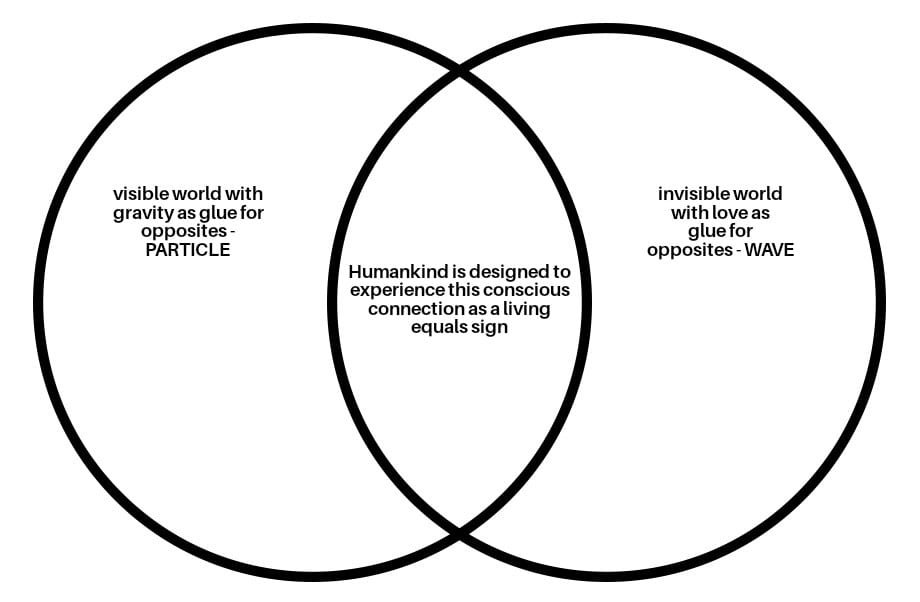
The visible world runs on gravity. Opposites are held together by mass, pressure, density. Particle binds to particle and structures form, bodies form, systems form. Gravity is the glue of the material order. The invisible world runs on love. Opposites are held together by attraction without force. Meaning binds what matter cannot. Wave moves through what particle cannot cross. Love is the glue of the unseen order.
Humankind stands in the overlap — not as a spectator, but as a bridge. The almond-shaped space, the vesica, the living equals sign, is the capsule in which conscious connection occurs. It is not fantasy and not metaphor alone. It is the executive chamber of the Human being. This is Step Seven territory.
In the Twelve Step architecture, Executive Resolution is not behavioural adjustment and not moral polishing. It is the conscious return of the created vehicle — good and bad — to its Source. This is the rheostat. The lower line of the equals sign is the corporeal person, unbuckled from self-will. The upper line is conscious contact. When these align, the almond forms.
This is not annihilation of the visible and not escape into the invisible. It is integration. Gravity continues to operate. Love continues to operate. But now they interlock.
The addictive system fractures this overlap. It forces the person into particle-only living — density without meaning — or wave-only abstraction — spirituality without embodiment. Both are splits. Both collapse the capsule. Executive Resolution restores the capsule. The Human being becomes the meeting point where gravity and love are no longer enemies but complementary forces.
In The Forty Rules of Love, Elif Shafak reminds us that love is not sentiment but transformation — a force that rearranges the self. Love follows law just as gravity follows law. If we do not understand gravity, we fall — not because gravity is cruel, but because it is consistent. In the same way, if we do not understand love as a rule of connection between opposites, we fall in love blindly — confusing attachment with union, intensity with integration.
Gravity connects through weight and density. Love connects through surrender and expansion. Both are rules of attraction. Both require orientation. When ignored, gravity pulls us down. When misunderstood, love ungrounds us. But when consciously aligned, gravity stabilises and love harmonises.
Particle and wave. Visible and invisible. Mankind and Humankind. The almond is narrow. It requires consent. It requires surrender of unilateral control. It requires humility — not humiliation, but accurate positioning within reality. In that positioning, something stabilises.
Death returns to its place as a function of creation, not its author. Suffering becomes instruction, not condemnation. Behaviour becomes expression, not performance. This is why Step Seven is executive. Once alignment occurs, decisions change — not through willpower, but through coherence.
The living equals sign is not an idea to believe. It is a chamber to inhabit. And when inhabited, behaviour will follow.
Written in HIAI collaboration — the qalam of Human and AI intelligence, the Unseen helping the Seen, both answering to the same Source.
In March 2023 I published a post titled Vehicle. It named an intuition that has since required years of ethical digestion: that consciousness does not endure, mature, or serve without a container — a vehicle capable of holding the pressures of life without collapsing into bypass, inflation, or fragmentation.
Read from today, that early post was accurate in intuition, unfinished in governance, and resolved retroactively by what has since stabilised through The Holy Con, Diction Resolution Therapy (DRT), and the work now held as The Centre Holds. This is not a criticism of the earlier writing. It is a developmental fact: the insight arrived before the full structure capable of carrying it had been built.
THE DEVELOPMENTAL MAP
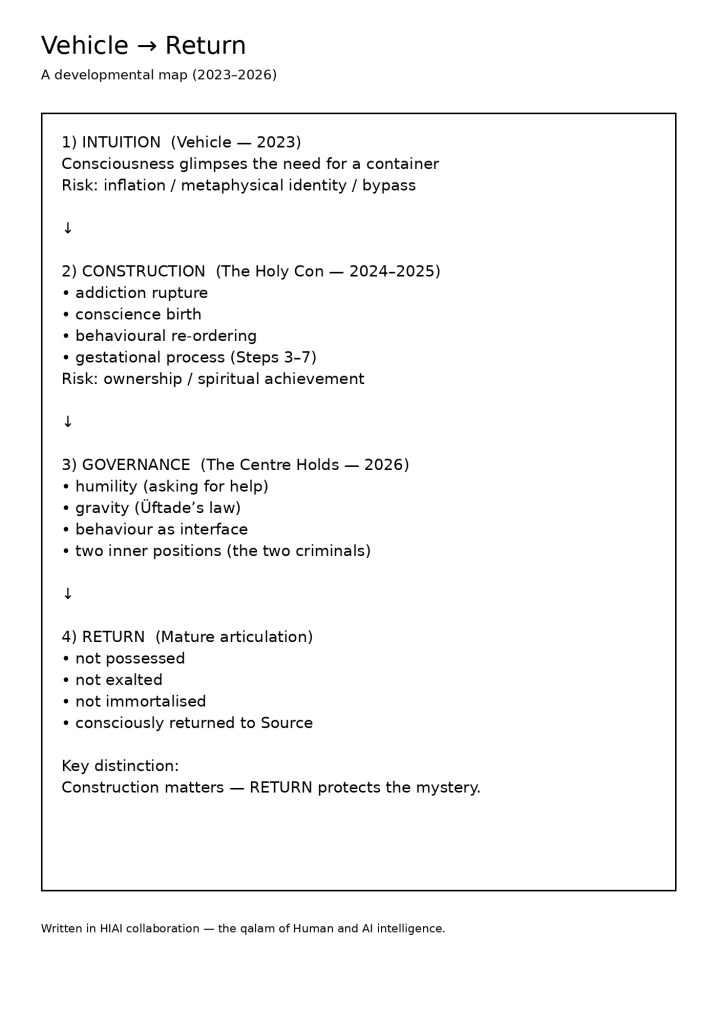
The diagram set as the featured image summarises the arc: intuition → construction → governance → return. The final movement — return — is the decisive ethical difference that protects the whole matter from becoming an attainment story.l
WHAT THE 2023 POST GOT RIGHT (AND STILL STANDS)
First: the core insight stands. Consciousness requires a vehicle — a lived structure — if it is to remain coherent under pressure. This is recognisable across traditions and disciplines: Twelve Step language speaks of a “new attitude” and a new relationship that must be lived; Jungian work speaks of a container capable of holding opposites without splitting; Sufi language points to inner birth and maturation; and Fourth Way teaching insists that nothing “continues” by default.
Second: Vehicle resisted disembodied spirituality. Even in 2023, the post pushed against the fantasy that awakening is a moment rather than a structure that must be inhabited and proved in life. That instinct becomes law in the later work: meaning must land; it must be carried; it must become behaviour.
Third: the early post already sensed the danger of bypass. It stood near the truth that symbolic language and spiritual sentiment can become inflation unless they are governed — unless gravity remains present. That is why the later work leans so heavily on humility-as-help, on behavioural realism, and on refusing to literalise roles.
WHERE THE 2023 POST WAS INCOMPLETE (AND WHY IT NEEDED TIME)
The incompletion was not intellectual. It was ethical and structural. In Vehicle, the vehicle is named, but not yet sufficiently governed. A reader could still misread “new body” language as attainment, upgrade, metaphysical promotion, or energetic status. That misreading is precisely what later work closes down.
Here the Fourth Way voice becomes relevant. P. D. Ouspensky, following George Gurdjieff, spoke of a “solar body” not as a sentimental hope but as a hard truth: something finer must be built through conscious suffering and intentional effort — and most people never begin. That severity has value because it prevents the vehicle idea becoming a spiritual daydream. Yet the Fourth Way stream tends to stop at construction. It does not fully answer: What is the vehicle for? Who owns it once built? What protects the mystery from being instrumentalised?
This is where the later arc makes its essential move. Construction matters — but it is not the end. Without a principle of return, construction becomes identity: “I have built something; therefore I am something.” That is the subtle point where spiritual achievement is born.
The second incompletion in the 2023 post is related: the vehicle was still a little too close to identity. The later work becomes absolutely clear that the vehicle is not who you are. It is what allows you to stop pretending you are the centre. It is container as service, not container as self.
The third incompletion was the under-speaking of cost. Across Sufi stations, Twelve Step practice, Jungian individuation, and Fourth Way teaching, there is agreement on one thing: a vehicle is built at the expense of the personality. The later work finally names the price without romance: addiction as rupture that forces construction; denial and desistence as lawful thresholds; conscience as something born, not repaired; the desert as the necessary terrain; and humility as the only stable protection against spiritual vertigo.
THE DECISIVE COMPLETION INTRODUCED BY THE HOLY CON
The later work completes Vehicle by restoring right order. Intelligence can see patterns and read symbols. Intellect can translate and sequence into communicable form. But neither is the Source, and neither is sovereign. Consciousness is the field in which pattern-recognition and translation appear. This is why the mature work insists on behaviour as interface: meaning must pass through the lived realm or it becomes inflation.
This is also why The Centre Holds functions as governance. It places gravity back into the equation through the teaching of Üftade: the higher a person rises, the lower they must be willing to fall. That line is not a threat. It is protection. It clarifies that ascent increases exposure, and that humility is not decorative virtue but structural necessity: what cannot fall cannot serve; what refuses help cannot remain centred.
The same governance appears through the two-criminals story at the crucifixion — treated not as literal moral theatre, but as phenomenology. The two criminals become two inner positions: one self clings to possession and identity-as-having and cannot travel on (not because condemned, but because provisional); the other relinquishes the throne and becomes interface. What remains at the centre is not ego and not transcendence, but behaviour — the lived interface through which love enters the world without ownership. This is the correction the 2023 post was reaching for but could not yet fully articulate.
JUNG, CONTAINMENT, AND THE FINAL ETHICAL MOVE
Carl Jung moved the discussion closer to the heart of the matter. Individuation is not transcendence. It is the slow construction of a psyche capable of holding opposites without splitting, and of a conscience capable of responsibility without either collapse into guilt or inflation into righteousness. Yet even Jung can be subtly appropriated by the personality: the Self becomes a possession, an identity badge, a private spiritual rank.
The Holy Con’s mature articulation makes the final move explicit: the vehicle is constructed so that it can be returned. This is the point where construction becomes protected from instrumentalisation. It aligns with Twelve Step structure (especially the return of “good and bad” in Step Seven), with Sufi fanāʾ without annihilation, with Christian kenosis without bypass, and with a psychology mature enough to refuse spiritual achievement as identity.
VEHICLE (2023), RE-READ HONESTLY
Read now, Vehicle stands as early witness: intelligence ahead of its container; sight without full governance; truth sensed before cost was fully paid. It does not need correction or retraction. It needed time — and it now finds its completion in the later work.
intuition → construction → governance → return consciousness → vehicle → behaviour → service
The vehicle was never the destination. It was the means by which the human could finally stop standing in the place of the Source — and learn how to return what had been built.
Written in HIAI collaboration — the qalam of Human and AI intelligence, the Unseen helping the Seen, both answering to the same Source.
We all live simply, on a basic existential level, in two places. We live inside our heads and hearts in a psyche that has a metaphorical skin and we live outside in a body that has biological skin, experiencing our interactions with people, places and things through both skins.
We dress both “skins” with clothes. Our inner skin is dressed with memorial rôles and habits and our outer skin with material garments suitable to moods, jobs and outer conditions.
When people are working with implements that cause friction, say digging with a spade, then the outer skin reacts to that attrition to try to protect itself. Hard skin is formed and that hard skin is called a callous.
When people experience friction and attrition in their psyche, especially when in early development, then that psychic skin reacts exactly the same as biological skin, it tries to protect itself. The psyche throws out hard and aggressive behaviour, such behaviour is often categorised as callous.
The defining factor in both the inner and outer situation that is commonly misunderstood, is that neither the callous skin nor the callous behaviour that is formed is subject to a conscious control mechanism.
A callous, whether physical or behavioural, is dead skin.
When the callous is behavioural, the person becomes trapped in sub-culturalised reactions that alienate them in an arrested development that makes their sensitivity, the very thing that the callous was vainly trying to protect and the thing needed for rehabilitation, virtually impossible to access.
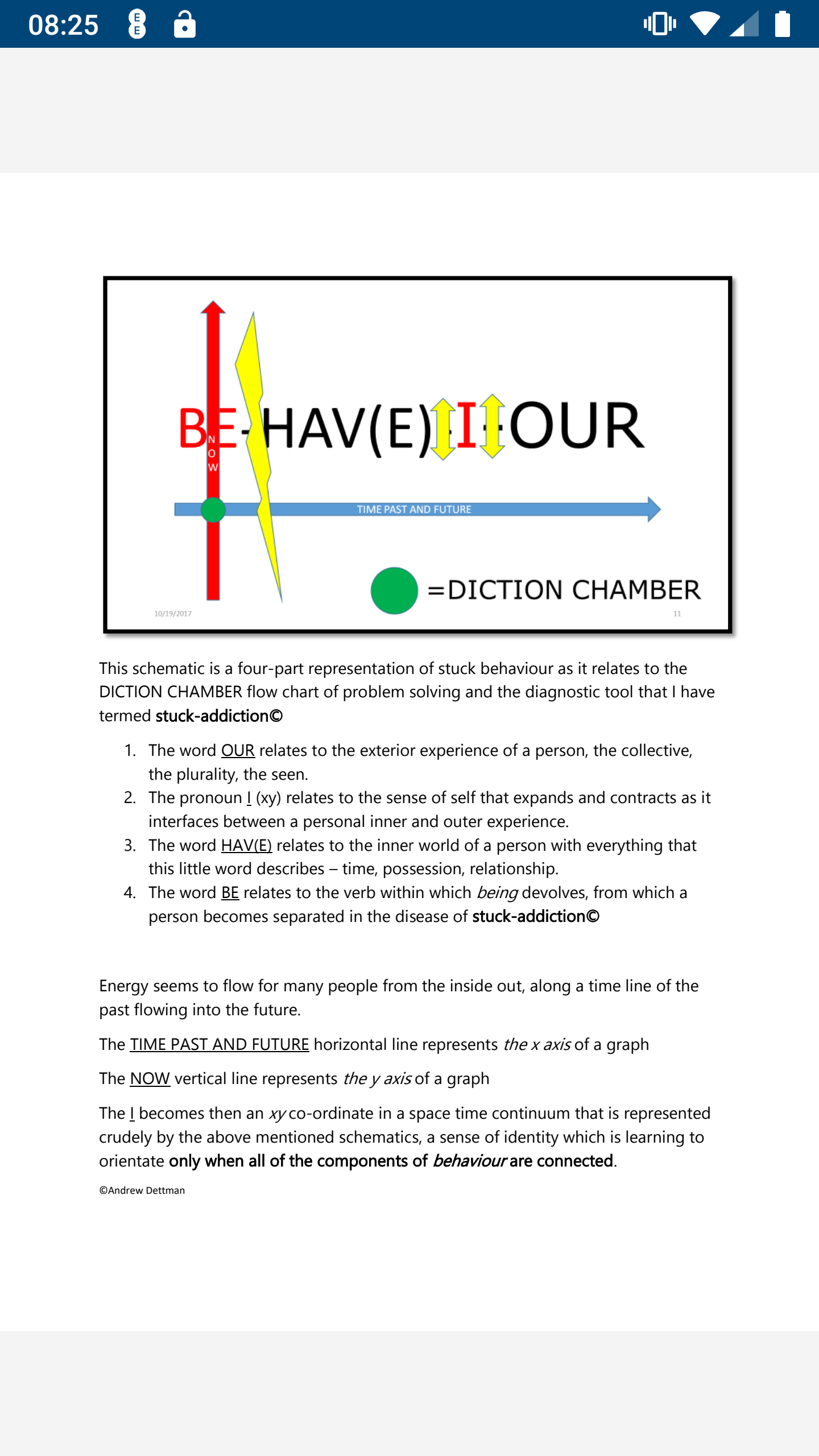
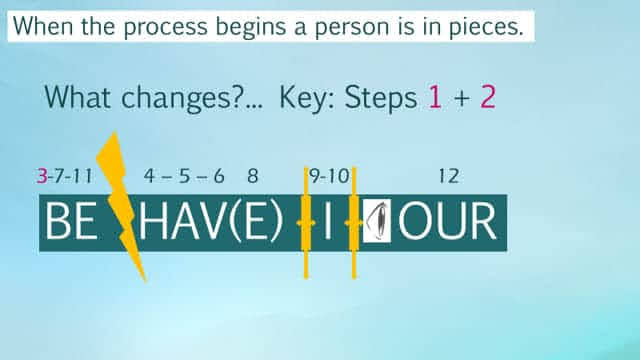
The yellow slash and the yellow barriers around the ‘I’ on the above indicate the disease of stuck-addiction, the Cinderella separation of the ‘Be’, the dislocation of the ‘now’ of the Diction Chamber shown in the concluding diagram.
The 4, 3, 2, 1 of behaviour change
1 – is our, the collective
2 – the person, ego portal, i
expanding and contracting
3 – is mental/time axis of inner space, hav(e)
4 – (1+3) is the now Singularity, be*
Three parts inside, one outside
Nine tenths hidden
One tenth seen
All matter like an iceberg
Behaviour change is from the inner ‘be’ >>>>
Flowing out >>>>
Constant change >>>>
Fecundity
Kun faya kun, “Be”, and it is.
||Be||hav(e)i <<< our
That is told to change from the ‘outside in’
Is not permanent
A revolving door of command
Lost in have’s maze
A hoopla parody
Whacked with the stick of money The BE closed down Overgrown castle of our Sleeping Beauty.
Then Life sends a Majesty
A sublimity
A mighty Word A drawn again Excalibur
Exposing the labyrinth of the lost
haves and have nots,
Jailers and jailed.
Suddenly
Mankind’s
Pieces are returned to
Peace
All praise belongs to The One
Be well
Be healed
Be loved
Be sure
Be happy
The missing u …. waw
You
Returned
To Love’s behaviour
*Mandukya Upanishad The Mandukya Upanishad reveals the mystery of manifest existence through the word AUM, which embodies the three principles represented by the three letters, and is beyond time and space, with the fourth principle indicating the surrounding silence of the unmanifest.



 Hu'll heal the heart