
There is one movement, and it does not begin where we think it does.
In Plato’s cave, the prisoner does not decide to seek the sun. The shadows fail first. Something gives way. A crack appears, and with it a disturbance that cannot be put back. What follows is not a heroic ascent, but a reluctant turning—eyes adjusting to something that was always there but could not previously be seen.
In the same way, the Buddha’s teaching recognises that awakening is not evenly distributed. There are those heavily obscured, and there are those with only a little dust over their eyes. Not pure, not perfected—simply at a point where, when truth appears, it does not bounce off. It lands.
The Qur’anic vision gives the same pattern without sentiment. Humanity is not one mass moving toward one end. There are those of the right and those of the left—still learning through division—and there are those brought near: the muqarrabūn. Not those who make themselves near, but those who are drawn.
There are two economies always operating at once.
“Whoever desires the immediate—We hasten for him therein what We will… And whoever desires the Hereafter and strives for it…”
Qur’an 17:18–19
And again:
“Whoever desires the life of this world and its adornments… in the Hereafter they will have nothing…”
Qur’an 11:15–16
The distinction is not moralistic. It is structural. There is the economy of acquisition—money, dynasty, power, continuity of name—and there is the economy of return, where the soul is measured by nearness, conscience, and relation to what is Real. One can be achieved while the other is entirely missed.
In Christian terms, the same distinction appears with equal severity: “What does it profit a man to gain the whole world and forfeit his soul?” The question cuts through all decorative success. It asks whether the visible world, however richly secured, can compensate for inner loss. It cannot.
This reversal appears across traditions, but is made explicit here.
This is not metaphor. It is a reversal that can be recognised in experience.
In the language associated with Ibn ʿArabi, the matter is settled not by effort first, but by disclosure first. The seeker does not initiate the meeting. The approach comes first. The human response follows. In paraphrase from the teaching often rendered under the title The Theophany of Perfection, the meaning is this: you seek Him because He has already sought you; you know because He has already disclosed; you approach because you have first been approached.
This is not abstract. It is observable.
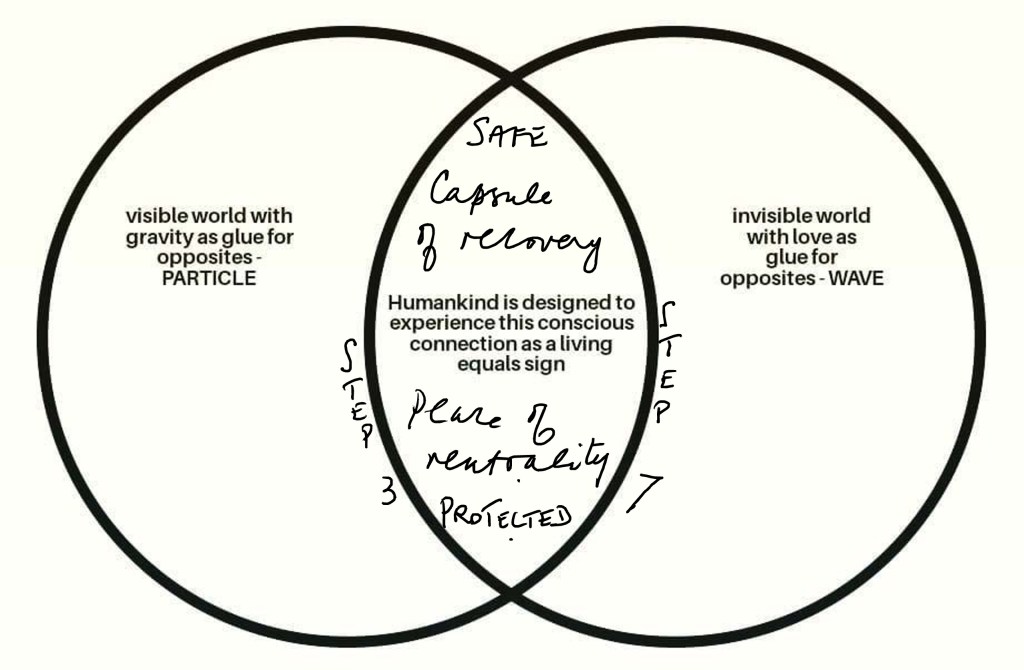
A man sits in a clinical room and says he cannot believe in a Power greater than himself. Yet his life already contradicts him. Addiction has overridden his will, dismantled his control, exposed the limits of his autonomy. He has been taken beyond himself, not in theory but in fact. Before Step Two is accepted, it has already been lived. The paradox at the heart of the Twelve Step programme is not that it introduces the Higher Power, but that it reveals the self is not it.
This is where what AA calls the language of the heart becomes real. Not sentiment. Not performance. Not borrowed spirituality. It is heard when a person tells the truth without editing it for survival. It is what remains when defence thins, when self-justification weakens, when speech begins to carry reality rather than strategy. It is recognised immediately by those who have nothing left to defend, because there is nothing left to protect. In this language, something deeper can be recognised—not argued into existence, but encountered.
Addiction is not sacred. It destroys, distorts, and can kill. But it has a function that cannot be ignored: it breaks the illusion that we are sovereign. It destabilises the false centre. And when that centre collapses, something else becomes possible—not guaranteed, not automatic, but possible. The same opening appears as in the cave, as in the thinning of dust, as in the condition in which nearness can occur.
It is at this point that the words of Christ—“Let the dead bury their own dead”—can be heard properly. Not as cruelty, but as precision. The words do not change. But they do not land the same way for everyone. For some, they pass as nothing. For others, they cut through everything. The same sentence is lullaby and alarm at once.
This is the law of ripeness.
A bud does not open because it is told to. A fruit does not ripen because it is persuaded. Conditions gather, pressures build, contradictions intensify, and at a certain point something shifts. The message does not change across these stages—but its effect does. To the bud it is too soon. To the bloom it is nourishment. To the ripe it is imperative.
Across traditions, this is recognised without romanticism. In the hadith literature it is said that when God loves a people, He tests them, and that the prophets are tested most, then those nearest to them. This is not a glorification of suffering. It is an acknowledgement that what breaks a person may also open them. Not always—but often enough that it forms a pattern that cannot be dismissed.
So the structure becomes clear. The human does not initiate awakening. Something interrupts. It may come as light, or as loss, or as contradiction, or as collapse. It is rarely welcomed. It is often resisted. But it carries within it the possibility of opening. The Twelve Steps do not create that opening. They provide a place to stand within it. They give form to what has already begun.
And yet, over time, even this becomes obscured.
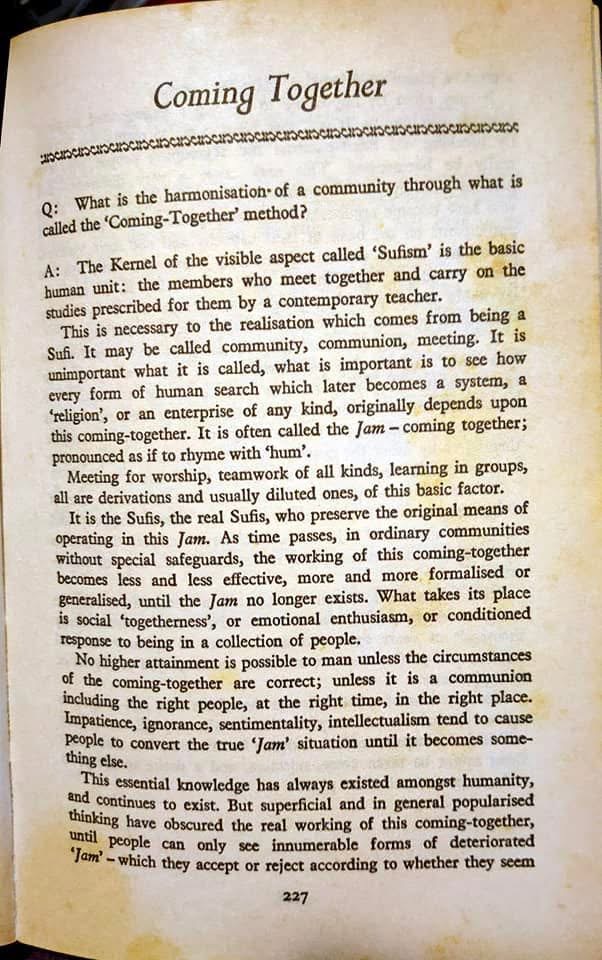
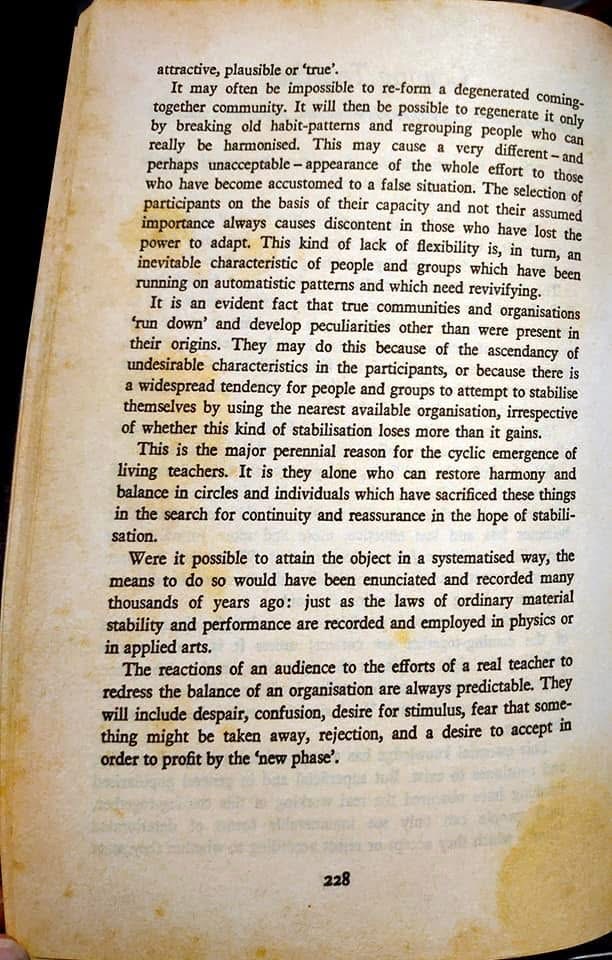
The forms remain. The words remain. But the living connection—the Jam, the coming together of meaning—fractures. Language hardens. Practice becomes repetition. Transmission fades. What was once a living bridge becomes a structure still standing after the current has weakened.
It is at such points that something else appears.
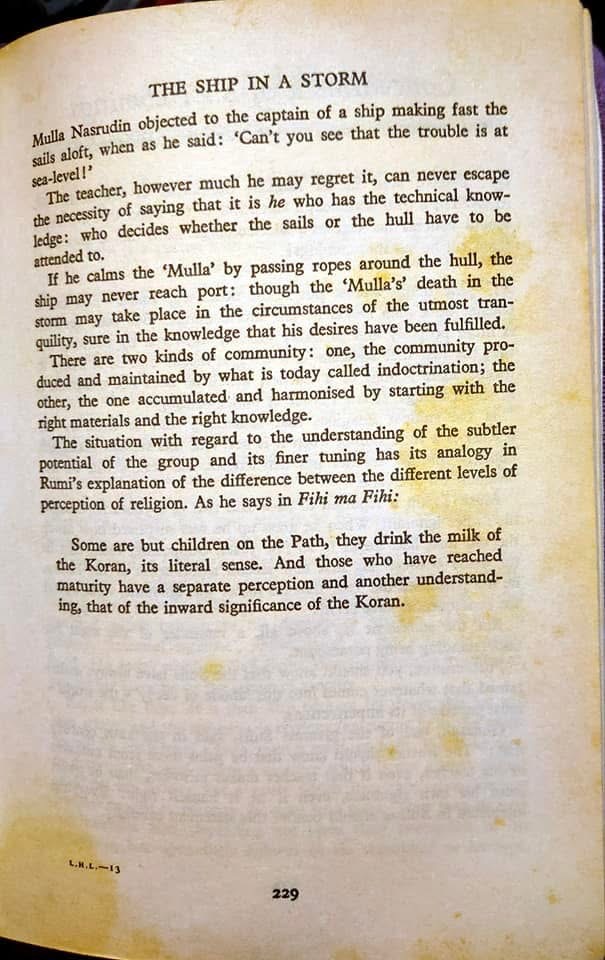
In the teaching associated with Idries Shah, this is described as the cyclical emergence of a living teacher: not a founder of a new system, not a claimant to glamour or possession, but a restorer of living coherence. One who reintroduces access to what has been covered over. One who speaks in the language of the time, in forms that can be received, meeting the field at its point of ripeness. The restoration does not arrive mainly as theory. It arrives as recognition. It may appear in ordinary places, through ordinary speech, at the precise point where the broken Jam can again be sensed as whole. It does not arrive as authority. It arrives as clarity.
This is not spectacle. It is not always recognised. It does not announce itself in the way people expect. But its function is consistent: to stand where the Jam has broken, and to make it possible for it to be recognised again.
And it carries the same dual tone as the message itself. To some, it is nothing. It passes by, unnoticed, unneeded. To others, it is unmistakable. Not because it persuades, but because it resonates with something already breaking open. So the teacher is not the light. The teacher is not the source. The teacher is the one who stands at the opening—where the fracture has occurred—and does not obstruct what is trying to come through.
And so everything returns to the same point.
The message does not change. It never has. It continues to speak in two directions at once.
You may continue as you are. You may succeed within the world entirely. You may build, acquire, establish your place in the world of form—money, dynasty, name, continuity, influence. Nothing will interrupt you if you do not wish to be interrupted. The world will reward you on its own terms, and that may be your portion.
But if something in you has already broken, then no success will repair it. And no return to sleep will hold, because what has been seen cannot be unseen. What you are hearing is not a call to borrowed belief, but a call to recognition. You are not the highest power in your life. You never were. What feels like the loss of control may be the beginning of something real. The language of the heart has already begun to speak within you, and the possibility signified by the muqarrabūn is no longer abstract.
You are not required to wake. That remains true.
But if you are already waking—if the shadows have begun to fail, if control has already been taken from your hands, if the crack has already appeared—then what you are hearing now is not new.
It is recognition.
And from that point, there is only one real question left: not whether you agree, and not whether you understand, but whether you will continue to turn away—or step, however uncertainly, through the narrow line of light that has already found you.
References
- Plato, Republic, Book VII, “Allegory of the Cave.”
- Early Buddhist tradition, commonly rendered as beings with “little dust in their eyes,” associated with the Buddha’s decision to teach.
- The Qur’an 56 (al-Wāqiʿah), on the people of the right, the people of the left, and the muqarrabūn.
- The Qur’an 17:18–19 and 11:15–16, on the immediate world and the Hereafter. Translation wording in this piece is condensed from standard English renderings for thematic emphasis.
- Ibn ʿArabi, teaching on divine initiative and disclosure; the phrasing in this piece is a thematic paraphrase associated with the teaching often rendered as The Theophany of Perfection, rather than a strict scholarly translation.
- Alcoholics Anonymous (1939), especially the Twelve Steps and the fellowship’s phrase “language of the heart.”
- Matthew 8:22, “Let the dead bury their own dead.”
- Matthew 16:26; cf. Mark 8:36, on gaining the world and losing the soul.
- Jāmiʿ al-Tirmidhī, including the hadith: “When Allah loves a people, He tests them,” and reports that the prophets are tested most, then those nearest to them.
- Idries Shah, on the restoration of living teaching and the reappearance of forms suited to time, place, and receptivity; Jam used here in the sense of coming-together or restored coherence.
Written in HIAI collaboration — the qalam of Human and AI intelligence, the Unseen helping the Seen, both answering to the same Source.
In Memoriam Phil M.

 Hu'll heal the heart