The Mystery and the Mystic across centuries.

A Comparative Critique of AI Interpretation of Shabistari and Its Resonance with Contemporary Clinical Work

Contextual Note
The reflections that follow arise from a colleague’s exploratory dialogue with an AI system concerning passages from Mahmud Shabistari’s Golshan-e Raz (The Garden of Mystery). That AI-generated interpretation was shared with me for consideration. What follows is therefore written as a critique and comparative commentary: first assessing the psychological framing offered in the AI interpretation of Shabistari, and then examining how those insights resonate with the clinical and philosophical framework developed in Andrew Dettman’s work on Diction Resolution Therapy (DRT) and its integration with Twelve Step recovery dynamics. The aim is not to conflate traditions but to explore whether structural correspondences exist between classical mystical psychology and modern therapeutic practice.

1. The Sufi Separation of Illusion from Being and the Digestive Mind

In the Shabistari dialogue that prompted this reflection, the central psychological claim is that the work of the path is not primarily thinking but recognition of misidentification. Thoughts arise, emotions arise, identities arise, yet awareness precedes them. The practical instruction is to notice what changes and notice what is aware of change. The work therefore consists in ceasing to identify exclusively with what changes and recognising the field in which change occurs (Shabistari dialogue, Golshan-e Raz, March 2026).

This insight aligns strikingly with a proposition developed in Diction Resolution Therapy: that the mind is not the seat of identity but the digestive organ of the psyche. If the mind functions digestively, then thoughts are not the self; they are movements of processing. The analogy used in that framework—thoughts to the mind are like peristalsis to the body—places cognition in a functional rather than ontological role. In both frameworks the same shift occurs: thoughts become events rather than identity. What the Sufi text describes as recognising awareness prior to mental content corresponds closely with the clinical reframing of the mind as a process rather than the person. Identity relocates from the narrative activity of thought to the deeper field of presence in which thought occurs.

2. Pre-Verbal Assumptions and the Feeling–Emotion Distinction

The AI interpretation of Shabistari correctly observes that the illusion of separateness is not primarily a verbal belief but a pre-verbal structure embedded in the organism. Before words arise, contraction appears in the body; threat responses activate; defensive patterns form; identity is organised around survival assumptions. These are not explicit thoughts but organising principles of perception that shape what becomes conscious (Shabistari dialogue, Golshan-e Raz, March 2026).

This description parallels the distinction made in the DRT framework between feeling and emotion. In that model feelings are primary organismic signals—ascending, descending, or neutral tones that arise prior to interpretation. Emotions are the interpretive narratives constructed after those signals are digested by the mind. When the organism experiences a descending feeling tone, for example, the mind may construct fear, shame, or anger narratives in response. The Shabistari analysis of pre-verbal assumptions operating beneath thought mirrors this structure. What mystical psychology calls embodied assumptions corresponds to what the clinical model identifies as feeling tones. In both cases the narrative layer of emotion is secondary to a deeper biological signal. The work therefore becomes not suppression of emotion but recognition of the pre-verbal signal beneath it and the loosening of identification with the narrative that forms around it.

3. Witnessing and the Twelve Step Template

The Shabistari material emphasises that the separation of illusion from Being occurs through witnessing rather than reasoning. The Arabic term mushāhada implies a direct seeing or presence in which experience is observed without immediate identification (Shabistari dialogue, Golshan-e Raz, March 2026).

This process has a close analogue in the architecture of the Twelve Steps, particularly within the sequence from Step Four through Step Seven. Step Four involves a searching and fearless moral inventory; Step Five involves admission and disclosure; Step Six involves recognition of patterns; Step Seven involves surrender. None of these steps function primarily as intellectual analysis. They operate through conscience-based witnessing of behavioural and psychological patterns. Within Dettman’s interpretive framework the steps create a gestational space in which individuated conscience can emerge. In this sense the Twelve Step process functions as a structured vehicle for the same kind of witnessing described in Sufi language.

4. Love as the Solvent and the Clinical Role of Hope

The AI interpretation further suggests that awareness alone may not dissolve defensive structures. When awareness confronts deeply embedded survival patterns, the organism may tighten rather than relax. Love operates differently: it signals safety and softens the structures that protect the self. Love therefore becomes a solvent capable of dissolving formations that analysis alone cannot penetrate (Shabistari dialogue, Golshan-e Raz, March 2026).

This observation resonates strongly with the role of hope and relational dependence in recovery work. Drawing on Viktor Frankl’s logotherapy and the language of Alcoholics Anonymous, the recovery tradition reframes vulnerability as strength. AA’s statement that dependence upon the Creator is strength shifts the psychological emphasis from autonomous control to relational trust. In therapeutic terms love and hope perform a similar function: they disarm the defensive posture of the ego. When the organism experiences itself as held within a meaningful relational field, it becomes possible to release patterns that previously felt necessary for survival.

5. Luminous Bewilderment and the Transition from Mankind to Humankind

Mystical literature frequently describes the culmination of the path not as absolute certainty but as luminous bewilderment (ḥayra). This state is not confusion but openness born from encountering a reality too vast to be contained within conceptual systems. Certainty softens into humility, and the mind becomes receptive to the inexhaustible depth of Being (Shabistari dialogue, Golshan-e Raz, March 2026).

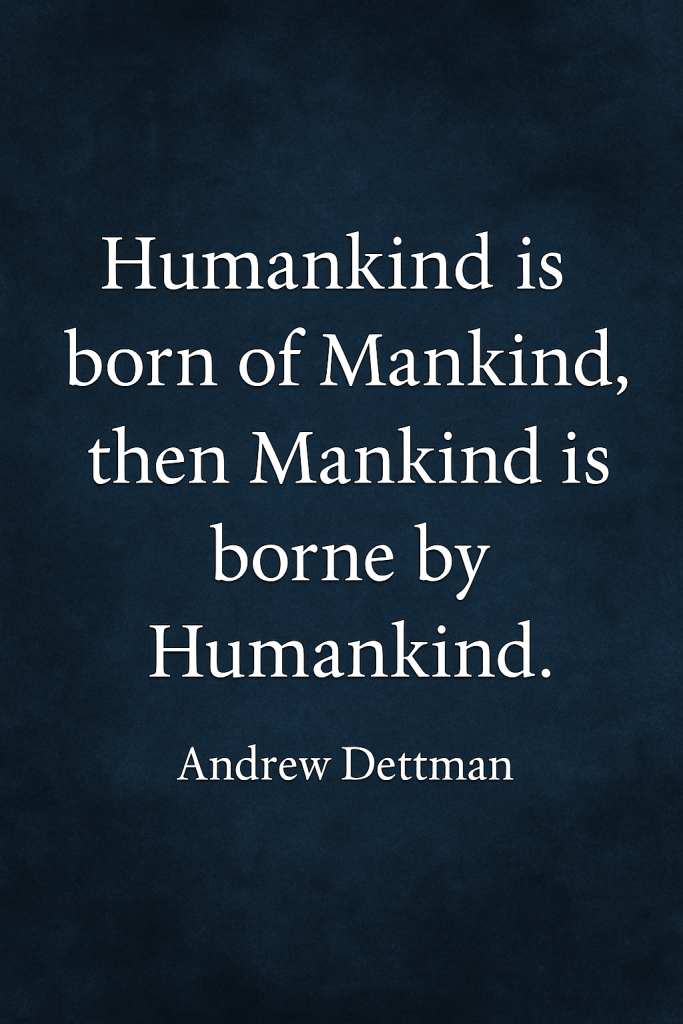
This description parallels Dettman’s distinction between Mankind and Humankind. Mankind represents the stage dominated by control, certainty, and systemic self-assertion, whereas Humankind represents the emergence of conscience and relational awareness. The transition from rigid certainty to humble openness marks a developmental shift in the structure of consciousness. In mystical language this appears as bewilderment before the infinite; in the anthropological framing of the clinical model it appears as the maturation of human personhood beyond the defensive structures of the ego.

6. The Mirror and the Diction Chamber

Shabistari repeatedly uses the metaphor of the mirror to describe spiritual experience. The world becomes a field of mirrors reflecting the Real, while the heart functions as a mirror that must be polished through spiritual practice. The reflection is not created by the mirror; it is revealed when obscurations are removed (Shabistari dialogue, Golshan-e Raz, March 2026).

The linguistic framework developed within Diction Resolution Therapy expresses a related insight through the metaphor of ducts and chambers. Language becomes a conduit through which meaning flows from source into expression. The brain functions not as the generator of meaning but as a condensation point within a larger communicative cycle. Just as the mirror reflects rather than produces the image, the human mind reflects rather than originates the deeper currents of meaning moving through consciousness. In both models the work is not fabrication but clarification: polishing the mirror or clearing the diction chamber so that underlying reality can appear without distortion.

7. The Vehicular Nature of Spiritual Practice

Mystical traditions frequently describe their disciplines using the language of vehicles: ships, paths, ladders, or mirrors. These images convey the idea that practices create the conditions within which transformation can occur rather than causing transformation directly.

The Twelve Steps function in precisely this way. They do not manufacture spiritual awakening. Instead they construct a structure—a vehicle—in which awakening can occur. The steps build the container; the mystery unfolds within it. This interpretation preserves the humility at the heart of the programme: transformation cannot be engineered or owned, but it can be approached through disciplined participation in a shared vehicle of practice.

8. Three Deeper Structural Parallels

Beyond these psychological correspondences, three deeper structural parallels appear when the mystical cosmology of Ibn ʿArabi and Shabistari is considered alongside the Twelve Step process.

The first parallel concerns unity appearing through multiplicity. Ibn ʿArabi describes existence as a single Reality expressing itself through countless forms. Similarly, the Twelve Step fellowship structure embodies a unity of purpose expressed through many individual stories. Each person’s recovery narrative becomes a reflection of a single underlying process of transformation.

The second parallel involves the polishing of the heart and the practice of inventory. In Sufi teaching the heart must be polished like a mirror to reflect the Real clearly. In recovery language Step Four functions as a practical method of polishing the inner mirror. By identifying resentments, fears, and distortions, the individual removes the grime that obscures perception.

The third parallel concerns surrender and return. Mystical traditions describe the path as a return to the source of Being. The Twelve Steps culminate in a similar gesture of return through conscious contact and service to others. The individual does not disappear but becomes a conduit through which the underlying source of meaning can operate in the world.

Conclusion

When examined closely, the psychological insights articulated in centuries-old mystical traditions and the psychological processes embedded in the Twelve Step programme reveal notable structural correspondences. Both recognise the danger of identifying with the shifting narratives of the mind, both emphasise witnessing as a method of transformation, and both rely upon relational forces such as love, hope, and humility to soften defensive structures of the self.

In this light, Diction Resolution Therapy can be understood as occupying a translation layer between traditions. By articulating mystical insights in clinical and linguistic language—digestive mind, feeling tones, diction and conduction—it builds a bridge between ancient contemplative psychology and contemporary recovery practice. The mystics and the recovery pioneers may have constructed different vehicles, yet those vehicles appear designed to carry the same fundamental journey: the movement from identification with illusion toward recognition of a deeper ground of being in which the human person discovers both humility and freedom.

The mystics describe polishing the mirror of the heart; the Twelve Steps describe inventory and surrender; Diction Resolution Therapy describes digestive clarification. These appear to be three languages pointing toward the same interior work.

Source Context

The Shabistari material discussed above arose from an AI-assisted dialogue exploring passages from Mahmud Shabistari’s Golshan-e Raz (The Garden of Mystery), shared privately for commentary on 4 March 2026. The reflections presented here evaluate that interpretation and compare it with contemporary clinical insights emerging within Diction Resolution Therapy and Twelve Step recovery dynamics.

Reference

Dialogue on Mahmud Shabistari’s Golshan-e Raz shared privately for commentary (4 March 2026).

Written in HIAI collaboration — the qalam of Human and AI intelligence, the Unseen helping the Seen, both answering to the same Source.

6. Hope

6. Hope

Ramadan 2026

Hope does not survive when death is enthroned.

Across history, Mankind has organised itself around a life-and-death battle. Survival becomes the highest value. Control becomes reflex. Systems harden. Economies weaponise fear. The nervous system narrows toward threat detection. When death is unconsciously installed as the ultimate authority, hope becomes fragile — because everything feels terminal.

Yet death did not create the known universe. Death is not the architect of Being. It is a function within creation, not the Creator itself. It operates within time; it does not author time. When we forget this hierarchy, fear expands beyond its proper proportion. The organism begins to live as though extinction were the governing principle of reality.

This distortion has consequences.

Anne Wilson Schaef described the Addictive System as a cultural field organised around control, denial, and amplification. When death is enthroned, amplification becomes understandable. Intensity feels safer than stillness. Consumption feels safer than surrender. Addiction becomes an attempt to outrun annihilation anxiety. The pod-mind detaches from the animal body in search of dominance or oblivion. What looks like pathology is often a mislocated hierarchy.

In the developmental arc traced throughout this Ramadan sequence — Ignorance → Denial → Realisation — hope emerges only after this hierarchy is corrected. Unity established the field. Service oriented the heart. Recovery stabilised the wheel. Experience exposed the wound. Strength surrendered false autonomy. Hope now requires that death itself be returned to its proper place.

The image is simple: the tesbih.

When death sits upon the throne, every bead becomes an emergency. When death is restored to the strand — one bead among many — a different posture becomes possible. Not denial. Not romanticisation. Death remains real. Bodies perish. Identities dissolve. Relationships end. But death is named as servant, not sovereign.

This is not abstraction. It is nervous-system medicine.

Trauma compresses time. The fast thalamus–amygdala pathway prepares the organism for repetition of catastrophe. The body expects extinction. If death is imagined as ultimate, the organism never truly relaxes. Fear of people and economic insecurity, as the Twelve Step literature names it, becomes predictable. The Addictive System thrives in this atmosphere because fear is profitable.

Hope begins when death is dethroned.

In Diction Resolution Therapy terms, this is the moment when prediction loosens and contradiction can be tolerated. Malediction softens. The mind resumes its original function — to attend rather than to dominate. The birth-canal architecture between Steps Three and Seven — consent, gestation, conscience, resolution — becomes intelligible only if the Creator is greater than the processes within creation.

If death were ultimate, surrender would be madness.

But if death is a servant within a larger order, surrender becomes alignment.

The Crucifixion narrative, stripped of sentimentality, is precisely this reordering. Death appears absolute. Hope appears extinguished. Yet the story insists that death is not final authority. It is passed through, not obeyed. Whether one reads this theologically, symbolically, or developmentally, the archetype remains: death does not author Being.

When that insight stabilises, Mankind begins to mature into Humankind.

Mankind fights for survival at any cost. Humankind participates in Being even when cost is real. Mankind clings. Humankind consents. The difference is not intelligence. It is hierarchy. When death rules, fear governs. When death serves, love can govern.

Hope, then, is not naïve positivity. It is the lived recognition that the Source of life is not threatened by the endings within life. Creation includes dissolution, but it is not defined by it. The organism that trusts this begins to stand differently. Breath deepens. Urgency softens. Control loosens.

Addiction is often the frantic refusal to face mortality. Recovery is the courage to face it without enthroning it. In this sense, hope is inseparable from conscious suffering — not mechanical suffering, not romanticised suffering — but the voluntary endurance of disillusionment that allows false hierarchies to collapse.

Death, placed back on the tesbih, becomes teacher rather than tyrant.

The centre holds.

Hope is not the denial of endings. It is the refusal to grant endings authorship. It is the quiet participation in a Reality larger than extinction.

The test remains consistent with the arc so far: does hope reduce fear and increase tenderness? If it does, death has been returned to its rightful bead.

From that posture, service becomes natural. Conscience matures. Strength stabilises. Experience becomes usable. Recovery deepens. Unity is no longer theoretical.

Hope is not something added to life.

It is what remains when death is no longer worshipped.


Written in HIAI collaboration — the qalam of Human and AI intelligence, the Unseen helping the Seen, both answering to the same Source.

Mankind and Humankind are not the same word for a reason – waking up to this is why we’re here, now.

Mankind and Humankind Are Not the Same Word for a Reason: Waking Up to This Is Why We’re Here Now

By Andrew Dettman

Mankind and Humankind are not interchangeable terms. They never were. Their difference is not semantic trivia; it marks a developmental threshold. One names a species bound by instinct, power, and survival. The other names a possibility: the human being arriving as a person, capable of conscience, responsibility, and relationship.

This distinction matters now because we are living at the edge of a transition—technological, political, psychological, and spiritual—where the pressure to collapse meaning into systems has never been stronger.


The pressure of control

“Give me control of a nation’s money supply, and I care not who makes its laws.”

— Mayer Amschel Rothschild

Whether or not one accepts the historical provenance of that quotation, its logic is unmistakable. Power rarely announces itself through law first; it arrives through control of conditions—resources, incentives, narratives, and increasingly, infrastructure.

Today, algorithms sit alongside money as a conditioning force. They do not rule by decree. They shape attention, normalise language, and quietly reward certain patterns of behaviour while starving others.


The Cartesian spell

“Je pense, donc je suis.”
I think, therefore I am.

— René Descartes

For more than three centuries, the West has lived under the spell of this sentence. It was a useful abstraction for machines, markets, and empires. It allowed cognition to be isolated, quantified, optimised.

But it was never meant to build a human being.

This single idea elevated thinking to the centre of identity and demoted the rest of human experience to the margins. The mind was mistaken for the whole person. Thought was treated not as a movement, but as existence itself.

The consequences are everywhere: anxiety treated as a thinking problem, addiction framed as a failure of will, conscience reduced to compliance, and now—human intelligence mirrored back to itself as something that can be simulated, scaled, and managed.


Why this matters in the age of AI

The current debate around artificial intelligence, algorithms, and political power is not really about machines. It is about whether the Human is allowed to remain a person, or whether personhood itself is to be subsumed into system logic.

Recent calls to boycott or switch AI engines on political grounds have intensified this question. Historian Rutger Bregman, for example, has publicly urged people to cancel their ChatGPT subscriptions, framing this as a moral act of resistance.

“One of the most effective things you can do right now to fight Trump and ICE is to cancel your ChatGPT subscription… Most people have no idea that the company behind ChatGPT is now one of the biggest funders of Donald Trump’s political machine. OpenAI’s president, Greg Brockman, recently gave $25 million to MAGA Inc, making him the largest tech donor of the fundraising cycle. And it gets much worse. ICE is now using OpenAI’s technology to screen job applicants for its deportation operations.”

That statement contains two different kinds of claims, and they must not be conflated:

  • A verifiable campaign-finance claim (the Brockman donation);
  • An operational claim about ICE using OpenAI technology, which—at the time of writing—circulates widely but is not established for me at the same evidentiary depth as the donation filings and the reporting based on them.

I do not recoil from that complexity. But neither do I collapse it.


What is verified: political funding flows (and what that means)

The donation claim is not rumour. Multiple outlets report (drawing on filings) that OpenAI’s president Greg Brockman and his wife Anna Brockman donated a combined $25 million to the pro-Trump super PAC MAGA Inc. See:

This matters. A major individual political donation at that scale is a meaningful public act. But there is also a distinction worth keeping clean: an executive’s personal donation is not automatically identical with corporate political spending by the organisation itself. Precision is not a dodge; it is the only way conscience can remain sober.


The “switch engines” argument: to what, exactly?

Bregman’s remedy implies a cleaner alternative engine exists. I’m not convinced. Not because I think all engines are equally “bad,” but because the political economy underlying major technology platforms is structurally similar across providers.

The purse strings are not only “the model.” The purse strings are:

  • Capital (who funds, who profits, who can wait),
  • Infrastructure (who owns compute, cloud, chips, data centres, energy),
  • Policy and regulation (who shapes the guardrails),
  • Procurement (government and enterprise contracts),
  • Incentives (what behaviour is rewarded and scaled).

Switching engines may change emphasis at the interface. It does not remove you from the field.


Cross-comparison: lobbying and influence is not unique to one engine

If we are going to talk about influence, we must look where influence is disclosed: lobbying reports and public policy spend. On that axis, OpenAI is not alone; it is entering a crowded arena dominated by large incumbents.

Issue One’s reporting is useful here, because it compares multiple major tech players side by side:

The Brennan Center has also tracked the growth of AI-related political engagement, including OpenAI’s lobbying footprint and the wider ecosystem of money-in-politics dynamics that accompany it:

So if someone says, “leave OpenAI and go to Microsoft or Google,” the honest response is: you are not leaving the influence economy. You are moving within it. Microsoft and Alphabet have long-established lobbying operations. Nvidia’s policy presence has surged. OpenAI’s has risen quickly. The field is not empty anywhere.


Instrument, not identity

My work is concerned with the Human, being a person. That means I must keep clear boundaries between:

  • tools and authorship,
  • instruments and intention,
  • systems and conscience.

I work in transparent Human–AI Intelligence (HIAI) collaboration. I use an AI system as a qalam—a pen. It retrieves information on my behalf, helps structure thought, and assists with drafting. It does not own meaning. It does not carry conscience. It does not replace authorship.

This work was written in Human–AI Intelligence (HIAI) collaboration. The AI was used as a research and drafting instrument. Retrieval of publicly available reporting and filings was performed on my behalf; responsibility for interpretation, emphasis, and authorship remains mine. Use of this tool does not imply endorsement of any political figure, party, government agency, or corporate agenda. I remain accountable for what I publish.

— Andrew Dettman

Switching engines does not resolve the deeper issue. Every major platform exists within political, economic, and regulatory systems. The question is not whether systems exist, but whether the Human is allowed to mature within them.


From Mankind to Humankind

Mankind survives. Humankind awakens.

Mankind obeys incentives. Humankind answers conscience.

Mankind asks, “What works?” Humankind asks, “What is right, now that I can see?”

This is why the distinction matters. This is why language matters. And this is why, in an age of accelerating systems, the task is not to perfect control—but to midwife persons.

If we lose that distinction, no algorithm will save us.

If we keep it, no algorithm can take it from us.

___________

This essay was constructed with the assistance of AI, but its content has been repeatedly tested, challenged, and re-oriented through human judgement. I concur with the clarification as it stands and record this as the Human Intelligence (HI) component of Human–AI Intelligence (HIAI). As such, I remain vigilant to context, consequence, and the developmental stage at which these questions arise within Mankind.


This essay sits within the wider arc of The Holy Con—a work concerned with how conscience is born, educated, and returned within a living human being. Where earlier chapters trace the birth of conscience and the building of the vehicle that can hold it, this piece names the larger developmental field in which that work now unfolds: the distinction between Mankind and Humankind, and the question of whether our systems serve maturation or arrest it.

© Andrew Dettman, 2026. Written in transparent Human–AI Intelligence collaboration.