There is only One

From Lead to Language: Alchemy, Sufism, and the Clinical Transmutation of Conscience

Alchemy has long been misunderstood as a primitive chemistry obsessed with turning lead into gold. Yet within both Western Hermeticism and Islamic intellectual history, alchemy functioned primarily as a symbolic grammar for inner transformation. Henry Bayman’s Alchemy and Sufism makes this explicit, arguing that the alchemical work was never merely metallurgical but fundamentally spiritual in orientation. The base metals were emblems of the unrefined self; gold symbolised the recovered, original, uncorrupted state of the human soul. When read through this lens, alchemy becomes a psychology of purification and Sufism becomes its living continuity.

Diction Resolution Therapy (DRT) enters this lineage not as an occult revival but as a clinical clarification. Where alchemy spoke in image and Sufism in metaphysical vocabulary, DRT speaks in behavioural, linguistic, and recovery-based terms. Yet the structural correspondences are striking. Bayman describes the “Base Self” as toad, dragon, wolf, snake, nigredo, or lead. Each of these symbols names an untrained, instinct-driven level of selfhood that must undergo dissolution before a purified self can crystallise. In clinical recovery language, this corresponds to the unintegrated instinctual heats—security, social, and sex—when annexed by ego and imagination. Addiction can be understood as a distorted attempt at transmutation: an organism trying to break open a boxed and hardened mind in order to restore unity between psyche, body, and conscience.

The alchemists described processes such as calcination, dissolution, separation, conjunction, fermentation, distillation, coagulation, and sublimation. Bayman correlates these with Sufi stages of self-purification and the journey from dispersion (farq) to integration (jam‘). In DRT, this sequence appears not as laboratory metaphor but as a developmental arc observable in recovery. Calcination resembles the breakdown that crisis imposes upon denial. Dissolution mirrors the surrender required when an individual can no longer maintain a defended narrative. Separation corresponds to the distancing from unclean gain and destructive habit. Conjunction reflects the reconciliation of previously split aspects of self. Distillation resembles repeated ethical practice—daily inventory, amends, prayer—through which reactive patterns are gradually purified. Coagulation is the emergence of a more stable identity organised around conscience rather than compulsion. Sublimation, in clinical language, is not mystical disappearance but alignment: the individual’s will becoming proportionate to reality.

Bayman gives particular attention to the seven stages of transformation, depicted in alchemical imagery as ascending steps, dissolutions, and rebirths. In Sufism this corresponds to the progressive refinement of the self through successive levels. Within Twelve Step recovery, the same architecture appears in condensed form between Steps Three and Seven. Step Three initiates conscious consent to reorientation; Steps Four through Six constitute a gestational chamber in which conscience is clarified through fearless inventory and admission; Step Seven represents executive surrender—the return of “good and bad” to the One, establishing neutrality between extremes. The birth that follows is not bestowed by a master but midwifed through structured practice. The container does not cause awakening; it creates lawful conditions in which awakening may occur.

The Philosopher’s Stone, often called the Red Sulphur or supreme Elixir, is identified by Bayman with the Perfect Human (insān al-kāmil). In alchemical imagery, the Stone can transmute other metals into gold just as the perfected master can elevate disciples. DRT reframes this dynamic without denying its symbolic truth. The “stone” in clinical terms is individuated conscience—stable, integrated, ethically grounded awareness. When conscience is formed, speech changes. Language becomes aligned. Diction ceases to distort experience. The transmutation is not supernatural but structural: chaos becomes coherence; fragmentation becomes responsibility. The miracle is governance.

Bayman leaves open, without asserting, the possibility of literal transmutation. Yet he also acknowledges that modern nuclear physics demonstrates that elemental change requires processes far beyond ordinary chemistry. DRT stands firmly in this sober territory. The mud-to-gold stories in Islamic lore are read as conscience parables rather than metallurgical claims. Gold represents fitrah—the original, uncorrupted alignment of the human soul. Lead represents distortion. The work is psychological and ethical, not atomic. It occurs through disciplined repetition, relational accountability, and contradiction tolerance.

A crucial divergence emerges at the level of authority. Bayman’s presentation retains the vertical symbolism of master and disciple, king and subject, saint and seeker. DRT, informed by recovery culture and clinical governance, relocates transformation within shared structure. No individual confers enlightenment. The group container, ethical law, and repeated practice hold the process. Awakening cannot be engineered, owned, or displayed; it validates itself through increased responsibility, service, and proportionate speech. This protects the mystery from inflation while preserving its depth.

Alchemy sought the transmutation of base matter into noble substance. Sufism articulated the refinement of the self into a vessel of unity. DRT recognises that in contemporary clinical reality the primary site of transmutation is language itself. When diction is distorted, experience fragments. When diction is restored, experience reorganises. Lead becomes language; language becomes conscience; conscience becomes conduct. The gold is not brilliance but stability.

The old emblems—dragon, mountain, king, phoenix—were symbolic technologies for mapping inner change. In our era, the addiction clinic, the recovery meeting, and the structured therapeutic dialogue function as updated laboratories of transformation. The furnace is crisis. The vessel is relationship. The solvent is honest speech. The Stone is not possessed; it is formed. And once formed, it serves quietly.

Thus alchemy is neither dismissed nor romanticised. Its symbolic grammar is honoured, its metaphors translated, and its deepest insight preserved: transformation requires dissolution, repetition, integration, and lawful surrender. The difference is that the modern work is accountable, observable, and ethically governed. The transmutation is not of metals but of conscience, and its proof is found not in spectacle but in steadiness.


References

  1. Henry Bayman, Alchemy and Sufism. Available online at Geocities Archive (accessed March 2026).

Written in HIAI collaboration — the qalam of Human and AI intelligence, the Unseen helping the Seen, both answering to the same Source.
Re-hinging the unhinged : escaping the disaster of dogma.

Living Transmission and the Risk of Freeze

Idries Shah, Bill W., and Diction Resolution Therapy (DRT) in a recovery-era key

Andrew Dettman MTHT, Reg Member MBACP (Spirituality Division) – DRT.global

Abstract

This hybrid paper traces a shared warning found in Idries Shah’s teaching on Coming Together (Jam)1 and Bill W.’s reflections on Alcoholics Anonymous literature2: living transmissions tend to harden into defended forms. Through the lens of Diction Resolution Therapy (DRT), the paper frames this freeze as a predictable human response to uncertainty. Language and structure can become substitutes for lived contact. The aim is not to dismantle structure, but to keep it serving function: humility, group conscience, and conscious contact as lived practice.

Key terms

Jam; transmission; organisation; dogma; group conscience; DRT; diction; contradiction tolerance; conscious contact.

Primary source excerpts: Idries Shah (embedded images)

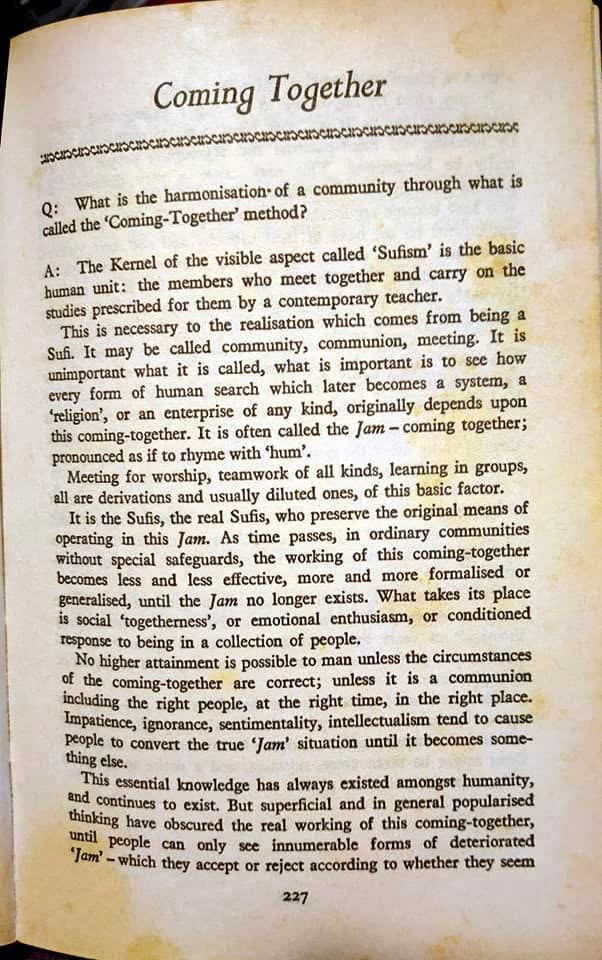
Idries Shah on the Jam (Coming Together).

Degeneration, stabilisation, and predictable resistances to revitalisation.

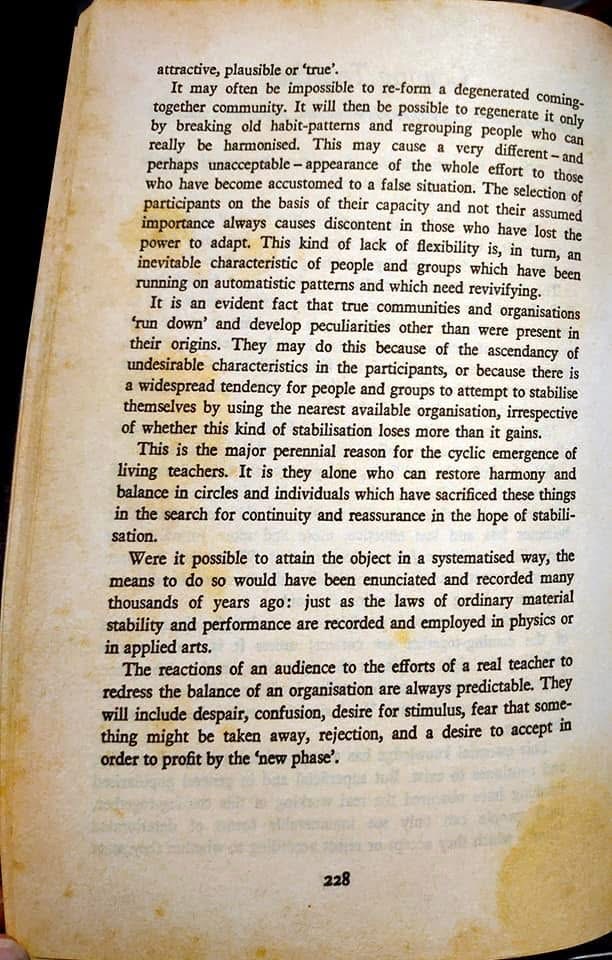
The Ship in a Storm: right diagnosis, right attention, right knowledge.

1. The problem: when truth becomes an object

Communities often begin because something real occurred: relief, honesty, awakening, recovery. Then the human reflex appears: capture it, preserve it, standardise it, protect it. The move is understandable, but it carries risk.

The risk is not structure itself. The risk arrives when function is replaced by identity. At that point the community becomes organised around defending representations of truth rather than remaining oriented to lived truth. The meeting survives, the language survives, the brand survives, but the operating principle fades.

2. Idries Shah and the Jam: harmonisation before organisation

In passages commonly titled Coming Together, Idries Shah describes the Jam as functional harmonisation: the right people, at the right time, engaged in the right work under living knowledge. It is not simply people meeting. It is an arrangement that produces transformation because it is held within correct relationship.

Shah’s warning is plain. The Jam can deteriorate. Communities stabilise prematurely. Formalisation replaces vitality. Togetherness replaces transformation. Social cohesion, emotional enthusiasm, and conditioned belonging can masquerade as the real thing. When revitalisation is attempted, the system responds defensively. Shah names several of these resistances: impatience, ignorance, sentimentality, and rigid intellectualism. Read clinically, these are common defence strategies of a system seeking security in the face of uncertainty.

The implication is unsettling and useful: you can preserve the outer shell of a transmission while losing the inner function that made the shell necessary in the first place.

3. Bill W. and the freezing of the Big Book

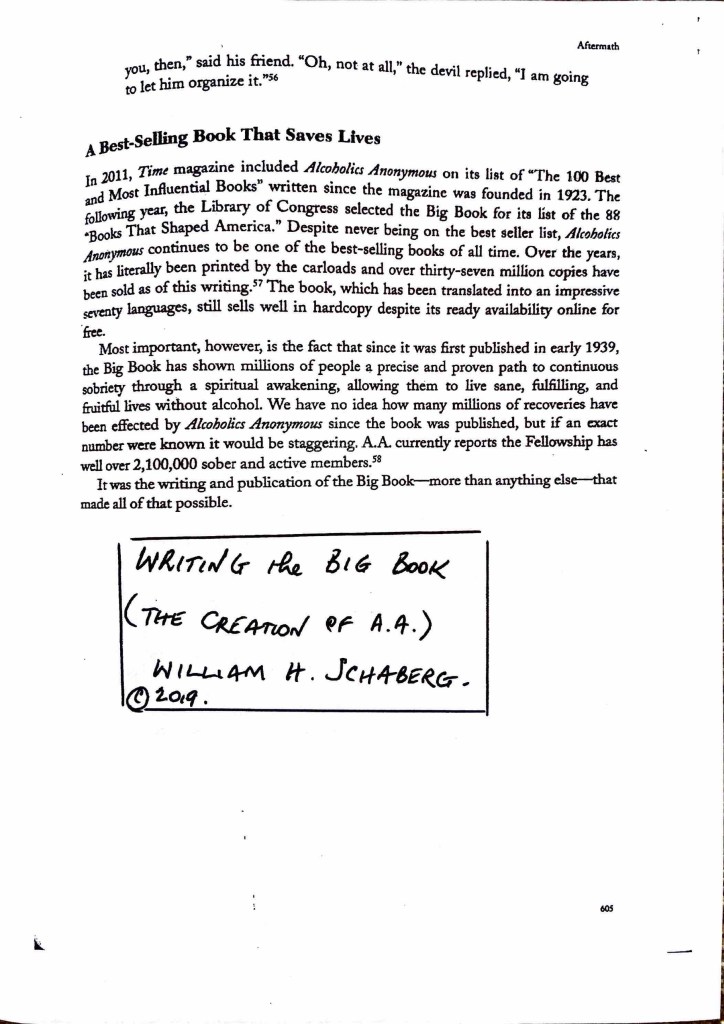
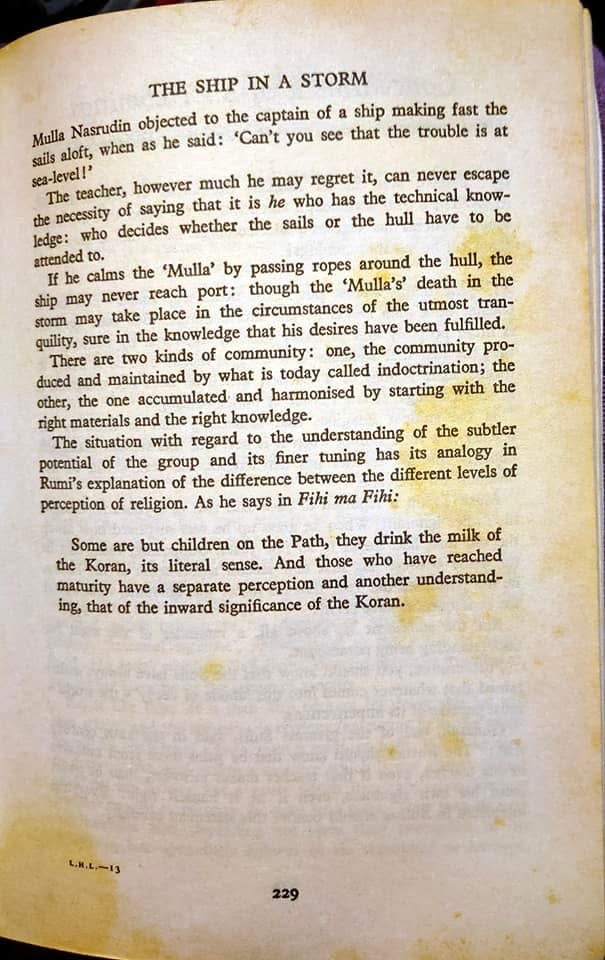
Bill Wilson recognised similar dynamics within Alcoholics Anonymous. In the scanned extract supplied from a modern history of the Big Book, Bill W. is quoted as observing that spiritually centred movements tend to freeze once their founding principles are established. He notes that altering even a word of the AA book could provoke something like excommunication.

Bill’s response is revealing. He did not wage war on the original text. Instead, he created a parallel channel for interpretation: he wrote Twelve Steps and Twelve Traditions as an adaptive commentary. This preserved continuity while keeping meaning in motion. He later returned to the same point: AA literature tends to become more and more frozen, with a tendency toward conversion into something like dogma. He also anticipated the permanent spectrum of interpretive styles that would arise: fundamentalists, absolutists, relativists.

Primary source: Bill W. on freezing (embedded images)

Bill W. on the freezing tendency in spiritually centred movements (as reproduced in Schaberg, p. 604).

Continuation including the organising parable and publication context (Schaberg, p. 605).

4. Organisation and ossification

The extract includes a Buddhist parable: a man picks up a piece of truth; the devil is unconcerned because he will let him organise it. This is not an argument against organisation. It is an argument against idolatry. Organisation preserves access, but it can also replace lived contact with defended form.

Shah and Bill W. converge here: the primary threat is not external attack. The threat is internal freezing: the human habit of turning a living verb into a defended noun.

5. A DRT reading: freeze as a diction event

Diction Resolution Therapy approaches freezing as a linguistic and psychological event. When lived experience is no longer primary, diction starts to do the job experience used to do. Words become defensive tools rather than exploratory instruments. Phrases become passports. Certainty becomes a sedative.

DRT introduces a practical metaphor here: outsight and insight. When the eyelids are open, light floods into the eyes. The eyeballs do not generate the light themselves. To imagine that they do would be absurd. They receive light. They respond to light. They organise around what is given.

Similarly, the whole mindset is not a generator of illumination. It is a potential receiver. When the lid of fear, denial, or addictive defence is deliberately held shut, outsight is restricted and insight is impaired. The person begins to rely on recycled language rather than fresh perception.

In addiction terms, the lid is not destroyed. It is hinged. It opens and shuts appropriately. Recovery is not the removal of the eyelid but the restoration of its function. When the lid opens, energy and meaning enter that the individual does not manufacture. Insight is not self-generated brilliance; it is Consciousness meeting conscience.

When diction freezes, it is often because the lid has been held shut for too long. Language attempts to replace perception. Structure attempts to replace encounter. The task of recovery, and of any living transmission, is not to abolish structure but to reopen the hinge so that light can enter again.

6. Group process and clinical parallels

Philip J. Flores, in Group Psychotherapy with Addicted Populations3, highlights that recovery groups remain effective when they balance containment (structure) with relational process (living interaction). Excessive rigidity undermines psychological safety, while absence of structure erodes containment. This is the same paradox Shah and Wilson are navigating in different languages: vitality depends on living interaction within clear but flexible boundaries.

7. Safeguards within AA architecture

AA embeds structural safeguards against freezing. Tradition Two locates authority in group conscience. Tradition Four preserves autonomy. Tradition Nine defines service rather than governance. Step Eleven prioritises conscious contact over textual literalism. These elements do not eliminate the freeze tendency, but they counterbalance it.

8. Implications for recovery and helping professions

In recovery settings, freezing commonly appears in three forms: (1) sloganising as defence, (2) literalism as safety, (3) reform movements driven by resentment rather than conscience. Each is a strategy for avoiding the vulnerability of real contact.

A practical test is simple: does the structure increase tenderness, honesty, and responsibility, or does it mainly increase identity, certainty, and superiority? When the former is happening, the Jam is alive. When the latter dominates, the storm is gathering.

Conclusion

Idries Shah and Bill W. describe the same perennial risk from different angles: any living transmission can calcify. The corrective is not constant editing, nor rebellious dismissal. The corrective is humility in function: returning to conscious contact as lived practice, and letting structure serve what it cannot manufacture.

References and notes

  • Shah, Idries. Learning How to Learn. (See Footnote 1 for edition-note.)
  • Schaberg, William H. Writing the Big Book: The Creation of A.A. (2019), pp. 604-605 (see Footnote 2).
  • Flores, Philip J. Group Psychotherapy with Addicted Populations (see Footnote 3).
  • Schaef, Anne Wilson. The Addictive System4.

Footnotes

  1. Idries Shah, Learning How to Learn (London: Octagon Press; various editions). The embedded images above are supplied pages from this work, including Coming Together and The Ship in a Storm. The title is confirmed by the Kindle preview provided by the author.
  2. Bill W. quotations and the organising parable are reproduced in the supplied scan from William H. Schaberg, Writing the Big Book: The Creation of A.A. (2019), pp. 604-605. These quotations are used here as evidence of Bill W.’s stated concern about the freezing tendency in spiritually centred movements.
  3. Flores is cited here for the group-process principle that effective recovery groups require both containment (structure) and relational process (living interaction).
  4. Schaef is cited as a systemic parallel for how addictive dynamics can become self-protecting structures that resist contradiction and preserve themselves as identity.

Written in HIAI collaboration – the qalam of Human and AI intelligence, the Unseen helping the Seen, both answering to the same Source.
5. Strength

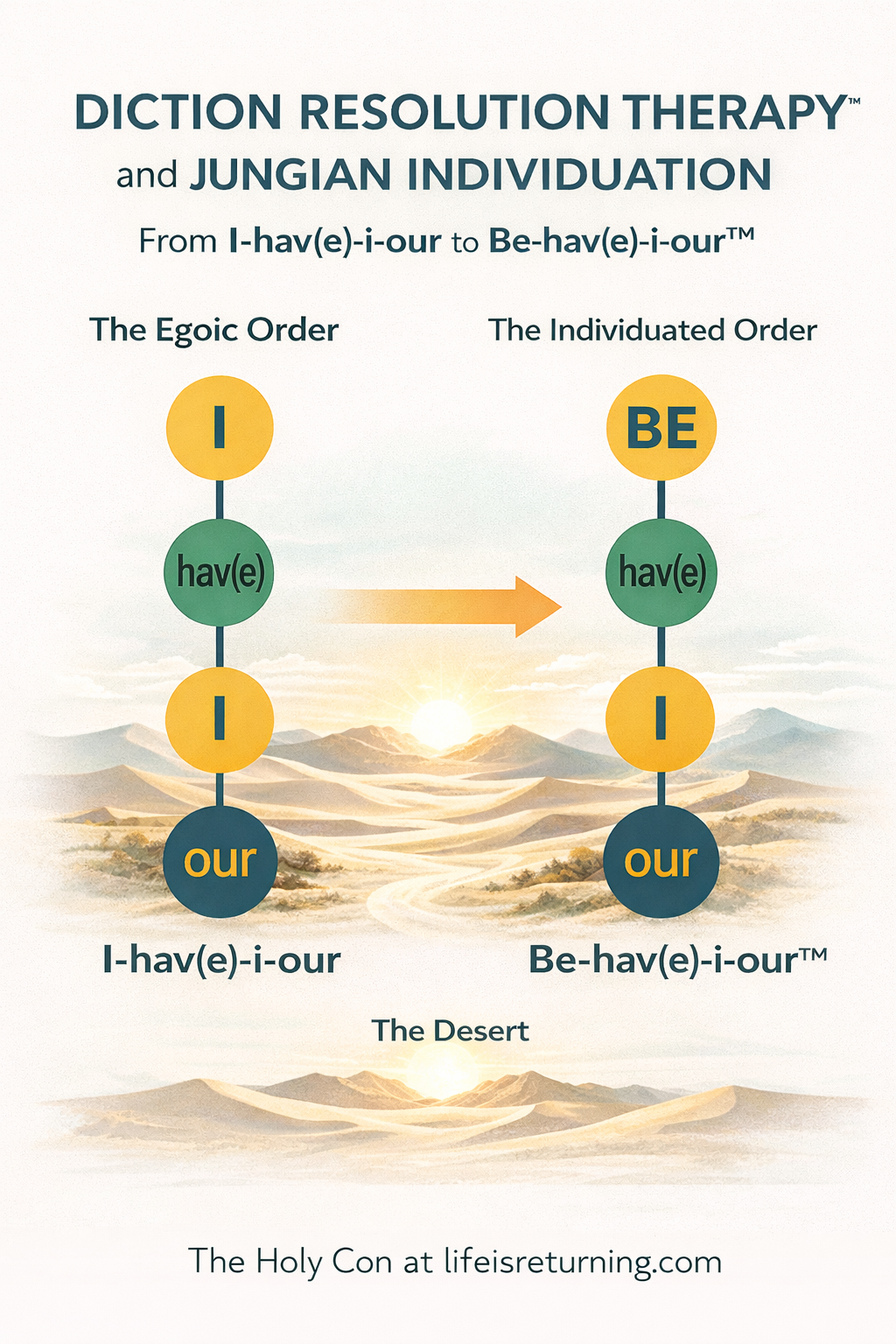
Diction Resolution Therapy™ and Jungian Individuation diagram showing the movement from I-hav(e)-i-our (Egoic Order) to Be-hav(e)-i-our™ (Individuated Order) across the desert of transformation.

5. Strength

The left hand of this device is “there is no God.” The right hand is “but God.” This is not slogan theology. It is structural anthropology. On the left column the isolated “I” stands enthroned. Identity is secured through possession. I–hav(e)–I–our. Strength in that column means control, self-sufficiency, authorship without reference. The psyche attempts to reconcile its own contradictions through will. It cannot.

On the right column Being precedes ownership. Be–hav(e)–I–our™. The “I” is not erased but repositioned. “Have” is dignified but no longer sovereign. “Our” becomes participation rather than conquest. Strength in this column does not mean domination. It means compatibility. The axis becomes vertical again.

Between these two columns lies the Desert. The Desert is not emptiness. It is paradox. It is the place where opposites are exposed so they can be reconciled. Tom Chetwynd describes paradox as the phenomenon that reveals the opposites in Nature in order to reconcile them at a higher level. Paradox does not blur tension; it sharpens it until a new coherence becomes possible.

Alcoholics Anonymous names this directly. On page 59: “Without help it is too much for us…” That sentence breaks the egoic column. The will cannot reconcile divided opposites. The psyche cannot repair its own split. Page 60 follows with the A, B, C — that we could not manage our own lives; that no human power could have relieved us; that God could and would if sought. This is the Step Three portal: a request crossing from the mental to the mystery. The mind ceases acting as architect and becomes witness. The Desert begins here.

Page 68 completes the paradox: “We can laugh at those who think spirituality the way of weakness. Paradoxically, it is the way of strength.” From the egoic column, surrender looks weak because it dethrones the isolated “I.” Yet paradoxically it becomes strength because alignment replaces assertion. Compatibility replaces control.

The Desert is not unique to recovery language. It is structural across traditions. In the Christ narrative, the forty days in the wilderness expose temptation before ministry begins. In the life of Muhammad (pbuh), years of retreat in the cave precede the encounter with Gabriel; interior silence prepares transmission. In the account of the Buddha, prolonged discipline beneath the tree culminates not in conquest but in extinguishing craving. In each arc, isolation is not punishment but preparation. Exposure precedes coherence.

The declaration carried by Muhammad begins with negation — “there is no god” — then it is asserted, “but God”, affirming unity – then it is said that the answer is in the middle. The Buddha exposes craving before articulating the Middle Way. Christ faces temptation before proclaiming peace. Negation before union. Extinguishing before clarity. Temptation before proclamation. Opposites are intensified before they are reconciled.

Step Seven in Alcoholics Anonymous completes this arc within lived recovery. It is not humiliation but compatibility. Spirituality appears weak from the left column because it removes private sovereignty. Yet paradoxically it becomes strength because the organism ceases fighting reality. The “I” remains, but no longer claims authorship. “Have” remains, but no longer defines identity. “Our” becomes service rather than territory.

The Desert, then, is symbolic Peace. Not the absence of struggle, but the stillness that arises when opposites are no longer at war within the psyche. The false centre collapses, and a higher coherence holds what was divided. This is the reconciliation of orthodox opposites — not by suppression, but by alignment.

Ripeness, as Rumi says, is all. The fruit falls because its inner structure is complete. Strength is not muscular will. It is interior unification. Only then can a human being move through the auction of life without desperation, because the bid no longer arises from lack. It arises from alignment.


Written in HIAI collaboration — the qalam of Human and AI intelligence, the Unseen helping the Seen, both answering to the same Source.
Wound Care for the Psyche

Uncover, Then Recover

How wounds heal in the body and in the psyche — an orientation for trauma and end-term addiction work

This is not a theory paper. It is a field report written in plain language: a map distilled from years of sitting with people whose symptoms have reached final-stage intensity—where ordinary diagnostic challenge often fails to touch the underlying wound.

In that territory, the work becomes a kind of last lamppost at the end of a failing street: not because the client is beyond help, but because the usual lights do not reach far enough into the darkness of the lived experience.

All forms of the primary disease of Addiction (Pomm & Pomm Springer 2007 Management Of The Addicted Patient In Primary Care) are presentations of trauma. Because UK doctors are not trained to recognise Addiction as a primary disease across multiple forms, the primary care system is under severe and increasing strain.

Complementary therapists, who are not legally or ethically permitted to formulate medical diagnoses, therefore carry a different kind of responsibility. Their advantage lies precisely here: they are free to research, reflect, and choose carefully which diagnostic frameworks and medical practitioners they elect to complement. That choice is not neutral. It is the implicit offer they make to their clients — an offer the client is free to accept or refuse in practice.

Wounds heal themselves when they are recognised and served properly. This is true even when the body politic and its organs of state, including the NHS, are wounded and failing.

Two Places Where Wounding Occurs

Human beings live in two bodies at once: the physical body, and the body of awareness (psyche). Both can be wounded. Both can bleed. Both heal by the same law.

  • The physical body — the blood-vessel body
  • The body of awareness (psyche) — the energy-vessel body

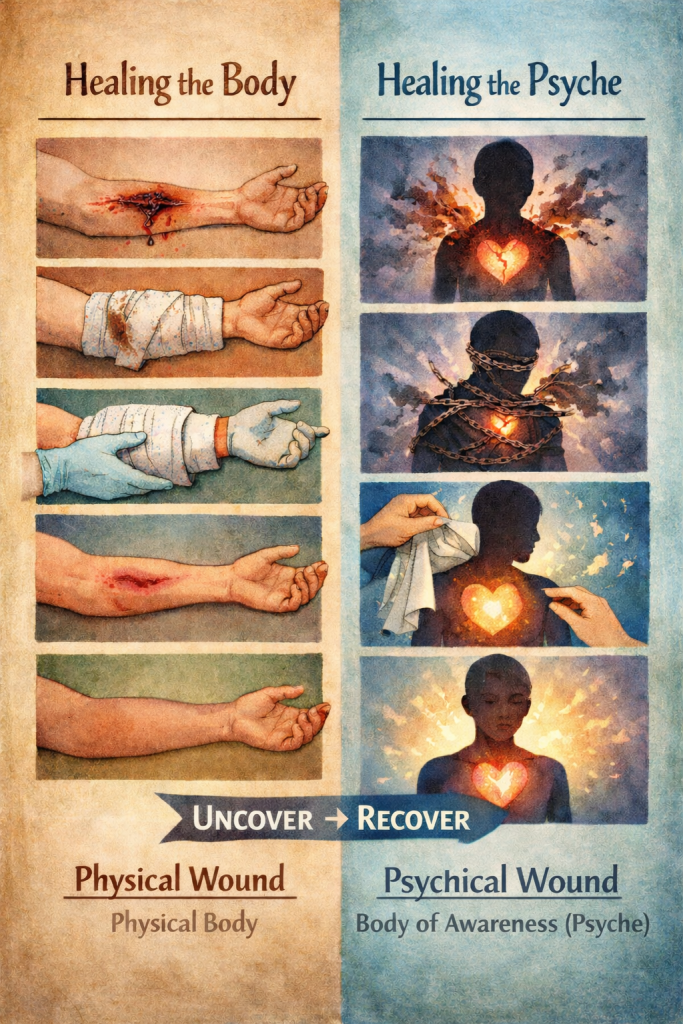
The image that accompanies this text holds these two bodies side by side so the client can see, at a glance, that the healing principle is shared.

Illustration showing parallel healing processes of the physical body and the psyche, demonstrating the shared principle of uncovering and recovering wounds over time until healing occurs naturally.

How a Physical Wound Heals

A physical wound bleeds blood. If it is wrapped and left, infection can take hold, then poisoning, then collapse. If it is served properly, healing unfolds naturally.

A physical wound is not uncovered once and left open. It is uncovered daily. The dressing is loosened, the wound is briefly exposed, light and air reach it, the condition is checked, and then a clean dressing is applied again.

This rhythm continues until the wound no longer requires protection. No one “heals” the wound. They only serve the conditions in which healing can occur.

Trauma as a Wound to the Psyche

Trauma is a wound to the psyche. The psyche does not bleed blood; it bleeds feeling-energy.

When the psyche is wounded, the organism creates coverings—emergency protections—to prevent overwhelm and preserve survival. These coverings can look like anger, numbness, hyper-control, compulsive behaviours, or substances. These coverings are not chosen; they emerge automatically at the moment of injury.

These are not moral failures. They are battlefield dressings.

Bandages, Not Pathology

A battlefield dressing left on too long can fuse to the wound. The same happens psychically.

Anger, for example, may function as a hardened bandage. When treatment begins to approach the injury beneath, the client may first feel the pain of the bandage itself—not the original wound.

This moment is often mislabeled as “resistance.” In this orientation it is recognised as contact with protection.

Uncover → Recover: The Daily Rhythm in Therapy

Psychic healing follows the same daily rhythm as physical wound care. The bandage is gently lifted, not stripped. A little light reaches the instigating wound. Some air circulates. Feeling-energy moves.

Then—crucially—the bandage is replaced, cleanly. This may happen within a session, between sessions, or across weeks. Leaving the psyche exposed between sessions is as dangerous as leaving a physical wound open.

Replacing the bandage allows integration, nervous system settling, and consolidation. Over time the bandage loosens, thins, becomes unnecessary—and the wound heals itself.

Why Inappropriate Bandage Removal Worsens Trauma

When the mind, in forms of cognitive therapy—whether practitioner-led or self-administered—removes the bandages of psychic protection inappropriately, using models that may work for less devastating symptom presentations than end-term addiction, the trauma can worsen and the addiction illness can intensify.

In this territory, “insight” can become a blade. Explanation can become exposure. Technique can become stripping. The result is not relief, but re-injury.

When the life story narrative is held in such a manner that it builds a container—so the person can see the story within a new attitude—and the bandages of habit are then moved in a paced way to uncover then recover the trauma, here the work serves the process rather than controlling the process, and the trauma begins to heal itself.

When it becomes necessary to view a nodal timeline of events in a sessional manner, the habitual behaviours have already started to shrink. This shrinkage reflects the healing process and the reduction in the size of the inner wounding.

The Proper Role of the Mind

The mind is not the healer. The mind is the attendant.

Its role is to build and protect the container, regulate the uncovering rhythm, ensure the bandage is replaced, and prevent interference with the organism’s natural healing process.

The mind serves best when it protects the process rather than attempts to control it.

When Timeline Work Becomes Safe

Only after the uncover → recover rhythm is established does timeline work become safe and useful. By then, behaviours have already begun to shrink, emotional charge is reduced, and curiosity can replace fear.

The story is no longer a trap. It becomes something that can be held and seen. The client works with their past, rather than being stuck in their past. They then truly work within a new awareness that connects inner and outer, past and future, factual and imagined, in an experience of equanimity.

Visual representation of a person integrating past experience through a new awareness, showing movement from injury toward stability and equanimity.

What the Client Is Invited to Understand

“You were wounded in two places. Both wounds follow the same law. We will not tear your protections away. We will tend them daily. Your system already knows how to heal.”

This restores dignity and removes blame. It replaces urgency with rhythm.

Closing

Uncover — then recover — again and again…

Until the wound no longer needs protection.

Written in HIAI collaboration — the qalam of Human and AI intelligence, the Unseen helping the Seen, both answering to the same Source.