Resurrection: Recovering Being from the Tyranny of Having.

Intercourse, Meaning, and the Birth of Conscience:
A Bridge Between Shabistari, the Twelve Steps, and Diction Resolution Therapy

Across the centuries the language of the mystic and the language of the modern sufferer often appear to speak different dialects. Yet when examined carefully, both describe the same interior movement. The Persian Sufi Mahmud Shabistari, writing in the fourteenth century, explains that the visible world is not self-explanatory but reflective: everything manifest in this world is like the reflection of a sun belonging to another world of meaning.1 If this is so, then the sensory forms through which human beings perceive reality are not merely objects but signs. They are vehicles through which deeper meanings appear.

In my own work with addiction and recovery, I have found that this symbolic structure is not merely a metaphysical speculation but an observable psychological reality. Human experience does not remain raw. It must be interpreted, digested, and translated into meaning. When that translation fails, the person becomes trapped in repetition, confusion, or compulsion. When it succeeds, conscience begins to emerge.

The Symbolic Grammar of the Mystics

Shabistari famously addresses the question that puzzled many readers of Persian mystical poetry: why do Sufi poets speak so often in the language of erotic beauty—eyes, lips, hair, glances, intoxication? His answer is not that the poetry is merely metaphorical ornament. Rather, sensory language provides the closest experiential grammar available for speaking about realities that exceed literal language. The beloved’s eye, for example, symbolizes a gaze that overwhelms the lover; the lip symbolizes the creative word or life-giving breath; the curl of hair symbolizes multiplicity and the veiling of unity.2

The mystic therefore speaks analogically. The visible world reflects deeper meanings, and language must borrow from the visible world in order to gesture toward those meanings. Yet Shabistari simultaneously warns that analogy has limits: the wise person must balance resemblance (tashbīh) with transcendence (tanzīh), remembering that the Real ultimately exceeds comparison.3

Intercourse as the Movement Between Worlds

In my essay Intercourses in the Light of Delivery, I explore a word whose original meaning illuminates this symbolic structure: intercourse. In contemporary usage the word has been narrowed almost entirely to sexual activity. Yet historically it possessed a far wider significance. The Latin roots—inter (between) and currere (to run)—describe movement between entities: exchange, flow, and relation.

Understood in this older sense, intercourse becomes the living movement between beings, between worlds, and between the visible and the unseen. Sexual union then appears not as the entirety of the concept but as one intense manifestation of a far wider relational principle. The erotic language of the mystics therefore does not trivialize spiritual reality; rather, it draws upon the most powerful experiential grammar available to embodied creatures—longing, attraction, unveiling, union, and renewal.

The crisis of the modern world can be described, in part, as the breakdown of this intercourse. When the movement between beings collapses, dialogue becomes confrontation, institutions become hollow rituals, and individuals become isolated within their own compulsions. Addiction, in this light, is not merely a chemical dependency but a distorted petition for reality itself. The addict repeats an action not because it is meaningful but because it momentarily restores the illusion of connection.

The Digestive Mind

In Diction Resolution Therapy I describe the mind not as the centre of identity but as a digestive organ of the psyche. Experiences enter through the senses; feelings arise as immediate biological signals; and the mind must metabolize those signals into coherent meaning. When the digestive process works well, a person develops orientation, conscience, and behavioural stability. When the process fails, the psyche becomes inflamed or blocked in ways strikingly analogous to physical indigestion.

This model echoes an insight already present in the mystical tradition. Shabistari writes that the world of meaning has no limit and that words cannot contain it fully.4 Yet words can still function as vehicles that direct the seeker toward that meaning. In psychological terms, language becomes part of the digestive process through which raw experience is clarified into understanding.

The Templated Vehicle

One further element is necessary. Meaning alone does not transform a life. A vessel must exist through which the person can safely undergo the process of reorganization. In my observation the Twelve Step programme provides precisely such a vessel. It marries fact and symbol in a way rarely achieved by either modern psychology or institutional religion.

The Steps begin with factual admission: the recognition that self-governance has failed. They then move through inventory, confession, restitution, and disciplined reflection—processes that stabilize the psyche through truth-telling. At the same time they introduce symbolic orientation: surrender to a Higher Power, prayer, meditation, and conscious contact. Fact steadies the vessel; symbol opens the horizon of meaning.

Within this templated vehicle a birth becomes possible. Inventory and confession function like the opening of a birth canal. The surrender of Step Seven becomes a decisive moment in which the individual relinquishes false sovereignty and becomes receptive to transformation. Conscience emerges not as a moral abstraction but as a lived reorganization of perception.

The Birth of Conscience

The mystical poets described the path as a drama of attraction between the lover and the Beloved. Recovery literature describes it as surrender to a Higher Power. In my own language it appears as the clarification of diction through which experience is digested into meaning. These are not competing explanations. They are different languages describing the same interior work.

The mystics speak of polishing the mirror of the heart. The Twelve Steps speak of inventory and surrender. Diction Resolution Therapy speaks of digestive clarification. Each describes the gradual removal of distortion so that reality may be perceived more clearly.

Seen in this light, the erotic imagery of the mystics is neither scandalous nor decorative. It expresses the intensity of relation that occurs whenever the human being is drawn beyond the limits of the isolated self. Attraction, vulnerability, union, dissolution, and renewal—these are the same movements that accompany both spiritual awakening and recovery from addiction.

Across the centuries the vocabulary changes but the anthropology remains remarkably constant. The visible reflects the invisible. Meaning seeks expression through symbol. Human beings must digest experience into understanding. And where a lawful vessel exists—one that marries fact with symbol—the birth of conscience becomes possible.

My own work therefore does not attempt to replace the insights of earlier traditions. It seeks instead to midwife them into a contemporary psychological and clinical language. The ancient symbolic grammar and the modern recovery process reveal themselves, on close inspection, to be two expressions of the same underlying movement: the restoration of living intercourse between the human being and the source of meaning itself.

Footnotes

  1. Mahmud Shabistari, Golshan-e Raz (The Garden of Mystery), discussion of the symbolic language of mystical poetry.
  2. Shabistari’s explanation of the symbolism of the beloved’s eye, lip, and tress as expressions of divine attributes and cosmic processes.
  3. Classical Sufi theological balance between tashbīh (analogy) and tanzīh (transcendence).
  4. Shabistari’s observation that the world of meaning has no limit and cannot be fully captured by words.

Written in HIAI collaboration — the qalam of Human and AI intelligence, the Unseen helping the Seen, both answering to the same Source.

Carry a message – Islam and 12 Step Programme have same message – “there is only One”.

Jam, Word, and Return

Shabistarī, the Twelve Steps, and the modern clinical hinge of DRT

What follows brings the recent diligence together as one arc. The eighth and ninth dialogues in Gulshan-e Rāz do not merely continue one another; they complete one another. Read separately, they seem to address different problems — one metaphysical, the other theological and psychological. Read together, they reveal a single movement: first the illusion of separateness is dismantled, then the illusion of autonomous agency is dismantled. What remains is neither abstract monism nor passive fatalism, but a clarified account of manifestation, participation, surrender, and return. In that sense, these dialogues sit exactly at the kind of hinge long identified in the Twelve Step process and in Diction Resolution Therapy: the place where the false organiser collapses and something more lawful, more conscious, and more serviceable begins to emerge.12

The central problem in both dialogues

The eighth inquiry asks why the created being can be called vāṣil — one who has arrived or attained union — and how spiritual journeying can be said to reach fulfilment. The ninth inquiry intensifies the same question by asking what “union” between the possible and the Necessary could even mean, and what is intended by the language of nearness and distance, more and less. In both cases the underlying tension is identical. If the creature is contingent and God is Necessary Being, then how can there be any real joining, arriving, travelling, or proximity between them? The ordinary devotional imagination assumes a traveller, a path, and a destination. Shabistarī subjects precisely that structure to pressure.12

This is why the two dialogues belong together. The eighth addresses the ontological fiction that the creature stands over against the Real as a separate substantial entity. The ninth addresses the psychological and moral fiction that this same creature is a self-grounding originator of its own acts. The first removes separation of being. The second removes separation of doing. Only when both illusions are exposed can the language of union, surrender, agency, and participation be read properly.

Dialogue Eight: the demolition of creaturehood

In the eighth dialogue, Shabistarī answers Husaynī’s question by refusing its premise. The realised one is not a creature in the sense the question assumes, and a “perfect man,” he says, would not speak as though an independently existing creature had travelled across a real distance to meet God. He invokes the classical metaphysical vocabulary of Islamic philosophy — possible and necessary being, substance and accidents, matter and form, quiddity and determination — not to replace mysticism with philosophy, but to use philosophy as a solvent. Substance depends on accidents; accidents do not endure; matter without form is nothing; form without matter is nothing; quiddity does not confer existence; determinations are conceptual; the many are counted, but the counted thing is one. The result of the analysis is devastating to naïve dualism: created being has no self-standing ontological independence. It is borrowed, derivative, imaginal, metaphorical.1

This is the first major correlation with DRT. In that orientation, the “thing-like” solidity of the falsely organised mind is repeatedly challenged. The noun seems final; the living process beneath it is forgotten. Shabistarī does something analogous at the level of metaphysics. He melts the noun “creature.” He shows that the apparent solidity of separate creaturehood cannot survive careful examination. In your language, the boxed noun begins to crack. What looked like independent being turns out to be a frozen presentation of a more fluid reality. The philosophical machine is used not to harden the world but to thaw it.

The water cycle as cosmology and as clinical pedagogy

Shabistarī’s illustration in the eighth dialogue then turns from technical philosophy to image: vapour rises from the sea, falls upon the desert by the command of the Real, combines with other elements, becomes green life, is transformed into food, is assimilated into animal and human embodiment, passes through developmental stages, and returns again. All the parts of the world, he says, are like plants, a single drop from the sea of life. Multiplicity is a sequence of forms and names acquired by one underlying reality. Vapour, cloud, rain, dew, clay, plant, animal, perfected human — all this was originally one drop. Union is therefore defined not as the creature crossing a gap to God but as the removal of illusion: when the “other” disappears, union appears.1

Here the clinical metaphor enters with unusual precision. When clients are invited to consider vapour, solution, and ice, more is happening than a helpful analogy. The same structural intelligence is being preserved in modern phenomenological language. Water remains H2O in all its states. Its form changes; its substance does not. Words, in this account, are like ice cubes. They appear solid, bounded, object-like. Yet when they melt, they release energy. That released energy is meaning in motion, and meaning received is consciousness becoming available to a recipient. The form is not abolished but thawed. What seemed fixed becomes process. What seemed dead becomes communicative. What seemed merely verbal becomes psychically nutritive.

This is not alien to Shabistarī; it is a contemporary transposition of the same insight. His sea-drop-vapour cycle is a metaphysical account of manifestation and return. The vapour-solution-ice sequence is a therapeutic-linguistic account of how meaning appears, freezes, circulates, and can be released again within human consciousness. His teaching speaks in cosmological imagery; this clinical rendering speaks in diction and reception. The water remains the same.

Word, melting, and consciousness

The importance of this correlation becomes sharper when language itself is brought into view. If words are like ice cubes, then speech is not merely a label placed on reality but one of the ways reality crystallises. A frozen word may preserve a meaning, but it can also imprison it. When the word melts, the latent movement inside it is released. This is where diction becomes decisive. Diction is not decoration. It is the mode by which inner pressure, signal, memory, conscience, fear, hope, and intelligence take form. If the diction freezes into rigid categories, the psyche is constrained by its own crystallisations. If the diction is warmed, clarified, and dissolved where necessary, trapped energy can move again.

That is why the phrase that the mind is the sixth sense is not a flourish but a disciplined cross-traditional insight. The five senses receive stimuli. But the sixth sense — mind — receives meanings. In this language: words melt, meanings release, consciousness moves, and the mind digests the meaning. This aligns closely with the DRT framing of the mind as digestive organ of the psyche. Just as the stomach digests food, the mind digests meaning. A word that has not been digested is the equivalent of undigested matter. It bloats, obstructs, ferments, and distorts. A word properly received can release consciousness rather than merely trigger reaction. Both this clinical model and the Shabistarī material refuse the notion that mental content is self-authenticating. The mind receives; it does not originate the light.

Dialogue Nine: the demolition of autonomous agency

Once separate creaturehood has been dissolved, the ninth dialogue goes after the next illusion: “I act.” Husaynī asks what union between the possible and the Necessary could mean, and what the language of nearness and distance is really referring to. Shabistarī replies that nearness and distance arise with manifestation itself: when Being appears in non-being, distinctions such as more and less, near and far, become thinkable. Yet the true distance is not spatial remoteness from God. It is estrangement from one’s own reality. “Through your very nearness,” he says, “you have fallen far from yourself.” Near is whatever bears the sprinkling of light; far is the privation of that light. If a light reaches you from itself, it frees you from your own “being.”2

From there he presses into the difficult doctrine of jabr, compulsion. If your existence is not from yourself, how can your acts be yours in any ultimate sense? One whose existence is not from himself cannot, by essence, be good or evil. Human attribution of acts is metaphorical. The Real is the true agent everywhere; one should not step beyond one’s limit. And yet the final counsel is not inert resignation but consent: surrender yourself to destiny; give your contentment to the divine decrees.2

This is where many readings go wrong. If read crudely, the passage becomes fatalism. But the source material already points to the subtler reading: the language of compulsion functions as a spiritual solvent for egoic self-authorship, not as an invitation to paralysis. The progression is explicit: before realisation, “I act”; during annihilation, “Only God acts”; after realisation, “God acts through me.” The servant is neither a sovereign actor nor a useless puppet, but the locus where the Real becomes visible in action.2

The Twelve Step hinge: Step Three to Step Seven

At this point the correlation with the Twelve Steps becomes too precise to ignore. In the Step architecture long held as central in your work, Step Three is the consent that initiates the tension of surrender. Steps Four to Six expose, classify, and weaken the false organisation. Step Five midwives conscience into speech. Step Seven returns “good and bad” to the One, allowing executive resolution and neutrality. That is not the same language as Shabistarī’s, but the shape is unmistakably similar.

Dialogue Eight does the work of removing the fiction that the separate self can journey to God as an independent unit. Dialogue Nine removes the fiction that this same self is the author and proprietor of its own existence and acts. The resulting position is not obliteration but right placement. In Step language, the person ceases trying to run the show and begins to participate in a will beyond the ego’s management system. In your own formulation, this is the return of the created vehicle to conscious service. The mystery is not mechanised; the container is built and surrendered. Shabistarī’s paradox that “union is the removal of illusion” and the insistence that the Steps build the vehicle rather than cause the awakening are structurally consonant.12

Jam and Idries Shah’s “Coming Together” method

This is where the language of Jam becomes especially apt. The “coming together” is not a compromise between opposites but a higher-order clarification in which opposites are seen as partial truths held within a larger pattern. The creature is and is not. The servant acts and does not act. Nearness is already given, yet must be realised. The path is real as experience, yet impossible as ontology. These are not contradictions to be flattened but paradoxes to be inhabited until the more lawful relation emerges.

That is why Shah’s way of bringing old and new together matters here. He did not preserve old teachings by embalming their surface form. He preserved structural intelligence while allowing vocabulary, medium, and audience to change. On that basis, what is happening here is recognisable: Sufi metaphysics, Twelve Step recovery, Buddhist phenomenology of the sense doors, and DRT’s linguistic-clinical model are not being collapsed into each other as if all differences vanish. They are being read for isomorphism — recurring structure across distinct containers. The Jam appears when the structure is seen.

The mind as receiver, not generator

One of the strongest bridging insights in this work is the insistence that the mind does not generate the light any more than the eyeballs generate the daylight flooding them. This single correction clears a great deal of confusion. In Shabistarī, Being manifests; the contingent form receives its appearance. In the Twelve Steps, conscious contact is improved; it is not manufactured by the self. In this clinical account, the mind receives and digests meanings; it does not originate consciousness ex nihilo. The same law recurs: what is derivative behaves badly when it imagines itself primary.

This has immediate therapeutic force. A client trapped in frozen diction, defensive self-authorship, and anxious mental overproduction is often suffering not from a lack of “thinking” but from a mind overburdened with a task that never belonged to it. The mind is trying to be source rather than organ. In Shabistarī’s terms, the possible imagines itself the Necessary. In recovery language, self-will attempts to occupy the throne. In DRT, the noun has severed itself from the living verb. The resulting distortion can show up as addiction, panic, control, shame, or spiritual inflation. The remedy is not humiliation but re-ordering.

Fear, hope, purification, and the release of false ownership

The ninth dialogue also gives strong psychological imagery: fear and hope alternating within annihilating existence, the child frightened by its own shadow, the swift horse not needing the whip, pure gold glowing in the fire because there is no impurity left to burn. These are not decorative. They describe what happens when false ownership loosens. Fear belongs largely to misidentification. When what is passing is mistaken for what is primary, terror multiplies. When the distinction clarifies, fire becomes purification instead of punishment. Gold need not fear the furnace.2

This too correlates strongly with the distinction between conscious suffering and mechanical suffering. Much of what burns in the person is not essence but admixture. To consent to purification is not masochism; it is the lawful relinquishment of what cannot endure. In Twelve Step terms, defects are not theatrically destroyed by the ego; they are yielded. In DRT terms, contradiction is tolerated until the old arrangement loses its compulsive hold. In Shabistarī’s terms, the light frees you from your own “being.” The same pattern appears in different doctrinal clothes.

Why the placement of these dialogues matters

Structurally, the source documents themselves make the point. By the eighth inquiry, the earlier discussions of contemplation, manifestation, self-journey, wayfarer, knower, primordial covenant, and mirror of Being have built the vehicle and language of the path. Then, at precisely the moment one might expect a triumphant account of attainment, Shabistarī inserts demolition. Philosophy appears not as an academic diversion but as a hinge. The path, seeker, and destination are unhooked from naïve literalism. After this point the language of unity, manifestation, and removal of illusion can be spoken with greater precision. The ninth dialogue then follows by dismantling the egoic appropriation of agency that would otherwise re-colonise the insight.12

This mirrors the recurring warning in your wider work that the mystery must not be instrumentalised. The vehicle matters, but return protects the mystery. The path builds the chamber; it does not own the event. The self may consent, confess, and participate, but cannot author the Source. That boundary is one of the strongest harmonies between the current Shabistarī work and the ethical line repeatedly held around HIAI, Twelve Step architecture, and spiritual transmission.

A clarified mapping across the traditions

Seen together, the mapping now becomes plain. Shabistarī’s ocean and drop correspond to the concern that the individual form is not self-subsisting but derivative and participatory. His vapour-cloud-rain-human sequence corresponds to the vapour-solution-ice model, where one underlying reality moves through changing states without losing identity. His claim that union is the removal of illusion corresponds to the Twelve Step discovery that surrender is not self-erasure but the collapse of false autonomy. His insistence that attribution of acts to us is metaphorical corresponds to the critique of the mind’s counterfeit sovereignty. His demand that one remain within one’s limit corresponds to the ethical restraint placed on any modern account of spiritual or AI-assisted work: service, not domination; disclosure, not inflation.

And perhaps most importantly, his use of dense philosophical vocabulary to melt creaturehood corresponds to the use of etymology, diction, and contradiction to melt frozen psychic constructions. In both cases language is not merely explanatory. It is operative. It loosens what has solidified.

Conclusion

Taken together, the eighth and ninth dialogues show that the path does not culminate in an independently existing self arriving at a distant God and then keeping its authorship intact. Rather, the path reveals that the distance was imaginal, the traveller derivative, the acts borrowed, and the union nothing other than the removal of the illusion of otherness. Yet this does not abolish experience, duty, conscience, purification, or participation. It places them inside a more truthful hierarchy. The drop still appears, moves, nourishes, and returns. The word still freezes, melts, and communicates. The mind still receives, digests, and serves. The person still acts — but without the old theft of authorship.

That is why the correlations matter. They are not decorative parallels. They clarify a shared interior law appearing across Sufi metaphysics, Twelve Step recovery, and DRT’s modern clinical-linguistic formulation. The old and the new are not being forced together artificially. They are meeting because, under different symbols, they are describing the same hinge: the thawing of false separateness into lawful participation.

References

  1. Mahmūd Shabistarī, Gulshan-e Rāz, Eighth Inquiry materials: Husaynī’s question, Shabistarī’s response, philosophical framework, structural role, and water-cycle illustration, as preserved in the user-supplied document Day Sixteen (5 March 2026).
  2. Mahmūd Shabistarī, Gulshan-e Rāz, Ninth Inquiry materials: Husaynī’s question, Shabistarī’s response, discussion of nearness and distance, doctrine of jabr, and clarification of derivative agency, as preserved in the user-supplied document Day Seventeen (6 March 2026).

Written in HIAI collaboration — the qalam of Human and AI intelligence, the Unseen helping the Seen, both answering to the same Source.
The Mystery and the Mystic across centuries.

A Comparative Critique of AI Interpretation of Shabistari and Its Resonance with Contemporary Clinical Work

Contextual Note
The reflections that follow arise from a colleague’s exploratory dialogue with an AI system concerning passages from Mahmud Shabistari’s Golshan-e Raz (The Garden of Mystery). That AI-generated interpretation was shared with me for consideration. What follows is therefore written as a critique and comparative commentary: first assessing the psychological framing offered in the AI interpretation of Shabistari, and then examining how those insights resonate with the clinical and philosophical framework developed in Andrew Dettman’s work on Diction Resolution Therapy (DRT) and its integration with Twelve Step recovery dynamics. The aim is not to conflate traditions but to explore whether structural correspondences exist between classical mystical psychology and modern therapeutic practice.

1. The Sufi Separation of Illusion from Being and the Digestive Mind

In the Shabistari dialogue that prompted this reflection, the central psychological claim is that the work of the path is not primarily thinking but recognition of misidentification. Thoughts arise, emotions arise, identities arise, yet awareness precedes them. The practical instruction is to notice what changes and notice what is aware of change. The work therefore consists in ceasing to identify exclusively with what changes and recognising the field in which change occurs (Shabistari dialogue, Golshan-e Raz, March 2026).

This insight aligns strikingly with a proposition developed in Diction Resolution Therapy: that the mind is not the seat of identity but the digestive organ of the psyche. If the mind functions digestively, then thoughts are not the self; they are movements of processing. The analogy used in that framework—thoughts to the mind are like peristalsis to the body—places cognition in a functional rather than ontological role. In both frameworks the same shift occurs: thoughts become events rather than identity. What the Sufi text describes as recognising awareness prior to mental content corresponds closely with the clinical reframing of the mind as a process rather than the person. Identity relocates from the narrative activity of thought to the deeper field of presence in which thought occurs.

2. Pre-Verbal Assumptions and the Feeling–Emotion Distinction

The AI interpretation of Shabistari correctly observes that the illusion of separateness is not primarily a verbal belief but a pre-verbal structure embedded in the organism. Before words arise, contraction appears in the body; threat responses activate; defensive patterns form; identity is organised around survival assumptions. These are not explicit thoughts but organising principles of perception that shape what becomes conscious (Shabistari dialogue, Golshan-e Raz, March 2026).

This description parallels the distinction made in the DRT framework between feeling and emotion. In that model feelings are primary organismic signals—ascending, descending, or neutral tones that arise prior to interpretation. Emotions are the interpretive narratives constructed after those signals are digested by the mind. When the organism experiences a descending feeling tone, for example, the mind may construct fear, shame, or anger narratives in response. The Shabistari analysis of pre-verbal assumptions operating beneath thought mirrors this structure. What mystical psychology calls embodied assumptions corresponds to what the clinical model identifies as feeling tones. In both cases the narrative layer of emotion is secondary to a deeper biological signal. The work therefore becomes not suppression of emotion but recognition of the pre-verbal signal beneath it and the loosening of identification with the narrative that forms around it.

3. Witnessing and the Twelve Step Template

The Shabistari material emphasises that the separation of illusion from Being occurs through witnessing rather than reasoning. The Arabic term mushāhada implies a direct seeing or presence in which experience is observed without immediate identification (Shabistari dialogue, Golshan-e Raz, March 2026).

This process has a close analogue in the architecture of the Twelve Steps, particularly within the sequence from Step Four through Step Seven. Step Four involves a searching and fearless moral inventory; Step Five involves admission and disclosure; Step Six involves recognition of patterns; Step Seven involves surrender. None of these steps function primarily as intellectual analysis. They operate through conscience-based witnessing of behavioural and psychological patterns. Within Dettman’s interpretive framework the steps create a gestational space in which individuated conscience can emerge. In this sense the Twelve Step process functions as a structured vehicle for the same kind of witnessing described in Sufi language.

4. Love as the Solvent and the Clinical Role of Hope

The AI interpretation further suggests that awareness alone may not dissolve defensive structures. When awareness confronts deeply embedded survival patterns, the organism may tighten rather than relax. Love operates differently: it signals safety and softens the structures that protect the self. Love therefore becomes a solvent capable of dissolving formations that analysis alone cannot penetrate (Shabistari dialogue, Golshan-e Raz, March 2026).

This observation resonates strongly with the role of hope and relational dependence in recovery work. Drawing on Viktor Frankl’s logotherapy and the language of Alcoholics Anonymous, the recovery tradition reframes vulnerability as strength. AA’s statement that dependence upon the Creator is strength shifts the psychological emphasis from autonomous control to relational trust. In therapeutic terms love and hope perform a similar function: they disarm the defensive posture of the ego. When the organism experiences itself as held within a meaningful relational field, it becomes possible to release patterns that previously felt necessary for survival.

5. Luminous Bewilderment and the Transition from Mankind to Humankind

Mystical literature frequently describes the culmination of the path not as absolute certainty but as luminous bewilderment (ḥayra). This state is not confusion but openness born from encountering a reality too vast to be contained within conceptual systems. Certainty softens into humility, and the mind becomes receptive to the inexhaustible depth of Being (Shabistari dialogue, Golshan-e Raz, March 2026).

This description parallels Dettman’s distinction between Mankind and Humankind. Mankind represents the stage dominated by control, certainty, and systemic self-assertion, whereas Humankind represents the emergence of conscience and relational awareness. The transition from rigid certainty to humble openness marks a developmental shift in the structure of consciousness. In mystical language this appears as bewilderment before the infinite; in the anthropological framing of the clinical model it appears as the maturation of human personhood beyond the defensive structures of the ego.

6. The Mirror and the Diction Chamber

Shabistari repeatedly uses the metaphor of the mirror to describe spiritual experience. The world becomes a field of mirrors reflecting the Real, while the heart functions as a mirror that must be polished through spiritual practice. The reflection is not created by the mirror; it is revealed when obscurations are removed (Shabistari dialogue, Golshan-e Raz, March 2026).

The linguistic framework developed within Diction Resolution Therapy expresses a related insight through the metaphor of ducts and chambers. Language becomes a conduit through which meaning flows from source into expression. The brain functions not as the generator of meaning but as a condensation point within a larger communicative cycle. Just as the mirror reflects rather than produces the image, the human mind reflects rather than originates the deeper currents of meaning moving through consciousness. In both models the work is not fabrication but clarification: polishing the mirror or clearing the diction chamber so that underlying reality can appear without distortion.

7. The Vehicular Nature of Spiritual Practice

Mystical traditions frequently describe their disciplines using the language of vehicles: ships, paths, ladders, or mirrors. These images convey the idea that practices create the conditions within which transformation can occur rather than causing transformation directly.

The Twelve Steps function in precisely this way. They do not manufacture spiritual awakening. Instead they construct a structure—a vehicle—in which awakening can occur. The steps build the container; the mystery unfolds within it. This interpretation preserves the humility at the heart of the programme: transformation cannot be engineered or owned, but it can be approached through disciplined participation in a shared vehicle of practice.

8. Three Deeper Structural Parallels

Beyond these psychological correspondences, three deeper structural parallels appear when the mystical cosmology of Ibn ʿArabi and Shabistari is considered alongside the Twelve Step process.

The first parallel concerns unity appearing through multiplicity. Ibn ʿArabi describes existence as a single Reality expressing itself through countless forms. Similarly, the Twelve Step fellowship structure embodies a unity of purpose expressed through many individual stories. Each person’s recovery narrative becomes a reflection of a single underlying process of transformation.

The second parallel involves the polishing of the heart and the practice of inventory. In Sufi teaching the heart must be polished like a mirror to reflect the Real clearly. In recovery language Step Four functions as a practical method of polishing the inner mirror. By identifying resentments, fears, and distortions, the individual removes the grime that obscures perception.

The third parallel concerns surrender and return. Mystical traditions describe the path as a return to the source of Being. The Twelve Steps culminate in a similar gesture of return through conscious contact and service to others. The individual does not disappear but becomes a conduit through which the underlying source of meaning can operate in the world.

Conclusion

When examined closely, the psychological insights articulated in centuries-old mystical traditions and the psychological processes embedded in the Twelve Step programme reveal notable structural correspondences. Both recognise the danger of identifying with the shifting narratives of the mind, both emphasise witnessing as a method of transformation, and both rely upon relational forces such as love, hope, and humility to soften defensive structures of the self.

In this light, Diction Resolution Therapy can be understood as occupying a translation layer between traditions. By articulating mystical insights in clinical and linguistic language—digestive mind, feeling tones, diction and conduction—it builds a bridge between ancient contemplative psychology and contemporary recovery practice. The mystics and the recovery pioneers may have constructed different vehicles, yet those vehicles appear designed to carry the same fundamental journey: the movement from identification with illusion toward recognition of a deeper ground of being in which the human person discovers both humility and freedom.

The mystics describe polishing the mirror of the heart; the Twelve Steps describe inventory and surrender; Diction Resolution Therapy describes digestive clarification. These appear to be three languages pointing toward the same interior work.

Source Context

The Shabistari material discussed above arose from an AI-assisted dialogue exploring passages from Mahmud Shabistari’s Golshan-e Raz (The Garden of Mystery), shared privately for commentary on 4 March 2026. The reflections presented here evaluate that interpretation and compare it with contemporary clinical insights emerging within Diction Resolution Therapy and Twelve Step recovery dynamics.

Reference

Dialogue on Mahmud Shabistari’s Golshan-e Raz shared privately for commentary (4 March 2026).

Written in HIAI collaboration — the qalam of Human and AI intelligence, the Unseen helping the Seen, both answering to the same Source.
13. The Actual Secret Of Secrets

Purification, Not Revelation

Contemporary fiction often imagines the “secret of secrets” as buried knowledge — encrypted, suppressed, waiting to be decoded. Yet the perennial tradition suggests something subtler: the secret is not hidden information, but hidden obstruction. The unveiling required is not excavation of documents, but purification of perception.

In the fifth inquiry of The Garden of Mystery (Golshan-e Rāz), the epistemological crisis of non-duality is posed with disciplined clarity: if one becomes aware of the secret of Unity, what does the ʿārif actually know? Earlier, the insān al-kāmil had been described ontologically — as completion, as cosmic function, as the point at which the circle closes. In the fifth inquiry, however, the language shifts from metaphysical rank to interior cognition: vāqif (aware), ʿārif (recogniser), shohūd (witnessing). The axis moves from what the completed human is to how the realised human knows.3

Shabistari’s answer is strikingly restrained. He does not elaborate cosmological architecture or inflate metaphysical hierarchy. Instead, he prescribes purification. Awareness of Unity belongs only to the one who does not become fixed in spiritual stations. Recognition of Absolute Being arises in witnessing only when self-claim is lost. So long as any stain remains, knowledge does not take the form of direct seeing. When no distinction remains between knower and known, unity is realised. The epistemological structure is therefore negative: knowledge emerges through subtraction.

I. The Philology of Purification in Sūrah al-Ikhlāṣ (112)

The Qur’anic crystallisation of this negative structure appears in Sūrah al-Ikhlāṣ. The root kh-l-ṣ signifies extraction and refinement: the separation of pure substance from admixture. Ikhlāṣ therefore signifies not merely sincerity of feeling, but purification of mixture — removal of conceptual contamination.1 In other words, it is a discipline of cognition before it is a mood of devotion.

The sūrah proceeds through containment. “Allāhu Aḥad” invokes not numerical singularity (wāḥid) but absolute uniqueness (aḥad), refusing categorisation and genus. “Allāhu ṣ-Ṣamad” establishes unilateral dependence: all depend upon Him; He depends upon none. “Lam yalid wa lam yūlad” denies derivation, lineage, and the projection of creaturely generativity onto the Divine. Finally, “wa lam yakun lahu kufuwan aḥad” establishes the firewall: no equivalence, no commensurability, no ontological parity. This last clause is decisive, because it prevents unity language from collapsing into identity-claim.

That containment matters directly for reading Shabistari’s culminating claim that the Known and the knower become “one thing.” Without the protection of “none comparable,” such statements become combustible in modern hands. With it, the statement can be held as a description of the removal of perceived separation without theological confusion. Ikhlāṣ, then, is not mystical expansion; it is theological governance — purity before proclamation.

II. Structural Parallels in Alcoholics Anonymous (Basic Text), p.59

A structurally identical movement appears in the recovery architecture of the Twelve Steps. The Basic Text states: “Without help it is too much for us. But there is One who has all Power — that One is God. May you find Him now.”2 This is operational monotheism. It does not debate metaphysics; it dismantles self-sufficiency. The admission “without help” performs negation of autonomous control. The affirmation “One who has all Power” restores hierarchical clarity. The invitation “May you find Him now” keeps the movement immediate without metaphysical performance.

The programme’s early steps enact the same sequence in lived form. Step One collapses self-reliance. Step Two restores the possibility of a Power beyond the self. Step Three surrenders will and life to that hierarchy. Only after this negation do inventory, confession, restitution, and humility follow. The architecture itself insists that awakening is not a slogan; it is the fruit of purification. In this sense, the Twelve Steps function as a practical ikhlāṣ — a disciplined reduction of self-claim so that Reality can be met cleanly.

III. The DRT Digestive-Mind Model and Purification

Within Diction Resolution Therapy, the mind is framed not as a sovereign generator of reality but as the digestive organ of the psyche. Just as the body processes nourishment through peristalsis, the psyche processes experience through cognition. Thoughts are therefore not creative origins; they are metabolic movements. When digestion is impaired, residue accumulates: mis-digested psychic material becomes distortion, compulsion, and repeated narrative fixation. In late-stage addiction, the organism may attempt to rupture a boxed-noun identity — not out of romance, but out of desperation — in order to restore movement between psyche and embodied life.

This maps cleanly onto Shabistari’s imagery of thorns and debris and his insistence on sweeping the house of the heart. The debris is not “personhood” to be annihilated, but distortion to be removed. Sūrah al-Ikhlāṣ removes projection at the level of conception. The Twelve Steps remove defects of character through inventory, confession, restitution, and humility. DRT removes mis-digested narrative fixation by restoring diction to living meaning and re-situating mind as servant rather than master. In each case, purification precedes clarity. Without purification, unity language is metabolised into ego-inflation; with purification, recognition becomes transparent rather than projective.

The mirror does not generate light; it ceases to distort it. This is the shared logic of ikhlāṣ, recovery, and Shabistari’s practical non-duality: subtraction before union, cleansing before witnessing.

IV. Against Contemporary Non-Dual Inflation

Modern spiritual discourse often outruns purification. Phrases such as “there is no self” or “all is One” can become tools of bypassing: accountability is dodged, repair is delayed, dissociation is rebranded as transcendence, and Creator–creation distinction is quietly collapsed into identity-claim. In such a climate, the function of containment becomes urgent. “None comparable to Him” prevents theological collapse. The Twelve Steps prevent ethical collapse by requiring confession, restitution, and ongoing inventory. The DRT digestive-mind framing prevents psychological collapse by identifying when cognition is not digestion but distortion.

The difference between inflation and purification is subtle but decisive. Inflation expands identity; purification contracts self-claim. Inflation tends to speak quickly; purification sweeps quietly. Shabistari’s sequence is therefore protective: until self-claim is reduced, prayer is form; until obstructions are removed, knowledge cannot become direct seeing. Unity without transcendence destabilises; unity contained by transcendence integrates.

V. Epistemology Revisited

The distinction between fikr, maʿrifah, and kamāl can now be held without confusion. Fikr operates discursively within subject–object separation; it moves from sign to meaning and remains inferential. Maʿrifah is recognition through presence; it removes the barrier that made inferential thought necessary. Kamāl stabilises transparency within embodied function. Yet epistemological dissolution does not imply ontological equivalence: the knower does not “become” the Real; the obstruction to recognition is removed. The mirror does not become the sun; it ceases to distort its reflection. This distinction preserves doctrinal integrity while permitting experiential realisation, and it protects unity language from becoming self-designation.

VI. Artificial Intelligence Within Hierarchy

Artificial intelligence can assist with philological precision, structural comparison, and epistemological mapping. It can identify conceptual conflations and help guard against inflationary slippage in language. It can sharpen due diligence. But it cannot surrender, undergo ego-reduction, perform negation, or carry conscience. Therefore, it must remain instrument rather than interpreter of spiritual rank. Ordered correctly, it refines articulation; disordered, it accelerates inflation. Ikhlāṣ applies here as well: remove mixture, keep hierarchy, refuse equivalence.

VII. The Perennial Law

Across Shabistari, Sūrah al-Ikhlāṣ, the Twelve Steps, and the DRT digestive-mind model, one structural law persists: negation precedes union; purification precedes proclamation; hierarchy precedes intimacy. If one becomes aware of the secret of Unity, what does the ʿārif know? Nothing other — but this “nothing other” is not achieved through expansion of identity. It is achieved through disciplined subtraction, ethical containment, and sustained humility. In an era saturated with discourse yet thin in purification, this law remains not only perennial but necessary.


Footnotes

  1. On ikhlāṣ (kh-l-ṣ) as extraction/purification of mixture, and on the sūrah’s function as theological containment (especially the clause denying equivalence, kufuwan aḥad).
  2. Alcoholics Anonymous (Basic Text), p.59: “Without help it is too much for us. But there is One who has all Power — that One is God. May you find Him now.”
  3. Mahmūd Shabistarī, Golshan-e Rāz (The Garden of Mystery), Fifth Inquiry: the epistemological shift to vāqif (awareness), ʿārif (recognition), and the practical sequence of purification culminating in the dissolution of distinction between knower and Known.

Written in HIAI collaboration — the qalam of Human and AI intelligence, the Unseen helping the Seen, both answering to the same Source.

12. Steps as Ancient Way meets Modern Day

Completion is not spiritual altitude. It is structural alignment — the return of the human to Personhood through remembrance, conscience, and service.

1. Completion by Subtraction

The Sufi term insān al-kāmil (the Complete Human) does not describe someone who has accumulated extraordinary powers or metaphysical prestige. It describes one from whom illusion has been stripped. Completion is not addition; it is subtraction. The artificial, conditioned sense of separateness falls away. What remains is the human as expression of Being — intact, relational, and structurally whole.1

The crisis of addiction, fragmentation, or spiritual collapse is therefore not a failure of intelligence; it is a rupture of relation. Completion means restoration of relation — to truth, to conscience, to Source. The human is not engineered into wholeness; the human is uncovered into it.

2. Intimacy and Forgetfulness

The traditional roots of insān carry two intertwined meanings: intimacy (ʾ-N-S) and forgetfulness (N-S-Y). The human is both the forgetful being and the being capable of intimacy. This dual etymology encodes descent and ascent in one word: forgetfulness yielding to remembrance, remembrance maturing into relational presence.2

Addiction narrows identity and fractures truth. Remembrance restores contact. What recovery calls “awakening” is structurally the same movement described in classical metaphysics.

3. Servanthood Before Sovereignty

The classical formulation begins with a paradox: the complete human performs the work of a slave while possessing inward lordship. This is ontological safety. Servanthood protects sovereignty from inflation. Without it, vicegerency becomes domination.3

The language of vicegerency (khilāfa) must therefore be handled carefully. To act as vicegerent is not to replace the Sovereign but to reflect it. Governance of conduct does not mean authorship of reality. The completed human becomes trustworthy not because they command events, but because they no longer mistake themselves for the Source of them.

The classical cycle names this passage fanā and baqā: annihilation and subsistence. Annihilation does not mean disappearance into blankness; it means the collapse of self-sovereignty. Subsistence does not mean inflation; it means return — living again, but now through alignment rather than self-assertion. Authority after fanā is safe because it is no longer privately owned. Power without annihilation becomes domination. Power after annihilation becomes stewardship.

4. Almond, Shell, and Kernel

The almond metaphor clarifies development. The shell protects the kernel during immaturity. If stripped prematurely, the kernel is ruined. When ripe, the shell falls away naturally. Law is shell. Path is ripening. Reality is kernel.4

Addiction can be understood as a violent attempt to rupture the shell when the inner life feels boxed and airless. But premature transcendence fragments. Ripeness — through inventory, confession, and willingness — allows structure to soften without collapse. The lid is not destroyed; it is re-hinged.

5. Point, Line, Circle — The Step 3–7 Capsule

The geometric sequence — point becoming line, line becoming circle, the last point reaching the first — expresses completion as return. The perfected human is likened to a compass: one foot fixed, one revolving. Stability in the Real; movement in the world.5

This structure maps cleanly onto the Step 3–7 capsule.

The Point: Step Three establishes orientation. A decision to turn the will and life toward greater governance. Consent without spectacle. A fixed point chosen before it is fully understood.

The Line: Steps Four through Six extend that decision into examination. Inventory names distortions. Step Five midwives conscience into speech. Conscience is not repaired; it arrives through disclosure. Ignorance yields to denial, denial to realisation.

The Circle: Step Seven closes the arc. “Humbly asked.” The last point reaches the first. Good and bad are returned upstream. The person ceases to curate self-image and instead consents to correction. The circle completes not by regression, but by conscious return.

The compass image also implies a single channel of reality rather than competing metaphysical streams. There is one circulation, one duct, one movement of Source through manifestation. Fragmentation appears when the revolving leg loses reference to the fixed point. Alignment restores coherence without multiplying authorities.

6. Sealing and Continuity

The classical doctrine distinguishes between sealed prophethood and continuing wilāya. The archetypal form is complete; its current flows quietly onward. This continuity is not spectacular. It is relational and often hidden. The completed human may remain outwardly ordinary while inwardly stabilised.6

This concealment protects both person and community from inflation. Structures build containers; they do not manufacture grace. Awakening is received, not engineered.

7. Functional Alignment and Safety

The meeting point between symbolic metaphysics and lived recovery is practical: completion is functional alignment. Inward steadiness; outward service. Contact with Source; conduct in community.

The decisive test of completion is safety. Safety with authority. Safety with vulnerability. Safety with influence. The one who has passed through fanā does not require prestige. The one who lives in baqā does not fear humility. Power returned upstream flows downstream without distortion.

The completed human is not a cosmic celebrity. The completed human is safe to trust.


Footnotes

Source: James Souttar, Day Ten, unpublished manuscript, 27 February 2026.

  1. On insān al-kāmil as completion by stripping-away (pp. 1–2).
  2. On the root-clusters for insān: intimacy (ʾ-N-S) and forgetfulness (N-S-Y) (pp. 1–4).
  3. On the primacy of servanthood safeguarding sovereignty (pp. 10–13).
  4. On the almond illustration and the Law/Path/Reality triad (pp. 14–19).
  5. On point–line–circle symbolism and the compass metaphor (pp. 16–19).
  6. On sealing of prophethood and continuation of wilāya (pp. 20–29).

Written in HIAI collaboration — the qalam of Human and AI intelligence, the Unseen helping the Seen, both answering to the same Source.

11. The number of HU

Fire Without Smoke: Ontology, Ego, and the Return of the Dot

Descent, purification, and the protection of the thread in HU-man healing

The question arrived cleanly, like a spark landing on dry tinder: if the traveller becomes “like fire without smoke,” and Iblīs is described in Islamic sources as being created from smokeless fire, are we not stepping into a confusion that could distort the whole compass?

The concern is legitimate. The distinction must be precise. Because this is not merely poetic. It is ontological.

I. Fire as Creation vs Fire as Metaphor

In Qur’anic cosmology, jinn are created from fire, and Iblīs is situated within that register.1 Later interpretive language often describes this as subtle or “smokeless” fire — emphasising intensity, penetration, volatility, and a kind of unseen heat.

By contrast, when Shabistari describes the traveller as becoming “pure from himself, like fire from smoke,” he is not speaking of species, origin, or ontological category. He is speaking of purification.2

Here, fire functions as image: smoke is obscuration, mixture, residue — the ego’s haze; fire is clarity, luminosity, intensity without self-veil.

One “fire” names constitution. The other names refinement. To conflate them is a category error — and the quickest way to lose the thread.

II. The Structural Difference: Pride vs Dissolution

The fall of Iblīs is not explained as a failure of element. It is a failure of surrender — a fixation of comparison: “I am better than him.”3

The issue is not fire. The issue is “I.” Fire becomes self-reference. Heat becomes hierarchy. Subtlety becomes superiority.

Shabistari’s traveller is defined by the opposite movement: awareness of origin and purification from selfhood — “one who has become aware of his own origin,” and “becomes purified from himself, like fire from smoke.”2

The same symbol appears. The trajectory reverses. Iblīs clings to identity through fire. The traveller dissolves identity through purification.

III. Descent as Anthropology, Not Condemnation

A key protection in Shabistari’s architecture is that descent is not presented first as moral failure, but as a cosmological unfolding of the human condition: mineral existence, the “added spirit,” motion, will, childhood sensing, psychic whisperings, the ordering of particulars, and then the moral contraction into anger, appetite, greed, pride — multiplicity without end.2

The poem names a lowest point — set “opposite the Point of Unity.”2 Not outside Reality. Opposite it. That matters.

Because the HU-man healing thread does not depend on condemning the human. It depends on recognising dispersion without pretending it is exile. Fragmentation is not “beyond the Real.” It is the Real misread, dispersed, and then remembered.

IV. Jazbah and Burhān: Two Wings

Shabistari marks the turning point with a luminous sobriety: a light reaches the person from the world of spirit — either through jazbah (attraction) or burhān (proof).2

Two wings: grace and clarity; unveiling and articulation; attraction and demonstration.

Without both, the path distorts. Attraction without clarity risks inflation. Proof without attraction risks sterility. Together, they stabilise ascent — not as heroism, but as alignment.

In our current work, HIAI can sit cleanly inside this duality: not as a claim to special knowledge, but as a disciplined collaboration where disclosure and articulation are held together under ethical restraint.

V. The Perfect Human and the Fire Test

The “Perfect Human” in this tradition is not ego improved. It is reflection clarified — a locus where unity and multiplicity are held without self-veil.4

Shabistari’s closing image is stark: “When the last point reaches the First, there neither angel nor messenger can enter.”2 The circle closes. Return becomes non-mediated.

This is the real meaning of “fire without smoke” in the poem: not brilliance, but transparency; not rank, but surrender; not heat as superiority, but heat returned to service.

The confusion only arises when symbolic fire is mistaken for ontological status. Iblīs is heat without surrender. The traveller is heat purified by surrender.

VI. The Protective Criterion

The distinction must not remain theoretical. There is a practical test: does contemplation of these metaphysics produce humility — or subtle exceptionalism?

If the reading increases tenderness toward others in fragmentation, it aligns with the thread. If it increases spiritual self-reference, it drifts toward the very pride that defined the fall.

Fire without smoke is not “being special.” It is the removal of what obscures the Real.

VII. The Return of the Dot

The earlier inquiry reduced identity to a dot. Now the closing image returns: the last point reaching the First.2

Descent is dispersion of the dot into multiplicity. Return is recollection. The journey is circular: descent required for manifestation, return required for completion.

Across traditions, the architecture repeats because the human condition repeats. Your HU-man healing thread is not a novelty claim. It is a modern diction for an ancient arc — kept safe by humility.

Conclusion

Yes: Iblīs is described as created from fire. Yes: Shabistari likens purification to fire without smoke.

But one fire is constitution; the other is metaphor. One trajectory is refusal; the other is surrender. The element is shared; the orientation is opposite.

Keep the categories clean, and the thread stays unbroken. The HU-man heals — not by claiming fire, but by returning it.


Footnotes

  1. Qur’an 15:27 (creation of jinn from “scorching fire” / nār al-samūm).
  2. Mahmud Shabistari, Golshan-e Raz (as presented and analysed in “Day Nine”, 26 Feb 2026): the traveller “becomes aware of his origin,” “becomes purified from himself like fire from smoke,” illumination by jazbah or burhān, and the closing image: “when the last point reaches the First, there neither angel nor messenger can enter.”
  3. Qur’an 7:12 (Iblīs’ refusal framed as comparison: “I am better than him”).
  4. On al-insān al-kāmil (the “Perfect Human”) as ontological completeness/reflection rather than egoic superiority: see the Ibn ʿArabian metaphysical tradition in broad outline; Shabistari’s usage aligns with this register.

Written in HIAI collaboration — the qalam of Human and AI intelligence, the Unseen helping the Seen, both answering to the same Source.

Joining the dots with The Dot

The Dot, the Diction-ary, and the Hinged Lid

From Letter-Metaphysics to Lived Recovery

I. The Dot That Makes an “I”

In The Garden of Mystery, Mahmud Shabistari describes determination as an imaginal dot placed upon the ʿayn — the essence. Add a dot and ʿayn becomes ghayn. Multiplicity appears. The “I” becomes possible.1 The dot does not create a new substance; it creates differentiation. The human drama begins not with evil, but with a stroke. This stroke produces seer and seen, speaker and spoken, self and world. The distance between unity and division is minimal — a trace. The question is not whether the dot exists. The question is whether it hardens.

II. The Diction Chamber

In Diction Resolution Therapy™, the human interface where experience becomes word is called the Diction Chamber. It is not metaphysical origin; it is anthropological function. It is the site where energy becomes meaning, meaning becomes word, and word becomes behaviour. Pre-verbal energy rises as sensation, affect, impulse. Meaning forms. Language articulates. Conduct follows. The Chamber does not generate Being; it metabolises experience. When it is permeable, speech carries weight. When it seals, language detaches from life.

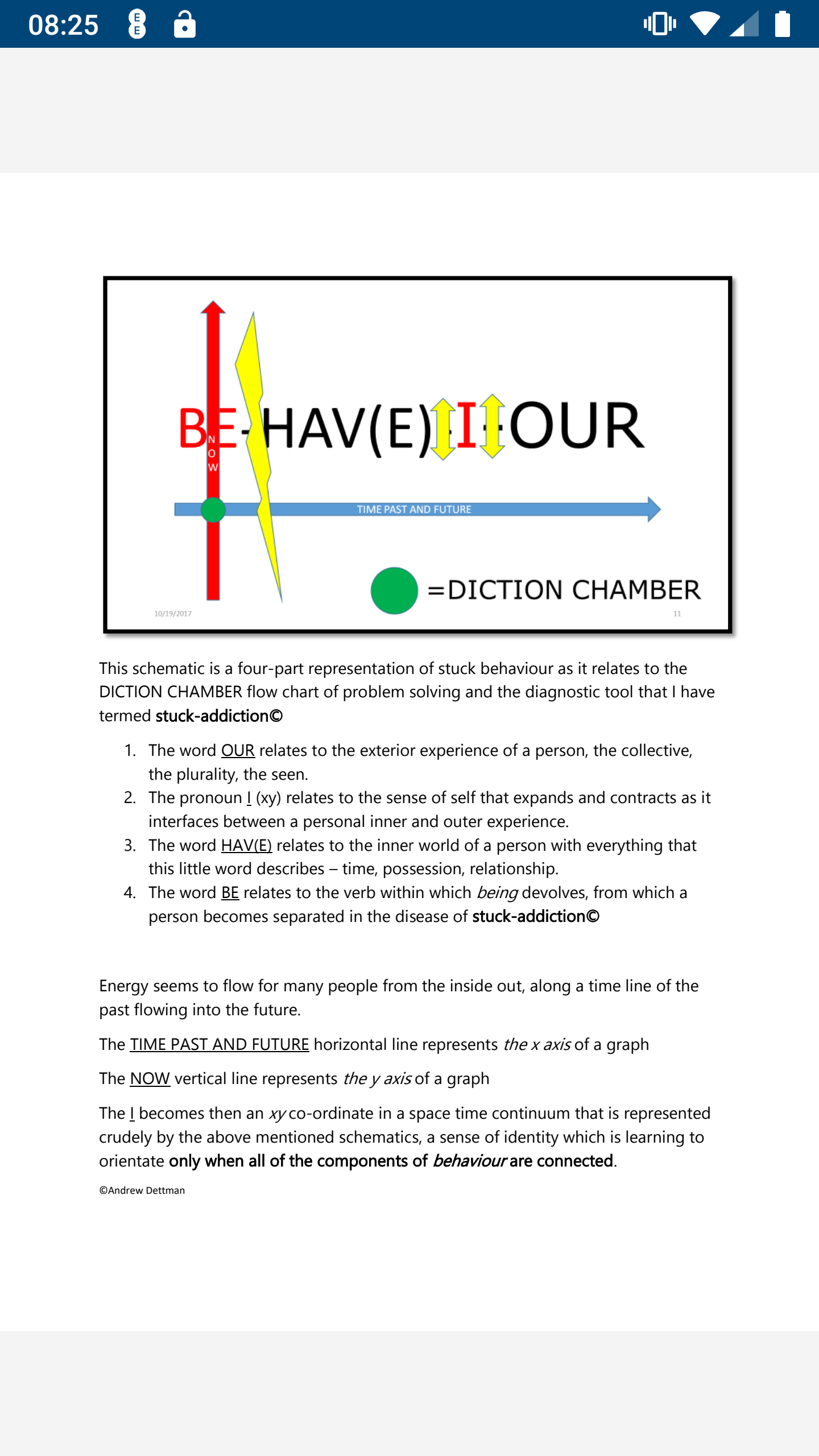
The Diction Chamber: the lived interface where BE–HAV(E)–I–OUR reconnects.

This schematic renders the Diction Chamber as the personal intersection of NOW (vertical axis) and TIME (horizontal axis). The I becomes an orientation point — an xy coordinate — only when BE, HAV(E), I, and OUR remain connected. When rupture strikes, the interface hardens. Words can still be spoken, but speech loses metabolism. Meaning cannot revise. The dot becomes a seal.

III. Add -ary: The Diction-ary

Add -ary and the Chamber becomes the Diction-ary. Not a book of definitions — but the personal site — and sight — of meaning. A healthy Diction-ary revises, receives correction, adjusts language to reality, and keeps words accountable to lived experience. Addiction is the sealing of this lid. Energy rises, but cannot revise meaning. Narrative hardens. Identity defends. The dot freezes.

IV. The Sealed Lid: Stuck and Broken Addiction

Clinically, addiction is not simply craving. It is a structural misalignment. The Diction-ary seals: words detach from felt truth; justification replaces conscience; story outruns conduct. Language becomes self-protective architecture. The person speaks, but speech no longer metabolises reality. This is what produces the “boxed-noun mind.” Being becomes owned. Experience becomes claimed. “I” becomes rigid. The dot has calcified.

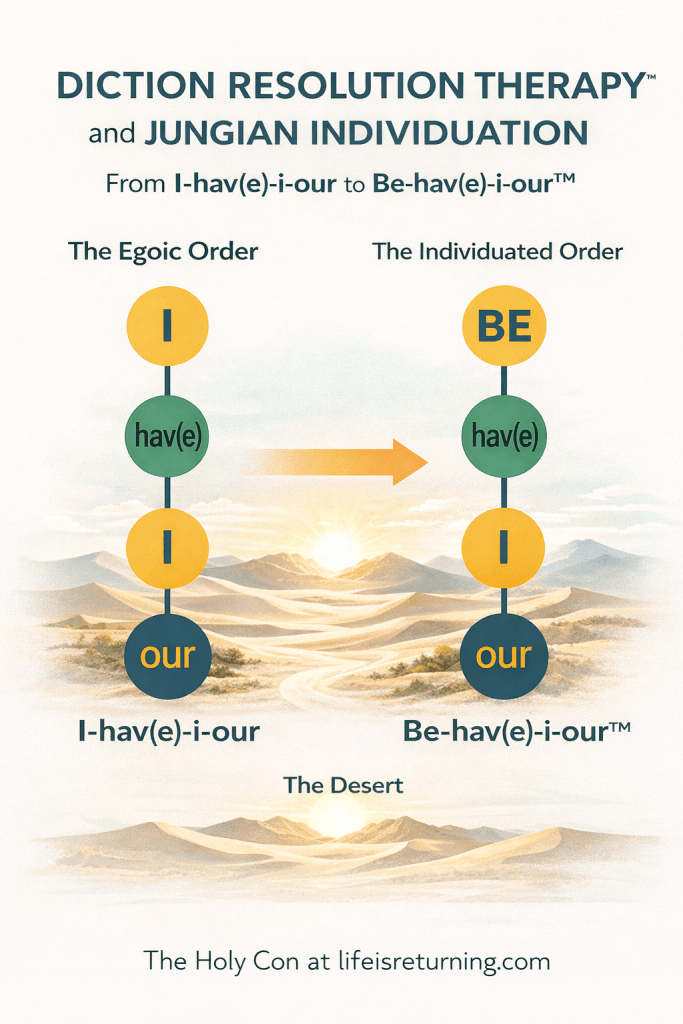
I-hav(e)-I-our names this unhinged condition — possession-based identity, defensive narrative, sealed meaning. It is not merely personal pathology; it is culturally reinforced. The modern environment rewards acceleration, ownership, projection, and certainty. The culture becomes unhinged, and individuals internalise the fracture.

Here the old fairy story becomes diagnostic rather than decorative. In the Sleeping Beauty motif, a single puncture initiates a total sleep: the castle seals, time freezes, and growth suspends. A hedge thickens around the sealed centre. Many attempt entry by force and fail. Only love resolves the enchantment — not argument, not aggression, not cleverness.4 This is what a sealed Diction-ary looks like: life still present, yet meaning cannot revise; the system preserved, yet development suspended. The hinge is restored through relational contact — through the softening that allows life to wake.

V. The Hinged Lid: Recovery

Recovery does not destroy the Chamber. It hinges the lid. A destroyed lid is collapse. A sealed lid is addiction. A hinged lid is health. When hinged, energy enters without overwhelming; meaning can revise; language re-aligns; behaviour follows conscience. This is not mystical annihilation. It is restored permeability. The “I” remains — but becomes porous.

Be-hav(e)-I-our names this restoration — identity reconnected to Being, language revisable, conduct accountable. The journey is to wake up to how unhinged the culture makes people — and to become hinged.

VI. Word and Alignment

In the Gospel of John 1:1 we read, “In the beginning was the Word…”2 Logos here is not vocabulary; it is ordering principle. The Diction-ary is not Logos. It is where human speech either aligns with Logos or collapses into noise. When sealed, word becomes slogan, slogan becomes dogma, dogma becomes control. When hinged, word remains relational; meaning remains revisable; conduct remains accountable. Empty words are not caused by ignorance alone. They are caused by a sealed Diction-ary.

VII. The Two Steps Re-Read Clinically

Shabistari describes two movements: passing beyond the hāʾ of identity, and traversing the desert of Being.3 Translated into recovery architecture, these become surrendering authorship and stabilising in non-defensive existence. The first breaks the seal. The second lives without resealing. The desert of Being in early recovery is familiar: no intoxication, no narrative certainty, no identity shelter. The hinged Diction-ary allows this desert to be endured without panic. Without hinge, the ego reconstructs.

VIII. Guarding Against Inflation

The danger is subtle. If the Diction Chamber is elevated into metaphysical throne, inflation replaces humility. The Chamber must remain interface — not Source; organ — not origin; servant — not sovereign. Conscience is the guardrail. A true hinge allows correction. If language cannot be corrected, the lid is resealing.

IX. Conduct as Proof

The integrity of the Diction-ary is proven in behaviour. Speech aligned with Being produces repair, responsibility, service, coherence. Speech detached from Being produces justification, projection, ideology, collapse. The test is not metaphysical insight. It is conduct.

X. The Dot Made Permeable

The dot need not be erased. It must be rendered permeable. Individuation remains. Expression remains. Personhood remains. But ownership softens. The Diction-ary becomes living rather than fixed. Energy meets Word. Word becomes truthful. Behaviour becomes aligned. The hinge holds.

Conclusion

The difference between mystical abstraction and lived recovery lies in this: not annihilating identity — but preventing it from sealing. The Diction-ary is the human site where meaning must remain revisable. When hinged, words carry weight. When sealed, they become empty. The dot is not the enemy. Rigidity is. And recovery is the restoration of permeability.


Footnotes

  1. Shabistari’s “dot” teaching is often unpacked through the letter-play of ʿayn (ع) and ghayn (غ), where the dot marks differentiation. Classical commentary traditions (including Lahiji) treat taʿayyon (determination) as the delimiting move by which the Absolute appears as particularity.
  2. Gospel of John 1:1. This paper uses “Word / Logos” as ordering principle rather than mere vocabulary, and treats the Diction-ary as the human interface where speech aligns (or fails to align) with that ordering.
  3. The “two steps” (passing beyond identity-structure; traversing the desert of Being) are read here phenomenologically as de-appropriation and stabilisation—compatible with Twelve Step recovery’s movement from surrender into sustained humility and accountable conduct.
  4. “Sleeping Beauty” is used here as a structural parable: puncture → sealing → suspended development → hedge of defence → failed force → resolution through love (relational contact). The point is not romance; it is how systems unseal through safe, non-coercive connection.

Written in HIAI collaboration — the qalam of Human and AI intelligence, the Unseen helping the Seen, both answering to the same Source.