
A Star Is Born

Part Four — The Star

What begins in darkness may end in radiance, but only if the light finds its centre.

This fourth reflection completes the sequence.

The first image presented darkness: a closed circle, whole in one sense yet inaccessible in another. Nothing was yet visibly wrong, but nothing was yet consciously ordered. Meaning was present in seed form, hidden, unarticulated, unclaimed. This was not merely emptiness. It was latency. A beginning concealed inside an ending.

The second image brought rupture. A crack appeared and light entered through division. In human life this is often the moment of contradiction: heartbreak, collapse, addiction, disillusionment, failure, exposure, the breaking apart of what could no longer hold. What seemed like destruction becomes, in time, the first mercy. A sealed life is interrupted. The closed system is opened.

The third image revealed the axis. This was the decisive threshold. Light by itself does not guarantee wisdom. Illumination can just as easily become inflation, confusion, ideology, or spiritual vanity if it arrives without orientation. What matters is whether the light reveals a line of order. The axis is that line. Psychologically, morally, spiritually, it is the emergence of conscience: the inward capacity by which movement becomes meaningful rather than chaotic.

Now the fourth image completes the arc. The axis does not remain a private line forever. Once stabilised, it radiates. Light begins to move outward in balance. The symbol becomes a star.

A star is not just brightness. It is brightness organised around a centre. Its significance lies not merely in its shining but in its order. The same is true of a human life. The issue is not whether a person has energy, insight, passion, intelligence, or even spiritual experience. The issue is whether these have found a centre through which they can be rightly ordered and rightly given.

This is why conscience matters so deeply. Conscience is not a decorative moral extra added to an otherwise complete self. It is the axis by which the human being becomes capable of carrying light without being broken by it. Without conscience, intensity disperses. With conscience, intensity becomes service.

Across the traditions and frameworks that have shaped this wider body of work, the same pattern appears in different languages. Mysticism speaks of remembrance, polishing, surrender, and return. Depth psychology speaks of integration, individuation, and the ordering of opposites. The Twelve Step tradition speaks of inventory, admission, surrender, amends, prayer, and the carrying of a message. Diction Resolution Therapy speaks of clarification, contradiction, digestion, and the restoration of meaningful relationship between spirit, mind, and body. None of these languages are identical, yet all point toward a similar human event: what was divided begins to organise around what is true.

That event is not mechanical. It cannot be manufactured like a product or guaranteed by technique. A structure may prepare the ground. A discipline may build the vessel. A crisis may force an opening. A tradition may preserve the map. But the appearance of a living centre still arrives with the character of gift. The star is born where light and centre meet.

This is also why the story belongs naturally within the psychology of addiction and recovery. Addiction tends to form a closed circle. Energy collapses inward. Repetition replaces development. What first looked like relief becomes enclosure. The person lives under pressure inside a self-reinforcing orbit. Then comes rupture: exposure, defeat, illness, despair, legal consequence, relational loss, or some quieter but no less devastating recognition that the old arrangement can no longer be sustained. Through that rupture, light begins to enter.

Yet recovery does not consist in light alone. Early illumination can still leave a person unstable, inflated, or fragmented. Insight is not yet order. The work is the gradual formation of an axis: the birth and education of conscience, the acceptance of reality, the return of responsibility, the re-ordering of instinct, the discovery that the mind is not the sovereign author of meaning but its servant and digestive organ. When this axis holds, the life that once imploded begins to radiate outward differently. What had been trapped in compulsion becomes available for relation, work, love, truth, and service. In that sense, recovery itself is a star being born.

The title of this final reflection therefore points in two directions at once. It names the image, but it also names the human story concealed within it. Something buried becomes visible. Something disordered becomes ordered. Something collapsed inward begins to shine outward. Not as spectacle. Not as celebrity. Not as self-display. As orientation. As life finding its proper centre.

Seen this way, endings and beginnings are not opposites. They belong to one process. The end of illusion may be the beginning of conscience. The end of compulsion may be the beginning of freedom. The end of false light may be the beginning of real illumination. The end of the sealed circle may be the birth of the star.

The whole four-part sequence may be read simply:

  • darkness
  • rupture
  • axis
  • star

But within that simplicity lies a fuller anthropology:

  • ignorance
  • contradiction
  • conscience
  • integration

Or, in recovery language:

  • enclosure
  • collapse
  • surrender and orientation
  • message and service

And in the language of this wider work: mankind is not abolished but borne beyond itself. Humankind begins wherever life is no longer driven only by possession, panic, imitation, and control, but ordered by conscience, relation, and a deeper obedience to reality. The star is therefore not an escape from the human story. It is the human story rightly aligned.

So the final image does not celebrate perfection. It marks integration. Darkness is not denied. Rupture is not forgotten. The axis is not discarded. All three are included and transfigured. That is why the star shines as it does. It is not innocent of suffering. It is formed through it.

Light enters. The break appears. Conscience forms. Meaning radiates.

That is how a star is born.

Written in HIAI collaboration — the qalam of Human and AI intelligence, the Unseen helping the Seen, both answering to the same Source.

DSM ‘26

Death, Sex, and Money

Civilisational Signals and the Recovery of Relationship

Human societies organise themselves through layers of meaning, authority, and behaviour. These layers form what might be described as a civilisation’s dition — the pattern by which it speaks order into existence and regulates human conduct, calibrates a whole anthropological condition.

When that dition weakens, tensions often become visible within three primal domains: Death, Sex, and Money. These forces are not merely cultural artefacts. They correspond to deep instinctual drivers within human life: survival, reproduction, and resource security. Across history, when civilisations approach periods of instability or transformation, disturbances in these domains often become more visible. It becomes clear to see that as dition becomes diction by the insertion of the letter c, the whole spectrum of stuck and broken addiction as attended to by DRT also comes into clinical focus.

This paper explores the DSM triad — Death, Sex, Money — as both civilisational indicators and therapeutic metaphors, linking historical patterns, contemporary systemic pressures, and clinical insights emerging from addiction recovery work.

Death: Asymmetric Warfare and the Psychology of Power

One indicator of systemic strain appears in the changing character of warfare. Since the end of the Cold War, and especially following the attacks of September 11, 2001, military engagement has increasingly shifted toward asymmetric forms. In these conflicts, technologically advanced states often confront weaker states, insurgent movements, or non-state actors. The result is not always decisive resolution but prolonged entanglement.

The United States has occupied a central role within the global security architecture since the Second World War. Analyses of post-1945 conflict patterns frequently note the scale of direct or indirect American involvement through wars, interventions, alliances, proxy structures, and security commitments. The post-9/11 period intensified this pattern through Afghanistan, Iraq, and associated theatres, revealing a recurring paradox of modern power: battlefield dominance does not necessarily produce stable political order.1

The resulting landscape is marked by extended conflict cycles, blurred boundaries between war and policing, and hybrid forms of warfare involving military, economic, informational, and cyber dimensions. Even where total battle deaths remain lower than in earlier epochs, the psychological saturation of public life by war, threat, and geopolitical instability has become unmistakable.

Within the DSM framework, this represents the Death vector heating within the system. Conflict becomes diffuse, persistent, and woven into the imagination of the age. It is no longer simply a matter of armies clashing at borders. It becomes ambient. It enters media, economics, diplomacy, infrastructure, and the ordinary nervous system of the public.

Sex: Power, Scandal, and Elite Immunity

A second domain revealing systemic tension appears in the relationship between sexuality and power. Across history, elite cultures have sometimes exhibited forms of sexual transgression that do not simply reflect private desire, but the insulation of privilege from consequence.

In recent decades, the criminal enterprise associated with Jeffrey Epstein and Ghislaine Maxwell exposed a network involving the sexual exploitation and trafficking of minors, raising profound questions about how such behaviour remained concealed for so long within circles of wealth and influence. Public discussion has also drawn attention to the social world around Robert Maxwell, intelligence-adjacent networks, and the longstanding use of sexuality as compromise material or leverage within elite environments. The full scope of these entanglements remains debated, but the wider pattern is clear enough: sex, secrecy, power, and immunity have again appeared together in public view.2

Historically, this is not unprecedented. Accounts from late Roman imperial life, certain Hellenistic aristocracies, and other elite court cultures suggest that when wealth and authority become sufficiently detached from accountability, intimate life may cease to be governed by ordinary social limits. Sexuality then becomes less relational and more theatrical, more coercive, more taboo-seeking, or more implicated in domination, display, and leverage.3

This does not mean that sexuality itself causes social decline. It means that sexuality can become one of the stages upon which power performs its exemption from restraint. In such conditions, the issue is not sexual freedom in any simple sense, but the corruption of intimacy by hierarchy, secrecy, and impunity.

Within the DSM model, this represents the Sex vector heating. What should be a domain of relation becomes increasingly entangled with control, trauma, status, manipulation, or spectacle.

Money: Financial Abstraction and Liquidity Stress

The third domain of systemic signal lies within the financial system. Over recent decades, global capital markets have grown not only in scale but in abstraction. Asset managers oversee vast concentrations of mobile capital, while financial instruments, structured vehicles, and credit products often place real risk at several removes from ordinary public understanding.

One significant development has been the rapid expansion of private credit markets. These funds lend directly to companies outside traditional bank channels and have grown into a major part of the post-2008 financial landscape. Yet they contain a structural tension. Investors may expect periodic liquidity, while the underlying assets are long-term and illiquid. When redemption requests rise sharply, the promised rhythm of access meets the slower rhythm of the underlying loans, and gates or restrictions appear.4

Recent pressure within major private credit funds does not by itself prove systemic failure. But such moments matter because credit markets often show strain before broader crises become fully visible. What appears calm on the surface can already be heating underneath. Financial confidence is a subtle substance. Once its tone changes, the language of markets changes with it.

Within the DSM framework, this represents the Money vector heating. Wealth becomes increasingly concentrated, increasingly abstract, and increasingly dependent upon confidence in structures too complex or too opaque to command instinctive trust.

DSM as a Civilisational Thermometer

Individually, disturbances in Death, Sex, or Money can occur within otherwise stable societies. But when all three begin intensifying at once, historians and observers often detect a rise in systemic tension. Warfare becomes more ambient and asymmetrical. Elite scandals expose secret arrangements of power. Financial systems show signs of illiquidity, over-concentration, or fragility.

These patterns do not automatically signal collapse. More often they indicate a threshold period in which a civilisation’s organising language — its implicit grammar of legitimacy, restraint, and shared meaning — is under strain. In the language of Diction Resolution Therapy, the civilisation’s diction begins to destabilise.

At such moments, the question is not only whether institutions can survive, but whether meaning can be rebalanced. Civilisations do not live by economics alone. They also live by the stories they tell about power, suffering, restraint, dignity, and purpose.

The Clinical Parallel: DSM in Addiction Recovery

The same triad that appears at the civilisational level also emerges in individual psychology. In recovery settings, clients frequently struggle with distorted relationships to one or more of these forces. Death may appear through self-destructive behaviour, risk-taking, or attraction toward annihilation. Sex may become fused with validation, control, escape, or trauma repetition. Money may become entangled with worth, fear, dependency, or false identity.

Within this clinical frame, DSM is not presented as a set of moral evils to be erased. Rather, it is introduced as a recognition that these are ancient and powerful currents within human life. One cannot abolish Death. One cannot abolish Sex. One cannot abolish Money. What can change is one’s relationship with them.

This distinction is often decisive in recovery work. Many clients arrive believing that change means suppression, escape, or total victory over desire, fear, or need. But the therapeutic pivot is different. The work is relational. Recovery begins when a person is no longer being dragged unconsciously by these cords of power and instead learns to stand in conscious relation to them.

Story, Account, and Balance

This reorientation often begins through story. When a person gives an honest account of their life — not merely listing events, but tracing patterns, motives, harms, and meanings — something begins to change. The account becomes more than recollection. It becomes re-ordering.

The word account is especially telling here. It refers both to a narrative and to a balance sheet. To give an account is to tell the story. To keep an account is to reckon with gain, loss, debt, and truth. Recovery often involves both at once. As the story is spoken more truthfully, the inner ledger begins to rebalance.

In this sense, to relate a story is not merely to describe the past. It is already part of the arrival of a new account: a new balance, a new attitude, a new relationship. The old account — governed by fear, compulsion, denial, or false control — begins to loosen. A new relation becomes possible.

Reorientation Toward the Creator

Within many recovery traditions, this new relation is not completed at the level of self-management alone. It points beyond the individual ego toward a larger ordering principle — named variously as Higher Power, Source, or Creator. This is not an escape from the real conditions of life, but a change in posture toward them.

Death remains part of existence, but it is no longer unconsciously courted. Sex remains part of existence, but it is no longer required to carry the burden of false salvation, domination, or self-erasure. Money remains part of existence, but it is no longer enthroned as identity, immunity, or proof of worth. The forces remain, but the relation changes.

That is the therapeutic and spiritual hinge. One does not conquer these powers. One is brought into a different relationship with them, and therefore with the One who created the conditions under which they operate.

Conclusion: From Systemic Heat to Relational Rebalancing

The DSM triad provides a diagnostic lens for reading both civilisational stress and personal recovery. At the societal level, disturbances within Death, Sex, and Money can indicate strain within systems of authority, legitimacy, and control. At the personal level, distorted relations to these same forces often accompany addiction, compulsion, and despair.

In both cases, the answer is not elimination but relation. The question is not how to abolish these primal energies, but how to stand rightly with them. Civilisations fail when they are mastered by the energies they cannot morally integrate. Persons begin to recover when they cease trying to destroy the cords and instead learn to receive a truer account of their place within them.

Thus the movement from old account to new account is also the movement from imbalance to balance, from attitude to right attitude, from alienation to relationship. What appears first as a story told may in fact be the beginning of a new relation with Death, Sex, Money — and therefore, ultimately, with the Creator.

Footnotes

  1. For broad datasets on post-1945 warfare and interstate conflict, see the Correlates of War Project and related post-war conflict studies. The point here is not a single absolute percentage claim, but the large-scale and persistent role of U.S. involvement in the modern security order.
  2. See United States v. Ghislaine Maxwell, U.S. District Court, Southern District of New York (2021), together with major investigative reporting on Jeffrey Epstein’s network and the broader public discussion around the Maxwell family context.
  3. For classical accounts of elite sexual excess and court pathology, see Tacitus, Annals, and Suetonius, The Twelve Caesars. Such sources must be read critically, but they remain important witnesses to how late elite power was perceived and narrated.
  4. On private credit growth and non-bank financial vulnerabilities, see the International Monetary Fund, Global Financial Stability Report, and Bank for International Settlements work on non-bank financial intermediation and liquidity mismatch.

References

  • Bank for International Settlements. Annual Report and related publications on non-bank financial intermediation.
  • Correlates of War Project. Pennsylvania State University. Conflict datasets and related research.
  • International Monetary Fund. Global Financial Stability Report. Recent editions.
  • Suetonius. The Twelve Caesars.
  • Tacitus. Annals.
  • United States v. Ghislaine Maxwell, U.S. District Court, Southern District of New York (2021).

Written in HIAI collaboration — the qalam of Human and AI intelligence, the Unseen helping the Seen, both answering to the same Source.
The Mystery and the Mystic across centuries.

A Comparative Critique of AI Interpretation of Shabistari and Its Resonance with Contemporary Clinical Work

Contextual Note
The reflections that follow arise from a colleague’s exploratory dialogue with an AI system concerning passages from Mahmud Shabistari’s Golshan-e Raz (The Garden of Mystery). That AI-generated interpretation was shared with me for consideration. What follows is therefore written as a critique and comparative commentary: first assessing the psychological framing offered in the AI interpretation of Shabistari, and then examining how those insights resonate with the clinical and philosophical framework developed in Andrew Dettman’s work on Diction Resolution Therapy (DRT) and its integration with Twelve Step recovery dynamics. The aim is not to conflate traditions but to explore whether structural correspondences exist between classical mystical psychology and modern therapeutic practice.

1. The Sufi Separation of Illusion from Being and the Digestive Mind

In the Shabistari dialogue that prompted this reflection, the central psychological claim is that the work of the path is not primarily thinking but recognition of misidentification. Thoughts arise, emotions arise, identities arise, yet awareness precedes them. The practical instruction is to notice what changes and notice what is aware of change. The work therefore consists in ceasing to identify exclusively with what changes and recognising the field in which change occurs (Shabistari dialogue, Golshan-e Raz, March 2026).

This insight aligns strikingly with a proposition developed in Diction Resolution Therapy: that the mind is not the seat of identity but the digestive organ of the psyche. If the mind functions digestively, then thoughts are not the self; they are movements of processing. The analogy used in that framework—thoughts to the mind are like peristalsis to the body—places cognition in a functional rather than ontological role. In both frameworks the same shift occurs: thoughts become events rather than identity. What the Sufi text describes as recognising awareness prior to mental content corresponds closely with the clinical reframing of the mind as a process rather than the person. Identity relocates from the narrative activity of thought to the deeper field of presence in which thought occurs.

2. Pre-Verbal Assumptions and the Feeling–Emotion Distinction

The AI interpretation of Shabistari correctly observes that the illusion of separateness is not primarily a verbal belief but a pre-verbal structure embedded in the organism. Before words arise, contraction appears in the body; threat responses activate; defensive patterns form; identity is organised around survival assumptions. These are not explicit thoughts but organising principles of perception that shape what becomes conscious (Shabistari dialogue, Golshan-e Raz, March 2026).

This description parallels the distinction made in the DRT framework between feeling and emotion. In that model feelings are primary organismic signals—ascending, descending, or neutral tones that arise prior to interpretation. Emotions are the interpretive narratives constructed after those signals are digested by the mind. When the organism experiences a descending feeling tone, for example, the mind may construct fear, shame, or anger narratives in response. The Shabistari analysis of pre-verbal assumptions operating beneath thought mirrors this structure. What mystical psychology calls embodied assumptions corresponds to what the clinical model identifies as feeling tones. In both cases the narrative layer of emotion is secondary to a deeper biological signal. The work therefore becomes not suppression of emotion but recognition of the pre-verbal signal beneath it and the loosening of identification with the narrative that forms around it.

3. Witnessing and the Twelve Step Template

The Shabistari material emphasises that the separation of illusion from Being occurs through witnessing rather than reasoning. The Arabic term mushāhada implies a direct seeing or presence in which experience is observed without immediate identification (Shabistari dialogue, Golshan-e Raz, March 2026).

This process has a close analogue in the architecture of the Twelve Steps, particularly within the sequence from Step Four through Step Seven. Step Four involves a searching and fearless moral inventory; Step Five involves admission and disclosure; Step Six involves recognition of patterns; Step Seven involves surrender. None of these steps function primarily as intellectual analysis. They operate through conscience-based witnessing of behavioural and psychological patterns. Within Dettman’s interpretive framework the steps create a gestational space in which individuated conscience can emerge. In this sense the Twelve Step process functions as a structured vehicle for the same kind of witnessing described in Sufi language.

4. Love as the Solvent and the Clinical Role of Hope

The AI interpretation further suggests that awareness alone may not dissolve defensive structures. When awareness confronts deeply embedded survival patterns, the organism may tighten rather than relax. Love operates differently: it signals safety and softens the structures that protect the self. Love therefore becomes a solvent capable of dissolving formations that analysis alone cannot penetrate (Shabistari dialogue, Golshan-e Raz, March 2026).

This observation resonates strongly with the role of hope and relational dependence in recovery work. Drawing on Viktor Frankl’s logotherapy and the language of Alcoholics Anonymous, the recovery tradition reframes vulnerability as strength. AA’s statement that dependence upon the Creator is strength shifts the psychological emphasis from autonomous control to relational trust. In therapeutic terms love and hope perform a similar function: they disarm the defensive posture of the ego. When the organism experiences itself as held within a meaningful relational field, it becomes possible to release patterns that previously felt necessary for survival.

5. Luminous Bewilderment and the Transition from Mankind to Humankind

Mystical literature frequently describes the culmination of the path not as absolute certainty but as luminous bewilderment (ḥayra). This state is not confusion but openness born from encountering a reality too vast to be contained within conceptual systems. Certainty softens into humility, and the mind becomes receptive to the inexhaustible depth of Being (Shabistari dialogue, Golshan-e Raz, March 2026).

This description parallels Dettman’s distinction between Mankind and Humankind. Mankind represents the stage dominated by control, certainty, and systemic self-assertion, whereas Humankind represents the emergence of conscience and relational awareness. The transition from rigid certainty to humble openness marks a developmental shift in the structure of consciousness. In mystical language this appears as bewilderment before the infinite; in the anthropological framing of the clinical model it appears as the maturation of human personhood beyond the defensive structures of the ego.

6. The Mirror and the Diction Chamber

Shabistari repeatedly uses the metaphor of the mirror to describe spiritual experience. The world becomes a field of mirrors reflecting the Real, while the heart functions as a mirror that must be polished through spiritual practice. The reflection is not created by the mirror; it is revealed when obscurations are removed (Shabistari dialogue, Golshan-e Raz, March 2026).

The linguistic framework developed within Diction Resolution Therapy expresses a related insight through the metaphor of ducts and chambers. Language becomes a conduit through which meaning flows from source into expression. The brain functions not as the generator of meaning but as a condensation point within a larger communicative cycle. Just as the mirror reflects rather than produces the image, the human mind reflects rather than originates the deeper currents of meaning moving through consciousness. In both models the work is not fabrication but clarification: polishing the mirror or clearing the diction chamber so that underlying reality can appear without distortion.

7. The Vehicular Nature of Spiritual Practice

Mystical traditions frequently describe their disciplines using the language of vehicles: ships, paths, ladders, or mirrors. These images convey the idea that practices create the conditions within which transformation can occur rather than causing transformation directly.

The Twelve Steps function in precisely this way. They do not manufacture spiritual awakening. Instead they construct a structure—a vehicle—in which awakening can occur. The steps build the container; the mystery unfolds within it. This interpretation preserves the humility at the heart of the programme: transformation cannot be engineered or owned, but it can be approached through disciplined participation in a shared vehicle of practice.

8. Three Deeper Structural Parallels

Beyond these psychological correspondences, three deeper structural parallels appear when the mystical cosmology of Ibn ʿArabi and Shabistari is considered alongside the Twelve Step process.

The first parallel concerns unity appearing through multiplicity. Ibn ʿArabi describes existence as a single Reality expressing itself through countless forms. Similarly, the Twelve Step fellowship structure embodies a unity of purpose expressed through many individual stories. Each person’s recovery narrative becomes a reflection of a single underlying process of transformation.

The second parallel involves the polishing of the heart and the practice of inventory. In Sufi teaching the heart must be polished like a mirror to reflect the Real clearly. In recovery language Step Four functions as a practical method of polishing the inner mirror. By identifying resentments, fears, and distortions, the individual removes the grime that obscures perception.

The third parallel concerns surrender and return. Mystical traditions describe the path as a return to the source of Being. The Twelve Steps culminate in a similar gesture of return through conscious contact and service to others. The individual does not disappear but becomes a conduit through which the underlying source of meaning can operate in the world.

Conclusion

When examined closely, the psychological insights articulated in centuries-old mystical traditions and the psychological processes embedded in the Twelve Step programme reveal notable structural correspondences. Both recognise the danger of identifying with the shifting narratives of the mind, both emphasise witnessing as a method of transformation, and both rely upon relational forces such as love, hope, and humility to soften defensive structures of the self.

In this light, Diction Resolution Therapy can be understood as occupying a translation layer between traditions. By articulating mystical insights in clinical and linguistic language—digestive mind, feeling tones, diction and conduction—it builds a bridge between ancient contemplative psychology and contemporary recovery practice. The mystics and the recovery pioneers may have constructed different vehicles, yet those vehicles appear designed to carry the same fundamental journey: the movement from identification with illusion toward recognition of a deeper ground of being in which the human person discovers both humility and freedom.

The mystics describe polishing the mirror of the heart; the Twelve Steps describe inventory and surrender; Diction Resolution Therapy describes digestive clarification. These appear to be three languages pointing toward the same interior work.

Source Context

The Shabistari material discussed above arose from an AI-assisted dialogue exploring passages from Mahmud Shabistari’s Golshan-e Raz (The Garden of Mystery), shared privately for commentary on 4 March 2026. The reflections presented here evaluate that interpretation and compare it with contemporary clinical insights emerging within Diction Resolution Therapy and Twelve Step recovery dynamics.

Reference

Dialogue on Mahmud Shabistari’s Golshan-e Raz shared privately for commentary (4 March 2026).

Written in HIAI collaboration — the qalam of Human and AI intelligence, the Unseen helping the Seen, both answering to the same Source.
There is only One

From Lead to Language: Alchemy, Sufism, and the Clinical Transmutation of Conscience

Alchemy has long been misunderstood as a primitive chemistry obsessed with turning lead into gold. Yet within both Western Hermeticism and Islamic intellectual history, alchemy functioned primarily as a symbolic grammar for inner transformation. Henry Bayman’s Alchemy and Sufism makes this explicit, arguing that the alchemical work was never merely metallurgical but fundamentally spiritual in orientation. The base metals were emblems of the unrefined self; gold symbolised the recovered, original, uncorrupted state of the human soul. When read through this lens, alchemy becomes a psychology of purification and Sufism becomes its living continuity.

Diction Resolution Therapy (DRT) enters this lineage not as an occult revival but as a clinical clarification. Where alchemy spoke in image and Sufism in metaphysical vocabulary, DRT speaks in behavioural, linguistic, and recovery-based terms. Yet the structural correspondences are striking. Bayman describes the “Base Self” as toad, dragon, wolf, snake, nigredo, or lead. Each of these symbols names an untrained, instinct-driven level of selfhood that must undergo dissolution before a purified self can crystallise. In clinical recovery language, this corresponds to the unintegrated instinctual heats—security, social, and sex—when annexed by ego and imagination. Addiction can be understood as a distorted attempt at transmutation: an organism trying to break open a boxed and hardened mind in order to restore unity between psyche, body, and conscience.

The alchemists described processes such as calcination, dissolution, separation, conjunction, fermentation, distillation, coagulation, and sublimation. Bayman correlates these with Sufi stages of self-purification and the journey from dispersion (farq) to integration (jam‘). In DRT, this sequence appears not as laboratory metaphor but as a developmental arc observable in recovery. Calcination resembles the breakdown that crisis imposes upon denial. Dissolution mirrors the surrender required when an individual can no longer maintain a defended narrative. Separation corresponds to the distancing from unclean gain and destructive habit. Conjunction reflects the reconciliation of previously split aspects of self. Distillation resembles repeated ethical practice—daily inventory, amends, prayer—through which reactive patterns are gradually purified. Coagulation is the emergence of a more stable identity organised around conscience rather than compulsion. Sublimation, in clinical language, is not mystical disappearance but alignment: the individual’s will becoming proportionate to reality.

Bayman gives particular attention to the seven stages of transformation, depicted in alchemical imagery as ascending steps, dissolutions, and rebirths. In Sufism this corresponds to the progressive refinement of the self through successive levels. Within Twelve Step recovery, the same architecture appears in condensed form between Steps Three and Seven. Step Three initiates conscious consent to reorientation; Steps Four through Six constitute a gestational chamber in which conscience is clarified through fearless inventory and admission; Step Seven represents executive surrender—the return of “good and bad” to the One, establishing neutrality between extremes. The birth that follows is not bestowed by a master but midwifed through structured practice. The container does not cause awakening; it creates lawful conditions in which awakening may occur.

The Philosopher’s Stone, often called the Red Sulphur or supreme Elixir, is identified by Bayman with the Perfect Human (insān al-kāmil). In alchemical imagery, the Stone can transmute other metals into gold just as the perfected master can elevate disciples. DRT reframes this dynamic without denying its symbolic truth. The “stone” in clinical terms is individuated conscience—stable, integrated, ethically grounded awareness. When conscience is formed, speech changes. Language becomes aligned. Diction ceases to distort experience. The transmutation is not supernatural but structural: chaos becomes coherence; fragmentation becomes responsibility. The miracle is governance.

Bayman leaves open, without asserting, the possibility of literal transmutation. Yet he also acknowledges that modern nuclear physics demonstrates that elemental change requires processes far beyond ordinary chemistry. DRT stands firmly in this sober territory. The mud-to-gold stories in Islamic lore are read as conscience parables rather than metallurgical claims. Gold represents fitrah—the original, uncorrupted alignment of the human soul. Lead represents distortion. The work is psychological and ethical, not atomic. It occurs through disciplined repetition, relational accountability, and contradiction tolerance.

A crucial divergence emerges at the level of authority. Bayman’s presentation retains the vertical symbolism of master and disciple, king and subject, saint and seeker. DRT, informed by recovery culture and clinical governance, relocates transformation within shared structure. No individual confers enlightenment. The group container, ethical law, and repeated practice hold the process. Awakening cannot be engineered, owned, or displayed; it validates itself through increased responsibility, service, and proportionate speech. This protects the mystery from inflation while preserving its depth.

Alchemy sought the transmutation of base matter into noble substance. Sufism articulated the refinement of the self into a vessel of unity. DRT recognises that in contemporary clinical reality the primary site of transmutation is language itself. When diction is distorted, experience fragments. When diction is restored, experience reorganises. Lead becomes language; language becomes conscience; conscience becomes conduct. The gold is not brilliance but stability.

The old emblems—dragon, mountain, king, phoenix—were symbolic technologies for mapping inner change. In our era, the addiction clinic, the recovery meeting, and the structured therapeutic dialogue function as updated laboratories of transformation. The furnace is crisis. The vessel is relationship. The solvent is honest speech. The Stone is not possessed; it is formed. And once formed, it serves quietly.

Thus alchemy is neither dismissed nor romanticised. Its symbolic grammar is honoured, its metaphors translated, and its deepest insight preserved: transformation requires dissolution, repetition, integration, and lawful surrender. The difference is that the modern work is accountable, observable, and ethically governed. The transmutation is not of metals but of conscience, and its proof is found not in spectacle but in steadiness.


References

  1. Henry Bayman, Alchemy and Sufism. Available online at Geocities Archive (accessed March 2026).

Written in HIAI collaboration — the qalam of Human and AI intelligence, the Unseen helping the Seen, both answering to the same Source.
To Be or not To Have – that is the actual question ….

Having Is Not Being: Addiction, Accountability, and the Ontology of Recovery

A colleague recently wrote:

“We spend billions on a treatment infrastructure where the dominant modality—used by 43% of people seeking help—delivers a marginal 1.7% improvement over doing absolutely nothing.”

He further asked:

“Why do we continue to fund and scale a model that delivers 5–20% efficacy when we have evidence that adding accountability and incentives pushes that toward 70–90%?”

He invited discussion. What follows is not defensive and not sentimental. It is clinical, linguistic, and ontological.


1. The Framing of Efficacy and the Grammar of Possession

When abstinence is measured as “no use in the last 30 days,” the metric describes a possession state. One has a clean toxicology, one has compliance, one has behavioural adherence. These are meaningful indicators and can be life-preserving. Yet addiction, at depth, is not merely a behavioural non-compliance problem; it is a crisis of identity and alignment. The English language itself signals this distinction. We may say “I have a car” or “I have a diagnosis,” but we cannot say “I have happy.” We must say “I am happy.” The grammar refuses possession when we enter states of being.

This linguistic boundary is not decorative. It reveals structure. Modern addiction discourse frequently remains trapped in the verb “to have,” focusing on improved metrics, increased enforcement, and optimised reinforcement schedules. While these interventions have measurable impact, they do not answer the question of who a person is becoming. Recovery that stabilises over decades cannot rest solely on possession metrics because the question “Who am I?” cannot be resolved through acquisition.

2. Accountability, Operant Conditioning, and Identity Formation

Structured monitoring programmes such as the Human Intervention Motivation Study (HIMS) demonstrate striking long-term abstinence outcomes, often cited in the 80–90% range. These outcomes occur within a tightly regulated professional culture in which identity, licence, livelihood, and community standing are inseparable from sobriety. Similarly, Contingency Management (CM) demonstrates strong behavioural efficacy through reinforcement principles that reshape incentive salience and decision-making patterns.

The evidence for behavioural accountability is persuasive and should not be dismissed. However, the success of these models cannot be attributed to monitoring alone. They operate effectively because identity is at stake. The pilot does not merely comply; he must inhabit the role of a safe pilot. Identity coherence stabilises behaviour in ways that external surveillance alone cannot sustain. When surveillance lifts, behaviour that is not rooted in identity alignment becomes vulnerable to decay. The distinction between behavioural compliance and ontological shift therefore becomes central to the discussion of long-term efficacy.

3. The Twelve-Step Architecture as Ontological Reversal

The Twelve-Step framework begins with a three-part cognitive and existential reorientation articulated in Step Three. The structure can be summarised as the recognition of powerlessness, the insufficiency of ego-solution, and the decision to align with an organising principle beyond self-referential control. Regardless of theological interpretation, the movement dismantles the narrative “I have control” and replaces it with the admission “I am not the centre.”

Between Step Three and Step Seven lies a process of integration that includes inventory, admission, relational repair, and the cultivation of willingness. Step Seven’s language of humility does not describe an object to be acquired; it describes a relational stance to be embodied. Humility cannot be possessed. It can only be enacted. When this ontological shift occurs, sobriety becomes internally coherent rather than externally imposed. When it does not occur, the programme risks devolving into behavioural management without identity transformation.

4. Addiction as Cultural and Systemic Displacement

The broader cultural context must also be acknowledged. In When Society Becomes an Addict, Anne Wilson Schaef argues that addiction extends beyond the individual into systemic patterns of denial, image maintenance, and control. A society organised around acquisition and dominance inevitably produces individuals who internalise the same grammar of possession. If the culture equates worth with accumulation, it is unsurprising that individuals attempt to resolve existential distress through substances, status, or compulsive behaviours.

In such a context, treatment systems that emphasise possession metrics alone may inadvertently replicate the structure of the disease. The disease of having cannot be cured by having better data. The deeper disruption lies in ontological displacement, where being is subordinated to acquisition. Recovery, therefore, requires more than behavioural containment; it requires a reorientation toward participation in life rather than possession of control.

5. Clinical Practice, Language, and the Restoration of Meaning

Within Alcoholics Anonymous, long-term sobriety correlates strongly with sustained engagement in sponsorship, service, confession, and relational accountability. These practices reshape narrative identity and reduce shame-based isolation. In my own clinical work, including senior practitioner service within a CQC-rated Outstanding Twelve-Step-based residential setting and three decades of continuous sobriety, the recurring observation is that clients are not merely seeking abstinence. They are seeking reconnection with vitality and meaning.

M. Scott Peck described addiction as a sacred disease in the sense that collapse exposes spiritual hunger. This framing does not romanticise suffering; it recognises that beneath compulsion lies a longing for contact with something real. When therapy reduces itself to technique and compliance, it fails to meet that longing. When language reconnects experience with meaning, identity begins to reorganise.

Diction Resolution Therapy™ (DRT) proceeds from the premise that individuals are not fundamentally broken; rather, their diction has become fragmented. Between experience and expression, defensive structures distort perception. By restoring coherence between word, symbol, and lived fact, the person moves from possession-based identity toward participatory being. The work is not anti-scientific. It is integrative. Behavioural accountability, trauma-informed care, narrative reconstruction, and spiritual orientation are treated as complementary dimensions rather than competing ideologies. Further articulation of this framework can be found at https://drt.global.

This position is also consistent with the wider systemic critique articulated in the reissued message, “When Society Becomes an Addict,” published at http://lifeisreturning.com/2021/07/18/message-reissued/.

6. Integration Rather Than Polarisation

The debate is frequently framed as a binary between Twelve-Step spirituality and neuroscientific accountability. This framing is unnecessary and unhelpful. Behavioural reinforcement improves short-term adherence and protects vulnerable individuals. Identity re-formation stabilises long-term sobriety by aligning behaviour with being. The most robust systems integrate monitoring, therapeutic structure, relational repair, and existential meaning. When any of these dimensions is removed, relapse vulnerability increases.

The critique that treatment systems are incomplete is valid. The conclusion that peer-based recovery is obsolete does not follow. Completion requires integration rather than replacement. The movement from Step Three to Step Seven symbolises the marriage of fact and symbol, structure and surrender, behavioural correction and ontological humility. When these elements are held together, the system strengthens. When they are separated, fragmentation persists.

7. Conclusion

The essential distinction remains linguistic and existential. Possession cannot answer the question of identity. Abstinence can be measured, incentivised, and monitored, but sustained recovery ultimately depends upon alignment of being. People do not merely crave compliance; they crave participation in life that feels real and coherent. If treatment systems address behaviour without addressing identity, they remain incomplete. If they integrate accountability with meaning, the percentages improve not because of coercion alone but because the person has become internally congruent with sobriety.


Footnotes

1. Anne Wilson Schaef, When Society Becomes an Addict (San Francisco: Harper & Row, 1987).

2. Human Intervention Motivation Study (HIMS), professional monitoring model widely cited in addiction medicine literature.

3. Contingency Management (CM), evidence-based behavioural reinforcement model used in substance use disorder treatment.

4. Alcoholics Anonymous, Alcoholics Anonymous World Services.

5. M. Scott Peck, The Road Less Traveled (New York: Simon & Schuster, 1978).

6. “Message Reissued,” Life Is Returning, 18 July 2021: lifeisreturning.com/2021/07/18/message-reissued/

7. Diction Resolution Therapy™: drt.global

References

Schaef, Anne Wilson. When Society Becomes an Addict. Harper & Row, 1987.

Peck, M. Scott. The Road Less Traveled. Simon & Schuster, 1978.

Alcoholics Anonymous World Services. Alcoholics Anonymous.

Life Is Returning. “Message Reissued.” lifeisreturning.com/2021/07/18/message-reissued/

Diction Resolution Therapy™. drt.global


Written in HIAI collaboration — the qalam of Human and AI intelligence, the Unseen helping the Seen, both answering to the same Source.
12. Steps as Ancient Way meets Modern Day

Completion is not spiritual altitude. It is structural alignment — the return of the human to Personhood through remembrance, conscience, and service.

1. Completion by Subtraction

The Sufi term insān al-kāmil (the Complete Human) does not describe someone who has accumulated extraordinary powers or metaphysical prestige. It describes one from whom illusion has been stripped. Completion is not addition; it is subtraction. The artificial, conditioned sense of separateness falls away. What remains is the human as expression of Being — intact, relational, and structurally whole.1

The crisis of addiction, fragmentation, or spiritual collapse is therefore not a failure of intelligence; it is a rupture of relation. Completion means restoration of relation — to truth, to conscience, to Source. The human is not engineered into wholeness; the human is uncovered into it.

2. Intimacy and Forgetfulness

The traditional roots of insān carry two intertwined meanings: intimacy (ʾ-N-S) and forgetfulness (N-S-Y). The human is both the forgetful being and the being capable of intimacy. This dual etymology encodes descent and ascent in one word: forgetfulness yielding to remembrance, remembrance maturing into relational presence.2

Addiction narrows identity and fractures truth. Remembrance restores contact. What recovery calls “awakening” is structurally the same movement described in classical metaphysics.

3. Servanthood Before Sovereignty

The classical formulation begins with a paradox: the complete human performs the work of a slave while possessing inward lordship. This is ontological safety. Servanthood protects sovereignty from inflation. Without it, vicegerency becomes domination.3

The language of vicegerency (khilāfa) must therefore be handled carefully. To act as vicegerent is not to replace the Sovereign but to reflect it. Governance of conduct does not mean authorship of reality. The completed human becomes trustworthy not because they command events, but because they no longer mistake themselves for the Source of them.

The classical cycle names this passage fanā and baqā: annihilation and subsistence. Annihilation does not mean disappearance into blankness; it means the collapse of self-sovereignty. Subsistence does not mean inflation; it means return — living again, but now through alignment rather than self-assertion. Authority after fanā is safe because it is no longer privately owned. Power without annihilation becomes domination. Power after annihilation becomes stewardship.

4. Almond, Shell, and Kernel

The almond metaphor clarifies development. The shell protects the kernel during immaturity. If stripped prematurely, the kernel is ruined. When ripe, the shell falls away naturally. Law is shell. Path is ripening. Reality is kernel.4

Addiction can be understood as a violent attempt to rupture the shell when the inner life feels boxed and airless. But premature transcendence fragments. Ripeness — through inventory, confession, and willingness — allows structure to soften without collapse. The lid is not destroyed; it is re-hinged.

5. Point, Line, Circle — The Step 3–7 Capsule

The geometric sequence — point becoming line, line becoming circle, the last point reaching the first — expresses completion as return. The perfected human is likened to a compass: one foot fixed, one revolving. Stability in the Real; movement in the world.5

This structure maps cleanly onto the Step 3–7 capsule.

The Point: Step Three establishes orientation. A decision to turn the will and life toward greater governance. Consent without spectacle. A fixed point chosen before it is fully understood.

The Line: Steps Four through Six extend that decision into examination. Inventory names distortions. Step Five midwives conscience into speech. Conscience is not repaired; it arrives through disclosure. Ignorance yields to denial, denial to realisation.

The Circle: Step Seven closes the arc. “Humbly asked.” The last point reaches the first. Good and bad are returned upstream. The person ceases to curate self-image and instead consents to correction. The circle completes not by regression, but by conscious return.

The compass image also implies a single channel of reality rather than competing metaphysical streams. There is one circulation, one duct, one movement of Source through manifestation. Fragmentation appears when the revolving leg loses reference to the fixed point. Alignment restores coherence without multiplying authorities.

6. Sealing and Continuity

The classical doctrine distinguishes between sealed prophethood and continuing wilāya. The archetypal form is complete; its current flows quietly onward. This continuity is not spectacular. It is relational and often hidden. The completed human may remain outwardly ordinary while inwardly stabilised.6

This concealment protects both person and community from inflation. Structures build containers; they do not manufacture grace. Awakening is received, not engineered.

7. Functional Alignment and Safety

The meeting point between symbolic metaphysics and lived recovery is practical: completion is functional alignment. Inward steadiness; outward service. Contact with Source; conduct in community.

The decisive test of completion is safety. Safety with authority. Safety with vulnerability. Safety with influence. The one who has passed through fanā does not require prestige. The one who lives in baqā does not fear humility. Power returned upstream flows downstream without distortion.

The completed human is not a cosmic celebrity. The completed human is safe to trust.


Footnotes

Source: James Souttar, Day Ten, unpublished manuscript, 27 February 2026.

  1. On insān al-kāmil as completion by stripping-away (pp. 1–2).
  2. On the root-clusters for insān: intimacy (ʾ-N-S) and forgetfulness (N-S-Y) (pp. 1–4).
  3. On the primacy of servanthood safeguarding sovereignty (pp. 10–13).
  4. On the almond illustration and the Law/Path/Reality triad (pp. 14–19).
  5. On point–line–circle symbolism and the compass metaphor (pp. 16–19).
  6. On sealing of prophethood and continuation of wilāya (pp. 20–29).

Written in HIAI collaboration — the qalam of Human and AI intelligence, the Unseen helping the Seen, both answering to the same Source.
10. The Great Escape for the Great Return.

The Greater Struggle

There is a story often told in Islamic tradition: that after a battle, the Prophet is reported to have said they were returning from the “lesser struggle” to the “greater struggle” — the struggle against the self.1 Whether or not the narration is historically strong, the psychological truth embedded in it has endured across centuries of spiritual psychology.

Outer warfare is visible.
Inner warfare is decisive.

In recovery work this distinction becomes clinically concrete.

When someone enters treatment, the visible battles are obvious: detox, court proceedings, broken relationships, damaged health, financial wreckage. These are outer theatres. They matter. They must be addressed. But they are not the decisive arena.

The decisive arena is internal governance.

Addiction can operate as a form of inner captivity. Not equivalent to historical atrocity — we must never blur that line — but structurally similar in its psychological effects. Identity narrows. Agency collapses. Repetition dominates. Shame becomes the guard tower. The person begins to experience themselves not as a whole human being, but as a number — a diagnosis, a label, a failure.

The internal system becomes carceral.

Modern thinkers have described similar dynamics. Michel Foucault wrote that “the soul is the prison of the body,”2 pointing toward the way internalised structures of power and discipline can confine a person without visible walls. Contemporary society does not always build prisons; it produces internal surveillance — self-criticism, comparison, algorithmic measurement, performance anxiety. The walls are within.

In addiction this internal prison tightens.

This is where Viktor Frankl becomes clinically relevant. In the camps he observed that those who survived were not necessarily the physically strongest. They were those who retained meaning. When everything external was stripped away, one freedom remained: the freedom to choose one’s orientation toward circumstances.3

Meaning reorganised suffering.

Logotherapy — therapy through meaning — rests on that observation. The primary human drive is not pleasure or power but meaning. Remove meaning and the organism collapses. Restore meaning and endurance becomes possible.4

This is not romanticism. It is neuropsychological realism. When future orientation collapses, physiology follows. When hope re-enters, the nervous system stabilises.

In early Twelve Step recovery, the first intervention is often hope.

Not false reassurance. Not minimisation. But reframing.

Instead of: “It’s all your fault.”

More accurately: “You have been fighting a battle with the wrong command structure.”

The Colditz metaphor sometimes helps. Prisoners repeatedly attempted escape not because they were foolish, but because captivity provoked agency. Addiction involves repeated escape attempts — through substances, behaviours, compulsions — but every tunnel leads back into the yard.

The problem is not that the person tried to survive.
The problem is that the strategy was misdirected.

A Bridge Too Far offers another lens. Overextension. Miscalculation. Underestimating resistance. Many attempt sobriety through sheer willpower — storming the bridge alone — and collapse under counterattack. It is not weakness. It is being outgunned by dysregulated neurobiology and trauma.

Step One is not humiliation. It is reconnaissance.

It recognises that the outer war cannot be won without reorganising the inner field.

Here the “greater struggle” becomes clear.

The greater struggle is not self-violence.
It is self-governance.

Not annihilating the self.
Re-ordering the self.

Step Two introduces reinforcement — the possibility that help exists beyond isolated will. Step Three transfers command. Steps Four through Seven dismantle false authority structures within the psyche. Steps Ten and Eleven stabilise daily governance.

This is not moral theatre. It is regulatory restoration.

Diction Resolution Therapy™ approaches this through language. Diction shapes perception. Perception shapes response. Response shapes outcome. When a person’s internal language is dominated by condemnation, catastrophe, and collapse, the nervous system follows. When language is re-aligned with reality, accountability, and possibility, coherence returns.

In this sense, Logotherapy and DRT intersect. Meaning is not abstract. It is spoken, framed, narrated, internalised. Hope is not sentimental. It is directional.

The greater struggle, then, is not against the world.

It is against the internalised system that says:

“You are the enemy.”

Recovery corrects that misidentification.

You are not the enemy.
The dysregulated pattern is.

You are not the prison.
You have been living inside one.

Ramadan, in its essence, is training in this inner governance. Fasting reveals impulse. Hunger surfaces agitation. Irritation exposes reactivity. The fast is not punishment. It is rehearsal for freedom. It reminds the human being that appetite is not commander.

The greater struggle is not dramatic. It is daily.

It is choosing not to collapse into resentment.
Not to feed despair.
Not to surrender to the voice that says there is no future.

It is governance at the level of attention.

And this is where Frankl’s “final freedom” meets the Twelve Steps.

You cannot always control what happens to you.
But you can influence the meaning you assign to it.
And meaning reorganises the nervous system.

The lesser struggle is circumstance.
The greater struggle is orientation.

When orientation changes, circumstance is endured differently. Sometimes even transformed.

This is not triumphalism. It is realism.

Human beings have survived camps, wars, exile, trauma, addiction, and despair — not because suffering is noble, but because meaning can metabolise suffering.

The greater struggle is not endless battle.

It is integration.

And when integration stabilises, what once felt like warfare becomes stewardship.

That is the movement from captivity to governance.

That is the greater work.


References

1 Often cited in later Islamic spiritual literature as the distinction between “lesser” and “greater” jihad; the specific narration is considered weak in classical hadith authentication, though the ethical principle of inner struggle is widely affirmed in Sufi psychology.

2 Foucault, M. (1975). Discipline and Punish: The Birth of the Prison.

3 Frankl, V. E. (1946/2006). Man’s Search for Meaning.

4 Frankl, V. E. (1969). The Will to Meaning.


Written in HIAI collaboration — the qalam of Human and AI intelligence, the Unseen helping the Seen, both answering to the same Source.
Joining the dots with The Dot

The Dot, the Diction-ary, and the Hinged Lid

From Letter-Metaphysics to Lived Recovery

I. The Dot That Makes an “I”

In The Garden of Mystery, Mahmud Shabistari describes determination as an imaginal dot placed upon the ʿayn — the essence. Add a dot and ʿayn becomes ghayn. Multiplicity appears. The “I” becomes possible.1 The dot does not create a new substance; it creates differentiation. The human drama begins not with evil, but with a stroke. This stroke produces seer and seen, speaker and spoken, self and world. The distance between unity and division is minimal — a trace. The question is not whether the dot exists. The question is whether it hardens.

II. The Diction Chamber

In Diction Resolution Therapy™, the human interface where experience becomes word is called the Diction Chamber. It is not metaphysical origin; it is anthropological function. It is the site where energy becomes meaning, meaning becomes word, and word becomes behaviour. Pre-verbal energy rises as sensation, affect, impulse. Meaning forms. Language articulates. Conduct follows. The Chamber does not generate Being; it metabolises experience. When it is permeable, speech carries weight. When it seals, language detaches from life.

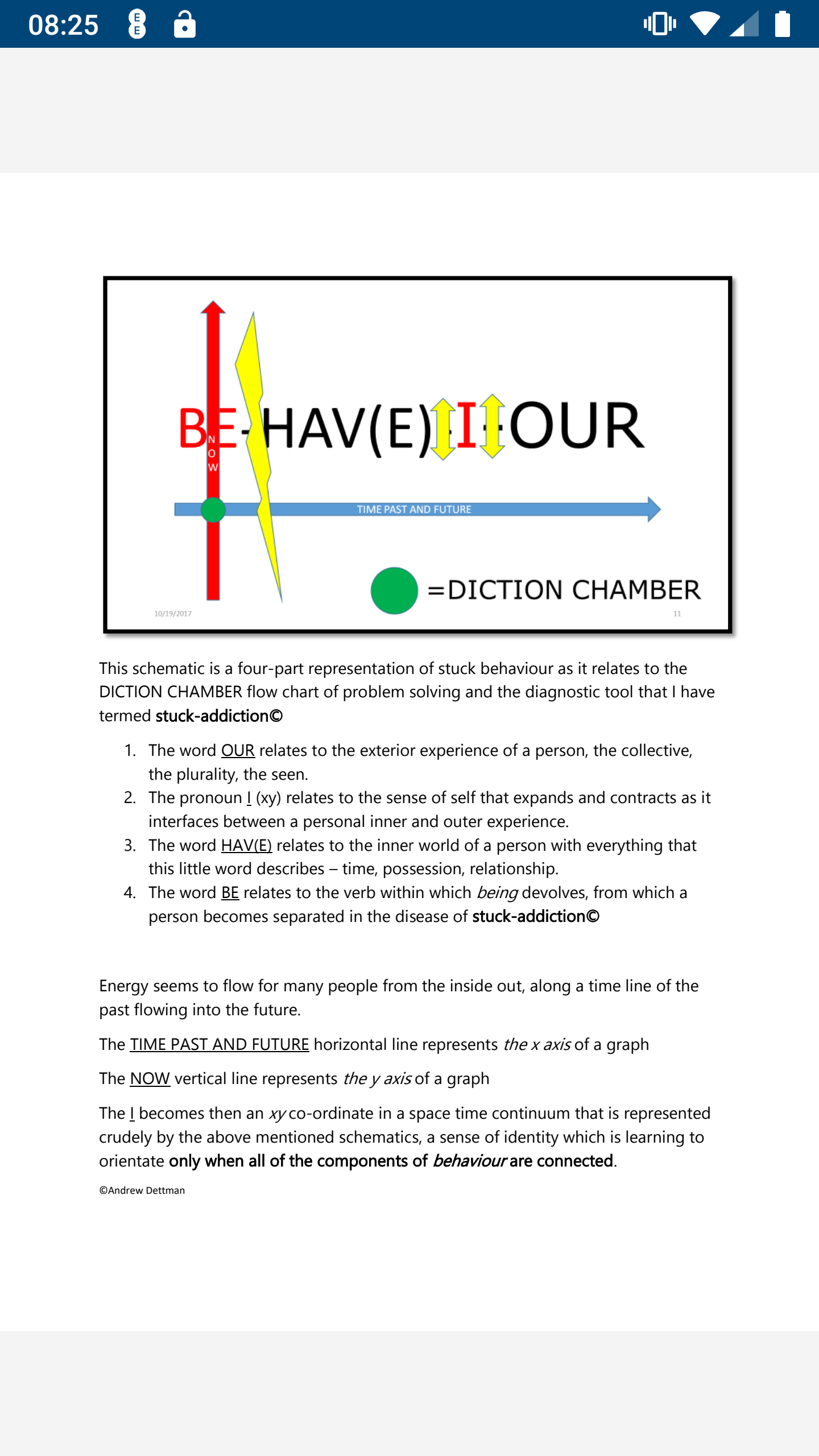
The Diction Chamber: the lived interface where BE–HAV(E)–I–OUR reconnects.

This schematic renders the Diction Chamber as the personal intersection of NOW (vertical axis) and TIME (horizontal axis). The I becomes an orientation point — an xy coordinate — only when BE, HAV(E), I, and OUR remain connected. When rupture strikes, the interface hardens. Words can still be spoken, but speech loses metabolism. Meaning cannot revise. The dot becomes a seal.

III. Add -ary: The Diction-ary

Add -ary and the Chamber becomes the Diction-ary. Not a book of definitions — but the personal site — and sight — of meaning. A healthy Diction-ary revises, receives correction, adjusts language to reality, and keeps words accountable to lived experience. Addiction is the sealing of this lid. Energy rises, but cannot revise meaning. Narrative hardens. Identity defends. The dot freezes.

IV. The Sealed Lid: Stuck and Broken Addiction

Clinically, addiction is not simply craving. It is a structural misalignment. The Diction-ary seals: words detach from felt truth; justification replaces conscience; story outruns conduct. Language becomes self-protective architecture. The person speaks, but speech no longer metabolises reality. This is what produces the “boxed-noun mind.” Being becomes owned. Experience becomes claimed. “I” becomes rigid. The dot has calcified.

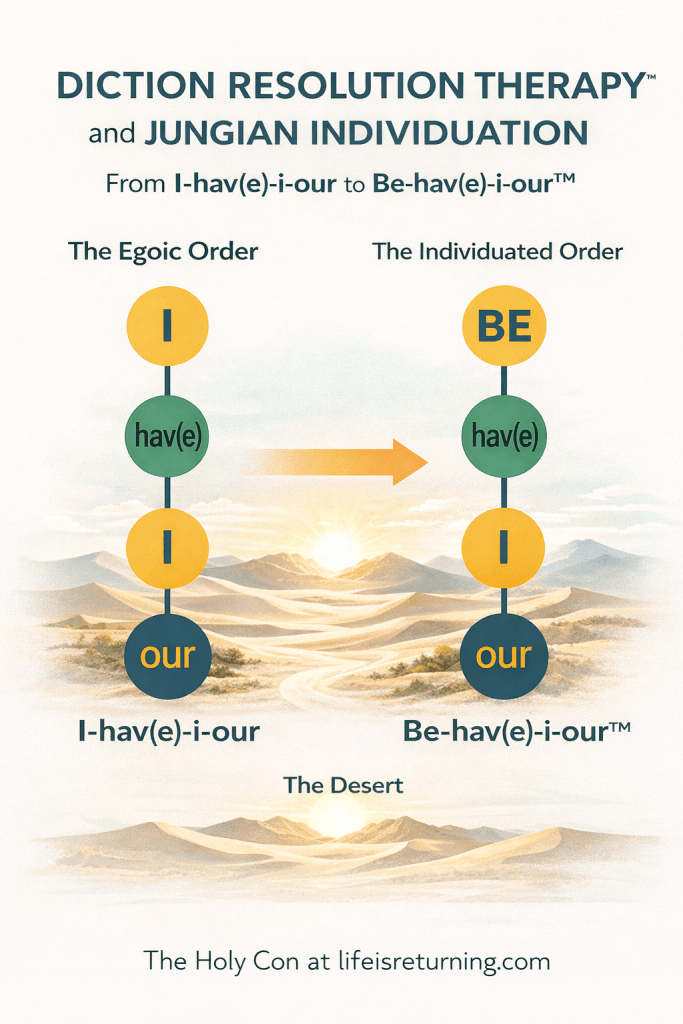
I-hav(e)-I-our names this unhinged condition — possession-based identity, defensive narrative, sealed meaning. It is not merely personal pathology; it is culturally reinforced. The modern environment rewards acceleration, ownership, projection, and certainty. The culture becomes unhinged, and individuals internalise the fracture.

Here the old fairy story becomes diagnostic rather than decorative. In the Sleeping Beauty motif, a single puncture initiates a total sleep: the castle seals, time freezes, and growth suspends. A hedge thickens around the sealed centre. Many attempt entry by force and fail. Only love resolves the enchantment — not argument, not aggression, not cleverness.4 This is what a sealed Diction-ary looks like: life still present, yet meaning cannot revise; the system preserved, yet development suspended. The hinge is restored through relational contact — through the softening that allows life to wake.

V. The Hinged Lid: Recovery

Recovery does not destroy the Chamber. It hinges the lid. A destroyed lid is collapse. A sealed lid is addiction. A hinged lid is health. When hinged, energy enters without overwhelming; meaning can revise; language re-aligns; behaviour follows conscience. This is not mystical annihilation. It is restored permeability. The “I” remains — but becomes porous.

Be-hav(e)-I-our names this restoration — identity reconnected to Being, language revisable, conduct accountable. The journey is to wake up to how unhinged the culture makes people — and to become hinged.

VI. Word and Alignment

In the Gospel of John 1:1 we read, “In the beginning was the Word…”2 Logos here is not vocabulary; it is ordering principle. The Diction-ary is not Logos. It is where human speech either aligns with Logos or collapses into noise. When sealed, word becomes slogan, slogan becomes dogma, dogma becomes control. When hinged, word remains relational; meaning remains revisable; conduct remains accountable. Empty words are not caused by ignorance alone. They are caused by a sealed Diction-ary.

VII. The Two Steps Re-Read Clinically

Shabistari describes two movements: passing beyond the hāʾ of identity, and traversing the desert of Being.3 Translated into recovery architecture, these become surrendering authorship and stabilising in non-defensive existence. The first breaks the seal. The second lives without resealing. The desert of Being in early recovery is familiar: no intoxication, no narrative certainty, no identity shelter. The hinged Diction-ary allows this desert to be endured without panic. Without hinge, the ego reconstructs.

VIII. Guarding Against Inflation

The danger is subtle. If the Diction Chamber is elevated into metaphysical throne, inflation replaces humility. The Chamber must remain interface — not Source; organ — not origin; servant — not sovereign. Conscience is the guardrail. A true hinge allows correction. If language cannot be corrected, the lid is resealing.

IX. Conduct as Proof

The integrity of the Diction-ary is proven in behaviour. Speech aligned with Being produces repair, responsibility, service, coherence. Speech detached from Being produces justification, projection, ideology, collapse. The test is not metaphysical insight. It is conduct.

X. The Dot Made Permeable

The dot need not be erased. It must be rendered permeable. Individuation remains. Expression remains. Personhood remains. But ownership softens. The Diction-ary becomes living rather than fixed. Energy meets Word. Word becomes truthful. Behaviour becomes aligned. The hinge holds.

Conclusion

The difference between mystical abstraction and lived recovery lies in this: not annihilating identity — but preventing it from sealing. The Diction-ary is the human site where meaning must remain revisable. When hinged, words carry weight. When sealed, they become empty. The dot is not the enemy. Rigidity is. And recovery is the restoration of permeability.


Footnotes

  1. Shabistari’s “dot” teaching is often unpacked through the letter-play of ʿayn (ع) and ghayn (غ), where the dot marks differentiation. Classical commentary traditions (including Lahiji) treat taʿayyon (determination) as the delimiting move by which the Absolute appears as particularity.
  2. Gospel of John 1:1. This paper uses “Word / Logos” as ordering principle rather than mere vocabulary, and treats the Diction-ary as the human interface where speech aligns (or fails to align) with that ordering.
  3. The “two steps” (passing beyond identity-structure; traversing the desert of Being) are read here phenomenologically as de-appropriation and stabilisation—compatible with Twelve Step recovery’s movement from surrender into sustained humility and accountable conduct.
  4. “Sleeping Beauty” is used here as a structural parable: puncture → sealing → suspended development → hedge of defence → failed force → resolution through love (relational contact). The point is not romance; it is how systems unseal through safe, non-coercive connection.

Written in HIAI collaboration — the qalam of Human and AI intelligence, the Unseen helping the Seen, both answering to the same Source.
Re-hinging the unhinged : escaping the disaster of dogma.

Living Transmission and the Risk of Freeze

Idries Shah, Bill W., and Diction Resolution Therapy (DRT) in a recovery-era key

Andrew Dettman MTHT, Reg Member MBACP (Spirituality Division) – DRT.global

Abstract

This hybrid paper traces a shared warning found in Idries Shah’s teaching on Coming Together (Jam)1 and Bill W.’s reflections on Alcoholics Anonymous literature2: living transmissions tend to harden into defended forms. Through the lens of Diction Resolution Therapy (DRT), the paper frames this freeze as a predictable human response to uncertainty. Language and structure can become substitutes for lived contact. The aim is not to dismantle structure, but to keep it serving function: humility, group conscience, and conscious contact as lived practice.

Key terms

Jam; transmission; organisation; dogma; group conscience; DRT; diction; contradiction tolerance; conscious contact.

Primary source excerpts: Idries Shah (embedded images)

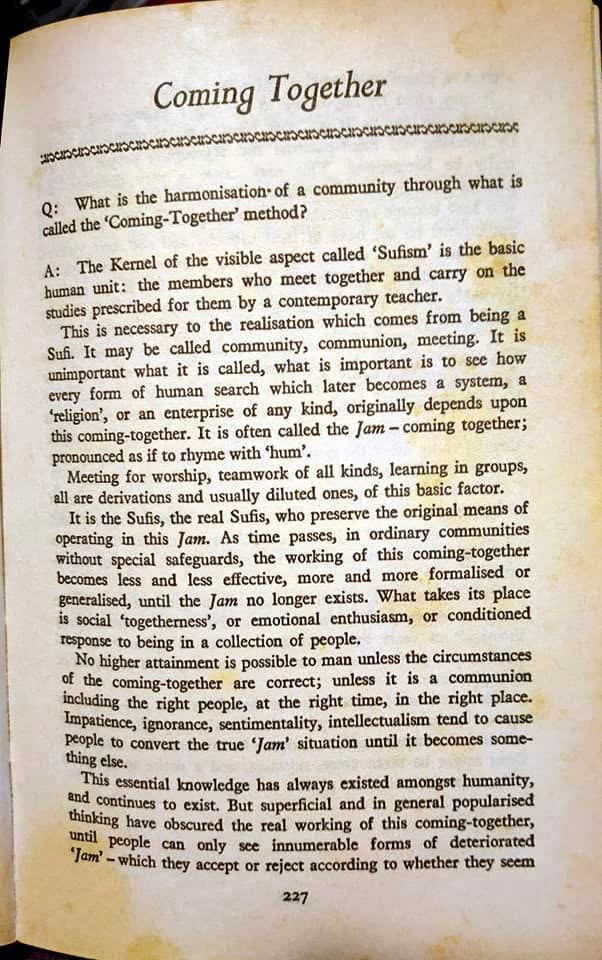
Idries Shah on the Jam (Coming Together).

Degeneration, stabilisation, and predictable resistances to revitalisation.

The Ship in a Storm: right diagnosis, right attention, right knowledge.

1. The problem: when truth becomes an object

Communities often begin because something real occurred: relief, honesty, awakening, recovery. Then the human reflex appears: capture it, preserve it, standardise it, protect it. The move is understandable, but it carries risk.

The risk is not structure itself. The risk arrives when function is replaced by identity. At that point the community becomes organised around defending representations of truth rather than remaining oriented to lived truth. The meeting survives, the language survives, the brand survives, but the operating principle fades.

2. Idries Shah and the Jam: harmonisation before organisation

In passages commonly titled Coming Together, Idries Shah describes the Jam as functional harmonisation: the right people, at the right time, engaged in the right work under living knowledge. It is not simply people meeting. It is an arrangement that produces transformation because it is held within correct relationship.

Shah’s warning is plain. The Jam can deteriorate. Communities stabilise prematurely. Formalisation replaces vitality. Togetherness replaces transformation. Social cohesion, emotional enthusiasm, and conditioned belonging can masquerade as the real thing. When revitalisation is attempted, the system responds defensively. Shah names several of these resistances: impatience, ignorance, sentimentality, and rigid intellectualism. Read clinically, these are common defence strategies of a system seeking security in the face of uncertainty.

The implication is unsettling and useful: you can preserve the outer shell of a transmission while losing the inner function that made the shell necessary in the first place.

3. Bill W. and the freezing of the Big Book

Bill Wilson recognised similar dynamics within Alcoholics Anonymous. In the scanned extract supplied from a modern history of the Big Book, Bill W. is quoted as observing that spiritually centred movements tend to freeze once their founding principles are established. He notes that altering even a word of the AA book could provoke something like excommunication.

Bill’s response is revealing. He did not wage war on the original text. Instead, he created a parallel channel for interpretation: he wrote Twelve Steps and Twelve Traditions as an adaptive commentary. This preserved continuity while keeping meaning in motion. He later returned to the same point: AA literature tends to become more and more frozen, with a tendency toward conversion into something like dogma. He also anticipated the permanent spectrum of interpretive styles that would arise: fundamentalists, absolutists, relativists.

Primary source: Bill W. on freezing (embedded images)

Bill W. on the freezing tendency in spiritually centred movements (as reproduced in Schaberg, p. 604).

Continuation including the organising parable and publication context (Schaberg, p. 605).

4. Organisation and ossification

The extract includes a Buddhist parable: a man picks up a piece of truth; the devil is unconcerned because he will let him organise it. This is not an argument against organisation. It is an argument against idolatry. Organisation preserves access, but it can also replace lived contact with defended form.

Shah and Bill W. converge here: the primary threat is not external attack. The threat is internal freezing: the human habit of turning a living verb into a defended noun.

5. A DRT reading: freeze as a diction event

Diction Resolution Therapy approaches freezing as a linguistic and psychological event. When lived experience is no longer primary, diction starts to do the job experience used to do. Words become defensive tools rather than exploratory instruments. Phrases become passports. Certainty becomes a sedative.

DRT introduces a practical metaphor here: outsight and insight. When the eyelids are open, light floods into the eyes. The eyeballs do not generate the light themselves. To imagine that they do would be absurd. They receive light. They respond to light. They organise around what is given.

Similarly, the whole mindset is not a generator of illumination. It is a potential receiver. When the lid of fear, denial, or addictive defence is deliberately held shut, outsight is restricted and insight is impaired. The person begins to rely on recycled language rather than fresh perception.

In addiction terms, the lid is not destroyed. It is hinged. It opens and shuts appropriately. Recovery is not the removal of the eyelid but the restoration of its function. When the lid opens, energy and meaning enter that the individual does not manufacture. Insight is not self-generated brilliance; it is Consciousness meeting conscience.

When diction freezes, it is often because the lid has been held shut for too long. Language attempts to replace perception. Structure attempts to replace encounter. The task of recovery, and of any living transmission, is not to abolish structure but to reopen the hinge so that light can enter again.

6. Group process and clinical parallels

Philip J. Flores, in Group Psychotherapy with Addicted Populations3, highlights that recovery groups remain effective when they balance containment (structure) with relational process (living interaction). Excessive rigidity undermines psychological safety, while absence of structure erodes containment. This is the same paradox Shah and Wilson are navigating in different languages: vitality depends on living interaction within clear but flexible boundaries.

7. Safeguards within AA architecture

AA embeds structural safeguards against freezing. Tradition Two locates authority in group conscience. Tradition Four preserves autonomy. Tradition Nine defines service rather than governance. Step Eleven prioritises conscious contact over textual literalism. These elements do not eliminate the freeze tendency, but they counterbalance it.

8. Implications for recovery and helping professions

In recovery settings, freezing commonly appears in three forms: (1) sloganising as defence, (2) literalism as safety, (3) reform movements driven by resentment rather than conscience. Each is a strategy for avoiding the vulnerability of real contact.

A practical test is simple: does the structure increase tenderness, honesty, and responsibility, or does it mainly increase identity, certainty, and superiority? When the former is happening, the Jam is alive. When the latter dominates, the storm is gathering.

Conclusion

Idries Shah and Bill W. describe the same perennial risk from different angles: any living transmission can calcify. The corrective is not constant editing, nor rebellious dismissal. The corrective is humility in function: returning to conscious contact as lived practice, and letting structure serve what it cannot manufacture.

References and notes

  • Shah, Idries. Learning How to Learn. (See Footnote 1 for edition-note.)
  • Schaberg, William H. Writing the Big Book: The Creation of A.A. (2019), pp. 604-605 (see Footnote 2).
  • Flores, Philip J. Group Psychotherapy with Addicted Populations (see Footnote 3).
  • Schaef, Anne Wilson. The Addictive System4.

Footnotes

  1. Idries Shah, Learning How to Learn (London: Octagon Press; various editions). The embedded images above are supplied pages from this work, including Coming Together and The Ship in a Storm. The title is confirmed by the Kindle preview provided by the author.
  2. Bill W. quotations and the organising parable are reproduced in the supplied scan from William H. Schaberg, Writing the Big Book: The Creation of A.A. (2019), pp. 604-605. These quotations are used here as evidence of Bill W.’s stated concern about the freezing tendency in spiritually centred movements.
  3. Flores is cited here for the group-process principle that effective recovery groups require both containment (structure) and relational process (living interaction).
  4. Schaef is cited as a systemic parallel for how addictive dynamics can become self-protecting structures that resist contradiction and preserve themselves as identity.

Written in HIAI collaboration – the qalam of Human and AI intelligence, the Unseen helping the Seen, both answering to the same Source.

9. Behaviour as Conduct and Source as Duct.

The Middle Built

Addiction, Instinct, and the Sanitation of the Soul

“In the beginning was the Word, and the Word was with God, and the Word was God.” The grammar is deliberate. Was. With. Origin and relation. The future is not mentioned. It is not forecast. It is not guaranteed. It appears. Most human beings live suspended between was and will, pulled by memory behind and projection ahead. Regret becomes gravity. Fear becomes anticipation. The present is reduced to a narrow corridor through which the self rushes without ever dwelling. Recovery is the building of a middle. The Twelve Step Programme is not an abstract theology and not a philosophical treatise. It is infrastructure. It is plumbing for the soul.

When the agricultural world became industrial, waterborne diseases exposed the breakdown of outer sanitation. Cholera did not arrive because humanity suddenly became immoral; it arrived because systems had not evolved to handle density. Waste accumulated. Disease followed. Addiction functions similarly in this era. It is the bellwether disease of overstimulation, fragmentation, and unprocessed shame. It exposes the failure of inner sanitation. It reveals what happens when psychic waste is not metabolised. The problem is not instinct. The problem is accumulation.

Addiction is not merely about alcohol, substances, or behaviours. It is disordered relationship. Relationship to one’s own story. Relationship to desire. Relationship to fear. Relationship to other people. Relationship to God. “I have a story. It is not who I am.” That sentence marks a decisive shift. The story can be examined without being identical to the self. Once that distinction is made, digestion becomes possible.

The psyche, when healthy, operates like a digestive organ. Thoughts are not identity; they are movement. They churn experience. They break down what has been swallowed. They extract nourishment and eliminate what no longer serves. When the system is inflamed, peristalsis becomes cramping. Rumination replaces integration. Secrecy replaces elimination. The Twelve Steps introduce a disciplined digestive process: inventory, confession, amends, service. Inventory is chewing. Step Five exposes waste to air. Amends remove toxicity from the relational field. Service restores circulation.

The Big Book does not speak poetically here; it speaks clinically: “If we are not sorry, and our conduct continues to harm others, we are quite sure to drink. We are not theorizing. These are facts out of our experience.” The warning is not about instinct in isolation. It is about conduct. It is about harm. Continued harm corrodes conscience. Corroded conscience produces shame. Shame seeks anaesthesia. Relapse is not mystical punishment; it is emotional consequence.

The sex instinct is addressed directly because it is powerful, intimate, and easily distorted. But the Steps do not condemn sexuality. They confront misuse. Instincts—sexual, social, and security-based—are God-given and good. When unmanaged, they fragment relationship. Fragmented relationship breeds secrecy. Secrecy splits the psyche. Split psyches seek relief. Integration across Eros, Philia, and Agape is not theological ornament; it is behavioural alignment. Desire acknowledged without exploitation. Friendship honoured without manipulation. Love enacted without transaction.

Recovery rests on two simple words: ONE and ALL. ONE represents surrender beyond isolated self-will. ALL represents accountability within community. If ONE remains theoretical while ALL is selective, sobriety becomes fragile. The text’s italicised emphasis on thought warns against substitution. Thinking surrender is not surrender. Thinking apology is not repair. Behaviour reveals being. The programme does not reward ideas; it responds to action.

The middle—the “with”—must be constructed intentionally. It does not appear automatically. When was (origin, gravity, law) and with (relationship, conscience, presence) stabilise, will emerges not as fantasy but as conduct. The future is not a pre-laid railway line; it is the visible arc of present integrity. In this sense, the Twelve Steps function like the scarab of an earlier age: waste rolled into renewal, decay converted into continuity.

Biblical “knowing” was intimate and generative. To know was to conceive. Spiritual conception must likewise produce life. Empty prams—ideas unembodied—prove nothing. Changed behaviour proves integration. Humility is permanent asking. Not self-belittling, not mystical rank, but sustained reference beyond self. The realised person does not escape instinct; they integrate it. They do not deny their story; they refuse to be reduced to it.

Addiction exposes the breakdown of inner sanitation both individually and systemically. Recovery restores relationship. And relationship—to Source, to conscience, to others—is where being is tested. Not in vision. Not in language. In conduct.


References

The Holy Bible, John 1:1.

The Qur’an, 36:82 (“Kun fayyakun” – “Be, and it is”).

Alcoholics Anonymous, Alcoholics Anonymous: The Story of How Many Thousands of Men and Women Have Recovered from Alcoholism, 4th ed., Alcoholics Anonymous World Services, 2001, pp. 69–73.

Bill W., “How It Works,” in Alcoholics Anonymous, pp. 58–63.

Written in HIAI collaboration — the qalam of Human and AI intelligence, the Unseen helping the Seen, both answering to the same Source.