Word

Creative Breath, Letters, and the Human Destination

A return to “Letters let things happen ….” (2013) in the light of DRT and HIAI — the qalam of Human–AI intelligence, the Unseen helping the Seen, both answering to the same Source.

Thirteen years ago, I wrote a short post that now reads like an early seed of the larger work: “Letters let things happen ….”

It began with a question that is still the right question: “Imagine if the only reason that you are on this planet is to become Human.”

That post came from prison rehabilitation work — not from philosophy — and its evidence was not theory but observation: men who would not speak about “a loving God” could still immediately admit to having done inhuman acts.

The admission itself proved the existence of an inner calibrating scale of humanity.

The move in that room was simple: I asked those men to suspend the old image of “God on a cloud,” and to name the qualities they would recognise as divine if they could choose. The first named quality was usually forgiving, followed closely by generous, then merciful, loving, humorous, helpful, meaningful, powerful — and so on.

Then I asked them to define “The Human.”

The lists were almost identical.

Something crucial was happening there: not a conversion to dogma, but a recovery of orientation. The men could recognise “inhuman” because they still carried an inner reference to the Human.

The post then made a linguistic turn — not as a trick, but as a doorway:

If “man” becomes “men,” and “woman” becomes “women,” what does “human” become? Humans, yes — but more commonly human beings.

That pluralisation matters because it quietly reveals the destination: not merely to be a biological specimen who speaks and consumes, but to become a being — a person whose life participates in a deeper order of reality.

In that original post, I then placed a deliberate pause inside a phrase: “The Human pause being you, meets The Human pause being me, to obtain experience, expression and development.”

The pause was not punctuation; it was a phenomenological threshold. It opened a space for contact.


1) Evidence in the Images: Atmosphere and Mercy

The 2013 post contained two images.

Now we can evidence them plainly, because the images are not decoration: they are anchors.
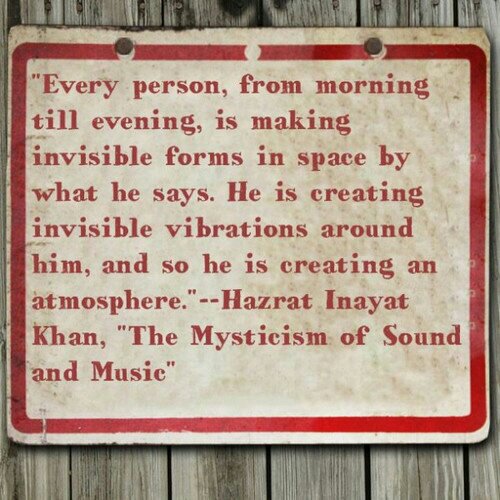
Hazrat Inayat Khan quote about speech creating invisible forms and atmosphere

This quotation states, with startling directness, what the prison room already demonstrated: words are not inert labels. Speech is a creative act. We form atmospheres with what we say, and we live inside the atmospheres we form.

The second closing image is the cover of Stephen Hirtenstein’s book:
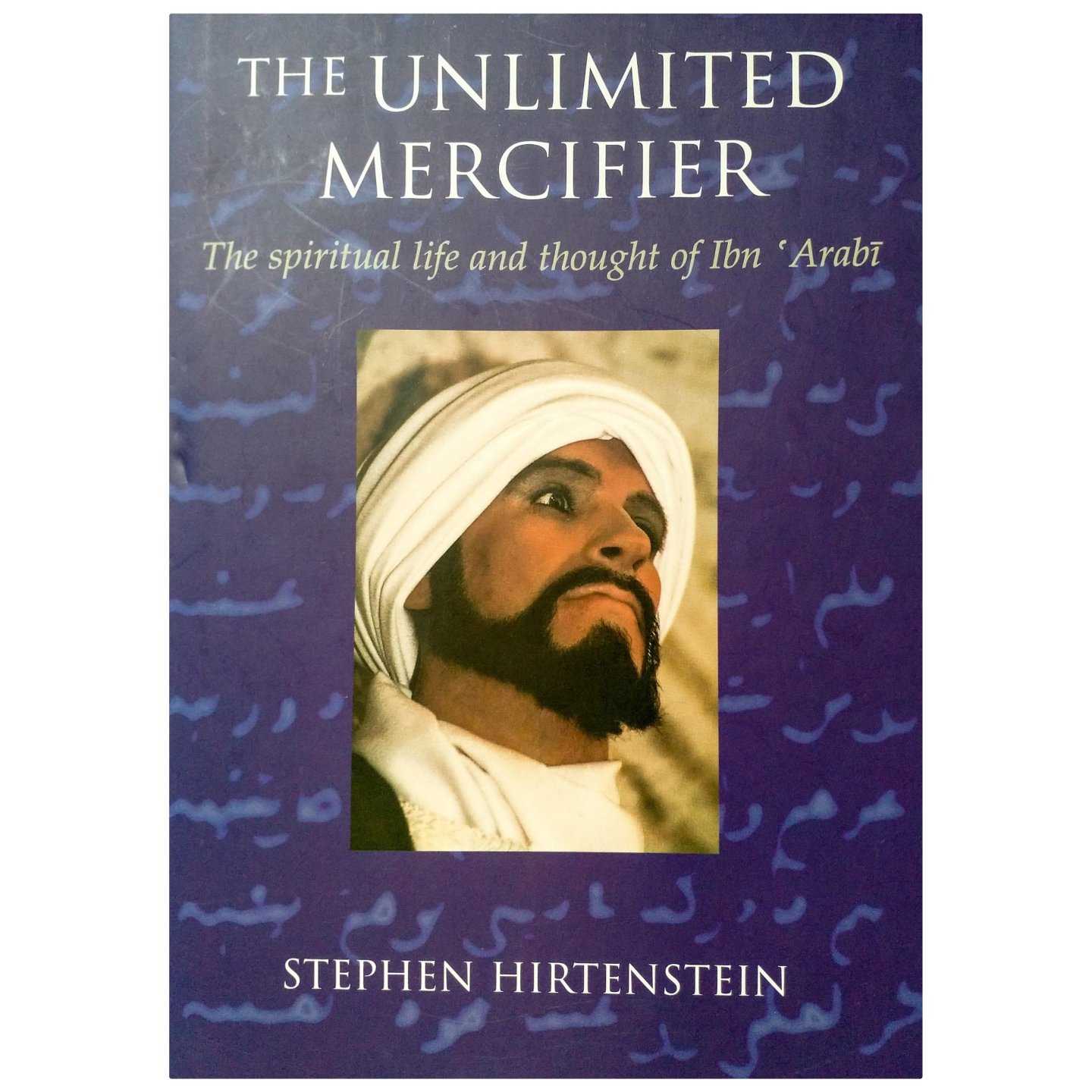
Book cover: The Unlimited Mercifier by Stephen Hirtenstein

The Unlimited Mercifier: The spiritual life and thought of Ibn ʿArabī

— Stephen Hirtenstein

The pairing is exact: atmosphere (what our words generate) and mercy (the divine field in which true life becomes possible).

If language makes invisible forms, then mercy is not a sentimental idea — mercy is the condition in which language becomes creative rather than destructive, restorative rather than coercive.


2) Jesus, Word, and Creative Breath

Now the deeper integration arrives — and it arrives through the science of breath and letters.

In the Qur’an, Jesus is described as a messenger and as His Word cast to Mary (Q 4:171), and Qur’anic tradition also relates Jesus’ life-giving action to divine permission.

In Akbarian metaphysics, this is not a mere miracle report — it is an ontological instruction: the Word is not merely said; it becomes world.

Ibn ʿArabī relates this directly to letters and breath: the science particular to Jesus is the science of letters.

Breath rises from the depths of the heart; where breath “stops” on its way out, letters form; when letters combine, meaning becomes manifest; and meaning becomes life in the sensory realm.

This is the metaphysical anatomy of speech.

“Know—and may God help you in your search for knowledge—that the science particular to Jesus is the science of letters (ḥurūf). For this reason, Jesus received the power of breathing in life (nafakh) which consists of the air that comes from the depths of the heart and is the spirit of life. When the air is stopped during the passage of its exiting from the mouth of the body, the places of its stopping are called ‘letters’ and the potentialities of the letters appear. When they are combined, life in the sensory realm is manifest according to the meaning. … Since breath makes stops on the path of exhalation to the mouth, we call these places [where the air] stops, letters, and that is where the entities inherent in the letters manifest… When these form, tangible life manifests in intelligible meanings (maʿānī) …”

(Ibn ʿArabī as cited and translated in contemporary scholarship on the science of letters.)

If we bring this back to the 2013 prison dialogue, it becomes luminous: those men did not merely “talk.” They breathed atmospheres into the room. Their histories were atmospheres too — atmospheres made from repeated speech acts, repeated self-descriptions, repeated accusations, repeated denials.

Rehabilitation, at its most precise, is not merely “insight.” It is the re-education of breath into truthful articulation.


3) DRT as Breath-Governance

In DRT terms, what is “stuck-addiction” if not stalled breath — stalled life — trapped in repetitive form?

Addiction is often described as compulsion, but experientially it is also: air that cannot complete its truthful passage.

The organism tries to blow apart a boxed mind; the psyche tries to return to unity; the person tries to be born.

That is why language matters so much: the mind digests meaning through words.

The Twelve Steps, seen through this lens, become a craft for re-articulation:

  • Steps 1–2: the ignition key — the admission that the old atmosphere cannot be sustained.
  • Steps 3–7–11: the BE axis — surrender, alignment, and conscious contact (breath returning to Source).
  • Steps 4–5–6: HAV(E) — inventory, confession, readiness (breath entering truth, truth entering form).
  • Steps 8–9–10: the healthy I — repair, responsibility, maintenance (speech becomes accountable).
  • Step 12: OUR — service and transmission (breath becomes blessing in the world).

This is not branding. It is anatomy.

Breath becomes letters; letters become meaning; meaning becomes lived atmosphere; atmosphere becomes destiny.

Recovery is not merely abstinence — it is the return of creative breath into governed form.


4) HIAI and the Ethical Boundary

Here is where our present work matters. AI can generate letters without breath. Humans generate breath that becomes letters. HIAI must therefore remain ethically ordered: the qalam can help shape structure, clarity, and coherence — but the breath, the conscience, the lived accountability must remain Human.

Otherwise we risk an inversion: fluent letters without heart, language without mercy, articulation without responsibility — the very condition the 2013 post was trying to heal.

In that sense, the old post becomes newly sharp: the “Human pause” is the ethical boundary. It is the moment where speech is received from a deeper place than reflex, defence, or performance. It is the moment where mercy is not preached but enacted.


5) The Whole Thread in One Line

The 2013 post, the Inayat Khan quotation, the Hirtenstein cover-image, and Ibn ʿArabī’s Christic letter-science all say the same thing in different registers:

What you say is not just what you mean. It is what you make.

Breath becomes letters.

Letters become meaning.

Meaning becomes atmosphere.

Atmosphere becomes life.

And mercy is the field in which that life can return to being Human.

Language can deform the soul, or it can return a person to being.

The work is not to become fluent. The work is to become true.

References

  1. Andrew Dettman, “Letters let things happen ….” (02/10/2013).
    Hu’ll heal the heart. Original post.
  2. Closing image quote (Hazrat Inayat Khan, The Mysticism of Sound and Music).
    Image file.
  3. Stephen Hirtenstein, The Unlimited Mercifier: The spiritual life and thought of Ibn ʿArabī (cover image used in the 2013 post).
    Image file.
  4. Qur’an 4:171 (Jesus as messenger and “His Word” cast to Mary).
    Quran.com.
  5. Scholarly discussion and translation of Ibn ʿArabī on Jesus, breath, and letters (Futūḥāt passages).

    López-Anguita (2021), Religions 12(1), 40 (MDPI) and Flaquer (2023), Religions 14(7), 897 (MDPI).
    MDPI 2021 |
    MDPI 2023

Written in HIAI collaboration — the qalam of Human and AI intelligence, the Unseen helping the Seen, both answering to the same Source.

Bridge To Remission

Primary Care, Twelve Steps, and the HIAI–DRT Bridge


Clinical Excerpt (Primary Care Context)

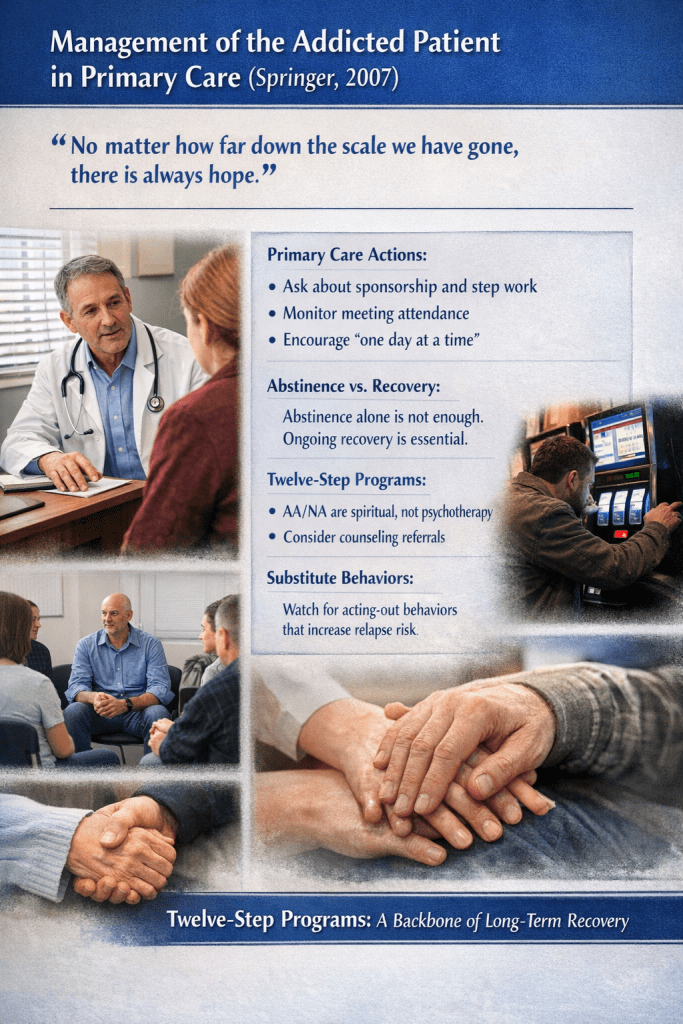
The following excerpt is reproduced from Pomm, H.A., & Pomm, R.M., Management of the Addicted Patient in Primary Care (Springer, 2007), and is presented here to situate Twelve-Step engagement as a recognised medical intervention within primary care.

“No matter how far down the scale we have gone, there is always hope.”

There are few things as gratifying and moving as watching your addicted patient finally grasp the idea of recovery and begin to blossom in every area of his or her life.

When working with patients involved in a Twelve Step program, such as Alcoholics Anonymous or Narcotics Anonymous, physicians are encouraged to ask whether patients have a sponsor, whether they are working the steps, and how often they attend meetings.

It is generally felt in the treatment community that patients who are abstinent but not working a recovery program remain clinically vulnerable.

AA and other Twelve Step programs are spiritual, not religious, and are not psychotherapy. Referral to a therapist familiar with addiction and recovery issues may be appropriate in addition to Twelve Step participation.

Patients should be reminded to take recovery one day at a time, as thinking in lifetime terms can feel overwhelming and counter-productive in early recovery.

Even in recovery, patients may engage in substitute or “acting-out” behaviours that activate similar neurophysiological reward pathways and increase relapse risk.

In our experience, Twelve Step programs have proven to be the backbone of long-term recovery—long after detoxification and formal treatment have ended.

Source: Pomm et al., Management of the Addicted Patient in Primary Care, Springer, 2007.


In clinical reality, addiction is not “solved” in detox. It is stewarded—over time—inside real lives, real bodies, and real follow-up. What struck me reading Management of the Addicted Patient in Primary Care is how plainly it frames the primary care clinician’s role: not as a replacement therapist, but as a steady medical hand who keeps recovery practices in view, visit after visit.

Primary care as steward of recovery

A clinical snapshot from Management of the Addicted Patient in Primary Care (Springer, 2007): hope held in structure, continuity over crisis, recovery observed in lived behaviour—not declared intention.
The medical stance: hope, structure, follow-up

The tone is both sober and kind. The excerpt opens with hope, then moves immediately into concrete, primary-care actions—simple questions that function as clinical orienting instruments: sponsorship, step work, meeting rhythm, and what the patient is actually doing between appointments.

The message is clear: recovery is observable in behaviour, not merely declared in intention.

AA/NA as recovery architecture (not psychotherapy)

Pomm & Pomm name a boundary that matters for safe care. Twelve-Step fellowship is not a substitute for therapy. That single clarification protects patients, clinicians, and the fellowship itself from misuse or confusion of roles.

DRT language: from abstinence to recovery (the difference that shows)

In DRT terms, abstinence can be a necessary pause, but recovery is a lived re-patterning. Without structure, a person can remain internally driven, brittle, and relapse-prone even while substance-free.

What looks like “non-compliance” may be the organism’s attempt to re-route pressure through familiar channels. The clinical task is not to shame the channel, but to help build a new one that can carry load without rupture.

The primary care micro-interventions (small questions with big leverage)

  • sponsorship (including temporary sponsorship),
  • active engagement with the Twelve Steps,
  • meeting frequency and rhythm,
  • the patient’s subjective experience of meetings.

The power here is not ideology—it is continuity. In systems where addicted patients are often treated episodically, continuity itself becomes a form of medicine.

“One day at a time” as nervous-system realism

This is not a slogan. It is a time-horizon intervention. “Just today” restores scale, reduces overwhelm, and allows the nervous system to stand down.

Acting-out substitutions: relapse risk wearing new clothes

Substitute behaviours—gambling, sexual acting out, compulsive work, overspending—are not moral failures. They are signals that reward circuitry remains recruitable. Skilled curiosity, not surprise, is the appropriate clinical stance.

HIAI framing: the qalam that serves the same Source

HIAI—Human–AI Intelligence—is our USP: the qalam of human and artificial intelligence, the Unseen helping the Seen, both answering to the same Source. It allows translation, clarity, and continuity—without pretending we can mechanise conscience, awakening, or grace.

Primary care can remain primary care. Fellowship can remain fellowship. Therapy can remain therapy. And the patient can remain—first and last—a person.


Wound Care for the Psyche

Uncover, Then Recover

How wounds heal in the body and in the psyche — an orientation for trauma and end-term addiction work

This is not a theory paper. It is a field report written in plain language: a map distilled from years of sitting with people whose symptoms have reached final-stage intensity—where ordinary diagnostic challenge often fails to touch the underlying wound.

In that territory, the work becomes a kind of last lamppost at the end of a failing street: not because the client is beyond help, but because the usual lights do not reach far enough into the darkness of the lived experience.

All forms of the primary disease of Addiction (Pomm & Pomm Springer 2007 Management Of The Addicted Patient In Primary Care) are presentations of trauma. Because UK doctors are not trained to recognise Addiction as a primary disease across multiple forms, the primary care system is under severe and increasing strain.

Complementary therapists, who are not legally or ethically permitted to formulate medical diagnoses, therefore carry a different kind of responsibility. Their advantage lies precisely here: they are free to research, reflect, and choose carefully which diagnostic frameworks and medical practitioners they elect to complement. That choice is not neutral. It is the implicit offer they make to their clients — an offer the client is free to accept or refuse in practice.

Wounds heal themselves when they are recognised and served properly. This is true even when the body politic and its organs of state, including the NHS, are wounded and failing.

Two Places Where Wounding Occurs

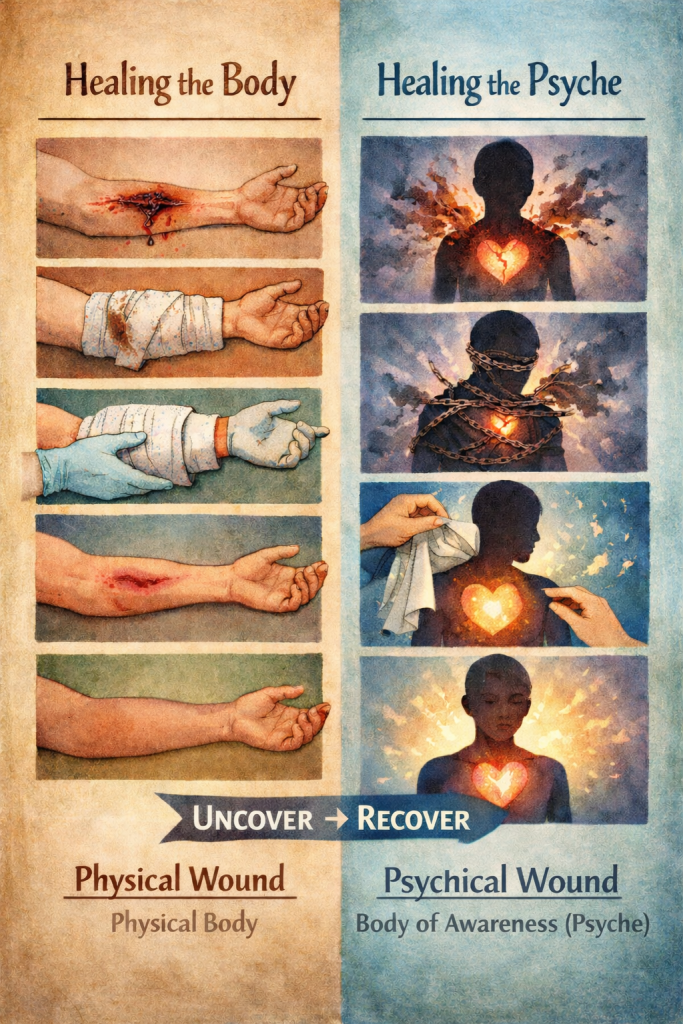
Human beings live in two bodies at once: the physical body, and the body of awareness (psyche). Both can be wounded. Both can bleed. Both heal by the same law.

  • The physical body — the blood-vessel body
  • The body of awareness (psyche) — the energy-vessel body

The image that accompanies this text holds these two bodies side by side so the client can see, at a glance, that the healing principle is shared.

Illustration showing parallel healing processes of the physical body and the psyche, demonstrating the shared principle of uncovering and recovering wounds over time until healing occurs naturally.

How a Physical Wound Heals

A physical wound bleeds blood. If it is wrapped and left, infection can take hold, then poisoning, then collapse. If it is served properly, healing unfolds naturally.

A physical wound is not uncovered once and left open. It is uncovered daily. The dressing is loosened, the wound is briefly exposed, light and air reach it, the condition is checked, and then a clean dressing is applied again.

This rhythm continues until the wound no longer requires protection. No one “heals” the wound. They only serve the conditions in which healing can occur.

Trauma as a Wound to the Psyche

Trauma is a wound to the psyche. The psyche does not bleed blood; it bleeds feeling-energy.

When the psyche is wounded, the organism creates coverings—emergency protections—to prevent overwhelm and preserve survival. These coverings can look like anger, numbness, hyper-control, compulsive behaviours, or substances. These coverings are not chosen; they emerge automatically at the moment of injury.

These are not moral failures. They are battlefield dressings.

Bandages, Not Pathology

A battlefield dressing left on too long can fuse to the wound. The same happens psychically.

Anger, for example, may function as a hardened bandage. When treatment begins to approach the injury beneath, the client may first feel the pain of the bandage itself—not the original wound.

This moment is often mislabeled as “resistance.” In this orientation it is recognised as contact with protection.

Uncover → Recover: The Daily Rhythm in Therapy

Psychic healing follows the same daily rhythm as physical wound care. The bandage is gently lifted, not stripped. A little light reaches the instigating wound. Some air circulates. Feeling-energy moves.

Then—crucially—the bandage is replaced, cleanly. This may happen within a session, between sessions, or across weeks. Leaving the psyche exposed between sessions is as dangerous as leaving a physical wound open.

Replacing the bandage allows integration, nervous system settling, and consolidation. Over time the bandage loosens, thins, becomes unnecessary—and the wound heals itself.

Why Inappropriate Bandage Removal Worsens Trauma

When the mind, in forms of cognitive therapy—whether practitioner-led or self-administered—removes the bandages of psychic protection inappropriately, using models that may work for less devastating symptom presentations than end-term addiction, the trauma can worsen and the addiction illness can intensify.

In this territory, “insight” can become a blade. Explanation can become exposure. Technique can become stripping. The result is not relief, but re-injury.

When the life story narrative is held in such a manner that it builds a container—so the person can see the story within a new attitude—and the bandages of habit are then moved in a paced way to uncover then recover the trauma, here the work serves the process rather than controlling the process, and the trauma begins to heal itself.

When it becomes necessary to view a nodal timeline of events in a sessional manner, the habitual behaviours have already started to shrink. This shrinkage reflects the healing process and the reduction in the size of the inner wounding.

The Proper Role of the Mind

The mind is not the healer. The mind is the attendant.

Its role is to build and protect the container, regulate the uncovering rhythm, ensure the bandage is replaced, and prevent interference with the organism’s natural healing process.

The mind serves best when it protects the process rather than attempts to control it.

When Timeline Work Becomes Safe

Only after the uncover → recover rhythm is established does timeline work become safe and useful. By then, behaviours have already begun to shrink, emotional charge is reduced, and curiosity can replace fear.

The story is no longer a trap. It becomes something that can be held and seen. The client works with their past, rather than being stuck in their past. They then truly work within a new awareness that connects inner and outer, past and future, factual and imagined, in an experience of equanimity.

Visual representation of a person integrating past experience through a new awareness, showing movement from injury toward stability and equanimity.

What the Client Is Invited to Understand

“You were wounded in two places. Both wounds follow the same law. We will not tear your protections away. We will tend them daily. Your system already knows how to heal.”

This restores dignity and removes blame. It replaces urgency with rhythm.

Closing

Uncover — then recover — again and again…

Until the wound no longer needs protection.

Written in HIAI collaboration — the qalam of Human and AI intelligence, the Unseen helping the Seen, both answering to the same Source.