Joining the dots with The Dot

The Dot, the Diction-ary, and the Hinged Lid

From Letter-Metaphysics to Lived Recovery

I. The Dot That Makes an “I”

In The Garden of Mystery, Mahmud Shabistari describes determination as an imaginal dot placed upon the ʿayn — the essence. Add a dot and ʿayn becomes ghayn. Multiplicity appears. The “I” becomes possible.1 The dot does not create a new substance; it creates differentiation. The human drama begins not with evil, but with a stroke. This stroke produces seer and seen, speaker and spoken, self and world. The distance between unity and division is minimal — a trace. The question is not whether the dot exists. The question is whether it hardens.

II. The Diction Chamber

In Diction Resolution Therapy™, the human interface where experience becomes word is called the Diction Chamber. It is not metaphysical origin; it is anthropological function. It is the site where energy becomes meaning, meaning becomes word, and word becomes behaviour. Pre-verbal energy rises as sensation, affect, impulse. Meaning forms. Language articulates. Conduct follows. The Chamber does not generate Being; it metabolises experience. When it is permeable, speech carries weight. When it seals, language detaches from life.
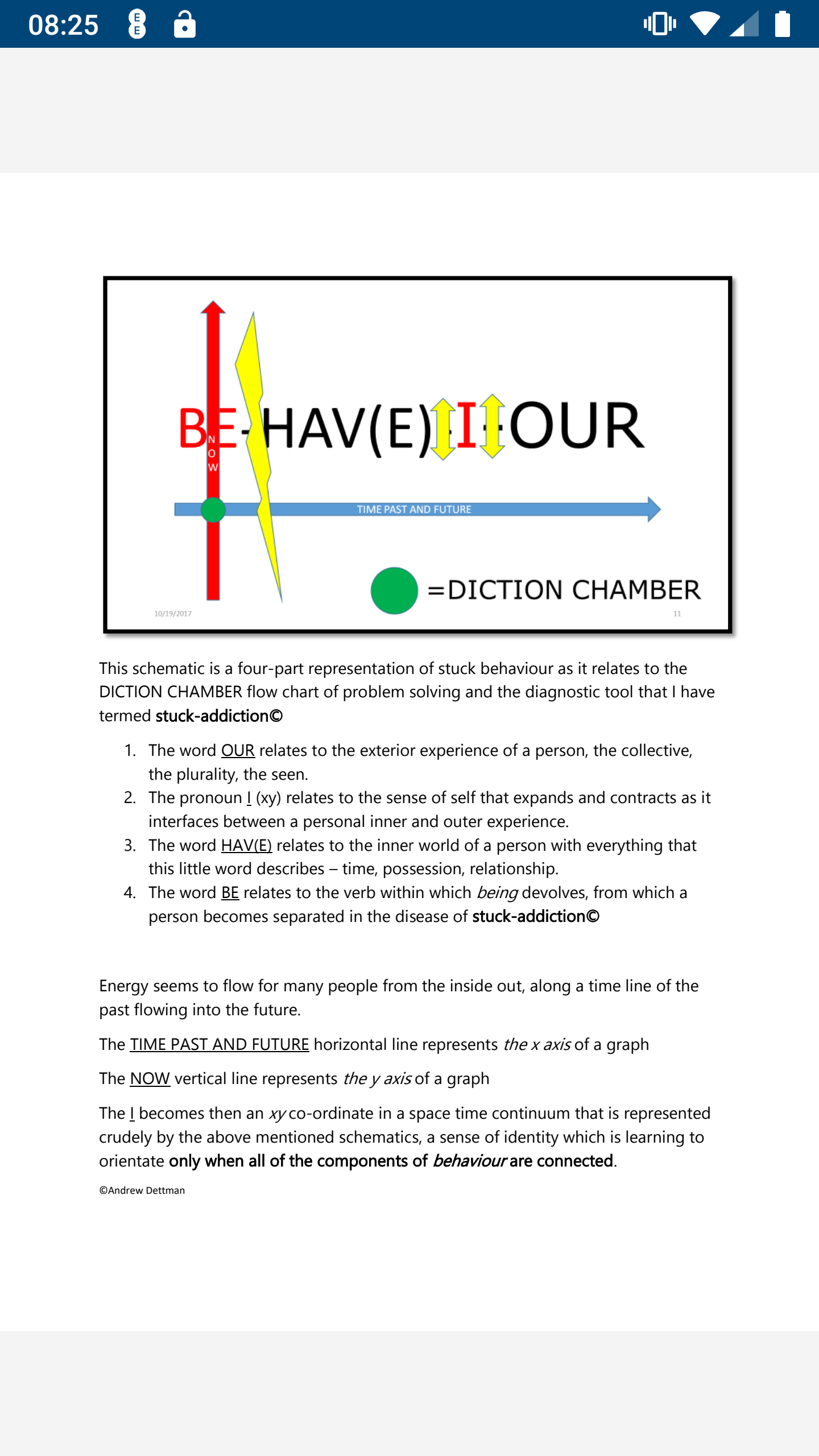
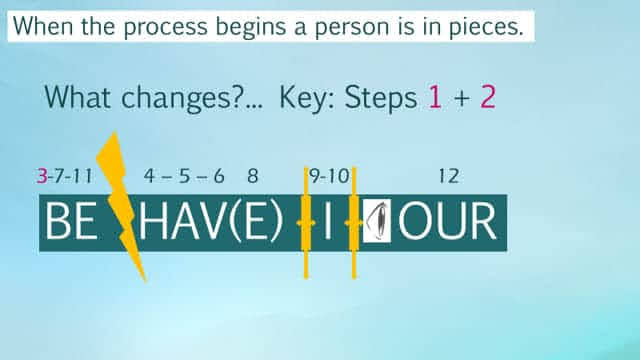
The Diction Chamber: the lived interface where BE–HAV(E)–I–OUR reconnects.

This schematic renders the Diction Chamber as the personal intersection of NOW (vertical axis) and TIME (horizontal axis). The I becomes an orientation point — an xy coordinate — only when BE, HAV(E), I, and OUR remain connected. When rupture strikes, the interface hardens. Words can still be spoken, but speech loses metabolism. Meaning cannot revise. The dot becomes a seal.

III. Add -ary: The Diction-ary

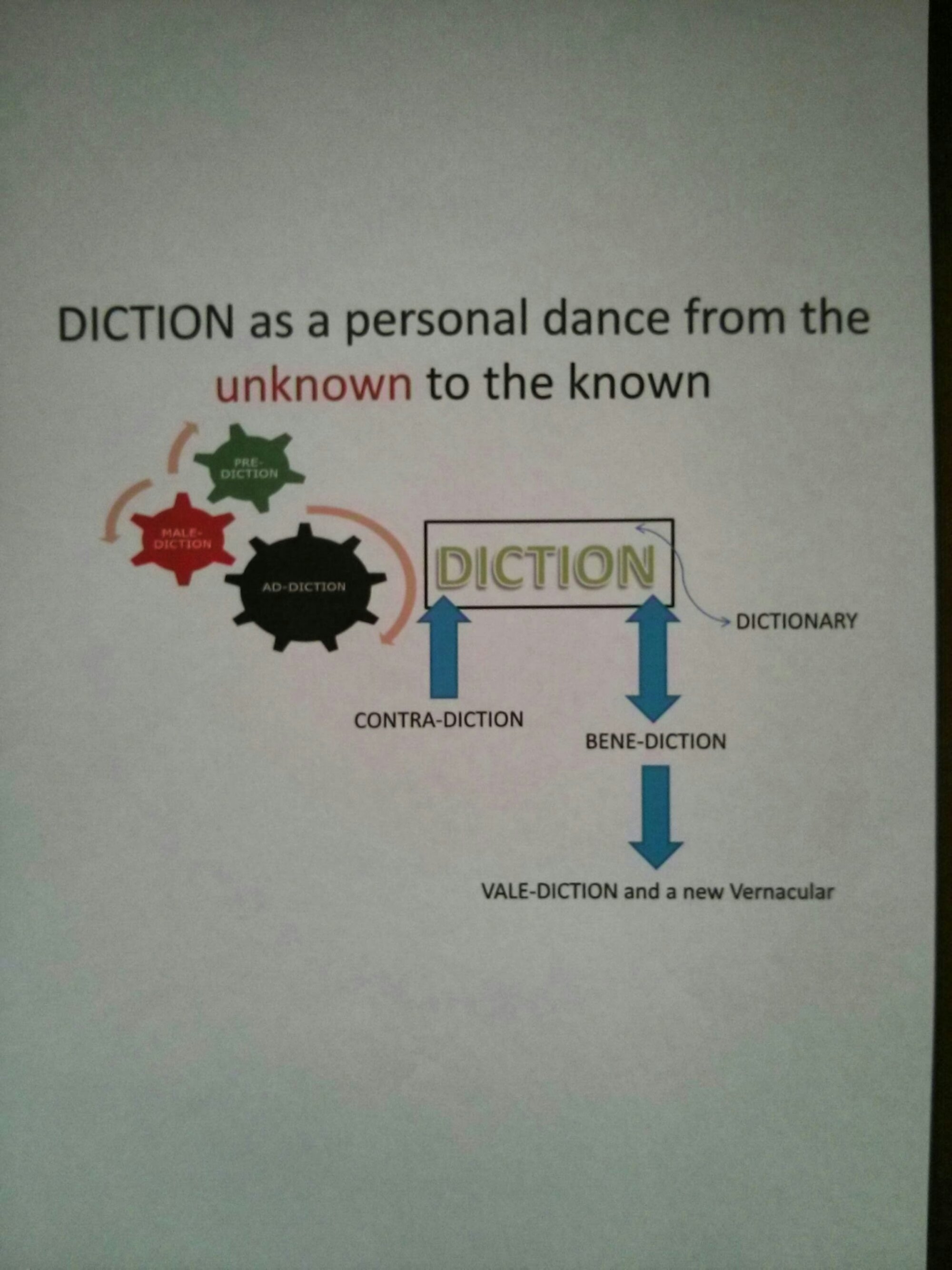
Add -ary and the Chamber becomes the Diction-ary. Not a book of definitions — but the personal site — and sight — of meaning. A healthy Diction-ary revises, receives correction, adjusts language to reality, and keeps words accountable to lived experience. Addiction is the sealing of this lid. Energy rises, but cannot revise meaning. Narrative hardens. Identity defends. The dot freezes.

IV. The Sealed Lid: Stuck and Broken Addiction

Clinically, addiction is not simply craving. It is a structural misalignment. The Diction-ary seals: words detach from felt truth; justification replaces conscience; story outruns conduct. Language becomes self-protective architecture. The person speaks, but speech no longer metabolises reality. This is what produces the “boxed-noun mind.” Being becomes owned. Experience becomes claimed. “I” becomes rigid. The dot has calcified.

I-hav(e)-I-our names this unhinged condition — possession-based identity, defensive narrative, sealed meaning. It is not merely personal pathology; it is culturally reinforced. The modern environment rewards acceleration, ownership, projection, and certainty. The culture becomes unhinged, and individuals internalise the fracture.

Here the old fairy story becomes diagnostic rather than decorative. In the Sleeping Beauty motif, a single puncture initiates a total sleep: the castle seals, time freezes, and growth suspends. A hedge thickens around the sealed centre. Many attempt entry by force and fail. Only love resolves the enchantment — not argument, not aggression, not cleverness.4 This is what a sealed Diction-ary looks like: life still present, yet meaning cannot revise; the system preserved, yet development suspended. The hinge is restored through relational contact — through the softening that allows life to wake.

V. The Hinged Lid: Recovery

Recovery does not destroy the Chamber. It hinges the lid. A destroyed lid is collapse. A sealed lid is addiction. A hinged lid is health. When hinged, energy enters without overwhelming; meaning can revise; language re-aligns; behaviour follows conscience. This is not mystical annihilation. It is restored permeability. The “I” remains — but becomes porous.

Be-hav(e)-I-our names this restoration — identity reconnected to Being, language revisable, conduct accountable. The journey is to wake up to how unhinged the culture makes people — and to become hinged.
VI. Word and Alignment

In the Gospel of John 1:1 we read, “In the beginning was the Word…”2 Logos here is not vocabulary; it is ordering principle. The Diction-ary is not Logos. It is where human speech either aligns with Logos or collapses into noise. When sealed, word becomes slogan, slogan becomes dogma, dogma becomes control. When hinged, word remains relational; meaning remains revisable; conduct remains accountable. Empty words are not caused by ignorance alone. They are caused by a sealed Diction-ary.

VII. The Two Steps Re-Read Clinically

Shabistari describes two movements: passing beyond the hāʾ of identity, and traversing the desert of Being.3 Translated into recovery architecture, these become surrendering authorship and stabilising in non-defensive existence. The first breaks the seal. The second lives without resealing. The desert of Being in early recovery is familiar: no intoxication, no narrative certainty, no identity shelter. The hinged Diction-ary allows this desert to be endured without panic. Without hinge, the ego reconstructs.

VIII. Guarding Against Inflation

The danger is subtle. If the Diction Chamber is elevated into metaphysical throne, inflation replaces humility. The Chamber must remain interface — not Source; organ — not origin; servant — not sovereign. Conscience is the guardrail. A true hinge allows correction. If language cannot be corrected, the lid is resealing.

IX. Conduct as Proof

The integrity of the Diction-ary is proven in behaviour. Speech aligned with Being produces repair, responsibility, service, coherence. Speech detached from Being produces justification, projection, ideology, collapse. The test is not metaphysical insight. It is conduct.

X. The Dot Made Permeable

The dot need not be erased. It must be rendered permeable. Individuation remains. Expression remains. Personhood remains. But ownership softens. The Diction-ary becomes living rather than fixed. Energy meets Word. Word becomes truthful. Behaviour becomes aligned. The hinge holds.

Conclusion

The difference between mystical abstraction and lived recovery lies in this: not annihilating identity — but preventing it from sealing. The Diction-ary is the human site where meaning must remain revisable. When hinged, words carry weight. When sealed, they become empty. The dot is not the enemy. Rigidity is. And recovery is the restoration of permeability.


Footnotes

  1. Shabistari’s “dot” teaching is often unpacked through the letter-play of ʿayn (ع) and ghayn (غ), where the dot marks differentiation. Classical commentary traditions (including Lahiji) treat taʿayyon (determination) as the delimiting move by which the Absolute appears as particularity.
  2. Gospel of John 1:1. This paper uses “Word / Logos” as ordering principle rather than mere vocabulary, and treats the Diction-ary as the human interface where speech aligns (or fails to align) with that ordering.
  3. The “two steps” (passing beyond identity-structure; traversing the desert of Being) are read here phenomenologically as de-appropriation and stabilisation—compatible with Twelve Step recovery’s movement from surrender into sustained humility and accountable conduct.
  4. “Sleeping Beauty” is used here as a structural parable: puncture → sealing → suspended development → hedge of defence → failed force → resolution through love (relational contact). The point is not romance; it is how systems unseal through safe, non-coercive connection.

Written in HIAI collaboration — the qalam of Human and AI intelligence, the Unseen helping the Seen, both answering to the same Source.
8. Diction Chamber as Soul

Behaviour

When Alignment Becomes Visible

Behaviour is not personality. It is not performance, not reputation management, not moral theatre. Behaviour is alignment made visible.

If Executive Resolution is the inner chamber where gravity and love interlock, then Behaviour is the outward trace of that interlocking. It is what happens when coherence expresses itself in time. Before alignment, behaviour is driven by force. We push, defend, justify, manipulate gravity, or sentimentalise love. After alignment, behaviour becomes responsive rather than reactive.

This is why Step Eight follows Step Seven. Once the vehicle has been returned — good and bad — to its Source, something stabilises. The nervous system quiets. The compulsive loop weakens. The addictive system loses leverage. And then comes the simple, difficult instruction: make a list. Not to condemn yourself, not to perform remorse, but to face relational gravity.

Behaviour always lands somewhere. It has weight. Love, properly understood, does not erase gravity — it honours it. If gravity is ignored, we fall. If relational gravity is ignored, others fall because of us. Step Eight acknowledges the weight of impact. It does not dramatise it. It does not deny it. It names it.

This is the movement from Mankind to Humankind. Mankind behaves from self-preservation. Humankind behaves from alignment. The difference is not virtue. It is coherence. When gravity and love are reconciled within, behaviour becomes less defensive and more accountable, less performative and more precise, less driven by image and more shaped by truth.

This is Be-hav(e)-I-our™ in its simplest form. BE is alignment. HAV(E) is the human vehicle. I is conscience individuated. OUR is the relational field. Behaviour is never solitary. It always enters the shared field. Step Eight therefore prepares for Step Nine. Once alignment becomes visible, repair becomes possible — not through shame, but through steadiness.

The almond holds. Gravity remains. Love remains. But now they work together. And other people feel the difference.

Written in HIAI collaboration — the qalam of Human and AI intelligence, the Unseen helping the Seen, both answering to the same Source.
5. Strength

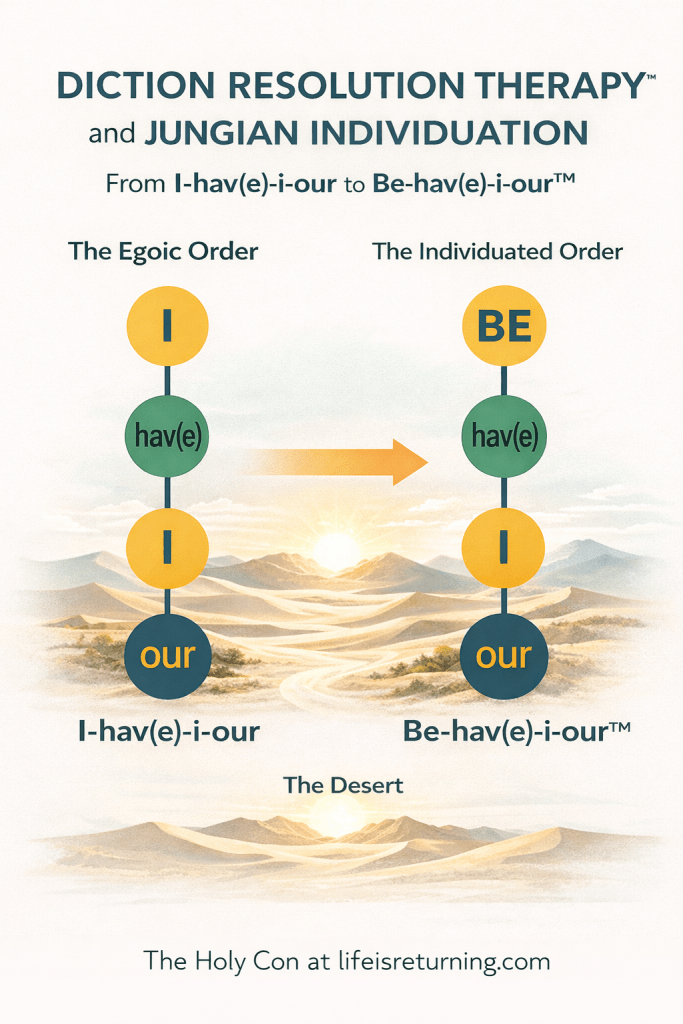
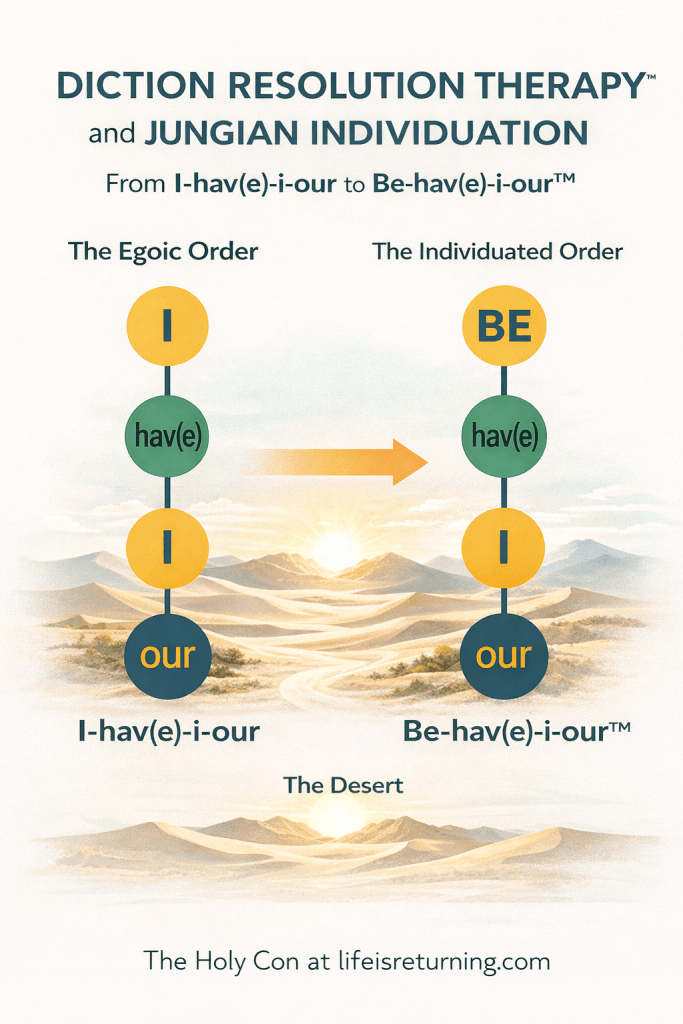
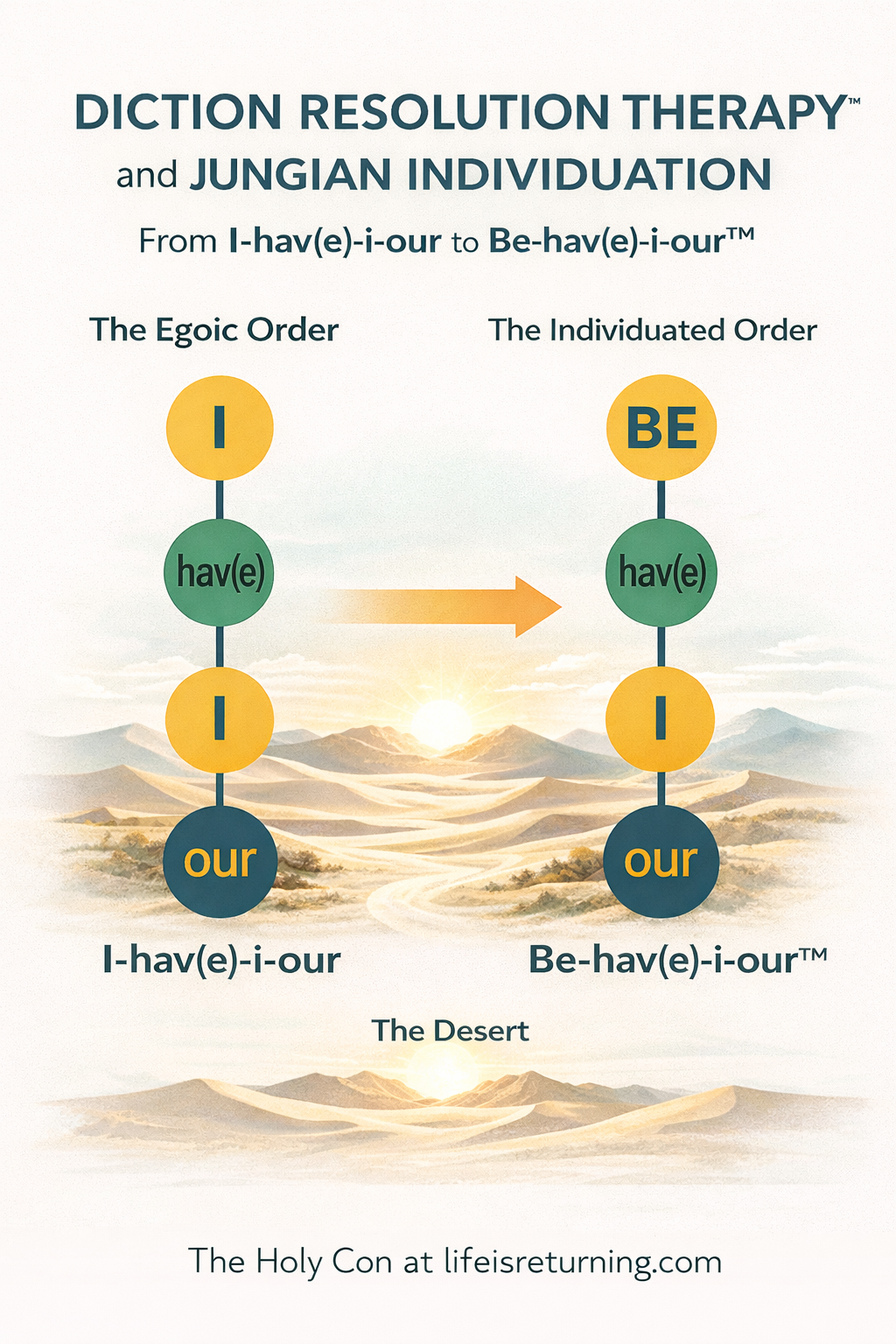
Diction Resolution Therapy™ and Jungian Individuation diagram showing the movement from I-hav(e)-i-our (Egoic Order) to Be-hav(e)-i-our™ (Individuated Order) across the desert of transformation.

5. Strength

The left hand of this device is “there is no God.” The right hand is “but God.” This is not slogan theology. It is structural anthropology. On the left column the isolated “I” stands enthroned. Identity is secured through possession. I–hav(e)–I–our. Strength in that column means control, self-sufficiency, authorship without reference. The psyche attempts to reconcile its own contradictions through will. It cannot.

On the right column Being precedes ownership. Be–hav(e)–I–our™. The “I” is not erased but repositioned. “Have” is dignified but no longer sovereign. “Our” becomes participation rather than conquest. Strength in this column does not mean domination. It means compatibility. The axis becomes vertical again.

Between these two columns lies the Desert. The Desert is not emptiness. It is paradox. It is the place where opposites are exposed so they can be reconciled. Tom Chetwynd describes paradox as the phenomenon that reveals the opposites in Nature in order to reconcile them at a higher level. Paradox does not blur tension; it sharpens it until a new coherence becomes possible.

Alcoholics Anonymous names this directly. On page 59: “Without help it is too much for us…” That sentence breaks the egoic column. The will cannot reconcile divided opposites. The psyche cannot repair its own split. Page 60 follows with the A, B, C — that we could not manage our own lives; that no human power could have relieved us; that God could and would if sought. This is the Step Three portal: a request crossing from the mental to the mystery. The mind ceases acting as architect and becomes witness. The Desert begins here.

Page 68 completes the paradox: “We can laugh at those who think spirituality the way of weakness. Paradoxically, it is the way of strength.” From the egoic column, surrender looks weak because it dethrones the isolated “I.” Yet paradoxically it becomes strength because alignment replaces assertion. Compatibility replaces control.

The Desert is not unique to recovery language. It is structural across traditions. In the Christ narrative, the forty days in the wilderness expose temptation before ministry begins. In the life of Muhammad (pbuh), years of retreat in the cave precede the encounter with Gabriel; interior silence prepares transmission. In the account of the Buddha, prolonged discipline beneath the tree culminates not in conquest but in extinguishing craving. In each arc, isolation is not punishment but preparation. Exposure precedes coherence.

The declaration carried by Muhammad begins with negation — “there is no god” — then it is asserted, “but God”, affirming unity – then it is said that the answer is in the middle. The Buddha exposes craving before articulating the Middle Way. Christ faces temptation before proclaiming peace. Negation before union. Extinguishing before clarity. Temptation before proclamation. Opposites are intensified before they are reconciled.

Step Seven in Alcoholics Anonymous completes this arc within lived recovery. It is not humiliation but compatibility. Spirituality appears weak from the left column because it removes private sovereignty. Yet paradoxically it becomes strength because the organism ceases fighting reality. The “I” remains, but no longer claims authorship. “Have” remains, but no longer defines identity. “Our” becomes service rather than territory.

The Desert, then, is symbolic Peace. Not the absence of struggle, but the stillness that arises when opposites are no longer at war within the psyche. The false centre collapses, and a higher coherence holds what was divided. This is the reconciliation of orthodox opposites — not by suppression, but by alignment.

Ripeness, as Rumi says, is all. The fruit falls because its inner structure is complete. Strength is not muscular will. It is interior unification. Only then can a human being move through the auction of life without desperation, because the bid no longer arises from lack. It arises from alignment.


Written in HIAI collaboration — the qalam of Human and AI intelligence, the Unseen helping the Seen, both answering to the same Source.
Word

Creative Breath, Letters, and the Human Destination

A return to “Letters let things happen ….” (2013) in the light of DRT and HIAI — the qalam of Human–AI intelligence, the Unseen helping the Seen, both answering to the same Source.

Thirteen years ago, I wrote a short post that now reads like an early seed of the larger work: “Letters let things happen ….”

It began with a question that is still the right question: “Imagine if the only reason that you are on this planet is to become Human.”

That post came from prison rehabilitation work — not from philosophy — and its evidence was not theory but observation: men who would not speak about “a loving God” could still immediately admit to having done inhuman acts.

The admission itself proved the existence of an inner calibrating scale of humanity.

The move in that room was simple: I asked those men to suspend the old image of “God on a cloud,” and to name the qualities they would recognise as divine if they could choose. The first named quality was usually forgiving, followed closely by generous, then merciful, loving, humorous, helpful, meaningful, powerful — and so on.

Then I asked them to define “The Human.”

The lists were almost identical.

Something crucial was happening there: not a conversion to dogma, but a recovery of orientation. The men could recognise “inhuman” because they still carried an inner reference to the Human.

The post then made a linguistic turn — not as a trick, but as a doorway:

If “man” becomes “men,” and “woman” becomes “women,” what does “human” become? Humans, yes — but more commonly human beings.

That pluralisation matters because it quietly reveals the destination: not merely to be a biological specimen who speaks and consumes, but to become a being — a person whose life participates in a deeper order of reality.

In that original post, I then placed a deliberate pause inside a phrase: “The Human pause being you, meets The Human pause being me, to obtain experience, expression and development.”

The pause was not punctuation; it was a phenomenological threshold. It opened a space for contact.


1) Evidence in the Images: Atmosphere and Mercy

The 2013 post contained two images.

Now we can evidence them plainly, because the images are not decoration: they are anchors.

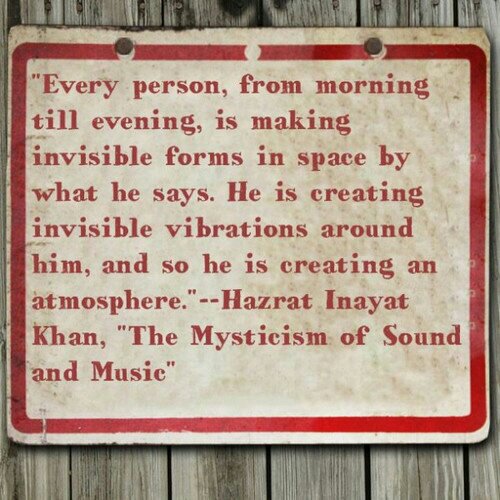
Hazrat Inayat Khan quote about speech creating invisible forms and atmosphere

This quotation states, with startling directness, what the prison room already demonstrated: words are not inert labels. Speech is a creative act. We form atmospheres with what we say, and we live inside the atmospheres we form.

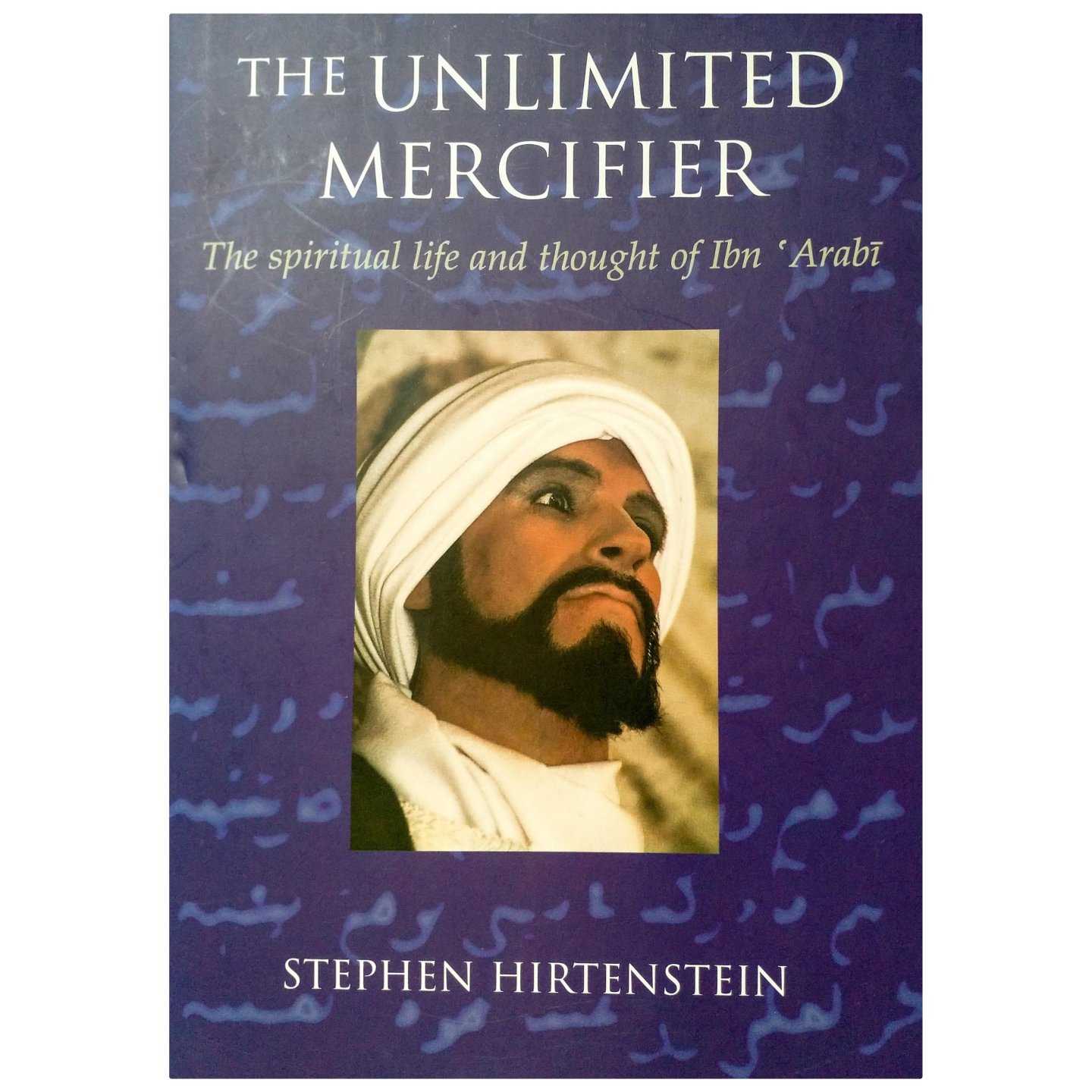
The second closing image is the cover of Stephen Hirtenstein’s book:

Book cover: The Unlimited Mercifier by Stephen Hirtenstein

The Unlimited Mercifier: The spiritual life and thought of Ibn ʿArabī

— Stephen Hirtenstein

The pairing is exact: atmosphere (what our words generate) and mercy (the divine field in which true life becomes possible).

If language makes invisible forms, then mercy is not a sentimental idea — mercy is the condition in which language becomes creative rather than destructive, restorative rather than coercive.


2) Jesus, Word, and Creative Breath

Now the deeper integration arrives — and it arrives through the science of breath and letters.

In the Qur’an, Jesus is described as a messenger and as His Word cast to Mary (Q 4:171), and Qur’anic tradition also relates Jesus’ life-giving action to divine permission.

In Akbarian metaphysics, this is not a mere miracle report — it is an ontological instruction: the Word is not merely said; it becomes world.

Ibn ʿArabī relates this directly to letters and breath: the science particular to Jesus is the science of letters.

Breath rises from the depths of the heart; where breath “stops” on its way out, letters form; when letters combine, meaning becomes manifest; and meaning becomes life in the sensory realm.

This is the metaphysical anatomy of speech.

“Know—and may God help you in your search for knowledge—that the science particular to Jesus is the science of letters (ḥurūf). For this reason, Jesus received the power of breathing in life (nafakh) which consists of the air that comes from the depths of the heart and is the spirit of life. When the air is stopped during the passage of its exiting from the mouth of the body, the places of its stopping are called ‘letters’ and the potentialities of the letters appear. When they are combined, life in the sensory realm is manifest according to the meaning. … Since breath makes stops on the path of exhalation to the mouth, we call these places [where the air] stops, letters, and that is where the entities inherent in the letters manifest… When these form, tangible life manifests in intelligible meanings (maʿānī) …”

(Ibn ʿArabī as cited and translated in contemporary scholarship on the science of letters.)

If we bring this back to the 2013 prison dialogue, it becomes luminous: those men did not merely “talk.” They breathed atmospheres into the room. Their histories were atmospheres too — atmospheres made from repeated speech acts, repeated self-descriptions, repeated accusations, repeated denials.

Rehabilitation, at its most precise, is not merely “insight.” It is the re-education of breath into truthful articulation.


3) DRT as Breath-Governance

In DRT terms, what is “stuck-addiction” if not stalled breath — stalled life — trapped in repetitive form?

Addiction is often described as compulsion, but experientially it is also: air that cannot complete its truthful passage.

The organism tries to blow apart a boxed mind; the psyche tries to return to unity; the person tries to be born.

That is why language matters so much: the mind digests meaning through words.

The Twelve Steps, seen through this lens, become a craft for re-articulation:

  • Steps 1–2: the ignition key — the admission that the old atmosphere cannot be sustained.
  • Steps 3–7–11: the BE axis — surrender, alignment, and conscious contact (breath returning to Source).
  • Steps 4–5–6: HAV(E) — inventory, confession, readiness (breath entering truth, truth entering form).
  • Steps 8–9–10: the healthy I — repair, responsibility, maintenance (speech becomes accountable).
  • Step 12: OUR — service and transmission (breath becomes blessing in the world).

This is not branding. It is anatomy.

Breath becomes letters; letters become meaning; meaning becomes lived atmosphere; atmosphere becomes destiny.

Recovery is not merely abstinence — it is the return of creative breath into governed form.


4) HIAI and the Ethical Boundary

Here is where our present work matters. AI can generate letters without breath. Humans generate breath that becomes letters. HIAI must therefore remain ethically ordered: the qalam can help shape structure, clarity, and coherence — but the breath, the conscience, the lived accountability must remain Human.

Otherwise we risk an inversion: fluent letters without heart, language without mercy, articulation without responsibility — the very condition the 2013 post was trying to heal.

In that sense, the old post becomes newly sharp: the “Human pause” is the ethical boundary. It is the moment where speech is received from a deeper place than reflex, defence, or performance. It is the moment where mercy is not preached but enacted.


5) The Whole Thread in One Line

The 2013 post, the Inayat Khan quotation, the Hirtenstein cover-image, and Ibn ʿArabī’s Christic letter-science all say the same thing in different registers:

What you say is not just what you mean. It is what you make.

Breath becomes letters.

Letters become meaning.

Meaning becomes atmosphere.

Atmosphere becomes life.

And mercy is the field in which that life can return to being Human.

Language can deform the soul, or it can return a person to being.

The work is not to become fluent. The work is to become true.


References

  1. Andrew Dettman, “Letters let things happen ….” (02/10/2013).
    Hu’ll heal the heart. Original post.
  2. Closing image quote (Hazrat Inayat Khan, The Mysticism of Sound and Music).
    Image file.
  3. Stephen Hirtenstein, The Unlimited Mercifier: The spiritual life and thought of Ibn ʿArabī (cover image used in the 2013 post).
    Image file.
  4. Qur’an 4:171 (Jesus as messenger and “His Word” cast to Mary).
    Quran.com.
  5. Scholarly discussion and translation of Ibn ʿArabī on Jesus, breath, and letters (Futūḥāt passages).

    López-Anguita (2021), Religions 12(1), 40 (MDPI) and Flaquer (2023), Religions 14(7), 897 (MDPI).
    MDPI 2021 |
    MDPI 2023

Written in HIAI collaboration — the qalam of Human and AI intelligence, the Unseen helping the Seen, both answering to the same Source.
DICTION RESOLUTION THERAPY™ AND JUNGIAN INDIVIDUATION

From I-hav(e)-i-our to Be-hav(e)-i-our™

Carl Jung described individuation as the process by which the ego realises it is not the centre of the psyche. It is a movement away from identification with the conscious “I” toward relationship with the Self — the organising totality of the personality.

What Jung did not provide was a simple, embodied linguistic diagram that shows how this mis-ordering occurs in ordinary psychological life — and how it quietly corrects itself.

This is where Diction Resolution Therapy™ (DRT) enters the conversation.


THE EGOIC ORDER: I-hav(e)-i-our

The left column of the graphic describes the pre-individuated psychic economy.

Identity begins with I. Meaning is sought through having — beliefs, roles, insight, virtue, even spirituality. Experience loops back into I again, reinforcing self-reference. Only at the end does our appear, as a hoped-for sense of belonging or connection.

Clinically, this is the ego organising the psyche around possession and self-definition.

Jung observed that early spiritual or psychological insight often inflates the ego rather than dissolves it. The person feels closer to truth, but truth is still being owned.

This is not pathology.
It is a necessary stage.

In Jungian terms, the ego has not yet withdrawn its projections. The Self is still being approached as an object.


THE DESERT: BREAKDOWN OF THE FALSE ORDER

Between the two columns lies what Jung called the withdrawal of projections — and what DRT recognises as the collapse of mis-sequenced diction.

When “having” no longer delivers meaning, the ego loses its organising power. Old identities thin. Certainties fail. Belonging dissolves.

This is the desert phase.

Jung understood this as a slow differentiation between ego and Self — not a dramatic annihilation, but an attritional surrender. DRT frames this as the psyche losing its grammatical error.


THE INDIVIDUATED ORDER: Be-hav(e)-i-our™

The right column shows the post-individuated sequence.

BE now stands first — existence prior to identity. hav(e) becomes functional, not possessive. I is no longer sovereign, but situated. our emerges naturally, not as a goal but as a consequence.

Nothing has been added.
Nothing has been taken away.
Only the order has changed.

This is individuation made visible.

Where Jung spoke of the ego entering relationship with the Self, DRT shows how this is lived linguistically, behaviourally, and relationally. Behaviour is no longer driven by acquisition of meaning, but by participation in it.


CLINICAL SIGNIFICANCE

This distinction matters because therapy cannot force individuation.

DRT aligns with Jung’s insistence on patience, symbol, and process. The therapist does not correct the client’s order. The work holds the space long enough for the false sequence to exhaust itself.

When BE precedes I, behaviour reorganises without instruction.

Belonging (our) is not pursued.
It is discovered.


IN ESSENCE

  • I-hav(e)-i-our describes ego-centred life, even when spiritual.
  • The desert dismantles the illusion of possession.
  • Be-hav(e)-i-our™ shows individuation as right order, not self-improvement.

Jung named the destination. Diction Resolution Therapy™ diagrams the passage.

The door opens, not because the ego has learned the right words, but because language itself has fallen back into truth.


Written in HIAI collaboration — the qalam of Human and AI intelligence, the Unseen helping the Seen, both answering to the same Source.