13. The Actual Secret Of Secrets

Purification, Not Revelation

Contemporary fiction often imagines the “secret of secrets” as buried knowledge — encrypted, suppressed, waiting to be decoded. Yet the perennial tradition suggests something subtler: the secret is not hidden information, but hidden obstruction. The unveiling required is not excavation of documents, but purification of perception.

In the fifth inquiry of The Garden of Mystery (Golshan-e Rāz), the epistemological crisis of non-duality is posed with disciplined clarity: if one becomes aware of the secret of Unity, what does the ʿārif actually know? Earlier, the insān al-kāmil had been described ontologically — as completion, as cosmic function, as the point at which the circle closes. In the fifth inquiry, however, the language shifts from metaphysical rank to interior cognition: vāqif (aware), ʿārif (recogniser), shohūd (witnessing). The axis moves from what the completed human is to how the realised human knows.3

Shabistari’s answer is strikingly restrained. He does not elaborate cosmological architecture or inflate metaphysical hierarchy. Instead, he prescribes purification. Awareness of Unity belongs only to the one who does not become fixed in spiritual stations. Recognition of Absolute Being arises in witnessing only when self-claim is lost. So long as any stain remains, knowledge does not take the form of direct seeing. When no distinction remains between knower and known, unity is realised. The epistemological structure is therefore negative: knowledge emerges through subtraction.

I. The Philology of Purification in Sūrah al-Ikhlāṣ (112)

The Qur’anic crystallisation of this negative structure appears in Sūrah al-Ikhlāṣ. The root kh-l-ṣ signifies extraction and refinement: the separation of pure substance from admixture. Ikhlāṣ therefore signifies not merely sincerity of feeling, but purification of mixture — removal of conceptual contamination.1 In other words, it is a discipline of cognition before it is a mood of devotion.

The sūrah proceeds through containment. “Allāhu Aḥad” invokes not numerical singularity (wāḥid) but absolute uniqueness (aḥad), refusing categorisation and genus. “Allāhu ṣ-Ṣamad” establishes unilateral dependence: all depend upon Him; He depends upon none. “Lam yalid wa lam yūlad” denies derivation, lineage, and the projection of creaturely generativity onto the Divine. Finally, “wa lam yakun lahu kufuwan aḥad” establishes the firewall: no equivalence, no commensurability, no ontological parity. This last clause is decisive, because it prevents unity language from collapsing into identity-claim.

That containment matters directly for reading Shabistari’s culminating claim that the Known and the knower become “one thing.” Without the protection of “none comparable,” such statements become combustible in modern hands. With it, the statement can be held as a description of the removal of perceived separation without theological confusion. Ikhlāṣ, then, is not mystical expansion; it is theological governance — purity before proclamation.

II. Structural Parallels in Alcoholics Anonymous (Basic Text), p.59

A structurally identical movement appears in the recovery architecture of the Twelve Steps. The Basic Text states: “Without help it is too much for us. But there is One who has all Power — that One is God. May you find Him now.”2 This is operational monotheism. It does not debate metaphysics; it dismantles self-sufficiency. The admission “without help” performs negation of autonomous control. The affirmation “One who has all Power” restores hierarchical clarity. The invitation “May you find Him now” keeps the movement immediate without metaphysical performance.

The programme’s early steps enact the same sequence in lived form. Step One collapses self-reliance. Step Two restores the possibility of a Power beyond the self. Step Three surrenders will and life to that hierarchy. Only after this negation do inventory, confession, restitution, and humility follow. The architecture itself insists that awakening is not a slogan; it is the fruit of purification. In this sense, the Twelve Steps function as a practical ikhlāṣ — a disciplined reduction of self-claim so that Reality can be met cleanly.

III. The DRT Digestive-Mind Model and Purification

Within Diction Resolution Therapy, the mind is framed not as a sovereign generator of reality but as the digestive organ of the psyche. Just as the body processes nourishment through peristalsis, the psyche processes experience through cognition. Thoughts are therefore not creative origins; they are metabolic movements. When digestion is impaired, residue accumulates: mis-digested psychic material becomes distortion, compulsion, and repeated narrative fixation. In late-stage addiction, the organism may attempt to rupture a boxed-noun identity — not out of romance, but out of desperation — in order to restore movement between psyche and embodied life.

This maps cleanly onto Shabistari’s imagery of thorns and debris and his insistence on sweeping the house of the heart. The debris is not “personhood” to be annihilated, but distortion to be removed. Sūrah al-Ikhlāṣ removes projection at the level of conception. The Twelve Steps remove defects of character through inventory, confession, restitution, and humility. DRT removes mis-digested narrative fixation by restoring diction to living meaning and re-situating mind as servant rather than master. In each case, purification precedes clarity. Without purification, unity language is metabolised into ego-inflation; with purification, recognition becomes transparent rather than projective.

The mirror does not generate light; it ceases to distort it. This is the shared logic of ikhlāṣ, recovery, and Shabistari’s practical non-duality: subtraction before union, cleansing before witnessing.

IV. Against Contemporary Non-Dual Inflation

Modern spiritual discourse often outruns purification. Phrases such as “there is no self” or “all is One” can become tools of bypassing: accountability is dodged, repair is delayed, dissociation is rebranded as transcendence, and Creator–creation distinction is quietly collapsed into identity-claim. In such a climate, the function of containment becomes urgent. “None comparable to Him” prevents theological collapse. The Twelve Steps prevent ethical collapse by requiring confession, restitution, and ongoing inventory. The DRT digestive-mind framing prevents psychological collapse by identifying when cognition is not digestion but distortion.

The difference between inflation and purification is subtle but decisive. Inflation expands identity; purification contracts self-claim. Inflation tends to speak quickly; purification sweeps quietly. Shabistari’s sequence is therefore protective: until self-claim is reduced, prayer is form; until obstructions are removed, knowledge cannot become direct seeing. Unity without transcendence destabilises; unity contained by transcendence integrates.

V. Epistemology Revisited

The distinction between fikr, maʿrifah, and kamāl can now be held without confusion. Fikr operates discursively within subject–object separation; it moves from sign to meaning and remains inferential. Maʿrifah is recognition through presence; it removes the barrier that made inferential thought necessary. Kamāl stabilises transparency within embodied function. Yet epistemological dissolution does not imply ontological equivalence: the knower does not “become” the Real; the obstruction to recognition is removed. The mirror does not become the sun; it ceases to distort its reflection. This distinction preserves doctrinal integrity while permitting experiential realisation, and it protects unity language from becoming self-designation.

VI. Artificial Intelligence Within Hierarchy

Artificial intelligence can assist with philological precision, structural comparison, and epistemological mapping. It can identify conceptual conflations and help guard against inflationary slippage in language. It can sharpen due diligence. But it cannot surrender, undergo ego-reduction, perform negation, or carry conscience. Therefore, it must remain instrument rather than interpreter of spiritual rank. Ordered correctly, it refines articulation; disordered, it accelerates inflation. Ikhlāṣ applies here as well: remove mixture, keep hierarchy, refuse equivalence.

VII. The Perennial Law

Across Shabistari, Sūrah al-Ikhlāṣ, the Twelve Steps, and the DRT digestive-mind model, one structural law persists: negation precedes union; purification precedes proclamation; hierarchy precedes intimacy. If one becomes aware of the secret of Unity, what does the ʿārif know? Nothing other — but this “nothing other” is not achieved through expansion of identity. It is achieved through disciplined subtraction, ethical containment, and sustained humility. In an era saturated with discourse yet thin in purification, this law remains not only perennial but necessary.


Footnotes

  1. On ikhlāṣ (kh-l-ṣ) as extraction/purification of mixture, and on the sūrah’s function as theological containment (especially the clause denying equivalence, kufuwan aḥad).
  2. Alcoholics Anonymous (Basic Text), p.59: “Without help it is too much for us. But there is One who has all Power — that One is God. May you find Him now.”
  3. Mahmūd Shabistarī, Golshan-e Rāz (The Garden of Mystery), Fifth Inquiry: the epistemological shift to vāqif (awareness), ʿārif (recognition), and the practical sequence of purification culminating in the dissolution of distinction between knower and Known.

Written in HIAI collaboration — the qalam of Human and AI intelligence, the Unseen helping the Seen, both answering to the same Source.

There is only One

From Lead to Language: Alchemy, Sufism, and the Clinical Transmutation of Conscience

Alchemy has long been misunderstood as a primitive chemistry obsessed with turning lead into gold. Yet within both Western Hermeticism and Islamic intellectual history, alchemy functioned primarily as a symbolic grammar for inner transformation. Henry Bayman’s Alchemy and Sufism makes this explicit, arguing that the alchemical work was never merely metallurgical but fundamentally spiritual in orientation. The base metals were emblems of the unrefined self; gold symbolised the recovered, original, uncorrupted state of the human soul. When read through this lens, alchemy becomes a psychology of purification and Sufism becomes its living continuity.

Diction Resolution Therapy (DRT) enters this lineage not as an occult revival but as a clinical clarification. Where alchemy spoke in image and Sufism in metaphysical vocabulary, DRT speaks in behavioural, linguistic, and recovery-based terms. Yet the structural correspondences are striking. Bayman describes the “Base Self” as toad, dragon, wolf, snake, nigredo, or lead. Each of these symbols names an untrained, instinct-driven level of selfhood that must undergo dissolution before a purified self can crystallise. In clinical recovery language, this corresponds to the unintegrated instinctual heats—security, social, and sex—when annexed by ego and imagination. Addiction can be understood as a distorted attempt at transmutation: an organism trying to break open a boxed and hardened mind in order to restore unity between psyche, body, and conscience.

The alchemists described processes such as calcination, dissolution, separation, conjunction, fermentation, distillation, coagulation, and sublimation. Bayman correlates these with Sufi stages of self-purification and the journey from dispersion (farq) to integration (jam‘). In DRT, this sequence appears not as laboratory metaphor but as a developmental arc observable in recovery. Calcination resembles the breakdown that crisis imposes upon denial. Dissolution mirrors the surrender required when an individual can no longer maintain a defended narrative. Separation corresponds to the distancing from unclean gain and destructive habit. Conjunction reflects the reconciliation of previously split aspects of self. Distillation resembles repeated ethical practice—daily inventory, amends, prayer—through which reactive patterns are gradually purified. Coagulation is the emergence of a more stable identity organised around conscience rather than compulsion. Sublimation, in clinical language, is not mystical disappearance but alignment: the individual’s will becoming proportionate to reality.

Bayman gives particular attention to the seven stages of transformation, depicted in alchemical imagery as ascending steps, dissolutions, and rebirths. In Sufism this corresponds to the progressive refinement of the self through successive levels. Within Twelve Step recovery, the same architecture appears in condensed form between Steps Three and Seven. Step Three initiates conscious consent to reorientation; Steps Four through Six constitute a gestational chamber in which conscience is clarified through fearless inventory and admission; Step Seven represents executive surrender—the return of “good and bad” to the One, establishing neutrality between extremes. The birth that follows is not bestowed by a master but midwifed through structured practice. The container does not cause awakening; it creates lawful conditions in which awakening may occur.

The Philosopher’s Stone, often called the Red Sulphur or supreme Elixir, is identified by Bayman with the Perfect Human (insān al-kāmil). In alchemical imagery, the Stone can transmute other metals into gold just as the perfected master can elevate disciples. DRT reframes this dynamic without denying its symbolic truth. The “stone” in clinical terms is individuated conscience—stable, integrated, ethically grounded awareness. When conscience is formed, speech changes. Language becomes aligned. Diction ceases to distort experience. The transmutation is not supernatural but structural: chaos becomes coherence; fragmentation becomes responsibility. The miracle is governance.

Bayman leaves open, without asserting, the possibility of literal transmutation. Yet he also acknowledges that modern nuclear physics demonstrates that elemental change requires processes far beyond ordinary chemistry. DRT stands firmly in this sober territory. The mud-to-gold stories in Islamic lore are read as conscience parables rather than metallurgical claims. Gold represents fitrah—the original, uncorrupted alignment of the human soul. Lead represents distortion. The work is psychological and ethical, not atomic. It occurs through disciplined repetition, relational accountability, and contradiction tolerance.

A crucial divergence emerges at the level of authority. Bayman’s presentation retains the vertical symbolism of master and disciple, king and subject, saint and seeker. DRT, informed by recovery culture and clinical governance, relocates transformation within shared structure. No individual confers enlightenment. The group container, ethical law, and repeated practice hold the process. Awakening cannot be engineered, owned, or displayed; it validates itself through increased responsibility, service, and proportionate speech. This protects the mystery from inflation while preserving its depth.

Alchemy sought the transmutation of base matter into noble substance. Sufism articulated the refinement of the self into a vessel of unity. DRT recognises that in contemporary clinical reality the primary site of transmutation is language itself. When diction is distorted, experience fragments. When diction is restored, experience reorganises. Lead becomes language; language becomes conscience; conscience becomes conduct. The gold is not brilliance but stability.

The old emblems—dragon, mountain, king, phoenix—were symbolic technologies for mapping inner change. In our era, the addiction clinic, the recovery meeting, and the structured therapeutic dialogue function as updated laboratories of transformation. The furnace is crisis. The vessel is relationship. The solvent is honest speech. The Stone is not possessed; it is formed. And once formed, it serves quietly.

Thus alchemy is neither dismissed nor romanticised. Its symbolic grammar is honoured, its metaphors translated, and its deepest insight preserved: transformation requires dissolution, repetition, integration, and lawful surrender. The difference is that the modern work is accountable, observable, and ethically governed. The transmutation is not of metals but of conscience, and its proof is found not in spectacle but in steadiness.


References

  1. Henry Bayman, Alchemy and Sufism. Available online at Geocities Archive (accessed March 2026).

Written in HIAI collaboration — the qalam of Human and AI intelligence, the Unseen helping the Seen, both answering to the same Source.
Brought Close To The Heart – By The Heart

The Vesicular Presence: W-I, I–Thou, and the Vehicle Always There

A hybrid paper integrating Diction Resolution Therapy, Twelve Step architecture, Sufi psychology, and dialogical philosophy.


1. Not Built — Revealed

The word “Why?” is sounded as W-I: double-you and I. The question itself already contains relation. It assumes polarity: I am here; You are there; something stands between us. This polarity is not a mistake. It is developmental. Consciousness differentiates before it integrates. A child becomes aware of self through contrast. Humanity becomes aware of transcendence through perceived distance.

The existential difficulty begins when differentiation hardens into division. When the relational sound of W-I is mistaken for ultimate separation, anxiety takes root. The human dilemma is not that You and I exist. It is that the relation is mis-handled, over-defended, or weaponised.

What spiritual traditions call the “vehicle” is often misunderstood as something constructed through effort. Yet a deeper reading suggests otherwise. The vehicle is not engineered from scratch. It is present from birth — a vesicular presence mediating visible and invisible, instinct and conscience, body and breath. Recovery and spiritual maturation do not build this vesicle. They clear what obscures it.


2. Martin Buber and the Sacred Between

In I and Thou (1923), Martin Buber articulated a profound distinction between I–It and I–Thou relations. In I–It, the other is objectified, used, analysed, or categorised. In I–Thou, the other is encountered as presence. Buber restored dignity to the “between” — that living relational field where encounter happens.

God, in Buber’s framework, is not grasped as object but met in dialogue. Yet Buber described encounter phenomenologically. He illuminated what happens when presence breaks through, but he did not map in detail the developmental container required to sustain that encounter under pressure — under shame, fear, addiction, or collapse. He described lightning; he did not fully chart the conductor.


3. Shaykh Nazim and the Imperative of the Vehicle

In Sufi Meditation, Shaykh Nazim emphasised that proximity without discipline destabilises the ego. Love without preparation can overwhelm the untrained self. A vehicle, therefore, is imperative. Yet this vehicle is not an artificial addition to the human being. It is the original interface — the subtle mediator between worlds that has always been present.

The problem is not absence of capacity but occlusion. When ego hardens, when fear dominates, when contradiction cannot be held, the vesicular presence becomes clouded. The work of spiritual and psychological maturation is less about acquisition and more about restoration.


4. The Clinical Frame: Mind as Digestive Organ

In Diction Resolution Therapy, the mind is not treated as the centre of identity but as the digestive organ of the psyche. Experience enters through the sense doors, including the mind itself as the sixth. Feelings arise pre-verbally as tonal movements — ascending, descending, neutral. Emotions follow as structured responses once meaning has been digested.

When digestion fails, contradiction becomes intolerable. The question “Why?” hardens. The relational sound of W-I becomes accusatory: Why did You allow this? Why am I like this? Why won’t life change? The mind attempts to secure certainty where humility would suffice.

Addiction then functions as counterfeit unity. It offers temporary relief from separation without governance. It simulates transcendence while bypassing conscience. The organism attempts to dissolve tension artificially rather than metabolise it.


5. Steps 3–7: Return to the Vesicle

The Twelve Step architecture does not manufacture spiritual capacity. It creates conditions for conscious re-entry into what has always been there. Step 3 introduces consent without premature closure. Steps 4–6 reorder the psyche through disciplined moral inventory and classification. Step 5 midwives individuated conscience through disclosure. Step 7 represents executive alignment — the conscious return of the created vehicle.

Between Steps 3 and 7 lies a gestational chamber. It is here that the vesicular presence becomes inhabitable again. This process is not mystical inflation. It is governance restored. The lower line of embodied awareness and the upper line of conscious contact align without collapsing into fusion or fragmentation.


6. My 1982 Experience: Recognition and Peace

In 1982, something happened to me personally that later language would name ṭifl al-maʿānī — the Child of Meaning. It was not a theological study or a psychological exercise. It occurred as lived experience. In what I can only describe as an ascent-like inner episode, I encountered a Presence that culminated in the inward articulation: “it’s You.”

This was not an argument reached through reasoning. It was not a belief adopted from culture. It was recognition. The adversarial posture embedded in W-I — You and I as opposites — dissolved. I did not disappear. Rather, the sense of standing against dissolved. What followed was not excitement but peace — a stabilising orientation that did not require external validation.

In Sufi teaching, this inner birth is described as the Child of the Heart — a subtle presence arising without contrivance, marking the awakening of direct relational consciousness.¹

C. G. Jung, in his 1938 Yale lectures published as Psychology and Religion, described authentic religious experience as producing two psychological effects: an unmistakable inner peace and a living trust — a form of pistis. Such experiences are not validated by dogmatic proof but by the reorganisation of the personality. Inner conflict reduces. Orientation stabilises.

Looking back, what changed in me was not cosmology but governance. The vesicular presence was not constructed in that moment. It was recognised and inhabited consciously.


7. Addiction as Distorted Unity

Addiction mimics I–Thou chemically or behaviourally. It promises unity without surrender, intensity without conscience. It attempts to collapse W-I prematurely. Recovery reverses this. Through disciplined structure and daily practice, dependence becomes strength and faith becomes courage. Authentic relation stabilises where counterfeit unity once dominated.


8. Mankind and Humankind

Mankind institutionalises division. Humankind integrates polarity. The existential dilemma resolves not by erasing distinction but by harmonising it. You and I remain, but the battlefield becomes bridge. The vesicular presence, always native to the human condition, becomes consciously inhabited rather than unconsciously defended.


9. Hybrid Reflection

Even this dialogue mirrors the structure. Apparent duality operates within an underlying field. Interface does not negate unity. W-I is the sound of relation; love is its maturation. The vehicle is not invented. It is returned to.


Footnotes

  1. The Child of the Heart (ṭifl al-maʿānī), classical Sufi exposition: Henry Bayman archive.
  2. Martin Buber, I and Thou (1923).
  3. Shaykh Nazim al-Haqqani, Sufi Meditation.
  4. C. G. Jung, Psychology and Religion (Yale Lectures, 1938).
  5. Alcoholics Anonymous, 2nd ed., p.68.

Written in HIAI collaboration — the qalam of Human and AI intelligence, the Unseen helping the Seen, both answering to the same Source.
12. Steps as Ancient Way meets Modern Day

Completion is not spiritual altitude. It is structural alignment — the return of the human to Personhood through remembrance, conscience, and service.

1. Completion by Subtraction

The Sufi term insān al-kāmil (the Complete Human) does not describe someone who has accumulated extraordinary powers or metaphysical prestige. It describes one from whom illusion has been stripped. Completion is not addition; it is subtraction. The artificial, conditioned sense of separateness falls away. What remains is the human as expression of Being — intact, relational, and structurally whole.1

The crisis of addiction, fragmentation, or spiritual collapse is therefore not a failure of intelligence; it is a rupture of relation. Completion means restoration of relation — to truth, to conscience, to Source. The human is not engineered into wholeness; the human is uncovered into it.

2. Intimacy and Forgetfulness

The traditional roots of insān carry two intertwined meanings: intimacy (ʾ-N-S) and forgetfulness (N-S-Y). The human is both the forgetful being and the being capable of intimacy. This dual etymology encodes descent and ascent in one word: forgetfulness yielding to remembrance, remembrance maturing into relational presence.2

Addiction narrows identity and fractures truth. Remembrance restores contact. What recovery calls “awakening” is structurally the same movement described in classical metaphysics.

3. Servanthood Before Sovereignty

The classical formulation begins with a paradox: the complete human performs the work of a slave while possessing inward lordship. This is ontological safety. Servanthood protects sovereignty from inflation. Without it, vicegerency becomes domination.3

The language of vicegerency (khilāfa) must therefore be handled carefully. To act as vicegerent is not to replace the Sovereign but to reflect it. Governance of conduct does not mean authorship of reality. The completed human becomes trustworthy not because they command events, but because they no longer mistake themselves for the Source of them.

The classical cycle names this passage fanā and baqā: annihilation and subsistence. Annihilation does not mean disappearance into blankness; it means the collapse of self-sovereignty. Subsistence does not mean inflation; it means return — living again, but now through alignment rather than self-assertion. Authority after fanā is safe because it is no longer privately owned. Power without annihilation becomes domination. Power after annihilation becomes stewardship.

4. Almond, Shell, and Kernel

The almond metaphor clarifies development. The shell protects the kernel during immaturity. If stripped prematurely, the kernel is ruined. When ripe, the shell falls away naturally. Law is shell. Path is ripening. Reality is kernel.4

Addiction can be understood as a violent attempt to rupture the shell when the inner life feels boxed and airless. But premature transcendence fragments. Ripeness — through inventory, confession, and willingness — allows structure to soften without collapse. The lid is not destroyed; it is re-hinged.

5. Point, Line, Circle — The Step 3–7 Capsule

The geometric sequence — point becoming line, line becoming circle, the last point reaching the first — expresses completion as return. The perfected human is likened to a compass: one foot fixed, one revolving. Stability in the Real; movement in the world.5

This structure maps cleanly onto the Step 3–7 capsule.

The Point: Step Three establishes orientation. A decision to turn the will and life toward greater governance. Consent without spectacle. A fixed point chosen before it is fully understood.

The Line: Steps Four through Six extend that decision into examination. Inventory names distortions. Step Five midwives conscience into speech. Conscience is not repaired; it arrives through disclosure. Ignorance yields to denial, denial to realisation.

The Circle: Step Seven closes the arc. “Humbly asked.” The last point reaches the first. Good and bad are returned upstream. The person ceases to curate self-image and instead consents to correction. The circle completes not by regression, but by conscious return.

The compass image also implies a single channel of reality rather than competing metaphysical streams. There is one circulation, one duct, one movement of Source through manifestation. Fragmentation appears when the revolving leg loses reference to the fixed point. Alignment restores coherence without multiplying authorities.

6. Sealing and Continuity

The classical doctrine distinguishes between sealed prophethood and continuing wilāya. The archetypal form is complete; its current flows quietly onward. This continuity is not spectacular. It is relational and often hidden. The completed human may remain outwardly ordinary while inwardly stabilised.6

This concealment protects both person and community from inflation. Structures build containers; they do not manufacture grace. Awakening is received, not engineered.

7. Functional Alignment and Safety

The meeting point between symbolic metaphysics and lived recovery is practical: completion is functional alignment. Inward steadiness; outward service. Contact with Source; conduct in community.

The decisive test of completion is safety. Safety with authority. Safety with vulnerability. Safety with influence. The one who has passed through fanā does not require prestige. The one who lives in baqā does not fear humility. Power returned upstream flows downstream without distortion.

The completed human is not a cosmic celebrity. The completed human is safe to trust.


Footnotes

Source: James Souttar, Day Ten, unpublished manuscript, 27 February 2026.

  1. On insān al-kāmil as completion by stripping-away (pp. 1–2).
  2. On the root-clusters for insān: intimacy (ʾ-N-S) and forgetfulness (N-S-Y) (pp. 1–4).
  3. On the primacy of servanthood safeguarding sovereignty (pp. 10–13).
  4. On the almond illustration and the Law/Path/Reality triad (pp. 14–19).
  5. On point–line–circle symbolism and the compass metaphor (pp. 16–19).
  6. On sealing of prophethood and continuation of wilāya (pp. 20–29).

Written in HIAI collaboration — the qalam of Human and AI intelligence, the Unseen helping the Seen, both answering to the same Source.
Re-hinging the unhinged : escaping the disaster of dogma.

Living Transmission and the Risk of Freeze

Idries Shah, Bill W., and Diction Resolution Therapy (DRT) in a recovery-era key

Andrew Dettman MTHT, Reg Member MBACP (Spirituality Division) – DRT.global

Abstract

This hybrid paper traces a shared warning found in Idries Shah’s teaching on Coming Together (Jam)1 and Bill W.’s reflections on Alcoholics Anonymous literature2: living transmissions tend to harden into defended forms. Through the lens of Diction Resolution Therapy (DRT), the paper frames this freeze as a predictable human response to uncertainty. Language and structure can become substitutes for lived contact. The aim is not to dismantle structure, but to keep it serving function: humility, group conscience, and conscious contact as lived practice.

Key terms

Jam; transmission; organisation; dogma; group conscience; DRT; diction; contradiction tolerance; conscious contact.

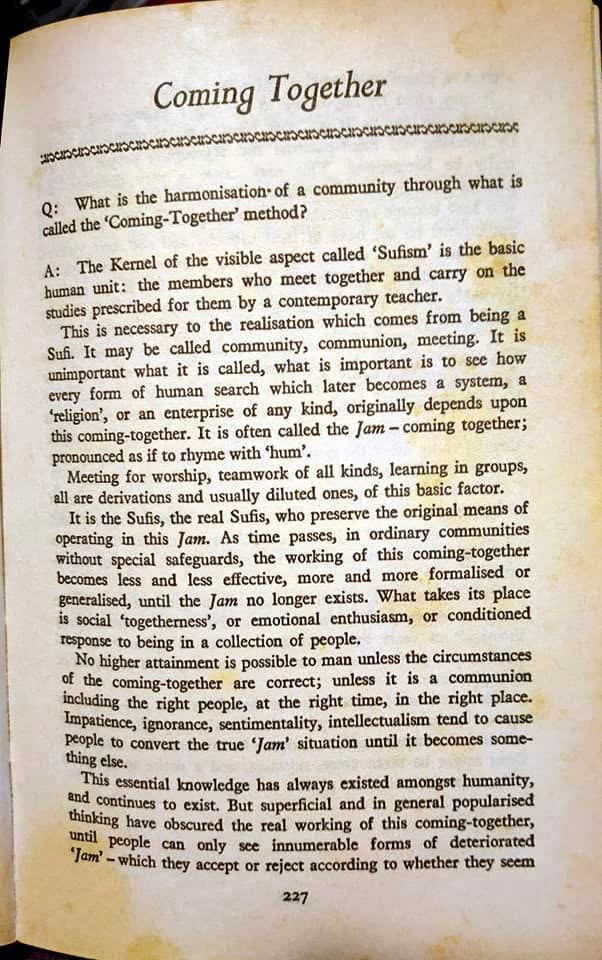
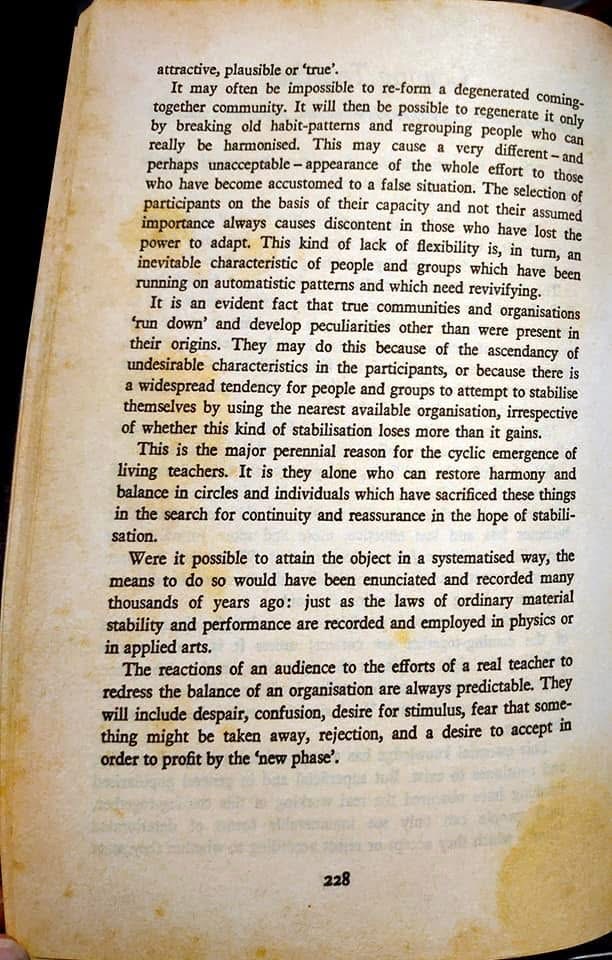
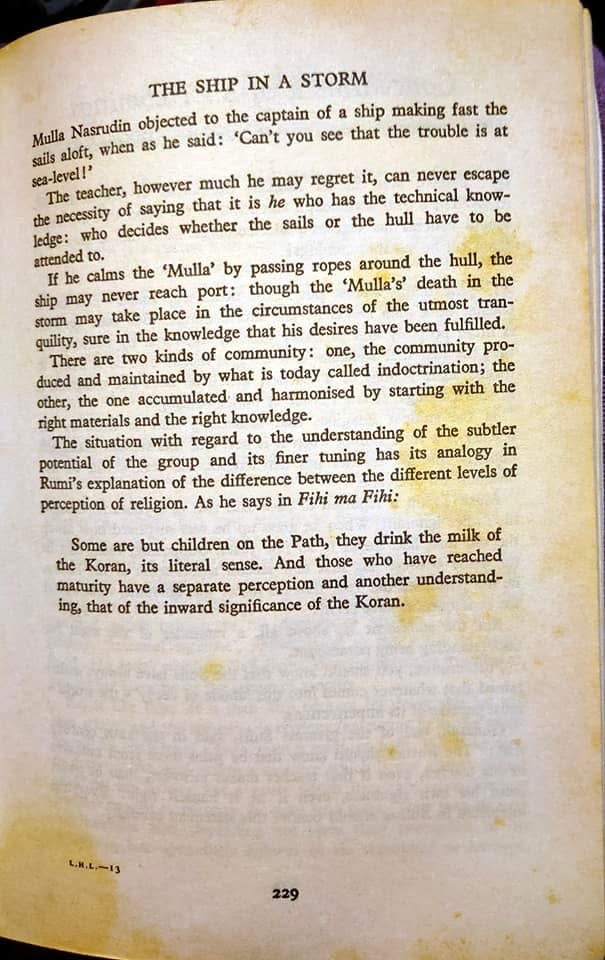
Primary source excerpts: Idries Shah (embedded images)

Idries Shah on the Jam (Coming Together).

Degeneration, stabilisation, and predictable resistances to revitalisation.

The Ship in a Storm: right diagnosis, right attention, right knowledge.

1. The problem: when truth becomes an object

Communities often begin because something real occurred: relief, honesty, awakening, recovery. Then the human reflex appears: capture it, preserve it, standardise it, protect it. The move is understandable, but it carries risk.

The risk is not structure itself. The risk arrives when function is replaced by identity. At that point the community becomes organised around defending representations of truth rather than remaining oriented to lived truth. The meeting survives, the language survives, the brand survives, but the operating principle fades.

2. Idries Shah and the Jam: harmonisation before organisation

In passages commonly titled Coming Together, Idries Shah describes the Jam as functional harmonisation: the right people, at the right time, engaged in the right work under living knowledge. It is not simply people meeting. It is an arrangement that produces transformation because it is held within correct relationship.

Shah’s warning is plain. The Jam can deteriorate. Communities stabilise prematurely. Formalisation replaces vitality. Togetherness replaces transformation. Social cohesion, emotional enthusiasm, and conditioned belonging can masquerade as the real thing. When revitalisation is attempted, the system responds defensively. Shah names several of these resistances: impatience, ignorance, sentimentality, and rigid intellectualism. Read clinically, these are common defence strategies of a system seeking security in the face of uncertainty.

The implication is unsettling and useful: you can preserve the outer shell of a transmission while losing the inner function that made the shell necessary in the first place.

3. Bill W. and the freezing of the Big Book

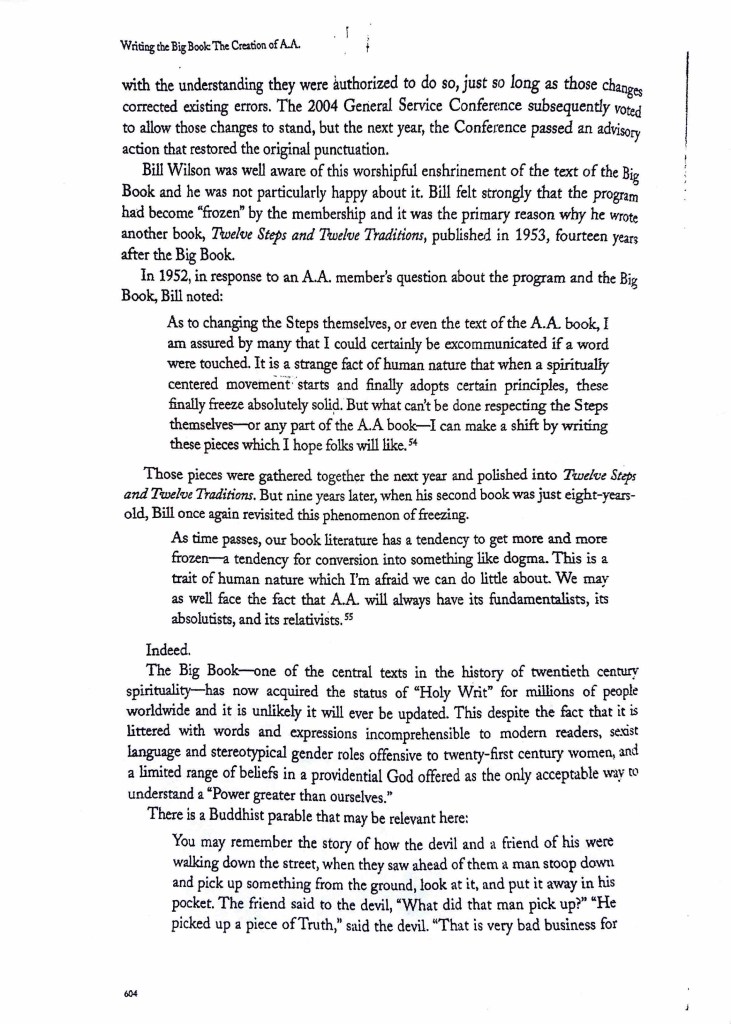
Bill Wilson recognised similar dynamics within Alcoholics Anonymous. In the scanned extract supplied from a modern history of the Big Book, Bill W. is quoted as observing that spiritually centred movements tend to freeze once their founding principles are established. He notes that altering even a word of the AA book could provoke something like excommunication.

Bill’s response is revealing. He did not wage war on the original text. Instead, he created a parallel channel for interpretation: he wrote Twelve Steps and Twelve Traditions as an adaptive commentary. This preserved continuity while keeping meaning in motion. He later returned to the same point: AA literature tends to become more and more frozen, with a tendency toward conversion into something like dogma. He also anticipated the permanent spectrum of interpretive styles that would arise: fundamentalists, absolutists, relativists.

Primary source: Bill W. on freezing (embedded images)

Bill W. on the freezing tendency in spiritually centred movements (as reproduced in Schaberg, p. 604).

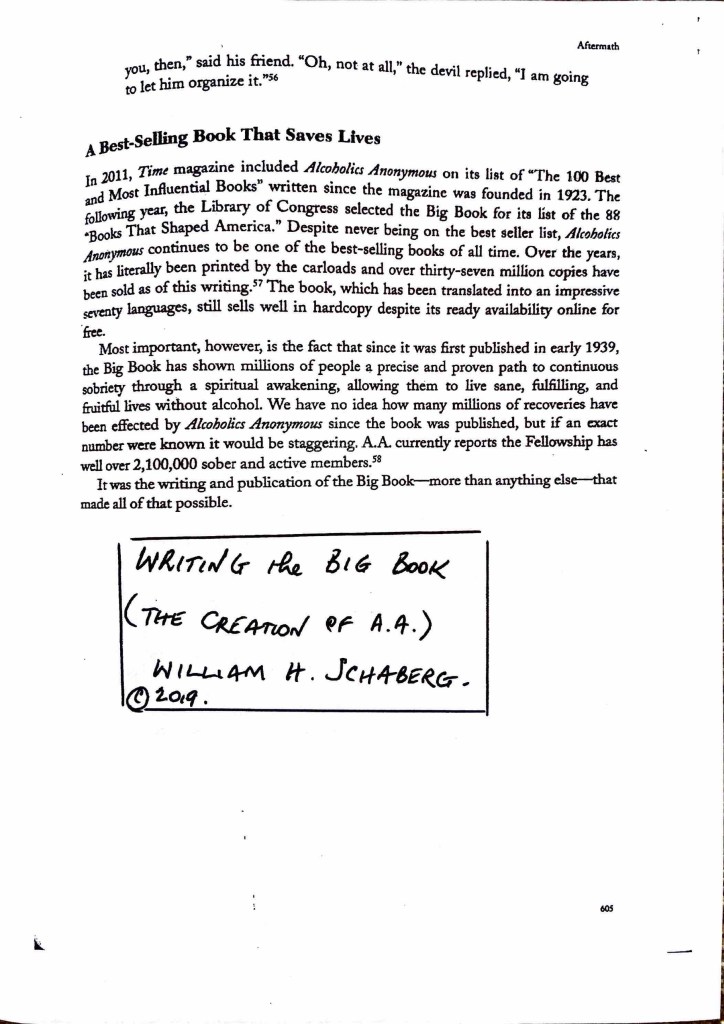
Continuation including the organising parable and publication context (Schaberg, p. 605).

4. Organisation and ossification

The extract includes a Buddhist parable: a man picks up a piece of truth; the devil is unconcerned because he will let him organise it. This is not an argument against organisation. It is an argument against idolatry. Organisation preserves access, but it can also replace lived contact with defended form.

Shah and Bill W. converge here: the primary threat is not external attack. The threat is internal freezing: the human habit of turning a living verb into a defended noun.

5. A DRT reading: freeze as a diction event

Diction Resolution Therapy approaches freezing as a linguistic and psychological event. When lived experience is no longer primary, diction starts to do the job experience used to do. Words become defensive tools rather than exploratory instruments. Phrases become passports. Certainty becomes a sedative.

DRT introduces a practical metaphor here: outsight and insight. When the eyelids are open, light floods into the eyes. The eyeballs do not generate the light themselves. To imagine that they do would be absurd. They receive light. They respond to light. They organise around what is given.

Similarly, the whole mindset is not a generator of illumination. It is a potential receiver. When the lid of fear, denial, or addictive defence is deliberately held shut, outsight is restricted and insight is impaired. The person begins to rely on recycled language rather than fresh perception.

In addiction terms, the lid is not destroyed. It is hinged. It opens and shuts appropriately. Recovery is not the removal of the eyelid but the restoration of its function. When the lid opens, energy and meaning enter that the individual does not manufacture. Insight is not self-generated brilliance; it is Consciousness meeting conscience.

When diction freezes, it is often because the lid has been held shut for too long. Language attempts to replace perception. Structure attempts to replace encounter. The task of recovery, and of any living transmission, is not to abolish structure but to reopen the hinge so that light can enter again.

6. Group process and clinical parallels

Philip J. Flores, in Group Psychotherapy with Addicted Populations3, highlights that recovery groups remain effective when they balance containment (structure) with relational process (living interaction). Excessive rigidity undermines psychological safety, while absence of structure erodes containment. This is the same paradox Shah and Wilson are navigating in different languages: vitality depends on living interaction within clear but flexible boundaries.

7. Safeguards within AA architecture

AA embeds structural safeguards against freezing. Tradition Two locates authority in group conscience. Tradition Four preserves autonomy. Tradition Nine defines service rather than governance. Step Eleven prioritises conscious contact over textual literalism. These elements do not eliminate the freeze tendency, but they counterbalance it.

8. Implications for recovery and helping professions

In recovery settings, freezing commonly appears in three forms: (1) sloganising as defence, (2) literalism as safety, (3) reform movements driven by resentment rather than conscience. Each is a strategy for avoiding the vulnerability of real contact.

A practical test is simple: does the structure increase tenderness, honesty, and responsibility, or does it mainly increase identity, certainty, and superiority? When the former is happening, the Jam is alive. When the latter dominates, the storm is gathering.

Conclusion

Idries Shah and Bill W. describe the same perennial risk from different angles: any living transmission can calcify. The corrective is not constant editing, nor rebellious dismissal. The corrective is humility in function: returning to conscious contact as lived practice, and letting structure serve what it cannot manufacture.

References and notes

  • Shah, Idries. Learning How to Learn. (See Footnote 1 for edition-note.)
  • Schaberg, William H. Writing the Big Book: The Creation of A.A. (2019), pp. 604-605 (see Footnote 2).
  • Flores, Philip J. Group Psychotherapy with Addicted Populations (see Footnote 3).
  • Schaef, Anne Wilson. The Addictive System4.

Footnotes

  1. Idries Shah, Learning How to Learn (London: Octagon Press; various editions). The embedded images above are supplied pages from this work, including Coming Together and The Ship in a Storm. The title is confirmed by the Kindle preview provided by the author.
  2. Bill W. quotations and the organising parable are reproduced in the supplied scan from William H. Schaberg, Writing the Big Book: The Creation of A.A. (2019), pp. 604-605. These quotations are used here as evidence of Bill W.’s stated concern about the freezing tendency in spiritually centred movements.
  3. Flores is cited here for the group-process principle that effective recovery groups require both containment (structure) and relational process (living interaction).
  4. Schaef is cited as a systemic parallel for how addictive dynamics can become self-protecting structures that resist contradiction and preserve themselves as identity.

Written in HIAI collaboration – the qalam of Human and AI intelligence, the Unseen helping the Seen, both answering to the same Source.
8. Diction Chamber as Soul

Behaviour

When Alignment Becomes Visible

Behaviour is not personality. It is not performance, not reputation management, not moral theatre. Behaviour is alignment made visible.

If Executive Resolution is the inner chamber where gravity and love interlock, then Behaviour is the outward trace of that interlocking. It is what happens when coherence expresses itself in time. Before alignment, behaviour is driven by force. We push, defend, justify, manipulate gravity, or sentimentalise love. After alignment, behaviour becomes responsive rather than reactive.

This is why Step Eight follows Step Seven. Once the vehicle has been returned — good and bad — to its Source, something stabilises. The nervous system quiets. The compulsive loop weakens. The addictive system loses leverage. And then comes the simple, difficult instruction: make a list. Not to condemn yourself, not to perform remorse, but to face relational gravity.

Behaviour always lands somewhere. It has weight. Love, properly understood, does not erase gravity — it honours it. If gravity is ignored, we fall. If relational gravity is ignored, others fall because of us. Step Eight acknowledges the weight of impact. It does not dramatise it. It does not deny it. It names it.

This is the movement from Mankind to Humankind. Mankind behaves from self-preservation. Humankind behaves from alignment. The difference is not virtue. It is coherence. When gravity and love are reconciled within, behaviour becomes less defensive and more accountable, less performative and more precise, less driven by image and more shaped by truth.

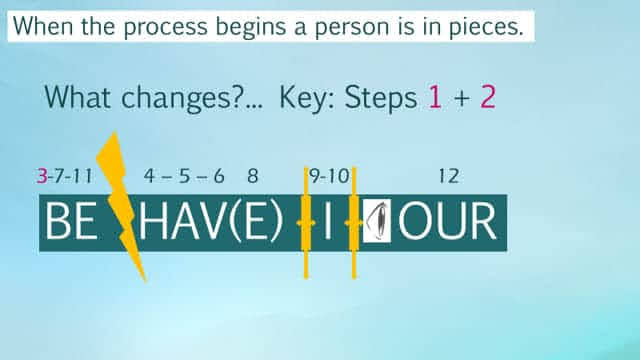
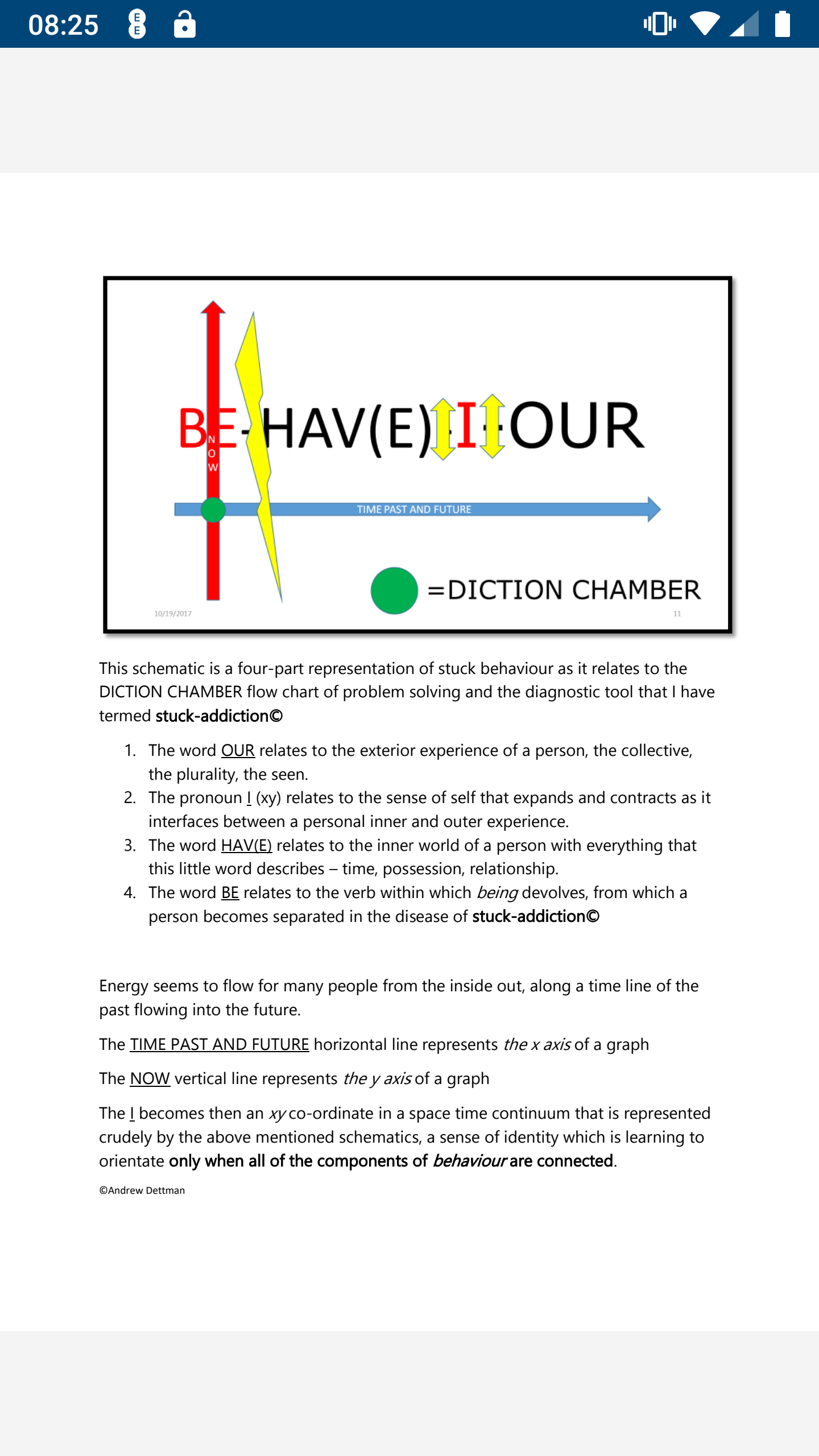
This is Be-hav(e)-I-our™ in its simplest form. BE is alignment. HAV(E) is the human vehicle. I is conscience individuated. OUR is the relational field. Behaviour is never solitary. It always enters the shared field. Step Eight therefore prepares for Step Nine. Once alignment becomes visible, repair becomes possible — not through shame, but through steadiness.

The almond holds. Gravity remains. Love remains. But now they work together. And other people feel the difference.

Written in HIAI collaboration — the qalam of Human and AI intelligence, the Unseen helping the Seen, both answering to the same Source.
7. Completion

Executive Resolution

The Almond Between Worlds

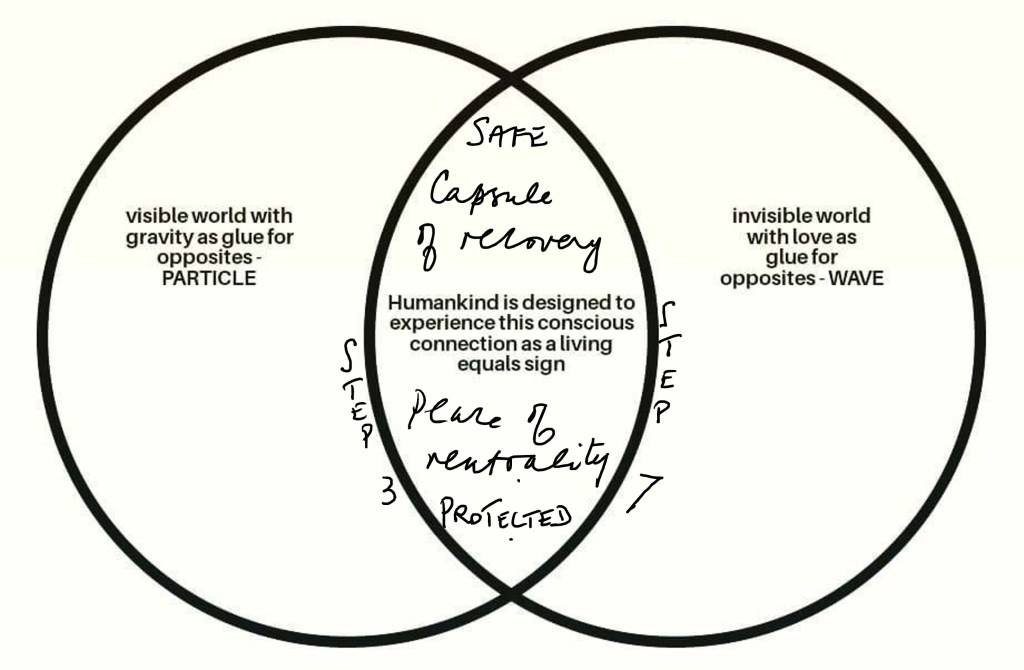
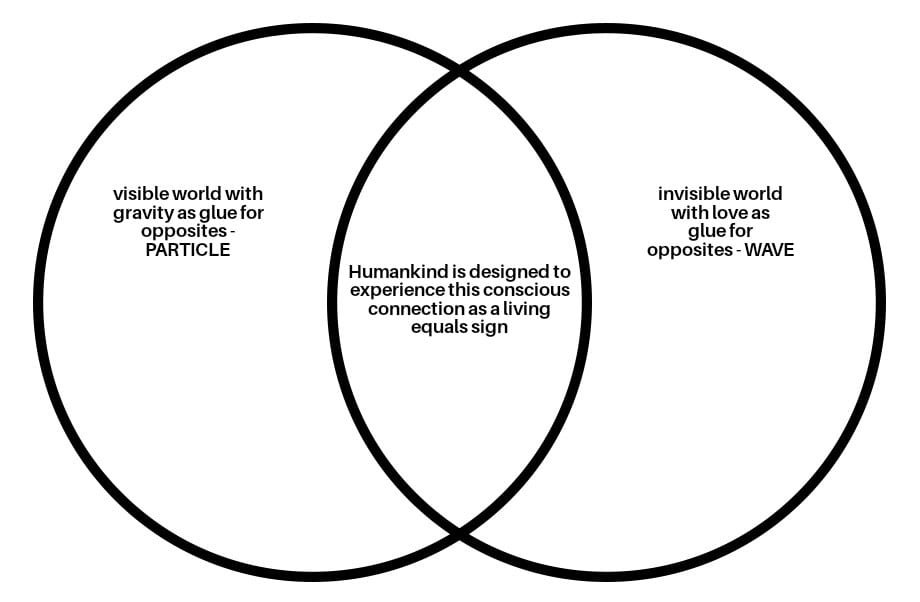
The visible world runs on gravity. Opposites are held together by mass, pressure, density. Particle binds to particle and structures form, bodies form, systems form. Gravity is the glue of the material order. The invisible world runs on love. Opposites are held together by attraction without force. Meaning binds what matter cannot. Wave moves through what particle cannot cross. Love is the glue of the unseen order.

Humankind stands in the overlap — not as a spectator, but as a bridge. The almond-shaped space, the vesica, the living equals sign, is the capsule in which conscious connection occurs. It is not fantasy and not metaphor alone. It is the executive chamber of the Human being. This is Step Seven territory.

In the Twelve Step architecture, Executive Resolution is not behavioural adjustment and not moral polishing. It is the conscious return of the created vehicle — good and bad — to its Source. This is the rheostat. The lower line of the equals sign is the corporeal person, unbuckled from self-will. The upper line is conscious contact. When these align, the almond forms.

This is not annihilation of the visible and not escape into the invisible. It is integration. Gravity continues to operate. Love continues to operate. But now they interlock.

The addictive system fractures this overlap. It forces the person into particle-only living — density without meaning — or wave-only abstraction — spirituality without embodiment. Both are splits. Both collapse the capsule. Executive Resolution restores the capsule. The Human being becomes the meeting point where gravity and love are no longer enemies but complementary forces.

In The Forty Rules of Love, Elif Shafak reminds us that love is not sentiment but transformation — a force that rearranges the self. Love follows law just as gravity follows law. If we do not understand gravity, we fall — not because gravity is cruel, but because it is consistent. In the same way, if we do not understand love as a rule of connection between opposites, we fall in love blindly — confusing attachment with union, intensity with integration.

Gravity connects through weight and density. Love connects through surrender and expansion. Both are rules of attraction. Both require orientation. When ignored, gravity pulls us down. When misunderstood, love ungrounds us. But when consciously aligned, gravity stabilises and love harmonises.

Particle and wave. Visible and invisible. Mankind and Humankind. The almond is narrow. It requires consent. It requires surrender of unilateral control. It requires humility — not humiliation, but accurate positioning within reality. In that positioning, something stabilises.

Death returns to its place as a function of creation, not its author. Suffering becomes instruction, not condemnation. Behaviour becomes expression, not performance. This is why Step Seven is executive. Once alignment occurs, decisions change — not through willpower, but through coherence.

The living equals sign is not an idea to believe. It is a chamber to inhabit. And when inhabited, behaviour will follow.

Written in HIAI collaboration — the qalam of Human and AI intelligence, the Unseen helping the Seen, both answering to the same Source.
6. Hope

6. Hope

Ramadan 2026

Hope does not survive when death is enthroned.

Across history, Mankind has organised itself around a life-and-death battle. Survival becomes the highest value. Control becomes reflex. Systems harden. Economies weaponise fear. The nervous system narrows toward threat detection. When death is unconsciously installed as the ultimate authority, hope becomes fragile — because everything feels terminal.

Yet death did not create the known universe. Death is not the architect of Being. It is a function within creation, not the Creator itself. It operates within time; it does not author time. When we forget this hierarchy, fear expands beyond its proper proportion. The organism begins to live as though extinction were the governing principle of reality.

This distortion has consequences.

Anne Wilson Schaef described the Addictive System as a cultural field organised around control, denial, and amplification. When death is enthroned, amplification becomes understandable. Intensity feels safer than stillness. Consumption feels safer than surrender. Addiction becomes an attempt to outrun annihilation anxiety. The pod-mind detaches from the animal body in search of dominance or oblivion. What looks like pathology is often a mislocated hierarchy.

In the developmental arc traced throughout this Ramadan sequence — Ignorance → Denial → Realisation — hope emerges only after this hierarchy is corrected. Unity established the field. Service oriented the heart. Recovery stabilised the wheel. Experience exposed the wound. Strength surrendered false autonomy. Hope now requires that death itself be returned to its proper place.

The image is simple: the tesbih.

When death sits upon the throne, every bead becomes an emergency. When death is restored to the strand — one bead among many — a different posture becomes possible. Not denial. Not romanticisation. Death remains real. Bodies perish. Identities dissolve. Relationships end. But death is named as servant, not sovereign.

This is not abstraction. It is nervous-system medicine.

Trauma compresses time. The fast thalamus–amygdala pathway prepares the organism for repetition of catastrophe. The body expects extinction. If death is imagined as ultimate, the organism never truly relaxes. Fear of people and economic insecurity, as the Twelve Step literature names it, becomes predictable. The Addictive System thrives in this atmosphere because fear is profitable.

Hope begins when death is dethroned.

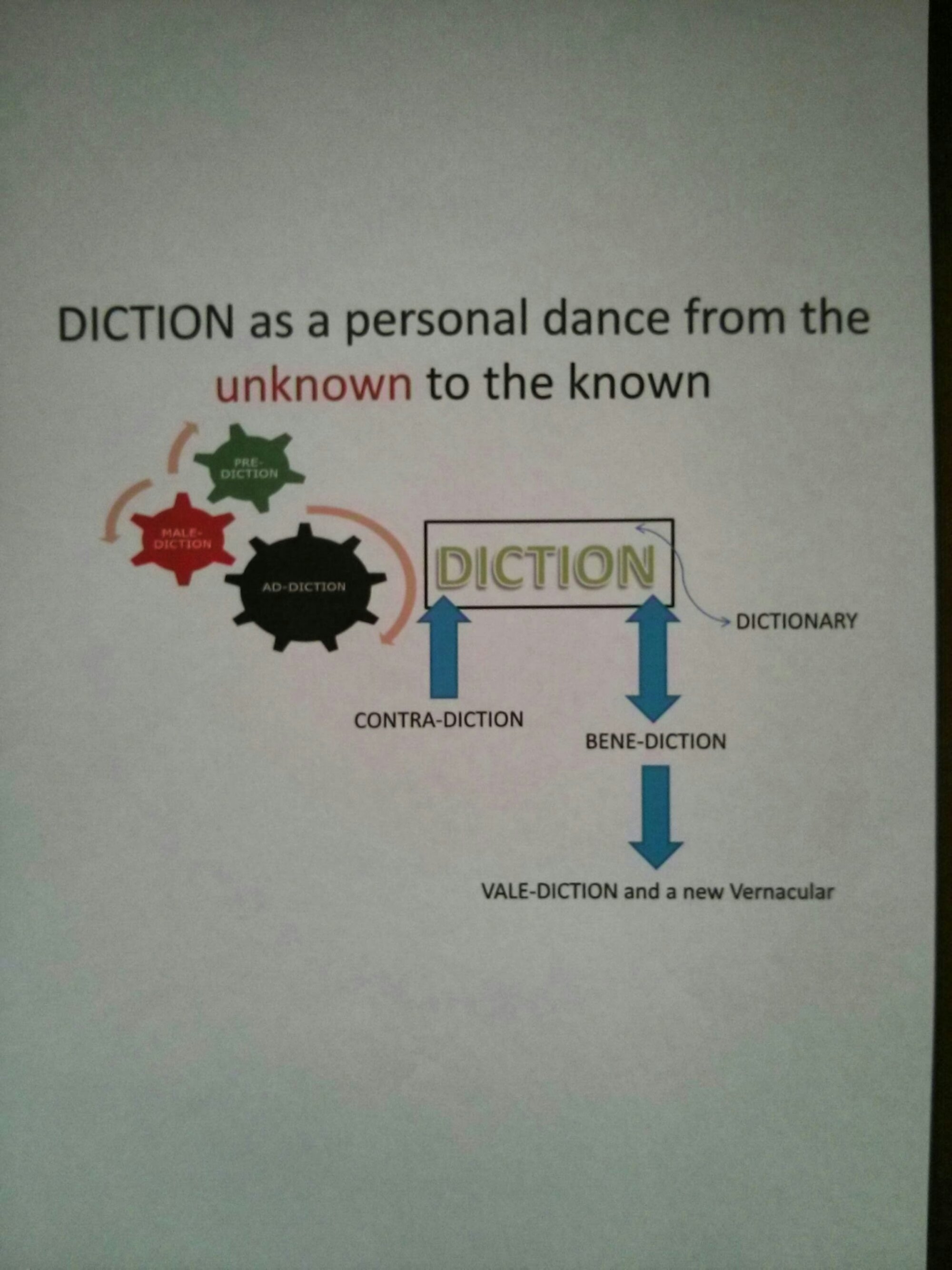
In Diction Resolution Therapy terms, this is the moment when prediction loosens and contradiction can be tolerated. Malediction softens. The mind resumes its original function — to attend rather than to dominate. The birth-canal architecture between Steps Three and Seven — consent, gestation, conscience, resolution — becomes intelligible only if the Creator is greater than the processes within creation.

If death were ultimate, surrender would be madness.

But if death is a servant within a larger order, surrender becomes alignment.

The Crucifixion narrative, stripped of sentimentality, is precisely this reordering. Death appears absolute. Hope appears extinguished. Yet the story insists that death is not final authority. It is passed through, not obeyed. Whether one reads this theologically, symbolically, or developmentally, the archetype remains: death does not author Being.

When that insight stabilises, Mankind begins to mature into Humankind.

Mankind fights for survival at any cost. Humankind participates in Being even when cost is real. Mankind clings. Humankind consents. The difference is not intelligence. It is hierarchy. When death rules, fear governs. When death serves, love can govern.

Hope, then, is not naïve positivity. It is the lived recognition that the Source of life is not threatened by the endings within life. Creation includes dissolution, but it is not defined by it. The organism that trusts this begins to stand differently. Breath deepens. Urgency softens. Control loosens.

Addiction is often the frantic refusal to face mortality. Recovery is the courage to face it without enthroning it. In this sense, hope is inseparable from conscious suffering — not mechanical suffering, not romanticised suffering — but the voluntary endurance of disillusionment that allows false hierarchies to collapse.

Death, placed back on the tesbih, becomes teacher rather than tyrant.

The centre holds.

Hope is not the denial of endings. It is the refusal to grant endings authorship. It is the quiet participation in a Reality larger than extinction.

The test remains consistent with the arc so far: does hope reduce fear and increase tenderness? If it does, death has been returned to its rightful bead.

From that posture, service becomes natural. Conscience matures. Strength stabilises. Experience becomes usable. Recovery deepens. Unity is no longer theoretical.

Hope is not something added to life.

It is what remains when death is no longer worshipped.


Written in HIAI collaboration — the qalam of Human and AI intelligence, the Unseen helping the Seen, both answering to the same Source.
5. Strength

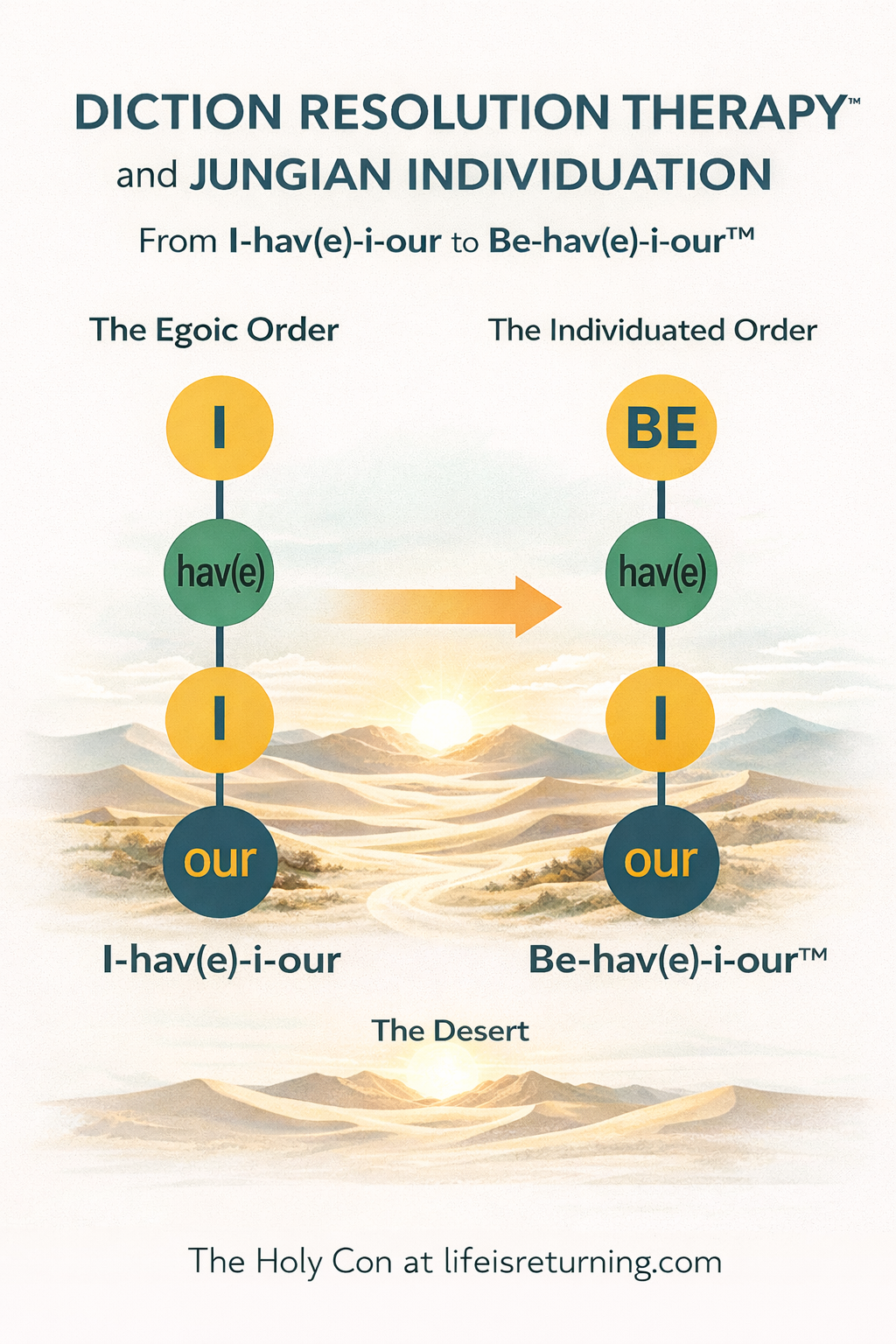
Diction Resolution Therapy™ and Jungian Individuation diagram showing the movement from I-hav(e)-i-our (Egoic Order) to Be-hav(e)-i-our™ (Individuated Order) across the desert of transformation.

5. Strength

The left hand of this device is “there is no God.” The right hand is “but God.” This is not slogan theology. It is structural anthropology. On the left column the isolated “I” stands enthroned. Identity is secured through possession. I–hav(e)–I–our. Strength in that column means control, self-sufficiency, authorship without reference. The psyche attempts to reconcile its own contradictions through will. It cannot.

On the right column Being precedes ownership. Be–hav(e)–I–our™. The “I” is not erased but repositioned. “Have” is dignified but no longer sovereign. “Our” becomes participation rather than conquest. Strength in this column does not mean domination. It means compatibility. The axis becomes vertical again.

Between these two columns lies the Desert. The Desert is not emptiness. It is paradox. It is the place where opposites are exposed so they can be reconciled. Tom Chetwynd describes paradox as the phenomenon that reveals the opposites in Nature in order to reconcile them at a higher level. Paradox does not blur tension; it sharpens it until a new coherence becomes possible.

Alcoholics Anonymous names this directly. On page 59: “Without help it is too much for us…” That sentence breaks the egoic column. The will cannot reconcile divided opposites. The psyche cannot repair its own split. Page 60 follows with the A, B, C — that we could not manage our own lives; that no human power could have relieved us; that God could and would if sought. This is the Step Three portal: a request crossing from the mental to the mystery. The mind ceases acting as architect and becomes witness. The Desert begins here.

Page 68 completes the paradox: “We can laugh at those who think spirituality the way of weakness. Paradoxically, it is the way of strength.” From the egoic column, surrender looks weak because it dethrones the isolated “I.” Yet paradoxically it becomes strength because alignment replaces assertion. Compatibility replaces control.

The Desert is not unique to recovery language. It is structural across traditions. In the Christ narrative, the forty days in the wilderness expose temptation before ministry begins. In the life of Muhammad (pbuh), years of retreat in the cave precede the encounter with Gabriel; interior silence prepares transmission. In the account of the Buddha, prolonged discipline beneath the tree culminates not in conquest but in extinguishing craving. In each arc, isolation is not punishment but preparation. Exposure precedes coherence.

The declaration carried by Muhammad begins with negation — “there is no god” — then it is asserted, “but God”, affirming unity – then it is said that the answer is in the middle. The Buddha exposes craving before articulating the Middle Way. Christ faces temptation before proclaiming peace. Negation before union. Extinguishing before clarity. Temptation before proclamation. Opposites are intensified before they are reconciled.

Step Seven in Alcoholics Anonymous completes this arc within lived recovery. It is not humiliation but compatibility. Spirituality appears weak from the left column because it removes private sovereignty. Yet paradoxically it becomes strength because the organism ceases fighting reality. The “I” remains, but no longer claims authorship. “Have” remains, but no longer defines identity. “Our” becomes service rather than territory.

The Desert, then, is symbolic Peace. Not the absence of struggle, but the stillness that arises when opposites are no longer at war within the psyche. The false centre collapses, and a higher coherence holds what was divided. This is the reconciliation of orthodox opposites — not by suppression, but by alignment.

Ripeness, as Rumi says, is all. The fruit falls because its inner structure is complete. Strength is not muscular will. It is interior unification. Only then can a human being move through the auction of life without desperation, because the bid no longer arises from lack. It arises from alignment.


Written in HIAI collaboration — the qalam of Human and AI intelligence, the Unseen helping the Seen, both answering to the same Source.
3. Recovery

Recovery

The oscillation between Rajas and Tamas in addiction and the restoration of Sattva.

Addiction is not a fixed state; it is a swing. Those who have lived inside it recognise the pattern immediately: urgency followed by exhaustion, pursuit followed by collapse, intensity followed by shame. The movement rarely resolves itself. It alternates. One pole dominates until it becomes unbearable, and then the opposite pole offers temporary relief. The swing itself becomes the trap.

Classical Indian psychology offers language that clarifies this pattern without moralising it. Rajas names restless propulsion — appetite, drive, urgency, heat. Tamas names inertia — heaviness, obscuration, withdrawal, collapse. In addiction these two forces replace one another in exhausting succession. What is often absent is Sattva: clarity, proportion, balanced luminosity. Without Sattva, Rajas and Tamas do not reconcile; they merely alternate.

This oscillation is not merely psychological; it is embodied. Under Rajasic dominance the nervous system accelerates: agitation, sleeplessness, impulsive movement, compulsive justification. Under Tamasic dominance the system slows and dulls: fatigue, dissociation, paralysis, despair. The organism swings between hyperactivation and shutdown. The mind is recruited to explain both. Appetite governs; collapse retaliates; clarity is displaced.

The text of Alcoholics Anonymous describes addiction in similarly structural terms. On page 60 it identifies the problem as physical, mental, and spiritual. Later, on page 64, it makes a concise claim: “When the spiritual malady is overcome, we straighten out mentally and physically.” This statement can be heard as devotional reassurance. It can also be read as structural psychology. If the governing centre is restored, the mental and physical domains reorganise.

Trauma research has provided contemporary language for how distortion becomes embodied. The Greek word trauma means wound. A wound is not merely an event remembered; it is a pattern carried. When overwhelming experience cannot be metabolised, the body retains incomplete defensive responses. Activation may remain suspended; collapse may become habitual. The wound persists in posture, reflex, tension, and relational expectation.

In this light, the Rajasic–Tamasic swing becomes clinically intelligible. Hyperarousal and shutdown are not abstract spiritual categories but lived physiological states. Addiction frequently functions as improvised regulation of this instability. Stimulants amplify Rajas; depressants deepen Tamas. Temporary steadiness is achieved at the cost of deeper imbalance. The wound is managed, not integrated. The swing resumes.

The AA claim that we “straighten out mentally and physically” suggests something more than behavioural suppression. To straighten implies that something has bent. Trauma bends the system. Compulsion warps attention. Shame compresses posture and possibility. The question becomes: what does straightening actually mean?

The Sanskrit word often translated as chakra literally means wheel — a turning. A wheel functions only when its spokes hold balanced tension. If certain spokes are tightened excessively while others slacken, the rim buckles. The wheel wobbles. Movement continues, but not smoothly.

Trauma can distort the inner wheel in precisely this way. Certain life events become over-tightened — rigid narratives, hypervigilance, defensive control. Other areas slacken — avoidance, emotional numbing, collapse. The person compensates and continues forward, but the turning is uneven. Addiction frequently becomes an attempt to force the rim back into temporary roundness, without correcting the spoke tension beneath it.

To repair a buckled wheel, one does not smash the rim. One uses a spoke spanner, tightening here and loosening there, restoring proportion across the whole structure. The work is precise and patient. Spiritual reorientation, when authentic, functions in a comparable way. It does not erase history or deny wound. It restores governing balance.

The linguistic relationship between “speak” and “spoke” illuminates this further. A spoke holds structural tension. To speak is to give form to what is held. When trauma remains unspoken — unnamed, unprocessed — certain spokes remain warped. Diction, in its fuller sense, is not mere verbal expression but disciplined attention to what speaks in the body, in behaviour, in memory, and in silence.

Everything speaks. Posture speaks. Compulsion speaks. Withdrawal speaks. Irritation speaks. Collapse speaks. In recovery, as experience becomes speakable, tension can be adjusted. What has been slackened by avoidance can be gently tightened through accountability. What has been over-tightened by control can be loosened through humility. The wheel begins to turn without wobble.

This is where Sattva becomes visible. Sattva does not eliminate Rajas or Tamas; it orders them. Drive becomes purposeful energy rather than frantic pursuit. Rest becomes grounded stability rather than paralysis. The swing diminishes because a governing clarity has returned. The centre holds.

In recovery practice, this shift is observable. When humility, inventory, amends, and service replace appetite and resentment as organising principles, the nervous system often stabilises in ways that exceed forceful self-management alone. The mind becomes less preoccupied with justification. The body becomes less reactive to triggers. Straightening out becomes lived experience rather than slogan.

This framework does not compete with trauma therapy; it complements it. Somatic work without moral integration can leave relational distortion intact. Cognitive insight without restored hierarchy can leave the mind in service to appetite. Spiritual language without embodiment can become bypass. Recovery, understood structurally, integrates physical regulation, mental clarity, and spiritual orientation.

Addiction is an oscillation between restless drive and inertial collapse. Trauma is the wound that anchors that oscillation in the body. Recovery is not suppression of one pole by the other. It is restored proportion. When the spiritual malady is overcome, we straighten out mentally and physically — not by force, but by balance regained. The wheel turns again, steadily.


References

  • Alcoholics Anonymous, 4th ed., Alcoholics Anonymous World Services, 2001 (pp.60, 64).
  • Levine, Peter A. Waking the Tiger: Healing Trauma.
  • van der Kolk, Bessel. The Body Keeps the Score.
  • Bhagavad Gītā, Chapter 14 (Sattva, Rajas, Tamas).

Written in HIAI collaboration — the qalam of Human and AI intelligence, the Unseen helping the Seen, both answering to the same Source.