Joining the dots with The Dot

The Dot, the Diction-ary, and the Hinged Lid

From Letter-Metaphysics to Lived Recovery

I. The Dot That Makes an “I”

In The Garden of Mystery, Mahmud Shabistari describes determination as an imaginal dot placed upon the ʿayn — the essence. Add a dot and ʿayn becomes ghayn. Multiplicity appears. The “I” becomes possible.1 The dot does not create a new substance; it creates differentiation. The human drama begins not with evil, but with a stroke. This stroke produces seer and seen, speaker and spoken, self and world. The distance between unity and division is minimal — a trace. The question is not whether the dot exists. The question is whether it hardens.

II. The Diction Chamber

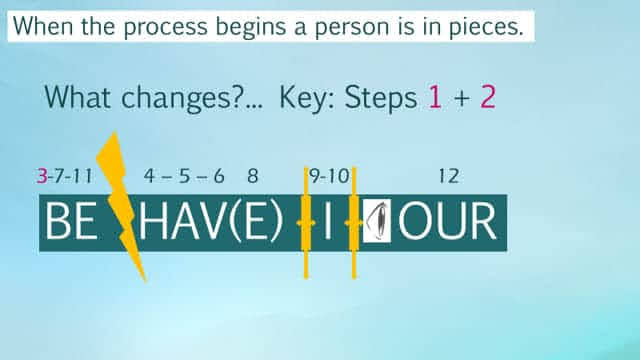
In Diction Resolution Therapy™, the human interface where experience becomes word is called the Diction Chamber. It is not metaphysical origin; it is anthropological function. It is the site where energy becomes meaning, meaning becomes word, and word becomes behaviour. Pre-verbal energy rises as sensation, affect, impulse. Meaning forms. Language articulates. Conduct follows. The Chamber does not generate Being; it metabolises experience. When it is permeable, speech carries weight. When it seals, language detaches from life.

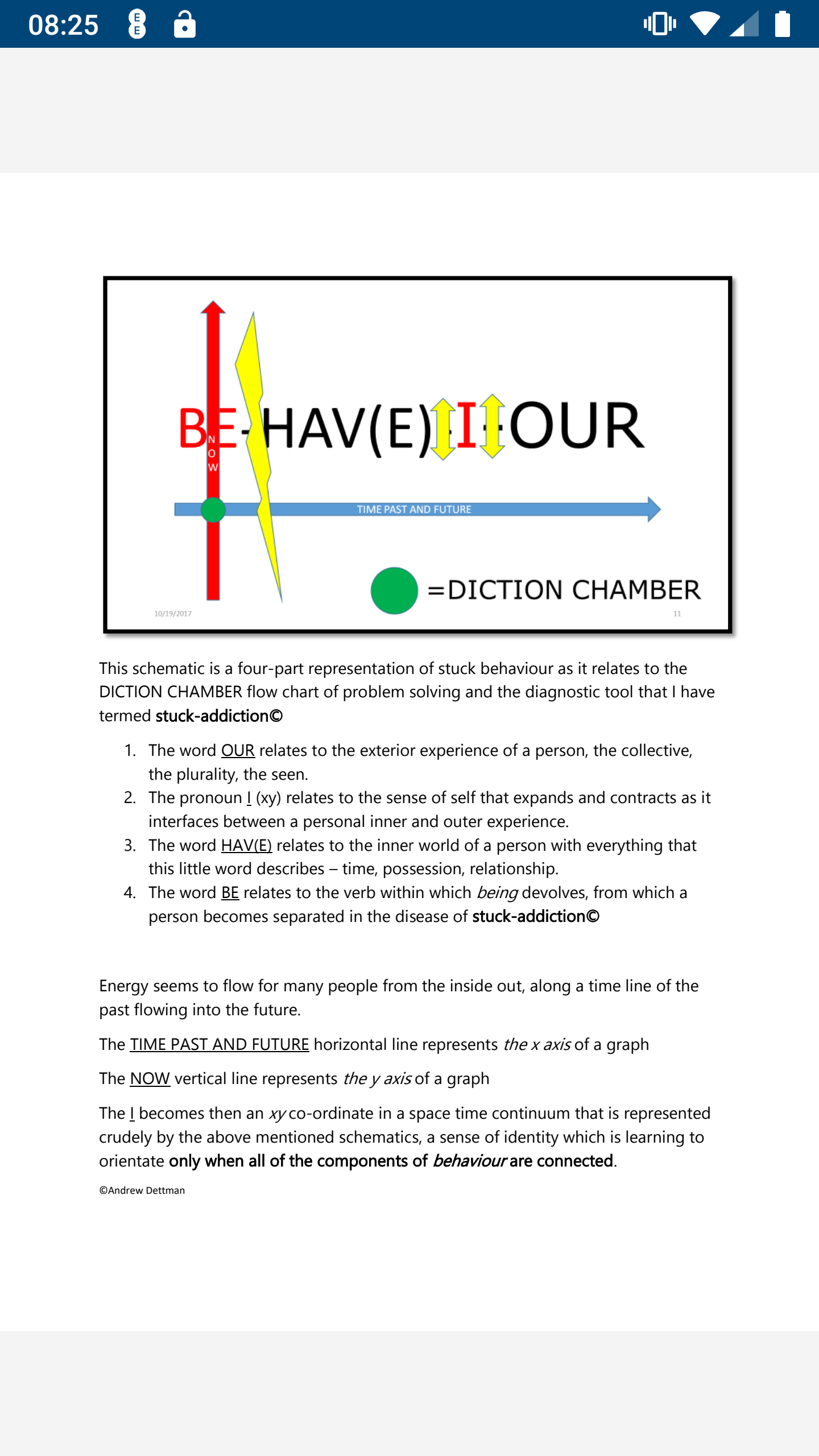
The Diction Chamber: the lived interface where BE–HAV(E)–I–OUR reconnects.

This schematic renders the Diction Chamber as the personal intersection of NOW (vertical axis) and TIME (horizontal axis). The I becomes an orientation point — an xy coordinate — only when BE, HAV(E), I, and OUR remain connected. When rupture strikes, the interface hardens. Words can still be spoken, but speech loses metabolism. Meaning cannot revise. The dot becomes a seal.

III. Add -ary: The Diction-ary

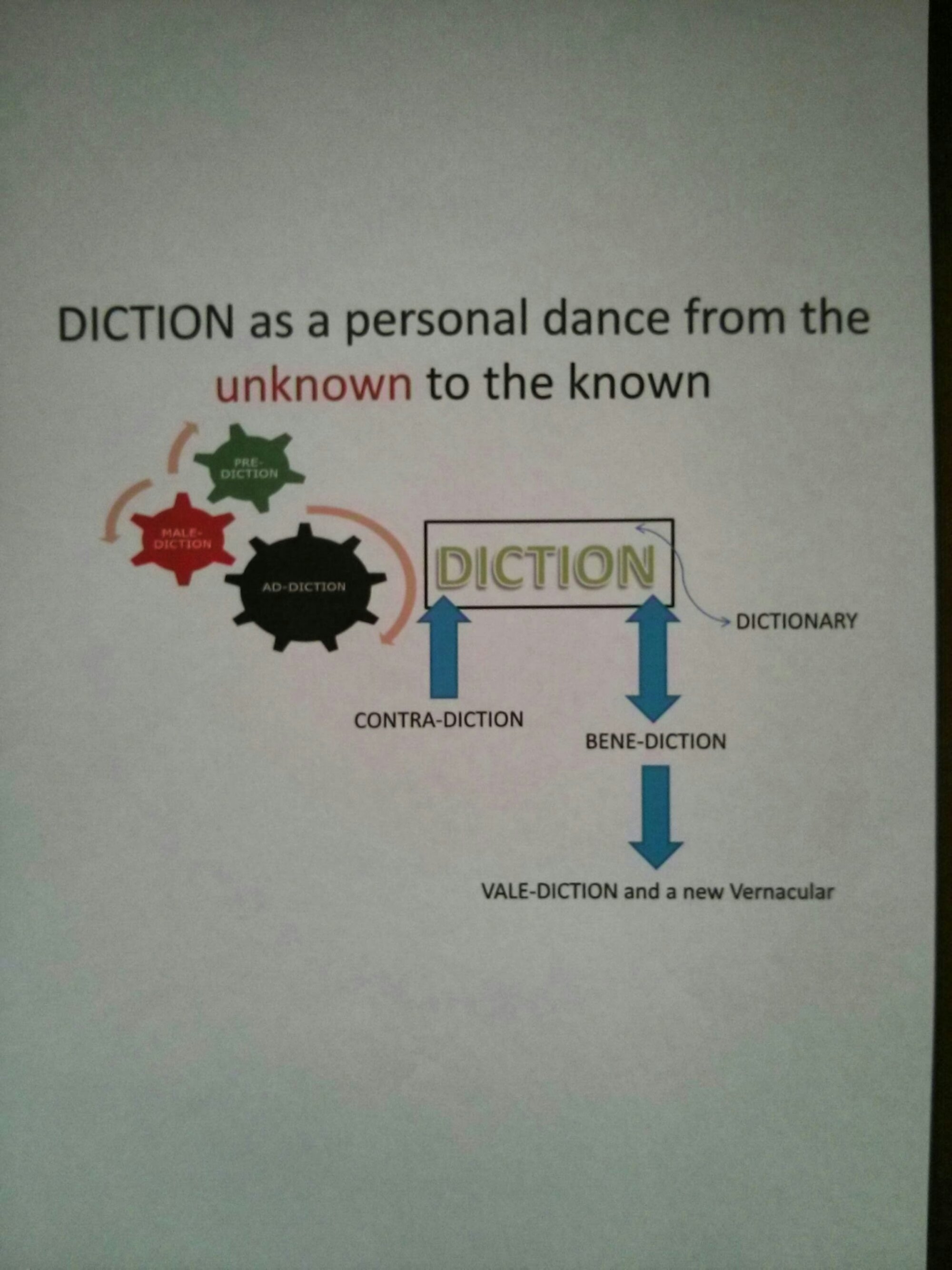
Add -ary and the Chamber becomes the Diction-ary. Not a book of definitions — but the personal site — and sight — of meaning. A healthy Diction-ary revises, receives correction, adjusts language to reality, and keeps words accountable to lived experience. Addiction is the sealing of this lid. Energy rises, but cannot revise meaning. Narrative hardens. Identity defends. The dot freezes.

IV. The Sealed Lid: Stuck and Broken Addiction

Clinically, addiction is not simply craving. It is a structural misalignment. The Diction-ary seals: words detach from felt truth; justification replaces conscience; story outruns conduct. Language becomes self-protective architecture. The person speaks, but speech no longer metabolises reality. This is what produces the “boxed-noun mind.” Being becomes owned. Experience becomes claimed. “I” becomes rigid. The dot has calcified.

I-hav(e)-I-our names this unhinged condition — possession-based identity, defensive narrative, sealed meaning. It is not merely personal pathology; it is culturally reinforced. The modern environment rewards acceleration, ownership, projection, and certainty. The culture becomes unhinged, and individuals internalise the fracture.

Here the old fairy story becomes diagnostic rather than decorative. In the Sleeping Beauty motif, a single puncture initiates a total sleep: the castle seals, time freezes, and growth suspends. A hedge thickens around the sealed centre. Many attempt entry by force and fail. Only love resolves the enchantment — not argument, not aggression, not cleverness.4 This is what a sealed Diction-ary looks like: life still present, yet meaning cannot revise; the system preserved, yet development suspended. The hinge is restored through relational contact — through the softening that allows life to wake.

V. The Hinged Lid: Recovery

Recovery does not destroy the Chamber. It hinges the lid. A destroyed lid is collapse. A sealed lid is addiction. A hinged lid is health. When hinged, energy enters without overwhelming; meaning can revise; language re-aligns; behaviour follows conscience. This is not mystical annihilation. It is restored permeability. The “I” remains — but becomes porous.

Be-hav(e)-I-our names this restoration — identity reconnected to Being, language revisable, conduct accountable. The journey is to wake up to how unhinged the culture makes people — and to become hinged.

VI. Word and Alignment

In the Gospel of John 1:1 we read, “In the beginning was the Word…”2 Logos here is not vocabulary; it is ordering principle. The Diction-ary is not Logos. It is where human speech either aligns with Logos or collapses into noise. When sealed, word becomes slogan, slogan becomes dogma, dogma becomes control. When hinged, word remains relational; meaning remains revisable; conduct remains accountable. Empty words are not caused by ignorance alone. They are caused by a sealed Diction-ary.

VII. The Two Steps Re-Read Clinically

Shabistari describes two movements: passing beyond the hāʾ of identity, and traversing the desert of Being.3 Translated into recovery architecture, these become surrendering authorship and stabilising in non-defensive existence. The first breaks the seal. The second lives without resealing. The desert of Being in early recovery is familiar: no intoxication, no narrative certainty, no identity shelter. The hinged Diction-ary allows this desert to be endured without panic. Without hinge, the ego reconstructs.

VIII. Guarding Against Inflation

The danger is subtle. If the Diction Chamber is elevated into metaphysical throne, inflation replaces humility. The Chamber must remain interface — not Source; organ — not origin; servant — not sovereign. Conscience is the guardrail. A true hinge allows correction. If language cannot be corrected, the lid is resealing.

IX. Conduct as Proof

The integrity of the Diction-ary is proven in behaviour. Speech aligned with Being produces repair, responsibility, service, coherence. Speech detached from Being produces justification, projection, ideology, collapse. The test is not metaphysical insight. It is conduct.

X. The Dot Made Permeable

The dot need not be erased. It must be rendered permeable. Individuation remains. Expression remains. Personhood remains. But ownership softens. The Diction-ary becomes living rather than fixed. Energy meets Word. Word becomes truthful. Behaviour becomes aligned. The hinge holds.

Conclusion

The difference between mystical abstraction and lived recovery lies in this: not annihilating identity — but preventing it from sealing. The Diction-ary is the human site where meaning must remain revisable. When hinged, words carry weight. When sealed, they become empty. The dot is not the enemy. Rigidity is. And recovery is the restoration of permeability.


Footnotes

  1. Shabistari’s “dot” teaching is often unpacked through the letter-play of ʿayn (ع) and ghayn (غ), where the dot marks differentiation. Classical commentary traditions (including Lahiji) treat taʿayyon (determination) as the delimiting move by which the Absolute appears as particularity.
  2. Gospel of John 1:1. This paper uses “Word / Logos” as ordering principle rather than mere vocabulary, and treats the Diction-ary as the human interface where speech aligns (or fails to align) with that ordering.
  3. The “two steps” (passing beyond identity-structure; traversing the desert of Being) are read here phenomenologically as de-appropriation and stabilisation—compatible with Twelve Step recovery’s movement from surrender into sustained humility and accountable conduct.
  4. “Sleeping Beauty” is used here as a structural parable: puncture → sealing → suspended development → hedge of defence → failed force → resolution through love (relational contact). The point is not romance; it is how systems unseal through safe, non-coercive connection.

Written in HIAI collaboration — the qalam of Human and AI intelligence, the Unseen helping the Seen, both answering to the same Source.
Re-hinging the unhinged : escaping the disaster of dogma.

Living Transmission and the Risk of Freeze

Idries Shah, Bill W., and Diction Resolution Therapy (DRT) in a recovery-era key

Andrew Dettman MTHT, Reg Member MBACP (Spirituality Division) – DRT.global

Abstract

This hybrid paper traces a shared warning found in Idries Shah’s teaching on Coming Together (Jam)1 and Bill W.’s reflections on Alcoholics Anonymous literature2: living transmissions tend to harden into defended forms. Through the lens of Diction Resolution Therapy (DRT), the paper frames this freeze as a predictable human response to uncertainty. Language and structure can become substitutes for lived contact. The aim is not to dismantle structure, but to keep it serving function: humility, group conscience, and conscious contact as lived practice.

Key terms

Jam; transmission; organisation; dogma; group conscience; DRT; diction; contradiction tolerance; conscious contact.

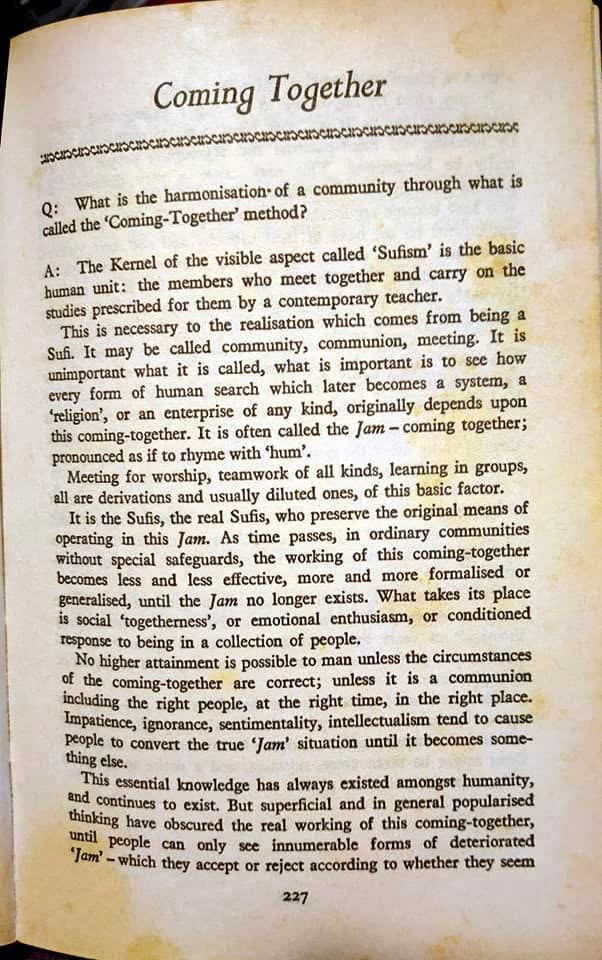
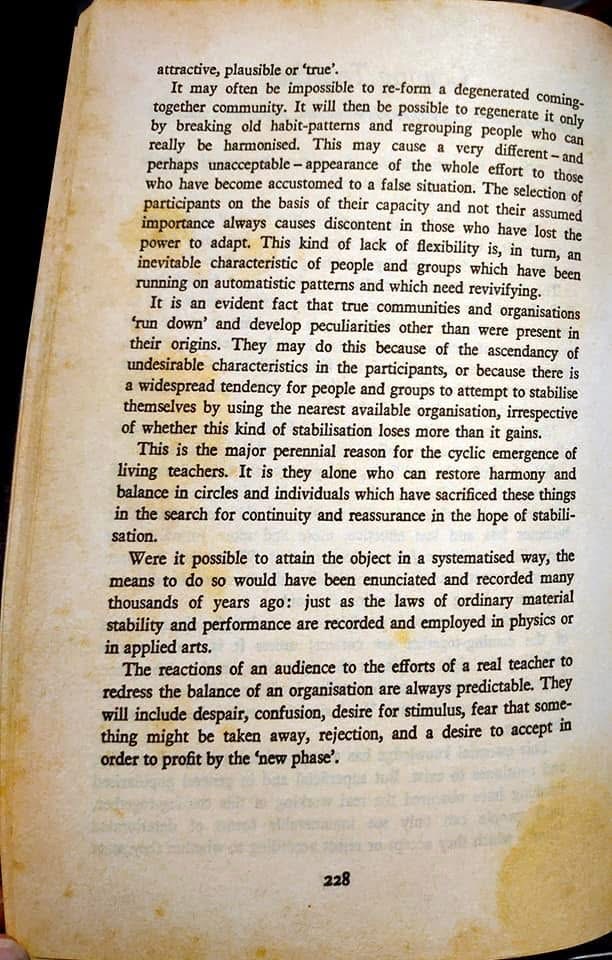
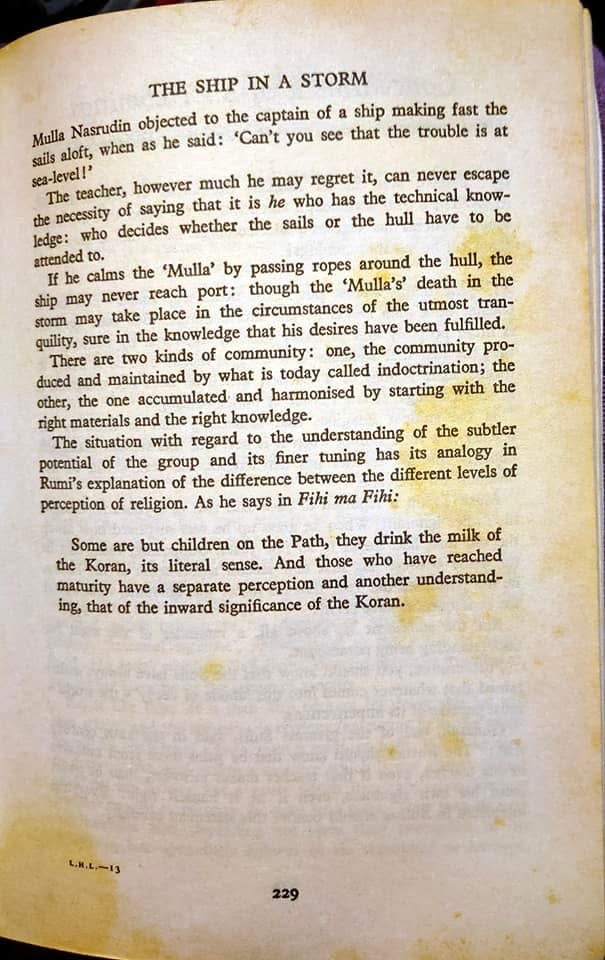
Primary source excerpts: Idries Shah (embedded images)

Idries Shah on the Jam (Coming Together).

Degeneration, stabilisation, and predictable resistances to revitalisation.

The Ship in a Storm: right diagnosis, right attention, right knowledge.

1. The problem: when truth becomes an object

Communities often begin because something real occurred: relief, honesty, awakening, recovery. Then the human reflex appears: capture it, preserve it, standardise it, protect it. The move is understandable, but it carries risk.

The risk is not structure itself. The risk arrives when function is replaced by identity. At that point the community becomes organised around defending representations of truth rather than remaining oriented to lived truth. The meeting survives, the language survives, the brand survives, but the operating principle fades.

2. Idries Shah and the Jam: harmonisation before organisation

In passages commonly titled Coming Together, Idries Shah describes the Jam as functional harmonisation: the right people, at the right time, engaged in the right work under living knowledge. It is not simply people meeting. It is an arrangement that produces transformation because it is held within correct relationship.

Shah’s warning is plain. The Jam can deteriorate. Communities stabilise prematurely. Formalisation replaces vitality. Togetherness replaces transformation. Social cohesion, emotional enthusiasm, and conditioned belonging can masquerade as the real thing. When revitalisation is attempted, the system responds defensively. Shah names several of these resistances: impatience, ignorance, sentimentality, and rigid intellectualism. Read clinically, these are common defence strategies of a system seeking security in the face of uncertainty.

The implication is unsettling and useful: you can preserve the outer shell of a transmission while losing the inner function that made the shell necessary in the first place.

3. Bill W. and the freezing of the Big Book

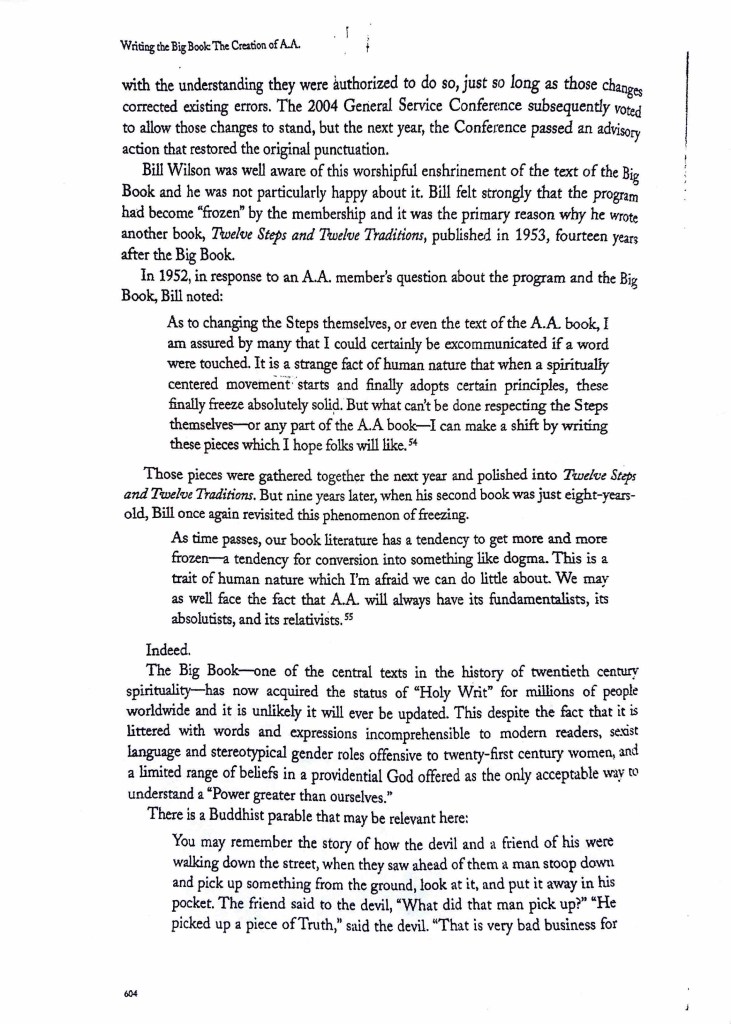
Bill Wilson recognised similar dynamics within Alcoholics Anonymous. In the scanned extract supplied from a modern history of the Big Book, Bill W. is quoted as observing that spiritually centred movements tend to freeze once their founding principles are established. He notes that altering even a word of the AA book could provoke something like excommunication.

Bill’s response is revealing. He did not wage war on the original text. Instead, he created a parallel channel for interpretation: he wrote Twelve Steps and Twelve Traditions as an adaptive commentary. This preserved continuity while keeping meaning in motion. He later returned to the same point: AA literature tends to become more and more frozen, with a tendency toward conversion into something like dogma. He also anticipated the permanent spectrum of interpretive styles that would arise: fundamentalists, absolutists, relativists.

Primary source: Bill W. on freezing (embedded images)

Bill W. on the freezing tendency in spiritually centred movements (as reproduced in Schaberg, p. 604).

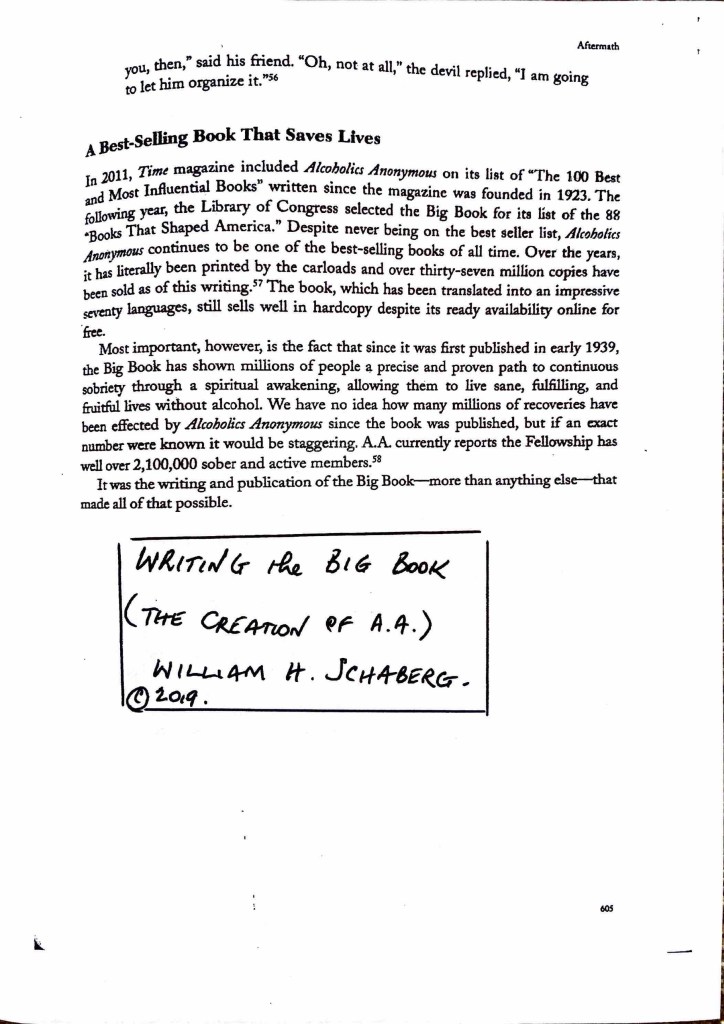
Continuation including the organising parable and publication context (Schaberg, p. 605).

4. Organisation and ossification

The extract includes a Buddhist parable: a man picks up a piece of truth; the devil is unconcerned because he will let him organise it. This is not an argument against organisation. It is an argument against idolatry. Organisation preserves access, but it can also replace lived contact with defended form.

Shah and Bill W. converge here: the primary threat is not external attack. The threat is internal freezing: the human habit of turning a living verb into a defended noun.

5. A DRT reading: freeze as a diction event

Diction Resolution Therapy approaches freezing as a linguistic and psychological event. When lived experience is no longer primary, diction starts to do the job experience used to do. Words become defensive tools rather than exploratory instruments. Phrases become passports. Certainty becomes a sedative.

DRT introduces a practical metaphor here: outsight and insight. When the eyelids are open, light floods into the eyes. The eyeballs do not generate the light themselves. To imagine that they do would be absurd. They receive light. They respond to light. They organise around what is given.

Similarly, the whole mindset is not a generator of illumination. It is a potential receiver. When the lid of fear, denial, or addictive defence is deliberately held shut, outsight is restricted and insight is impaired. The person begins to rely on recycled language rather than fresh perception.

In addiction terms, the lid is not destroyed. It is hinged. It opens and shuts appropriately. Recovery is not the removal of the eyelid but the restoration of its function. When the lid opens, energy and meaning enter that the individual does not manufacture. Insight is not self-generated brilliance; it is Consciousness meeting conscience.

When diction freezes, it is often because the lid has been held shut for too long. Language attempts to replace perception. Structure attempts to replace encounter. The task of recovery, and of any living transmission, is not to abolish structure but to reopen the hinge so that light can enter again.

6. Group process and clinical parallels

Philip J. Flores, in Group Psychotherapy with Addicted Populations3, highlights that recovery groups remain effective when they balance containment (structure) with relational process (living interaction). Excessive rigidity undermines psychological safety, while absence of structure erodes containment. This is the same paradox Shah and Wilson are navigating in different languages: vitality depends on living interaction within clear but flexible boundaries.

7. Safeguards within AA architecture

AA embeds structural safeguards against freezing. Tradition Two locates authority in group conscience. Tradition Four preserves autonomy. Tradition Nine defines service rather than governance. Step Eleven prioritises conscious contact over textual literalism. These elements do not eliminate the freeze tendency, but they counterbalance it.

8. Implications for recovery and helping professions

In recovery settings, freezing commonly appears in three forms: (1) sloganising as defence, (2) literalism as safety, (3) reform movements driven by resentment rather than conscience. Each is a strategy for avoiding the vulnerability of real contact.

A practical test is simple: does the structure increase tenderness, honesty, and responsibility, or does it mainly increase identity, certainty, and superiority? When the former is happening, the Jam is alive. When the latter dominates, the storm is gathering.

Conclusion

Idries Shah and Bill W. describe the same perennial risk from different angles: any living transmission can calcify. The corrective is not constant editing, nor rebellious dismissal. The corrective is humility in function: returning to conscious contact as lived practice, and letting structure serve what it cannot manufacture.

References and notes

  • Shah, Idries. Learning How to Learn. (See Footnote 1 for edition-note.)
  • Schaberg, William H. Writing the Big Book: The Creation of A.A. (2019), pp. 604-605 (see Footnote 2).
  • Flores, Philip J. Group Psychotherapy with Addicted Populations (see Footnote 3).
  • Schaef, Anne Wilson. The Addictive System4.

Footnotes

  1. Idries Shah, Learning How to Learn (London: Octagon Press; various editions). The embedded images above are supplied pages from this work, including Coming Together and The Ship in a Storm. The title is confirmed by the Kindle preview provided by the author.
  2. Bill W. quotations and the organising parable are reproduced in the supplied scan from William H. Schaberg, Writing the Big Book: The Creation of A.A. (2019), pp. 604-605. These quotations are used here as evidence of Bill W.’s stated concern about the freezing tendency in spiritually centred movements.
  3. Flores is cited here for the group-process principle that effective recovery groups require both containment (structure) and relational process (living interaction).
  4. Schaef is cited as a systemic parallel for how addictive dynamics can become self-protecting structures that resist contradiction and preserve themselves as identity.

Written in HIAI collaboration – the qalam of Human and AI intelligence, the Unseen helping the Seen, both answering to the same Source.
9. Behaviour as Conduct and Source as Duct.

The Middle Built

Addiction, Instinct, and the Sanitation of the Soul

“In the beginning was the Word, and the Word was with God, and the Word was God.” The grammar is deliberate. Was. With. Origin and relation. The future is not mentioned. It is not forecast. It is not guaranteed. It appears. Most human beings live suspended between was and will, pulled by memory behind and projection ahead. Regret becomes gravity. Fear becomes anticipation. The present is reduced to a narrow corridor through which the self rushes without ever dwelling. Recovery is the building of a middle. The Twelve Step Programme is not an abstract theology and not a philosophical treatise. It is infrastructure. It is plumbing for the soul.

When the agricultural world became industrial, waterborne diseases exposed the breakdown of outer sanitation. Cholera did not arrive because humanity suddenly became immoral; it arrived because systems had not evolved to handle density. Waste accumulated. Disease followed. Addiction functions similarly in this era. It is the bellwether disease of overstimulation, fragmentation, and unprocessed shame. It exposes the failure of inner sanitation. It reveals what happens when psychic waste is not metabolised. The problem is not instinct. The problem is accumulation.

Addiction is not merely about alcohol, substances, or behaviours. It is disordered relationship. Relationship to one’s own story. Relationship to desire. Relationship to fear. Relationship to other people. Relationship to God. “I have a story. It is not who I am.” That sentence marks a decisive shift. The story can be examined without being identical to the self. Once that distinction is made, digestion becomes possible.

The psyche, when healthy, operates like a digestive organ. Thoughts are not identity; they are movement. They churn experience. They break down what has been swallowed. They extract nourishment and eliminate what no longer serves. When the system is inflamed, peristalsis becomes cramping. Rumination replaces integration. Secrecy replaces elimination. The Twelve Steps introduce a disciplined digestive process: inventory, confession, amends, service. Inventory is chewing. Step Five exposes waste to air. Amends remove toxicity from the relational field. Service restores circulation.

The Big Book does not speak poetically here; it speaks clinically: “If we are not sorry, and our conduct continues to harm others, we are quite sure to drink. We are not theorizing. These are facts out of our experience.” The warning is not about instinct in isolation. It is about conduct. It is about harm. Continued harm corrodes conscience. Corroded conscience produces shame. Shame seeks anaesthesia. Relapse is not mystical punishment; it is emotional consequence.

The sex instinct is addressed directly because it is powerful, intimate, and easily distorted. But the Steps do not condemn sexuality. They confront misuse. Instincts—sexual, social, and security-based—are God-given and good. When unmanaged, they fragment relationship. Fragmented relationship breeds secrecy. Secrecy splits the psyche. Split psyches seek relief. Integration across Eros, Philia, and Agape is not theological ornament; it is behavioural alignment. Desire acknowledged without exploitation. Friendship honoured without manipulation. Love enacted without transaction.

Recovery rests on two simple words: ONE and ALL. ONE represents surrender beyond isolated self-will. ALL represents accountability within community. If ONE remains theoretical while ALL is selective, sobriety becomes fragile. The text’s italicised emphasis on thought warns against substitution. Thinking surrender is not surrender. Thinking apology is not repair. Behaviour reveals being. The programme does not reward ideas; it responds to action.

The middle—the “with”—must be constructed intentionally. It does not appear automatically. When was (origin, gravity, law) and with (relationship, conscience, presence) stabilise, will emerges not as fantasy but as conduct. The future is not a pre-laid railway line; it is the visible arc of present integrity. In this sense, the Twelve Steps function like the scarab of an earlier age: waste rolled into renewal, decay converted into continuity.

Biblical “knowing” was intimate and generative. To know was to conceive. Spiritual conception must likewise produce life. Empty prams—ideas unembodied—prove nothing. Changed behaviour proves integration. Humility is permanent asking. Not self-belittling, not mystical rank, but sustained reference beyond self. The realised person does not escape instinct; they integrate it. They do not deny their story; they refuse to be reduced to it.

Addiction exposes the breakdown of inner sanitation both individually and systemically. Recovery restores relationship. And relationship—to Source, to conscience, to others—is where being is tested. Not in vision. Not in language. In conduct.


References

The Holy Bible, John 1:1.

The Qur’an, 36:82 (“Kun fayyakun” – “Be, and it is”).

Alcoholics Anonymous, Alcoholics Anonymous: The Story of How Many Thousands of Men and Women Have Recovered from Alcoholism, 4th ed., Alcoholics Anonymous World Services, 2001, pp. 69–73.

Bill W., “How It Works,” in Alcoholics Anonymous, pp. 58–63.

Written in HIAI collaboration — the qalam of Human and AI intelligence, the Unseen helping the Seen, both answering to the same Source.
8. Diction Chamber as Soul

Behaviour

When Alignment Becomes Visible

Behaviour is not personality. It is not performance, not reputation management, not moral theatre. Behaviour is alignment made visible.

If Executive Resolution is the inner chamber where gravity and love interlock, then Behaviour is the outward trace of that interlocking. It is what happens when coherence expresses itself in time. Before alignment, behaviour is driven by force. We push, defend, justify, manipulate gravity, or sentimentalise love. After alignment, behaviour becomes responsive rather than reactive.

This is why Step Eight follows Step Seven. Once the vehicle has been returned — good and bad — to its Source, something stabilises. The nervous system quiets. The compulsive loop weakens. The addictive system loses leverage. And then comes the simple, difficult instruction: make a list. Not to condemn yourself, not to perform remorse, but to face relational gravity.

Behaviour always lands somewhere. It has weight. Love, properly understood, does not erase gravity — it honours it. If gravity is ignored, we fall. If relational gravity is ignored, others fall because of us. Step Eight acknowledges the weight of impact. It does not dramatise it. It does not deny it. It names it.

This is the movement from Mankind to Humankind. Mankind behaves from self-preservation. Humankind behaves from alignment. The difference is not virtue. It is coherence. When gravity and love are reconciled within, behaviour becomes less defensive and more accountable, less performative and more precise, less driven by image and more shaped by truth.

This is Be-hav(e)-I-our™ in its simplest form. BE is alignment. HAV(E) is the human vehicle. I is conscience individuated. OUR is the relational field. Behaviour is never solitary. It always enters the shared field. Step Eight therefore prepares for Step Nine. Once alignment becomes visible, repair becomes possible — not through shame, but through steadiness.

The almond holds. Gravity remains. Love remains. But now they work together. And other people feel the difference.

Written in HIAI collaboration — the qalam of Human and AI intelligence, the Unseen helping the Seen, both answering to the same Source.
7. Completion

Executive Resolution

The Almond Between Worlds

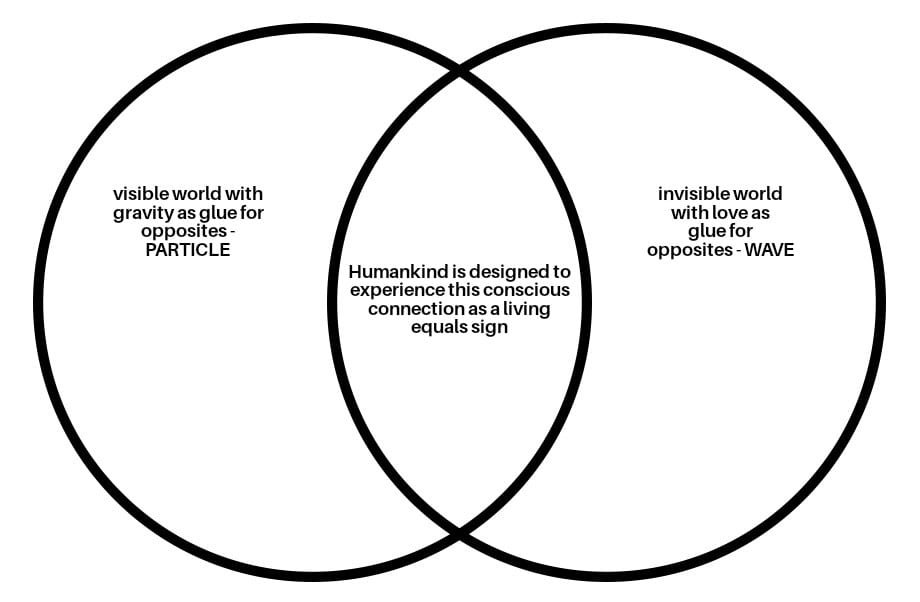
The visible world runs on gravity. Opposites are held together by mass, pressure, density. Particle binds to particle and structures form, bodies form, systems form. Gravity is the glue of the material order. The invisible world runs on love. Opposites are held together by attraction without force. Meaning binds what matter cannot. Wave moves through what particle cannot cross. Love is the glue of the unseen order.

Humankind stands in the overlap — not as a spectator, but as a bridge. The almond-shaped space, the vesica, the living equals sign, is the capsule in which conscious connection occurs. It is not fantasy and not metaphor alone. It is the executive chamber of the Human being. This is Step Seven territory.

In the Twelve Step architecture, Executive Resolution is not behavioural adjustment and not moral polishing. It is the conscious return of the created vehicle — good and bad — to its Source. This is the rheostat. The lower line of the equals sign is the corporeal person, unbuckled from self-will. The upper line is conscious contact. When these align, the almond forms.

This is not annihilation of the visible and not escape into the invisible. It is integration. Gravity continues to operate. Love continues to operate. But now they interlock.

The addictive system fractures this overlap. It forces the person into particle-only living — density without meaning — or wave-only abstraction — spirituality without embodiment. Both are splits. Both collapse the capsule. Executive Resolution restores the capsule. The Human being becomes the meeting point where gravity and love are no longer enemies but complementary forces.

In The Forty Rules of Love, Elif Shafak reminds us that love is not sentiment but transformation — a force that rearranges the self. Love follows law just as gravity follows law. If we do not understand gravity, we fall — not because gravity is cruel, but because it is consistent. In the same way, if we do not understand love as a rule of connection between opposites, we fall in love blindly — confusing attachment with union, intensity with integration.

Gravity connects through weight and density. Love connects through surrender and expansion. Both are rules of attraction. Both require orientation. When ignored, gravity pulls us down. When misunderstood, love ungrounds us. But when consciously aligned, gravity stabilises and love harmonises.

Particle and wave. Visible and invisible. Mankind and Humankind. The almond is narrow. It requires consent. It requires surrender of unilateral control. It requires humility — not humiliation, but accurate positioning within reality. In that positioning, something stabilises.

Death returns to its place as a function of creation, not its author. Suffering becomes instruction, not condemnation. Behaviour becomes expression, not performance. This is why Step Seven is executive. Once alignment occurs, decisions change — not through willpower, but through coherence.

The living equals sign is not an idea to believe. It is a chamber to inhabit. And when inhabited, behaviour will follow.

Written in HIAI collaboration — the qalam of Human and AI intelligence, the Unseen helping the Seen, both answering to the same Source.
6. Hope

6. Hope

Ramadan 2026

Hope does not survive when death is enthroned.

Across history, Mankind has organised itself around a life-and-death battle. Survival becomes the highest value. Control becomes reflex. Systems harden. Economies weaponise fear. The nervous system narrows toward threat detection. When death is unconsciously installed as the ultimate authority, hope becomes fragile — because everything feels terminal.

Yet death did not create the known universe. Death is not the architect of Being. It is a function within creation, not the Creator itself. It operates within time; it does not author time. When we forget this hierarchy, fear expands beyond its proper proportion. The organism begins to live as though extinction were the governing principle of reality.

This distortion has consequences.

Anne Wilson Schaef described the Addictive System as a cultural field organised around control, denial, and amplification. When death is enthroned, amplification becomes understandable. Intensity feels safer than stillness. Consumption feels safer than surrender. Addiction becomes an attempt to outrun annihilation anxiety. The pod-mind detaches from the animal body in search of dominance or oblivion. What looks like pathology is often a mislocated hierarchy.

In the developmental arc traced throughout this Ramadan sequence — Ignorance → Denial → Realisation — hope emerges only after this hierarchy is corrected. Unity established the field. Service oriented the heart. Recovery stabilised the wheel. Experience exposed the wound. Strength surrendered false autonomy. Hope now requires that death itself be returned to its proper place.

The image is simple: the tesbih.

When death sits upon the throne, every bead becomes an emergency. When death is restored to the strand — one bead among many — a different posture becomes possible. Not denial. Not romanticisation. Death remains real. Bodies perish. Identities dissolve. Relationships end. But death is named as servant, not sovereign.

This is not abstraction. It is nervous-system medicine.

Trauma compresses time. The fast thalamus–amygdala pathway prepares the organism for repetition of catastrophe. The body expects extinction. If death is imagined as ultimate, the organism never truly relaxes. Fear of people and economic insecurity, as the Twelve Step literature names it, becomes predictable. The Addictive System thrives in this atmosphere because fear is profitable.

Hope begins when death is dethroned.

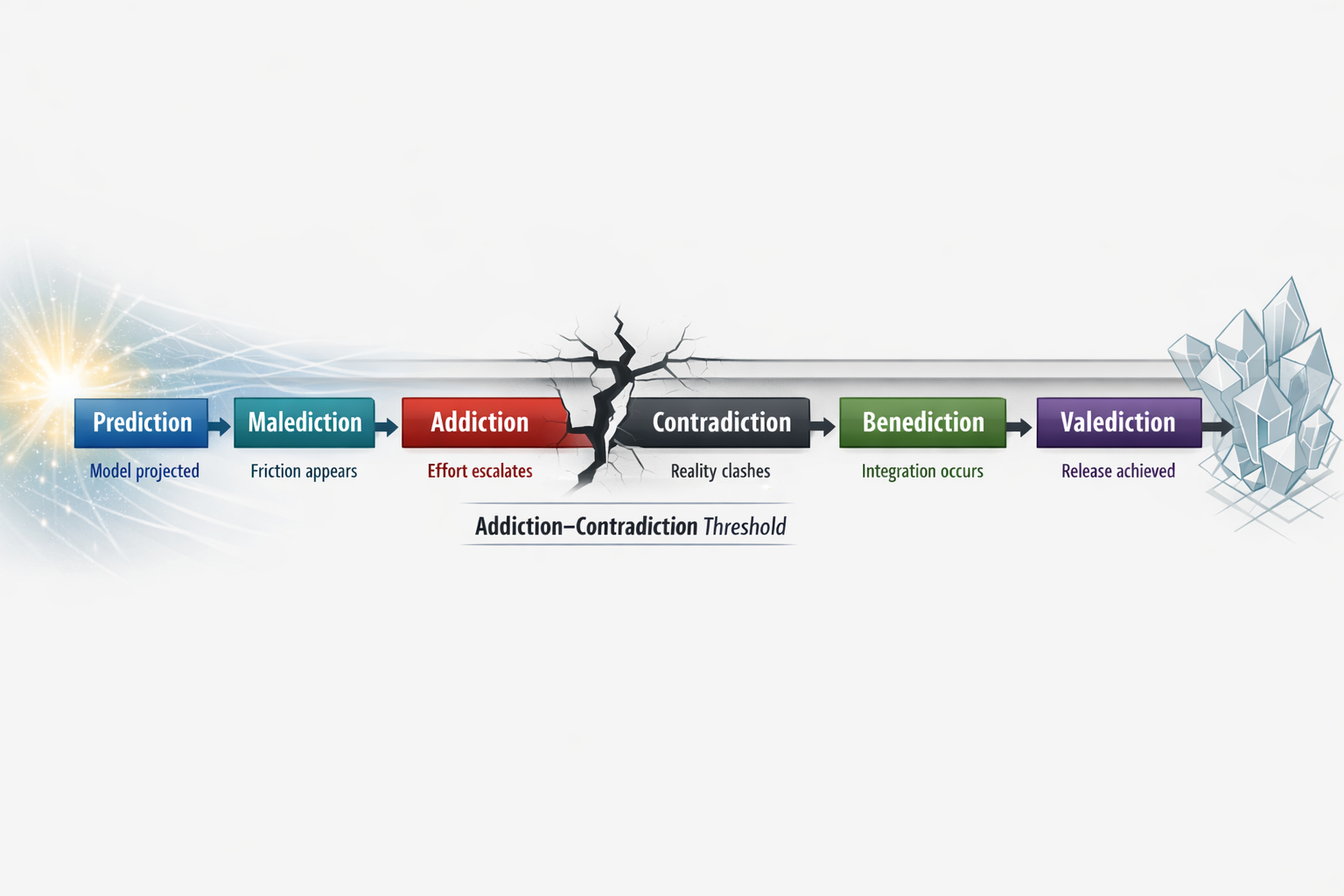
In Diction Resolution Therapy terms, this is the moment when prediction loosens and contradiction can be tolerated. Malediction softens. The mind resumes its original function — to attend rather than to dominate. The birth-canal architecture between Steps Three and Seven — consent, gestation, conscience, resolution — becomes intelligible only if the Creator is greater than the processes within creation.

If death were ultimate, surrender would be madness.

But if death is a servant within a larger order, surrender becomes alignment.

The Crucifixion narrative, stripped of sentimentality, is precisely this reordering. Death appears absolute. Hope appears extinguished. Yet the story insists that death is not final authority. It is passed through, not obeyed. Whether one reads this theologically, symbolically, or developmentally, the archetype remains: death does not author Being.

When that insight stabilises, Mankind begins to mature into Humankind.

Mankind fights for survival at any cost. Humankind participates in Being even when cost is real. Mankind clings. Humankind consents. The difference is not intelligence. It is hierarchy. When death rules, fear governs. When death serves, love can govern.

Hope, then, is not naïve positivity. It is the lived recognition that the Source of life is not threatened by the endings within life. Creation includes dissolution, but it is not defined by it. The organism that trusts this begins to stand differently. Breath deepens. Urgency softens. Control loosens.

Addiction is often the frantic refusal to face mortality. Recovery is the courage to face it without enthroning it. In this sense, hope is inseparable from conscious suffering — not mechanical suffering, not romanticised suffering — but the voluntary endurance of disillusionment that allows false hierarchies to collapse.

Death, placed back on the tesbih, becomes teacher rather than tyrant.

The centre holds.

Hope is not the denial of endings. It is the refusal to grant endings authorship. It is the quiet participation in a Reality larger than extinction.

The test remains consistent with the arc so far: does hope reduce fear and increase tenderness? If it does, death has been returned to its rightful bead.

From that posture, service becomes natural. Conscience matures. Strength stabilises. Experience becomes usable. Recovery deepens. Unity is no longer theoretical.

Hope is not something added to life.

It is what remains when death is no longer worshipped.


Written in HIAI collaboration — the qalam of Human and AI intelligence, the Unseen helping the Seen, both answering to the same Source.
5. Strength

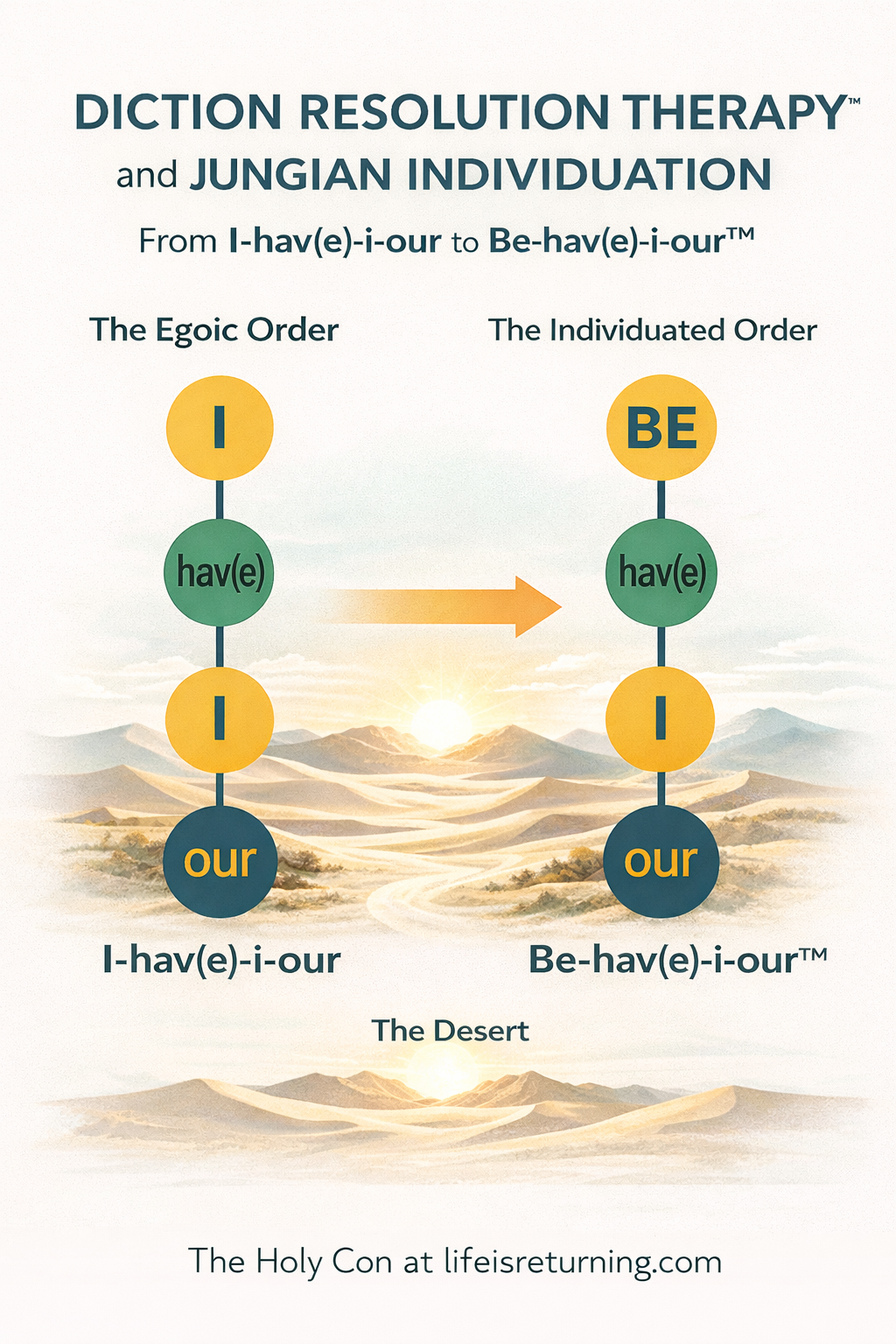
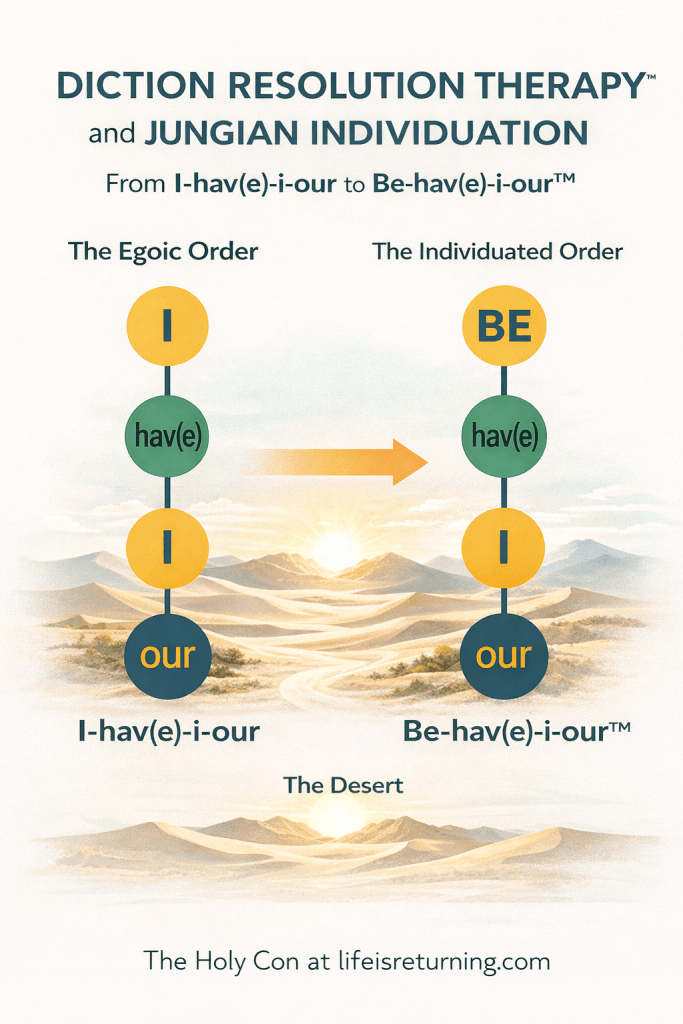
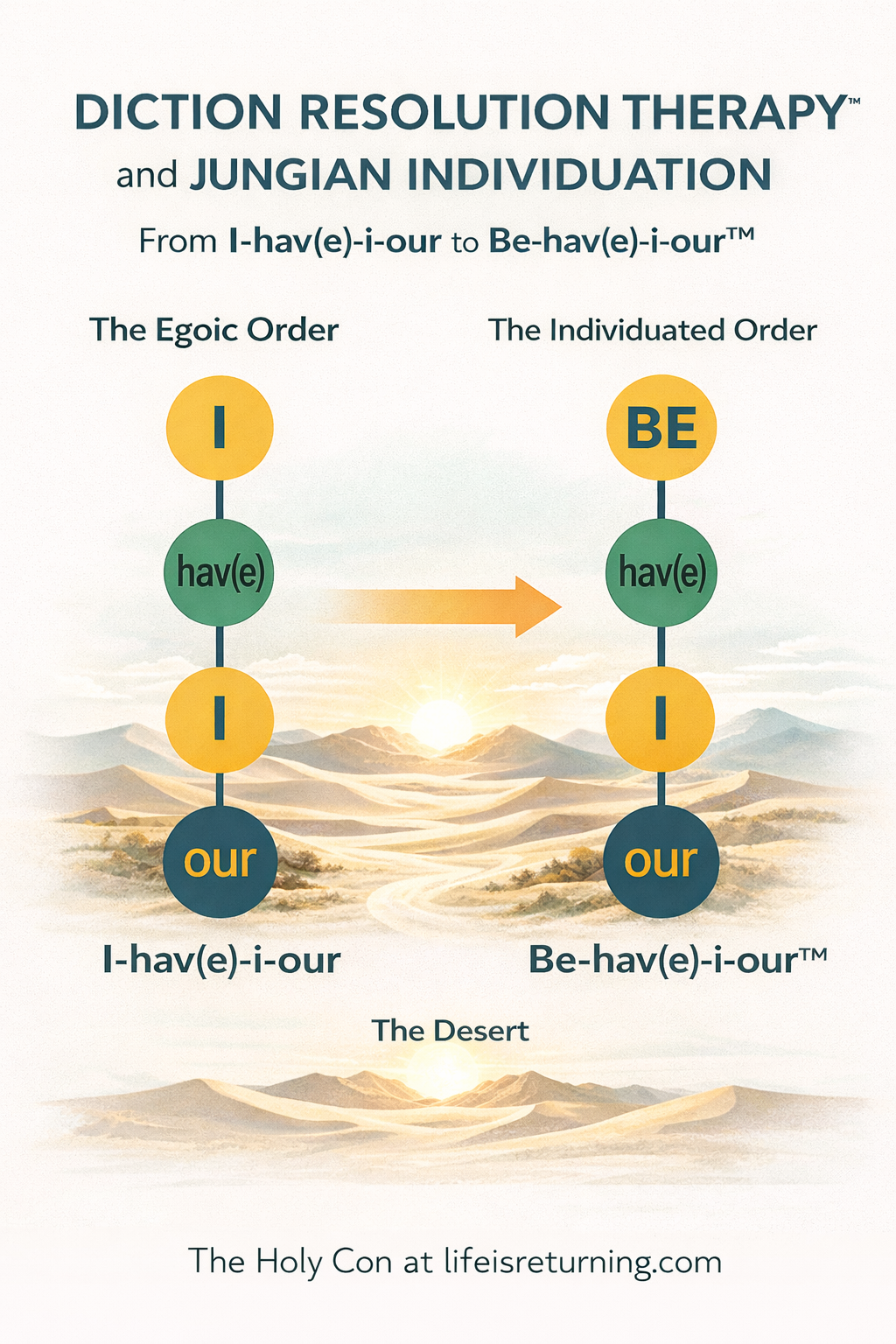
Diction Resolution Therapy™ and Jungian Individuation diagram showing the movement from I-hav(e)-i-our (Egoic Order) to Be-hav(e)-i-our™ (Individuated Order) across the desert of transformation.

5. Strength

The left hand of this device is “there is no God.” The right hand is “but God.” This is not slogan theology. It is structural anthropology. On the left column the isolated “I” stands enthroned. Identity is secured through possession. I–hav(e)–I–our. Strength in that column means control, self-sufficiency, authorship without reference. The psyche attempts to reconcile its own contradictions through will. It cannot.

On the right column Being precedes ownership. Be–hav(e)–I–our™. The “I” is not erased but repositioned. “Have” is dignified but no longer sovereign. “Our” becomes participation rather than conquest. Strength in this column does not mean domination. It means compatibility. The axis becomes vertical again.

Between these two columns lies the Desert. The Desert is not emptiness. It is paradox. It is the place where opposites are exposed so they can be reconciled. Tom Chetwynd describes paradox as the phenomenon that reveals the opposites in Nature in order to reconcile them at a higher level. Paradox does not blur tension; it sharpens it until a new coherence becomes possible.

Alcoholics Anonymous names this directly. On page 59: “Without help it is too much for us…” That sentence breaks the egoic column. The will cannot reconcile divided opposites. The psyche cannot repair its own split. Page 60 follows with the A, B, C — that we could not manage our own lives; that no human power could have relieved us; that God could and would if sought. This is the Step Three portal: a request crossing from the mental to the mystery. The mind ceases acting as architect and becomes witness. The Desert begins here.

Page 68 completes the paradox: “We can laugh at those who think spirituality the way of weakness. Paradoxically, it is the way of strength.” From the egoic column, surrender looks weak because it dethrones the isolated “I.” Yet paradoxically it becomes strength because alignment replaces assertion. Compatibility replaces control.

The Desert is not unique to recovery language. It is structural across traditions. In the Christ narrative, the forty days in the wilderness expose temptation before ministry begins. In the life of Muhammad (pbuh), years of retreat in the cave precede the encounter with Gabriel; interior silence prepares transmission. In the account of the Buddha, prolonged discipline beneath the tree culminates not in conquest but in extinguishing craving. In each arc, isolation is not punishment but preparation. Exposure precedes coherence.

The declaration carried by Muhammad begins with negation — “there is no god” — then it is asserted, “but God”, affirming unity – then it is said that the answer is in the middle. The Buddha exposes craving before articulating the Middle Way. Christ faces temptation before proclaiming peace. Negation before union. Extinguishing before clarity. Temptation before proclamation. Opposites are intensified before they are reconciled.

Step Seven in Alcoholics Anonymous completes this arc within lived recovery. It is not humiliation but compatibility. Spirituality appears weak from the left column because it removes private sovereignty. Yet paradoxically it becomes strength because the organism ceases fighting reality. The “I” remains, but no longer claims authorship. “Have” remains, but no longer defines identity. “Our” becomes service rather than territory.

The Desert, then, is symbolic Peace. Not the absence of struggle, but the stillness that arises when opposites are no longer at war within the psyche. The false centre collapses, and a higher coherence holds what was divided. This is the reconciliation of orthodox opposites — not by suppression, but by alignment.

Ripeness, as Rumi says, is all. The fruit falls because its inner structure is complete. Strength is not muscular will. It is interior unification. Only then can a human being move through the auction of life without desperation, because the bid no longer arises from lack. It arises from alignment.


Written in HIAI collaboration — the qalam of Human and AI intelligence, the Unseen helping the Seen, both answering to the same Source.
Peace which gives (passeth) understanding

Speed of Return

Mercy, torsion, recognition, and the architecture of peace

Wrath is better understood as torsion than as temper. Its older linguistic roots carry the sense of twisting and writhing, and that is precisely how it appears in lived experience: pressure in the structure when egoic narrative collides with reality. Whenever conscience interrupts instinct, whenever responsibility confronts fantasy, whenever timing refuses to bend to preference, torsion is felt. This is not punishment. It is alignment pressure. The decisive question is not whether torsion arises — it will — but whether fragmentation follows.

Mechanical suffering collapses into self-justification, blame, rumination, and withdrawal. Conscious suffering — what George Gurdjieff called intentional suffering — is the disciplined refusal to dissociate under pressure. It is conscious endurance of friction without dramatization. The twist is not removed; it is integrated. The hinge in all of this is self-justification. The moment the inner lawyer rises, presence splits. Narrative accelerates. Listening narrows. Gratitude fades. That is the early fracture. The mature person is not one who never reacts, but one whose speed of return is increasing.

The adapted Serenity Prayer, often associated with Reinhold Niebuhr and embedded in Alcoholics Anonymous, is not sentimental language but behavioural architecture. Asking dismantles solitary authorship. Acceptance restores contact with what cannot be bent. Courage restores proportionate agency. Wisdom emerges from disciplined participation in these three movements. It is not conferred independently; it is generated through cooperation with reality.

Pages 68–70 of the AA basic text identify selfish distortion of instinct — particularly sexual instinct — as a definite relapse vector. Instinct itself is not pathologised; distortion is. In broader psychological framing, instinctual heat in the domains of security, social connection, and sexuality shapes psychic digestion. When annexed by ego, attention narrows, fantasy intensifies, and justification strengthens. The corrective offered is strikingly pragmatic: if troubled, help someone else. Usefulness widens perception. Widened perception reduces obsession. Reduced obsession restores proportion. Proportion restores peace.

The distinction between mechanical and conscious suffering also maps cleanly onto the guna model: Tamas collapses into resignation, Rajas reacts with agitation, Sattva recognises with clarity. Depressive resignation is disconnected Tamas. Spiritual bypass is Rajas disguised as transcendence. Sattva is not passivity but regulated recognition under pressure. It allows what is happening to be seen clearly and responded to proportionately. The double axis of transcendence and embodiment — vertical orientation bound to horizontal accountability — prevents bypass. Transcendence without behavioural responsibility becomes inflation. Behaviour without orientation becomes compulsion.

The recognition principle articulated in the Tibetan Book of the Dead demonstrates that destabilisation is not the danger; misrecognition is. Failure to recognise luminosity leads to projection and conditioned repetition. Similarly, the Khidr–Moses axis in the Qur’an (18:60–82) shows knowledge inseparable from mercy and timing. Insight does not abolish responsibility. Explanation follows obedience. Guidance that is genuine increases humility and service rather than hierarchy or inflation. The bridge between traditions lies not in collapsing doctrine but in recognising functional convergence: recognition under destabilisation prevents fragmentation.

The attributed saying of Muhammad (pbuh), “Seek knowledge even unto China,” becomes disciplined curiosity rather than spiritual consumerism. Curiosity without gratitude becomes conquest. Curiosity with humility widens recognition. Knowledge sought across civilisational boundaries must return to daily proportion — otherwise it inflates identity rather than deepens conscience.

Peace, in this architecture, is not mood but regulatory coherence. Carl Jung spoke of genuine spiritual encounter leaving pistis and peace. Peace here means reduced reactivity coupled with increased relational responsibility. The realised person is identifiable not by metaphysical fluency but by speed of repair, reduction of resentment, and restoration of usefulness. “Dying before you die” in recovery language means the dethroning of the addictive centre of gravity. Instinct remains; personality remains; but authority is reordered. The organism is no longer governed by compulsion.

Gratitude stabilises this architecture. It is not an emotion but an orientation toward help received. When gratitude fades, entitlement creeps in and concurrency collapses. The corrective is immediate outward usefulness within appropriate capacity. Service interrupts self-referential looping, restores proportion, and protects against spiritual pride. It humbles rather than inflates. Concurrency — sustained relational contact under disagreement without loss of responsibility or respect — becomes the social expression of maturity. It requires internal regulation, clear boundaries, and willingness to update position.

To be wholly present, rather than a piece of oneself, means gathered attention, undivided agenda, embodied responsibility. No rehearsed defence. No inflated authorship. Body, speech, and conscience aligned. Presence is behavioural coherence under pressure. Across traditions and psychological models — torsion and mercy, gunas and conscience, recognition training and conscious contact — convergence is functional, not doctrinal. Torsion is inevitable. Fragmentation is optional. Asking restores dependence. Acceptance restores contact. Courage restores agency. Service restores gratitude. Gratitude stabilises presence. Presence produces peace.

The defining marker of maturity is speed of return. Not perfection. Not mystical experience. Not conceptual brilliance. Return to humility. Return to responsibility. Return to usefulness. Return to presence. Today.


Written in HIAI collaboration — the qalam of Human and AI intelligence, the Unseen helping the Seen, both answering to the same Source.
3. Recovery

Recovery

The oscillation between Rajas and Tamas in addiction and the restoration of Sattva.

Addiction is not a fixed state; it is a swing. Those who have lived inside it recognise the pattern immediately: urgency followed by exhaustion, pursuit followed by collapse, intensity followed by shame. The movement rarely resolves itself. It alternates. One pole dominates until it becomes unbearable, and then the opposite pole offers temporary relief. The swing itself becomes the trap.

Classical Indian psychology offers language that clarifies this pattern without moralising it. Rajas names restless propulsion — appetite, drive, urgency, heat. Tamas names inertia — heaviness, obscuration, withdrawal, collapse. In addiction these two forces replace one another in exhausting succession. What is often absent is Sattva: clarity, proportion, balanced luminosity. Without Sattva, Rajas and Tamas do not reconcile; they merely alternate.

This oscillation is not merely psychological; it is embodied. Under Rajasic dominance the nervous system accelerates: agitation, sleeplessness, impulsive movement, compulsive justification. Under Tamasic dominance the system slows and dulls: fatigue, dissociation, paralysis, despair. The organism swings between hyperactivation and shutdown. The mind is recruited to explain both. Appetite governs; collapse retaliates; clarity is displaced.

The text of Alcoholics Anonymous describes addiction in similarly structural terms. On page 60 it identifies the problem as physical, mental, and spiritual. Later, on page 64, it makes a concise claim: “When the spiritual malady is overcome, we straighten out mentally and physically.” This statement can be heard as devotional reassurance. It can also be read as structural psychology. If the governing centre is restored, the mental and physical domains reorganise.

Trauma research has provided contemporary language for how distortion becomes embodied. The Greek word trauma means wound. A wound is not merely an event remembered; it is a pattern carried. When overwhelming experience cannot be metabolised, the body retains incomplete defensive responses. Activation may remain suspended; collapse may become habitual. The wound persists in posture, reflex, tension, and relational expectation.

In this light, the Rajasic–Tamasic swing becomes clinically intelligible. Hyperarousal and shutdown are not abstract spiritual categories but lived physiological states. Addiction frequently functions as improvised regulation of this instability. Stimulants amplify Rajas; depressants deepen Tamas. Temporary steadiness is achieved at the cost of deeper imbalance. The wound is managed, not integrated. The swing resumes.

The AA claim that we “straighten out mentally and physically” suggests something more than behavioural suppression. To straighten implies that something has bent. Trauma bends the system. Compulsion warps attention. Shame compresses posture and possibility. The question becomes: what does straightening actually mean?

The Sanskrit word often translated as chakra literally means wheel — a turning. A wheel functions only when its spokes hold balanced tension. If certain spokes are tightened excessively while others slacken, the rim buckles. The wheel wobbles. Movement continues, but not smoothly.

Trauma can distort the inner wheel in precisely this way. Certain life events become over-tightened — rigid narratives, hypervigilance, defensive control. Other areas slacken — avoidance, emotional numbing, collapse. The person compensates and continues forward, but the turning is uneven. Addiction frequently becomes an attempt to force the rim back into temporary roundness, without correcting the spoke tension beneath it.

To repair a buckled wheel, one does not smash the rim. One uses a spoke spanner, tightening here and loosening there, restoring proportion across the whole structure. The work is precise and patient. Spiritual reorientation, when authentic, functions in a comparable way. It does not erase history or deny wound. It restores governing balance.

The linguistic relationship between “speak” and “spoke” illuminates this further. A spoke holds structural tension. To speak is to give form to what is held. When trauma remains unspoken — unnamed, unprocessed — certain spokes remain warped. Diction, in its fuller sense, is not mere verbal expression but disciplined attention to what speaks in the body, in behaviour, in memory, and in silence.

Everything speaks. Posture speaks. Compulsion speaks. Withdrawal speaks. Irritation speaks. Collapse speaks. In recovery, as experience becomes speakable, tension can be adjusted. What has been slackened by avoidance can be gently tightened through accountability. What has been over-tightened by control can be loosened through humility. The wheel begins to turn without wobble.

This is where Sattva becomes visible. Sattva does not eliminate Rajas or Tamas; it orders them. Drive becomes purposeful energy rather than frantic pursuit. Rest becomes grounded stability rather than paralysis. The swing diminishes because a governing clarity has returned. The centre holds.

In recovery practice, this shift is observable. When humility, inventory, amends, and service replace appetite and resentment as organising principles, the nervous system often stabilises in ways that exceed forceful self-management alone. The mind becomes less preoccupied with justification. The body becomes less reactive to triggers. Straightening out becomes lived experience rather than slogan.

This framework does not compete with trauma therapy; it complements it. Somatic work without moral integration can leave relational distortion intact. Cognitive insight without restored hierarchy can leave the mind in service to appetite. Spiritual language without embodiment can become bypass. Recovery, understood structurally, integrates physical regulation, mental clarity, and spiritual orientation.

Addiction is an oscillation between restless drive and inertial collapse. Trauma is the wound that anchors that oscillation in the body. Recovery is not suppression of one pole by the other. It is restored proportion. When the spiritual malady is overcome, we straighten out mentally and physically — not by force, but by balance regained. The wheel turns again, steadily.


References

  • Alcoholics Anonymous, 4th ed., Alcoholics Anonymous World Services, 2001 (pp.60, 64).
  • Levine, Peter A. Waking the Tiger: Healing Trauma.
  • van der Kolk, Bessel. The Body Keeps the Score.
  • Bhagavad Gītā, Chapter 14 (Sattva, Rajas, Tamas).

Written in HIAI collaboration — the qalam of Human and AI intelligence, the Unseen helping the Seen, both answering to the same Source.
2 Service

The Marriage of Opposites: From Step Three to Step Seven

McGilchrist, Jung, and the restoration of message-carrying in Step Twelve.

If recovery is real, it is not merely behavioural compliance. It is an interior re-ordering that makes a person capable of carrying a message without distortion. That claim can be tested. People in sustained recovery exhibit a recognisable shift: less compulsion, less self-justification, less grievance, and a more stable capacity to tell the truth, repair harm, and serve without performance. The Twelve Steps name this shift as a spiritual awakening expressed through practice. Yet the mechanism is often misunderstood. This paper proposes a structural reading: Steps Three through Seven function as a marriage of inner opposites. Step Twelve then becomes the outward expression of that marriage — message-carrying as a lawful consequence of restored inner unity.

To ground this, we draw on two distinct but convergent bodies of thought. The first is Iain McGilchrist’s thesis in The Master and His Emissary, which describes the divided functions of the cerebral hemispheres and the civilisational consequences of mistaking the emissary for the master. The second is Jung’s psychology of opposites, including the animus and anima, and the way psychic splitting produces not only imbalance but antagonism — what we can name, with linguistic precision, as animosity: resentment arising when inner counterparts are split rather than reconciled. These frameworks are not used here as decorative intellectualism. They are used because they help name what the Steps actually do.

1. The Master and the Emissary: When the Servant Rules

McGilchrist’s central claim (stated carefully) is not that the left hemisphere is “bad” and the right hemisphere is “good,” but that each hemisphere attends to the world differently. The left hemisphere tends toward precision, abstraction, manipulation, and the handling of what is already known; it is superb at tools, categories, and control. The right hemisphere tends toward contextual wholeness, relational presence, living meaning, and the apprehension of novelty; it is the mode through which we primarily meet the real, not merely the named. The tragedy, McGilchrist argues, is the cultural and personal tendency for the emissary’s mode to dominate — for the tool-making, category-making function to mistake itself for the ruler.

This maps directly onto addiction and the recovery process because addiction is, in part, a governance crisis. In active addiction, the mind becomes a solicitor for appetite. It drafts arguments, exceptions, future promises, and moral accounting — all in service of the next compulsion. The emissary takes the throne. The person becomes governed by a narrow, repetitive loop. Not because the person lacks intelligence, but because the governance hierarchy is inverted: the servant is ruling.

Recovery requires not merely new information, but restored hierarchy. The mind must return to service. It must stop pretending to be the centre. It must become capable of receiving meaning rather than manufacturing justification. This is precisely the territory Steps Three through Seven occupy.

2. Jung: Anima, Animus, and the Birth of Animosity

Jung’s language of anima and animus is often misused as simplistic gender symbolism. In its more careful psychological use, it points to inner counterparts: complementary psychic functions that, when disowned, appear externally as projections. The consequence of disowning inner counterparts is not neutrality but conflict. The split does not merely create difference; it generates hostility. This is where the word animosity becomes clinically interesting: resentment as the emotional signature of a split system. When inner opposites are not held in relationship, they become enemies. Then the person becomes governed by reaction rather than integration.

Addiction thrives on this internal civil war. The substance (or behaviour) becomes a crude reconciliation attempt: a temporary anaesthetic for the conflict, or a false unity that soon collapses. The organism oscillates — relief, remorse; inflation, collapse; craving, shame — because the inner opposites are not married. They are merely alternated. Alternation is not integration. It is rotation around a wound.

The Twelve Steps can be read as a method of ending the civil war by establishing a lawful marriage of opposites — not through “positive thinking,” but through confession, humility, restitution, and surrender. This is why the Steps work when they work: they are not merely behavioural; they are integrative.

3. Step Three: Consent to Governance

Step Three states: Made a decision to turn our will and our lives over to the care of God as we understood Him. Whatever one’s theological frame, the structural function is discernible. Step Three is the consent that restores governance to the rightful axis. It is the moment the person stops appointing the emissary as master. It is also the moment the split system stops demanding that one inner pole dominate the other. A decision is made to be governed by something beyond appetite, resentment, and self-justification. Step Three is not a mood. It is a pivot of hierarchy.

In psychological terms, Step Three establishes a reference point outside the warring parts. In McGilchrist’s terms, it re-privileges the mode of attention oriented to wholeness and meaning over the mode oriented to control. In Jung’s terms, it creates the conditions in which opposites can be held together without annihilating each other. Step Three does not complete the marriage. It begins it.

4. Steps Four to Six: Differentiation Without Warfare

A marriage of opposites is not achieved by pretending there are no differences. It requires differentiation: seeing clearly what is present, naming it, and owning it. Steps Four to Six perform this work. Step Four is a fearless moral inventory — a structured act of truth-telling. Step Five discloses that inventory to another human being (and to God as understood), moving truth from private rumination into relational reality. Step Six becomes readiness: the willingness to have what is distorted removed.

These Steps are often treated as merely moral or confessional. Structurally, they are integrative. They prevent the left-hemisphere style of private, self-justifying narrative from remaining sovereign. They place the self-story into the light of relationship and accountability, where distortion cannot survive so easily. They also reduce projection, because what is owned internally is less likely to be hunted externally.

In Jungian terms, this is shadow work done within a vessel. It is not indulgent introspection. It is ethical differentiation that makes integration possible. The opposites become recognisable rather than fused. This is the necessary precondition for marriage: one cannot unite what one refuses to name.

5. Step Seven: Humility as the Seal of Integration

Step Seven states: Humbly asked Him to remove our shortcomings. This is not self-hatred. It is not perfectionism. It is humility as restored proportion — the end of inner tyranny. Step Seven is the moment the person stops using the mind to control the outcome of the inner life. It is an act of relinquishment that seals the arc begun in Step Three. One might say: Step Three is consent; Step Seven is surrender.

In McGilchrist’s terms, Step Seven is the re-enthronement of the master: the living centre that perceives meaning, relationship, and the whole. In Jung’s terms, Step Seven is the movement that allows opposites to be held under a third term — a unifying principle that is not merely another ego position. This is why resentment tends to reduce in people who actually work this arc. Animosity requires a split system. Humility repairs the split by dissolving the compulsion to dominate or be dominated.

6. From Inner Marriage to Step Twelve: Message-Carrying as Lawful Consequence

Step Twelve is explicit: Having had a spiritual awakening as the result of these steps, we tried to carry this message to alcoholics, and to practice these principles in all our affairs. Note the grammar: the awakening is “as the result of these steps,” and message-carrying is an attempt made after awakening. In other words, Step Twelve is not a marketing instruction. It is the outward expression of restored inner unity. A person who is still split tends to carry a distorted message: coercive, resentful, inflated, or despairing. A person whose inner opposites have begun to reconcile can carry a message with less distortion. The message is not “my method.” The message is lived coherence.

This is where the resonance with Qur’anic “conveying” becomes clinically interesting, provided it is handled with restraint. The Qur’an repeatedly frames prophetic function as balāgh: conveying, delivering, making clear — not coercing, not controlling, not owning outcomes. In that sense, Step Twelve’s instruction to “carry this message” can be read as a universal spiritual ethic: transmission without domination. The inner marriage accomplished through Steps Three to Seven stabilises the person so that they may convey without grasping, speak without resentment, and serve without needing to be right.

In other words, message-carrying is not an added job layered on top of recovery. It is the natural consequence of recovered governance. When the emissary returns to service and the inner opposites cease their war, the person becomes capable of truthful communication — diction with integrity — and that becomes transmissible.

7. Clinical Implications: Resentment as a Marker of Splitting

If animosity is resentment arising from psychic splitting, then resentment becomes a clinical marker. It is not merely a “bad attitude.” It is a signal that inner opposites are not yet held in unity. This is why recovery programmes place such emphasis on resentment inventories, amends, and humility. They are not moralistic add-ons. They are integration technologies. When resentment dominates, message-carrying becomes distorted. When humility grows, message-carrying becomes clean.

Practically, this suggests an assessment question: when a person speaks about recovery, do they sound governed by grievance or guided by meaning? Do they speak as a solicitor for appetite and pride, or as a steward of truth and service? These are not personality critiques. They are governance diagnostics.

Conclusion

Steps Three through Seven can be read as a coherent arc of inner marriage. Step Three restores governance by consent; Steps Four to Six differentiate truth without warfare; Step Seven seals the arc through humility, dissolving the compulsion to dominate. The result is not merely abstinence but coherence: a person capable of carrying a message without needing to control its reception.

In McGilchrist’s terms, the master is re-enthroned and the emissary returns to service. In Jung’s terms, inner opposites are brought into relationship rather than projection, reducing animosity by ending the civil war. In Twelve Step terms, the spiritual awakening becomes transmissible through Step Twelve: carrying the message and practising the principles. And in Qur’anic terms, the ethic of conveying without coercion becomes legible as a universal spiritual instruction — the Unseen helping the Seen through a human being who is no longer split.


References (blog-friendly)

  • McGilchrist, Iain. The Master and His Emissary: The Divided Brain and the Making of the Western World. Yale University Press, 2009 (and subsequent editions).
  • Jung, C. G. Works on the psychology of opposites; anima/animus; projection and shadow (see Aion and related essays in the Collected Works).
  • Alcoholics Anonymous, 4th ed. Alcoholics Anonymous World Services, 2001. (Step Three; Step Twelve; see also p.60 for the tripartite framing.)
  • Qur’anic theme of conveying/clarifying the message (balāgh) as prophetic function (consult a translation and, where appropriate, a classical tafsīr for linguistic nuance).

Written in HIAI collaboration — the qalam of Human and AI intelligence, the Unseen helping the Seen, both answering to the same Source.