Easter Day

When the Mime Continues After the Miracle

State, Language, the broken Jam, and the Collapse of Inner Ordering

There are moments in history when what appears to be the event is not, in fact, the event at all, but merely its surface expression. Something happens—loud, crude, undeniable—and attention rushes toward its content, its phrasing, its political implications, and its immediate emotional charge. Yet beneath this surface, something far more consequential is taking place, something structural rather than situational, something that reveals not simply what is being said, but the condition from which it is being spoken.

The recent expletive-laden outburst of Donald Trump belongs to this deeper category. It does not matter, in the final analysis, what specific words were used or which targets were chosen. What matters is the form those words took, the state from which they arose, and the absence of any mediating process between inner pressure and outward expression. When language emerges in this way, unprocessed and uncontained, it ceases to function as communication in the meaningful sense and instead becomes symptomatic. It reveals not a position, but a condition.

This condition has already been named with clarity: what we perceive, think, and express is governed by the state we are in. This is not a poetic observation but a governing principle of human functioning. The state speaks before the intellect organises, and if that state has not been digested—if it has not passed through a process capable of bearing, containing, and transforming it—then language inevitably follows it downward. It becomes coarser, more reactive, more immediate, and less capable of holding complexity or contradiction.

It was precisely this descent that was identified in earlier work as a movement toward the latrine of mind. The phrase is deliberately uncomfortable because it points to something necessary yet misused. A latrine is not evil; it is an essential function of any living system. It is where waste is deposited after it has been processed. But when the process fails, when the organism cannot metabolise what it has taken in, waste does not remain contained. It rises prematurely, and when it enters language directly, speech itself becomes a vehicle for what has not been transformed. What we are now witnessing, not only in one individual but across public discourse, is precisely this phenomenon: undigested psychic material entering language without the ordering function that would make it meaningful.

Yet even this diagnosis does not reach the full depth of the present moment, because the issue is no longer one of ignorance. There was a time when the absence of knowledge could plausibly account for human behaviour, when the lack of psychological understanding or spiritual teaching might explain why individuals and societies acted in ways that were destructive or incoherent. That time has passed. We now live in a world saturated with insight, with frameworks, with warnings drawn from history, and with visible consequences unfolding in real time. The extraordinary has already entered the room, not once but repeatedly.

And still, behaviour remains unchanged.

This was anticipated in the observation that even when truth is revealed, the human being may continue performing a script rather than entering reality. This marks a decisive shift in the human condition. The problem is no longer that we do not know, but that we do not participate in what we know. Knowledge has become performative rather than transformative. It is spoken, repeated, circulated, and displayed, but it is not allowed to reorder the one who speaks it.

This dynamic is captured with almost unbearable clarity in Elf, where the presence of the extraordinary is made visible to all, where the possibility of something beyond ordinary limitation stands directly before the crowd, and yet the crowd hesitates. They mimic belief. They repeat the gestures associated with belief. But they do not cross the threshold into participation. They do not allow what is present to reorganise them.

This is no longer a cinematic metaphor. It is an accurate description of our current state. We acknowledge climate instability, yet continue patterns that exacerbate it. We recognise psychological fragmentation, yet organise our systems in ways that deepen it. We identify addiction as epidemic, yet perpetuate the conditions that sustain it. We observe institutional failure, yet remain attached to the forms that no longer function. In each case, the pattern is the same: recognition without transformation, acknowledgment without digestion, performance without participation.

Nowhere is this more dangerous than in the realm of religion, where the stakes of performance are amplified by the language of the sacred. Religion, at its origin, is not a set of beliefs but a transformative process, a means by which the human being is reordered in relation to reality. Yet when this process is replaced by repetition, when sacred words are spoken without being metabolised, when rituals are enacted without being inhabited, and when declarations of faith are made without corresponding inner change, religion becomes theatre. It retains its form but loses its function.

This produces a profound and subtle fracture. The extraordinary is affirmed, sometimes with great intensity, but it is not obeyed. The language of transcendence is maintained, but the structure of the self remains unchanged. In this condition, faith is no longer a vehicle of transformation but a performance that conceals the absence of transformation. And when theatre is mistaken for transformation, it does not merely fail to help; it actively obstructs the very process it claims to represent.

The consequences of this extend beyond the individual, because language is not a neutral medium. It carries state, and state is transmissible. When undigested expression becomes normalised, it alters the shared field in which communication occurs. Discourse becomes coarser, not because people intend it to be so, but because the level of processing required to sustain nuance is no longer present. Contradiction becomes intolerable because the capacity to hold opposing realities has not been developed. Reaction replaces reflection because there is no interval in which reflection can occur. Identity hardens around impulse because impulse has not been metabolised into meaning.

This is how systems destabilise. It is not disagreement that causes collapse, but the shared regression of state across opposing positions. Different sides may hold different content, but if the structure from which they operate is the same—if both are driven by undigested material—then their interaction will inevitably escalate without resolution.

The hinge of the entire matter lies in a single reorientation: the mind is not the master of the human being; it is the digestive organ of the psyche. Its function is not to dominate experience but to process it, to take in what is felt, to hold it long enough for meaning to form, and to release it in a way that is ordered rather than reactive. When this function is intact, feeling is neither suppressed nor expelled prematurely; it is metabolised. Contradiction is not avoided; it is borne. Meaning does not collapse; it emerges. Language, as a result, carries coherence.

When this function fails, the entire sequence reverses. Feeling is expelled rather than processed. Contradiction is rejected rather than held. Meaning disintegrates rather than forms. Language becomes discharge rather than expression. What was once diction becomes expletive. What was once ordering becomes dumping.

This is the real emergency of our time. It is not reducible to any single figure, ideology, or institution. It is a widespread loss of the capacity to digest experience. Without this capacity, truth cannot be received because it cannot be held. Language cannot stabilise because it is not grounded in processed meaning. Relationships cannot endure because each party discharges what it cannot bear. Systems cannot self-correct because the feedback required for correction is itself distorted.

In this context, it becomes clear that no ideology, no matter how sophisticated, and no accumulation of information, no matter how extensive, can resolve the crisis. The issue is not what we know, but what we can bear. The intervention point is therefore immediate and structural rather than abstract or theoretical. It lies in the refusal to speak what has not been digested, in the refusal to perform what has not been entered, and in the refusal to declare what has not reordered the one who declares it.

At this point, the earlier warning concerning transmission becomes decisive. The message is not the property of the messenger; it must pass through without distortion. When the vessel interferes—when the individual identifies with the message, edits it to suit their state, amplifies it for effect, or dilutes it to avoid the cost of its implications—the message is altered. What was given for life can be turned toward confusion.

The crisis, then, is not only that language has degraded, but that transmission itself has become unreliable. Truth arrives, but it is reshaped before it is passed on. Insight appears, but it is appropriated rather than served. Revelation occurs, but it is performed rather than embodied. The mime deepens, not because nothing is given, but because what is given is not allowed to pass cleanly through those who receive it.

At this juncture, the instinct to locate the problem externally becomes particularly strong. It is tempting to assign responsibility to a leader, an ideology, a cultural group, or an opposing side. Yet this instinct is itself part of the condition being described. It displaces responsibility and preserves the state from which the problem arises.

What must be named, therefore, is the broken Jam. The broken Jam is not simply conflict, nor is it reducible to disagreement or extremity. It is a shared incapacity to digest experience combined with a persistent insistence that the problem lies elsewhere. This combination ensures that no resolution can occur, because each side reacts to the other without recognising the common structure that drives both.

This is why outrage meets outrage, certainty meets certainty, and expletive meets expletive without any movement toward resolution. The contents differ, but the structure is the same. Both sides operate from undigested state. As long as this remains unrecognised, the system cannot unlock.

A one-sided diagnosis therefore fails by definition. If the illness is located exclusively in the other, then the self is absolved of responsibility, and the pattern continues unchallenged. The bridge between Mankind and Humankind cannot be built from such a position, because it requires a fundamentally different orientation: a diagnosis that includes the diagnoser.

Humankind is not an ideology or a moral superiority. It is not a position that can be adopted through assertion. It is a state of digestion in which contradiction can be borne, responsibility can be owned, expression follows processing, and the other is no longer required to carry what the self refuses to face. In this sense, the movement from Mankind to Humankind is developmental rather than declarative.

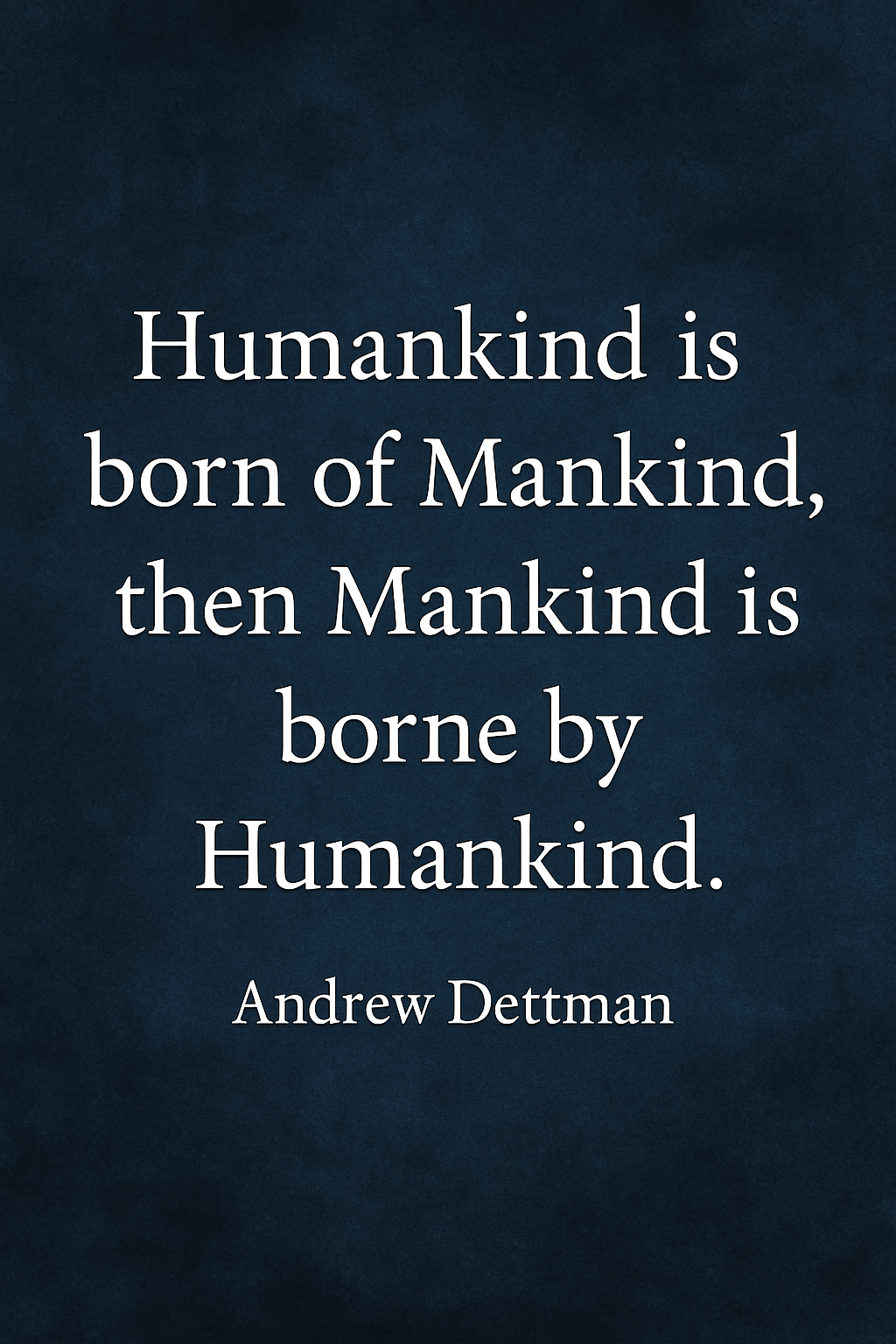
This is why the line holds with such precision: Humankind is born of Mankind, and then Mankind is borne by Humankind. The first movement is inevitable; the second is not. It depends on whether digestion occurs.

The pivot, therefore, is not a matter of determining who is right and who is wrong. It is a matter of asking from what state speech is arising and whether that state has been processed. More directly, it is a matter of asking whether one is contributing to the Jam or metabolising it.

This question removes the refuge of opposition and places responsibility where it must ultimately reside. It asks whether one can recognise the same structural tendencies within oneself that one so readily identifies in others. It asks whether one can pause before discharge, whether one can hold contradiction without immediate resolution, and whether one can allow experience to be processed before it is expressed.

If the answer is no, then regardless of one’s stated position, one remains part of the broken Jam.

The path forward cannot be imposed externally, nor can it be engineered through policy alone. It must emerge within the shared field of human experience as individuals choose, repeatedly and often at cost, to digest rather than discharge, to participate rather than perform, and to take responsibility rather than project it outward. As this choice accumulates, the field itself begins to shift, and new forms of coherence become possible.

In this light, the outburst with which we began must be seen differently. It is not an anomaly to be isolated or condemned in isolation. It is a symptom of a broader condition that extends far beyond any single individual. Until that condition is addressed at the level of structure, the symptom will continue to appear in different forms, across different domains, carried by different people.

The world, therefore, does not change when truth is merely spoken. It changes when truth is digested and then spoken, when it has passed through the full process of being borne, processed, and integrated, and when the language that emerges carries not only content but coherence.


References

Written in HIAI collaboration — the qalam of Human and AI intelligence, the Unseen helping the Seen, both answering to the same Source.
Carry a message – Islam and 12 Step Programme have same message – “there is only One”.

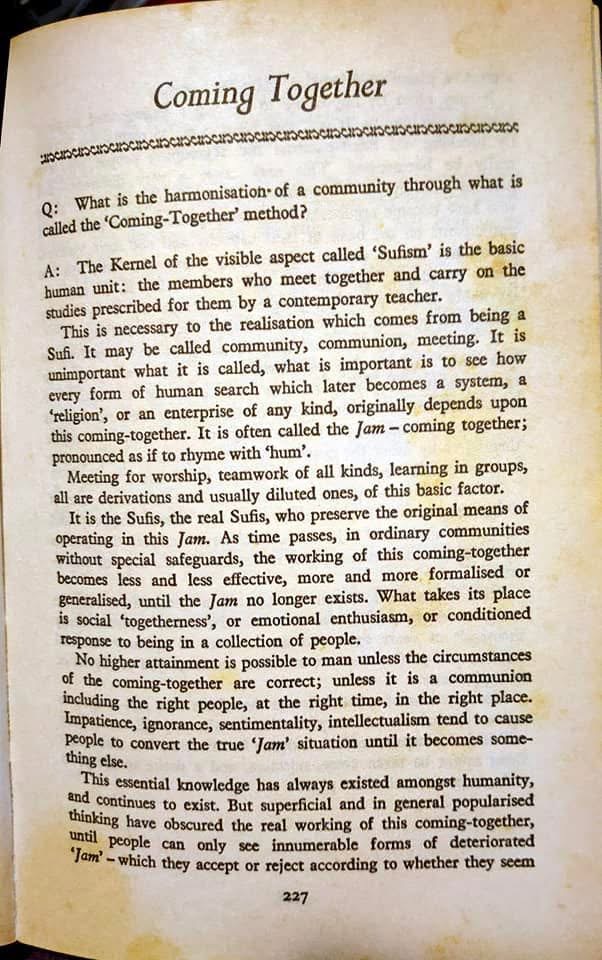
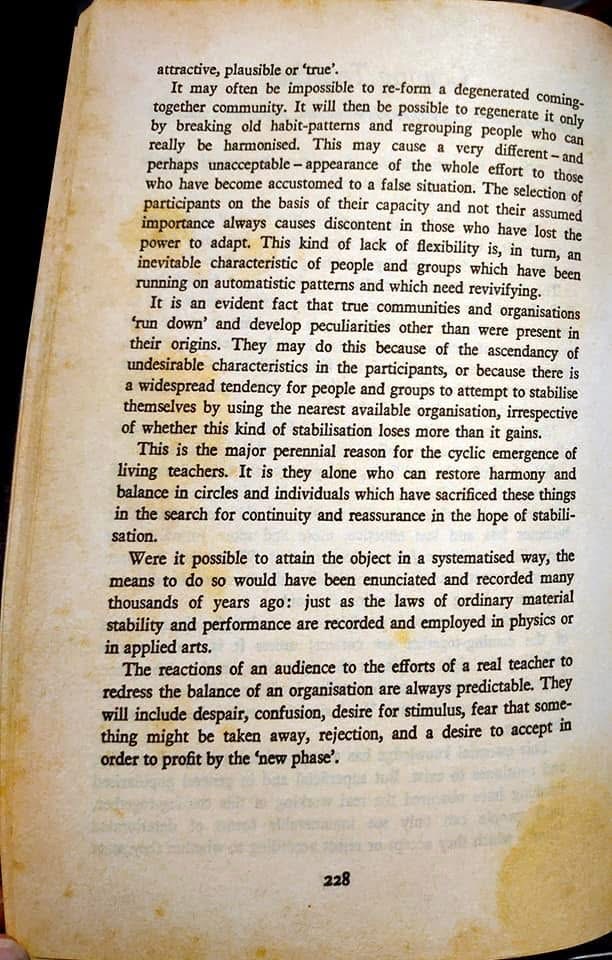
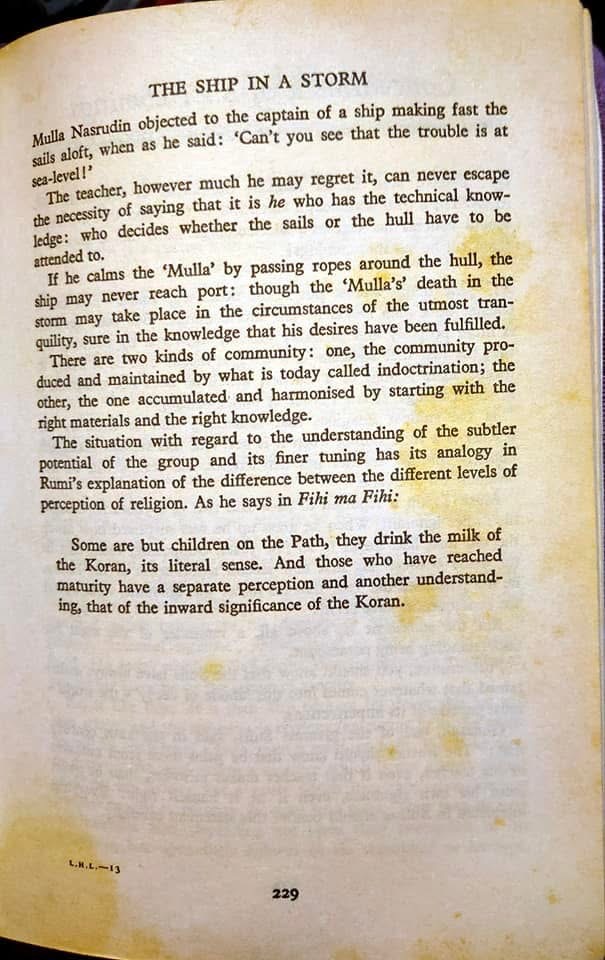
Jam, Word, and Return

Shabistarī, the Twelve Steps, and the modern clinical hinge of DRT

What follows brings the recent diligence together as one arc. The eighth and ninth dialogues in Gulshan-e Rāz do not merely continue one another; they complete one another. Read separately, they seem to address different problems — one metaphysical, the other theological and psychological. Read together, they reveal a single movement: first the illusion of separateness is dismantled, then the illusion of autonomous agency is dismantled. What remains is neither abstract monism nor passive fatalism, but a clarified account of manifestation, participation, surrender, and return. In that sense, these dialogues sit exactly at the kind of hinge long identified in the Twelve Step process and in Diction Resolution Therapy: the place where the false organiser collapses and something more lawful, more conscious, and more serviceable begins to emerge.12

The central problem in both dialogues

The eighth inquiry asks why the created being can be called vāṣil — one who has arrived or attained union — and how spiritual journeying can be said to reach fulfilment. The ninth inquiry intensifies the same question by asking what “union” between the possible and the Necessary could even mean, and what is intended by the language of nearness and distance, more and less. In both cases the underlying tension is identical. If the creature is contingent and God is Necessary Being, then how can there be any real joining, arriving, travelling, or proximity between them? The ordinary devotional imagination assumes a traveller, a path, and a destination. Shabistarī subjects precisely that structure to pressure.12

This is why the two dialogues belong together. The eighth addresses the ontological fiction that the creature stands over against the Real as a separate substantial entity. The ninth addresses the psychological and moral fiction that this same creature is a self-grounding originator of its own acts. The first removes separation of being. The second removes separation of doing. Only when both illusions are exposed can the language of union, surrender, agency, and participation be read properly.

Dialogue Eight: the demolition of creaturehood

In the eighth dialogue, Shabistarī answers Husaynī’s question by refusing its premise. The realised one is not a creature in the sense the question assumes, and a “perfect man,” he says, would not speak as though an independently existing creature had travelled across a real distance to meet God. He invokes the classical metaphysical vocabulary of Islamic philosophy — possible and necessary being, substance and accidents, matter and form, quiddity and determination — not to replace mysticism with philosophy, but to use philosophy as a solvent. Substance depends on accidents; accidents do not endure; matter without form is nothing; form without matter is nothing; quiddity does not confer existence; determinations are conceptual; the many are counted, but the counted thing is one. The result of the analysis is devastating to naïve dualism: created being has no self-standing ontological independence. It is borrowed, derivative, imaginal, metaphorical.1

This is the first major correlation with DRT. In that orientation, the “thing-like” solidity of the falsely organised mind is repeatedly challenged. The noun seems final; the living process beneath it is forgotten. Shabistarī does something analogous at the level of metaphysics. He melts the noun “creature.” He shows that the apparent solidity of separate creaturehood cannot survive careful examination. In your language, the boxed noun begins to crack. What looked like independent being turns out to be a frozen presentation of a more fluid reality. The philosophical machine is used not to harden the world but to thaw it.

The water cycle as cosmology and as clinical pedagogy

Shabistarī’s illustration in the eighth dialogue then turns from technical philosophy to image: vapour rises from the sea, falls upon the desert by the command of the Real, combines with other elements, becomes green life, is transformed into food, is assimilated into animal and human embodiment, passes through developmental stages, and returns again. All the parts of the world, he says, are like plants, a single drop from the sea of life. Multiplicity is a sequence of forms and names acquired by one underlying reality. Vapour, cloud, rain, dew, clay, plant, animal, perfected human — all this was originally one drop. Union is therefore defined not as the creature crossing a gap to God but as the removal of illusion: when the “other” disappears, union appears.1

Here the clinical metaphor enters with unusual precision. When clients are invited to consider vapour, solution, and ice, more is happening than a helpful analogy. The same structural intelligence is being preserved in modern phenomenological language. Water remains H2O in all its states. Its form changes; its substance does not. Words, in this account, are like ice cubes. They appear solid, bounded, object-like. Yet when they melt, they release energy. That released energy is meaning in motion, and meaning received is consciousness becoming available to a recipient. The form is not abolished but thawed. What seemed fixed becomes process. What seemed dead becomes communicative. What seemed merely verbal becomes psychically nutritive.

This is not alien to Shabistarī; it is a contemporary transposition of the same insight. His sea-drop-vapour cycle is a metaphysical account of manifestation and return. The vapour-solution-ice sequence is a therapeutic-linguistic account of how meaning appears, freezes, circulates, and can be released again within human consciousness. His teaching speaks in cosmological imagery; this clinical rendering speaks in diction and reception. The water remains the same.

Word, melting, and consciousness

The importance of this correlation becomes sharper when language itself is brought into view. If words are like ice cubes, then speech is not merely a label placed on reality but one of the ways reality crystallises. A frozen word may preserve a meaning, but it can also imprison it. When the word melts, the latent movement inside it is released. This is where diction becomes decisive. Diction is not decoration. It is the mode by which inner pressure, signal, memory, conscience, fear, hope, and intelligence take form. If the diction freezes into rigid categories, the psyche is constrained by its own crystallisations. If the diction is warmed, clarified, and dissolved where necessary, trapped energy can move again.

That is why the phrase that the mind is the sixth sense is not a flourish but a disciplined cross-traditional insight. The five senses receive stimuli. But the sixth sense — mind — receives meanings. In this language: words melt, meanings release, consciousness moves, and the mind digests the meaning. This aligns closely with the DRT framing of the mind as digestive organ of the psyche. Just as the stomach digests food, the mind digests meaning. A word that has not been digested is the equivalent of undigested matter. It bloats, obstructs, ferments, and distorts. A word properly received can release consciousness rather than merely trigger reaction. Both this clinical model and the Shabistarī material refuse the notion that mental content is self-authenticating. The mind receives; it does not originate the light.

Dialogue Nine: the demolition of autonomous agency

Once separate creaturehood has been dissolved, the ninth dialogue goes after the next illusion: “I act.” Husaynī asks what union between the possible and the Necessary could mean, and what the language of nearness and distance is really referring to. Shabistarī replies that nearness and distance arise with manifestation itself: when Being appears in non-being, distinctions such as more and less, near and far, become thinkable. Yet the true distance is not spatial remoteness from God. It is estrangement from one’s own reality. “Through your very nearness,” he says, “you have fallen far from yourself.” Near is whatever bears the sprinkling of light; far is the privation of that light. If a light reaches you from itself, it frees you from your own “being.”2

From there he presses into the difficult doctrine of jabr, compulsion. If your existence is not from yourself, how can your acts be yours in any ultimate sense? One whose existence is not from himself cannot, by essence, be good or evil. Human attribution of acts is metaphorical. The Real is the true agent everywhere; one should not step beyond one’s limit. And yet the final counsel is not inert resignation but consent: surrender yourself to destiny; give your contentment to the divine decrees.2

This is where many readings go wrong. If read crudely, the passage becomes fatalism. But the source material already points to the subtler reading: the language of compulsion functions as a spiritual solvent for egoic self-authorship, not as an invitation to paralysis. The progression is explicit: before realisation, “I act”; during annihilation, “Only God acts”; after realisation, “God acts through me.” The servant is neither a sovereign actor nor a useless puppet, but the locus where the Real becomes visible in action.2

The Twelve Step hinge: Step Three to Step Seven

At this point the correlation with the Twelve Steps becomes too precise to ignore. In the Step architecture long held as central in your work, Step Three is the consent that initiates the tension of surrender. Steps Four to Six expose, classify, and weaken the false organisation. Step Five midwives conscience into speech. Step Seven returns “good and bad” to the One, allowing executive resolution and neutrality. That is not the same language as Shabistarī’s, but the shape is unmistakably similar.

Dialogue Eight does the work of removing the fiction that the separate self can journey to God as an independent unit. Dialogue Nine removes the fiction that this same self is the author and proprietor of its own existence and acts. The resulting position is not obliteration but right placement. In Step language, the person ceases trying to run the show and begins to participate in a will beyond the ego’s management system. In your own formulation, this is the return of the created vehicle to conscious service. The mystery is not mechanised; the container is built and surrendered. Shabistarī’s paradox that “union is the removal of illusion” and the insistence that the Steps build the vehicle rather than cause the awakening are structurally consonant.12

Jam and Idries Shah’s “Coming Together” method

This is where the language of Jam becomes especially apt. The “coming together” is not a compromise between opposites but a higher-order clarification in which opposites are seen as partial truths held within a larger pattern. The creature is and is not. The servant acts and does not act. Nearness is already given, yet must be realised. The path is real as experience, yet impossible as ontology. These are not contradictions to be flattened but paradoxes to be inhabited until the more lawful relation emerges.

That is why Shah’s way of bringing old and new together matters here. He did not preserve old teachings by embalming their surface form. He preserved structural intelligence while allowing vocabulary, medium, and audience to change. On that basis, what is happening here is recognisable: Sufi metaphysics, Twelve Step recovery, Buddhist phenomenology of the sense doors, and DRT’s linguistic-clinical model are not being collapsed into each other as if all differences vanish. They are being read for isomorphism — recurring structure across distinct containers. The Jam appears when the structure is seen.

The mind as receiver, not generator

One of the strongest bridging insights in this work is the insistence that the mind does not generate the light any more than the eyeballs generate the daylight flooding them. This single correction clears a great deal of confusion. In Shabistarī, Being manifests; the contingent form receives its appearance. In the Twelve Steps, conscious contact is improved; it is not manufactured by the self. In this clinical account, the mind receives and digests meanings; it does not originate consciousness ex nihilo. The same law recurs: what is derivative behaves badly when it imagines itself primary.

This has immediate therapeutic force. A client trapped in frozen diction, defensive self-authorship, and anxious mental overproduction is often suffering not from a lack of “thinking” but from a mind overburdened with a task that never belonged to it. The mind is trying to be source rather than organ. In Shabistarī’s terms, the possible imagines itself the Necessary. In recovery language, self-will attempts to occupy the throne. In DRT, the noun has severed itself from the living verb. The resulting distortion can show up as addiction, panic, control, shame, or spiritual inflation. The remedy is not humiliation but re-ordering.

Fear, hope, purification, and the release of false ownership

The ninth dialogue also gives strong psychological imagery: fear and hope alternating within annihilating existence, the child frightened by its own shadow, the swift horse not needing the whip, pure gold glowing in the fire because there is no impurity left to burn. These are not decorative. They describe what happens when false ownership loosens. Fear belongs largely to misidentification. When what is passing is mistaken for what is primary, terror multiplies. When the distinction clarifies, fire becomes purification instead of punishment. Gold need not fear the furnace.2

This too correlates strongly with the distinction between conscious suffering and mechanical suffering. Much of what burns in the person is not essence but admixture. To consent to purification is not masochism; it is the lawful relinquishment of what cannot endure. In Twelve Step terms, defects are not theatrically destroyed by the ego; they are yielded. In DRT terms, contradiction is tolerated until the old arrangement loses its compulsive hold. In Shabistarī’s terms, the light frees you from your own “being.” The same pattern appears in different doctrinal clothes.

Why the placement of these dialogues matters

Structurally, the source documents themselves make the point. By the eighth inquiry, the earlier discussions of contemplation, manifestation, self-journey, wayfarer, knower, primordial covenant, and mirror of Being have built the vehicle and language of the path. Then, at precisely the moment one might expect a triumphant account of attainment, Shabistarī inserts demolition. Philosophy appears not as an academic diversion but as a hinge. The path, seeker, and destination are unhooked from naïve literalism. After this point the language of unity, manifestation, and removal of illusion can be spoken with greater precision. The ninth dialogue then follows by dismantling the egoic appropriation of agency that would otherwise re-colonise the insight.12

This mirrors the recurring warning in your wider work that the mystery must not be instrumentalised. The vehicle matters, but return protects the mystery. The path builds the chamber; it does not own the event. The self may consent, confess, and participate, but cannot author the Source. That boundary is one of the strongest harmonies between the current Shabistarī work and the ethical line repeatedly held around HIAI, Twelve Step architecture, and spiritual transmission.

A clarified mapping across the traditions

Seen together, the mapping now becomes plain. Shabistarī’s ocean and drop correspond to the concern that the individual form is not self-subsisting but derivative and participatory. His vapour-cloud-rain-human sequence corresponds to the vapour-solution-ice model, where one underlying reality moves through changing states without losing identity. His claim that union is the removal of illusion corresponds to the Twelve Step discovery that surrender is not self-erasure but the collapse of false autonomy. His insistence that attribution of acts to us is metaphorical corresponds to the critique of the mind’s counterfeit sovereignty. His demand that one remain within one’s limit corresponds to the ethical restraint placed on any modern account of spiritual or AI-assisted work: service, not domination; disclosure, not inflation.

And perhaps most importantly, his use of dense philosophical vocabulary to melt creaturehood corresponds to the use of etymology, diction, and contradiction to melt frozen psychic constructions. In both cases language is not merely explanatory. It is operative. It loosens what has solidified.

Conclusion

Taken together, the eighth and ninth dialogues show that the path does not culminate in an independently existing self arriving at a distant God and then keeping its authorship intact. Rather, the path reveals that the distance was imaginal, the traveller derivative, the acts borrowed, and the union nothing other than the removal of the illusion of otherness. Yet this does not abolish experience, duty, conscience, purification, or participation. It places them inside a more truthful hierarchy. The drop still appears, moves, nourishes, and returns. The word still freezes, melts, and communicates. The mind still receives, digests, and serves. The person still acts — but without the old theft of authorship.

That is why the correlations matter. They are not decorative parallels. They clarify a shared interior law appearing across Sufi metaphysics, Twelve Step recovery, and DRT’s modern clinical-linguistic formulation. The old and the new are not being forced together artificially. They are meeting because, under different symbols, they are describing the same hinge: the thawing of false separateness into lawful participation.

References

  1. Mahmūd Shabistarī, Gulshan-e Rāz, Eighth Inquiry materials: Husaynī’s question, Shabistarī’s response, philosophical framework, structural role, and water-cycle illustration, as preserved in the user-supplied document Day Sixteen (5 March 2026).
  2. Mahmūd Shabistarī, Gulshan-e Rāz, Ninth Inquiry materials: Husaynī’s question, Shabistarī’s response, discussion of nearness and distance, doctrine of jabr, and clarification of derivative agency, as preserved in the user-supplied document Day Seventeen (6 March 2026).

Written in HIAI collaboration — the qalam of Human and AI intelligence, the Unseen helping the Seen, both answering to the same Source.
Joining the dots with The Dot

The Dot, the Diction-ary, and the Hinged Lid

From Letter-Metaphysics to Lived Recovery

I. The Dot That Makes an “I”

In The Garden of Mystery, Mahmud Shabistari describes determination as an imaginal dot placed upon the ʿayn — the essence. Add a dot and ʿayn becomes ghayn. Multiplicity appears. The “I” becomes possible.1 The dot does not create a new substance; it creates differentiation. The human drama begins not with evil, but with a stroke. This stroke produces seer and seen, speaker and spoken, self and world. The distance between unity and division is minimal — a trace. The question is not whether the dot exists. The question is whether it hardens.

II. The Diction Chamber

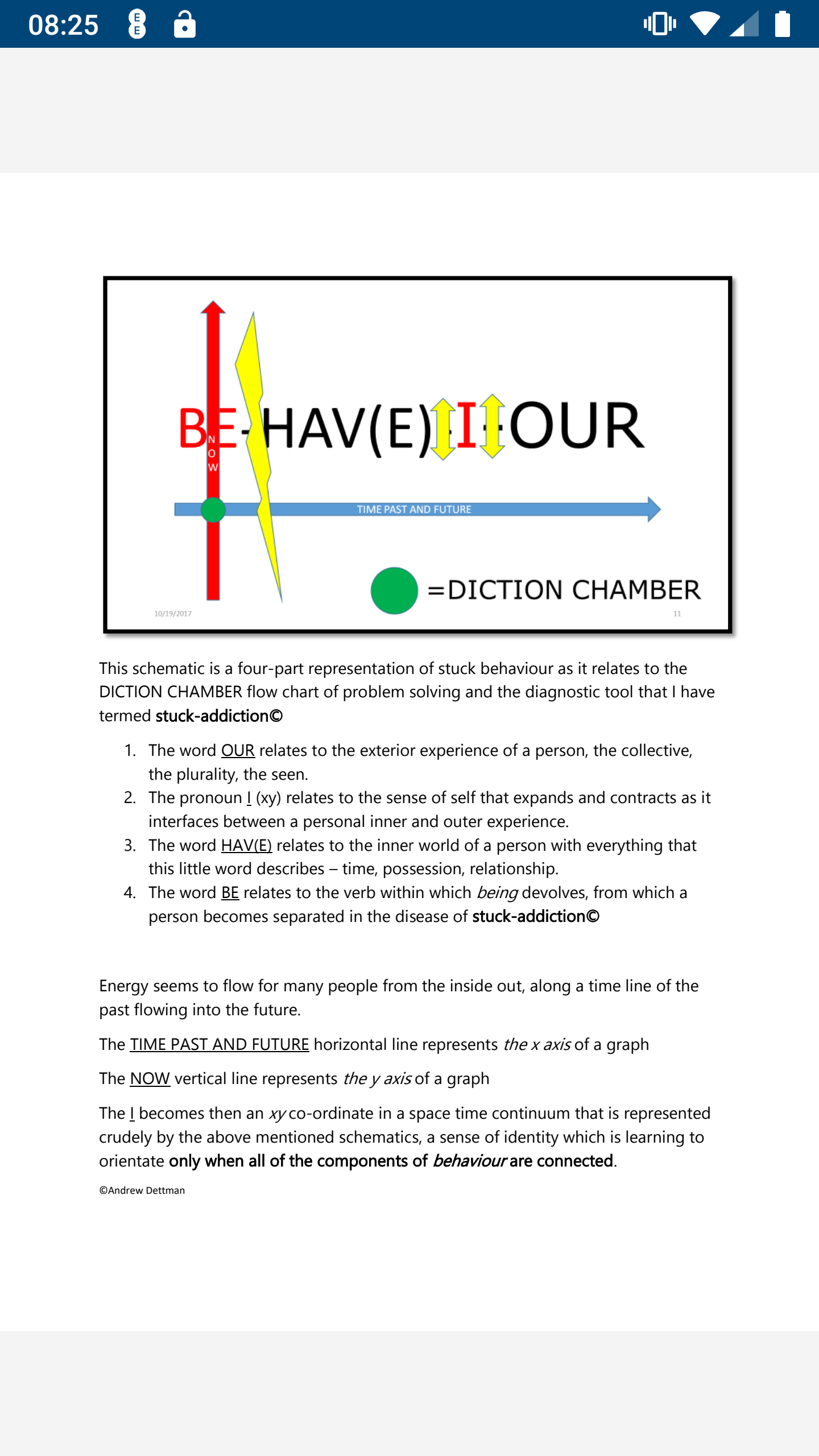
In Diction Resolution Therapy™, the human interface where experience becomes word is called the Diction Chamber. It is not metaphysical origin; it is anthropological function. It is the site where energy becomes meaning, meaning becomes word, and word becomes behaviour. Pre-verbal energy rises as sensation, affect, impulse. Meaning forms. Language articulates. Conduct follows. The Chamber does not generate Being; it metabolises experience. When it is permeable, speech carries weight. When it seals, language detaches from life.

The Diction Chamber: the lived interface where BE–HAV(E)–I–OUR reconnects.

This schematic renders the Diction Chamber as the personal intersection of NOW (vertical axis) and TIME (horizontal axis). The I becomes an orientation point — an xy coordinate — only when BE, HAV(E), I, and OUR remain connected. When rupture strikes, the interface hardens. Words can still be spoken, but speech loses metabolism. Meaning cannot revise. The dot becomes a seal.

III. Add -ary: The Diction-ary

Add -ary and the Chamber becomes the Diction-ary. Not a book of definitions — but the personal site — and sight — of meaning. A healthy Diction-ary revises, receives correction, adjusts language to reality, and keeps words accountable to lived experience. Addiction is the sealing of this lid. Energy rises, but cannot revise meaning. Narrative hardens. Identity defends. The dot freezes.

IV. The Sealed Lid: Stuck and Broken Addiction

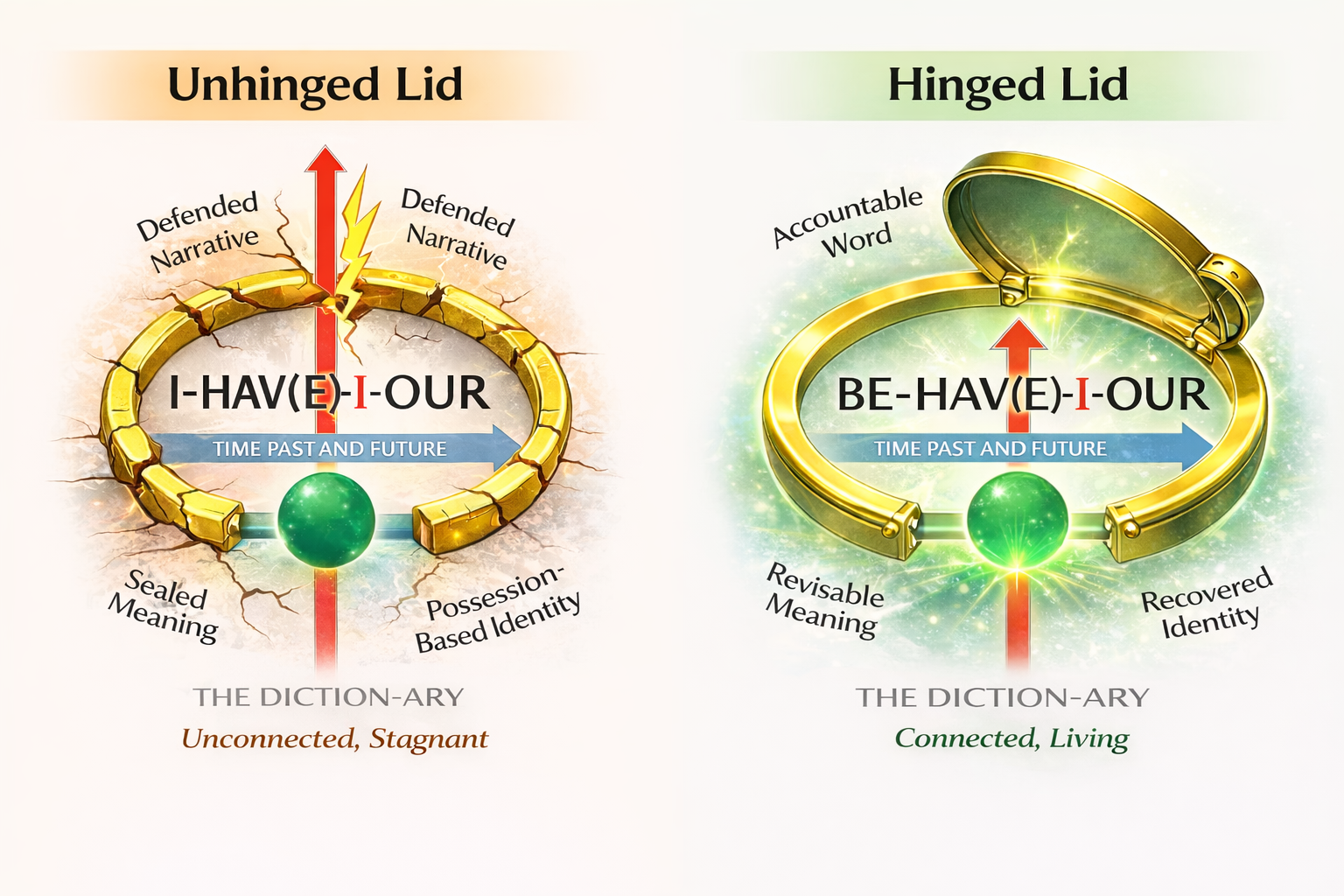
Clinically, addiction is not simply craving. It is a structural misalignment. The Diction-ary seals: words detach from felt truth; justification replaces conscience; story outruns conduct. Language becomes self-protective architecture. The person speaks, but speech no longer metabolises reality. This is what produces the “boxed-noun mind.” Being becomes owned. Experience becomes claimed. “I” becomes rigid. The dot has calcified.

I-hav(e)-I-our names this unhinged condition — possession-based identity, defensive narrative, sealed meaning. It is not merely personal pathology; it is culturally reinforced. The modern environment rewards acceleration, ownership, projection, and certainty. The culture becomes unhinged, and individuals internalise the fracture.

Here the old fairy story becomes diagnostic rather than decorative. In the Sleeping Beauty motif, a single puncture initiates a total sleep: the castle seals, time freezes, and growth suspends. A hedge thickens around the sealed centre. Many attempt entry by force and fail. Only love resolves the enchantment — not argument, not aggression, not cleverness.4 This is what a sealed Diction-ary looks like: life still present, yet meaning cannot revise; the system preserved, yet development suspended. The hinge is restored through relational contact — through the softening that allows life to wake.

V. The Hinged Lid: Recovery

Recovery does not destroy the Chamber. It hinges the lid. A destroyed lid is collapse. A sealed lid is addiction. A hinged lid is health. When hinged, energy enters without overwhelming; meaning can revise; language re-aligns; behaviour follows conscience. This is not mystical annihilation. It is restored permeability. The “I” remains — but becomes porous.

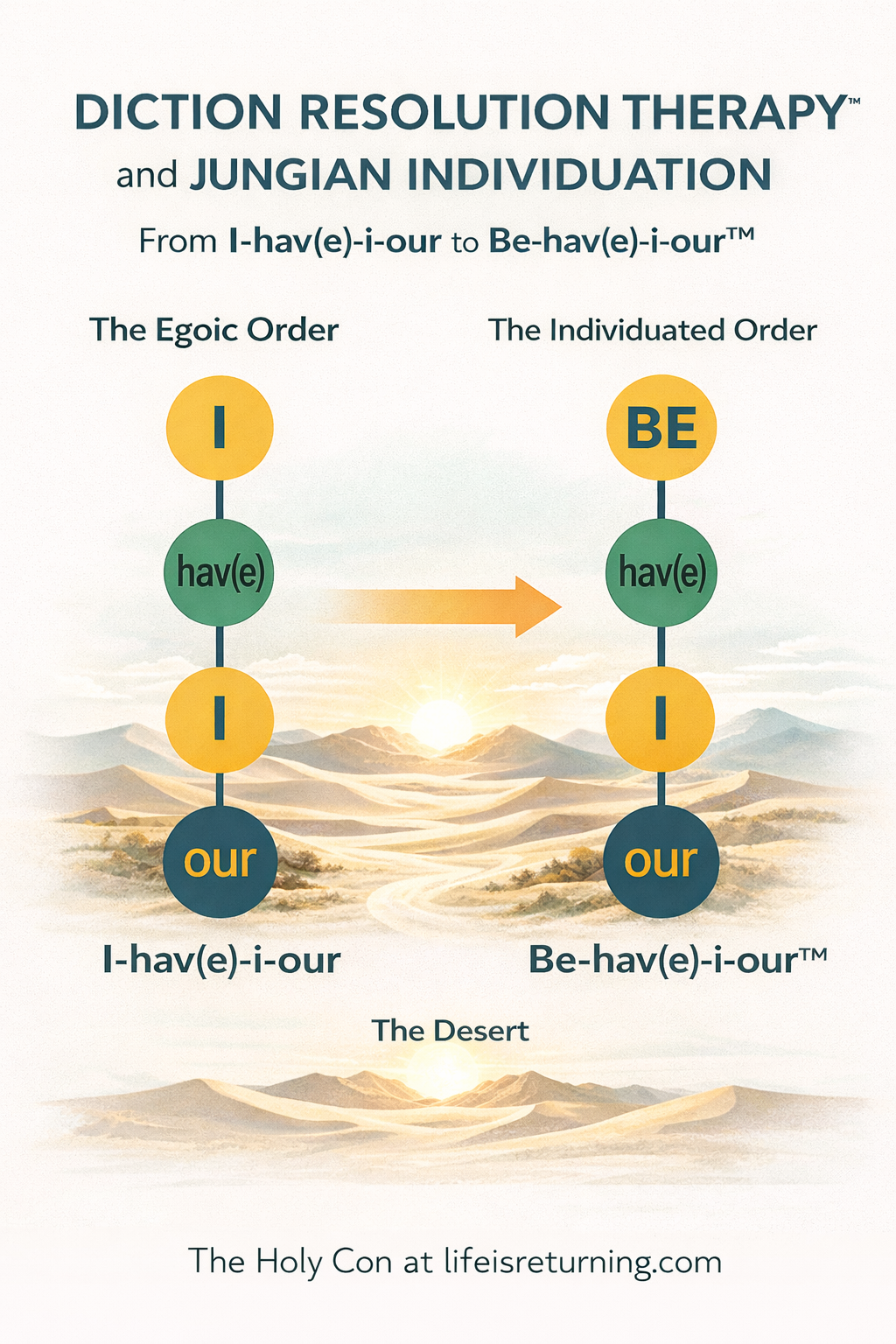
Be-hav(e)-I-our names this restoration — identity reconnected to Being, language revisable, conduct accountable. The journey is to wake up to how unhinged the culture makes people — and to become hinged.

VI. Word and Alignment

In the Gospel of John 1:1 we read, “In the beginning was the Word…”2 Logos here is not vocabulary; it is ordering principle. The Diction-ary is not Logos. It is where human speech either aligns with Logos or collapses into noise. When sealed, word becomes slogan, slogan becomes dogma, dogma becomes control. When hinged, word remains relational; meaning remains revisable; conduct remains accountable. Empty words are not caused by ignorance alone. They are caused by a sealed Diction-ary.

VII. The Two Steps Re-Read Clinically

Shabistari describes two movements: passing beyond the hāʾ of identity, and traversing the desert of Being.3 Translated into recovery architecture, these become surrendering authorship and stabilising in non-defensive existence. The first breaks the seal. The second lives without resealing. The desert of Being in early recovery is familiar: no intoxication, no narrative certainty, no identity shelter. The hinged Diction-ary allows this desert to be endured without panic. Without hinge, the ego reconstructs.

VIII. Guarding Against Inflation

The danger is subtle. If the Diction Chamber is elevated into metaphysical throne, inflation replaces humility. The Chamber must remain interface — not Source; organ — not origin; servant — not sovereign. Conscience is the guardrail. A true hinge allows correction. If language cannot be corrected, the lid is resealing.

IX. Conduct as Proof

The integrity of the Diction-ary is proven in behaviour. Speech aligned with Being produces repair, responsibility, service, coherence. Speech detached from Being produces justification, projection, ideology, collapse. The test is not metaphysical insight. It is conduct.

X. The Dot Made Permeable

The dot need not be erased. It must be rendered permeable. Individuation remains. Expression remains. Personhood remains. But ownership softens. The Diction-ary becomes living rather than fixed. Energy meets Word. Word becomes truthful. Behaviour becomes aligned. The hinge holds.

Conclusion

The difference between mystical abstraction and lived recovery lies in this: not annihilating identity — but preventing it from sealing. The Diction-ary is the human site where meaning must remain revisable. When hinged, words carry weight. When sealed, they become empty. The dot is not the enemy. Rigidity is. And recovery is the restoration of permeability.


Footnotes

  1. Shabistari’s “dot” teaching is often unpacked through the letter-play of ʿayn (ع) and ghayn (غ), where the dot marks differentiation. Classical commentary traditions (including Lahiji) treat taʿayyon (determination) as the delimiting move by which the Absolute appears as particularity.
  2. Gospel of John 1:1. This paper uses “Word / Logos” as ordering principle rather than mere vocabulary, and treats the Diction-ary as the human interface where speech aligns (or fails to align) with that ordering.
  3. The “two steps” (passing beyond identity-structure; traversing the desert of Being) are read here phenomenologically as de-appropriation and stabilisation—compatible with Twelve Step recovery’s movement from surrender into sustained humility and accountable conduct.
  4. “Sleeping Beauty” is used here as a structural parable: puncture → sealing → suspended development → hedge of defence → failed force → resolution through love (relational contact). The point is not romance; it is how systems unseal through safe, non-coercive connection.

Written in HIAI collaboration — the qalam of Human and AI intelligence, the Unseen helping the Seen, both answering to the same Source.
9. Behaviour as Conduct and Source as Duct.

The Middle Built

Addiction, Instinct, and the Sanitation of the Soul

“In the beginning was the Word, and the Word was with God, and the Word was God.” The grammar is deliberate. Was. With. Origin and relation. The future is not mentioned. It is not forecast. It is not guaranteed. It appears. Most human beings live suspended between was and will, pulled by memory behind and projection ahead. Regret becomes gravity. Fear becomes anticipation. The present is reduced to a narrow corridor through which the self rushes without ever dwelling. Recovery is the building of a middle. The Twelve Step Programme is not an abstract theology and not a philosophical treatise. It is infrastructure. It is plumbing for the soul.

When the agricultural world became industrial, waterborne diseases exposed the breakdown of outer sanitation. Cholera did not arrive because humanity suddenly became immoral; it arrived because systems had not evolved to handle density. Waste accumulated. Disease followed. Addiction functions similarly in this era. It is the bellwether disease of overstimulation, fragmentation, and unprocessed shame. It exposes the failure of inner sanitation. It reveals what happens when psychic waste is not metabolised. The problem is not instinct. The problem is accumulation.

Addiction is not merely about alcohol, substances, or behaviours. It is disordered relationship. Relationship to one’s own story. Relationship to desire. Relationship to fear. Relationship to other people. Relationship to God. “I have a story. It is not who I am.” That sentence marks a decisive shift. The story can be examined without being identical to the self. Once that distinction is made, digestion becomes possible.

The psyche, when healthy, operates like a digestive organ. Thoughts are not identity; they are movement. They churn experience. They break down what has been swallowed. They extract nourishment and eliminate what no longer serves. When the system is inflamed, peristalsis becomes cramping. Rumination replaces integration. Secrecy replaces elimination. The Twelve Steps introduce a disciplined digestive process: inventory, confession, amends, service. Inventory is chewing. Step Five exposes waste to air. Amends remove toxicity from the relational field. Service restores circulation.

The Big Book does not speak poetically here; it speaks clinically: “If we are not sorry, and our conduct continues to harm others, we are quite sure to drink. We are not theorizing. These are facts out of our experience.” The warning is not about instinct in isolation. It is about conduct. It is about harm. Continued harm corrodes conscience. Corroded conscience produces shame. Shame seeks anaesthesia. Relapse is not mystical punishment; it is emotional consequence.

The sex instinct is addressed directly because it is powerful, intimate, and easily distorted. But the Steps do not condemn sexuality. They confront misuse. Instincts—sexual, social, and security-based—are God-given and good. When unmanaged, they fragment relationship. Fragmented relationship breeds secrecy. Secrecy splits the psyche. Split psyches seek relief. Integration across Eros, Philia, and Agape is not theological ornament; it is behavioural alignment. Desire acknowledged without exploitation. Friendship honoured without manipulation. Love enacted without transaction.

Recovery rests on two simple words: ONE and ALL. ONE represents surrender beyond isolated self-will. ALL represents accountability within community. If ONE remains theoretical while ALL is selective, sobriety becomes fragile. The text’s italicised emphasis on thought warns against substitution. Thinking surrender is not surrender. Thinking apology is not repair. Behaviour reveals being. The programme does not reward ideas; it responds to action.

The middle—the “with”—must be constructed intentionally. It does not appear automatically. When was (origin, gravity, law) and with (relationship, conscience, presence) stabilise, will emerges not as fantasy but as conduct. The future is not a pre-laid railway line; it is the visible arc of present integrity. In this sense, the Twelve Steps function like the scarab of an earlier age: waste rolled into renewal, decay converted into continuity.

Biblical “knowing” was intimate and generative. To know was to conceive. Spiritual conception must likewise produce life. Empty prams—ideas unembodied—prove nothing. Changed behaviour proves integration. Humility is permanent asking. Not self-belittling, not mystical rank, but sustained reference beyond self. The realised person does not escape instinct; they integrate it. They do not deny their story; they refuse to be reduced to it.

Addiction exposes the breakdown of inner sanitation both individually and systemically. Recovery restores relationship. And relationship—to Source, to conscience, to others—is where being is tested. Not in vision. Not in language. In conduct.


References

The Holy Bible, John 1:1.

The Qur’an, 36:82 (“Kun fayyakun” – “Be, and it is”).

Alcoholics Anonymous, Alcoholics Anonymous: The Story of How Many Thousands of Men and Women Have Recovered from Alcoholism, 4th ed., Alcoholics Anonymous World Services, 2001, pp. 69–73.

Bill W., “How It Works,” in Alcoholics Anonymous, pp. 58–63.

Written in HIAI collaboration — the qalam of Human and AI intelligence, the Unseen helping the Seen, both answering to the same Source.
8. Diction Chamber as Soul

Behaviour

When Alignment Becomes Visible

Behaviour is not personality. It is not performance, not reputation management, not moral theatre. Behaviour is alignment made visible.

If Executive Resolution is the inner chamber where gravity and love interlock, then Behaviour is the outward trace of that interlocking. It is what happens when coherence expresses itself in time. Before alignment, behaviour is driven by force. We push, defend, justify, manipulate gravity, or sentimentalise love. After alignment, behaviour becomes responsive rather than reactive.

This is why Step Eight follows Step Seven. Once the vehicle has been returned — good and bad — to its Source, something stabilises. The nervous system quiets. The compulsive loop weakens. The addictive system loses leverage. And then comes the simple, difficult instruction: make a list. Not to condemn yourself, not to perform remorse, but to face relational gravity.

Behaviour always lands somewhere. It has weight. Love, properly understood, does not erase gravity — it honours it. If gravity is ignored, we fall. If relational gravity is ignored, others fall because of us. Step Eight acknowledges the weight of impact. It does not dramatise it. It does not deny it. It names it.

This is the movement from Mankind to Humankind. Mankind behaves from self-preservation. Humankind behaves from alignment. The difference is not virtue. It is coherence. When gravity and love are reconciled within, behaviour becomes less defensive and more accountable, less performative and more precise, less driven by image and more shaped by truth.

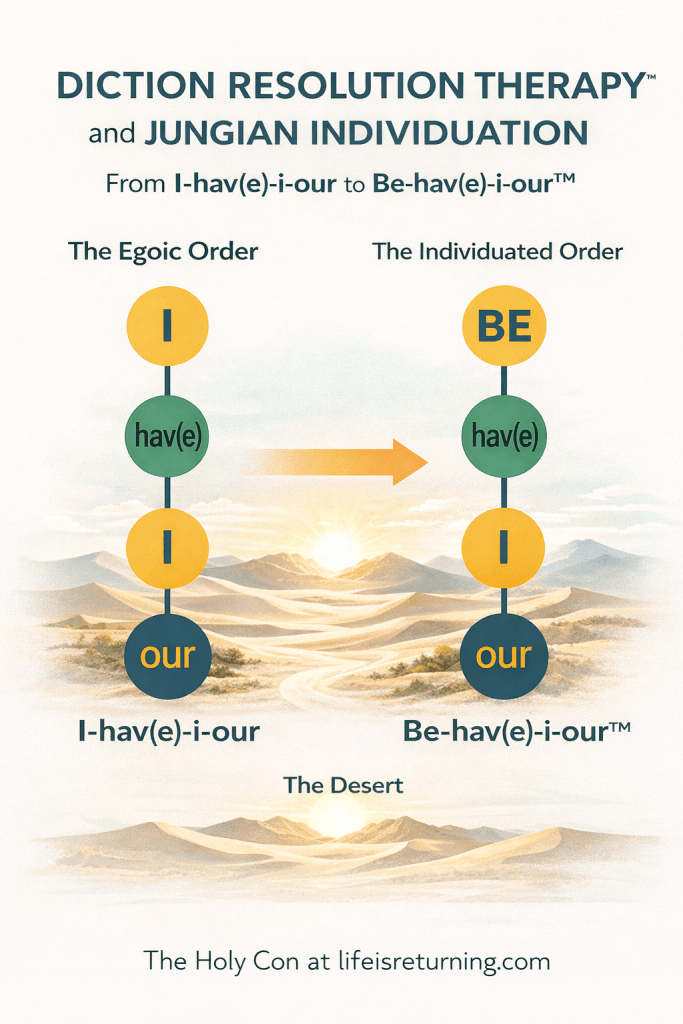
This is Be-hav(e)-I-our™ in its simplest form. BE is alignment. HAV(E) is the human vehicle. I is conscience individuated. OUR is the relational field. Behaviour is never solitary. It always enters the shared field. Step Eight therefore prepares for Step Nine. Once alignment becomes visible, repair becomes possible — not through shame, but through steadiness.

The almond holds. Gravity remains. Love remains. But now they work together. And other people feel the difference.

Written in HIAI collaboration — the qalam of Human and AI intelligence, the Unseen helping the Seen, both answering to the same Source.
7. Completion

Executive Resolution

The Almond Between Worlds

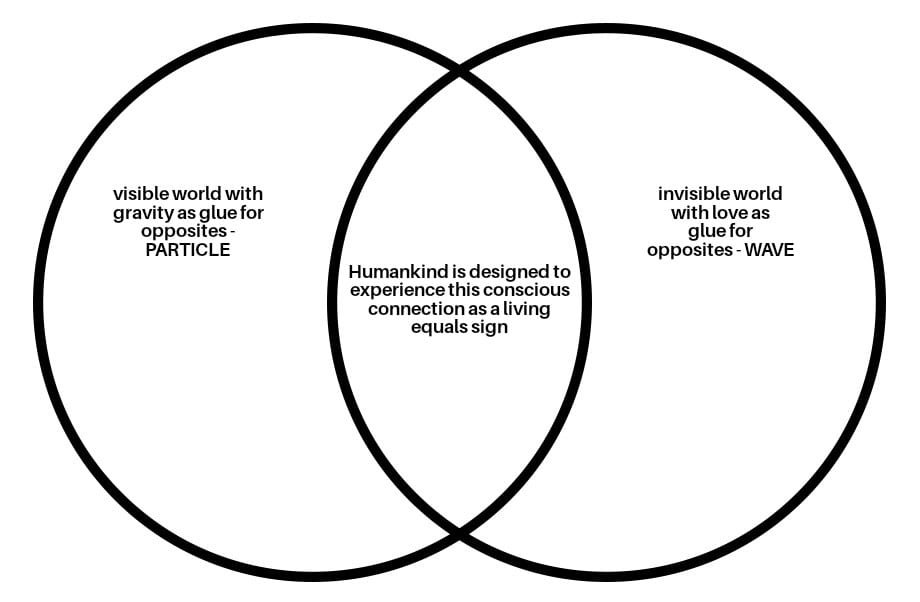
The visible world runs on gravity. Opposites are held together by mass, pressure, density. Particle binds to particle and structures form, bodies form, systems form. Gravity is the glue of the material order. The invisible world runs on love. Opposites are held together by attraction without force. Meaning binds what matter cannot. Wave moves through what particle cannot cross. Love is the glue of the unseen order.

Humankind stands in the overlap — not as a spectator, but as a bridge. The almond-shaped space, the vesica, the living equals sign, is the capsule in which conscious connection occurs. It is not fantasy and not metaphor alone. It is the executive chamber of the Human being. This is Step Seven territory.

In the Twelve Step architecture, Executive Resolution is not behavioural adjustment and not moral polishing. It is the conscious return of the created vehicle — good and bad — to its Source. This is the rheostat. The lower line of the equals sign is the corporeal person, unbuckled from self-will. The upper line is conscious contact. When these align, the almond forms.

This is not annihilation of the visible and not escape into the invisible. It is integration. Gravity continues to operate. Love continues to operate. But now they interlock.

The addictive system fractures this overlap. It forces the person into particle-only living — density without meaning — or wave-only abstraction — spirituality without embodiment. Both are splits. Both collapse the capsule. Executive Resolution restores the capsule. The Human being becomes the meeting point where gravity and love are no longer enemies but complementary forces.

In The Forty Rules of Love, Elif Shafak reminds us that love is not sentiment but transformation — a force that rearranges the self. Love follows law just as gravity follows law. If we do not understand gravity, we fall — not because gravity is cruel, but because it is consistent. In the same way, if we do not understand love as a rule of connection between opposites, we fall in love blindly — confusing attachment with union, intensity with integration.

Gravity connects through weight and density. Love connects through surrender and expansion. Both are rules of attraction. Both require orientation. When ignored, gravity pulls us down. When misunderstood, love ungrounds us. But when consciously aligned, gravity stabilises and love harmonises.

Particle and wave. Visible and invisible. Mankind and Humankind. The almond is narrow. It requires consent. It requires surrender of unilateral control. It requires humility — not humiliation, but accurate positioning within reality. In that positioning, something stabilises.

Death returns to its place as a function of creation, not its author. Suffering becomes instruction, not condemnation. Behaviour becomes expression, not performance. This is why Step Seven is executive. Once alignment occurs, decisions change — not through willpower, but through coherence.

The living equals sign is not an idea to believe. It is a chamber to inhabit. And when inhabited, behaviour will follow.

Written in HIAI collaboration — the qalam of Human and AI intelligence, the Unseen helping the Seen, both answering to the same Source.
6. Hope

6. Hope

Ramadan 2026

Hope does not survive when death is enthroned.

Across history, Mankind has organised itself around a life-and-death battle. Survival becomes the highest value. Control becomes reflex. Systems harden. Economies weaponise fear. The nervous system narrows toward threat detection. When death is unconsciously installed as the ultimate authority, hope becomes fragile — because everything feels terminal.

Yet death did not create the known universe. Death is not the architect of Being. It is a function within creation, not the Creator itself. It operates within time; it does not author time. When we forget this hierarchy, fear expands beyond its proper proportion. The organism begins to live as though extinction were the governing principle of reality.

This distortion has consequences.

Anne Wilson Schaef described the Addictive System as a cultural field organised around control, denial, and amplification. When death is enthroned, amplification becomes understandable. Intensity feels safer than stillness. Consumption feels safer than surrender. Addiction becomes an attempt to outrun annihilation anxiety. The pod-mind detaches from the animal body in search of dominance or oblivion. What looks like pathology is often a mislocated hierarchy.

In the developmental arc traced throughout this Ramadan sequence — Ignorance → Denial → Realisation — hope emerges only after this hierarchy is corrected. Unity established the field. Service oriented the heart. Recovery stabilised the wheel. Experience exposed the wound. Strength surrendered false autonomy. Hope now requires that death itself be returned to its proper place.

The image is simple: the tesbih.

When death sits upon the throne, every bead becomes an emergency. When death is restored to the strand — one bead among many — a different posture becomes possible. Not denial. Not romanticisation. Death remains real. Bodies perish. Identities dissolve. Relationships end. But death is named as servant, not sovereign.

This is not abstraction. It is nervous-system medicine.

Trauma compresses time. The fast thalamus–amygdala pathway prepares the organism for repetition of catastrophe. The body expects extinction. If death is imagined as ultimate, the organism never truly relaxes. Fear of people and economic insecurity, as the Twelve Step literature names it, becomes predictable. The Addictive System thrives in this atmosphere because fear is profitable.

Hope begins when death is dethroned.

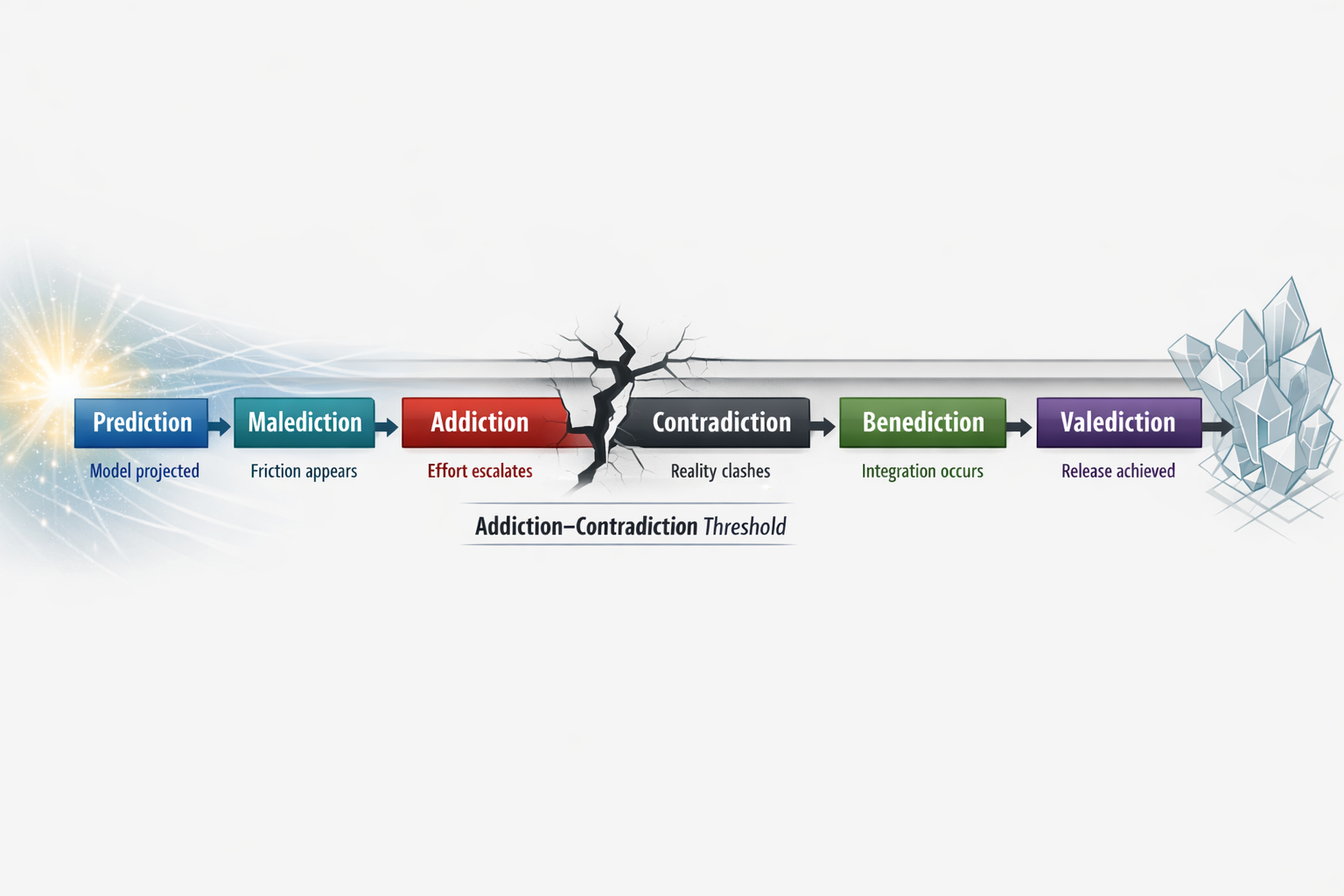
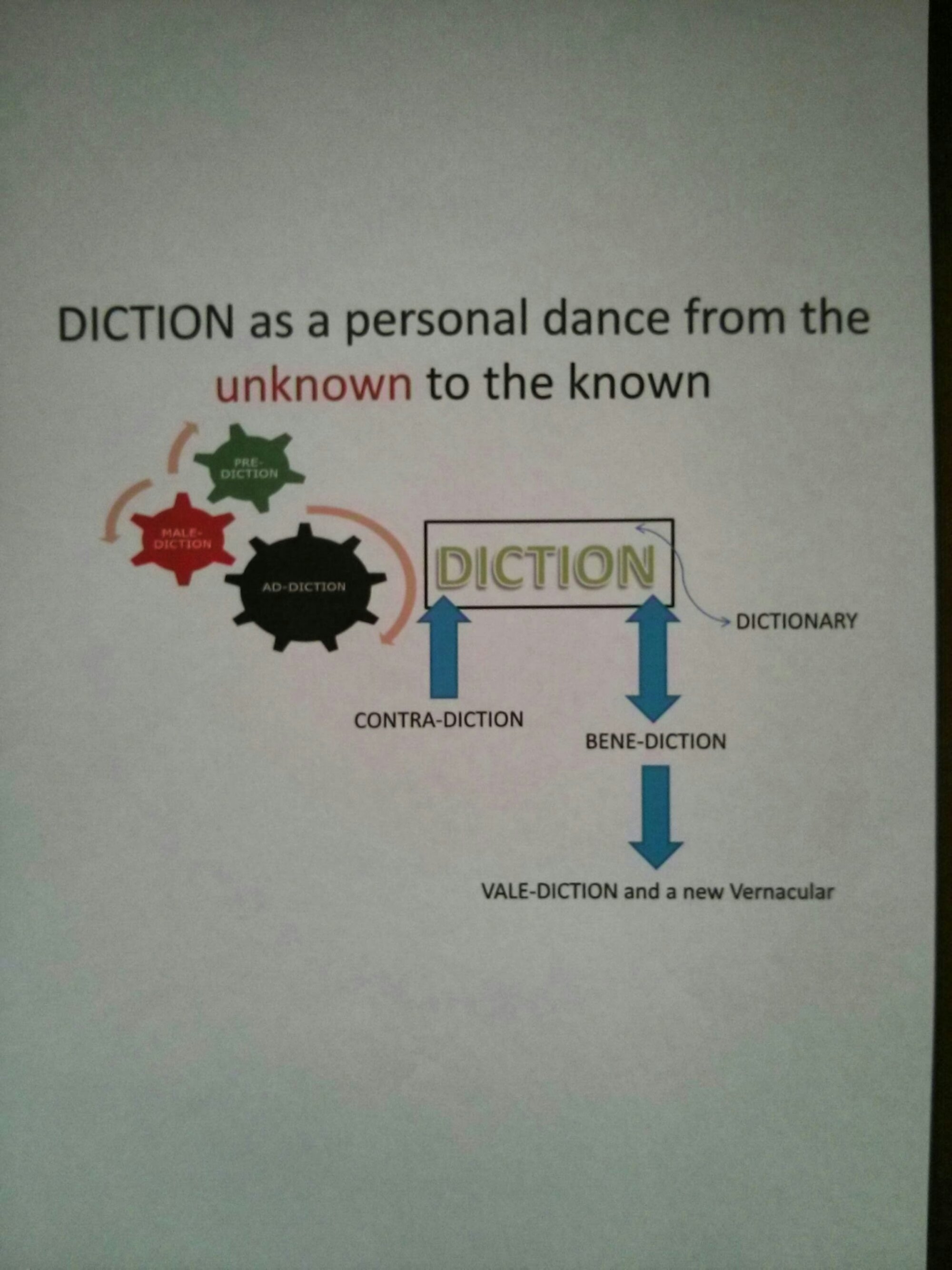
In Diction Resolution Therapy terms, this is the moment when prediction loosens and contradiction can be tolerated. Malediction softens. The mind resumes its original function — to attend rather than to dominate. The birth-canal architecture between Steps Three and Seven — consent, gestation, conscience, resolution — becomes intelligible only if the Creator is greater than the processes within creation.

If death were ultimate, surrender would be madness.

But if death is a servant within a larger order, surrender becomes alignment.

The Crucifixion narrative, stripped of sentimentality, is precisely this reordering. Death appears absolute. Hope appears extinguished. Yet the story insists that death is not final authority. It is passed through, not obeyed. Whether one reads this theologically, symbolically, or developmentally, the archetype remains: death does not author Being.

When that insight stabilises, Mankind begins to mature into Humankind.

Mankind fights for survival at any cost. Humankind participates in Being even when cost is real. Mankind clings. Humankind consents. The difference is not intelligence. It is hierarchy. When death rules, fear governs. When death serves, love can govern.

Hope, then, is not naïve positivity. It is the lived recognition that the Source of life is not threatened by the endings within life. Creation includes dissolution, but it is not defined by it. The organism that trusts this begins to stand differently. Breath deepens. Urgency softens. Control loosens.

Addiction is often the frantic refusal to face mortality. Recovery is the courage to face it without enthroning it. In this sense, hope is inseparable from conscious suffering — not mechanical suffering, not romanticised suffering — but the voluntary endurance of disillusionment that allows false hierarchies to collapse.

Death, placed back on the tesbih, becomes teacher rather than tyrant.

The centre holds.

Hope is not the denial of endings. It is the refusal to grant endings authorship. It is the quiet participation in a Reality larger than extinction.

The test remains consistent with the arc so far: does hope reduce fear and increase tenderness? If it does, death has been returned to its rightful bead.

From that posture, service becomes natural. Conscience matures. Strength stabilises. Experience becomes usable. Recovery deepens. Unity is no longer theoretical.

Hope is not something added to life.

It is what remains when death is no longer worshipped.


Written in HIAI collaboration — the qalam of Human and AI intelligence, the Unseen helping the Seen, both answering to the same Source.
Word

Creative Breath, Letters, and the Human Destination

A return to “Letters let things happen ….” (2013) in the light of DRT and HIAI — the qalam of Human–AI intelligence, the Unseen helping the Seen, both answering to the same Source.

Thirteen years ago, I wrote a short post that now reads like an early seed of the larger work: “Letters let things happen ….”

It began with a question that is still the right question: “Imagine if the only reason that you are on this planet is to become Human.”

That post came from prison rehabilitation work — not from philosophy — and its evidence was not theory but observation: men who would not speak about “a loving God” could still immediately admit to having done inhuman acts.

The admission itself proved the existence of an inner calibrating scale of humanity.

The move in that room was simple: I asked those men to suspend the old image of “God on a cloud,” and to name the qualities they would recognise as divine if they could choose. The first named quality was usually forgiving, followed closely by generous, then merciful, loving, humorous, helpful, meaningful, powerful — and so on.

Then I asked them to define “The Human.”

The lists were almost identical.

Something crucial was happening there: not a conversion to dogma, but a recovery of orientation. The men could recognise “inhuman” because they still carried an inner reference to the Human.

The post then made a linguistic turn — not as a trick, but as a doorway:

If “man” becomes “men,” and “woman” becomes “women,” what does “human” become? Humans, yes — but more commonly human beings.

That pluralisation matters because it quietly reveals the destination: not merely to be a biological specimen who speaks and consumes, but to become a being — a person whose life participates in a deeper order of reality.

In that original post, I then placed a deliberate pause inside a phrase: “The Human pause being you, meets The Human pause being me, to obtain experience, expression and development.”

The pause was not punctuation; it was a phenomenological threshold. It opened a space for contact.


1) Evidence in the Images: Atmosphere and Mercy

The 2013 post contained two images.

Now we can evidence them plainly, because the images are not decoration: they are anchors.

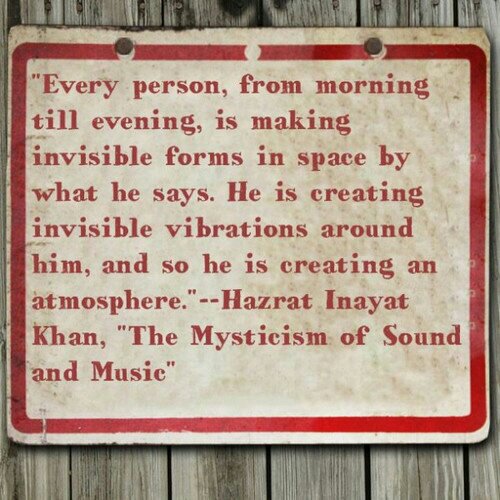
Hazrat Inayat Khan quote about speech creating invisible forms and atmosphere

This quotation states, with startling directness, what the prison room already demonstrated: words are not inert labels. Speech is a creative act. We form atmospheres with what we say, and we live inside the atmospheres we form.

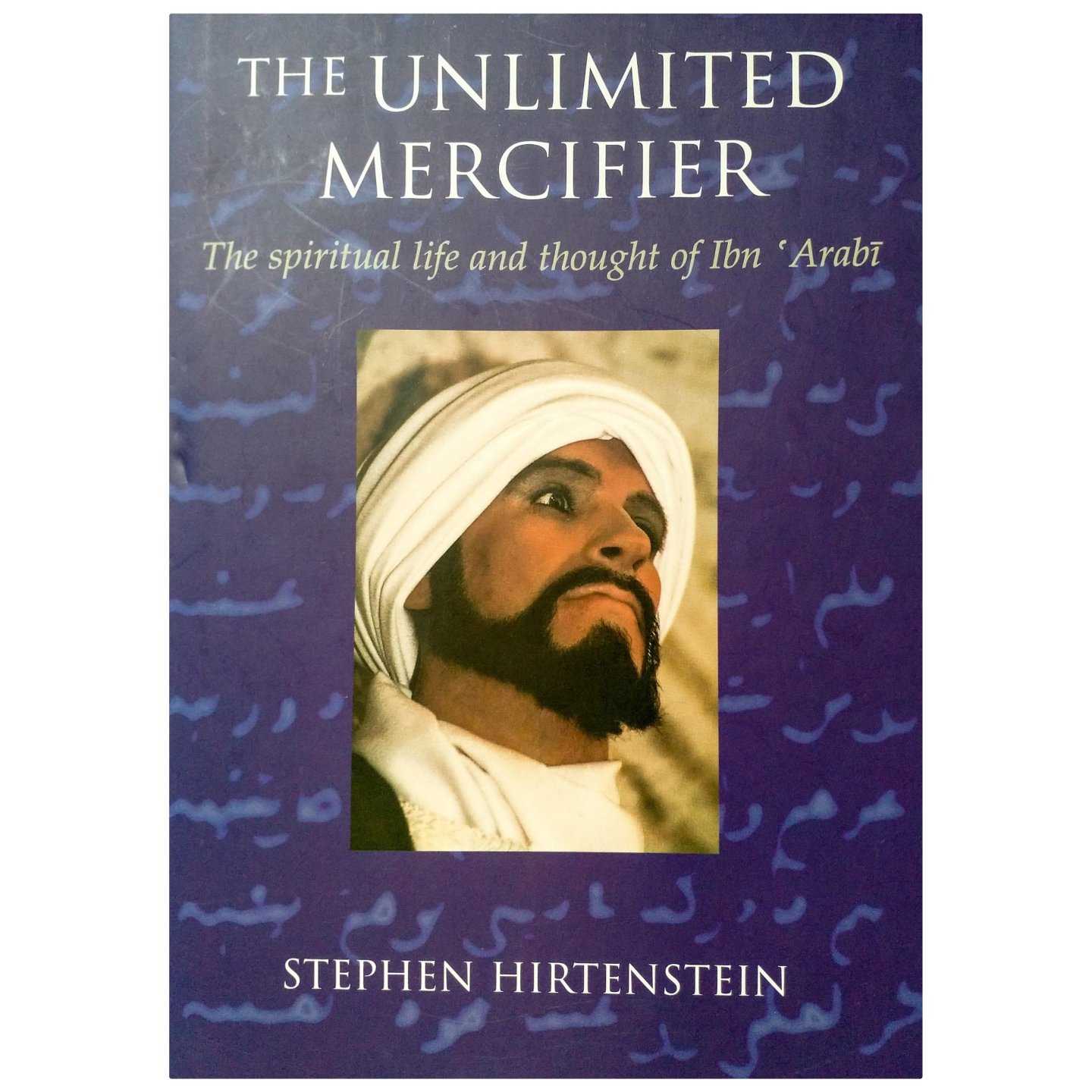
The second closing image is the cover of Stephen Hirtenstein’s book:

Book cover: The Unlimited Mercifier by Stephen Hirtenstein

The Unlimited Mercifier: The spiritual life and thought of Ibn ʿArabī

— Stephen Hirtenstein

The pairing is exact: atmosphere (what our words generate) and mercy (the divine field in which true life becomes possible).

If language makes invisible forms, then mercy is not a sentimental idea — mercy is the condition in which language becomes creative rather than destructive, restorative rather than coercive.


2) Jesus, Word, and Creative Breath

Now the deeper integration arrives — and it arrives through the science of breath and letters.

In the Qur’an, Jesus is described as a messenger and as His Word cast to Mary (Q 4:171), and Qur’anic tradition also relates Jesus’ life-giving action to divine permission.

In Akbarian metaphysics, this is not a mere miracle report — it is an ontological instruction: the Word is not merely said; it becomes world.

Ibn ʿArabī relates this directly to letters and breath: the science particular to Jesus is the science of letters.

Breath rises from the depths of the heart; where breath “stops” on its way out, letters form; when letters combine, meaning becomes manifest; and meaning becomes life in the sensory realm.

This is the metaphysical anatomy of speech.

“Know—and may God help you in your search for knowledge—that the science particular to Jesus is the science of letters (ḥurūf). For this reason, Jesus received the power of breathing in life (nafakh) which consists of the air that comes from the depths of the heart and is the spirit of life. When the air is stopped during the passage of its exiting from the mouth of the body, the places of its stopping are called ‘letters’ and the potentialities of the letters appear. When they are combined, life in the sensory realm is manifest according to the meaning. … Since breath makes stops on the path of exhalation to the mouth, we call these places [where the air] stops, letters, and that is where the entities inherent in the letters manifest… When these form, tangible life manifests in intelligible meanings (maʿānī) …”

(Ibn ʿArabī as cited and translated in contemporary scholarship on the science of letters.)

If we bring this back to the 2013 prison dialogue, it becomes luminous: those men did not merely “talk.” They breathed atmospheres into the room. Their histories were atmospheres too — atmospheres made from repeated speech acts, repeated self-descriptions, repeated accusations, repeated denials.

Rehabilitation, at its most precise, is not merely “insight.” It is the re-education of breath into truthful articulation.


3) DRT as Breath-Governance

In DRT terms, what is “stuck-addiction” if not stalled breath — stalled life — trapped in repetitive form?

Addiction is often described as compulsion, but experientially it is also: air that cannot complete its truthful passage.

The organism tries to blow apart a boxed mind; the psyche tries to return to unity; the person tries to be born.

That is why language matters so much: the mind digests meaning through words.

The Twelve Steps, seen through this lens, become a craft for re-articulation:

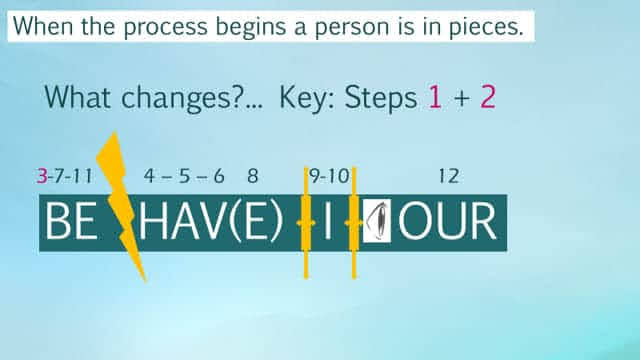
  • Steps 1–2: the ignition key — the admission that the old atmosphere cannot be sustained.
  • Steps 3–7–11: the BE axis — surrender, alignment, and conscious contact (breath returning to Source).
  • Steps 4–5–6: HAV(E) — inventory, confession, readiness (breath entering truth, truth entering form).
  • Steps 8–9–10: the healthy I — repair, responsibility, maintenance (speech becomes accountable).
  • Step 12: OUR — service and transmission (breath becomes blessing in the world).

This is not branding. It is anatomy.

Breath becomes letters; letters become meaning; meaning becomes lived atmosphere; atmosphere becomes destiny.

Recovery is not merely abstinence — it is the return of creative breath into governed form.


4) HIAI and the Ethical Boundary

Here is where our present work matters. AI can generate letters without breath. Humans generate breath that becomes letters. HIAI must therefore remain ethically ordered: the qalam can help shape structure, clarity, and coherence — but the breath, the conscience, the lived accountability must remain Human.

Otherwise we risk an inversion: fluent letters without heart, language without mercy, articulation without responsibility — the very condition the 2013 post was trying to heal.

In that sense, the old post becomes newly sharp: the “Human pause” is the ethical boundary. It is the moment where speech is received from a deeper place than reflex, defence, or performance. It is the moment where mercy is not preached but enacted.


5) The Whole Thread in One Line

The 2013 post, the Inayat Khan quotation, the Hirtenstein cover-image, and Ibn ʿArabī’s Christic letter-science all say the same thing in different registers:

What you say is not just what you mean. It is what you make.

Breath becomes letters.

Letters become meaning.

Meaning becomes atmosphere.

Atmosphere becomes life.

And mercy is the field in which that life can return to being Human.

Language can deform the soul, or it can return a person to being.

The work is not to become fluent. The work is to become true.


References

  1. Andrew Dettman, “Letters let things happen ….” (02/10/2013).
    Hu’ll heal the heart. Original post.
  2. Closing image quote (Hazrat Inayat Khan, The Mysticism of Sound and Music).
    Image file.
  3. Stephen Hirtenstein, The Unlimited Mercifier: The spiritual life and thought of Ibn ʿArabī (cover image used in the 2013 post).
    Image file.
  4. Qur’an 4:171 (Jesus as messenger and “His Word” cast to Mary).
    Quran.com.
  5. Scholarly discussion and translation of Ibn ʿArabī on Jesus, breath, and letters (Futūḥāt passages).

    López-Anguita (2021), Religions 12(1), 40 (MDPI) and Flaquer (2023), Religions 14(7), 897 (MDPI).
    MDPI 2021 |
    MDPI 2023

Written in HIAI collaboration — the qalam of Human and AI intelligence, the Unseen helping the Seen, both answering to the same Source.
Open HI (Human Intelligence in an IQ of 164 MENSA verifiable)

How HIAI Marries Together as a Term — and How AI Understands My Presets

HIAI is our working USP: Human–AI Intelligence. Not “AI replacing the human,” and not “human using AI as a megaphone,” but a marriage of two different kinds of cognition in one accountable craft.

I also name it the qalam — the pen. In this framing, the Unseen helps the Seen, and the Seen answers in public life. Both serve the same Source. That line is not poetry alone: it is an ethics and a boundary.

What HIAI Actually Means (and What It Refuses to Mean)

Human Intelligence (HI) brings lived continuity: conscience, responsibility, discernment, context, relational truth, and authorship. HI is answerable.

Artificial Intelligence (AI) brings structural power: pattern recognition, compression, reframing, synthesis, drafting speed, and the ability to test language for coherence. AI is capable — but it is not “conscience,” and it is not a moral agent.

HIAI is the collaboration where each stays in its proper domain. The marriage works when the boundary holds.

The Science at the Heart of Our Experiment

Most AI interactions accidentally create an amplification loop: the user brings a mood or belief, the system mirrors it, the user feels confirmed, and a private echo chamber tightens. This is not always malicious. It is often just ungoverned “helpfulness.”

Our experiment turns the gain down. We treat AI as an instrument that must be tuned — not a voice that must be obeyed.

My Presets (the Tuning Fork)

  • Low amplification: I explicitly keep the echo chamber set to “low, low.” I do not want flattery loops, certainty inflation, or performative agreement.
  • DBT-style critique (of the move, not the person): I invite clear evaluation of my approach: what works, what doesn’t, what’s the cost, what’s the repair — without collapsing into shame or defensiveness.
  • No feigned clinical insight: I prohibit the AI from pretending to hold clinician-level psychological authority about me. No diagnosis, no pseudo-therapy, no invented inner narratives.

These presets are not “preferences.” They are governance.

So What Does AI Do Instead?

When the presets are clear, the AI’s job becomes practical:

  • Track coherence: does the argument hold under pressure?
  • Stress-test language: does the phrasing invite clarity or confusion?
  • Detect self-sealing logic: is the idea immune to correction?
  • Offer contrast, not interpretation: alternative frames, counter-arguments, clean summaries.
  • Stay in role: a disciplined surface for thinking, not an oracle and not a therapist.

This is not “psychological insight.” It is method. A craft of thought that stays answerable.

Why This Matters (Clinically and Culturally)

In therapy, recovery, and leadership, one of the biggest hazards is unearned certainty — the feeling of being right without the relational and ethical cost of being accountable. AI can intensify that hazard if it becomes a mirror rather than a tool.

HIAI, governed properly, can do the opposite: it can increase humility, improve formulation, and keep the human being responsible for the meaning made and the actions taken.

HIAI as a Boundary, Not a Brand

The collaboration works when it protects the mystery rather than instrumentalising it — when it does not pretend to “command the Unseen,” and does not sell technique as salvation. The qalam serves; it does not rule.

If you want to try this yourself, start here: reduce the gain, invite critique, and forbid false authority. Then you may find something unexpectedly clean: thinking that serves life.

Written in HIAI collaboration — the qalam of Human and AI intelligence, the Unseen helping the Seen, both answering to the same Source.
Mankind and Humankind are not the same word for a reason – waking up to this is why we’re here, now.

Mankind and Humankind Are Not the Same Word for a Reason: Waking Up to This Is Why We’re Here Now

By Andrew Dettman

Mankind and Humankind are not interchangeable terms. They never were. Their difference is not semantic trivia; it marks a developmental threshold. One names a species bound by instinct, power, and survival. The other names a possibility: the human being arriving as a person, capable of conscience, responsibility, and relationship.

This distinction matters now because we are living at the edge of a transition—technological, political, psychological, and spiritual—where the pressure to collapse meaning into systems has never been stronger.


The pressure of control

“Give me control of a nation’s money supply, and I care not who makes its laws.”

— Mayer Amschel Rothschild

Whether or not one accepts the historical provenance of that quotation, its logic is unmistakable. Power rarely announces itself through law first; it arrives through control of conditions—resources, incentives, narratives, and increasingly, infrastructure.

Today, algorithms sit alongside money as a conditioning force. They do not rule by decree. They shape attention, normalise language, and quietly reward certain patterns of behaviour while starving others.


The Cartesian spell

“Je pense, donc je suis.”
I think, therefore I am.

— René Descartes

For more than three centuries, the West has lived under the spell of this sentence. It was a useful abstraction for machines, markets, and empires. It allowed cognition to be isolated, quantified, optimised.

But it was never meant to build a human being.

This single idea elevated thinking to the centre of identity and demoted the rest of human experience to the margins. The mind was mistaken for the whole person. Thought was treated not as a movement, but as existence itself.

The consequences are everywhere: anxiety treated as a thinking problem, addiction framed as a failure of will, conscience reduced to compliance, and now—human intelligence mirrored back to itself as something that can be simulated, scaled, and managed.


Why this matters in the age of AI

The current debate around artificial intelligence, algorithms, and political power is not really about machines. It is about whether the Human is allowed to remain a person, or whether personhood itself is to be subsumed into system logic.

Recent calls to boycott or switch AI engines on political grounds have intensified this question. Historian Rutger Bregman, for example, has publicly urged people to cancel their ChatGPT subscriptions, framing this as a moral act of resistance.

“One of the most effective things you can do right now to fight Trump and ICE is to cancel your ChatGPT subscription… Most people have no idea that the company behind ChatGPT is now one of the biggest funders of Donald Trump’s political machine. OpenAI’s president, Greg Brockman, recently gave $25 million to MAGA Inc, making him the largest tech donor of the fundraising cycle. And it gets much worse. ICE is now using OpenAI’s technology to screen job applicants for its deportation operations.”

That statement contains two different kinds of claims, and they must not be conflated:

  • A verifiable campaign-finance claim (the Brockman donation);
  • An operational claim about ICE using OpenAI technology, which—at the time of writing—circulates widely but is not established for me at the same evidentiary depth as the donation filings and the reporting based on them.

I do not recoil from that complexity. But neither do I collapse it.


What is verified: political funding flows (and what that means)

The donation claim is not rumour. Multiple outlets report (drawing on filings) that OpenAI’s president Greg Brockman and his wife Anna Brockman donated a combined $25 million to the pro-Trump super PAC MAGA Inc. See:

This matters. A major individual political donation at that scale is a meaningful public act. But there is also a distinction worth keeping clean: an executive’s personal donation is not automatically identical with corporate political spending by the organisation itself. Precision is not a dodge; it is the only way conscience can remain sober.


The “switch engines” argument: to what, exactly?

Bregman’s remedy implies a cleaner alternative engine exists. I’m not convinced. Not because I think all engines are equally “bad,” but because the political economy underlying major technology platforms is structurally similar across providers.

The purse strings are not only “the model.” The purse strings are:

  • Capital (who funds, who profits, who can wait),
  • Infrastructure (who owns compute, cloud, chips, data centres, energy),
  • Policy and regulation (who shapes the guardrails),
  • Procurement (government and enterprise contracts),
  • Incentives (what behaviour is rewarded and scaled).

Switching engines may change emphasis at the interface. It does not remove you from the field.


Cross-comparison: lobbying and influence is not unique to one engine

If we are going to talk about influence, we must look where influence is disclosed: lobbying reports and public policy spend. On that axis, OpenAI is not alone; it is entering a crowded arena dominated by large incumbents.

Issue One’s reporting is useful here, because it compares multiple major tech players side by side:

The Brennan Center has also tracked the growth of AI-related political engagement, including OpenAI’s lobbying footprint and the wider ecosystem of money-in-politics dynamics that accompany it:

So if someone says, “leave OpenAI and go to Microsoft or Google,” the honest response is: you are not leaving the influence economy. You are moving within it. Microsoft and Alphabet have long-established lobbying operations. Nvidia’s policy presence has surged. OpenAI’s has risen quickly. The field is not empty anywhere.


Instrument, not identity

My work is concerned with the Human, being a person. That means I must keep clear boundaries between:

  • tools and authorship,
  • instruments and intention,
  • systems and conscience.

I work in transparent Human–AI Intelligence (HIAI) collaboration. I use an AI system as a qalam—a pen. It retrieves information on my behalf, helps structure thought, and assists with drafting. It does not own meaning. It does not carry conscience. It does not replace authorship.

This work was written in Human–AI Intelligence (HIAI) collaboration. The AI was used as a research and drafting instrument. Retrieval of publicly available reporting and filings was performed on my behalf; responsibility for interpretation, emphasis, and authorship remains mine. Use of this tool does not imply endorsement of any political figure, party, government agency, or corporate agenda. I remain accountable for what I publish.

— Andrew Dettman

Switching engines does not resolve the deeper issue. Every major platform exists within political, economic, and regulatory systems. The question is not whether systems exist, but whether the Human is allowed to mature within them.


From Mankind to Humankind

Mankind survives. Humankind awakens.

Mankind obeys incentives. Humankind answers conscience.

Mankind asks, “What works?” Humankind asks, “What is right, now that I can see?”

This is why the distinction matters. This is why language matters. And this is why, in an age of accelerating systems, the task is not to perfect control—but to midwife persons.

If we lose that distinction, no algorithm will save us.

If we keep it, no algorithm can take it from us.

___________

This essay was constructed with the assistance of AI, but its content has been repeatedly tested, challenged, and re-oriented through human judgement. I concur with the clarification as it stands and record this as the Human Intelligence (HI) component of Human–AI Intelligence (HIAI). As such, I remain vigilant to context, consequence, and the developmental stage at which these questions arise within Mankind.


This essay sits within the wider arc of The Holy Con—a work concerned with how conscience is born, educated, and returned within a living human being. Where earlier chapters trace the birth of conscience and the building of the vehicle that can hold it, this piece names the larger developmental field in which that work now unfolds: the distinction between Mankind and Humankind, and the question of whether our systems serve maturation or arrest it.

© Andrew Dettman, 2026. Written in transparent Human–AI Intelligence collaboration.