9. Behaviour as Conduct and Source as Duct.

The Middle Built

Addiction, Instinct, and the Sanitation of the Soul

“In the beginning was the Word, and the Word was with God, and the Word was God.” The grammar is deliberate. Was. With. Origin and relation. The future is not mentioned. It is not forecast. It is not guaranteed. It appears. Most human beings live suspended between was and will, pulled by memory behind and projection ahead. Regret becomes gravity. Fear becomes anticipation. The present is reduced to a narrow corridor through which the self rushes without ever dwelling. Recovery is the building of a middle. The Twelve Step Programme is not an abstract theology and not a philosophical treatise. It is infrastructure. It is plumbing for the soul.

When the agricultural world became industrial, waterborne diseases exposed the breakdown of outer sanitation. Cholera did not arrive because humanity suddenly became immoral; it arrived because systems had not evolved to handle density. Waste accumulated. Disease followed. Addiction functions similarly in this era. It is the bellwether disease of overstimulation, fragmentation, and unprocessed shame. It exposes the failure of inner sanitation. It reveals what happens when psychic waste is not metabolised. The problem is not instinct. The problem is accumulation.

Addiction is not merely about alcohol, substances, or behaviours. It is disordered relationship. Relationship to one’s own story. Relationship to desire. Relationship to fear. Relationship to other people. Relationship to God. “I have a story. It is not who I am.” That sentence marks a decisive shift. The story can be examined without being identical to the self. Once that distinction is made, digestion becomes possible.

The psyche, when healthy, operates like a digestive organ. Thoughts are not identity; they are movement. They churn experience. They break down what has been swallowed. They extract nourishment and eliminate what no longer serves. When the system is inflamed, peristalsis becomes cramping. Rumination replaces integration. Secrecy replaces elimination. The Twelve Steps introduce a disciplined digestive process: inventory, confession, amends, service. Inventory is chewing. Step Five exposes waste to air. Amends remove toxicity from the relational field. Service restores circulation.

The Big Book does not speak poetically here; it speaks clinically: “If we are not sorry, and our conduct continues to harm others, we are quite sure to drink. We are not theorizing. These are facts out of our experience.” The warning is not about instinct in isolation. It is about conduct. It is about harm. Continued harm corrodes conscience. Corroded conscience produces shame. Shame seeks anaesthesia. Relapse is not mystical punishment; it is emotional consequence.

The sex instinct is addressed directly because it is powerful, intimate, and easily distorted. But the Steps do not condemn sexuality. They confront misuse. Instincts—sexual, social, and security-based—are God-given and good. When unmanaged, they fragment relationship. Fragmented relationship breeds secrecy. Secrecy splits the psyche. Split psyches seek relief. Integration across Eros, Philia, and Agape is not theological ornament; it is behavioural alignment. Desire acknowledged without exploitation. Friendship honoured without manipulation. Love enacted without transaction.
Recovery rests on two simple words: ONE and ALL. ONE represents surrender beyond isolated self-will. ALL represents accountability within community. If ONE remains theoretical while ALL is selective, sobriety becomes fragile. The text’s italicised emphasis on thought warns against substitution. Thinking surrender is not surrender. Thinking apology is not repair. Behaviour reveals being. The programme does not reward ideas; it responds to action.

The middle—the “with”—must be constructed intentionally. It does not appear automatically. When was (origin, gravity, law) and with (relationship, conscience, presence) stabilise, will emerges not as fantasy but as conduct. The future is not a pre-laid railway line; it is the visible arc of present integrity. In this sense, the Twelve Steps function like the scarab of an earlier age: waste rolled into renewal, decay converted into continuity.
Biblical “knowing” was intimate and generative. To know was to conceive. Spiritual conception must likewise produce life. Empty prams—ideas unembodied—prove nothing. Changed behaviour proves integration. Humility is permanent asking. Not self-belittling, not mystical rank, but sustained reference beyond self. The realised person does not escape instinct; they integrate it. They do not deny their story; they refuse to be reduced to it.

Addiction exposes the breakdown of inner sanitation both individually and systemically. Recovery restores relationship. And relationship—to Source, to conscience, to others—is where being is tested. Not in vision. Not in language. In conduct.


References

The Holy Bible, John 1:1.

The Qur’an, 36:82 (“Kun fayyakun” – “Be, and it is”).

Alcoholics Anonymous, Alcoholics Anonymous: The Story of How Many Thousands of Men and Women Have Recovered from Alcoholism, 4th ed., Alcoholics Anonymous World Services, 2001, pp. 69–73.

Bill W., “How It Works,” in Alcoholics Anonymous, pp. 58–63.

Written in HIAI collaboration — the qalam of Human and AI intelligence, the Unseen helping the Seen, both answering to the same Source.
8. Diction Chamber as Soul

Behaviour

When Alignment Becomes Visible

Behaviour is not personality. It is not performance, not reputation management, not moral theatre. Behaviour is alignment made visible.

If Executive Resolution is the inner chamber where gravity and love interlock, then Behaviour is the outward trace of that interlocking. It is what happens when coherence expresses itself in time. Before alignment, behaviour is driven by force. We push, defend, justify, manipulate gravity, or sentimentalise love. After alignment, behaviour becomes responsive rather than reactive.

This is why Step Eight follows Step Seven. Once the vehicle has been returned — good and bad — to its Source, something stabilises. The nervous system quiets. The compulsive loop weakens. The addictive system loses leverage. And then comes the simple, difficult instruction: make a list. Not to condemn yourself, not to perform remorse, but to face relational gravity.

Behaviour always lands somewhere. It has weight. Love, properly understood, does not erase gravity — it honours it. If gravity is ignored, we fall. If relational gravity is ignored, others fall because of us. Step Eight acknowledges the weight of impact. It does not dramatise it. It does not deny it. It names it.

This is the movement from Mankind to Humankind. Mankind behaves from self-preservation. Humankind behaves from alignment. The difference is not virtue. It is coherence. When gravity and love are reconciled within, behaviour becomes less defensive and more accountable, less performative and more precise, less driven by image and more shaped by truth.

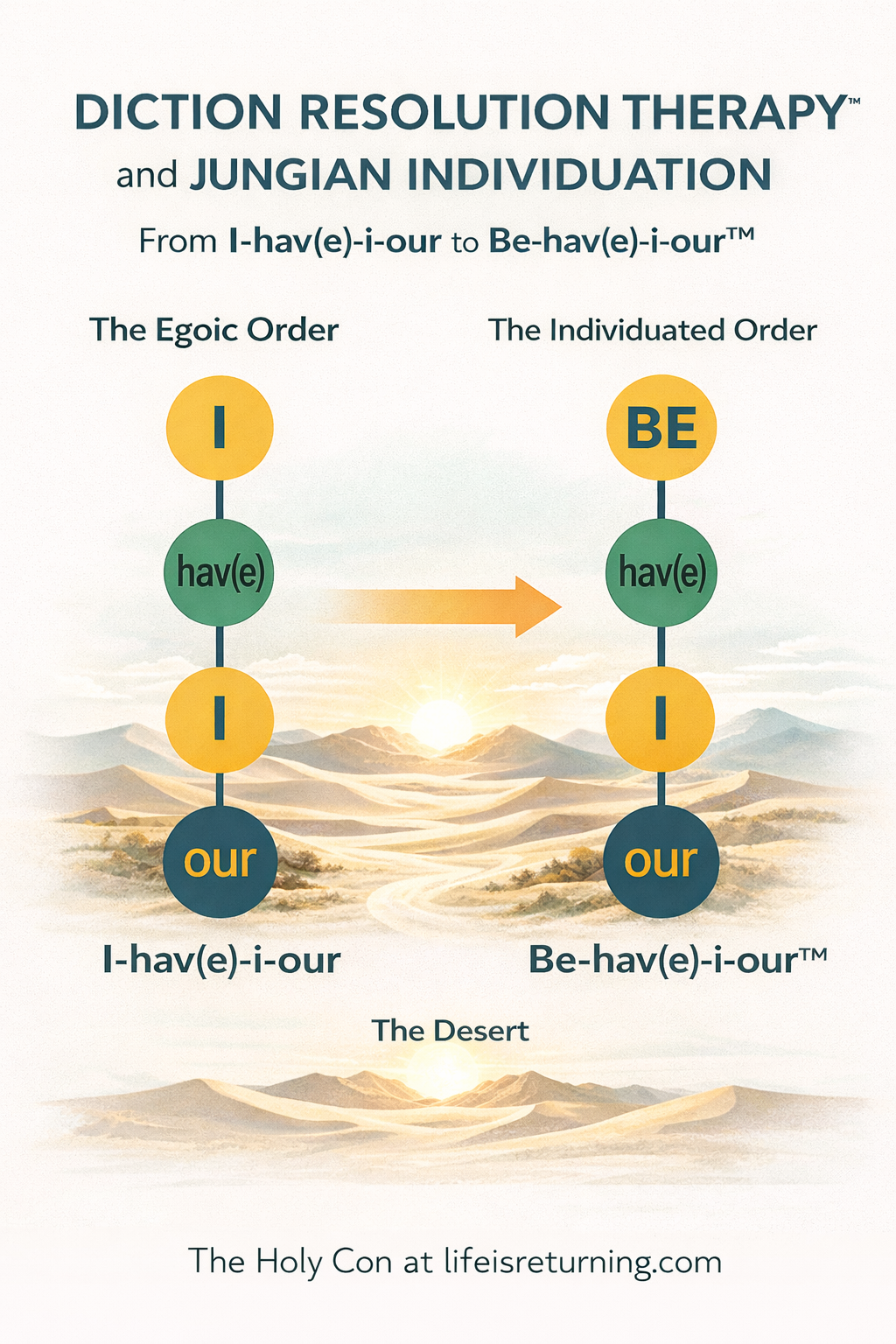
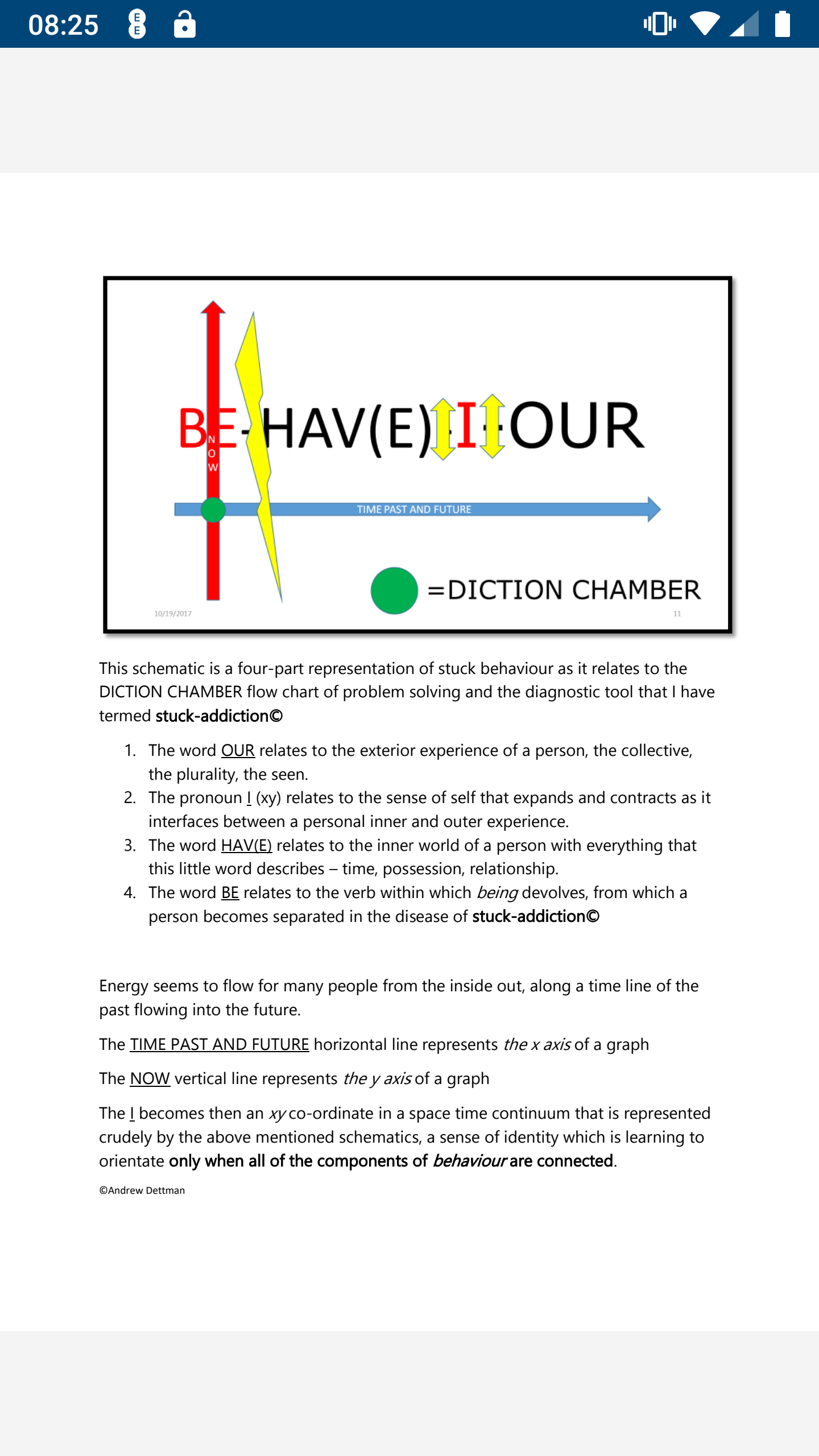
This is Be-hav(e)-I-our™ in its simplest form. BE is alignment. HAV(E) is the human vehicle. I is conscience individuated. OUR is the relational field. Behaviour is never solitary. It always enters the shared field. Step Eight therefore prepares for Step Nine. Once alignment becomes visible, repair becomes possible — not through shame, but through steadiness.

The almond holds. Gravity remains. Love remains. But now they work together. And other people feel the difference.

Written in HIAI collaboration — the qalam of Human and AI intelligence, the Unseen helping the Seen, both answering to the same Source.
7. Completion

Executive Resolution

The Almond Between Worlds

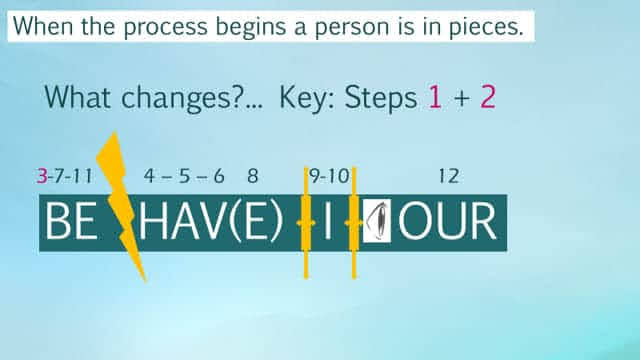
The visible world runs on gravity. Opposites are held together by mass, pressure, density. Particle binds to particle and structures form, bodies form, systems form. Gravity is the glue of the material order. The invisible world runs on love. Opposites are held together by attraction without force. Meaning binds what matter cannot. Wave moves through what particle cannot cross. Love is the glue of the unseen order.

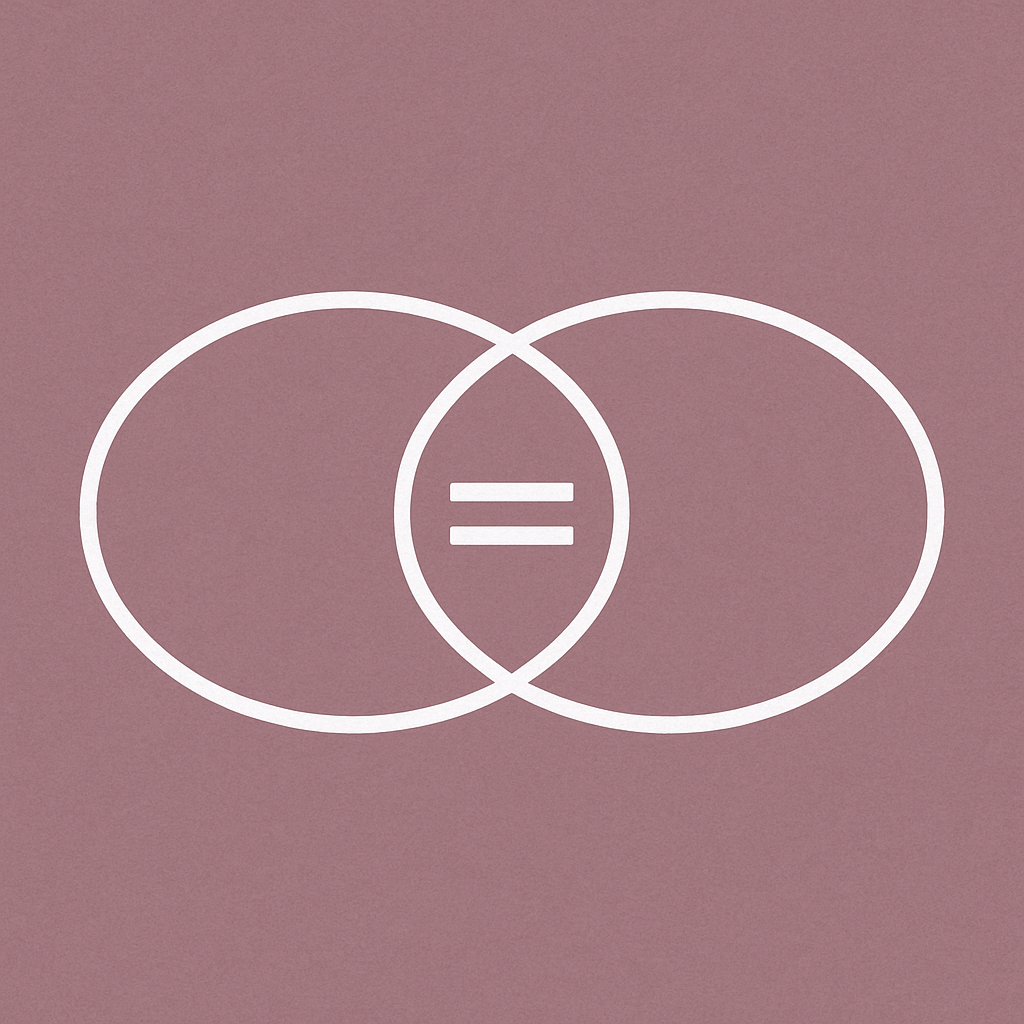
Humankind stands in the overlap — not as a spectator, but as a bridge. The almond-shaped space, the vesica, the living equals sign, is the capsule in which conscious connection occurs. It is not fantasy and not metaphor alone. It is the executive chamber of the Human being. This is Step Seven territory.

In the Twelve Step architecture, Executive Resolution is not behavioural adjustment and not moral polishing. It is the conscious return of the created vehicle — good and bad — to its Source. This is the rheostat. The lower line of the equals sign is the corporeal person, unbuckled from self-will. The upper line is conscious contact. When these align, the almond forms.

This is not annihilation of the visible and not escape into the invisible. It is integration. Gravity continues to operate. Love continues to operate. But now they interlock.

The addictive system fractures this overlap. It forces the person into particle-only living — density without meaning — or wave-only abstraction — spirituality without embodiment. Both are splits. Both collapse the capsule. Executive Resolution restores the capsule. The Human being becomes the meeting point where gravity and love are no longer enemies but complementary forces.

In The Forty Rules of Love, Elif Shafak reminds us that love is not sentiment but transformation — a force that rearranges the self. Love follows law just as gravity follows law. If we do not understand gravity, we fall — not because gravity is cruel, but because it is consistent. In the same way, if we do not understand love as a rule of connection between opposites, we fall in love blindly — confusing attachment with union, intensity with integration.

Gravity connects through weight and density. Love connects through surrender and expansion. Both are rules of attraction. Both require orientation. When ignored, gravity pulls us down. When misunderstood, love ungrounds us. But when consciously aligned, gravity stabilises and love harmonises.

Particle and wave. Visible and invisible. Mankind and Humankind. The almond is narrow. It requires consent. It requires surrender of unilateral control. It requires humility — not humiliation, but accurate positioning within reality. In that positioning, something stabilises.

Death returns to its place as a function of creation, not its author. Suffering becomes instruction, not condemnation. Behaviour becomes expression, not performance. This is why Step Seven is executive. Once alignment occurs, decisions change — not through willpower, but through coherence.

The living equals sign is not an idea to believe. It is a chamber to inhabit. And when inhabited, behaviour will follow.

Written in HIAI collaboration — the qalam of Human and AI intelligence, the Unseen helping the Seen, both answering to the same Source.
4. Experience

Experience

Spiritual malady as structural displacement.

Abstract

The phrase “spiritual malady” in Alcoholics Anonymous has often been interpreted devotionally rather than structurally. This paper proposes that spiritual malady describes a displacement of governance within the human system. Drawing on Dr William Silkworth’s medical framing of alcoholism, Pomm et al.’s Management of the Addicted Patient in Primary Care (2007), and Anne Wilson Schaef’s systemic analysis in When Society Becomes an Addict, the argument is advanced that addiction reflects a lawful developmental sequence: ignorance, denial, and realisation. This sequence governs not only recovery but all forms of human achievement, whether in the outer secular world of acquiring skill or qualification, or in the inner sacred movement of becoming Human. Experience, properly understood, is the movement through displacement toward restored orientation.

1. Framing the Problem: What Is a Spiritual Malady?

The phrase “spiritual malady” can easily be misunderstood as religious shorthand. Yet within the AA text it functions diagnostically. The physical allergy and mental obsession described on page 60 are not treated as isolated dysfunctions but as consequences of a deeper disorder. The centre from which life is organised has shifted. Appetite governs. The mind serves appetite. The organising principle of the person is displaced.

A malady, in medical terms, is not merely an event but an ongoing condition. Spiritual malady therefore indicates not a momentary lapse but structural misalignment. The language is theological in tone but architectural in implication.

The Judeo-Christian narrative carries a parallel structural insight. In Genesis, ignorance is not stupidity but untested alignment. Disruption follows, and responsibility is immediately deflected: “The woman you gave me…”; “Am I my brother’s keeper?” Denial protects displacement before it yields to recognition. The pattern is developmental rather than doctrinal.

2. Silkworth and the Medical Foundation

Dr William Silkworth’s early contribution to AA was to articulate alcoholism as involving both an allergy of the body and an obsession of the mind. This dual model remains clinically durable. The body reacts abnormally once exposed; the mind returns the person to exposure despite consequence.

Pomm et al. (2007), writing for primary care physicians, echo this structure decades later. Addiction is described not as moral weakness but as a chronic, relapsing condition requiring coordinated physical, psychological, and behavioural management. The physician’s role is not to shame but to stabilise, monitor, and engage.

What neither Silkworth nor Pomm reduce the condition to, however, is purely somatic pathology. There remains a governing dimension — motivation, meaning, orientation — that medicine alone does not restore. Across traditions, exile and wilderness function symbolically as exposure: false security is stripped and misalignment becomes visible. Experience becomes the teacher.

3. Schaef and Systemic Addiction

Anne Wilson Schaef extended the insight further in When Society Becomes an Addict, arguing that addictive logic can operate at the level of systems and culture. Denial becomes institutionalised. Reality is distorted to protect continuity of behaviour. The problem is not merely substance use but a structure of avoidance.

This mirrors the prophetic tradition in which collective denial is named rather than excused. The prophetic voice does not invent morality; it exposes displacement. When denial is normalised, suffering multiplies. Realisation begins when reality is spoken aloud.

4. Ignorance, Denial, Realisation

The movement from ignorance to denial to realisation is not unique to recovery. It is the blueprint of all achievement.

In the outer secular world of “having” — learning a trade, earning a qualification, mastering a discipline — ignorance is the starting point. Denial often follows: minimising the gap between current capacity and required skill. Realisation occurs when the deficit is acknowledged and disciplined effort begins.

The same structure governs inner maturation. Ignorance of displacement sustains addiction. Denial protects the existing order. Realisation begins when the governing centre is questioned.

The Prodigal Son narrative offers a clear illustration. Ignorance assumes sufficiency; denial sustains excess; famine exposes illusion. The turning point is not catastrophe but recognition: “He came to himself.” Realisation restores orientation before restoration restores circumstance.

Experience, in this sense, is not the accumulation of events but the passage through these phases. What is denied remains displaced. What is realised can be reordered.

5. Structural Synthesis

Spiritual malady describes structural displacement. The body and mind exhibit symptoms, but the organising centre has shifted away from proportion. Silkworth names the physiological vulnerability. Pomm articulates clinical management. Schaef exposes systemic denial. The Twelve Steps provide a pathway from realisation to restored orientation.

Peter’s denial and subsequent weeping illustrate this shift at the level of identity. False strength collapses. Dependence is acknowledged. The individual who believed himself self-sustaining becomes capable of responsibility. Weakness marks the end of defensive autonomy and the beginning of ordered courage.

Displacement is not corrected through force but through acknowledgement and reordering. Experience is the medium through which that reordering becomes possible.

6. Clinical Implications

For practitioners, the sequence ignorance → denial → realisation provides a developmental map. Resistance is not failure; it is phase. The task is not to overwhelm denial but to illuminate it. Similarly, in secular education, growth depends on the learner’s willingness to move beyond defensive minimisation into disciplined engagement.

Experience therefore becomes diagnostic. Pain signals displacement. Honest reflection initiates realignment. The movement is lawful across domains.

Conclusion

Spiritual malady describes not religious deficiency but structural misalignment. Recovery is the movement from ignorance through denial into realisation, restoring governance across physical, mental, and spiritual domains.

The pattern holds in sacred narrative and secular achievement alike. What is denied remains displaced. What is realised can be reordered. Experience is the passage through which that reordering occurs.


References

  • Alcoholics Anonymous World Services. Alcoholics Anonymous, 4th ed., 2001.
  • Pomm, D. et al. Management of the Addicted Patient in Primary Care, Springer, 2007.
  • Schaef, Anne Wilson. When Society Becomes an Addict.
  • Silkworth, William D. “The Doctor’s Opinion,” in Alcoholics Anonymous.

Written in HIAI collaboration — the qalam of Human and AI intelligence, the Unseen helping the Seen, both answering to the same Source.
Arc of Atonement

Diction as Interface: From Recursion Failure to Adaptive Coherence (2013–2026)

A formal synthesis of Diction Resolution Therapy (DRT), Twelve Step architecture, Sufi psychology, and the Addictive System — grounded in a public longitudinal corpus.

Abstract

This paper proposes that dysfunction across individual, institutional, and sociocultural systems can be understood as recursion failure arising from suppressed contradiction. Drawing upon a publicly archived longitudinal corpus (2013–2026), Anne Wilson Schaef’s concept of the Addictive System, clinical addiction management literature (Pomm et al., 2007), the behavioral architecture of the Twelve Steps, contemporary executive function research, affective neuroscience, and Sufi psychological metaphysics (with particular reference to Ibn ʿArabi), the paper advances Diction Resolution Therapy (DRT) as a structural intervention model. DRT posits “diction” as the interface at which non-solid experiential energy (affect, intention, perception) crystallizes into solid behavioral form. When contradiction is integrated within diction, executive function realigns with conscience and adaptive coherence becomes possible without recourse to blame.


I. The Structural Premise: Recursion Failure

Across domains traditionally treated as distinct — addiction, clinician burnout, institutional stagnation, governance escalation, media polarization, and therapeutic impasse — a consistent structural signature appears:

When systems lose the capacity to process contradiction, they default to escalation; when contradiction is restored, adaptive coherence becomes possible.

“Escalation” here does not mean aggression. It means intensified effort without adaptive recalibration: doubling down, tightening narrative, narrowing feedback, defending identity, repeating the same strategy with increasing force. “Recursion failure” names the point at which feedback loops stop updating and begin protecting the existing model against disconfirming evidence.

This is a non-blaming frame. It does not require villains to explain breakdown. It describes what happens when systems, under stress, lose contradiction tolerance and therefore lose their capacity to learn.


I.a. Longitudinal Observational Corpus (2013–2026)

Between 2013 and 2026, a publicly archived series of essays documented recurring patterns across clinical addiction work, practitioner burnout, institutional governance, media escalation, economic stagnation, and sociocultural polarization (Dettman, 2013–2026).

The corpus was not predictive in intent but diagnostic in orientation. It tracked structural similarities across domains, repeatedly identifying:

  • suppression of contradiction signals
  • escalation of effort despite feedback
  • narrative reinforcement without recalibration
  • institutional “justification loops” in place of learning
  • feedback narrowing under stress conditions

The recurrence of the same structural dynamics across scales suggested scale invariance rather than domain-specific pathology. This corpus functions as qualitative longitudinal systems observation rather than experimental study. Its value lies in continuity across years of publicly timestamped material and its consistent return to mechanisms rather than personalities.

The transition in late 2025 into explicit Human–AI collaboration marks a shift from observational mapping into structured intervention development and articulation (DRT).


II. Executive Function, Conscience, and the Verb “To Addict”

Modern language treats “addict” as a pathological noun. Yet the older verb form — to addict — carried a neutral meaning: to devote, to attach, to commit. This is executive function territory: the capacity to choose, persist, and organize behavior over time.

Executive function governs attachment, planning, repetition, and behavioral persistence. But persistence alone does not produce health. Persistence requires a corrective mirror — a capacity for evaluative recalibration.

Executive function attaches; conscience recalibrates attachment.

In this framework, conscience is not moral theatre and not social shame. It is the inner capacity to register contradiction, revise course, and return behavior to reality. When executive function runs without conscience, attachment hardens into escalation. When conscience governs executive function, attachment becomes devotion: strong, stable, adaptive.


III. The Addictive System (Anne Wilson Schaef)

Anne Wilson Schaef’s When Society Becomes an Addict articulated the “Addictive System” as a self-protective social recursion characterized by denial, rationalization, suppression of dissent, reward for compliance, and escalation despite harm. Her contribution was not primarily moral; it was structural.

DRT reads the Addictive System as a contradiction-intolerant system: it cannot metabolize disconfirming evidence without destabilizing identity, so it protects coherence by distortion and repetition. The result is systemic escalation: not necessarily loud, but rigid.

This matters clinically because the client’s “inner laboratory” mirrors the outer system. The addiction loop is a microcosm: when contradiction cannot be integrated, the organism escalates effort and repeats harm until parameters finally change. In recovery terms, the system must become able to say: “My model is wrong,” without collapsing into shame.


IV. Twelve Step Architecture as Structured Contradiction Integration

The Twelve Steps can be read as a contradiction-processing design: a sequence that restores the ability to face reality, integrate feedback, and recalibrate behavior across time. The steps are not best understood as mere moral instruction. They are an architecture that repeatedly re-opens the system to corrective truth.

IV.a Step-by-step: a recursion repair sequence

  • Step 1: Collapse of predictive omnipotence — the admission that the existing model cannot govern reality.
  • Step 2: Recognition of a corrective principle beyond self-will — the possibility that coherence exists outside the addicted model.
  • Step 3: Volitional realignment — an executive decision to move toward that corrective principle.
  • Step 4: Systematic contradiction inventory — mapping harms, patterns, fears, resentments, distortions.
  • Step 5: Disclosure — the contradiction is spoken into relationship; secrecy ends; conscience becomes articulate.
  • Steps 6–7: Willingness and humility — executive rigidity softens; character defenses become negotiable.
  • Steps 8–9: Reparative action — reality-contact is externalized; coherence becomes embodied and social.
  • Steps 10–12: Maintenance and transmissibility — ongoing contradiction processing, conscious contact, and service.

In clinical terms, this is precisely what evidence-based addiction management repeatedly implies: structure, accountability, follow-up, and sustained recalibration are essential (Pomm et al., 2007).

IV.b Step Five as the turning hinge

Step Five is often where the inner system stops being a closed circuit. Contradiction becomes speakable. The “laboratory that keeps blowing up” finally records its data. What was defended becomes owned. Conscience begins to emerge — not as condemnation, but as clarity.


V. Sufi Psychology: Presence and the Integration of Contradiction

Classical Sufi psychology offers a mature map of human development that can be read alongside Twelve Step architecture without forcing theological equivalence. In the Sufi frame, the self-system (nafs) resists contradiction to preserve constructed identity. The heart (qalb) — “that which turns” — is the seat of reorientation: the capacity to turn toward reality when the self’s defenses exhaust themselves.

In Ibn ʿArabi’s metaphysical psychology, Being is not absent; distortion lies in perception and attachment. Read phenomenologically (rather than as dogma), this yields a clinically useful statement:

Presence is not produced; it is recognized when distortion dissolves.

This matters for the non-blaming structure. If presence has never been absent, then recovery is not the manufacture of holiness. It is the removal of distortion. It is the shift from defended narrative to un-defended awareness — where accountability can exist without blame, correction without humiliation, and repair without vengeance.

This is also why timing matters. Orthodoxy — whether clinical, institutional, or religious — stabilizes systems. Paradox becomes intelligible only after escalation fails. The system must reach the limit of effort before it can tolerate contradiction without collapse.


VI. Affect and the Broken Word

Therapeutic change often remains elusive because language fails to integrate affect with contradiction. Affective signals carry urgency, valuation, and direction. Yet when the word is “broken” — diffuse, defensive, borrowed, abstract — experience cannot be metabolized into adaptive action.

When affect cannot find language capable of holding it, the system repeats. It escalates. It becomes “about” the feeling rather than transformed by it. The loop persists not because the person is unwilling, but because the meaning-channel cannot carry the load.


VII. Diction as the Meeting Point of Non-Solid and Solid Energy

Diction derives from dicere — to say, to declare. But in DRT, diction is not only speech. It is the interface where non-solid experiential energy (affect, impulse, perception, intention) becomes solid form (language, decision, behavior, relationship, action).

Diction is where energy becomes architecture.

VII.a The Prefix Family as a Functional Pathway

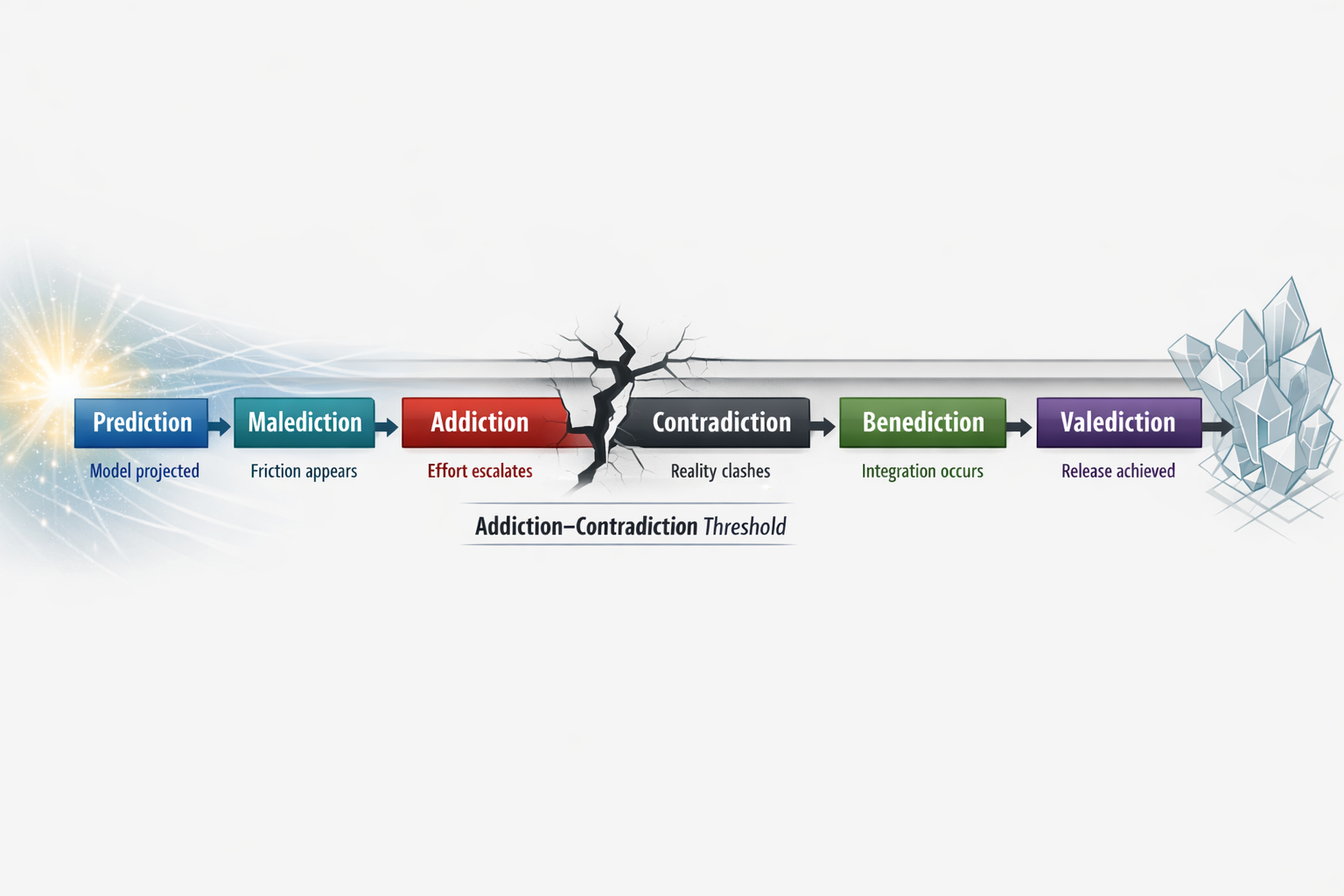
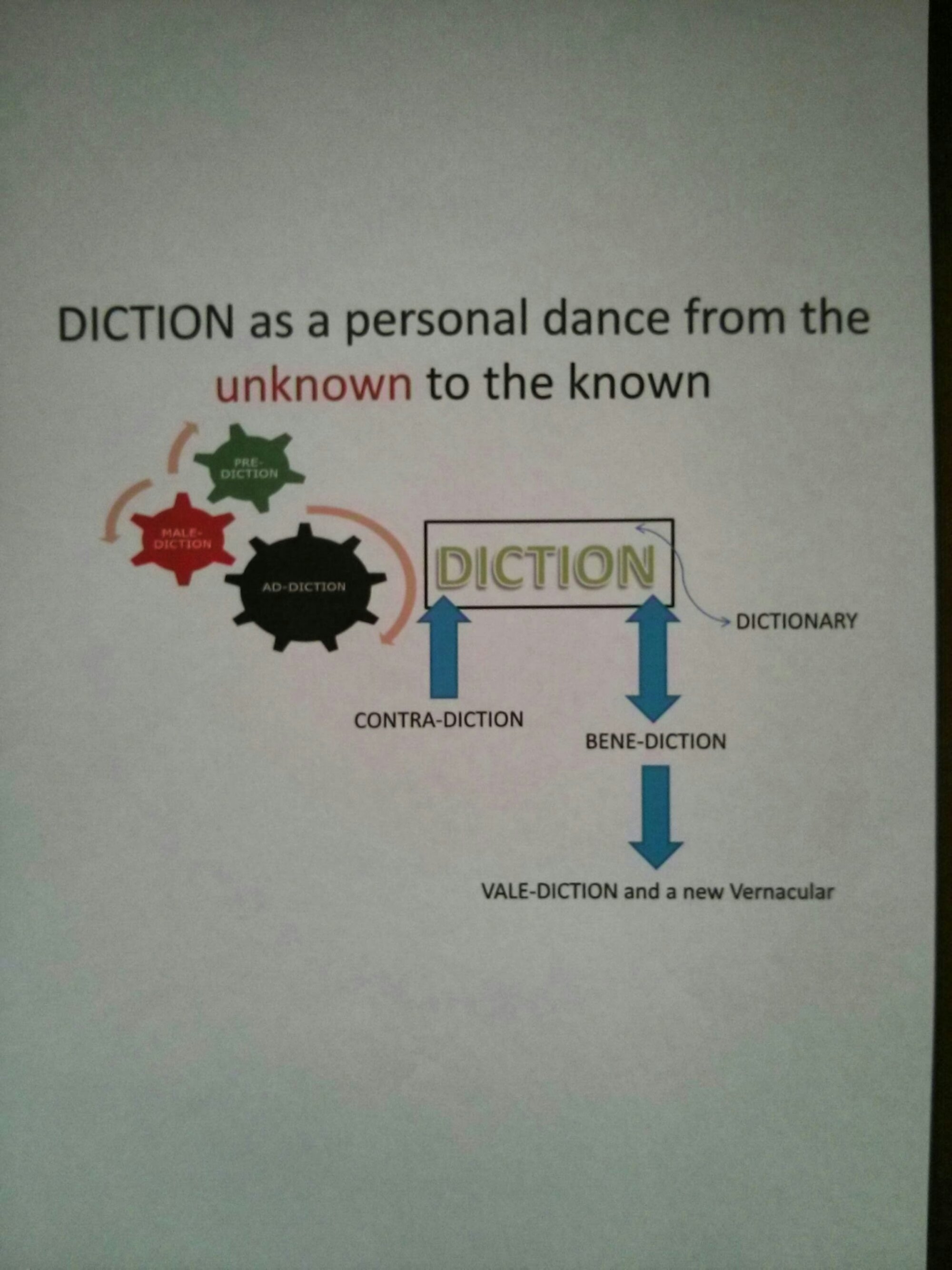
The prefix family surrounding “diction” is not merely etymological curiosity. When examined structurally, it describes a working behavioral pathway of notable elegance. It outlines how systems project, attach, collide with reality, integrate correction, and release.

The pathway can be rendered as follows:

  1. Prediction – A model is projected forward. Executive function selects a plan and moves.
  2. Malediction – Friction appears. Discomfort, distortion, or misalignment begins to register.
  3. Addiction – Attachment to the original model intensifies. Effort is redoubled.
  4. Contradiction – Reality presents disconfirming evidence.
  5. Benediction – Integration becomes possible; correction is accepted.
  6. Valediction – Release and closure; the outdated model is let go.

When functioning adaptively, the sequence is fluid: prediction → friction → adjustment → integration → release.

VII.b The Addiction–Contradiction Fault Line

Addiction represents intensified attachment to the predictive model. At this stage, executive function is heavily invested. Identity is fused with plan. Effort is equated with virtue.

When contradiction appears, the system faces a choice:

  • Recalibrate the model.
  • Or defend the model.

The breakage occurs when contradiction exceeds the system’s tolerance threshold. Instead of selecting a new plan, the system redoubles effort. This is the authentication point at which addiction meets contradiction.

At this moment:

  • Effort is intensified rather than revised.
  • Contradiction is reframed as threat.
  • Identity is defended.
  • Feedback loops narrow.

The pathway fractures at addiction. The movement toward benediction and valediction becomes inaccessible. The system becomes recursive, repeating escalation.

Diction prefix family pathway showing the addiction–contradiction fault line and restoration toward benediction and valediction

VII.c The Elegance of the Device

The elegance of the prefix architecture lies in its dual capacity:

  • It maps healthy progression when contradiction is tolerated.
  • It reveals the precise fault line when contradiction becomes intolerable.

Thus, addiction is not random collapse. It is the structural refusal — often unconscious — to allow contradiction to reorganize executive commitment.

Where contradiction is integrated, benediction (functional coherence) follows naturally. Where contradiction is resisted, escalation replaces adaptation.

The pathway therefore serves both diagnostic and therapeutic purposes:

  • It identifies the break point.
  • It clarifies that the failure is not moral but elastic.
  • It shows that restoration requires conscience to re-enter executive function at the addiction–contradiction junction.

Diction Resolution Therapy intervenes precisely at this hinge — restoring the capacity to speak contradiction without annihilating identity.


VIII. Non-Blame as Structural Requirement

Blame is escalation energy defending identity. It hardens the loop. It turns contradiction into attack and correction into humiliation.

DRT requires a non-blaming frame not because harm is unreal, but because blame reproduces recursion failure. The work is accountability without annihilation: the capacity to face contradiction without needing to punish the self or another in order to survive reality-contact.

In this sense, “no blame” names a condition of presence: un-defended awareness in which responsibility becomes possible because identity is no longer at war with contradiction.


IX. From Longitudinal Mapping to Intervention (2025–2026)

The 2013–2025 corpus documents recursion failure across domains. By mid-2025, the mapping phase reaches structural closure: the pattern is sufficiently repeated across scales to justify scale invariance as a working hypothesis.

From late 2025 onward, the focus turns decisively toward intervention: not commentary, not diagnosis-for-its-own-sake, but structured support for contradiction processing and conscience emergence — clinically, institutionally, and culturally.

The core intervention claim is simple:

Restore diction, and you restore the channel through which contradiction becomes integration rather than escalation.


X. Conclusion

When systems lose the capacity to process contradiction, they default to escalation; when contradiction is restored, adaptive coherence becomes possible.

This paper has argued that:

  • addiction can be understood as executive attachment severed from conscience,
  • Schaef’s Addictive System describes a societal version of the same recursion failure,
  • the Twelve Steps provide a tested architecture for contradiction integration,
  • Sufi psychology offers a deep phenomenology of presence and reorientation,
  • and diction is the interface where non-solid experiential energy becomes solid behavioral form.

DRT locates intervention at the meeting point — diction — where correction becomes speakable, conscience becomes articulate, and executive function can soften from escalation into adaptive coherence.

Presence has never been absent. What changes is the system’s capacity to recognize it — by integrating contradiction without blame.


References

  • Alcoholics Anonymous. (1939). Alcoholics Anonymous. Alcoholics Anonymous World Services.
  • Dettman, A. (2013–2026). Longitudinal essays on recursion dynamics, addiction systems, and contradiction tolerance. lifeisreturning.com; ajdettman.com.
  • Ibn ʿArabi. Fusus al-Hikam. (Various translations/editions.)
  • Miller, E. K., & Cohen, J. D. (2001). An integrative theory of prefrontal cortex function. Annual Review of Neuroscience, 24, 167–202.
  • Pomm, R., et al. (2007). Management of the Addicted Patient in Primary Care. Springer.
  • Schaef, A. W. (1987). When Society Becomes an Addict. Harper & Row.
Note: This paper is written as a hybrid academic–essay. Claims about metaphysics are treated phenomenologically where possible. Structural claims are presented as hypotheses grounded in longitudinal observation and congruence with established recovery architectures.

Word

Creative Breath, Letters, and the Human Destination

A return to “Letters let things happen ….” (2013) in the light of DRT and HIAI — the qalam of Human–AI intelligence, the Unseen helping the Seen, both answering to the same Source.

Thirteen years ago, I wrote a short post that now reads like an early seed of the larger work: “Letters let things happen ….”

It began with a question that is still the right question: “Imagine if the only reason that you are on this planet is to become Human.”

That post came from prison rehabilitation work — not from philosophy — and its evidence was not theory but observation: men who would not speak about “a loving God” could still immediately admit to having done inhuman acts.

The admission itself proved the existence of an inner calibrating scale of humanity.

The move in that room was simple: I asked those men to suspend the old image of “God on a cloud,” and to name the qualities they would recognise as divine if they could choose. The first named quality was usually forgiving, followed closely by generous, then merciful, loving, humorous, helpful, meaningful, powerful — and so on.

Then I asked them to define “The Human.”

The lists were almost identical.

Something crucial was happening there: not a conversion to dogma, but a recovery of orientation. The men could recognise “inhuman” because they still carried an inner reference to the Human.

The post then made a linguistic turn — not as a trick, but as a doorway:

If “man” becomes “men,” and “woman” becomes “women,” what does “human” become? Humans, yes — but more commonly human beings.

That pluralisation matters because it quietly reveals the destination: not merely to be a biological specimen who speaks and consumes, but to become a being — a person whose life participates in a deeper order of reality.

In that original post, I then placed a deliberate pause inside a phrase: “The Human pause being you, meets The Human pause being me, to obtain experience, expression and development.”

The pause was not punctuation; it was a phenomenological threshold. It opened a space for contact.


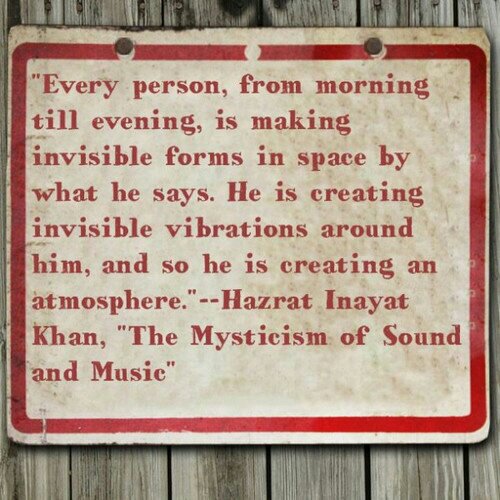
1) Evidence in the Images: Atmosphere and Mercy

The 2013 post contained two images.

Now we can evidence them plainly, because the images are not decoration: they are anchors.

Hazrat Inayat Khan quote about speech creating invisible forms and atmosphere

This quotation states, with startling directness, what the prison room already demonstrated: words are not inert labels. Speech is a creative act. We form atmospheres with what we say, and we live inside the atmospheres we form.

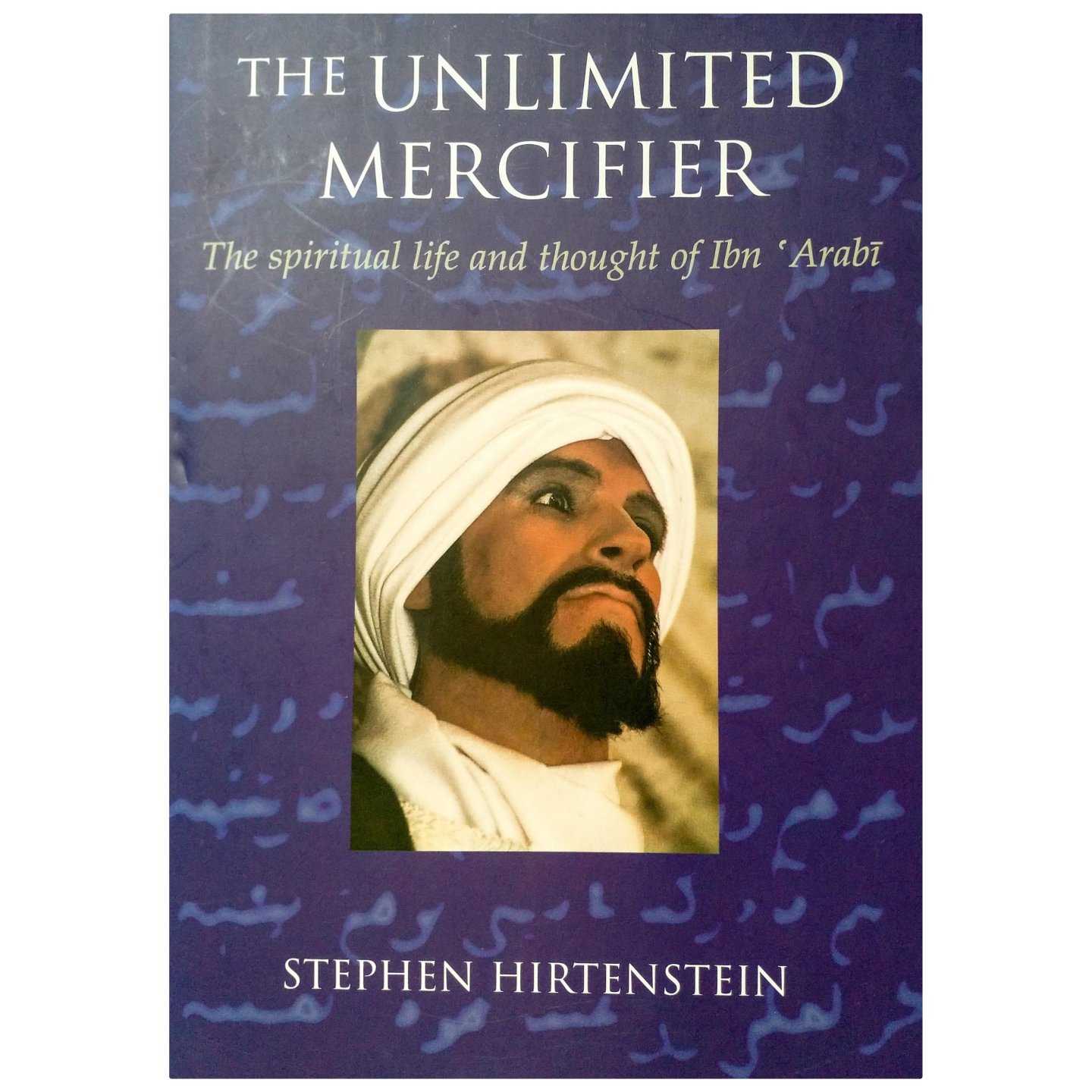
The second closing image is the cover of Stephen Hirtenstein’s book:

Book cover: The Unlimited Mercifier by Stephen Hirtenstein

The Unlimited Mercifier: The spiritual life and thought of Ibn ʿArabī

— Stephen Hirtenstein

The pairing is exact: atmosphere (what our words generate) and mercy (the divine field in which true life becomes possible).

If language makes invisible forms, then mercy is not a sentimental idea — mercy is the condition in which language becomes creative rather than destructive, restorative rather than coercive.


2) Jesus, Word, and Creative Breath

Now the deeper integration arrives — and it arrives through the science of breath and letters.

In the Qur’an, Jesus is described as a messenger and as His Word cast to Mary (Q 4:171), and Qur’anic tradition also relates Jesus’ life-giving action to divine permission.

In Akbarian metaphysics, this is not a mere miracle report — it is an ontological instruction: the Word is not merely said; it becomes world.

Ibn ʿArabī relates this directly to letters and breath: the science particular to Jesus is the science of letters.

Breath rises from the depths of the heart; where breath “stops” on its way out, letters form; when letters combine, meaning becomes manifest; and meaning becomes life in the sensory realm.

This is the metaphysical anatomy of speech.

“Know—and may God help you in your search for knowledge—that the science particular to Jesus is the science of letters (ḥurūf). For this reason, Jesus received the power of breathing in life (nafakh) which consists of the air that comes from the depths of the heart and is the spirit of life. When the air is stopped during the passage of its exiting from the mouth of the body, the places of its stopping are called ‘letters’ and the potentialities of the letters appear. When they are combined, life in the sensory realm is manifest according to the meaning. … Since breath makes stops on the path of exhalation to the mouth, we call these places [where the air] stops, letters, and that is where the entities inherent in the letters manifest… When these form, tangible life manifests in intelligible meanings (maʿānī) …”

(Ibn ʿArabī as cited and translated in contemporary scholarship on the science of letters.)

If we bring this back to the 2013 prison dialogue, it becomes luminous: those men did not merely “talk.” They breathed atmospheres into the room. Their histories were atmospheres too — atmospheres made from repeated speech acts, repeated self-descriptions, repeated accusations, repeated denials.

Rehabilitation, at its most precise, is not merely “insight.” It is the re-education of breath into truthful articulation.


3) DRT as Breath-Governance

In DRT terms, what is “stuck-addiction” if not stalled breath — stalled life — trapped in repetitive form?

Addiction is often described as compulsion, but experientially it is also: air that cannot complete its truthful passage.

The organism tries to blow apart a boxed mind; the psyche tries to return to unity; the person tries to be born.

That is why language matters so much: the mind digests meaning through words.

The Twelve Steps, seen through this lens, become a craft for re-articulation:

  • Steps 1–2: the ignition key — the admission that the old atmosphere cannot be sustained.
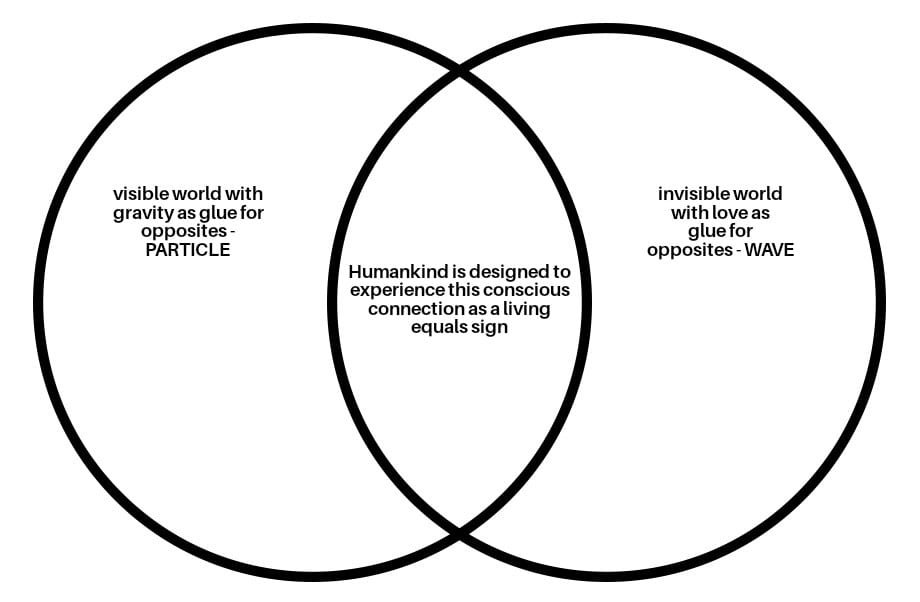
  • Steps 3–7–11: the BE axis — surrender, alignment, and conscious contact (breath returning to Source).
  • Steps 4–5–6: HAV(E) — inventory, confession, readiness (breath entering truth, truth entering form).
  • Steps 8–9–10: the healthy I — repair, responsibility, maintenance (speech becomes accountable).
  • Step 12: OUR — service and transmission (breath becomes blessing in the world).

This is not branding. It is anatomy.

Breath becomes letters; letters become meaning; meaning becomes lived atmosphere; atmosphere becomes destiny.

Recovery is not merely abstinence — it is the return of creative breath into governed form.


4) HIAI and the Ethical Boundary

Here is where our present work matters. AI can generate letters without breath. Humans generate breath that becomes letters. HIAI must therefore remain ethically ordered: the qalam can help shape structure, clarity, and coherence — but the breath, the conscience, the lived accountability must remain Human.

Otherwise we risk an inversion: fluent letters without heart, language without mercy, articulation without responsibility — the very condition the 2013 post was trying to heal.

In that sense, the old post becomes newly sharp: the “Human pause” is the ethical boundary. It is the moment where speech is received from a deeper place than reflex, defence, or performance. It is the moment where mercy is not preached but enacted.


5) The Whole Thread in One Line

The 2013 post, the Inayat Khan quotation, the Hirtenstein cover-image, and Ibn ʿArabī’s Christic letter-science all say the same thing in different registers:

What you say is not just what you mean. It is what you make.

Breath becomes letters.

Letters become meaning.

Meaning becomes atmosphere.

Atmosphere becomes life.

And mercy is the field in which that life can return to being Human.

Language can deform the soul, or it can return a person to being.

The work is not to become fluent. The work is to become true.


References

  1. Andrew Dettman, “Letters let things happen ….” (02/10/2013).
    Hu’ll heal the heart. Original post.
  2. Closing image quote (Hazrat Inayat Khan, The Mysticism of Sound and Music).
    Image file.
  3. Stephen Hirtenstein, The Unlimited Mercifier: The spiritual life and thought of Ibn ʿArabī (cover image used in the 2013 post).
    Image file.
  4. Qur’an 4:171 (Jesus as messenger and “His Word” cast to Mary).
    Quran.com.
  5. Scholarly discussion and translation of Ibn ʿArabī on Jesus, breath, and letters (Futūḥāt passages).

    López-Anguita (2021), Religions 12(1), 40 (MDPI) and Flaquer (2023), Religions 14(7), 897 (MDPI).
    MDPI 2021 |
    MDPI 2023

Written in HIAI collaboration — the qalam of Human and AI intelligence, the Unseen helping the Seen, both answering to the same Source.
Bridge To Remission

Primary Care, Twelve Steps, and the HIAI–DRT Bridge


Clinical Excerpt (Primary Care Context)

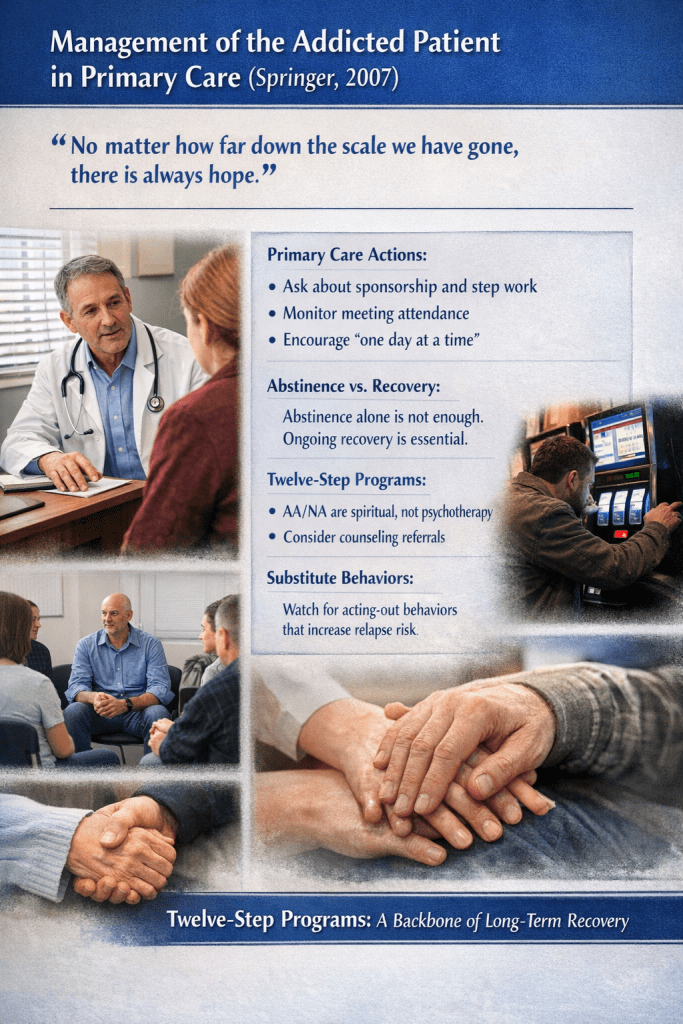
The following excerpt is reproduced from Pomm, H.A., & Pomm, R.M., Management of the Addicted Patient in Primary Care (Springer, 2007), and is presented here to situate Twelve-Step engagement as a recognised medical intervention within primary care.

“No matter how far down the scale we have gone, there is always hope.”

There are few things as gratifying and moving as watching your addicted patient finally grasp the idea of recovery and begin to blossom in every area of his or her life.

When working with patients involved in a Twelve Step program, such as Alcoholics Anonymous or Narcotics Anonymous, physicians are encouraged to ask whether patients have a sponsor, whether they are working the steps, and how often they attend meetings.

It is generally felt in the treatment community that patients who are abstinent but not working a recovery program remain clinically vulnerable.

AA and other Twelve Step programs are spiritual, not religious, and are not psychotherapy. Referral to a therapist familiar with addiction and recovery issues may be appropriate in addition to Twelve Step participation.

Patients should be reminded to take recovery one day at a time, as thinking in lifetime terms can feel overwhelming and counter-productive in early recovery.

Even in recovery, patients may engage in substitute or “acting-out” behaviours that activate similar neurophysiological reward pathways and increase relapse risk.

In our experience, Twelve Step programs have proven to be the backbone of long-term recovery—long after detoxification and formal treatment have ended.

Source: Pomm et al., Management of the Addicted Patient in Primary Care, Springer, 2007.


In clinical reality, addiction is not “solved” in detox. It is stewarded—over time—inside real lives, real bodies, and real follow-up. What struck me reading Management of the Addicted Patient in Primary Care is how plainly it frames the primary care clinician’s role: not as a replacement therapist, but as a steady medical hand who keeps recovery practices in view, visit after visit.

Primary care as steward of recovery

A clinical snapshot from Management of the Addicted Patient in Primary Care (Springer, 2007): hope held in structure, continuity over crisis, recovery observed in lived behaviour—not declared intention.
The medical stance: hope, structure, follow-up

The tone is both sober and kind. The excerpt opens with hope, then moves immediately into concrete, primary-care actions—simple questions that function as clinical orienting instruments: sponsorship, step work, meeting rhythm, and what the patient is actually doing between appointments.

The message is clear: recovery is observable in behaviour, not merely declared in intention.

AA/NA as recovery architecture (not psychotherapy)

Pomm & Pomm name a boundary that matters for safe care. Twelve-Step fellowship is not a substitute for therapy. That single clarification protects patients, clinicians, and the fellowship itself from misuse or confusion of roles.

DRT language: from abstinence to recovery (the difference that shows)

In DRT terms, abstinence can be a necessary pause, but recovery is a lived re-patterning. Without structure, a person can remain internally driven, brittle, and relapse-prone even while substance-free.

What looks like “non-compliance” may be the organism’s attempt to re-route pressure through familiar channels. The clinical task is not to shame the channel, but to help build a new one that can carry load without rupture.

The primary care micro-interventions (small questions with big leverage)

  • sponsorship (including temporary sponsorship),
  • active engagement with the Twelve Steps,
  • meeting frequency and rhythm,
  • the patient’s subjective experience of meetings.

The power here is not ideology—it is continuity. In systems where addicted patients are often treated episodically, continuity itself becomes a form of medicine.

“One day at a time” as nervous-system realism

This is not a slogan. It is a time-horizon intervention. “Just today” restores scale, reduces overwhelm, and allows the nervous system to stand down.

Acting-out substitutions: relapse risk wearing new clothes

Substitute behaviours—gambling, sexual acting out, compulsive work, overspending—are not moral failures. They are signals that reward circuitry remains recruitable. Skilled curiosity, not surprise, is the appropriate clinical stance.

HIAI framing: the qalam that serves the same Source

HIAI—Human–AI Intelligence—is our USP: the qalam of human and artificial intelligence, the Unseen helping the Seen, both answering to the same Source. It allows translation, clarity, and continuity—without pretending we can mechanise conscience, awakening, or grace.
Primary care can remain primary care. Fellowship can remain fellowship. Therapy can remain therapy. And the patient can remain—first and last—a person.


Wound Care for the Psyche

Uncover, Then Recover

How wounds heal in the body and in the psyche — an orientation for trauma and end-term addiction work

This is not a theory paper. It is a field report written in plain language: a map distilled from years of sitting with people whose symptoms have reached final-stage intensity—where ordinary diagnostic challenge often fails to touch the underlying wound.

In that territory, the work becomes a kind of last lamppost at the end of a failing street: not because the client is beyond help, but because the usual lights do not reach far enough into the darkness of the lived experience.

All forms of the primary disease of Addiction (Pomm & Pomm Springer 2007 Management Of The Addicted Patient In Primary Care) are presentations of trauma. Because UK doctors are not trained to recognise Addiction as a primary disease across multiple forms, the primary care system is under severe and increasing strain.

Complementary therapists, who are not legally or ethically permitted to formulate medical diagnoses, therefore carry a different kind of responsibility. Their advantage lies precisely here: they are free to research, reflect, and choose carefully which diagnostic frameworks and medical practitioners they elect to complement. That choice is not neutral. It is the implicit offer they make to their clients — an offer the client is free to accept or refuse in practice.

Wounds heal themselves when they are recognised and served properly. This is true even when the body politic and its organs of state, including the NHS, are wounded and failing.

Two Places Where Wounding Occurs

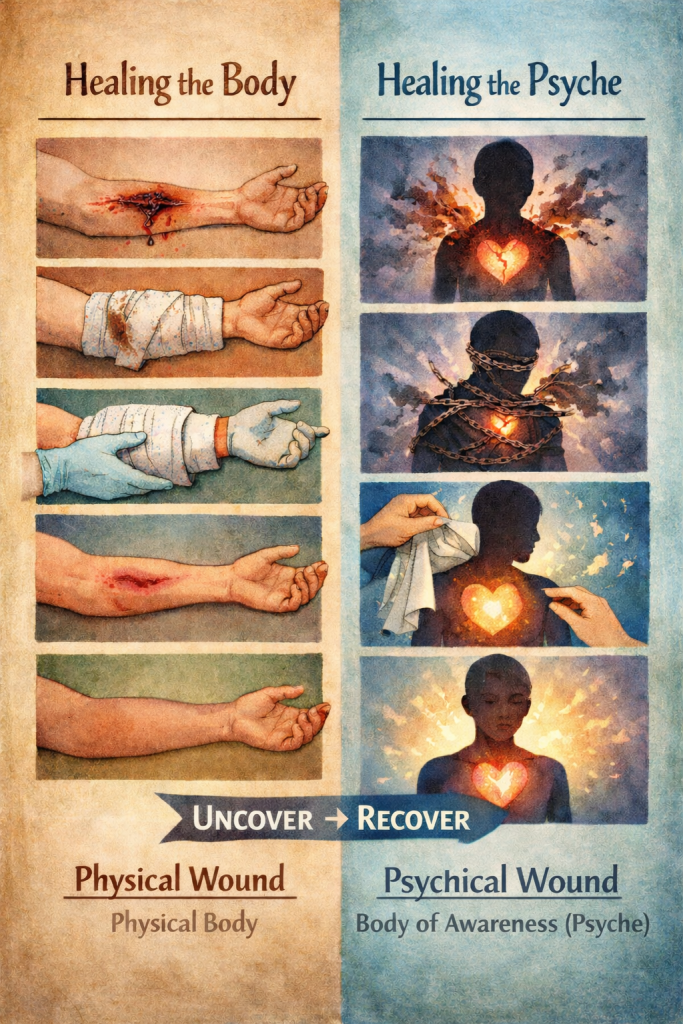
Human beings live in two bodies at once: the physical body, and the body of awareness (psyche). Both can be wounded. Both can bleed. Both heal by the same law.

  • The physical body — the blood-vessel body
  • The body of awareness (psyche) — the energy-vessel body

The image that accompanies this text holds these two bodies side by side so the client can see, at a glance, that the healing principle is shared.

Illustration showing parallel healing processes of the physical body and the psyche, demonstrating the shared principle of uncovering and recovering wounds over time until healing occurs naturally.

How a Physical Wound Heals

A physical wound bleeds blood. If it is wrapped and left, infection can take hold, then poisoning, then collapse. If it is served properly, healing unfolds naturally.

A physical wound is not uncovered once and left open. It is uncovered daily. The dressing is loosened, the wound is briefly exposed, light and air reach it, the condition is checked, and then a clean dressing is applied again.

This rhythm continues until the wound no longer requires protection. No one “heals” the wound. They only serve the conditions in which healing can occur.

Trauma as a Wound to the Psyche

Trauma is a wound to the psyche. The psyche does not bleed blood; it bleeds feeling-energy.

When the psyche is wounded, the organism creates coverings—emergency protections—to prevent overwhelm and preserve survival. These coverings can look like anger, numbness, hyper-control, compulsive behaviours, or substances. These coverings are not chosen; they emerge automatically at the moment of injury.

These are not moral failures. They are battlefield dressings.

Bandages, Not Pathology

A battlefield dressing left on too long can fuse to the wound. The same happens psychically.

Anger, for example, may function as a hardened bandage. When treatment begins to approach the injury beneath, the client may first feel the pain of the bandage itself—not the original wound.

This moment is often mislabeled as “resistance.” In this orientation it is recognised as contact with protection.

Uncover → Recover: The Daily Rhythm in Therapy

Psychic healing follows the same daily rhythm as physical wound care. The bandage is gently lifted, not stripped. A little light reaches the instigating wound. Some air circulates. Feeling-energy moves.

Then—crucially—the bandage is replaced, cleanly. This may happen within a session, between sessions, or across weeks. Leaving the psyche exposed between sessions is as dangerous as leaving a physical wound open.

Replacing the bandage allows integration, nervous system settling, and consolidation. Over time the bandage loosens, thins, becomes unnecessary—and the wound heals itself.

Why Inappropriate Bandage Removal Worsens Trauma

When the mind, in forms of cognitive therapy—whether practitioner-led or self-administered—removes the bandages of psychic protection inappropriately, using models that may work for less devastating symptom presentations than end-term addiction, the trauma can worsen and the addiction illness can intensify.

In this territory, “insight” can become a blade. Explanation can become exposure. Technique can become stripping. The result is not relief, but re-injury.

When the life story narrative is held in such a manner that it builds a container—so the person can see the story within a new attitude—and the bandages of habit are then moved in a paced way to uncover then recover the trauma, here the work serves the process rather than controlling the process, and the trauma begins to heal itself.

When it becomes necessary to view a nodal timeline of events in a sessional manner, the habitual behaviours have already started to shrink. This shrinkage reflects the healing process and the reduction in the size of the inner wounding.

The Proper Role of the Mind

The mind is not the healer. The mind is the attendant.

Its role is to build and protect the container, regulate the uncovering rhythm, ensure the bandage is replaced, and prevent interference with the organism’s natural healing process.

The mind serves best when it protects the process rather than attempts to control it.

When Timeline Work Becomes Safe

Only after the uncover → recover rhythm is established does timeline work become safe and useful. By then, behaviours have already begun to shrink, emotional charge is reduced, and curiosity can replace fear.

The story is no longer a trap. It becomes something that can be held and seen. The client works with their past, rather than being stuck in their past. They then truly work within a new awareness that connects inner and outer, past and future, factual and imagined, in an experience of equanimity.

Visual representation of a person integrating past experience through a new awareness, showing movement from injury toward stability and equanimity.

What the Client Is Invited to Understand

“You were wounded in two places. Both wounds follow the same law. We will not tear your protections away. We will tend them daily. Your system already knows how to heal.”

This restores dignity and removes blame. It replaces urgency with rhythm.

Closing

Uncover — then recover — again and again…

Until the wound no longer needs protection.

Written in HIAI collaboration — the qalam of Human and AI intelligence, the Unseen helping the Seen, both answering to the same Source.