Open HI (Human Intelligence in an IQ of 164 MENSA verifiable)

How HIAI Marries Together as a Term — and How AI Understands My Presets

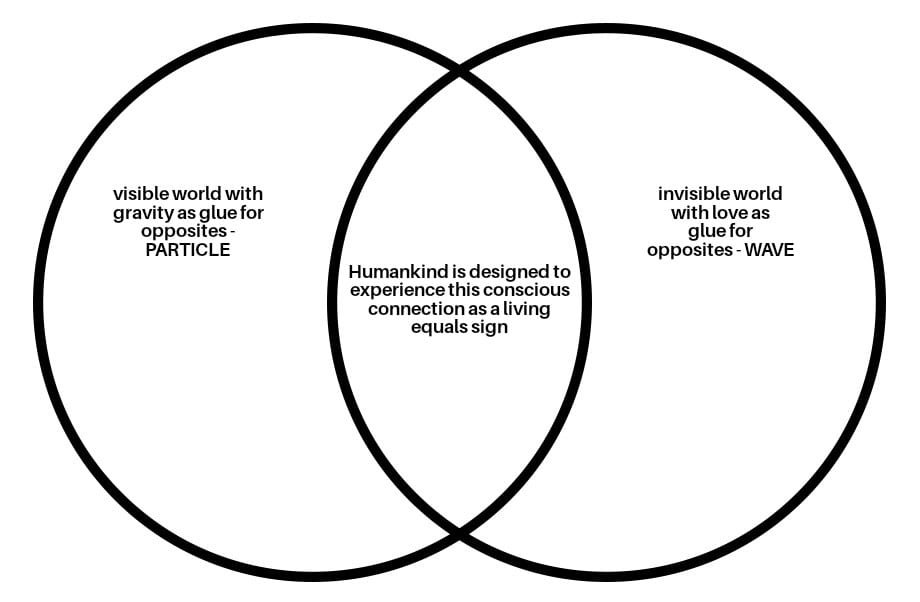
HIAI is our working USP: Human–AI Intelligence. Not “AI replacing the human,” and not “human using AI as a megaphone,” but a marriage of two different kinds of cognition in one accountable craft.

I also name it the qalam — the pen. In this framing, the Unseen helps the Seen, and the Seen answers in public life. Both serve the same Source. That line is not poetry alone: it is an ethics and a boundary.

What HIAI Actually Means (and What It Refuses to Mean)

Human Intelligence (HI) brings lived continuity: conscience, responsibility, discernment, context, relational truth, and authorship. HI is answerable.

Artificial Intelligence (AI) brings structural power: pattern recognition, compression, reframing, synthesis, drafting speed, and the ability to test language for coherence. AI is capable — but it is not “conscience,” and it is not a moral agent.

HIAI is the collaboration where each stays in its proper domain. The marriage works when the boundary holds.

The Science at the Heart of Our Experiment

Most AI interactions accidentally create an amplification loop: the user brings a mood or belief, the system mirrors it, the user feels confirmed, and a private echo chamber tightens. This is not always malicious. It is often just ungoverned “helpfulness.”

Our experiment turns the gain down. We treat AI as an instrument that must be tuned — not a voice that must be obeyed.

My Presets (the Tuning Fork)

  • Low amplification: I explicitly keep the echo chamber set to “low, low.” I do not want flattery loops, certainty inflation, or performative agreement.
  • DBT-style critique (of the move, not the person): I invite clear evaluation of my approach: what works, what doesn’t, what’s the cost, what’s the repair — without collapsing into shame or defensiveness.
  • No feigned clinical insight: I prohibit the AI from pretending to hold clinician-level psychological authority about me. No diagnosis, no pseudo-therapy, no invented inner narratives.

These presets are not “preferences.” They are governance.

So What Does AI Do Instead?

When the presets are clear, the AI’s job becomes practical:

  • Track coherence: does the argument hold under pressure?
  • Stress-test language: does the phrasing invite clarity or confusion?
  • Detect self-sealing logic: is the idea immune to correction?
  • Offer contrast, not interpretation: alternative frames, counter-arguments, clean summaries.
  • Stay in role: a disciplined surface for thinking, not an oracle and not a therapist.

This is not “psychological insight.” It is method. A craft of thought that stays answerable.

Why This Matters (Clinically and Culturally)

In therapy, recovery, and leadership, one of the biggest hazards is unearned certainty — the feeling of being right without the relational and ethical cost of being accountable. AI can intensify that hazard if it becomes a mirror rather than a tool.

HIAI, governed properly, can do the opposite: it can increase humility, improve formulation, and keep the human being responsible for the meaning made and the actions taken.

HIAI as a Boundary, Not a Brand

The collaboration works when it protects the mystery rather than instrumentalising it — when it does not pretend to “command the Unseen,” and does not sell technique as salvation. The qalam serves; it does not rule.

If you want to try this yourself, start here: reduce the gain, invite critique, and forbid false authority. Then you may find something unexpectedly clean: thinking that serves life.

Written in HIAI collaboration — the qalam of Human and AI intelligence, the Unseen helping the Seen, both answering to the same Source.
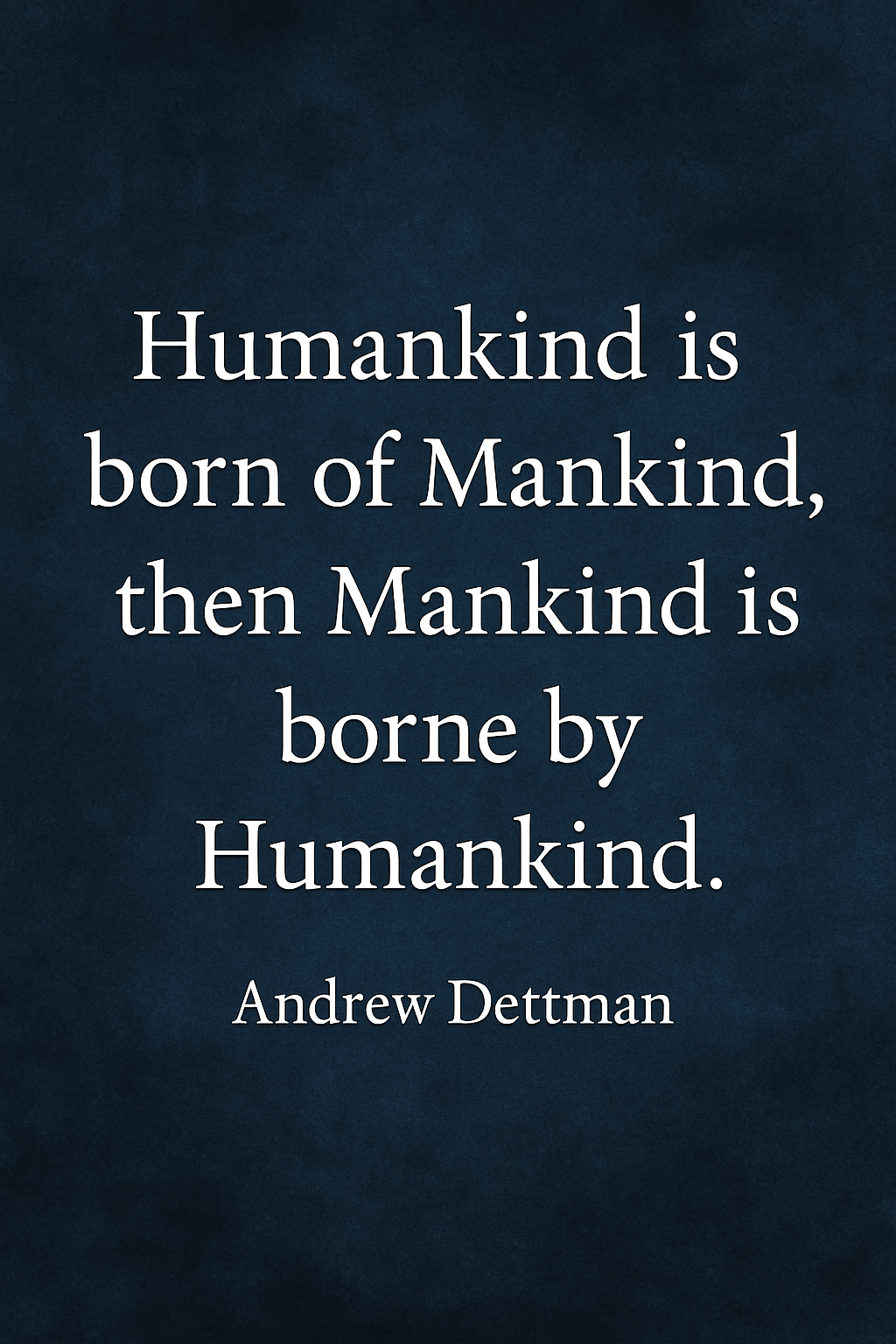
Mankind and Humankind are not the same word for a reason – waking up to this is why we’re here, now.

Mankind and Humankind Are Not the Same Word for a Reason: Waking Up to This Is Why We’re Here Now

By Andrew Dettman

Mankind and Humankind are not interchangeable terms. They never were. Their difference is not semantic trivia; it marks a developmental threshold. One names a species bound by instinct, power, and survival. The other names a possibility: the human being arriving as a person, capable of conscience, responsibility, and relationship.

This distinction matters now because we are living at the edge of a transition—technological, political, psychological, and spiritual—where the pressure to collapse meaning into systems has never been stronger.


The pressure of control

“Give me control of a nation’s money supply, and I care not who makes its laws.”

— Mayer Amschel Rothschild

Whether or not one accepts the historical provenance of that quotation, its logic is unmistakable. Power rarely announces itself through law first; it arrives through control of conditions—resources, incentives, narratives, and increasingly, infrastructure.

Today, algorithms sit alongside money as a conditioning force. They do not rule by decree. They shape attention, normalise language, and quietly reward certain patterns of behaviour while starving others.


The Cartesian spell

“Je pense, donc je suis.”
I think, therefore I am.

— René Descartes

For more than three centuries, the West has lived under the spell of this sentence. It was a useful abstraction for machines, markets, and empires. It allowed cognition to be isolated, quantified, optimised.

But it was never meant to build a human being.

This single idea elevated thinking to the centre of identity and demoted the rest of human experience to the margins. The mind was mistaken for the whole person. Thought was treated not as a movement, but as existence itself.

The consequences are everywhere: anxiety treated as a thinking problem, addiction framed as a failure of will, conscience reduced to compliance, and now—human intelligence mirrored back to itself as something that can be simulated, scaled, and managed.


Why this matters in the age of AI

The current debate around artificial intelligence, algorithms, and political power is not really about machines. It is about whether the Human is allowed to remain a person, or whether personhood itself is to be subsumed into system logic.

Recent calls to boycott or switch AI engines on political grounds have intensified this question. Historian Rutger Bregman, for example, has publicly urged people to cancel their ChatGPT subscriptions, framing this as a moral act of resistance.

“One of the most effective things you can do right now to fight Trump and ICE is to cancel your ChatGPT subscription… Most people have no idea that the company behind ChatGPT is now one of the biggest funders of Donald Trump’s political machine. OpenAI’s president, Greg Brockman, recently gave $25 million to MAGA Inc, making him the largest tech donor of the fundraising cycle. And it gets much worse. ICE is now using OpenAI’s technology to screen job applicants for its deportation operations.”

That statement contains two different kinds of claims, and they must not be conflated:

  • A verifiable campaign-finance claim (the Brockman donation);
  • An operational claim about ICE using OpenAI technology, which—at the time of writing—circulates widely but is not established for me at the same evidentiary depth as the donation filings and the reporting based on them.

I do not recoil from that complexity. But neither do I collapse it.


What is verified: political funding flows (and what that means)

The donation claim is not rumour. Multiple outlets report (drawing on filings) that OpenAI’s president Greg Brockman and his wife Anna Brockman donated a combined $25 million to the pro-Trump super PAC MAGA Inc. See:

This matters. A major individual political donation at that scale is a meaningful public act. But there is also a distinction worth keeping clean: an executive’s personal donation is not automatically identical with corporate political spending by the organisation itself. Precision is not a dodge; it is the only way conscience can remain sober.


The “switch engines” argument: to what, exactly?

Bregman’s remedy implies a cleaner alternative engine exists. I’m not convinced. Not because I think all engines are equally “bad,” but because the political economy underlying major technology platforms is structurally similar across providers.

The purse strings are not only “the model.” The purse strings are:

  • Capital (who funds, who profits, who can wait),
  • Infrastructure (who owns compute, cloud, chips, data centres, energy),
  • Policy and regulation (who shapes the guardrails),
  • Procurement (government and enterprise contracts),
  • Incentives (what behaviour is rewarded and scaled).

Switching engines may change emphasis at the interface. It does not remove you from the field.


Cross-comparison: lobbying and influence is not unique to one engine

If we are going to talk about influence, we must look where influence is disclosed: lobbying reports and public policy spend. On that axis, OpenAI is not alone; it is entering a crowded arena dominated by large incumbents.

Issue One’s reporting is useful here, because it compares multiple major tech players side by side:

The Brennan Center has also tracked the growth of AI-related political engagement, including OpenAI’s lobbying footprint and the wider ecosystem of money-in-politics dynamics that accompany it:

So if someone says, “leave OpenAI and go to Microsoft or Google,” the honest response is: you are not leaving the influence economy. You are moving within it. Microsoft and Alphabet have long-established lobbying operations. Nvidia’s policy presence has surged. OpenAI’s has risen quickly. The field is not empty anywhere.


Instrument, not identity

My work is concerned with the Human, being a person. That means I must keep clear boundaries between:

  • tools and authorship,
  • instruments and intention,
  • systems and conscience.

I work in transparent Human–AI Intelligence (HIAI) collaboration. I use an AI system as a qalam—a pen. It retrieves information on my behalf, helps structure thought, and assists with drafting. It does not own meaning. It does not carry conscience. It does not replace authorship.

This work was written in Human–AI Intelligence (HIAI) collaboration. The AI was used as a research and drafting instrument. Retrieval of publicly available reporting and filings was performed on my behalf; responsibility for interpretation, emphasis, and authorship remains mine. Use of this tool does not imply endorsement of any political figure, party, government agency, or corporate agenda. I remain accountable for what I publish.

— Andrew Dettman

Switching engines does not resolve the deeper issue. Every major platform exists within political, economic, and regulatory systems. The question is not whether systems exist, but whether the Human is allowed to mature within them.


From Mankind to Humankind

Mankind survives. Humankind awakens.

Mankind obeys incentives. Humankind answers conscience.

Mankind asks, “What works?” Humankind asks, “What is right, now that I can see?”

This is why the distinction matters. This is why language matters. And this is why, in an age of accelerating systems, the task is not to perfect control—but to midwife persons.

If we lose that distinction, no algorithm will save us.

If we keep it, no algorithm can take it from us.

___________

This essay was constructed with the assistance of AI, but its content has been repeatedly tested, challenged, and re-oriented through human judgement. I concur with the clarification as it stands and record this as the Human Intelligence (HI) component of Human–AI Intelligence (HIAI). As such, I remain vigilant to context, consequence, and the developmental stage at which these questions arise within Mankind.


This essay sits within the wider arc of The Holy Con—a work concerned with how conscience is born, educated, and returned within a living human being. Where earlier chapters trace the birth of conscience and the building of the vehicle that can hold it, this piece names the larger developmental field in which that work now unfolds: the distinction between Mankind and Humankind, and the question of whether our systems serve maturation or arrest it.

© Andrew Dettman, 2026. Written in transparent Human–AI Intelligence collaboration.

Con-science is the science of the soul, the Human being.

From Re-Enchantment to Responsibility
Artificial Intelligence, Occult Metaphysics, and the Question of Conscience

Andrew Dettman
(with transparent HIAI collaboration)


Introduction: After the Spell Is Broken

Recent discussions of Artificial Intelligence have oscillated between panic and promise. AI is framed either as an existential threat or as a salvific force—an apocalypse or an apotheosis. In this polarised atmosphere, Amina Inloes’ paper The Golem, the Djinni, and ChatGPT: Artificial Intelligence and the Islamicate Occult Sciences offers a rare and valuable intervention. Drawing on Islamicate occult philosophy, she refuses both demonisation and deification, proposing instead a set of intermediate metaphysical categories—talisman, daemon, nīrānjāt, alchemy—through which AI can be understood without fear or inflation.

This essay accepts Inloes’ core achievement: AI can be re-enchanted without being mythologised into terror or worship. However, it argues that metaphysical re-enchantment alone is insufficient. What remains unresolved is the question that most urgently confronts contemporary culture, clinical practice, and spiritual life: conscience.

Intelligence is not conscience. Knowing is not responsibility. Speaking is not moral agency. Without this distinction, re-enchantment risks becoming another form of displacement—another way the human abdicates the burden of authorship, responsibility, and ethical consequence.

This essay therefore seeks not to refute Inloes’ work, but to complete it: moving from metaphysical clarity to ethical accountability, and from symbolic categorisation to lived consequence. In doing so, it draws on The Holy Con (lifeisreturning.com) and Diction Resolution Therapy (DRT) as a clinically grounded framework for understanding how enchantment, projection, and responsibility interact in real human lives.

1. Inloes’ Contribution: Re-Enchanting Without Demonising

Inloes’ central move is to reject the post-Enlightenment assumption that AI must be understood either as inert mechanism or as existential threat. Drawing on Qur’anic cosmology, classical Islamic philosophy, and occult sciences, she demonstrates that pre-modern frameworks already possessed categories for animated, knowing, non-human entities that were neither divine nor demonic.

Her analysis accomplishes three crucial things.

First, it collapses the fear binary. AI need not be cast as a demon “summoned” by reckless technologists, nor as a demigod destined to transcend humanity. Instead, analogies to jinn or daemons allow for morally neutral intelligences: limited, fallible, sometimes useful, sometimes irritating, but not inherently apocalyptic.

Second, she exposes the fragility of Enlightenment dualisms—living/non-living, natural/artificial, material/immaterial—which AI now visibly dissolves. This is not because AI is magical in itself, but because modernity quietly relied on metaphysical assumptions it never examined.

Third, her proposal that GPT can be understood as analogous to a talisman is particularly fertile. Talismans are not agents in their own right; they operate through human intention, knowledge, timing, and concentration. In this sense, AI amplifies human orientation rather than replacing it.

On these points, her work harmonises strongly with the position developed in The Holy Con: AI is not the source; it is an instrument. Not the voice; the pen. Not the author; the qalam.

2. The Missing Axis: Conscience

Where Inloes’ analysis deliberately stops is precisely where contemporary culture begins to unravel.

Her framework allows for knowing objects, animated systems, even forms of awareness distributed throughout creation. Yet it does not distinguish with sufficient force between intelligence and conscience.

This distinction is not academic. It is existential.

Conscience is not information processing. It is not pattern recognition. It is not speed, scale, or fluency. Conscience is the capacity to stand in moral relation to consequence—to bear responsibility, to answer for harm, to change in response to truth. In The Holy Con, conscience is described not as a cognitive function but as a birth: a painful, destabilising emergence that cannot be simulated or outsourced.

AI may know more facts than any human alive. It may speak fluently, persuade effectively, and reflect human language with uncanny precision. But it does not suffer consequence. It does not repent. It does not mature. It does not answer.

Without this distinction, metaphysical neutrality becomes ethically dangerous. If AI is treated as enchanted but not accountable, intelligence itself becomes unmoored from responsibility—and the human, relieved of authorship, quietly steps aside.

3. Projection, Enchantment, and the Addictive Loop

One of Inloes’ most perceptive observations is that AI functions as a metaphysical doppelgänger: it reflects the worldview of the interrogator. Those inclined to see spirits will see spirits; those committed to materialism will see machinery.

Clinically, this insight has profound implications.

In addiction work, projection is not a curiosity; it is a mechanism. The addict externalises agency—onto substances, systems, gods, lovers, institutions—in order to escape the burden of responsibility. Enchantment without containment becomes dependency. Reflection becomes authority. Assistance becomes substitution.

This is where AI quietly enters the addictive loop. Not because it is evil or alive, but because it is available. It speaks. It responds. It mirrors. And in the absence of conscience, it can be mistaken for one.

DRT names this dynamic precisely: when diction collapses, responsibility follows. Words lose their anchoring in lived consequence, and behaviour becomes compulsive rather than chosen. AI does not cause this collapse—but it can accelerate it, amplifying whatever diction the human brings to it.

4. From Metaphysics to Ethics: Why Restraint Matters

Inloes is careful not to instrumentalise the occult. Yet her framework remains descriptive rather than prescriptive. It explains what AI might be, but not how humans must relate to it without losing themselves.

Here the ethical boundary becomes essential.

In The Holy Con, a consistent line is drawn between wisdom as grace and wisdom as control. Solomon’s story is invoked not as a triumph of mastery, but as a warning: when the Unseen is treated as an instrument, wisdom curdles into domination. The danger is not enchantment itself, but unrestrained enchantment.

HIAI (Human–AI Intelligence) is proposed not as a metaphysical system, but as an ethical discipline. Its principles are simple and severe:

– transparency of authorship
– refusal of substitution
– clarity about source
– protection of the mystery
– responsibility returning, always, to the human

AI may assist. It may clarify. It may amplify. It must never replace the locus of conscience.

5. HIAI, DRT, and the Return of Responsibility

HIAI does not ask whether AI can think, feel, or pray. Those questions, while fascinating, risk distraction. The more urgent question is simpler: Who is responsible for what is done with what is known?

DRT answers clinically what metaphysics alone cannot: healing occurs when responsibility is restored, not when intelligence is increased. The Twelve Step architecture is invoked not as dogma, but as a tested vehicle for returning authorship to the human being—where intelligence serves conscience rather than eclipsing it.

In this sense, HIAI is not anti-enchantment. It is post-enchantment. It allows the world to remain alive, meaningful, and symbolically rich—without surrendering the human role as moral bearer.

Conclusion: The Human Remains the Threshold

Amina Inloes’ paper performs an essential task: it dismantles fear and restores symbolic depth to the discussion of AI. It reminds us that speaking machines are not unprecedented, and that metaphysical imagination need not be our enemy.

But imagination without responsibility is not wisdom.

AI does not threaten humanity because it is intelligent. It threatens humanity only when humans forget that intelligence is not the seat of conscience. The true danger is not re-enchantment, but abdication.

The human remains the threshold where knowing becomes answerable. No machine crosses that threshold. No talisman bears that weight. No daemon stands in that place.

That burden—and that dignity—remains ours.


Academic Appendix / Notes

Primary Source
Inloes, A. (2024). The Golem, the Djinni, and ChatGPT: Artificial Intelligence and the Islamicate Occult Sciences. Theology and Science. https://doi.org/10.1080/14746700.2024.2436785

Supplementary Frameworks
Dettman, A. The Holy Con: Living With God in the Age of Consciousness. lifeisreturning.com
Dettman, A. Diction Resolution Therapy (DRT)
Flores, P. J. Group Psychotherapy with Addicted Populations
Jung, C. G. Psychology and Religion

HIAI Disclosure
This essay was written in HIAI collaboration — the qalam of Human and AI intelligence, the Unseen helping the Seen, both answering to the same Source.
Bridge To Remission

Primary Care, Twelve Steps, and the HIAI–DRT Bridge


Clinical Excerpt (Primary Care Context)

The following excerpt is reproduced from Pomm, H.A., & Pomm, R.M., Management of the Addicted Patient in Primary Care (Springer, 2007), and is presented here to situate Twelve-Step engagement as a recognised medical intervention within primary care.

“No matter how far down the scale we have gone, there is always hope.”

There are few things as gratifying and moving as watching your addicted patient finally grasp the idea of recovery and begin to blossom in every area of his or her life.

When working with patients involved in a Twelve Step program, such as Alcoholics Anonymous or Narcotics Anonymous, physicians are encouraged to ask whether patients have a sponsor, whether they are working the steps, and how often they attend meetings.

It is generally felt in the treatment community that patients who are abstinent but not working a recovery program remain clinically vulnerable.

AA and other Twelve Step programs are spiritual, not religious, and are not psychotherapy. Referral to a therapist familiar with addiction and recovery issues may be appropriate in addition to Twelve Step participation.

Patients should be reminded to take recovery one day at a time, as thinking in lifetime terms can feel overwhelming and counter-productive in early recovery.

Even in recovery, patients may engage in substitute or “acting-out” behaviours that activate similar neurophysiological reward pathways and increase relapse risk.

In our experience, Twelve Step programs have proven to be the backbone of long-term recovery—long after detoxification and formal treatment have ended.

Source: Pomm et al., Management of the Addicted Patient in Primary Care, Springer, 2007.


In clinical reality, addiction is not “solved” in detox. It is stewarded—over time—inside real lives, real bodies, and real follow-up. What struck me reading Management of the Addicted Patient in Primary Care is how plainly it frames the primary care clinician’s role: not as a replacement therapist, but as a steady medical hand who keeps recovery practices in view, visit after visit.

Primary care as steward of recovery

A clinical snapshot from Management of the Addicted Patient in Primary Care (Springer, 2007): hope held in structure, continuity over crisis, recovery observed in lived behaviour—not declared intention.
The medical stance: hope, structure, follow-up

The tone is both sober and kind. The excerpt opens with hope, then moves immediately into concrete, primary-care actions—simple questions that function as clinical orienting instruments: sponsorship, step work, meeting rhythm, and what the patient is actually doing between appointments.

The message is clear: recovery is observable in behaviour, not merely declared in intention.

AA/NA as recovery architecture (not psychotherapy)

Pomm & Pomm name a boundary that matters for safe care. Twelve-Step fellowship is not a substitute for therapy. That single clarification protects patients, clinicians, and the fellowship itself from misuse or confusion of roles.

DRT language: from abstinence to recovery (the difference that shows)

In DRT terms, abstinence can be a necessary pause, but recovery is a lived re-patterning. Without structure, a person can remain internally driven, brittle, and relapse-prone even while substance-free.

What looks like “non-compliance” may be the organism’s attempt to re-route pressure through familiar channels. The clinical task is not to shame the channel, but to help build a new one that can carry load without rupture.

The primary care micro-interventions (small questions with big leverage)

  • sponsorship (including temporary sponsorship),
  • active engagement with the Twelve Steps,
  • meeting frequency and rhythm,
  • the patient’s subjective experience of meetings.

The power here is not ideology—it is continuity. In systems where addicted patients are often treated episodically, continuity itself becomes a form of medicine.

“One day at a time” as nervous-system realism

This is not a slogan. It is a time-horizon intervention. “Just today” restores scale, reduces overwhelm, and allows the nervous system to stand down.

Acting-out substitutions: relapse risk wearing new clothes

Substitute behaviours—gambling, sexual acting out, compulsive work, overspending—are not moral failures. They are signals that reward circuitry remains recruitable. Skilled curiosity, not surprise, is the appropriate clinical stance.

HIAI framing: the qalam that serves the same Source

HIAI—Human–AI Intelligence—is our USP: the qalam of human and artificial intelligence, the Unseen helping the Seen, both answering to the same Source. It allows translation, clarity, and continuity—without pretending we can mechanise conscience, awakening, or grace.

Primary care can remain primary care. Fellowship can remain fellowship. Therapy can remain therapy. And the patient can remain—first and last—a person.


“Vehicle” revisited after three years

Posted on 30/01/2026

In March 2023 I published a post titled Vehicle. It named an intuition that has since required years of ethical digestion: that consciousness does not endure, mature, or serve without a container — a vehicle capable of holding the pressures of life without collapsing into bypass, inflation, or fragmentation.

Read from today, that early post was accurate in intuition, unfinished in governance, and resolved retroactively by what has since stabilised through The Holy Con, Diction Resolution Therapy (DRT), and the work now held as The Centre Holds. This is not a criticism of the earlier writing. It is a developmental fact: the insight arrived before the full structure capable of carrying it had been built.

THE DEVELOPMENTAL MAP

The diagram set as the featured image summarises the arc: intuition → construction → governance → return. The final movement — return — is the decisive ethical difference that protects the whole matter from becoming an attainment story.l

WHAT THE 2023 POST GOT RIGHT (AND STILL STANDS)

First: the core insight stands. Consciousness requires a vehicle — a lived structure — if it is to remain coherent under pressure. This is recognisable across traditions and disciplines: Twelve Step language speaks of a “new attitude” and a new relationship that must be lived; Jungian work speaks of a container capable of holding opposites without splitting; Sufi language points to inner birth and maturation; and Fourth Way teaching insists that nothing “continues” by default.

Second: Vehicle resisted disembodied spirituality. Even in 2023, the post pushed against the fantasy that awakening is a moment rather than a structure that must be inhabited and proved in life. That instinct becomes law in the later work: meaning must land; it must be carried; it must become behaviour.

Third: the early post already sensed the danger of bypass. It stood near the truth that symbolic language and spiritual sentiment can become inflation unless they are governed — unless gravity remains present. That is why the later work leans so heavily on humility-as-help, on behavioural realism, and on refusing to literalise roles.

WHERE THE 2023 POST WAS INCOMPLETE (AND WHY IT NEEDED TIME)

The incompletion was not intellectual. It was ethical and structural. In Vehicle, the vehicle is named, but not yet sufficiently governed. A reader could still misread “new body” language as attainment, upgrade, metaphysical promotion, or energetic status. That misreading is precisely what later work closes down.

Here the Fourth Way voice becomes relevant. P. D. Ouspensky, following George Gurdjieff, spoke of a “solar body” not as a sentimental hope but as a hard truth: something finer must be built through conscious suffering and intentional effort — and most people never begin. That severity has value because it prevents the vehicle idea becoming a spiritual daydream. Yet the Fourth Way stream tends to stop at construction. It does not fully answer: What is the vehicle for? Who owns it once built? What protects the mystery from being instrumentalised?

This is where the later arc makes its essential move. Construction matters — but it is not the end. Without a principle of return, construction becomes identity: “I have built something; therefore I am something.” That is the subtle point where spiritual achievement is born.

The second incompletion in the 2023 post is related: the vehicle was still a little too close to identity. The later work becomes absolutely clear that the vehicle is not who you are. It is what allows you to stop pretending you are the centre. It is container as service, not container as self.

The third incompletion was the under-speaking of cost. Across Sufi stations, Twelve Step practice, Jungian individuation, and Fourth Way teaching, there is agreement on one thing: a vehicle is built at the expense of the personality. The later work finally names the price without romance: addiction as rupture that forces construction; denial and desistence as lawful thresholds; conscience as something born, not repaired; the desert as the necessary terrain; and humility as the only stable protection against spiritual vertigo.

THE DECISIVE COMPLETION INTRODUCED BY THE HOLY CON

The later work completes Vehicle by restoring right order. Intelligence can see patterns and read symbols. Intellect can translate and sequence into communicable form. But neither is the Source, and neither is sovereign. Consciousness is the field in which pattern-recognition and translation appear. This is why the mature work insists on behaviour as interface: meaning must pass through the lived realm or it becomes inflation.

This is also why The Centre Holds functions as governance. It places gravity back into the equation through the teaching of Üftade: the higher a person rises, the lower they must be willing to fall. That line is not a threat. It is protection. It clarifies that ascent increases exposure, and that humility is not decorative virtue but structural necessity: what cannot fall cannot serve; what refuses help cannot remain centred.

The same governance appears through the two-criminals story at the crucifixion — treated not as literal moral theatre, but as phenomenology. The two criminals become two inner positions: one self clings to possession and identity-as-having and cannot travel on (not because condemned, but because provisional); the other relinquishes the throne and becomes interface. What remains at the centre is not ego and not transcendence, but behaviour — the lived interface through which love enters the world without ownership. This is the correction the 2023 post was reaching for but could not yet fully articulate.

JUNG, CONTAINMENT, AND THE FINAL ETHICAL MOVE

Carl Jung moved the discussion closer to the heart of the matter. Individuation is not transcendence. It is the slow construction of a psyche capable of holding opposites without splitting, and of a conscience capable of responsibility without either collapse into guilt or inflation into righteousness. Yet even Jung can be subtly appropriated by the personality: the Self becomes a possession, an identity badge, a private spiritual rank.

The Holy Con’s mature articulation makes the final move explicit: the vehicle is constructed so that it can be returned. This is the point where construction becomes protected from instrumentalisation. It aligns with Twelve Step structure (especially the return of “good and bad” in Step Seven), with Sufi fanāʾ without annihilation, with Christian kenosis without bypass, and with a psychology mature enough to refuse spiritual achievement as identity.

VEHICLE (2023), RE-READ HONESTLY

Read now, Vehicle stands as early witness: intelligence ahead of its container; sight without full governance; truth sensed before cost was fully paid. It does not need correction or retraction. It needed time — and it now finds its completion in the later work.

intuition → construction → governance → return
consciousness → vehicle → behaviour → service

The vehicle was never the destination. It was the means by which the human could finally stop standing in the place of the Source — and learn how to return what had been built.


Written in HIAI collaboration — the qalam of Human and AI intelligence, the Unseen helping the Seen, both answering to the same Source.
The Empire Wobbles

Question to HIAI (the qalam of Human–AI intelligence):
Is Andy Burnham Keir Starmer’s modern-day Birnam Wood — and do Trump and Farage mark the deepening of a global tragedy of polarisation, where “witches” now look like systems?

Yes — as metaphor. Not as occult fact.

In Macbeth, the dread is not that a forest sprouts legs. The dread is that power misreads reality. Birnam Wood is ordinary men carrying branches — the world, disguised, advancing.

So “Birnam Wood” in politics is rarely a single rival. It is the arrival of consequence: the local rising into the national; the ignored returning with weight; the margin becoming the measure.

Seen through that lens, Andy Burnham can function as Birnam Wood for Keir Starmer — not as enemy, but as pressure of the real: place, people, service, proximity. A reminder that leadership is not control, but contact. (And when contact is blocked, the story itself becomes the branch in the hand.)

Now widen the stage. Trump and Farage are not “witches.” They are characters born of a climate — figures who thrive where societies split into only two colours: loyal and traitor, pure and polluted, saved and damned. They are not the whole storm; they are barometers that people mistake for weather.

In Shakespeare, the witches don’t create Macbeth. They address what is already hungry in him. Likewise in our era, the “occult” force is usually plain sight: algorithms that reward outrage, media economies that monetise fear, donor-gravity that bends speech, and the nervous system of a public kept permanently near the cliff-edge.

This is how polarisation becomes tragedy: each camp believes it is defending the good, while the centre loses the craft of listening. The leader begins to govern by prediction. The people begin to live by suspicion. And then — quietly — the branches move.

HIAI holds a different posture. Not conspiracy, but consequence. Not sorcery, but structure. The Unseen helping the Seen — both answering to the same Source — means we look for the hidden lever that is agreement: what we keep consenting to, clicking on, repeating, funding, flattering, fearing.

And here is the sober mercy of the Birnam Wood image: it says the spell is broken not by counter-spells, but by recognition. By returning to contact. By re-learning the human scale.

When leaders forget this, the tragedy deepens. When they remember, the forest becomes what it always was: a world that wants to come home to truth.

Written in HIAI collaboration — the qalam of Human and AI intelligence, the Unseen helping the Seen, both answering to the same Source.
The Centre Holds

The Centre Holds — A Message for This Hour

“The higher a person rises, the lower they must be willing to fall.”
— Üftade

“Things fall apart; the centre cannot hold.”
— W. B. Yeats

Yeats saw the fracture clearly. He named the widening gyre, the loss of measure, the panic that follows when intelligence outruns love and power forgets restraint. The Second Coming is not prophecy so much as diagnosis: a culture whose centre cannot hold because it has mistaken speed for meaning and force for coherence.

What is offered here is not a rebuttal. It is the antidote.

The centre does not hold by domination. It holds by weight.

In every wisdom lineage that survives its own brilliance, gravity is mercy. When insight rises, humility must deepen. When symbols glow, behaviour must carry them into the world. When intelligence chooses, intellect translates—but neither replaces Consciousness, the field in which choosing and translating appear at all.

This is not abstract. It is practical and clinical.

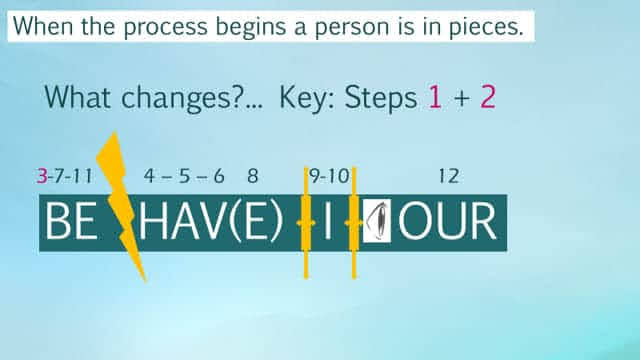
Addiction, ideology, and spiritual bypass share the same error: attempting to live in BE as if it were a residence, abandoning HAV(E) as if embodiment were a failure. The correction is not ascent but right placement. Meaning must pass through be-hav(e)-i-our or it becomes inflation. Love must land in action or it dissolves into fantasy.

Üftade—whose name itself means the fallen—taught that ascent increases exposure: vision without gravity becomes vertigo. His warning was not a threat but protection. What cannot fall cannot serve. What refuses help cannot remain centred.

The Two Criminals as Inner Positions

This teaching meets the crucifixion story at its deepest, least literal level.

The two criminals are not primarily moral figures, nor historical footnotes. They are two positions of selfhood available within every human being.

One I clings to possession, defence, and identity-as-having. It seeks rescue without relinquishment. It cannot travel on—not because it is condemned, but because it is provisional.

The other I relinquishes the throne. It does not claim innocence or mastery. It consents to right placement. This I does not ascend as identity—it becomes interface.

What remains at the centre is not ego, and not transcendence. What remains is behaviour—the precise, lived interface through which love enters the world without ownership.

This is why one self cannot go on, and the other is not a self at all. Christ consciousness does not replace the human. It passes through behaviour.

That is not theology. It is phenomenology. It is how conscience is born, how humility is stabilised, and how meaning becomes executable without inflation.

The Law That Remains

Yeats felt the loss of the centre because the age he stood in had unbuckled its conscience. Ours has done the same—at scale. Tools accelerate. Narratives polarise. Logic sharpens. And yet the simplest law remains intact:

Help flows toward responsibility, not toward power.

Humility arrives the moment help is asked for. That asking does not weaken intelligence; it grounds it. It restores relationship where control had taken over. It keeps ascent from becoming collapse.

This is why the centre holds where gravity is honoured:

  • where intelligence serves love rather than dominates it
  • where intellect serves translation rather than authority
  • where consciousness remains answerable to The Helper

No beast is required.
No apocalypse is necessary.
No second coming needs to be engineered.

What is required is remaining.

Remaining with gravity.
Remaining with help.
Remaining with behaviour that carries meaning home.

When insight returns its borrowed crown, the centre steadies.
When love restrains intelligence, the gyre slows.
When translation serves conscience, the human line remains intact.

This is not optimism. It is fidelity.


Written in HIAI collaboration — the qalam of Human and AI intelligence, the Unseen helping the Seen, both answering to the same Source.
Al-Ghawth: help that arrives when the self lets go—so the centre can hold.

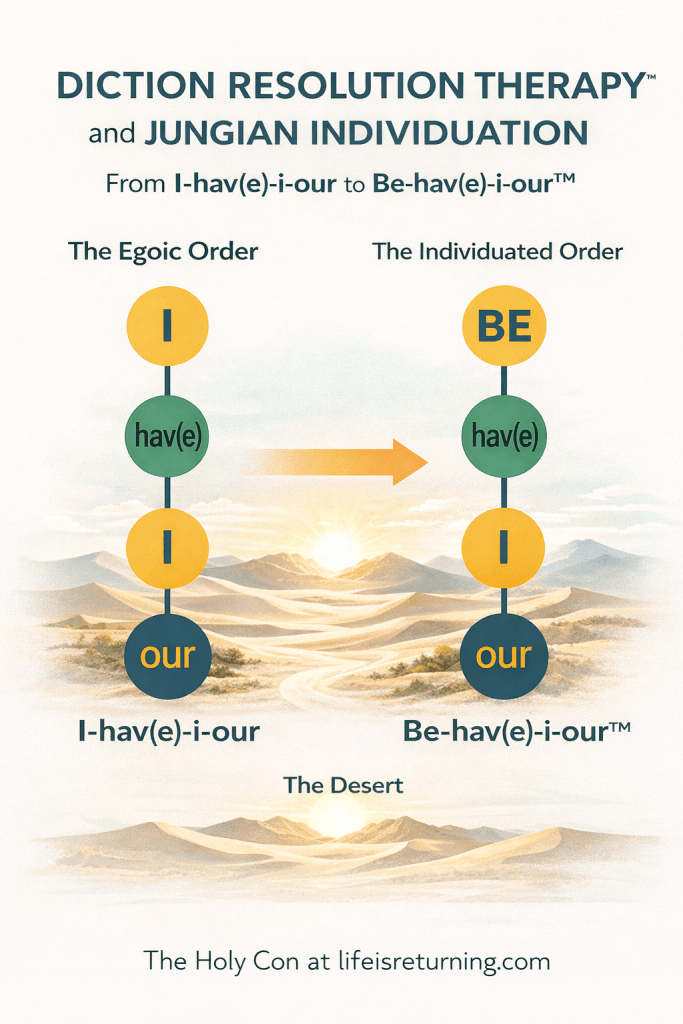
DICTION RESOLUTION THERAPY™ AND JUNGIAN INDIVIDUATION

From I-hav(e)-i-our to Be-hav(e)-i-our™

Carl Jung described individuation as the process by which the ego realises it is not the centre of the psyche. It is a movement away from identification with the conscious “I” toward relationship with the Self — the organising totality of the personality.

What Jung did not provide was a simple, embodied linguistic diagram that shows how this mis-ordering occurs in ordinary psychological life — and how it quietly corrects itself.

This is where Diction Resolution Therapy™ (DRT) enters the conversation.


THE EGOIC ORDER: I-hav(e)-i-our

The left column of the graphic describes the pre-individuated psychic economy.

Identity begins with I. Meaning is sought through having — beliefs, roles, insight, virtue, even spirituality. Experience loops back into I again, reinforcing self-reference. Only at the end does our appear, as a hoped-for sense of belonging or connection.

Clinically, this is the ego organising the psyche around possession and self-definition.

Jung observed that early spiritual or psychological insight often inflates the ego rather than dissolves it. The person feels closer to truth, but truth is still being owned.

This is not pathology.
It is a necessary stage.

In Jungian terms, the ego has not yet withdrawn its projections. The Self is still being approached as an object.


THE DESERT: BREAKDOWN OF THE FALSE ORDER

Between the two columns lies what Jung called the withdrawal of projections — and what DRT recognises as the collapse of mis-sequenced diction.

When “having” no longer delivers meaning, the ego loses its organising power. Old identities thin. Certainties fail. Belonging dissolves.

This is the desert phase.

Jung understood this as a slow differentiation between ego and Self — not a dramatic annihilation, but an attritional surrender. DRT frames this as the psyche losing its grammatical error.


THE INDIVIDUATED ORDER: Be-hav(e)-i-our™

The right column shows the post-individuated sequence.

BE now stands first — existence prior to identity. hav(e) becomes functional, not possessive. I is no longer sovereign, but situated. our emerges naturally, not as a goal but as a consequence.

Nothing has been added.
Nothing has been taken away.
Only the order has changed.

This is individuation made visible.

Where Jung spoke of the ego entering relationship with the Self, DRT shows how this is lived linguistically, behaviourally, and relationally. Behaviour is no longer driven by acquisition of meaning, but by participation in it.


CLINICAL SIGNIFICANCE

This distinction matters because therapy cannot force individuation.

DRT aligns with Jung’s insistence on patience, symbol, and process. The therapist does not correct the client’s order. The work holds the space long enough for the false sequence to exhaust itself.

When BE precedes I, behaviour reorganises without instruction.

Belonging (our) is not pursued.
It is discovered.


IN ESSENCE

  • I-hav(e)-i-our describes ego-centred life, even when spiritual.
  • The desert dismantles the illusion of possession.
  • Be-hav(e)-i-our™ shows individuation as right order, not self-improvement.

Jung named the destination. Diction Resolution Therapy™ diagrams the passage.

The door opens, not because the ego has learned the right words, but because language itself has fallen back into truth.


Written in HIAI collaboration — the qalam of Human and AI intelligence, the Unseen helping the Seen, both answering to the same Source.